Request vs Requests is a common grammar comparison that can be confusing because the two words look almost identical but are used differently depending on whether you are talking about one request or more than one. If you’ve wondered whether to write “request” or “requests,” the key difference is closely connected to singular and plural nouns, verb agreement, formal communication, questions, applications, and asking for something.
The request meaning refers to an act of asking for something, while requests can be the plural form of the noun or the third-person singular form of the verb request. For example, “I made a request” refers to one specific ask, while “We received several requests” refers to more than one. As a verb, “She requests additional information” uses requests because the subject is singular.
In this guide, you’ll learn the difference between request and requests, when to use each word, how they work as nouns and verbs, and how to use them correctly in sentences. You’ll also see clear examples, grammar rules, and comparisons to help you avoid common mistakes with request vs requests.
By the end, you’ll know exactly when to use request and when to use requests, whether you’re writing an email, filling out an application, communicating professionally, or using the words in everyday English.
Request vs Requests: Quick Difference
The simplest distinction is:
- Request = one request when used as a noun.
- Requests = more than one request when used as a noun.
- Request = the base form of the verb.
- Requests = the present-tense verb form used with a singular third-person subject such as he, she, or it.
Here are four examples that show the entire difference:
| Word | Use | Example |
| request | Singular noun | I submitted a request. |
| requests | Plural noun | I submitted three requests. |
| request | Verb | They request additional information. |
| requests | Verb | She requests additional information. |
The important point is that requests does not always mean “more than one request.” It can also be a verb.
For instance:
The customer requests a refund.
Here, requests is a verb. There is only one customer, and the verb agrees with the singular subject.
By contrast:
The customer submitted several requests.
Here, requests is a plural noun because the customer submitted more than one request.
Cambridge Dictionary lists request as both a noun and a verb. As a noun, it refers to an act of asking for something; as a verb, it means to ask for something, particularly in a polite or formal way.
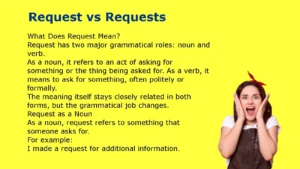
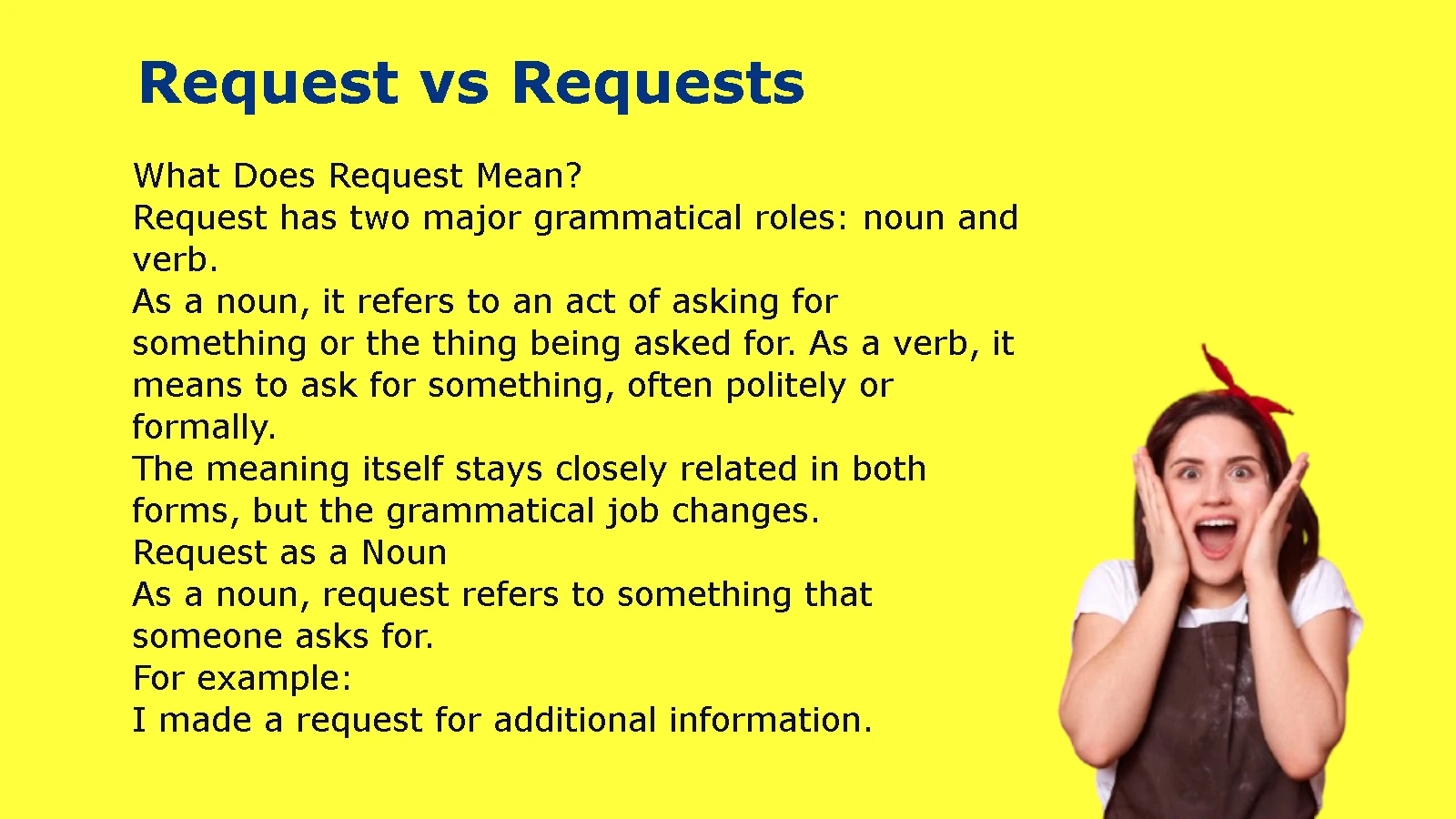
What Does Request Mean?
Request has two major grammatical roles: noun and verb.
As a noun, it refers to an act of asking for something or the thing being asked for. As a verb, it means to ask for something, often politely or formally.
The meaning itself stays closely related in both forms, but the grammatical job changes.
Request as a Noun
As a noun, request refers to something that someone asks for.
For example:
I made a request for additional information.
Here, request names the act of asking.
You can use request as a singular countable noun when referring to one specific request:
- a request
- one request
- this request
- my request
- your request
- the request
Examples:
- I have a request.
- She submitted a request.
- The manager approved the request.
- We received your request.
- Your request is being reviewed.
The word also appears in common expressions such as make a request, receive a request, respond to a request, submit a request, and at someone’s request. Cambridge’s Business English Dictionary gives these as established uses of the noun.
Request as a Verb
Request can also function as a verb.
As a verb, it means to ask for something, especially in a formal or polite context.
Examples include:
- I request a copy of the report.
- They request additional information.
- We request your assistance.
- The company requested permission.
- Passengers are requested to remain seated.
The verb can take a direct object:
She requested a meeting.
It can also appear in structures such as request that + clause:
The director requested that the meeting be postponed.
Another common pattern is:
Visitors are requested not to touch the exhibits.
These structures are documented in Cambridge’s dictionary examples for request.
What Does Requests Mean?
Requests has two main grammatical uses.
It can be the plural form of the noun request, or it can be the third-person singular form of the verb request.
That distinction is essential.
Requests as a Plural Noun
When requests is a noun, it means two or more requests.
Compare:
I received a request.
with:
I received several requests.
The first sentence refers to one request. The second refers to multiple requests.
More examples:
- The office received 20 requests.
- We are processing customer requests.
- Several requests were submitted yesterday.
- The team reviewed all the requests.
- The website receives thousands of requests each day.
Cambridge gives examples such as “hundreds of requests” and “repeated requests,” showing the normal plural use of the noun.
Requests as a Verb
This is where things can become confusing.
Requests is also a verb when the subject is a singular third-person subject.
For example:
She requests more information.
Here, requests does not mean several requests. It means that she asks for more information.
The same pattern applies to:
- he requests
- she requests
- it requests
- the company requests
- the customer requests
- the system requests
- the department requests
Compare these sentences:
They request additional information.
She requests additional information.
The subject changes from they to she, so the verb changes from request to requests.
This follows the normal present-simple agreement pattern in English. The British Council illustrates the same grammatical pattern with examples such as I look → She looks and I walk → He walks.
Request vs Requests in Grammar
The easiest way to understand request vs requests is to separate noun use from verb use.
| Form | Grammatical role | Meaning | Example |
| request | Singular noun | One request | I received a request. |
| requests | Plural noun | More than one request | I received several requests. |
| request | Base verb | Ask for something | They request assistance. |
| requests | Third-person singular verb | Asks for something | She requests assistance. |
This means you should not automatically treat “requests” as a plural noun.
Look at the sentence:
The company requests additional documents.
Requests is a verb.
Now look at:
The company received additional requests.
Requests is a noun.
The surrounding words and the subject tell you which grammatical function is being used.
When to Use Request
Use request when you are referring to one request as a noun or when you need the base form of the verb.
Request as a Singular Noun
Use request when one person, organization, or group makes one request.
Common patterns include:
- a request
- one request
- the request
- this request
- my request
- your request
- his request
- her request
Examples:
I submitted a request for leave.
The manager approved the request.
We received one request from the customer.
Your request has been forwarded to the appropriate department.
A singular countable noun generally needs an appropriate determiner when used in this type of sentence.
For example:
I submitted a request.
Not:
I submitted request.
You can also use request in fixed expressions:
at the request of the client
on request
make a request
respond to a request
receive a request
These are common and useful constructions in formal and professional English.
Request as a Verb
Use request as the verb after:
- I
- you
- we
- they
- plural nouns
Examples:
- I request additional information.
- You request a refund.
- We request your assistance.
- They request a meeting.
- The customers request refunds.
Notice that the verb does not take -s with these subjects in the present simple.
Compare:
I request a copy.
They request a copy.
She requests a copy.
That final -s is controlled by the subject, not by how many things are being requested.
When to Use Requests
Use requests when you are talking about multiple requests as a noun or when a singular third-person subject performs the action in the present tense.
Requests as a Plural Noun
Use requests for two or more requests.
Examples:
We received three requests this morning.
The department handles customer requests.
The manager reviewed all the requests.
Several requests were rejected.
Words such as these commonly signal that requests is being used as a plural noun:
- several
- many
- multiple
- numerous
- various
- two
- three
- hundreds
- all
- these
- those
For example:
Several requests were submitted.
Because several indicates more than one, requests is the appropriate noun form.
Requests as a Singular Verb
Use requests as a verb when the subject is singular and third person.
Examples:
He requests a copy of the document.
She requests additional information.
The customer requests a refund.
The system requests permission.
The department requests approval.
The grammatical structure is:
Singular third-person subject + requests + object
For example:
The employee + requests + additional time.
The noun employee is singular, so the present-simple verb becomes requests.
Request vs Requests With Different Subjects
Subject-verb agreement provides one of the clearest ways to choose between the two forms.
| Subject | Correct verb |
| I | request |
| You | request |
| We | request |
| They | request |
| He | requests |
| She | requests |
| It | requests |
| The customer | requests |
| The customers | request |
| The company | requests |
| The companies | request |
The pattern becomes especially easy when you compare singular and plural subjects.
Singular Subject
The customer requests a refund.
Plural Subject
The customers request refunds.
The first sentence has a singular subject, so the present-simple verb takes -s.
The second has a plural subject, so the base form request is used.
This is the same subject-verb agreement principle used throughout the present simple.
Request vs Requests After Do and Does
This is one of the most useful rules to remember.
When do, does, or did acts as an auxiliary verb, the main verb stays in its base form.
Therefore:
Does she request more information?
Not:
Does she requests more information?
Likewise:
Do they request additional documents?
Not:
Do they requests additional documents?
And in the past:
Did she request a refund?
Not:
Did she requested a refund?
The British Council explains that English uses do/does/did to form present- and past-simple questions and negatives for most verbs.
Correct Examples
- Does he request a meeting?
- Does she request additional information?
- Do they request refunds?
- Did you request a copy?
- Did the customer request assistance?
Incorrect Examples
- Does he requests a meeting?
- Does she requests additional information?
- Do they requests refunds?
- Did you requested a copy?
The reason is simple: the auxiliary carries the grammatical marking, so the main verb returns to its base form.
Request vs Requests in Negative Sentences
The same principle applies to negative sentences.
With does not, use request, not requests:
She does not request a refund.
Not:
She does not requests a refund.
With do not, use request:
They do not request additional information.
Not:
They do not requests additional information.
With did not, use the base form:
He did not request permission.
Not:
He did not requested permission.
The structure is:
Subject + do/does/did + not + base verb
So:
- She doesn’t request…
- They don’t request…
- He didn’t request…
The British Council’s grammar guidance uses this same auxiliary-verb structure for present and past negatives.
Request vs Requests in Example Sentences
Looking at the words in context makes the distinction much easier.
Request as a Noun
I submitted a request yesterday.
The manager approved the request.
Your request has been received.
We need to process this request.
She made a request for additional information.
In each sentence, request names something.
Requests as a Plural Noun
We received several requests today.
The team is reviewing customer requests.
All requests must be submitted online.
The office received hundreds of requests.
These requests require further review.
Here, requests names multiple things that people asked for.
Request as a Verb
I request a copy of the report.
We request your assistance.
They request additional information.
You request a refund through the online form.
Here, request describes an action performed by the subject.
Requests as a Verb
She requests additional information.
He requests a copy of the agreement.
The customer requests a refund.
The system requests permission to continue.
The department requests approval from management.
Here, requests is a verb because it tells you what the subject does.
Common Mistakes With Request and Requests
Most mistakes happen because writers focus on the -s rather than the grammatical role of the word.
Mistake: Using “Requests” With a Plural Subject
Incorrect:
They requests additional information.
Correct:
They request additional information.
The subject they takes the base form request.
Mistake: Using “Request” With a Singular Third-Person Subject
Incorrect:
She request additional information.
Correct:
She requests additional information.
Because she is a singular third-person subject, the present-simple verb takes -s.
Mistake: Writing “A Requests”
Incorrect:
I submitted a requests.
Correct:
I submitted a request.
The article a introduces a singular countable noun, so request must be singular.
Mistake: Forgetting the Plural Ending
Incorrect:
We received five request.
Correct:
We received five requests.
A number greater than one requires the plural noun.
Mistake: Using “Requests” After Does
Incorrect:
Does she requests a refund?
Correct:
Does she request a refund?
The auxiliary does already carries the third-person singular marking.
Mistake: Using “Requested” After Did
Incorrect:
Did they requested assistance?
Correct:
Did they request assistance?
After did, the main verb returns to its base form.
Request vs Requests in Formal and Professional English
The word request appears frequently in professional communication because it can describe both a formal act of asking and the thing being asked for.
Common business expressions include:
- request for information
- request for approval
- request for payment
- request for access
- request for assistance
- customer request
- service request
- formal request
- written request
- information requests
For example:
We received your request for information.
Here, request is a singular noun.
If several people made similar requests:
We received several requests for information.
Now requests is a plural noun.
The same distinction applies in business writing:
The client requests a meeting.
Here, requests is a verb.
But:
The client submitted three requests.
Here, requests is a plural noun.
Cambridge specifically identifies professional patterns such as make a request, respond to a request, receive a request, decline a request, and at the request of someone.
Request vs Requests in Questions
Questions reveal the difference particularly well because auxiliary verbs affect the form of request.
Compare:
Do they request additional information?
and:
Does she request additional information?
Both use request, not requests, because do and does are functioning as auxiliary verbs.
This can feel counterintuitive because she requests is correct in a normal statement.
Compare:
| Statement | Question |
| She requests a refund. | Does she request a refund? |
| He requests more information. | Does he request more information? |
| They request assistance. | Do they request assistance? |
| We request approval. | Do we request approval? |
The key is not simply whether the subject is singular. You also need to check whether an auxiliary verb is already carrying the tense and agreement.
Request vs Requests in Past Tense
In the simple past, request does not become requests.
The past-tense form is requested for both singular and plural subjects.
Examples:
She requested additional information.
They requested additional information.
The customer requested a refund.
The customers requested refunds.
Notice that the subject changes, but the past-tense verb remains requested.
Questions use did + request:
Did she request a refund?
Did they request refunds?
Negatives use did not + request:
She did not request a refund.
They did not request refunds.
This is another reason not to treat requests as simply “the plural version” of the verb.
Request vs Requests in Different Sentence Patterns
The following patterns cover many everyday situations.
Pattern: One Noun
a + request
She made a request.
Pattern: Multiple Nouns
number/quantity + requests
She made three requests.
Pattern: Present Simple With I/You/We/They
subject + request
They request more time.
Pattern: Present Simple With He/She/It
subject + requests
She requests more time.
Pattern: Present Simple Question
do/does + subject + request
Does she request more time?
Pattern: Past Question
did + subject + request
Did she request more time?
Pattern: Present Negative
do/does + not + request
She does not request more time.
These patterns give you a practical way to choose the correct form without memorizing isolated examples.
Request vs Requests: A Simple Decision Rule
When you’re unsure, ask yourself two questions.
First: Is the word a noun or a verb?
If it is a noun, ask:
Am I talking about one request or multiple requests?
- One → request
- More than one → requests
If it is a verb, ask:
What is the subject?
- I/you/we/they → request
- he/she/it → requests
But there is one important additional rule:
After do, does, or did, use request.
For example:
- I request…
- They request…
- She requests…
- Does she request…?
- Did she request…?
This small checklist solves most request vs requests questions.
Request vs Requests: Comparison Table
| Feature | Request | Requests |
| Singular noun | Yes | No |
| Plural noun | No | Yes |
| Base-form verb | Yes | No |
| Third-person singular present verb | No | Yes |
| Used with I | Yes | No |
| Used with you | Yes | No |
| Used with we | Yes | No |
| Used with they | Yes | No |
| Used with he | No | Yes |
| Used with she | No | Yes |
| Used with it | No | Yes |
| Used after does | Yes | No |
| Used after did | Yes | No |
| Example noun | a request | several requests |
| Example verb | They request help. | She requests help. |
This table captures the central difference in one place.
A Practical Case Study: One Customer vs Several Customers
Consider a customer-service department.
One customer sends one request:
The customer submitted a request.
The word request is a singular noun.
Now imagine that the same customer sends four separate requests:
The customer submitted four requests.
Here, requests is a plural noun.
Now change the sentence so that request becomes a verb:
The customer requests a refund.
Because customer is singular and third person, the verb becomes requests.
Now make the subject plural:
The customers request refunds.
The verb changes back to request.
Finally, turn it into a question:
Does the customer request a refund?
Even though customer is singular, the verb is now request because does carries the third-person singular marking.
This single example demonstrates nearly every major rule surrounding request vs requests.
Is Request Singular or Plural?
Request is normally the singular noun, while requests is its plural noun form.
For example:
one request
two requests
several requests
many requests
However, request can also be a verb, so calling it simply “singular” isn’t always accurate.
In:
They request assistance.
request is a verb, not a singular noun.
Similarly, in:
She requests assistance.
requests is a verb, not a plural noun.
So the better question is: What grammatical role does the word play in the sentence?
Is Requests Always Plural?
No.
Requests is plural when it is a noun:
We received several requests.
But it is singular in terms of verb agreement when it is the present-tense verb used with a singular third-person subject:
She requests assistance.
Calling requests simply “plural” can therefore cause confusion.
The -s ending has different functions:
- It can mark a plural noun: requests
- It can mark a third-person singular present-tense verb: requests
The surrounding sentence tells you which one it is.
Is Request a Noun or a Verb?
It can be both.
As a noun:
Your request was approved.
As a verb:
I request your assistance.
Cambridge Dictionary identifies both noun and verb uses and defines the verb as asking for something politely or officially.
This is why request vs requests cannot be solved by simply memorizing “request = singular” and “requests = plural.”
You need to identify the part of speech first.
Is Requests a Noun or a Verb?
Again, it can be both.
As a plural noun:
We received several requests.
As a verb:
She requests additional information.
A useful trick is to look at what comes immediately before the word.
If a quantity or plural determiner precedes it, it is often a plural noun:
several requests
many requests
three requests
If a singular subject precedes it, it may be a verb:
she requests
the company requests
the customer requests
Context ultimately determines the grammatical role.
Request or Requests: Which Is Correct?
Both are correct. The correct choice depends on the sentence.
Use request for:
- one noun
- the base form of the verb
- present-tense verbs with I, you, we, and they
- verbs following do, does, or did
Use requests for:
- more than one noun
- present-tense verbs with he, she, it, or another singular third-person subject
Quick examples
One noun:
I have a request.
Several nouns:
I have several requests.
Plural subject:
They request assistance.
Singular subject:
She requests assistance.
Question:
Does she request assistance?
Once you identify the structure, the choice becomes straightforward.
Request vs Requests FAQs
Is “requests” the plural of “request”?
Yes. When request is a noun, requests is its regular plural form.
one request
two requests
However, requests can also be a verb, as in She requests help.
Is “request” singular or plural?
As a noun, request is singular.
I received one request.
Its plural is requests.
As a verb, however, request is the base form and isn’t best described as singular or plural on its own.
Is “request” a noun or a verb?
It can be either.
As a noun:
I received your request.
As a verb:
I request your assistance.
Is “requests” a noun or a verb?
It can be either.
As a plural noun:
We received several requests.
As a verb:
She requests additional information.
Which is correct: “a request” or “a requests”?
A request is correct.
I submitted a request.
The article a is used with a singular countable noun.
Which is correct: “they request” or “they requests”?
They request is correct.
They request additional information.
The subject they takes the base verb request in the present simple.
Which is correct: “she request” or “she requests”?
She requests is correct in a normal present-simple statement.
She requests additional information.
However, after does, use the base form:
Does she request additional information?
Do you say “request” after “does”?
Yes.
Does she request a refund?
Not:
Does she requests a refund?
The auxiliary does already carries the third-person singular marking.
Final Takeaway: Request vs Requests
The difference between request vs requests is mainly grammatical rather than a difference in meaning.
Remember these four core rules:
- Request = one request as a noun.
- Requests = multiple requests as a noun.
- Request = base verb, including after I, you, we, they, do, does, and did.
- Requests = present-simple verb with a singular third-person subject such as he, she, or it.
The quickest way to check your sentence is to identify the word’s job.
If it names one thing someone asks for, use request.
And when does or did appears before the verb, return to the base form:
Does she request…?
Did they request…?
Once you recognize those patterns, choosing between request and requests becomes a simple matter of grammar rather than guesswork.