Jealous vs envious describes two closely related emotions, but the words have traditionally expressed different feelings. Jealousy usually involves fear of losing someone or something you value, while envy involves wanting something another person has. For example, you might feel jealous when someone flirts with your partner but envious when a friend gets a promotion you wanted. Both emotions involve comparison, insecurity, and desire, yet their meanings depend on context. Understanding the difference between jealousy, envy, and covetousness helps you choose the right word in everyday conversations and formal writing.
| Question | Answer |
| What is the difference between jealous and envious? | Jealous means fearing the loss of something valued, while envious means wanting something someone else has. |
| Are jealous and envious synonyms? | Yes. They overlap in everyday English, although their traditional meanings differ. |
| What is the difference between jealous, envious, and covetous? | Jealous involves fear of loss, envious involves desire, and covetous describes an intense desire to possess something. |
| Can you use jealous instead of envious? | Yes. People commonly use jealous to express envy, especially in casual conversation. |
| What is an example of jealous vs envious? | You feel jealous when your partner gives someone else attention and envious when your friend earns a higher salary. |
What Is the Difference Between Jealous and Envious?
The main difference between jealous and envious concerns what triggers the emotion. Jealousy traditionally describes the fear of losing something you already have, especially someone’s affection, attention, or loyalty. Envy describes the desire to have something another person possesses, such as wealth, success, beauty, or opportunities.
Consider these two situations:
- Jealous: Sarah feels uncomfortable because her boyfriend spends a lot of time with another woman. She worries that their relationship might be threatened.
- Envious: Sarah admires her colleague’s expensive house and wishes she could afford one herself.
Both situations involve emotional comparison, but the underlying feelings differ.
Jealousy focuses on protecting something valuable. Envy focuses on wanting something desirable.
However, modern English does not always maintain this distinction. People frequently use jealous when they actually mean envious. This usage is widely understood in everyday conversation.
What Does Jealous Mean?
Jealous is an adjective that describes someone who feels threatened, insecure, or resentful because they believe another person might take something valuable away from them.
The emotion often appears in romantic relationships, friendships, family connections, and professional environments.
For example, imagine that a man notices his girlfriend talking warmly with another person. He begins to worry that she might develop romantic feelings for that person. His reaction comes from a perceived threat to his relationship.
That feeling is jealousy.
Jealousy can develop from several emotional triggers:
- Fear of abandonment: Worrying that someone you love might leave.
- Insecurity: Feeling that another person is more attractive, successful, or interesting.
- Competition: Believing someone else wants what you have.
- Distrust: Suspecting that someone might be dishonest or unfaithful.
- Possessiveness: Feeling uncomfortable when someone shares their attention with others.
Jealousy does not always mean someone has done something wrong. Sometimes, the emotion develops from assumptions rather than actual threats.
For instance, a person might feel jealous when their best friend makes a new friend. However, the new friendship does not necessarily threaten their existing relationship.
Example sentences:
- Daniel felt jealous when his girlfriend complimented another man’s appearance.
- My younger brother gets jealous whenever our parents praise me.
- She was jealous of the attention her colleague received.
- He became jealous when his best friend started spending time with someone else.
- The manager felt jealous after another employee received recognition.
What Does Envious Mean?
Envious is an adjective that describes the feeling of wanting something another person has. That something might be a possession, achievement, opportunity, physical quality, personal ability, or lifestyle.
Unlike traditional jealousy, envy does not necessarily involve fear of losing something.
Imagine that your friend receives a scholarship to study abroad. You congratulate her, but you also wish you had received the same opportunity.
That feeling is envy.
Envy can involve different emotional reactions:
- Admiration: Appreciating something another person has.
- Longing: Wishing you could enjoy the same advantage.
- Dissatisfaction: Feeling unhappy about your own circumstances.
- Resentment: Becoming frustrated because someone else has what you want.
- Motivation: Using another person’s success as inspiration to improve your own situation.
Not every envious feeling produces bitterness. Sometimes, envy simply reveals something you genuinely want.
For example, feeling envious of a friend’s successful business might encourage you to develop your own business idea.
Example sentences:
- I felt envious of my friend’s beautiful new apartment.
- She was envious of her sister’s confidence and independence.
- Mark became envious when his colleague received a promotion.
- They were envious of the opportunities their neighbors enjoyed.
- He felt envious of his brother’s ability to travel frequently.
Are Jealous and Envious Synonyms?
Yes. Jealous and envious are overlapping synonyms in modern English, although they have traditionally described different emotional experiences.
The distinction remains useful when you want to communicate precisely.
For example:
- “I’m jealous of your new car” is common conversational English.
- “I’m envious of your new car” more directly expresses the desire to own something similar.
- “I’m jealous that you spend so much time with him” expresses concern about losing someone’s attention.
The words can overlap because jealousy sometimes includes envy. Someone might resent another person’s advantages while also feeling threatened by that person’s success.
In everyday conversation, either word may communicate the intended feeling. However, writers should consider the context before choosing one.
Jealous vs Envious: Key Differences at a Glance
Although jealousy and envy share emotional similarities, their traditional meanings, triggers, and common situations differ.
| Comparison point | Jealous | Envious |
| Basic meaning | Fear of losing something valued | Wanting something another person has |
| Main emotion | Insecurity or fear | Desire or dissatisfaction |
| Primary focus | Protecting something you have | Obtaining something you lack |
| Common situation | Romantic relationships | Career and lifestyle comparisons |
| Emotional trigger | A perceived threat | Someone else’s advantage |
| Typical example | Feeling threatened by a romantic rival | Wanting a friend’s promotion |
| Related noun | Jealousy | Envy |
| Related adverb | Jealously | Enviously |
Jealousy Involves Fear of Losing Something
Jealousy often develops when someone believes a valued relationship, possession, or position might be taken away.
Relationships provide some of the clearest examples.
Suppose Emma has been dating James for two years. James starts spending more time with a new colleague. Emma notices their growing friendship and worries that James might become romantically interested in the colleague.
Emma’s emotional response involves jealousy because she fears losing her relationship.
The same principle applies outside romantic situations.
A business owner might feel jealous when a competitor attracts a loyal customer. An employee might feel jealous when a colleague receives special attention from management.
In each situation, the person believes something valuable could be lost or taken away.
Envy Involves Wanting Something Someone Else Has
Envy develops when you compare your circumstances with another person’s advantages.
You might want their income, professional success, appearance, confidence, education, or lifestyle.
For example, imagine that two friends graduate from university. One receives a high-paying job immediately, while the other struggles to find employment.
The second friend might feel envious of the first friend’s professional success.
Envy does not necessarily mean the person dislikes their friend. They might genuinely celebrate the achievement while wishing they had experienced the same opportunity.
This distinction matters because admiration and envy can exist together.
You can appreciate someone’s accomplishments while recognizing that you would also like to achieve something similar.
Can You Feel Jealous and Envious at the Same Time?
Yes. Jealousy and envy can occur together because emotions do not always fit into separate categories.
Imagine that your colleague receives a promotion and becomes your manager. You wanted that position, so you feel envious of the promotion. At the same time, you worry that your colleague might receive more recognition and influence within the company.
The first feeling involves envy. The second involves jealousy.
Another example involves friendships.
Your best friend starts spending more time with a wealthy new friend. You might:
- Feel envious of the new friend’s financial success.
- Feel jealous because your best friend gives that person more attention.
- Feel insecure because you worry about losing your friendship.
Recognizing these differences helps you understand your emotional reactions instead of treating every uncomfortable feeling as the same experience.
Jealous vs Envious vs Covetous: What’s the Difference?
Jealous, envious, and covetous describe related emotions involving attachment, desire, and comparison. However, each word emphasizes a different aspect of human behavior.
Jealousy traditionally involves fear of losing something valuable. Envy involves wanting another person’s advantage. Covetousness emphasizes an intense desire to possess something that belongs to someone else.
What Does Covetous Mean?
Covetous is an adjective describing someone who strongly desires another person’s possessions, wealth, property, or advantages.
The word often carries a negative meaning because it suggests excessive desire or an unwillingness to respect what belongs to someone else.
For example:
“His covetous attitude toward his neighbor’s property damaged their friendship.”
This sentence suggests more than ordinary admiration. The person strongly wants something that belongs to another individual.
Covetousness commonly appears in discussions about:
- Wealth and material possessions.
- Expensive houses and vehicles.
- Financial status.
- Property ownership.
- Power and influence.
- Another person’s success or advantages.
The word also has a strong moral association. It frequently appears in religious, literary, and philosophical discussions about greed and excessive desire.
Jealous vs Envious vs Covetous Comparison Table
| Word | Central idea | Typical feeling | Example |
| Jealous | Fear of losing something valued | Insecurity | He was jealous of his partner’s close friendship. |
| Envious | Wanting another person’s advantage | Desire | She was envious of her colleague’s promotion. |
| Covetous | Strong desire to possess something | Possessiveness | He was covetous of his neighbor’s expensive property. |
Which Word Should You Use in Different Situations?
The best word depends on the emotion you want to communicate.
Use jealous when someone feels threatened by a potential loss.
Example: “She was jealous when her boyfriend started spending time with another woman.”
Use envious when someone wants an advantage another person enjoys.
Example: “He was envious of his friend’s successful career.”
Use covetous when you want to emphasize an intense desire to possess something.
Example: “The investor was covetous of the valuable property next door.”
Here is another way to distinguish the three:
- Jealousy asks, “What if I lose what I have?”
- Envy asks, “Why can’t I have what they have?”
- Covetousness asks, “How badly do I want to possess what belongs to them?”
This simple comparison makes the differences easier to remember.
Jealous vs Envious According to the Oxford Dictionary
Dictionary definitions help explain why jealous and envious sometimes overlap. Both words describe uncomfortable emotional reactions connected to other people’s relationships, possessions, or advantages.
However, their traditional meanings place emphasis on different experiences.
Oxford Dictionary Meaning of Jealous
The word jealous describes feelings involving suspicion, resentment, or fear that someone might take away something or someone you value.
In romantic situations, jealousy often involves concern about a partner’s affection or loyalty.
The word also applies to competition and professional relationships.
For example:
- She became jealous when her partner praised another woman.
- The employee was jealous of his colleague’s relationship with the director.
- He felt jealous when his younger brother received more attention.
Jealousy can also describe a strong desire to protect something.
For example, a person might be described as jealous of their privacy. In this context, the word emphasizes how carefully they protect something they value.
Oxford Dictionary Meaning of Envious
Envious describes the feeling of wanting something that another person has.
The desired advantage might involve material possessions or personal qualities.
Examples include:
- Being envious of someone’s wealth.
- Feeling envious of another person’s professional achievements.
- Being envious of a friend’s confidence.
- Feeling envious of someone’s opportunities.
Envy does not always involve resentment. Someone might feel envious of another person’s lifestyle while remaining genuinely happy for them.
The important point is the desire to enjoy the same advantage.
Does Oxford Treat Jealous and Envious as Synonyms?
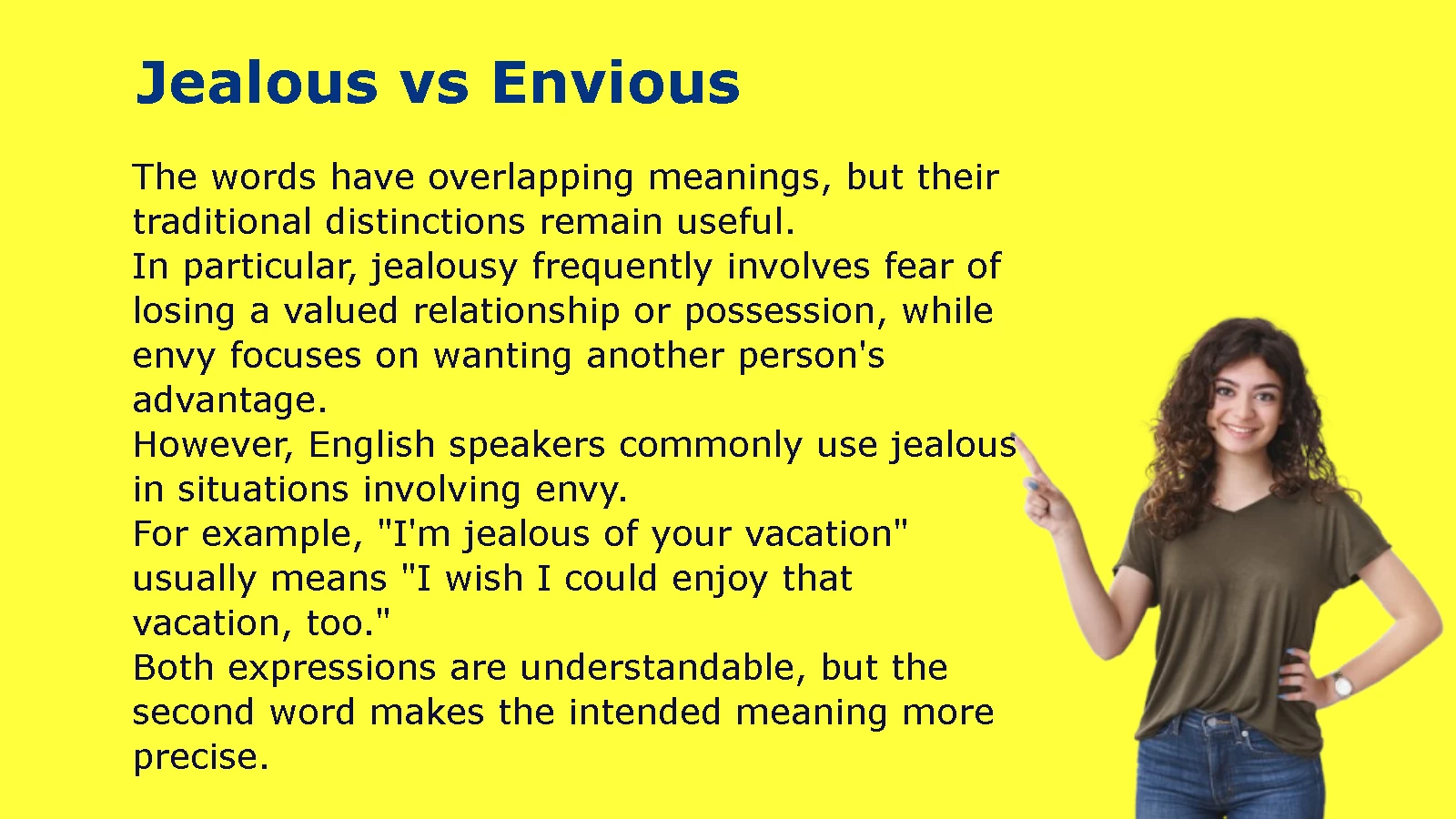
The words have overlapping meanings, but their traditional distinctions remain useful.
In particular, jealousy frequently involves fear of losing a valued relationship or possession, while envy focuses on wanting another person’s advantage.
However, English speakers commonly use jealous in situations involving envy.
For example, “I’m jealous of your vacation” usually means “I wish I could enjoy that vacation, too.”
Both expressions are understandable, but the second word makes the intended meaning more precise.
Writing tip: Choose envious when you want to emphasize desire and jealous when you want to emphasize insecurity, rivalry, or fear of loss. For exact dictionary wording, check the current Oxford entry before quoting it.
Jealous vs Envious Examples in Everyday Situations
Examples make the difference easier to understand because emotional meaning often depends on the situation.
The following sections show how jealousy, envy, and covetousness appear in everyday life.
Examples of Jealousy
Jealousy frequently involves relationships, attention, competition, and the fear of losing something valuable.
Here are some original examples:
- Maria felt jealous when her boyfriend liked another woman’s photographs.
- Daniel became jealous when his best friend started spending weekends with a new group.
- The little girl was jealous because her parents gave her brother a new toy.
- James felt jealous when his manager praised another employee.
- She became jealous after noticing how much attention her partner gave his colleague.
- My younger sister gets jealous when our parents compliment me.
- The athlete felt jealous when his teammate received more recognition.
- He was jealous of the friendship between his wife and her childhood friend.
- Sarah felt jealous when her best friend shared a secret with someone else.
- The employee became jealous after another worker received a leadership opportunity.
Notice that each example involves something the person values and a perceived threat to it.
Examples of Envy
Envy usually appears when someone wants another person’s possessions, abilities, achievements, or opportunities.
Consider these examples:
- I felt envious of my friend’s beautiful new house.
- She was envious of her sister’s academic achievements.
- Mark became envious when his colleague received a promotion.
- They were envious of their neighbors’ luxurious lifestyle.
- He felt envious of his brother’s ability to travel around the world.
- Sarah was envious of her friend’s confidence.
- I sometimes feel envious of people who can work remotely.
- The young artist was envious of the recognition another painter received.
- She felt envious of her classmate’s scholarship.
- He was envious of the time his friend could spend with his family.
These examples focus on something another person enjoys that the speaker also wants.
Examples of Covetousness
Covetousness emphasizes a strong desire to possess something belonging to another person.
Examples include:
- The businessman was covetous of his competitor’s profitable company.
- He became covetous of his neighbor’s large estate.
- The collector was covetous of a rare painting owned by another family.
- She had a covetous interest in her wealthy relative’s inheritance.
- The landlord seemed covetous of the property next door.
These examples suggest stronger desire than ordinary envy.
Jealous vs Envious Examples in Different Contexts
The same general situation can produce different emotions depending on what the person feels.
| Situation | Better word | Explanation |
| Your partner spends time with someone else | Jealous | You fear losing affection or attention. |
| Your friend receives a promotion | Envious | You want the same professional achievement. |
| Your neighbor owns your dream house | Envious | You wish you had a similar property. |
| Someone threatens your relationship | Jealous | You perceive a romantic threat. |
| You desperately want another person’s property | Covetous | You strongly desire possession. |
| Your colleague receives praise from your manager | Jealous or envious | Jealous if you fear losing status; envious if you want their recognition. |
| Your friend travels frequently | Envious | You want the same freedom or opportunity. |
Jealous vs Envious in a Sentence: How to Use Each Word
Understanding the meanings is only part of using these words correctly. You also need to know their grammatical forms and common sentence patterns.
Both jealous and envious function as adjectives. They describe feelings or emotional characteristics.
How to Use Jealous in a Sentence
The adjective jealous commonly appears with the preposition of.
For example:
- She was jealous of her sister.
- He felt jealous of his colleague.
- My friend gets jealous of other people’s relationships.
You can also use jealous about when discussing a particular situation or concern.
Examples:
- She was jealous about the attention her boyfriend received from other women.
- He became jealous when his best friend invited someone else.
- I felt jealous of the relationship between my parents.
- The child was jealous of his brother’s new bicycle.
- My colleague seemed jealous of my promotion.
- She gets jealous whenever her partner talks about his ex.
- He was jealous of the respect his manager received.
- The actress felt jealous of her co-star’s popularity.
- They became jealous when another team won the championship.
- I never realized how jealous he was of his older brother.
How to Use Envious in a Sentence
The adjective envious also commonly appears with the preposition of.
It describes the desire to enjoy an advantage that belongs to another person.
Examples:
- I am envious of your success.
- She felt envious of her friend’s new apartment.
- He was envious of his brother’s intelligence.
- They were envious of the family’s wealth.
- My classmates were envious of her scholarship.
- I felt envious of people who could travel whenever they wanted.
- The young entrepreneur was envious of the company’s rapid growth.
- She became envious of her colleague’s professional achievements.
- He was envious of his friend’s confidence.
- We were envious of the opportunities they received.
Common Grammar Mistakes to Avoid
Although these words are easy to use, writers sometimes confuse their grammatical forms.
Mistake 1: Confusing adjectives and nouns
Incorrect: She felt envy of her boyfriend’s attention.
Better: She felt envious of her boyfriend’s attention.
You can also write:
“She felt envy when her boyfriend gave someone else attention.”
Here, envy functions as a noun.
Mistake 2: Using jealousy when you mean the noun envy
Incorrect: His jealousy of her expensive car made him unhappy.
This sentence is understandable, but envy is more precise if he simply wants the same car.
Better: His envy of her expensive car made him unhappy.
Mistake 3: Forgetting the correct preposition
Natural expressions include:
- Jealous of someone.
- Envious of someone.
- Covetous of something.
For example:
“She was envious of her friend’s success.”
Mistake 4: Assuming jealousy always involves romance
Jealousy can appear in friendships, families, workplaces, and competitive environments.
For example:
“The employee felt jealous when his colleague received special recognition.”
The sentence does not involve a romantic relationship.
Jealous vs Envious: Word Forms and Related Vocabulary
| Adjective | Noun | Adverb |
| Jealous | Jealousy | Jealously |
| Envious | Envy | Enviously |
| Covetous | Covetousness | Covetously |
These related forms allow you to express similar ideas in different grammatical structures.
For example:
- Adjective: She was jealous.
- Noun: Her jealousy became obvious.
- Adverb: He watched them jealously.
Similarly:
- Adjective: She was envious.
- Noun: Her envy was understandable.
- Adverb: He looked enviously at the expensive watch.
Jealous vs Envious in The Simpsons: Homer Simpson Explained
Pop-culture examples and vocabulary application
The Mystery Unveiled: Revealing The Color Of Homer Simpson’s Pants | ShunVogue
The animated sitcom The Simpsons provides an entertaining way to understand jealousy and envy through exaggerated characters and everyday conflicts.
Homer Simpson frequently displays insecurity, competitiveness, impulsive behavior, and a desire for things that other people enjoy. These characteristics make him a useful fictional example for understanding the difference between the two emotions.
However, the distinction depends on the situation rather than the character himself.
Is Homer Simpson Jealous or Envious?
Homer can demonstrate both jealousy and envy.
Imagine that Marge gives another person more attention than she gives Homer. Homer becomes uncomfortable because he worries that someone might threaten his relationship.
That reaction illustrates jealousy.
Now imagine that Homer sees another person enjoying an expensive car, a large television, or a luxurious lifestyle. He wants the same things for himself.
That reaction illustrates envy.
The difference comes from what Homer wants or fears:
- He is jealous when he fears losing Marge’s affection.
- He is envious when he wants another person’s possessions or advantages.
- He is covetous when he intensely desires something that belongs to someone else.
These are illustrative situations, not quotations or claims about particular episodes.
Jealous vs Envious Through Homer Simpson Examples
Consider these original sentences:
Jealous Homer:
“Homer felt jealous when Marge spent more time talking to another man.”
The emotion comes from insecurity and fear of losing affection.
Envious Homer:
“Homer was envious of his neighbor’s expensive car.”
The emotion comes from wanting something another person owns.
Covetous Homer:
“Homer became covetous of his neighbor’s luxurious house.”
The sentence emphasizes a strong desire to possess someone else’s property.
What The Simpsons Teaches Us About Jealousy and Envy
Comedy often makes complicated emotions easier to recognize.
Homer’s exaggerated reactions highlight several familiar human experiences:
- Comparing your life with someone else’s.
- Wanting possessions that appear attractive.
- Feeling insecure about relationships.
- Competing for attention and recognition.
- Becoming frustrated when other people enjoy advantages.
These examples demonstrate why context matters more than simply identifying a person as jealous or envious.
A single character can experience both emotions in different situations.
What Do English Speakers Say About Jealous vs Envious?
English speakers do not always follow the traditional distinction between jealousy and envy.
In everyday conversation, people frequently use jealous to describe wanting something another person has.
For example:
“I’m so jealous of your vacation!”
Most listeners understand that the speaker wants to enjoy a similar vacation. They do not necessarily assume that the speaker fears losing something.
This usage has become common in informal English.
However, envious often provides a more precise alternative when someone wants to emphasize another person’s advantage.
Jealous vs Envious on Reddit: Common Opinions and Discussions
Online language discussions often raise an interesting question: Are jealous and envious genuinely different, or are they simply interchangeable?
The traditional distinction provides one answer:
- Jealousy involves fear of losing something valued.
- Envy involves wanting something someone else has.
However, everyday speakers often use jealous for both experiences.
For example, someone might say:
“I’m jealous that you got the job.”
Another person might say:
“I’m envious that you got the job.”
Both sentences communicate dissatisfaction with not receiving the same opportunity.
The difference lies mainly in emphasis.
The first sounds more conversational. The second emphasizes desire for the other person’s achievement.
A useful writing principle: Do not assume that every speaker uses the words according to the traditional distinction. Pay attention to the sentence and the intended emotion.
Is Jealous More Common Than Envious?
In everyday conversation, jealous is generally the more familiar and widely used expression.
People commonly use it when discussing:
- Romantic relationships.
- Friendships.
- Family attention.
- Professional competition.
- Someone else’s lifestyle.
- Attractive possessions.
For example, “I’m jealous of your new job” sounds natural in casual conversation.
Envious often sounds slightly more formal or deliberate. Writers may choose it when they want to express admiration mixed with a desire for the same advantage.
For example:
“She was envious of her colleague’s professional achievements.”
Neither word is inherently better. The best choice depends on the intended meaning and tone.
Which Word Sounds More Negative?
Both words can carry negative associations, but their emotional implications differ.
Jealousy often sounds negative because it can involve suspicion, insecurity, possessiveness, and distrust.
For example:
“His jealousy damaged their relationship.”
This sentence suggests that insecurity affected the relationship.
Envy can sound less hostile, especially when someone admires another person’s success.
For example:
“I am envious of her ability to speak five languages.”
This statement does not necessarily suggest resentment.
Covetousness usually carries a stronger negative association because it emphasizes excessive desire to possess something.
For example:
“His covetous attitude toward his neighbor’s wealth concerned his family.”
The sentence suggests an unhealthy level of desire.
How to Choose Between Jealous, Envious, and Covetous
Choosing the correct word becomes easier when you identify the emotion behind the situation.
You do not need to memorize complicated definitions. Instead, consider whether the person fears losing something, wants something another person has, or strongly desires possession.
Use Jealous When You Fear Losing Something
Choose jealous when someone feels threatened by the possibility of losing a valued relationship, possession, or position.
Common situations include:
- A partner giving someone else romantic attention.
- A best friend developing a closer friendship with another person.
- A colleague receiving recognition that you believe threatens your position.
- A family member receiving attention you want.
Example:
“James became jealous when his girlfriend started spending more time with her new colleague.”
The sentence emphasizes fear and insecurity.
Use Envious When You Want Something Someone Else Has
Choose envious when you want an advantage another person enjoys.
Common situations include:
- Wanting someone’s salary.
- Admiring another person’s appearance.
- Wishing you had a friend’s confidence.
- Wanting another person’s career opportunities.
- Desiring a similar house or lifestyle.
Example:
“Sarah was envious of her friend’s successful career.”
The sentence emphasizes desire rather than fear of loss.
Use Covetous When Desire Becomes Possessive
Choose covetous when you want to emphasize a strong or excessive desire to possess something that belongs to someone else.
Common situations include:
- Desiring another person’s valuable property.
- Wanting someone’s wealth.
- Becoming obsessed with another person’s possessions.
- Showing excessive interest in someone else’s financial advantages.
Example:
“The businessman was covetous of his competitor’s valuable land.”
The word communicates a stronger and more negative desire than ordinary envy.
A Simple Three-Step Word Selection Test
Use this quick method whenever you are unsure which word belongs in a sentence.
Step 1: Identify whether fear is involved.
Ask yourself: Am I worried about losing something or someone I value?
If yes, jealous is probably the best choice.
Step 2: Identify whether desire is involved.
Ask yourself: Do I want something another person has?
If yes, envious usually communicates the meaning more precisely.
Step 3: Identify whether the desire is possessive or excessive.
Ask yourself: Am I emphasizing a strong desire to possess someone else’s property or advantage?
If yes, covetous may be the most accurate word.
Quick memory trick
- Jealous = Fear of losing.
- Envious = Wanting what someone else has.
- Covetous = Strongly wanting to possess it.
Frequently Asked Questions
What Is the Main Difference Between Jealous and Envious?
Jealous traditionally describes fear of losing something or someone you value, while envious describes wanting something another person has. For example, you might feel jealous when your partner gives someone else attention but envious when your friend receives a promotion you wanted. Modern English sometimes uses the words interchangeably.
Is It Correct to Say Jealous Instead of Envious?
Yes. Using jealous instead of envious is common in everyday English. For example, “I’m jealous of your new car” usually means that you wish you had a similar car. However, envious is more precise when you specifically want something another person possesses.
What Is the Difference Between Jealous, Envious, and Covetous?
Jealous describes fear of losing something valuable. Envious describes wanting another person’s possessions, achievements, or advantages. Covetous describes an intense desire to possess something belonging to someone else. Covetous often carries a stronger negative meaning because it suggests excessive or possessive desire.
What Does Oxford Say About Jealous vs Envious?
The traditional distinction separates jealousy, which involves fear of losing something valued, from envy, which involves wanting something another person has. However, the meanings overlap in contemporary English. Both words can express resentment or dissatisfaction when someone else enjoys an advantage.
Can You Give Examples of Jealous and Envious in Sentences?
Certainly:
- Jealous: She felt jealous when her boyfriend spent the evening with another woman.
- Envious: She felt envious when her colleague received a promotion.
- Jealous: He was jealous of the attention his brother received.
- Envious: He was envious of his friend’s expensive house.
Is Homer Simpson Jealous or Envious?
Homer Simpson can illustrate both emotions, depending on the situation. He would be jealous if he feared losing Marge’s affection to someone else. He would be envious if he wanted another person’s expensive possessions or professional advantages. The distinction depends on his emotional reaction, not his personality.
Conclusion: Jealous vs Envious
Understanding jealous vs envious comes down to recognizing the difference between fear and desire.
Jealousy traditionally involves worrying about losing something you already value. Envy involves wanting something another person has, whether that means wealth, success, confidence, relationships, or opportunities. Covetousness takes desire further by emphasizing an intense wish to possess something belonging to someone else.
Remember these distinctions:
- Jealous: You fear losing something valuable.
- Envious: You want something someone else has.
- Covetous: You strongly desire to possess something belonging to another person.