Querry vs query is a common English spelling confusion, but only one spelling is correct when you mean a question or request for information. The correct word is query, while querry is a misspelling. A query can refer to a question, a request for clarification, or a command used to retrieve information from a database through SQL. Understanding its meaning, pronunciation, plural form, and differences from quarry, enquiry, and inquiry will help you use it accurately in everyday and professional writing.
| Question | Answer |
| Is it querry or query? | Query is the correct spelling. |
| What does query mean? | A question, request for information, or expression of doubt. |
| How do you pronounce query? | Commonly pronounced KWEER-ee, with stress on the first syllable. |
| What is the plural of query? | The correct plural is queries. |
| Is querry a real word? | Querry is not the standard spelling of query and is generally considered a spelling mistake. |
Querry vs Query: Which Spelling Is Correct?
Query is the correct spelling when referring to a question, request for information, or formal expression of doubt. Querry is a common spelling mistake and is not an accepted standard alternative in modern English. Use query in emails, academic writing, business communication, and computer programming.
The confusion often comes from the way people hear and spell English words. Many familiar words contain double consonants, so writers sometimes assume that query needs two r’s. However, the standard spelling contains only one r.
Consider these examples:
- Correct: I have a query about the new payment policy.
- Incorrect: I have a querry about the new payment policy.
- Correct: The customer submitted three queries.
- Incorrect: The customer submitted three querries.
The difference is small, but the spelling matters. A misspelled word can make an otherwise professional email, report, or document look less polished.
Why Do People Spell Query as Querry?
People commonly spell query as querry because they rely on how the word sounds rather than remembering its actual letter pattern. The pronunciation can make the spelling less obvious, especially for English learners. The familiar spelling patterns of other words may also encourage writers to add an unnecessary second r.
Several factors contribute to this mistake:
- Sound-based spelling: Writers sometimes choose letters based on the sounds they hear.
- Consonant doubling: English contains words such as hurry, worry, and carry, which may influence how someone spells query.
- Typing habits: Repeatedly typing an incorrect version can reinforce the mistake.
- Limited exposure: Someone who rarely encounters the written word may not remember its spelling.
- Autocorrect limitations: Some spelling tools may not immediately identify every unusual typo, particularly in technical text or names.
For example, someone writing a customer-service email might type, “I have a querry regarding my recent order.” The intended meaning is clear, but the correct sentence is “I have a query regarding my recent order.”
The best solution is to remember the standard spelling rather than rely entirely on pronunciation.
Querry or Query: Which One Should You Use?
Always use query when you mean a question or request for information. It is the accepted spelling in both American and British English. Querry should not replace it in formal documents, school assignments, workplace messages, or technical writing.
Here are some situations where you might use query:
| Situation | Correct example |
| Business email | I have a query about the invoice. |
| Customer service | The support team answered my query. |
| Education | The student raised a query about the assignment. |
| Research | The researcher queried the accuracy of the data. |
| Programming | The developer created a database query. |
A simple spelling trick can help you remember the difference:
Query has one r. Querry has an unnecessary second r.
Whenever you are unsure, choose query.
Querry or Query Meaning in Different Contexts
People searching for “querry or query meaning” usually want to know whether the two spellings represent different words.
In the intended question-related context, they do not have two separate meanings. Query is the correct word, and querry is generally a misspelling of it.
However, query itself has several uses depending on the situation.
- In everyday English, it means a question.
- In business communication, it often means a request for clarification.
- In education, it can describe a student’s question about a subject.
- In programming, it refers to an instruction or request sent to a database.
- As a verb, it can mean to question or express doubt about something.
Understanding these contexts makes it easier to recognize why query appears in so many different types of writing.
What Does Query Mean?
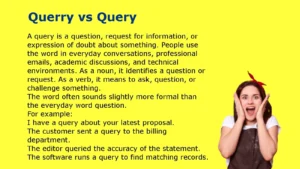
A query is a question, request for information, or expression of doubt about something. People use the word in everyday conversations, professional emails, academic discussions, and technical environments. As a noun, it identifies a question or request. As a verb, it means to ask, question, or challenge something.
The word often sounds slightly more formal than the everyday word question.
For example:
- I have a query about your latest proposal.
- The customer sent a query to the billing department.
- The editor queried the accuracy of the statement.
- The software runs a query to find matching records.
Although these examples involve different situations, they share one central idea: asking for information or examining something more closely.
Query as a Noun
As a noun, query means a question or request that someone wants another person or organization to answer.
It commonly appears in professional communication because it provides a concise way to describe a request for clarification.
For example:
- The manager answered my query about the new schedule.
- Please direct your queries to the administration office.
- The customer submitted a query about an unexpected charge.
- Her query concerned the company’s refund policy.
In each sentence, query refers to something that needs an answer.
You may also encounter the word in formal notices, application forms, customer-support pages, and university websites.
For example, a website might display:
“Contact our support team if you have any queries about your application.”
This means applicants can contact the team whenever they need information or clarification.
Query as a Verb
Query also functions as a verb. In this form, it means to question something, express doubt, or ask whether information is correct.
The verb is particularly common in formal, professional, and administrative writing.
Examples include:
- The accountant queried the unusual expense.
- The editor queried the source of the statistics.
- The manager queried the employee’s explanation.
- The researcher queried the reliability of the results.
Notice that the verb does not always mean asking a simple question. Sometimes it suggests challenging information or requesting evidence.
For example, if an accountant queries an expense, the accountant may want supporting documents before approving the transaction.
Common grammatical forms include:
| Form | Usage | Example |
| Query | Base form or noun | I have a query. |
| Queries | Plural noun or third-person verb | She queries the results. |
| Queried | Past tense | He queried the decision. |
| Querying | Present participle | They are querying the figures. |
What Does “I Have a Query” Mean?
“I have a query” means “I have a question” or “I need some information or clarification.”
People commonly use this expression in workplace communication, customer service, academic discussions, and formal correspondence.
For example:
“I have a query regarding the payment deadline.”
The speaker wants clarification about when the payment must be made.
Here are more examples:
- I have a query about my examination results.
- I have a query regarding the terms of the agreement.
- I have a query concerning the documents you requested.
- I have a query about the delivery date.
Query vs question: Both words can communicate the same basic idea, but query often sounds more formal or administrative. Question works naturally in almost every situation, including casual conversations.
Compare:
| Expression | Tone |
| I have a question. | Neutral and conversational |
| I have a query. | Slightly more formal |
| I need some clarification. | Professional and direct |
| I would like to make an inquiry. | Formal |
Choose the expression that suits your audience and the situation.
Common Expressions Using Query
Query appears in several established English expressions. Learning these combinations can improve your vocabulary and make professional writing more natural.
| Expression | Meaning | Example |
| Raise a query | Ask a question | She raised a query during the meeting. |
| Submit a query | Send a question or request | Please submit your query online. |
| Answer a query | Respond to a question | The support agent answered my query. |
| Handle a query | Deal with a request | Our team handles customer queries. |
| Query a decision | Question a decision | The employee queried the final decision. |
| Customer query | A question from a customer | We received a customer query this morning. |
| Technical query | A question about technical matters | The engineer addressed the technical query. |
| Search query | Words entered into a search engine | The user entered a search query into Google. |
These expressions appear frequently in business, education, customer support, research, and technology.
How to Pronounce Query
The word query has two syllables and receives stress on its first syllable. Its pronunciation varies slightly between British and American English. A common American pronunciation sounds like KWEER-ee, while British speakers may use a pronunciation with a more noticeable vowel distinction. The word should not be confused with quarry.
The standard pronunciation is commonly represented as:
- American English: /ˈkwɪr.i/
- British English: /ˈkwɪə.ri/
The first syllable carries the main stress.
Query Pronunciation in American and British English
American and British speakers generally recognize the same word, but their accents can change the vowel sound.
In common American pronunciation, the first syllable sounds similar to the beginning of the word queer, while the second syllable has a short, unstressed sound.
In British English, the first syllable may have a slightly different vowel quality, and the second syllable can sound more distinct.
Both pronunciations are standard.
A useful way to practice is to say the word slowly, identify its two syllables, and then repeat it at a natural speaking speed.
Remember these points:
- Query contains two syllables.
- The first syllable receives the stress.
- The second syllable is usually shorter and less stressed.
- Regional accents can influence the vowel sounds.
Quarry vs Query Pronunciation
Quarry and query look similar, but they have different meanings and can have different vowel sounds.
Query means a question or request for information. Quarry usually refers to a place where stone, sand, or other materials are extracted. It can also mean something or someone being pursued.
Their pronunciations are commonly represented as follows:
| Word | IPA | Syllables | Meaning |
| Query | /ˈkwɪr.i/ | 2 | Question or request |
| Quarry | /ˈkwɔːr.i/ | 2 | Extraction site or object of pursuit |
The distinction is especially noticeable in some British accents, although American pronunciation can also vary.
Consider these sentences:
- I sent a query to the customer-service department.
- The workers extracted limestone from the quarry.
The first sentence concerns communication. The second describes a place where natural materials are removed from the ground.
Memory tip: A query asks for information, while a quarry can contain stone.
How to Remember the Pronunciation of Query
If you struggle to pronounce query, practice it in short sentences rather than repeating the word without context.
Try these examples:
- I have a query.
- Please answer my query.
- The customer submitted a query.
- The database processes each query.
Focus on the first syllable and avoid giving equal stress to both parts.
You can also listen to different English accents to become familiar with natural variations. The goal is to recognize the word and pronounce it clearly, not to imitate one particular accent.
Query vs Enquiry vs Inquiry: What’s the Difference?
Query usually refers to a question or request for clarification. Enquiry commonly describes a request for information, especially in British English. Inquiry can also mean a question, but it frequently refers to a formal investigation.
These words overlap, so context matters more than a rigid spelling rule.
Query vs Enquiry
Query and enquiry can both describe requests for information.
However, query often sounds more direct and is widely used in professional, technical, and administrative communication. Enquiry is particularly familiar in British English when someone wants to obtain information.
Compare these examples:
- I have a query about my electricity bill.
- I made an enquiry about the available courses.
Both sentences describe requests for information.
The difference is mainly one of convention and context.
Query is particularly common in:
- Customer-service communication.
- Technical documentation.
- Business correspondence.
- Academic discussions.
- Database terminology.
Enquiry is common in:
- General requests for information.
- Course and admission questions.
- Travel-related questions.
- Customer-service communication.
- British English correspondence.
For example, a university might provide an enquiry form for prospective students. A student might then submit a query about a particular admission requirement.
Query vs Inquiry
Query and inquiry have overlapping meanings, but inquiry often carries a stronger investigative meaning.
A query generally asks for information or clarification. An inquiry can describe a formal examination of events, evidence, or circumstances.
Consider these examples:
- The customer submitted a query about the missing payment.
- The government launched an inquiry into the incident.
The first sentence describes a request for information. The second describes an investigation.
However, inquiry can also simply mean a question.
For example:
“The office received several inquiries about the new policy.”
Here, inquiries means requests for information rather than formal investigations.
The distinction depends on how the word functions in the sentence.
Enquiry vs Inquiry in British and American English
British and American English have different spelling preferences for enquiry and inquiry.
In British English, both spellings are used. Some writers prefer enquiry for ordinary requests for information and inquiry for formal investigations.
In American English, inquiry is generally the preferred spelling for both meanings.
Here is a practical comparison:
| Variety | Preferred spelling | Common usage |
| American English | Inquiry | Questions and investigations |
| British English | Enquiry | General requests for information |
| British English | Inquiry | Formal investigations and general questions |
These are common conventions rather than absolute restrictions. You may encounter both forms in different publications and organizations.
For consistent writing, follow the spelling style used by your publication, employer, or institution.
Query vs Enquiry vs Inquiry: Comparison Table
The following table summarizes their meanings and typical uses.
| Word | Main meaning | Common context | Example |
| Query | Question or request | Professional and technical communication | I have a query about the report. |
| Enquiry | Request for information | British English | I sent an enquiry about the course. |
| Inquiry | Question or investigation | American English and formal investigations | An inquiry examined the incident. |
One important distinction is that query has a separate technical meaning in computing. Enquiry and inquiry do not normally replace it in SQL or database terminology.
What Is a Query in a Database or SQL?
A database query is a request that asks a database to perform an operation or return specific information. In SQL, or Structured Query Language, a query can retrieve, insert, update, or delete records. Developers use queries to search databases, filter information, and manage stored data.
This technical meaning connects naturally with the everyday definition of query.
In ordinary English, a query asks for information. In computing, a database query tells a database what information or operation is required.
For example, an online store may contain thousands of customer records. When an employee searches for customers who placed orders during a particular month, the application can send a query to the database.
The database processes the request and returns matching information.
What Does Query Mean in a Database?
In a database, a query is an instruction used to interact with stored information.
Databases organize information into structures such as tables, rows, and columns. A query allows users or applications to access and manipulate that information without manually examining every record.
Imagine an online bookstore with a customer database.
The database might contain:
| Customer ID | Name | City | Orders |
| 101 | Sarah | Chicago | 5 |
| 102 | Michael | Boston | 2 |
| 103 | Emma | Denver | 8 |
| 104 | James | Austin | 3 |
Suppose an employee wants to find customers from Chicago.
Instead of searching every row manually, the application can send a database query that filters the records by city.
The database returns Sarah’s information because her city matches the requested condition.
Common database query operations include:
- Retrieving data: Finding records that match specific conditions.
- Filtering data: Displaying only relevant records.
- Sorting data: Arranging records by date, name, or another field.
- Inserting data: Adding new records.
- Updating data: Changing existing information.
- Deleting data: Removing selected records.
Queries make databases more useful because they allow users to work with large amounts of information efficiently.
What Is an SQL Query?
An SQL query is an instruction written in Structured Query Language that communicates with a relational database.
SQL is widely used to manage information in database systems. Developers, analysts, and database administrators use it to retrieve and modify stored records.
A basic SQL query looks like this:
SELECT * FROM customers;
This statement asks the database to return all columns and records from the customers table.
Here is another example:
SELECT name, city
FROM customers
WHERE city = ‘Chicago’;
This query retrieves the names and cities of customers whose city is Chicago.
SQL includes several commonly used commands:
| SQL command | Purpose | Example |
| SELECT | Retrieve information | SELECT * FROM customers; |
| INSERT | Add new records | INSERT INTO customers VALUES (…); |
| UPDATE | Change existing records | UPDATE customers SET city = ‘Boston’; |
| DELETE | Remove records | DELETE FROM customers WHERE id = 101; |
A query can be simple or complex. Some retrieve a few records, while others combine multiple tables, apply conditions, and calculate results.
Query or Querry in SQL: Which Is Correct?
Query is the only correct spelling for the standard SQL and database term. Querry is a misspelling and should not appear in technical documentation, programming instructions, database comments, or code.
For example:
Correct:
SELECT * FROM products;
Incorrect terminology:
Write a querry to retrieve customer records.
Correct terminology:
Write a query to retrieve customer records.
The same spelling rule applies whether you are discussing SQL, search engines, application programming, or database management.
Programmers should also remember that the plural form is queries.
For example:
“The application executes multiple queries to retrieve the required information.”
Everyday Query vs Database Query
The everyday and technical meanings of query share a common foundation: requesting information.
However, the way people use the word changes according to context.
| Feature | Everyday query | Database query |
| Meaning | A question or request | An instruction sent to a database |
| User | Customer, student, employee | Developer, analyst, application |
| Purpose | Obtain clarification | Retrieve or manipulate data |
| Format | Spoken or written language | SQL or another query language |
| Example | I have a query about my bill. | SELECT * FROM invoices; |
Think of a database query as a structured question directed at stored information.
A person might ask, “Which customers live in Chicago?” A database query translates that request into instructions the computer can process.
This connection explains why the same word works naturally in both everyday communication and computer science.
What Is the Plural of Query?
The plural of query is queries, not querys or querries. To form the plural, replace the final y with ies. This spelling pattern also applies to many English nouns that end in a consonant followed by y, such as company and city.
For example:
- One query.
- Two queries.
- Several queries.
- Multiple customer queries.
The spelling changes, but the basic meaning remains the same.
Query vs Queries
Query is singular, while queries is plural.
Use query when discussing one question or request. Use queries when referring to two or more questions or requests.
Examples:
Singular:
- I submitted a query yesterday.
- The manager answered my query.
- This query concerns the payment deadline.
Plural:
- I submitted three queries yesterday.
- The manager answered all my queries.
- These queries concern the payment deadline.
The distinction is important because English verbs and determiners must agree with singular and plural nouns.
Compare:
- Correct: This query needs an answer.
- Correct: These queries need answers.
- Incorrect: These query needs answers.
Query, Queries, Querying, and Queried
Query has several grammatical forms. Each form serves a different purpose in a sentence.
| Word | Grammatical form | Example |
| Query | Base verb or singular noun | I have a query. |
| Queries | Plural noun or third-person verb | She queries the information. |
| Querying | Present participle or gerund | They are querying the results. |
| Queried | Past tense or past participle | He queried the decision. |
Understanding these forms helps prevent spelling and grammar mistakes.
For instance, you should write “the customer submitted two queries,” not “the customer submitted two querys.”
Similarly, the past-tense form is queried, not queryed.
How to Spell Query Like a Question
If you want to spell the word that means a question or request for information, write query.
Remember these simple points:
- Start with q.
- Follow it with u.
- Use e and r in the middle.
- Finish with y.
- Use only one r.
The spelling pattern is:
Q-U-E-R-Y
A useful way to remember it is to connect the word with its plural form:
- Query becomes queries.
- The final y changes to ies.
- The original spelling still contains only one r.
This method helps you remember both the singular and plural forms.
Common Mistakes When Using Query
Knowing the correct spelling is only the first step. Writers also need to understand how query functions in a sentence and how it differs from similar-looking words.
Here are common mistakes and practical ways to avoid them.
Writing Querry Instead of Query
This is the most direct spelling mistake.
Because querry looks and sounds plausible to some English learners, it can appear in emails, reports, website content, and online discussions.
Incorrect:
“I have a querry about the application process.”
Correct:
“I have a query about the application process.”
Another example:
Incorrect:
“The support team received five querries.”
Correct:
“The support team received five queries.”
Remember: Query has one r in every standard grammatical form, including queries, querying, and queried.
Confusing Query With Quarry
Query and quarry look similar, but their meanings are different.
A query is a question or request for information. A quarry is a place where people extract natural materials such as stone, sand, and gravel.
Quarry also has a figurative meaning. It can describe a person or object being pursued.
Examples:
- The customer raised a query about the service.
- The construction company purchased stone from a nearby quarry.
- The detective followed his quarry through the streets.
These words are not interchangeable.
A useful memory trick is to associate query with questions and quarry with rock extraction.
Using Query When Question Is More Natural
Query is a useful word, but it does not always sound natural in casual conversation.
For example:
Formal: “I have a query about your proposal.”
Conversational: “I have a question about your proposal.”
Both sentences are correct, but the second sounds more natural in many everyday situations.
Choose query when you want a slightly formal or professional tone. Choose question when you want simple, direct language.
Other alternatives include:
- Request for clarification.
- Point of concern.
- Inquiry.
- Request for information.
- Question about a particular issue.
The best choice depends on your audience and the message you want to communicate.
Confusing Queries With Querys
Another common mistake occurs when writers form the plural incorrectly.
Incorrect: “The website received several querys.”
Correct: “The website received several queries.”
The rule is straightforward. When a noun ends in a consonant followed by y, the usual plural form changes y to ies.
Compare:
| Singular | Correct plural |
| Query | Queries |
| City | Cities |
| Company | Companies |
| Story | Stories |
| Activity | Activities |
This pattern makes queries the correct plural form.
Querry vs Query: Correct Examples in Sentences
Examples make the difference between the two spellings easier to understand. Query works as both a noun and a verb, so it can appear in several sentence structures.
The following examples cover everyday communication, professional writing, and technical usage.
Examples of Query as a Noun
When query functions as a noun, it identifies a question or request for information.
- I have a query about the new company policy.
- The customer submitted a query regarding an incorrect charge.
- The teacher answered every student’s query.
- Please send your queries to the admissions department.
- Her query concerned the deadline for the assignment.
- The support team received several queries this morning.
- I would like to raise a query about the final report.
- The employee sent a query to the human resources department.
- The website includes a section for frequently asked queries.
- Our team will respond to your query within two business days.
These examples show how query works in different professional and academic situations.
Examples of Query as a Verb
When query functions as a verb, it means to question something or express doubt about its accuracy.
- The accountant queried the unusual transaction.
- She queried the accuracy of the report.
- The manager queried the information in the application.
- The editor queried the source of the quotation.
- The auditor queried several expenses.
- The researcher queried the reliability of the results.
- The committee queried the proposed changes.
- The employee queried the decision during the meeting.
Notice how query can describe a request for clarification or a challenge to information.
Examples of Query in Technology
In computing, query commonly refers to an instruction that retrieves or manipulates information.
Examples:
- The developer wrote an SQL query to retrieve customer records.
- This database query returns all active users.
- The application processes several queries simultaneously.
- The search engine analyzes the user’s query.
- The analyst created a query to filter sales data.
- The database rejected the query because it contained invalid syntax.
- The developer optimized the query to improve performance.
- The search query returned thousands of relevant results.
These examples demonstrate that query is a standard term in computer science and digital technology.
Incorrect vs Correct Sentences
Use the following comparison table to recognize common mistakes quickly.
| Incorrect sentence | Correct sentence |
| I have a querry. | I have a query. |
| Please submit your querries. | Please submit your queries. |
| Write a querry in SQL. | Write a query in SQL. |
| She raised an important querry. | She raised an important query. |
| The customer sent two querys. | The customer sent two queries. |
| He querried the decision. | He queried the decision. |
| The application runs multiple querries. | The application runs multiple queries. |
Practical proofreading tip: When editing a document, search for querry and querries. Replace them with the appropriate standard forms, query and queries, after checking the context.
Frequently Asked Questions About Querry vs Query
Is Querry a Real Word?
Querry is not the standard English spelling of query and is generally treated as a misspelling when someone intends to describe a question or request for information. Use query in professional, academic, everyday, and technical writing.
Is It Querry or Query?
Query is correct. Querry is a common spelling error. If you are writing about a question, customer request, search term, or database instruction, always use query.
Why Is Query Spelled With One R?
The standard spelling of query contains one r because that is its established English form. Adding another r creates the nonstandard spelling querry. Remembering the five-letter pattern Q-U-E-R-Y can help prevent this mistake.
What Is the Difference Between Query and Quarry?
A query is a question or request for information. A quarry is a place where materials such as stone, sand, or gravel are extracted. Quarry can also refer to something being pursued. Although the words look similar, their meanings are unrelated.
Is Query British or American English?
Query is standard in both British and American English. Unlike some words that have different British and American spellings, query does not change its spelling between these varieties. Both use query and its plural form, queries.
What Is the Plural of Query?
The plural of query is queries. Replace the final y with ies when forming the plural. For example, one query becomes two queries. Querys and querries are incorrect plural forms.
Conclusion: Always Choose Query Over Querry
The difference between querry vs query is simple: query is the correct spelling, while querry is a common misspelling. Query means a question, request for information, or expression of doubt. It also serves as an important technical term in database management, SQL, and search technology.
Remember these key points:
- Query is correct in both American and British English.
- Querry is not a standard alternative spelling.
- The plural of query is queries.
- Query can function as both a noun and a verb.
- Quarry has a different meaning and should not replace query.
- Enquiry and inquiry have overlapping meanings but different usage conventions.
- In SQL and database terminology, query is the correct spelling.
Whether you are writing a professional email, preparing an academic assignment, answering a customer, or working with database software, use query whenever you mean a question or information request.
Before publishing your next document or sending an important email, check the spelling: query, not querry.