Gauge vs Guage: Gauge is the correct standard spelling, while guage is a common spelling mistake. However, there is another spelling worth knowing: gage is an accepted variant used in some American English and technical contexts. The word gauge means to measure, estimate, or assess something, and it can also refer to an instrument that measures pressure, thickness, or other quantities. Although gauge and gouge look similar, they have completely different meanings and pronunciations.
Whether you want to gauge someone’s interest, gauge a situation, identify the correct metal thickness gauge, or write pressure gauge in a technical document, understanding these differences will help you choose the right word.
Gauge vs Guage: Quick Answer
| Question | Answer |
| Is it gauge or guage? | Gauge is correct. Guage is a misspelling. |
| Is gage a correct word? | Yes. Gage is an accepted spelling variant, particularly in some American technical contexts. |
| What does gauge mean? | To measure, estimate, evaluate, or assess something. |
| How do you pronounce gauge? | /ɡeɪdʒ/, rhyming with cage and page. |
| Is it gauge or gouge? | Gauge means measure or assess; gouge means cut, carve, or overcharge. |
Guage vs Gauge: Which Spelling Is Correct?
Gauge is the correct standard spelling in modern English. Guage is an incorrect spelling that commonly results from confusing the order of the letters. When writing about measurement, evaluation, pressure, or interest, use gauge rather than guage.
The confusion often occurs because English spelling does not always follow pronunciation. Although gauge contains an unusual arrangement of letters, its spelling remains consistent across common expressions such as pressure gauge, fuel gauge, and temperature gauge.
Consider these examples:
- Correct: We need to gauge customer interest before launching the product.
- Incorrect: We need to guage customer interest before launching the product.
- Correct: Check the pressure gauge before starting the machine.
- Incorrect: Check the pressure guage before starting the machine.
Is Guage a Word?
No. Guage is not the accepted standard spelling of the word gauge. It does not function as a standard alternative in ordinary English writing.
People sometimes type guage because they expect the letter U to appear before A. However, the correct spelling places A before U.
| Incorrect spelling | Correct spelling |
| Guage | Gauge |
| Pressure guage | Pressure gauge |
| Metal guage | Metal gauge |
| Guage interest | Gauge interest |
| Guage a situation | Gauge a situation |
A simple way to remember the difference is to focus on the first four letters: GAUG, not GUAG.
Why Do People Spell Gauge as Guage?
The spelling mistake happens mainly because of the unusual vowel arrangement. Many familiar English words contain the combination GU before another vowel, so writers sometimes reverse the letters when spelling gauge.
Several factors contribute to this mistake:
- Unfamiliar spelling: Gauge does not follow a spelling pattern that many learners encounter regularly.
- Pronunciation confusion: The pronunciation does not clearly reveal the written order of A and U.
- Typing mistakes: People often type guage because they remember the sound but not the exact spelling.
- Limited exposure: Someone who rarely encounters technical terms such as pressure gauge may not recognize the correct form immediately.
To avoid the mistake, remember that gauge starts with GAU. You can also use the word in familiar combinations, such as fuel gauge and pressure gauge, to reinforce its spelling.
Gauge vs Guage Examples in Sentences
The following sentences demonstrate how to use the correct spelling in different situations.
| Correct sentence | Incorrect sentence |
| We should gauge the audience’s reaction. | We should guage the audience’s reaction. |
| The mechanic checked the fuel gauge. | The mechanic checked the fuel guage. |
| She tried to gauge his interest. | She tried to guage his interest. |
| This tool measures the thickness of metal sheets using a gauge system. | This tool measures the thickness of metal sheets using a guage system. |
| The technician inspected the pressure gauge. | The technician inspected the pressure guage. |
The rule is straightforward: choose gauge whenever you mean measure, estimate, assess, or a measuring instrument.
Gauge vs. Gage: What’s the Difference?
Gauge and gage are both accepted spellings, but gauge is the more common form in general English. Gage appears in certain American English contexts, including established technical expressions. For everyday writing, gauge is usually the safest choice.
The distinction matters because writers sometimes assume that gage is simply another incorrect spelling. That assumption is not accurate.
The word gage has a legitimate history as a spelling variant. However, its use is more limited than gauge, especially in contemporary general writing.
Is Gage a Correct Spelling?
Yes. Gage is a recognized variant of gauge. It can refer to a measuring instrument, a standard of measurement, or something used to evaluate a particular quantity.
You may encounter gage in:
- American technical documents.
- Engineering terminology.
- Manufacturing specifications.
- Established equipment names.
- Specialized measurement expressions.
For example:
- The technician inspected the pressure gage.
- The manufacturer supplied a thickness gage.
- The engineer checked the measuring gage before production.
These examples illustrate contexts where gage may appear. However, that does not mean every writer should replace gauge with gage.
For general audiences, gauge remains the more familiar spelling.
Gauge vs. Gage in American and British English
Both American and British English generally use gauge as the standard spelling.
Some American technical industries and specialized documents also use gage. This variation does not establish a simple American-versus-British spelling rule.
| Context | Preferred spelling |
| General American English | Gauge |
| General British English | Gauge |
| Everyday communication | Gauge |
| General business writing | Gauge |
| Specialized American technical terminology | Gauge or gage, depending on convention |
| Established equipment or industry terminology | Follow the official designation |
If you are writing an article, email, report, or general business document, choose gauge. If you are preparing an engineering specification, follow the terminology used by the applicable standard or manufacturer.
Gauge vs. Gage Examples
Here are some examples that demonstrate how both spellings can appear:
Using gauge:
- We need to gauge the customer’s response.
- The mechanic replaced the damaged pressure gauge.
- The manufacturer produces metal thickness gauges.
- She used the survey to gauge public interest.
Using gage:
- The technician checked the measuring gage.
- The workshop maintains several specialized gages.
- The engineer referred to the specified gage in the technical documentation.
The important distinction is that gage is a legitimate variant, whereas guage is a misspelling.
Gauge vs. Gouge: Understanding the Difference
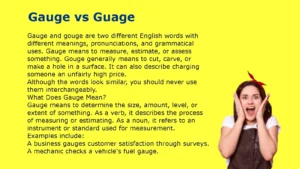
Gauge and gouge are two different English words with different meanings, pronunciations, and grammatical uses. Gouge generally means to cut, carve, or make a hole in a surface. It can also describe charging someone an unfairly high price.
Although the words look similar, you should never use them interchangeably.
What Does Gauge Mean?
Gauge means to determine the size, amount, level, or extent of something. As a verb, it describes the process of measuring or estimating. As a noun, it refers to an instrument or standard used for measurement.
Examples include:
- A business gauges customer satisfaction through surveys.
- A mechanic checks a vehicle’s fuel gauge.
- A teacher gauges students’ understanding through questions.
- An engineer uses a pressure gauge to monitor a machine.
The central idea behind gauge is measurement or assessment, whether someone measures something physically or evaluates it mentally.
What Does Gouge Mean?
Gouge has several meanings, but it usually refers to removing material from a surface by cutting, digging, or scraping.
As a verb, it can mean:
- To cut or make a hole in something.
- To remove material from wood, metal, or another surface.
- To damage something with a sharp object.
- To charge an unfairly high price.
As a noun, a gouge can refer to a tool with a curved cutting edge or a deep groove in a surface.
Examples:
- The carpenter used a gouge to carve a decorative pattern into the wood.
- A sharp object gouged a deep mark into the table.
- The company faced criticism for gouging customers during a shortage.
- The mechanic noticed a gouge on the metal surface.
Gauge vs. Gouge Examples in Sentences
Compare these examples to understand the difference:
| Gauge | Gouge |
| We need to gauge the project’s progress. | The worker gouged the wooden surface. |
| The instrument measures air pressure with a gauge. | The sharp tool left a gouge in the metal. |
| She tried to gauge his reaction. | The seller was accused of price gouging. |
| The company wants to gauge customer interest. | The carpenter used a gouge to shape the wood. |
Gauge vs. Gouge Comparison Table
| Feature | Gauge | Gouge |
| Pronunciation | /ɡeɪdʒ/ | /ɡaʊdʒ/ |
| Main meaning | Measure or assess | Cut, carve, or overcharge |
| Part of speech | Noun and verb | Noun and verb |
| Common context | Measurement and evaluation | Cutting, carving, and pricing |
| Example | Gauge the temperature | Gouge the wood |
The easiest way to remember the distinction is to associate gauge with measurement and gouge with cutting or damage.
What Does Gauge Mean?
Gauge means to measure, estimate, or evaluate the amount, level, quality, or extent of something. It can describe physical measurement with an instrument or an informal assessment based on observation. As a noun, gauge refers to a device or standard used to measure something, such as pressure, thickness, or temperature.
The word appears in everyday conversations, workplaces, engineering, manufacturing, business, and scientific settings.
For example, a manager might gauge employee satisfaction by collecting feedback. A mechanic might read a pressure gauge to check a vehicle’s tire pressure. Although these situations differ, both involve determining a particular level or condition.
Gauge as a Verb
When you use gauge as a verb, you mean that you are measuring, estimating, judging, or assessing something.
The verb often describes an evaluation rather than an exact numerical measurement.
For example:
- We need to gauge the audience’s reaction before changing the presentation.
- The manager wants to gauge employee satisfaction.
- It is difficult to gauge the project’s success at this early stage.
- The doctor used several tests to gauge the patient’s response to treatment.
- She watched his expression to gauge his feelings.
Notice that gauge does not always require a physical measuring instrument. You can gauge someone’s mood through facial expressions, assess interest through questions, or estimate progress by reviewing completed work.
Common grammatical forms of gauge:
| Form | Example |
| Base form | We gauge customer interest. |
| Third-person singular | She gauges the situation carefully. |
| Past tense | They gauged the market response. |
| Present participle | He is gauging public opinion. |
| Past participle | The results have been gauged. |
The verb usually takes a direct object.
For example:
- Gauge the reaction.
- Gauge the temperature.
- Gauge the pressure.
- Gauge the audience’s interest.
- Gauge the situation.
Gauge as a Noun
As a noun, gauge refers to an instrument, measurement system, or standard used to determine a particular quantity.
A gauge can display information through a dial, needle, digital screen, or another measurement mechanism.
Common examples include:
| Type of gauge | What it measures |
| Pressure gauge | Pressure in gases or liquids |
| Fuel gauge | Fuel level in a vehicle |
| Temperature gauge | Temperature |
| Tire pressure gauge | Air pressure inside a tire |
| Thickness gauge | Material thickness |
| Rain gauge | Amount of rainfall |
| Wire gauge | Wire diameter classification |
For example, a vehicle’s fuel gauge helps the driver estimate how much fuel remains in the tank. A pressure gauge allows a technician to monitor pressure in a pipe, tank, or mechanical system.
In these examples, gauge refers to the measuring device rather than the act of measuring.
What Does It Mean to Gauge Something?
To gauge something means to determine its level, amount, condition, or likely outcome through measurement or careful observation.
The process can involve numbers, instruments, surveys, conversations, or personal judgment.
For instance, imagine a restaurant owner who wants to introduce a new menu. Instead of immediately changing every dish, the owner offers a few new items and collects customer feedback.
The owner uses those responses to gauge customer interest.
Other practical examples include:
- A teacher gauges students’ understanding by asking questions.
- A manager gauges team morale through regular discussions.
- A salesperson gauges a customer’s interest before recommending a product.
- A driver gauges the distance between two vehicles.
- A project manager gauges progress by comparing completed tasks with planned milestones.
In each situation, the person gathers information before making a decision.
Synonyms for Gauge
The best synonym for gauge depends on the context. Some alternatives describe physical measurement, while others refer to judgment or evaluation.
| Meaning | Synonyms | Example |
| Measure | Quantify, calculate, determine | Measure the distance. |
| Estimate | Approximate, predict, judge | Estimate the cost. |
| Evaluate | Assess, appraise, examine | Assess the performance. |
| Understand a reaction | Interpret, read, evaluate | Read the room. |
| Monitor progress | Track, monitor, review | Track project progress. |
| Determine a level | Establish, identify, calculate | Determine the pressure. |
Gauge often works better than a more specific synonym when you want to describe an informed estimate rather than an exact measurement.
For example, you can measure the temperature with a thermometer, but you might gauge someone’s interest through their behavior.
How to Pronounce Gauge
The word gauge is pronounced /ɡeɪdʒ/ in standard English. It rhymes with cage, page, and stage. The word has one syllable, begins with a hard G sound, contains a long A vowel, and ends with the sound represented by J.
Its spelling may look unusual, but its pronunciation is relatively simple.
Gauge Pronunciation in American English
American English speakers generally pronounce gauge as one syllable.
You can understand its pronunciation through three sounds:
- G: Start with the hard G sound found in go.
- A: Use the long A sound found in day.
- GE: Finish with the J sound found in age.
The entire word rhymes with:
- Cage
- Page
- Stage
- Age
- Wage
The final E does not create a separate syllable.
Is Gauge Pronounced Like Gouge?
No. Gauge and gouge have different vowel sounds, even though both words end with the same consonant sound.
| Word | IPA | Rhyming example |
| Gauge | /ɡeɪdʒ/ | Cage |
| Gouge | /ɡaʊdʒ/ | Pouch |
The difference appears in the vowel sound.
Gauge contains the long A sound, while gouge contains the sound found in words such as house and mouse.
This distinction matters because confusing the pronunciation can also lead to confusion about meaning.
Common Gauge Pronunciation Mistakes
English learners sometimes struggle with gauge because its written form does not clearly reveal its pronunciation.
Avoid these common mistakes:
- Pronouncing every letter separately.
- Treating the word as if it contains two syllables.
- Confusing its vowel sound with gouge.
- Replacing the final J sound with a hard G sound.
Remember that gauge has one syllable and rhymes with page.
Gauge or Gage Interest: Which Is Correct?
Gauge interest is the preferred standard expression in modern English. It means to determine how interested someone is in a product, service, idea, event, or opportunity. Although gage is an accepted spelling variant, gauge interest is the more familiar and natural choice in general business and everyday communication.
The expression is particularly common in marketing, sales, business planning, education, and personal conversations.
What Does Gauge Interest Mean?
To gauge interest means to assess how much attention, curiosity, enthusiasm, or willingness someone has toward something.
You might gauge interest before investing money in a new product, organizing an event, or introducing a service.
For example, imagine a company planning to launch a subscription service. Before investing in development, its marketing team creates a survey asking potential customers whether they would pay for the service.
The team reviews the responses to gauge interest.
Businesses use several methods to measure interest:
- Customer surveys: Ask potential customers about their preferences.
- Email campaigns: Monitor clicks and responses.
- Product demonstrations: Observe how people react to a new offering.
- Social media polls: Collect opinions from an online audience.
- Preorders and sign-ups: Measure actual purchasing or participation intent.
A strong response suggests that people may want the product. However, expressed interest does not always translate into actual purchases. Businesses should compare survey results with real customer behavior before making major decisions.
Gauge Interest in a Sentence
Here are original examples showing how to use the expression naturally:
- We organized a short survey to gauge interest in the new training program.
- The company wants to gauge customer interest before expanding its product line.
- She asked a few questions to gauge his interest in the partnership.
- The school conducted a poll to gauge interest in an additional language course.
- The marketing team launched a campaign to gauge public interest in its upcoming product.
- Before booking a larger venue, the organizers decided to gauge interest among local residents.
These examples show that gauge interest works in both professional and everyday communication.
Gauge Interest vs. Measure Interest
Both expressions describe assessing someone’s level of interest, but they can suggest slightly different approaches.
Gauge interest often implies an estimate based on observations, responses, or feedback.
Measure interest can suggest a more systematic or numerical approach.
| Expression | Meaning | Example |
| Gauge interest | Estimate someone’s level of interest | We gauged interest through conversations. |
| Measure interest | Determine interest using a defined method | We measured interest through a survey. |
| Assess interest | Evaluate someone’s willingness or enthusiasm | The team assessed interest among customers. |
| Test interest | Check whether people respond positively | We tested interest with a small campaign. |
All four expressions can work. Choose the one that best describes your method.
Gauge or Gage a Situation: Which Spelling Should You Use?
Gauge a situation is the standard expression in modern English. It means to assess the circumstances, understand what is happening, and form an opinion before deciding how to respond. Although gage is an accepted spelling variant, gauge a situation is the more widely recognized expression.
People use this phrase in workplaces, negotiations, social interactions, emergencies, and everyday decision-making.
What Does It Mean to Gauge a Situation?
To gauge a situation means to examine the available information and understand the conditions before taking action.
You might consider people’s reactions, possible risks, surrounding circumstances, or likely outcomes.
For example, imagine a manager noticing tension between two employees. Instead of immediately assigning blame, the manager listens to both sides, observes their behavior, and gathers information.
The manager is trying to gauge the situation before deciding how to resolve the disagreement.
The same approach applies in other situations:
- Business negotiations: Assess the other party’s expectations before making an offer.
- Social interactions: Read people’s expressions to understand their reactions.
- Workplace decisions: Evaluate the circumstances before changing a project plan.
- Emergency situations: Assess immediate risks before taking action.
- Customer service: Understand a customer’s frustration before recommending a solution.
The phrase suggests careful judgment rather than simply guessing.
Gauge a Situation in Example Sentences
Use these examples to understand how the expression works in different contexts:
- Take a few minutes to gauge the situation before responding.
- The manager observed the discussion to gauge the situation.
- She wanted to gauge the situation before making a financial commitment.
- Police officers assessed the surroundings to understand the situation.
- He spoke with several employees to gauge the situation within the department.
- We should gauge the situation before deciding whether to continue the negotiations.
The expression usually takes the article the when referring to a specific set of circumstances.
For example:
- Correct: We need to gauge the situation.
- Correct: She quickly gauged the situation.
- Correct: He is trying to gauge the current situation.
Other Ways to Say Gauge a Situation
You can replace gauge a situation with several expressions, depending on the context and tone.
| Alternative expression | Meaning |
| Assess the situation | Evaluate the current circumstances |
| Evaluate the circumstances | Examine the conditions carefully |
| Read the room | Understand people’s feelings and reactions |
| Judge the conditions | Form an opinion based on available information |
| Take stock of the situation | Review what is happening |
| Analyze the circumstances | Examine the details systematically |
| Get a feel for the situation | Develop an initial understanding |
| Understand the situation | Identify what is happening and why |
For professional writing, assess the situation and evaluate the circumstances are useful alternatives.
In informal conversations, read the room and get a feel for the situation often sound more natural.
Gage or Gauge for Metal Thickness?
Gauge is the standard general-English spelling in expressions such as metal gauge and sheet metal gauge. The term describes a measurement classification used to identify the thickness of certain materials. Gage also appears in specialized American technical terminology, but gauge is the more familiar spelling for general readers.
Metal gauge is especially important in manufacturing, construction, automotive production, metal fabrication, and engineering.
However, one detail often causes confusion: a higher gauge number generally means thinner metal, not thicker metal, within the same applicable gauge system.
What Is a Metal Gauge?
A metal gauge is a system used to identify the thickness of sheet metal, wire, and certain other materials.
Manufacturers and metalworkers use gauge numbers to specify material thickness without always writing the measurement in inches or millimeters.
For example, sheet metal may be described as 16-gauge steel or 20-gauge steel.
These numbers represent different thickness categories. The actual thickness depends on the material and the gauge standard.
Metal gauge systems have practical uses in:
- Automotive body manufacturing.
- Roofing and construction.
- Heating and ventilation systems.
- Industrial equipment.
- Metal furniture production.
- Electrical enclosures.
- Sheet metal fabrication.
A fabricator might select a particular gauge based on the strength, weight, flexibility, and intended use of a metal component.
Does a Higher Metal Gauge Mean Thicker or Thinner Metal?
A higher gauge number generally indicates thinner metal, while a lower gauge number generally indicates thicker metal.
This relationship can seem counterintuitive because people often assume that a larger number represents a larger physical measurement.
Consider this simplified example for common steel sheet thicknesses:
| Steel gauge | Approximate thickness |
| 10 gauge | 0.1345 inches |
| 12 gauge | 0.1046 inches |
| 14 gauge | 0.0747 inches |
| 16 gauge | 0.0598 inches |
| 18 gauge | 0.0478 inches |
| 20 gauge | 0.0359 inches |
| 22 gauge | 0.0299 inches |
Illustrative U.S. standard steel sheet thickness values. Actual specifications and tolerances should be checked against the applicable material standard.
Notice how the thickness decreases as the gauge number increases.
For example:
- 10-gauge steel is thicker than 16-gauge steel.
- 16-gauge steel is thicker than 20-gauge steel.
- 22-gauge steel is thinner than 18-gauge steel.
This relationship helps metalworkers select materials for specific applications.
Practical example: A manufacturer producing a heavy-duty metal enclosure may select thicker sheet metal for greater rigidity. A company producing lightweight panels may choose a thinner material to reduce weight and manufacturing costs.
The correct choice depends on the design, load requirements, material properties, and manufacturing process.
Metal Gauge vs. Actual Thickness
Although gauge numbers are convenient, they do not always provide enough information for precise manufacturing work.
Different materials can have different thicknesses at the same gauge number.
For example, a 16-gauge steel sheet and a 16-gauge aluminum sheet do not necessarily have identical thicknesses.
The following factors explain why:
- Material type: Steel, stainless steel, aluminum, and other metals may follow different gauge charts.
- Measurement standard: Different gauge systems can assign different thickness values.
- Manufacturing tolerances: Actual sheet thickness may vary within permitted limits.
- Application requirements: Engineering specifications may require an exact thickness rather than a gauge designation.
For accurate work, specify thickness in inches or millimeters alongside the gauge number when appropriate.
For example, instead of writing only “16-gauge sheet,” a technical specification can state the material, applicable standard, and required thickness.
This reduces confusion between suppliers, engineers, and fabricators.
Gauge or Gage for Metal Thickness in a Sentence
Both spellings may appear in technical environments, but gauge is the more recognizable choice in general English.
Examples:
- The manufacturer produces 18-gauge steel sheets.
- The technician checked the thickness of the metal panel.
- We need a thicker gauge of steel for this application.
- The engineer specified 16-gauge material for the enclosure.
- The workshop uses a thickness gauge to inspect finished components.
- The supplier provided a metal gauge chart for the fabrication team.
When writing for a general audience, use metal gauge, sheet metal gauge, and thickness gauge.
If an engineering specification uses gage as part of an established technical designation, follow that convention consistently.
Pressure Gage or Gauge: Which Is Correct?
Pressure gauge is the standard spelling in general English and the more familiar expression across most everyday and industrial contexts. When choosing between them, use gauge unless a specific technical standard, manufacturer, or established designation requires gage.
Both expressions refer to an instrument used to measure pressure.
What Is a Pressure Gauge?
A pressure gauge is a measuring instrument that indicates the pressure of a gas or liquid within a system.
It helps operators monitor whether pressure remains within an acceptable range.
Pressure gauges appear in many environments, including:
- Vehicle tire systems.
- Industrial pipelines.
- Air compressors.
- Boilers and heating systems.
- Hydraulic equipment.
- Water supply systems.
- Manufacturing machinery.
- Refrigeration and HVAC equipment.
For example, a mechanic uses a tire pressure gauge to check whether a vehicle’s tires contain the recommended air pressure.
An industrial technician may use a pressure gauge to monitor a pipeline and identify unusual pressure changes.
These instruments help operators detect conditions that could affect equipment performance or safety.
Types of Pressure Gauges
Different pressure gauges serve different measurement requirements.
Common pressure-measuring instrument types
111.12 Bourdon Tube Pressure Gauge – WIKA – Telematic Controls
Analog pressure gauge
Uses a dial and needle to display pressure. It is common in industrial equipment, compressors, and mechanical systems.
Pressure Gauges | DG25 Digital Pressure Gauge | Ashcroft
Digital pressure gauge
Displays pressure readings electronically. Some models offer additional features such as data recording and selectable measurement units.
Stewarts-USA Gauges – Differential Pressure Gauges
Differential pressure gauge
Measures the difference between pressure at two points. It is useful in filtration, ventilation, and fluid systems.
Parts Of A Pressure Gauge at Kurt Scott blog
Bourdon tube pressure gauge
Uses a curved metal tube that changes shape under pressure. Its movement drives the pointer across the dial.
Pressure Gauge vs. Pressure Gage Examples
Both spellings can appear in technical writing, but pressure gauge is generally the safer choice.
| Expression | Usage |
| Pressure gauge | Standard general-English expression |
| Pressure gage | Variant found in some American technical contexts |
| Digital pressure gauge | Standard general usage |
| Tire pressure gauge | Standard general usage |
| Differential pressure gauge | Standard general usage |
| Pressure gauge reading | Standard general usage |
Examples in sentences:
- The technician replaced the damaged pressure gauge.
- Check the pressure gauge before operating the compressor.
- The digital pressure gauge displays the current system pressure.
- The engineer inspected the pressure gage specified in the equipment documentation.
When writing technical documents, consistency matters. If the manufacturer or applicable standard uses gage, retain that spelling throughout the document rather than switching between forms.
Gauge vs Guage vs. Gage vs. Gouge: Quick Comparison
The four words may look or sound similar, but their spelling and meanings differ.
| Word | Correct spelling? | Meaning | Usage |
| Gauge | Yes | Measure, estimate, assess, or measuring instrument | Standard general English |
| Guage | No | Incorrect spelling of gauge | Avoid |
| Gage | Yes | Accepted variant of gauge | Some American technical contexts |
| Gouge | Yes | Cut, carve, damage, or overcharge | Separate word |
Which Spelling Should You Use?
The correct choice depends on what you want to communicate.
Use these guidelines:
- Gauge: Choose this spelling when discussing measurement, estimation, assessment, pressure, interest, or thickness.
- Guage: Avoid this spelling because it is incorrect in standard English.
- Gage: Use it when a recognized technical convention, established term, or manufacturer specifies this variant.
- Gouge: Use it when referring to cutting, carving, a groove, or unfair pricing.
Here are a few practical comparisons:
| Intended meaning | Correct expression |
| Assess customer interest | Gauge interest |
| Evaluate circumstances | Gauge a situation |
| Measure liquid pressure | Pressure gauge |
| Identify sheet metal thickness | Metal gauge |
| Cut a groove into wood | Gouge the wood |
| Charge an unfair price | Price gouge |
| Measure fuel level | Fuel gauge |
A Practical Editing Example
Imagine reviewing a technical report containing these sentences:
- The technician checked the pressure guage.
- The manager wanted to guage customer interest.
- The engineer selected 16-gage steel.
- The carpenter used a gauge to cut the wooden surface.
A careful editor would make the following corrections:
| Original sentence | Improved sentence | Reason |
| The technician checked the pressure guage. | The technician checked the pressure gauge. | Guage is misspelled. |
| The manager wanted to guage customer interest. | The manager wanted to gauge customer interest. | Gauge is the standard spelling. |
| The engineer selected 16-gage steel. | The engineer selected 16-gauge steel. | Gauge is preferred in general writing. |
| The carpenter used a gauge to cut the wooden surface. | The carpenter used a gouge to cut the wooden surface. | Gouge refers to a cutting tool. |
The fourth example is particularly important. Changing gauge to gouge changes the meaning of the sentence, not merely its spelling.
Frequently Asked Questions About Gauge vs Guage
Is it gauge or guage?
Gauge is the correct standard spelling. Guage is a common misspelling caused by reversing the A and U. Use gauge when referring to measurement, estimation, pressure, thickness, or assessment.
What is the difference between gauge and gage?
Both gauge and gage are accepted spellings. Gauge is more common in general American and British English, while gage appears in some American technical terminology. For everyday writing, gauge is the preferred choice.
Is it gauge or gouge?
Gauge means to measure, estimate, or assess something. Gouge means to cut, carve, or remove material from a surface. Gouge can also describe charging an unfairly high price. The words have different meanings and pronunciations.
Is it gauge or gage interest?
Gauge interest is the preferred expression. It means assessing how interested someone is in a product, service, idea, or opportunity. For example, a business might conduct a survey to gauge customer interest before launching a new product.
Is it pressure gage or pressure gauge?
Pressure gauge is the standard spelling in general English. Pressure gage also appears in certain American technical documents and industry conventions. Follow the terminology used by the applicable technical specification or equipment manufacturer.
How do you pronounce gauge?
Gauge is pronounced /ɡeɪdʒ/. It has one syllable and rhymes with cage, page, and stage. Its pronunciation differs from gouge, which has a different vowel sound.
Conclusion: Remember the Difference Between Gauge, Guage, Gage, and Gouge
The difference between Gauge vs Guage is straightforward once you understand the spelling rule. Gauge is the correct standard spelling, while guage is an incorrect form. Gage is an accepted spelling variant that appears in some American technical contexts.
The word gauge has several useful applications. You can use it as a verb to measure, estimate, or assess something, or as a noun to describe an instrument used for measurement.
Remember these key points:
- Gauge is the preferred spelling in general English.
- Guage is a misspelling and should be avoided.
- Gage is a legitimate variant used in certain technical contexts.
- Gouge is a different word that means to cut, carve, or overcharge.
- Gauge interest and gauge a situation are standard expressions.
- Pressure gauge and metal gauge are the preferred general-English forms.