Superintendant vs Superintendent: The correct spelling is superintendent, while superintendant is a common misspelling. The word refers to someone who oversees, manages, or supervises an organization, department, institution, or operation. You will commonly encounter it in titles such as School Superintendent, Superintendent of Police, Medical Superintendent, and Nursing Superintendent.
The confusion usually comes from the similar sounds of the endings -ent and -ant. However, standard English uses superintendent, with an -ent ending. Understanding this spelling also helps you recognize related professional titles, distinguish a Deputy Superintendent from an Assistant Superintendent, and use the word correctly in formal writing.
| Question | Answer |
| Is superintendant or superintendent correct? | Superintendent is the correct spelling. |
| Is superintendant a real word? | It is a common misspelling, not the standard form of the professional title. |
| What does superintendent mean? | A person responsible for overseeing an organization, department, or operation. |
| How do you pronounce superintendent? | SOO-per-in-TEN-dent. |
| What is a superintendent of police? | A senior police officer responsible for supervising police operations within an assigned area or unit. |
Superintendant vs Superintendent: Which Is Correct?
Superintendent is the correct spelling in standard English. The spelling superintendant is incorrect when referring to the professional or administrative title. Although both forms may look reasonable, only superintendent is the established spelling used in education, healthcare, law enforcement, construction, and organizational management.
Superintendent Is the Correct Spelling
The word superintendent describes a person who supervises or manages an organization, institution, department, or specific operation. It commonly appears as an official job title.
For example, a school superintendent oversees an entire school district, while a construction superintendent manages daily activities at a building site.
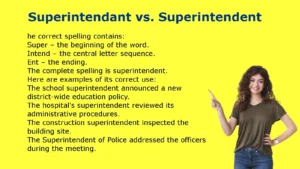
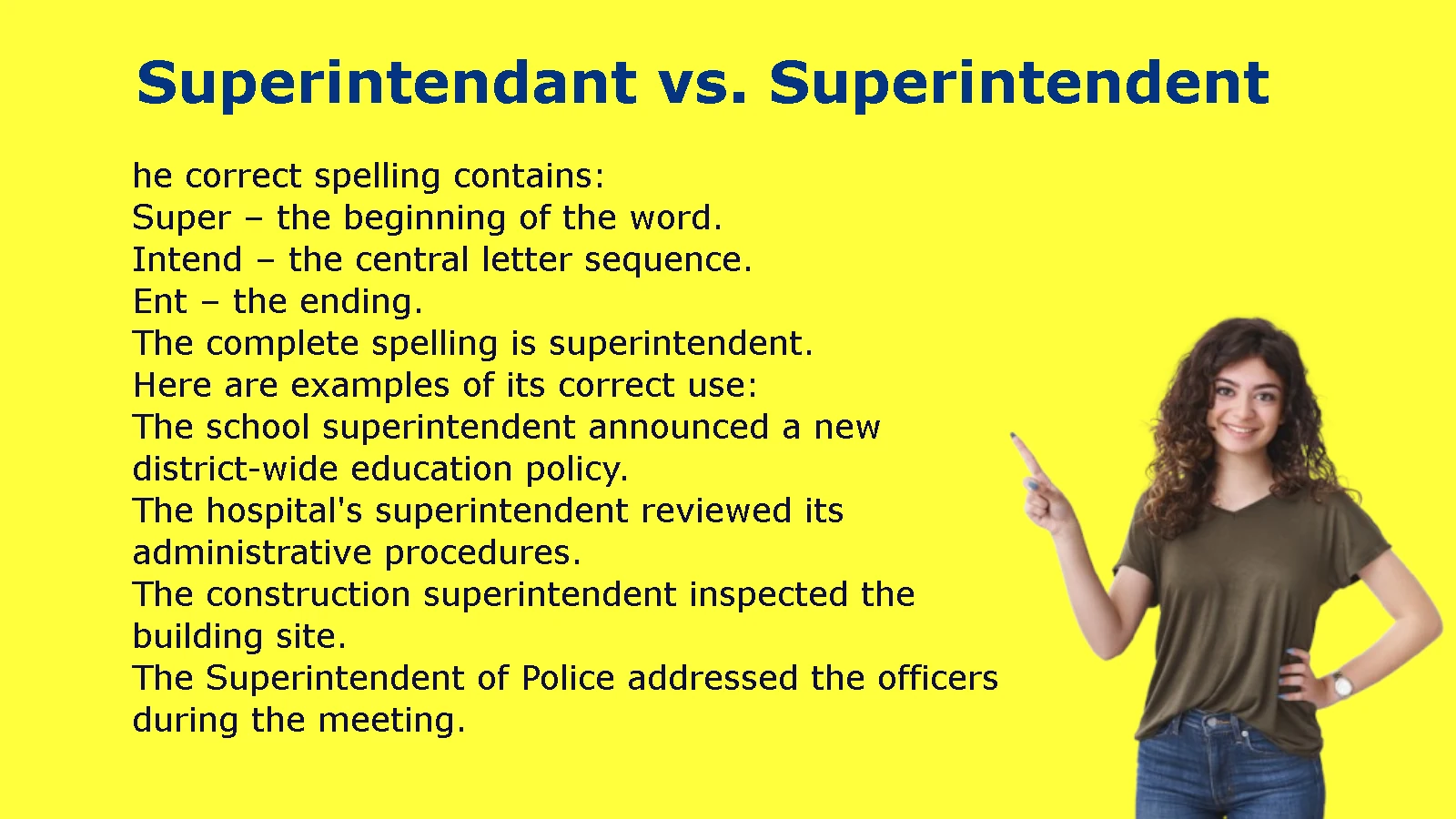
The correct spelling contains:
- Super – the beginning of the word.
- Intend – the central letter sequence.
- Ent – the ending.
The complete spelling is superintendent.
Here are examples of its correct use:
- The school superintendent announced a new district-wide education policy.
- The hospital’s superintendent reviewed its administrative procedures.
- The construction superintendent inspected the building site.
- The Superintendent of Police addressed the officers during the meeting.
Notice that each sentence uses the same spelling, regardless of the industry.
Why Is Superintendant a Common Misspelling?
People often write superintendant because English contains many words ending in -ant and -ent. These endings sound similar in ordinary conversation, especially when speakers pronounce unstressed syllables quickly.
For example, words such as assistant, applicant, and participant end in -ant. Meanwhile, superintendent, independent, and correspondent use -ent.
The spelling confusion can happen for several reasons:
- Sound similarity: The final syllables of superintendent may sound like an unstressed -ant to some speakers.
- Visual assumptions: Writers may assume that a professional title follows the spelling pattern of other job titles.
- Limited exposure: Someone who hears the word more often than they read it may remember its pronunciation but not its exact spelling.
- Typing mistakes: The longer word contains several syllables, making it easier to introduce an incorrect letter.
The best solution is to memorize the established spelling rather than rely on how the ending sounds.
Superintendent vs Superintendant: Quick Comparison
| Feature | Superintendent | Superintendant |
| Spelling status | Correct | Incorrect |
| Standard English usage | Accepted | Not accepted as the standard title |
| Meaning | A person who oversees or manages | No separate standard meaning |
| Professional usage | Common | Incorrect |
| Recommended form | Yes | No |
Remember: Use superintendent in professional documents, school reports, job descriptions, applications, emails, and official correspondence.
What Does Superintendent Mean?
A superintendent is a person responsible for overseeing, supervising, or managing an organization, department, institution, or operation. The position usually involves leadership, administration, decision-making, and monitoring performance. Its exact responsibilities depend on the industry, workplace, and organizational structure.
Superintendent as a Job Title
The word superintendent describes a supervisory position rather than one specific profession. Different organizations use the title for people who oversee different types of work.
A superintendent may manage employees, monitor operations, enforce policies, coordinate resources, and report progress to senior leadership.
For example, consider three different workplaces:
- Education: A school superintendent manages a school district and works with principals, teachers, administrators, and school boards.
- Healthcare: A medical superintendent helps oversee hospital operations, medical services, and administrative procedures.
- Construction: A construction superintendent coordinates workers, subcontractors, schedules, and daily site activities.
Although these positions belong to different industries, they share one central responsibility: supervision and organizational oversight.
The title may also indicate different levels of authority. In one organization, a superintendent may lead an entire district. In another, the position may focus on a single facility or operational department.
Superintendent in American English
In American English, superintendent appears frequently in education, construction, public administration, and property management.
One of its best-known uses is the school superintendent.
A school superintendent typically serves as the chief executive or senior administrative leader of a school district. The person works with the school board and helps turn educational policies into practical district-wide decisions.
Common responsibilities include:
- Managing district budgets.
- Supervising school principals.
- Developing educational improvement plans.
- Reviewing academic performance.
- Coordinating staffing decisions.
- Communicating with parents and community members.
- Ensuring schools follow applicable regulations.
The title also appears in residential property management. An apartment building superintendent, for example, may handle repairs, inspect common areas, coordinate maintenance, and respond to building-related problems.
Superintendent in British and Other English Varieties
The spelling superintendent is also used in British English and other varieties of English.
However, the professional context can differ.
In the United Kingdom, Superintendent is an established rank within police forces. In some South Asian administrative and law enforcement systems, the title also appears in professional designations such as Superintendent of Police.
These regional differences do not change the spelling.
Whether you are writing about an American school superintendent, a British police superintendent, or a medical superintendent in South Asia, the correct spelling remains superintendent.
How to Pronounce Superintendent
The word superintendent has five syllables and carries its main stress on the fourth syllable. In American English, a common pronunciation guide is SOO-per-in-TEN-dent. Learning the syllable pattern can make the word easier to pronounce and remember when writing professional titles.
Superintendent Pronunciation in American English
The IPA pronunciation is:
– American English: /ˌsuː.pɚ.ɪnˈtɛn.dənt/
Break the word into five syllables:
| Syllable | Pronunciation guide |
| Su | Soo |
| Per | Per |
| In | In |
| Ten | Ten |
| Dent | Dent |
The fourth syllable receives the strongest emphasis. Avoid giving every syllable equal stress because that can make the word sound unnatural.
You can practice it by saying the word slowly before increasing your speed:
- Say the first three syllables smoothly.
- Emphasize the fourth syllable.
- Finish with the final syllable without adding an extra sound.
This approach works well when speaking in meetings, interviews, presentations, and professional conversations.
Why People Misspell Superintendent
Pronunciation and spelling do not always follow the same patterns in English. The final syllables of superintendent can sound similar to other words that end in -ant.
However, the spoken ending does not determine the written form.
For example:
| Word | Correct ending |
| Superintendent | -ent |
| Independent | -ent |
| Assistant | -ant |
| Participant | -ant |
| Correspondent | -ent |
| Applicant | -ant |
The word superintendent belongs to the -ent group.
A useful strategy is to connect its pronunciation with its written form. Whenever you hear or use the professional title, remember that it ends with -dent, not -dant.
How to Remember the Spelling of Superintendent
The easiest way to remember superintendent is to focus on its final letters.
Use this simple memory technique:
Superintendent = Super + Intend + Ent
Although this breakdown is a spelling aid rather than a complete historical analysis, it helps you remember the correct letter sequence.
You can also use these practical techniques:
- Write superintendent several times while looking at the correct spelling.
- Include it in a sentence related to your profession or workplace.
- Remember that the word ends in -dent.
- Use the spelling in a short paragraph instead of memorizing isolated letters.
- Check official job titles before submitting formal documents.
For example, if you regularly write about education, practice this sentence:
“The school superintendent approved the district’s annual improvement plan.”
Repeated exposure to the correct spelling makes it easier to recognize and reproduce.
Different Types of Superintendents and Their Responsibilities
The title superintendent appears in several professional fields. Although the responsibilities differ, the position generally involves supervision, administration, and operational oversight. School districts, police departments, hospitals, construction companies, and property management organizations all use the title in different ways.
School Superintendent
A school superintendent is a senior educational administrator responsible for overseeing a school district. The position connects the district’s leadership, school principals, teachers, families, and governing school board.
In many American school districts, the superintendent serves as the chief executive officer and reports to the elected or appointed school board.
The role involves more than managing classrooms or supervising teachers. A superintendent helps establish district-wide priorities and ensures that schools have the resources they need.
Common responsibilities include:
- Educational leadership: Developing strategies to improve teaching quality and student achievement.
- Financial management: Preparing budgets and allocating resources across schools.
- Staff supervision: Working with principals and other senior administrators.
- Policy implementation: Ensuring that schools follow district policies and applicable education laws.
- Community relations: Communicating with parents, teachers, students, and local organizations.
- Performance monitoring: Reviewing attendance, graduation rates, academic results, and other indicators.
For example, imagine a school district experiencing declining mathematics performance. The superintendent may work with principals to identify struggling schools, arrange teacher training, review instructional materials, and establish measurable improvement targets.
This example shows why the superintendent’s role extends beyond ordinary school administration.
Superintendent of Police
A Superintendent of Police is a professional law enforcement title used in several countries, particularly within police systems influenced by British administrative traditions.
The position generally involves supervising police operations, managing personnel, coordinating investigations, and maintaining public safety within an assigned area or unit.
Responsibilities may include:
- Supervising police stations and subordinate officers.
- Reviewing crime reports and operational performance.
- Coordinating investigations and law enforcement activities.
- Managing personnel and departmental resources.
- Maintaining communication with senior police officials.
- Supporting public safety initiatives.
In Pakistan and India, the designation Superintendent of Police (SP) commonly appears in police administration.
The exact authority and rank structure depend on the country’s police service and applicable regulations.
For example, a district-level Superintendent of Police may coordinate operational activities, monitor law enforcement performance, and work with other government departments on public safety matters.
Spelling reminder: Write Superintendent of Police, not Superintendant of Police.
Medical Superintendent
A Medical Superintendent is a senior healthcare administrator responsible for overseeing medical services and supporting the effective operation of a hospital or healthcare institution.
The position often combines clinical knowledge with administrative leadership.
A medical superintendent may coordinate medical departments, review service quality, monitor staffing requirements, and help ensure that hospital procedures follow applicable healthcare standards.
Typical responsibilities include:
- Supervising medical departments and clinical services.
- Coordinating with doctors and hospital administrators.
- Reviewing healthcare delivery and patient safety procedures.
- Helping manage hospital resources.
- Monitoring operational challenges.
- Supporting medical policies and institutional standards.
- Addressing administrative issues affecting clinical departments.
For example, suppose a hospital experiences delays in emergency department services. The medical superintendent may review staffing levels, patient flow, departmental coordination, and resource availability to identify the problem.
The objective is to improve hospital operations while maintaining appropriate standards of medical care.
The title should always use the correct spelling: Medical Superintendent.
Nursing Superintendent
A Nursing Superintendent is a senior nursing administrator who oversees nursing services within a hospital or healthcare institution.
Unlike a medical superintendent, whose responsibilities may cover broader hospital operations and medical services, a nursing superintendent focuses primarily on nursing personnel, patient care standards, and nursing department management.
Typical responsibilities include:
- Supervising nursing staff.
- Coordinating nursing schedules and duty assignments.
- Monitoring nursing care standards.
- Supporting staff development and training.
- Ensuring compliance with nursing procedures.
- Reviewing patient care concerns.
- Coordinating with hospital management and other clinical departments.
For example, a nursing superintendent may review staffing arrangements across intensive care, emergency, and general wards to ensure that each department has appropriate nursing coverage.
The role also involves maintaining consistent nursing practices and helping staff follow established patient care protocols.
Construction Superintendent
A construction superintendent manages the daily activities of a construction site. The position focuses on coordinating workers, subcontractors, materials, schedules, and site safety.
Unlike a school superintendent, who oversees an educational district, a construction superintendent concentrates on completing a building project according to its plans and requirements.
Common duties include:
- Coordinating daily construction activities.
- Monitoring project schedules.
- Supervising subcontractors and site workers.
- Inspecting completed work.
- Communicating with project managers and contractors.
- Monitoring workplace safety.
- Identifying delays and operational problems.
Consider a commercial building project that involves electricians, plumbers, carpenters, and concrete workers.
The construction superintendent coordinates their activities so that different teams can complete their work in the correct sequence.
For instance, electrical installation may need to finish before certain walls are closed. Poor coordination could cause delays and expensive rework.
The superintendent helps prevent these problems through daily supervision and planning.
Superintendent vs Deputy Superintendent vs Assistant Superintendent
A superintendent generally holds a senior supervisory position, while a deputy superintendent and an assistant superintendent support leadership through delegated duties. The exact difference depends on the employer, industry, and organizational structure.
Superintendent and Deputy Superintendent
A Deputy Superintendent typically serves as a senior supporting officer who assists the superintendent with management and operational responsibilities.
In some organizations, the deputy acts as the second-in-command and may take over leadership responsibilities when the superintendent is unavailable.
The superintendent usually has broader overall authority, while the deputy handles assigned areas of responsibility.
For example, in a police department:
- The Superintendent may oversee the department’s overall operations.
- The Deputy Superintendent may manage specific administrative or operational duties.
- The deputy may represent the superintendent during meetings or official assignments.
In South Asian police systems, the abbreviation DSP commonly refers to Deputy Superintendent of Police.
However, the exact responsibilities and reporting relationships vary between police organizations.
Superintendent and Assistant Superintendent
An Assistant Superintendent supports a superintendent by managing assigned departments, administrative functions, or operational activities.
The position may involve direct supervision of employees, implementing policies, reviewing reports, and coordinating daily work.
In an educational district, an assistant superintendent may oversee a particular area such as:
- Curriculum and instruction.
- Human resources.
- Finance and budgeting.
- Student services.
- School operations.
For example, an Assistant Superintendent for Curriculum and Instruction may work with principals and instructional leaders to improve teaching methods and academic performance.
The superintendent usually maintains broader district-wide responsibility, while the assistant superintendent concentrates on a particular area.
Deputy Superintendent vs Assistant Superintendent
These titles sound similar, but they do not always represent the same organizational position.
A deputy often has a broader delegated leadership role and may act on behalf of the superintendent. An assistant typically manages specific responsibilities or departments.
| Comparison | Deputy Superintendent | Assistant Superintendent |
| Main purpose | Supports senior leadership | Supports administration and operations |
| Authority | Often has broad delegated authority | Usually has assigned departmental authority |
| Leadership role | May act for the superintendent | Usually manages designated functions |
| Responsibilities | Strategic and operational support | Specialized administrative supervision |
| Common setting | Police and public administration | Education and organizational management |
Important distinction: Employers do not use these titles uniformly. Some organizations give assistant superintendents substantial executive authority, while others place deputy superintendents in specialized roles.
Always examine the organization’s official hierarchy before assuming one title ranks above another.
Superintendent vs Medical Superintendent vs Nursing Superintendent
The terms superintendent, medical superintendent, and nursing superintendent share the same main word, but they describe different levels or areas of professional responsibility.
A general superintendent may supervise many types of operations. A medical superintendent focuses on medical services and hospital administration, while a nursing superintendent concentrates on nursing services.
What Is a Medical Superintendent?
A medical superintendent helps manage the medical and administrative operations of a healthcare institution.
Depending on the hospital, the position may involve clinical service coordination, staff supervision, resource management, and quality improvement.
For example, a medical superintendent may coordinate with department heads to improve emergency services, manage operational challenges, and maintain consistent hospital procedures.
The role may also involve communication with government health authorities, hospital boards, and other administrative bodies.
What Is a Nursing Superintendent?
A nursing superintendent manages the nursing department and oversees the delivery of nursing services.
The position focuses on ensuring that nursing staff have appropriate assignments, training, supervision, and resources.
For example, if a hospital introduces a new patient monitoring procedure, the nursing superintendent may coordinate staff training and help ensure that nurses follow the updated process.
The role supports patient care by maintaining consistent nursing practices throughout the institution.
Medical Superintendent vs Nursing Superintendent
| Feature | Medical Superintendent | Nursing Superintendent |
| Primary focus | Medical services and hospital administration | Nursing services |
| Main responsibility | Medical and operational oversight | Nursing workforce and care standards |
| Staff coordination | Medical and administrative teams | Nursing personnel |
| Typical duties | Clinical service coordination and hospital management | Staff supervision, scheduling, and nursing quality |
| Workplace | Hospitals and healthcare institutions | Hospitals and healthcare institutions |
These positions often work closely together. A medical superintendent may coordinate broader hospital services, while a nursing superintendent manages nursing operations.
Neither title should be confused with the other when writing professional documents or describing hospital responsibilities.
Correct Spelling of Superintendent in Sentences
The best way to understand the correct spelling is to see how the word works in different sentences. Superintendent can function as a common noun or part of an official job title.
Everyday Examples Using Superintendent
Here are original examples from different professional contexts:
- The superintendent reviewed the school district’s annual budget before presenting it to the board.
- Our building superintendent arranged repairs to the heating system.
- The Superintendent of Police attended the regional security meeting.
- The hospital’s medical superintendent introduced new administrative procedures.
- The nursing superintendent discussed staff scheduling with the head nurses.
- The construction superintendent inspected the foundation before approving the next stage of work.
- The district superintendent met with parents to discuss changes to the education program.
These examples show that the word retains the same spelling across different industries.
Examples of the Incorrect Spelling Superintendant
The following sentences contain the common misspelling:
| Incorrect sentence | Correct sentence |
| The superintendant approved the school budget. | The superintendent approved the school budget. |
| The superintendant of police addressed the officers. | The Superintendent of Police addressed the officers. |
| The medical superintendant reviewed the hospital. | The medical superintendent reviewed the hospital. |
| The nursing superintendant organized the staff. | The nursing superintendent organized the staff. |
The correction is straightforward: replace superintendant with superintendent.
Common Spelling Mistakes to Avoid
Writers sometimes repeat the same mistake in longer professional titles.
Watch out for these incorrect forms:
- Superintendant
- Superintendant of Police
- Medical Superintendant
- Nursing Superintendant
- Deputy Superintendant
- Assistant Superintendant
- School Superintendant
Use these correct alternatives:
- Superintendent
- Superintendent of Police
- Medical Superintendent
- Nursing Superintendent
- Deputy Superintendent
- Assistant Superintendent
- School Superintendent
A useful editing habit is to search your document for superintendant before publishing or submitting it. This can help you catch the mistake even if your spellchecker does not flag it.
Origin and History of the Word Superintendent
Understanding the origin of superintendent provides another way to remember its meaning and spelling. The word developed from Latin roots associated with overseeing or supervising something. Its historical meaning connects directly to its modern use as a professional title for someone who manages people, activities, or institutions.
Where Does Superintendent Come From?
The word superintendent traces back to the Latin verb superintendere, meaning to oversee or direct attention toward something.
Its components help explain the meaning:
- Super: A Latin element meaning above or over.
- Intendere: A Latin verb associated with directing, stretching, or focusing.
The word entered English through historical forms associated with supervision and management.
Its development reflects the idea of someone responsible for overseeing the work of others.
This connection also explains why superintendent appears in so many professional fields. Schools, hospitals, construction companies, and government departments all need people who supervise operations.
The historical roots also make the word easier to understand: a superintendent is someone who oversees an activity or organization.
How the Meaning of Superintendent Developed
The meaning of superintendent expanded as organizations developed more complex administrative structures.
Historically, institutions needed designated people to monitor activities, enforce rules, and coordinate workers. The title became useful for identifying individuals responsible for these supervisory duties.
Over time, different industries adopted it.
For example:
- Educational institutions began using the title for senior district administrators.
- Police organizations adopted it for supervisory ranks.
- Hospitals used it for senior administrative and medical positions.
- Construction companies applied it to professionals responsible for daily site operations.
- Property management organizations used it for building supervisors.
Today, the word has a broad professional meaning, but its central idea remains consistent: someone who oversees and manages responsibilities.
Superintendent vs Similar Words
Several English words describe people who manage or supervise others. However, superintendent, supervisor, manager, administrator, and director do not always mean the same thing.
Understanding their differences helps you choose the right professional title when writing job descriptions, reports, and workplace documents.
Superintendent vs Supervisor
A supervisor generally monitors the daily work of employees or a particular team. A superintendent often has a broader responsibility involving an entire institution, department, district, or operation.
For example, a factory supervisor may monitor one production team, while a factory superintendent may oversee several operational areas.
| Superintendent | Supervisor |
| May oversee an entire organization or major operation | Usually oversees a team or work unit |
| Often has broader administrative responsibilities | Focuses on daily employee activities |
| May establish operational priorities | Usually implements established procedures |
| Common in education, police, healthcare, and construction | Common across many industries |
The distinction depends on the employer, but superintendent often indicates a wider scope of responsibility.
Superintendent vs Manager
A manager plans, organizes, and controls resources to achieve specific business or organizational objectives.
A superintendent may perform similar duties but often works within an institution or industry where the title has a specific supervisory meaning.
For example, a hotel manager oversees hotel operations, while a construction superintendent coordinates daily construction activities.
The two roles can overlap in:
- Employee supervision.
- Budget management.
- Resource allocation.
- Performance monitoring.
- Operational planning.
However, their professional titles are not interchangeable in every industry.
Superintendent vs Administrator
An administrator manages organizational systems, procedures, records, policies, or resources.
A superintendent may also perform administrative work, but the title often emphasizes direct supervision and overall oversight.
For instance, a school administrator may manage enrollment records and school procedures. A school superintendent generally has broader responsibility for district-wide leadership and policy implementation.
An administrator can work at many levels of an organization, whereas superintendent often identifies a particular leadership position.
Superintendent vs Director
A director usually leads a department, division, or organization and may establish strategic objectives.
A superintendent also holds leadership responsibilities, but the title is more common in certain professional and public-sector structures.
For example, an education director may lead a specific educational program, while a school district superintendent oversees the broader district administration.
| Word | Main responsibility | Typical context |
| Superintendent | Overall supervision and operational oversight | Schools, police, hospitals, construction |
| Supervisor | Monitoring employees and daily work | Offices, factories, retail |
| Manager | Planning and controlling resources | Businesses and organizations |
| Administrator | Managing systems and procedures | Education, healthcare, government |
| Director | Leading a department or organization | Businesses, institutions, nonprofits |
The right choice depends on the actual responsibilities rather than the perceived importance of a title.
Practical Case Study: Choosing the Correct Superintendent Spelling
Consider a school administrator preparing an official announcement about a new district superintendent.
The original draft contains this sentence:
“The new superintendant will oversee educational planning, school budgets, and staff development.”
Although the meaning is understandable, the spelling is incorrect.
The corrected version reads:
“The new superintendent will oversee educational planning, school budgets, and staff development.”
This small correction matters because professional documents represent an organization’s standards and credibility.
Now consider how the same mistake could affect other documents:
| Document | Incorrect usage | Correct usage |
| Employment advertisement | Medical Superintendant | Medical Superintendent |
| Police report | Deputy Superintendant | Deputy Superintendent |
| Hospital notice | Nursing Superintendant | Nursing Superintendent |
| Construction report | Site Superintendant | Site Superintendent |
| Education announcement | School Superintendant | School Superintendent |
Practical lesson: Always use superintendent when referring to the established professional title. Do not change its spelling based on the industry or the person’s responsibilities.
“The superintendent is responsible for overseeing the work, not merely holding the title.”
This simple principle captures the central meaning of the word across different professional settings.
Frequently Asked Questions About Superintendant vs Superintendent
Is Superintendant or Superintendent the Correct Spelling?
Superintendent is the correct spelling in standard English. The alternative superintendant is a common spelling mistake. Use superintendent when referring to a school administrator, police officer, hospital administrator, construction supervisor, or other professional responsible for overseeing operations.
Why Do People Spell Superintendent as Superintendant?
People often confuse the two spellings because the endings -ent and -ant can sound similar in spoken English. However, the established spelling of the professional title uses -ent. Remembering the final letters can help prevent this mistake in formal writing.
How Do You Pronounce Superintendent?
In American English, superintendent is commonly pronounced SOO-per-in-TEN-dent. It has five syllables, with the strongest stress on the fourth syllable. Its IPA pronunciation is /ˌsuː.pɚ.ɪnˈtɛn.dənt/.
What Is the Difference Between a Superintendent and a Deputy Superintendent?
A superintendent generally holds the senior supervisory position and oversees broader organizational responsibilities. A deputy superintendent supports that leadership role and may manage delegated operations or act on behalf of the superintendent. Their exact authority depends on the organization’s structure.
What Is the Difference Between a Medical Superintendent and a Nursing Superintendent?
A medical superintendent generally oversees medical services and broader hospital administration. A nursing superintendent manages nursing operations, including staff supervision, duty assignments, and nursing care standards. Both positions contribute to effective hospital management but focus on different professional responsibilities.
Is Superintendent an American or British Spelling?
Superintendent is the accepted spelling in both American and British English. The word appears in education, law enforcement, healthcare, construction, and administration. Although its professional applications vary between countries, its spelling does not change between these English varieties.
Conclusion: Always Use Superintendent, Not Superintendant
The correct spelling is superintendent, not superintendant. Although the incorrect form may seem reasonable because of the similar pronunciation of English word endings, standard English consistently uses the -ent spelling.
The word describes someone who supervises, manages, or oversees an organization, department, institution, or operation. Its professional applications include school superintendents, Superintendents of Police, medical superintendents, nursing superintendents, and construction superintendents.
Remember these key points:
- Superintendent is the correct spelling.
- Superintendant is a common misspelling.
- The word has five syllables and carries its main stress on the fourth.
- Its professional meaning depends on the industry.
- Deputy and assistant superintendents generally support the senior superintendent through delegated responsibilities.
- The spelling remains the same in American and British English.
If you are preparing a professional document, writing a job description, or discussing an administrative position, always choose superintendent. Save the correct spelling and use it consistently in your writing.