Wich vs which is a common English spelling confusion, but which is the correct spelling when asking a question or identifying something. Wich is generally a misspelling of which, while witch is a different word that refers to a person associated with magic or witchcraft. Although which and witch sound alike, they have different meanings, spellings, and grammatical uses.
Understanding the difference between wich, which, and witch helps you avoid spelling mistakes in everyday writing. The distinction also involves homophones, pronunciation, interrogative pronouns, relative pronouns, and sentence structure. Once you understand what each word means, choosing the correct spelling becomes much easier.
| Question | Answer |
| Is wich or which correct? | Which is the correct standard spelling when asking a question or identifying something. |
| Is wich a real word? | Wich has limited historical, regional, and specialized uses, but it is generally a misspelling of which in everyday writing. |
| What is the difference between which and witch? | Which identifies or asks about something, while witch refers to a person associated with magic. |
| Are which and witch homophones? | Yes. They generally have the same pronunciation but different meanings and spellings. |
| How do you spell which one? | The correct spelling is two separate words: which one. |
Wich vs Which: What’s the Difference?
Which is the correct standard English spelling when you ask about a person, object, place, or choice. Wich is generally an incorrect spelling of which. The word witch is also correctly spelled, but it has a different meaning. It refers to a person associated with magic or witchcraft. These distinctions depend on meaning and sentence context.
Which Is the Correct Spelling?
Which is the correct spelling when you want to ask someone to identify or select something from a group. It is a common English word that functions as an interrogative pronoun, interrogative determiner, or relative pronoun.
For example:
- Which shirt do you want to wear?
- Which student answered the question?
- Which restaurant serves the best pizza?
- I don’t know which road leads to the station.
The word helps readers understand that someone must identify a particular option or piece of information.
You can use which in both spoken and written English. It appears in everyday conversations, academic writing, business communication, emails, and formal documents.
One useful way to remember the spelling is to associate the H with the complete word which. The letter H appears immediately after W, giving you the correct five-letter spelling: W-H-I-C-H.
Is Wich a Word?
Wich is not the standard spelling of which, but that doesn’t mean the letter combination never appears in legitimate English contexts. It can occur in historical terms, place names, surnames, and specialized word forms.
For example, the Old English element wic appeared in certain place names and historically referred to a dwelling, settlement, or specialized trading place. Related spellings also appear in historical and geographical contexts.
However, these limited uses do not make wich an acceptable replacement for which in ordinary sentences.
Consider these examples:
| Sentence | Correct or incorrect? | Explanation |
| Wich book should I read? | Incorrect | Use which to ask about a book. |
| Which book should I read? | Correct | Which identifies a choice. |
| The historical place name contains Wich. | Context-dependent | Wich may appear as part of a proper name. |
| I don’t know wich answer is right. | Incorrect | The correct spelling is which. |
The important distinction is context. If you are asking a question or identifying something, write which, not wich.
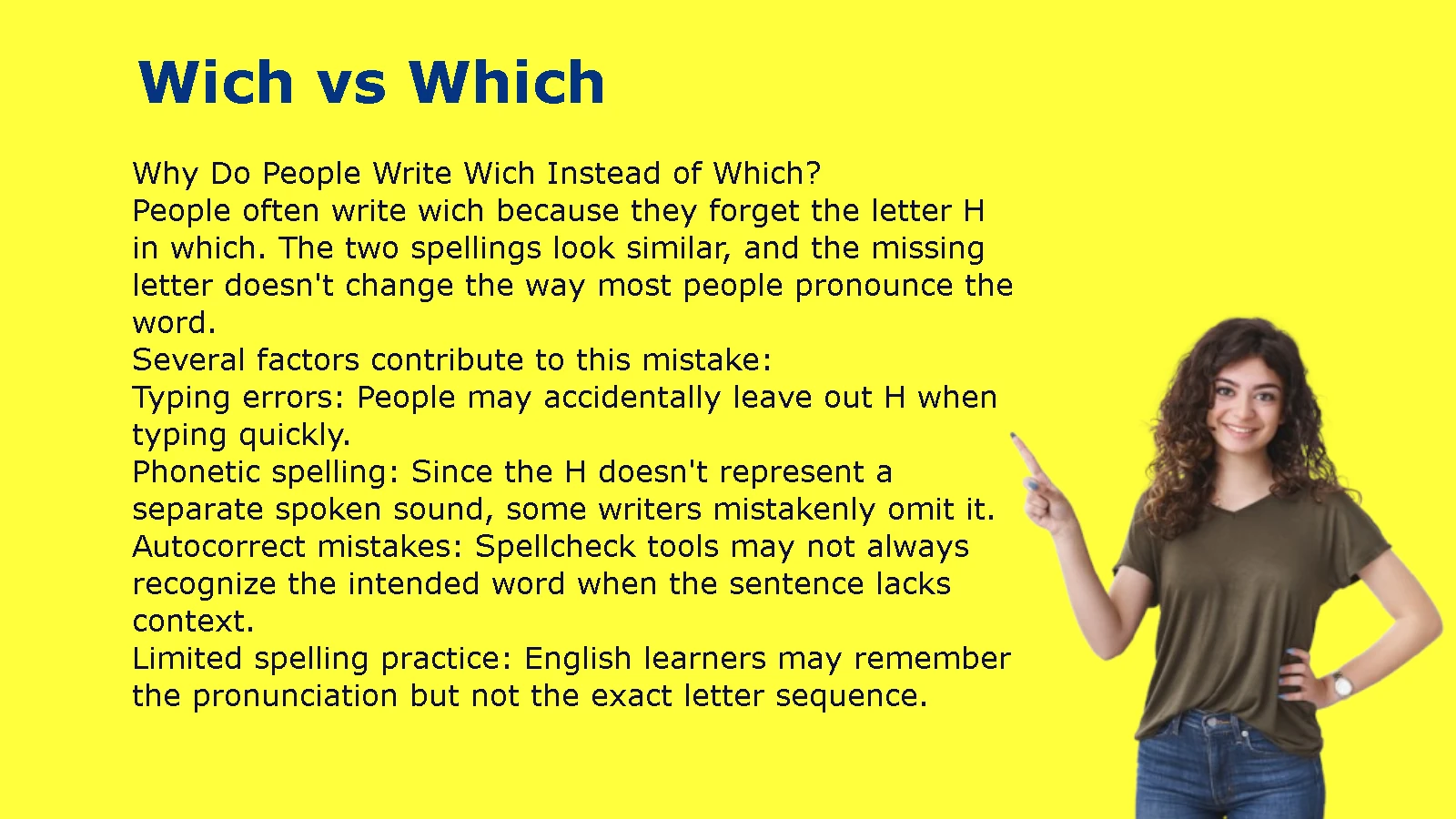
Why Do People Write Wich Instead of Which?
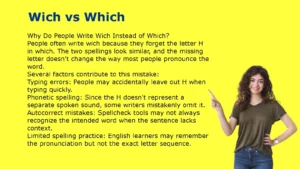
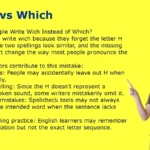
People often write wich because they forget the letter H in which. The two spellings look similar, and the missing letter doesn’t change the way most people pronounce the word.
Several factors contribute to this mistake:
- Typing errors: People may accidentally leave out H when typing quickly.
- Phonetic spelling: Since the H doesn’t represent a separate spoken sound, some writers mistakenly omit it.
- Autocorrect mistakes: Spellcheck tools may not always recognize the intended word when the sentence lacks context.
- Limited spelling practice: English learners may remember the pronunciation but not the exact letter sequence.
- Homophone confusion: People who know that which and witch sound alike may also struggle to remember their different spellings.
For example, someone might type, “Wich one do you prefer?” because the missing H doesn’t affect how the sentence sounds.
The simplest correction is to remember that the standard question word always contains five letters: W-H-I-C-H.
Witch vs Which: Understanding the Difference
Which and witch are two correctly spelled English words with different meanings. Which helps identify or ask about something, while witch refers to a person associated with magic, supernatural powers, or witchcraft. Although they generally sound identical, their grammatical roles and meanings make them easy to distinguish when you examine the surrounding sentence.
What Does Which Mean?
Which is a word used to ask about a particular person, object, or choice. It can also introduce additional information about a noun in a sentence.
It has several grammatical functions.
1. Which as an interrogative determiner
An interrogative determiner appears before a noun to ask someone to identify something.
Examples:
- Which movie are we watching tonight?
- Which subject do you enjoy most?
- Which phone belongs to your brother?
- Which team won the competition?
In these sentences, which comes before a noun and helps narrow down the available choices.
2. Which as an interrogative pronoun
An interrogative pronoun replaces a noun when the speaker asks someone to identify an option.
Examples:
- Which is yours?
- Which should we choose?
- Which looks better?
- Which would you recommend?
Here, which stands alone because the noun doesn’t need to appear immediately afterward.
3. Which as a relative pronoun
A relative pronoun introduces a relative clause that provides additional information about a noun or an entire preceding idea.
Examples:
- I bought a new laptop, which works perfectly.
- She selected the blue dress, which matched her shoes.
- We visited the museum, which opened last year.
In these examples, which connects additional information to the main sentence.
Understanding these three uses helps you recognize which in different grammatical situations.
What Does Witch Mean?
A witch is a noun that traditionally refers to a person believed to practice magic or possess supernatural powers.
The word frequently appears in folklore, fairy tales, fantasy literature, Halloween stories, and discussions of witchcraft.
For example:
- The witch lived in a small cottage near the forest.
- The story describes a powerful witch who protects the village.
- Children dressed as witches for Halloween.
- The movie features a young witch learning to control her powers.
The word witch can also appear in modern cultural and religious contexts. Not every person who practices contemporary witchcraft fits the frightening fictional image found in traditional fairy tales.
Unlike which, witch doesn’t function as a question word. It names a person or character.
Which vs Witch: Comparison Table
The following table highlights their main differences.
| Feature | Which | Witch |
| Part of speech | Pronoun or determiner | Noun |
| Meaning | Asks about or identifies something | Person associated with magic |
| Pronunciation | /wɪtʃ/ | /wɪtʃ/ |
| Number of letters | 5 | 5 |
| Example | Which book is yours? | The witch entered the forest. |
| Common context | Questions and descriptions | Magic, folklore, and stories |
Remember: Which relates to choices and information. Witch relates to magic and witchcraft.
Which and Witch Are Homophones
Which and witch are homophones because they generally have the same pronunciation but different spellings and meanings. Homophones can create confusion in English because listeners cannot always identify the correct spelling from sound alone. Writers must use sentence meaning and grammatical context to select the right word.
What Are Homophones?
Homophones are words that sound alike but have different meanings and often different spellings.
The term comes from Greek elements meaning “same” and “sound.”
English contains many common homophone pairs. Here are a few examples:
| Homophone pair | Meaning |
| Which / Witch | A question word / a person associated with magic |
| Their / There | Belonging to them / referring to a place |
| Write / Right | To form words / correct or a direction |
| Flower / Flour | A plant / an ingredient used in baking |
| Sea / See | A large body of water / to perceive with your eyes |
| Pair / Pear | Two matching items / a fruit |
| Brake / Break | A device used to slow a vehicle / to separate or damage something |
Homophones are particularly challenging for English learners because spelling and pronunciation don’t always follow the same patterns.
For example, you might hear someone say, “Which one is yours?” However, the pronunciation alone cannot tell you whether the speaker means which or witch.
You need context to understand the intended word.
Are Which and Witch Pronounced the Same?
Yes. In most varieties of English, which and witch have the same pronunciation.
Both words generally use the same three sounds:
- /w/ represents the opening consonant sound.
- /ɪ/ represents the short vowel sound found in words such as sit and fish.
- /tʃ/ represents the final sound heard in chair and chocolate.
This produces the pronunciation /wɪtʃ/.
Some English accents distinguish which from witch through a historical difference between the initial sounds. However, most modern speakers pronounce them identically.
This means you cannot rely on pronunciation alone to determine which spelling someone intends.
Compare:
- Which student won the award?
- The witch won the magical competition.
The two sentences sound similar in the target word, but their meanings are completely different.
Which vs Witch Pronunciation
The standard pronunciation of both words is represented by the International Phonetic Alphabet (IPA) as /wɪtʃ/.
You can break the pronunciation into three parts:
| Sound | Explanation | Example |
| /w/ | A soft opening sound | Water |
| /ɪ/ | A short vowel sound | Sit |
| /tʃ/ | The final “ch” sound | Chair |
To pronounce both words naturally:
- Begin with the /w/ sound.
- Follow it with the short vowel sound /ɪ/.
- Finish with the /tʃ/ sound.
- Keep the word short and avoid adding an extra syllable.
The important lesson is that spelling, rather than pronunciation, distinguishes these homophones.
How to Spell Which, Wich, and Witch Correctly
The correct spelling depends on the meaning you want to express. Write which when asking someone to identify something, witch when referring to a person associated with magic, and avoid using wich as a substitute for either word in ordinary writing.
How to Spell Wich or Witch
People sometimes confuse wich, which, and witch because the words look and sound similar.
However, their spelling patterns are different.
Which: W-H-I-C-H
Use which when asking a question or introducing additional information.
Examples:
- Which option should I select?
- Which house belongs to your family?
- I found the book, which was missing yesterday.
Witch: W-I-T-C-H
Use witch when referring to a person associated with magic.
Examples:
- The witch appeared in the fairy tale.
- My daughter wore a witch costume.
- The old story describes a powerful witch.
Wich: W-I-C-H
This spelling is generally incorrect when you intend to write which or witch.
Examples of mistakes:
- Wich one should I buy?
- The wich lives in the forest.
- Wich answer is correct?
Corrected versions:
- Which one should I buy?
- The witch lives in the forest.
- Which answer is correct?
Always check the intended meaning before correcting the spelling.
How to Spell Which One
The correct spelling is which one, written as two separate words.
Which identifies or asks about a choice, while one represents the particular item or person being selected.
For example:
- Which one is your favorite?
- Which one should we purchase?
- Which one belongs to Sarah?
- Do you know which one is correct?
Avoid writing wich one or whichone.
| Incorrect spelling | Correct spelling |
| Wich one | Which one |
| Whichone | Which one |
| Witch one | Which one, when asking about a choice |
The expression which one is common in everyday English because it allows speakers to ask about a particular option without repeating the noun.
For example:
“Which phone do you prefer?”
can become:
“Which one do you prefer?”
The second sentence works when both speakers already know that the conversation concerns phones.
Easy Tricks to Remember the Correct Spelling
A simple memory technique can help you avoid confusing these three words.
1. Associate which with questions.
Think of common expressions such as:
- Which one?
- Which book?
- Which way?
Whenever you ask someone to choose, remember the spelling W-H-I-C-H.
2. Associate witch with witchcraft.
Both words begin with W-I-T-C-H.
If your sentence involves magic, spells, or a supernatural character, witch is probably the correct choice.
3. Remember that wich usually needs correction.
If you type wich in an ordinary question, check whether you meant which.
4. Read the entire sentence.
Don’t correct a word without considering its meaning. A sentence about a magical character needs witch, not which.
5. Use a spelling checker.
A grammar or spelling checker can identify many missing-letter mistakes, although you should still review the meaning yourself.
Wich or Which Examples in Everyday Sentences
The easiest way to understand the difference between wich and which is to examine real sentence patterns. Which appears in questions, relative clauses, and everyday conversations. Wich is generally a spelling error in these contexts, while witch belongs in sentences about magic or witchcraft.
Examples of Which in Questions
Which commonly appears in direct questions when someone wants to identify a particular option.
Here are 15 original examples:
- Which movie should we watch tonight?
- Which subject do you find most interesting?
- Which restaurant would you recommend?
- Which bag belongs to your sister?
- Which road leads to the city center?
- Which color looks better with this shirt?
- Which student completed the assignment?
- Which laptop offers better performance?
- Which country would you like to visit?
- Which language are you learning?
- Which answer did your teacher approve?
- Which train arrives first?
- Which website should I use?
- Which dress would you wear to the wedding?
- Which of these options is the most affordable?
Notice that which helps identify something from a group of possible answers.
You can also use it in indirect questions:
- I wonder which movie she selected.
- Please tell me which route is faster.
- He asked which candidate had more experience.
These sentences don’t use direct question word order, but which still introduces a choice or request for information.
Examples of Which in Relative Clauses
Which also introduces relative clauses. These clauses provide additional information about a noun or something mentioned earlier.
Consider these examples:
- I bought a laptop, which has a powerful processor.
- She visited Paris, which is famous for its architecture.
- We watched a documentary, which explained climate change.
- He purchased a bicycle, which was surprisingly affordable.
- They renovated the house, which needed several repairs.
- I read the article, which contained useful information.
- The company launched a new product, which attracted many customers.
- She selected a university, which offered excellent scholarships.
In these sentences, which connects the additional information to the main idea.
A useful grammar distinction involves restrictive and nonrestrictive relative clauses.
Nonrestrictive relative clauses add extra information that isn’t essential to identifying the noun. They are commonly separated by commas.
Example:
“My phone, which I bought last year, still works perfectly.”
The clause provides additional information about the phone.
Restrictive relative clauses identify which particular thing the speaker means. In American English, writers often prefer that for restrictive clauses referring to things, although which also appears in some styles.
Example:
“The laptop which has the broken screen belongs to me.”
The clause identifies the specific laptop.
Understanding this distinction helps you use which more accurately in formal and informal writing.
Wich in a Sentence: Incorrect and Correct Examples
If you are searching for wich in a sentence, you probably want to know whether the spelling works in ordinary English.
In most everyday sentences, replace wich with which.
| Incorrect sentence | Correct sentence |
| Wich book do you want? | Which book do you want? |
| Wich one is better? | Which one is better? |
| Tell me wich color you prefer. | Tell me which color you prefer. |
| I don’t know wich road to take. | I don’t know which road to take. |
| Wich answer did you select? | Which answer did you select? |
| Can you tell me wich phone is yours? | Can you tell me which phone is yours? |
| Wich movie did you watch? | Which movie did you watch? |
| Do you remember wich day we met? | Do you remember which day we met? |
The pattern is consistent: when you need the question word, include the H.
Examples Using Witch in Sentences
The word witch belongs in sentences involving a person associated with magic, witchcraft, or supernatural traditions.
Here are some original examples:
- The witch prepared a mysterious potion.
- A young witch learned to control her magical powers.
- The children dressed as witches for Halloween.
- The village legend described a witch who lived near the mountains.
- The fantasy novel introduced a witch with unusual abilities.
- The witch used her knowledge to protect the kingdom.
- The movie featured a friendly witch who helped lost travelers.
- The old story warned children about a witch in the forest.
These examples show why context matters.
If the sentence refers to a person or character, witch may be appropriate. If it asks someone to identify an option, use which.
What Does Which One Mean?
Which one means a particular person or thing selected from a known group of choices. The expression helps speakers ask someone to identify one option without repeating the noun. It commonly appears in everyday questions, shopping conversations, comparisons, and situations where people must choose between alternatives.
Definition of Which One
The phrase which one combines two words with separate grammatical functions.
- Which asks about a specific choice or identifies an option.
- One represents a single person or thing.
Together, they form an expression that asks someone to identify one item from a group.
For example:
“Which one is your favorite?”
This question assumes that the listener has several options available and needs to select one.
Other examples include:
- Which one belongs to you?
- Which one should I purchase?
- Which one is more expensive?
- Which one would you recommend?
The expression is particularly useful when the noun is already clear from the conversation.
How to Use Which One in a Sentence
You can use which one in several everyday situations.
When identifying an object:
- Which one is your notebook?
- Which one belongs to my brother?
- Which one did you leave on the table?
When comparing products:
- Which one has a better battery?
- Which one offers more storage?
- Which one is worth the money?
For recommendations:
- Which one would you recommend for beginners?
- Which one is better for everyday use?
- Which one should I read first?
These examples demonstrate that which one works naturally whenever someone must identify or select a single option.
Which vs Which One: Is There a Difference?
Yes. Which can appear before a noun or function independently as a pronoun. Which one specifically refers to a single choice from a group.
| Expression | Meaning | Example |
| Which book | Asks about a particular book | Which book did you buy? |
| Which one | Asks someone to identify one option | Which one did you buy? |
| Which color | Identifies a particular color | Which color do you prefer? |
| Which of these | Identifies an option from a group | Which of these is yours? |
The difference becomes clearer when you compare two questions.
“Which phone do you want?”
Here, which directly modifies the noun phone.
“Which one do you want?”
Here, one replaces the noun because the conversation already establishes that the available choices are phones.
Both expressions are grammatically correct. Your choice depends on whether you need to repeat the noun.
Common Mistakes When Using Which and Witch
Even experienced English writers sometimes confuse which and witch because their pronunciation is identical. However, most mistakes become easy to correct once you understand their meanings and grammatical functions.
Writing Wich Instead of Which
This is one of the most common spelling errors.
Incorrect:
- Wich subject do you prefer?
- Wich restaurant is open?
- I don’t know wich answer is correct.
Correct:
- Which subject do you prefer?
- Which restaurant is open?
- I don’t know which answer is correct.
Correction tip: Remember the H immediately after W. The standard spelling contains five letters.
Confusing Which With Witch
These words sound alike, but they don’t perform the same grammatical function.
Incorrect:
“Which lived in the haunted house.”
Correct:
“The witch lived in the haunted house.”
Incorrect:
“Witch color do you prefer?”
Correct:
“Which color do you prefer?”
The first example needs a noun referring to a person associated with magic. The second needs a question word.
Always consider what your sentence is trying to communicate.
Writing Whichone as One Word
Another mistake involves combining which and one.
Incorrect:
- Whichone is yours?
- Tell me whichone you selected.
Correct:
- Which one is yours?
- Tell me which one you selected.
Which and one are separate words, even when they function together as one expression.
Using Which When Witch Is Needed
Sometimes writers choose which because they recognize it as a question word but forget that witch has a separate meaning.
Compare:
- The which prepared a magical potion.
- The witch prepared a magical potion.
The second sentence is correct because witch identifies the person performing the action.
Now consider:
- Witch book should I read?
- Which book should I read?
The second sentence is correct because the speaker is asking about a choice.
The surrounding words provide enough information to determine the intended spelling.
Which vs Wich vs Witch: Quick Reference Guide
The three spellings become easier to remember when you compare their meanings, grammatical functions, and everyday uses.
| Word | Correct spelling? | Meaning | Example |
| Which | Yes | Used to ask or identify something | Which dress is yours? |
| Wich | Generally incorrect in ordinary usage | Usually a misspelling of which | Wich dress is yours? |
| Witch | Yes | A person associated with magic | The witch wore a black hat. |
A Simple Decision Guide
Use these three rules whenever you are unsure:
Use which when asking about a choice.
Example: Which restaurant should we visit?
Use witch when referring to a person associated with magic.
Example: The witch appeared in the story.
Avoid wich when you mean which or witch.
Example: Wich restaurant should we visit? is incorrect.
This simple comparison covers most everyday situations.
Real-World Example: Choosing the Correct Word
Imagine that a student is writing a short paragraph about a fantasy movie.
The student writes:
“I watched a movie about a wich who lived in a forest. I liked the story, but I don’t know wich character was the most interesting.”
Both uses of wich are incorrect, but they require different corrections.
The corrected paragraph is:
“I watched a movie about a witch who lived in a forest. I liked the story, but I don’t know which character was the most interesting.”
Why?
- Witch is correct because the paragraph describes a magical character.
- Which is correct because the student asks about a particular character.
This example demonstrates why replacing every instance of wich with which would not always produce the correct sentence.
Meaning must guide spelling.
Frequently Asked Questions
Is Wich or Which Correct?
Which is the correct standard spelling when asking a question or identifying something. Wich is generally a spelling mistake caused by leaving out the H. For example, write “Which one do you prefer?” rather than “Wich one do you prefer?”
Is Wich Ever a Real Word?
Wich can appear in historical, geographical, and specialized contexts, including certain place names and proper nouns. However, it isn’t the standard spelling of which in everyday English. If you want to ask about a choice, use which.
How Do You Spell Which One?
The correct spelling is which one, written as two separate words. Which identifies a choice, while one represents a single person or object. For example, “Which one is yours?” is correct, while “Wichone is yours?” is incorrect.
Are Which and Witch Homophones?
Yes. Which and witch are generally homophones because they share the same pronunciation but have different spellings and meanings. Which is used to ask questions or identify something, while witch refers to a person associated with magic or witchcraft.
How Do You Pronounce Which and Witch?
Both words are generally pronounced /wɪtʃ/ in modern English. They begin with a /w/ sound, contain a short /ɪ/ vowel, and end with /tʃ/. Some regional accents preserve a historical pronunciation distinction, but most speakers use the same pronunciation.
How Do You Use Which in a Sentence?
Use which to ask about a particular choice or introduce additional information about something. For example, “Which book should I read?” uses which in a question, while “I bought a book, which was very interesting” uses it in a relative clause.
Conclusion: Remember the Difference Between Wich, Which, and Witch
Understanding wich vs which comes down to recognizing the intended meaning of each word. Which is the correct standard spelling when asking questions, identifying choices, or introducing relative clauses. Witch refers to a person associated with magic, while wich is generally a misspelling in ordinary English writing.
Remember these three simple rules:
- Write which when asking someone to identify or select something.
- Write witch when referring to a person associated with magic.
- Avoid wich when you intend to use either of the two standard words.
Also, remember that which and witch are homophones in most modern English accents. Their identical pronunciation makes context especially important when writing.
The next time you wonder whether to write wich or which, check the meaning of your sentence and choose the spelling that communicates your idea correctly. With these examples and spelling rules, you can avoid the mistake and write with greater confidence.