Compair vs Compare is a common spelling confusion in English because both forms sound almost identical when spoken. However, compare is the correct spelling of the standard English verb, while compair is a common misspelling. The word compare means to examine two or more people, objects, ideas, or situations to identify their similarities and differences. Its related forms include compared, comparing, and comparison. You may also encounter compere, a different word that describes someone who hosts an event or television show.
Understanding the difference between these words helps you avoid spelling mistakes, choose the correct grammatical form, and communicate more clearly in academic, professional, and everyday writing.
| Question | Answer |
| Is it compair or compare? | Compare is the correct standard English spelling. |
| What does compare mean? | It means to examine two or more things to identify their similarities and differences. |
| Is compair a real English word? | It is not a standard spelling of the English verb compare. |
| What is the difference between compare and compared? | Compare is the base verb, while compared is its past-tense and past-participle form. |
| Is compare a noun or a verb? | Compare is primarily a verb. Its common noun form is comparison. |
Compair vs Compare: Which One Is Correct?
Compare is the correct spelling in standard English. Compair is a common spelling mistake that occurs because the final syllable of compare sounds similar to the word pair. Although the two forms may look and sound alike, only compare is the accepted spelling of the ordinary English verb meaning to examine similarities and differences.
For example:
- Correct: I want to compare these two laptops before buying one.
- Incorrect: I want to compair these two laptops before buying one.
The distinction matters in school assignments, business documents, professional emails, product reviews, and online content. Using the wrong spelling can make otherwise clear writing look careless.
Is Compair a Word?
Compair is not the standard English spelling of the verb compare. If you use it in an ordinary English sentence, readers will generally understand it as a misspelling. However, a particular business, product, surname, or other proper name could independently use the spelling Compair.
The important distinction is between a proper name and a standard dictionary word.
Consider these examples:
- Incorrect: We need to compair the available options.
- Correct: We need to compare the available options.
- Correct: The company name is Compair.
In the first example, compair should be compare because the sentence describes evaluating different options.
If you encounter Compair as part of a brand or company name, preserve its official spelling. Proper names do not necessarily follow ordinary English spelling conventions.
For everyday writing, remember this simple rule: Use compare whenever you mean to examine similarities or differences.
Why Do People Spell Compare as Compair?
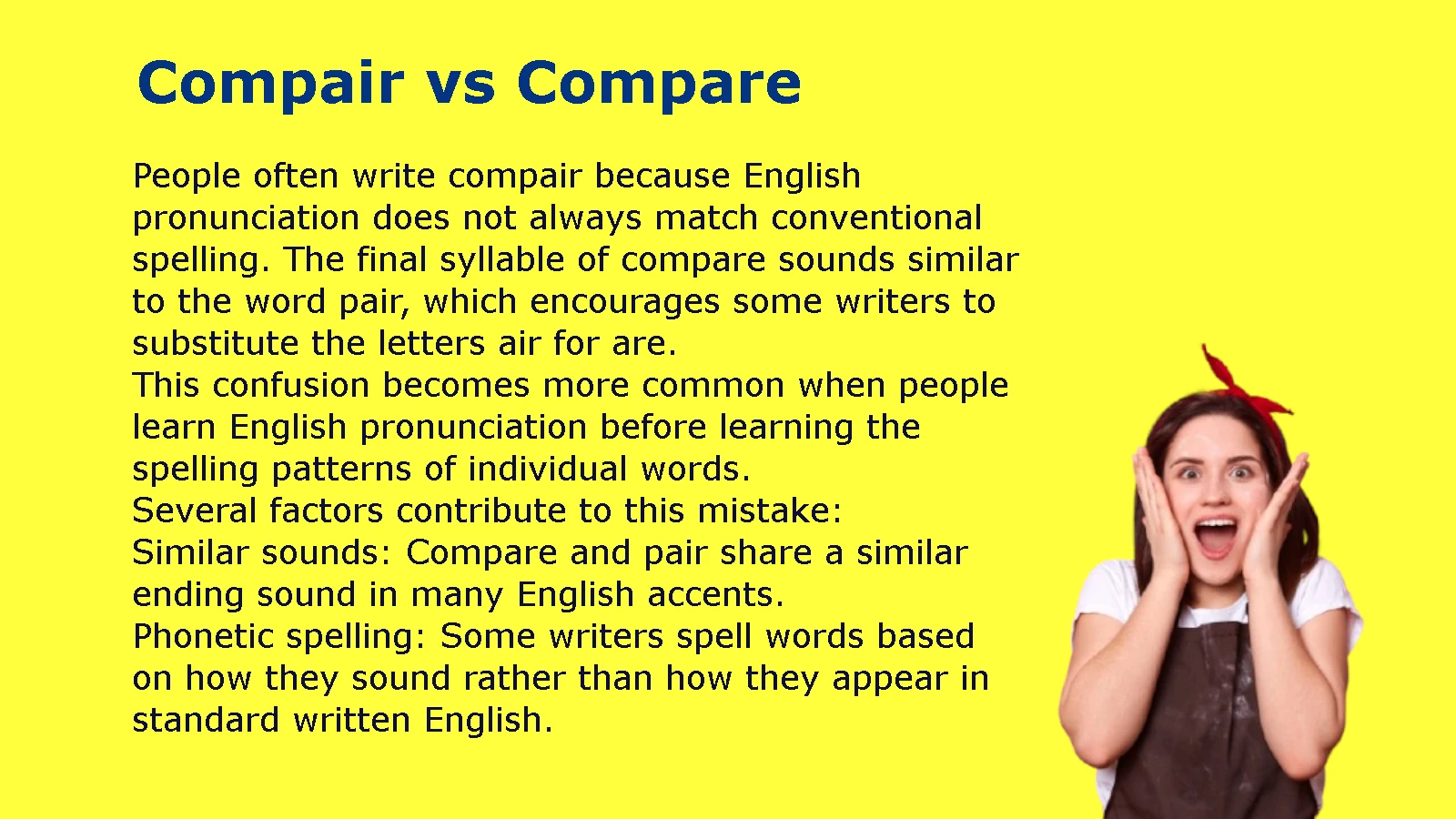
People often write compair because English pronunciation does not always match conventional spelling. The final syllable of compare sounds similar to the word pair, which encourages some writers to substitute the letters air for are.
This confusion becomes more common when people learn English pronunciation before learning the spelling patterns of individual words.
Several factors contribute to this mistake:
- Similar sounds: Compare and pair share a similar ending sound in many English accents.
- Phonetic spelling: Some writers spell words based on how they sound rather than how they appear in standard written English.
- Limited exposure: People who rarely read the word may remember its pronunciation but forget its spelling.
- Autocorrect limitations: Spell-checking software does not always identify every contextual error, especially when a misspelled form resembles a name.
For example, someone might hear a teacher say, “Compare the two answers,” and remember the ending as air.
However, pronunciation does not determine the correct written form. English spelling follows established conventions, and the accepted form is compare.
Compair or Compare: Quick Spelling Comparison
The following table makes the difference easy to remember.
| Feature | Compair | Compare |
| Standard English spelling | Incorrect | Correct |
| Part of speech | Not the standard verb form | Verb |
| Meaning | Common misspelling | Examine similarities and differences |
| Formal writing | Avoid | Accepted |
| Academic writing | Avoid | Accepted |
| Business writing | Avoid | Accepted |
| Example | Compair the prices | Compare the prices |
The easiest way to remember the distinction is to connect compare with comparison. Both words contain the same spelling sequence at the beginning.
Compair or Compare Meaning: What Does Compare Mean?
Compare means to examine two or more things to discover how they are similar or different. People use the verb when evaluating products, people, ideas, experiences, performances, or situations. For example, a customer might compare two smartphones by examining their prices, cameras, battery life, and features before making a purchase.
The word appears in everyday conversations as well as academic, scientific, commercial, and professional writing.
For example:
- Teachers compare students’ answers to identify differences.
- Customers compare prices before purchasing products.
- Scientists compare experimental results.
- Businesses compare sales figures across different months.
- Readers compare two books based on their themes and writing styles.
In each situation, comparison helps someone understand the relationship between different things.
Compare Meaning in Simple English
In simple English, compare means to look at two or more things carefully and see what is alike and what is different.
Imagine that you want to buy a new phone. You find two models with different prices and features. Instead of choosing immediately, you examine their cameras, storage capacities, battery performance, and designs.
You are comparing the phones.
Here are some additional examples:
- Compare these two shirts to see which one fits better.
- My teacher asked me to compare two historical events.
- We compared the restaurant menus before choosing a place.
- She likes to compare different travel destinations.
- The manager compared this year’s results with last year’s figures.
Comparison helps people make informed decisions. It allows them to look beyond individual features and understand how different options relate to one another.
Compare as a Verb
Compare primarily functions as a verb. A verb expresses an action, process, or state. In this case, compare describes the action of examining things to identify similarities or differences.
The verb commonly appears in several sentence patterns.
Compare A with B
This construction emphasizes examining two things side by side.
Examples:
- Compare this report with the previous version.
- The researcher compared the new findings with earlier studies.
- You should compare your final answer with the example.
Compare A to B
This construction often highlights similarities or draws an analogy between two things. However, modern English also uses compare to for general comparisons.
Examples:
- The writer compared her voice to a musical instrument.
- People often compare the human brain to a computer.
- The coach compared the team’s performance to last season.
Compare two or more things
This construction directly identifies the objects being examined.
Examples:
- We need to compare three insurance policies.
- Students compared their research findings.
- The company compares customer feedback from different regions.
Both compare with and compare to are grammatically acceptable. The best choice depends on the intended meaning and context.
Compare Noun Meaning: Is Compare a Noun?
Compare is primarily a verb, not a noun in ordinary modern English usage. The standard noun form is comparison, which describes the act, process, or result of examining two or more things.
For example:
- Verb: We compare the two products.
- Noun: We made a comparison between the two products.
Understanding this distinction helps you choose the correct word in a sentence.
Here are several related grammatical forms:
| Word | Part of speech | Meaning | Example |
| Compare | Verb | Examine similarities and differences | Compare the two designs. |
| Comparison | Noun | The act or result of comparing | The comparison was helpful. |
| Compared | Verb form | Past tense or past participle | We compared the results. |
| Comparing | Verb form | Ongoing action | She is comparing prices. |
| Compares | Verb form | Third-person singular | He compares different options. |
| Comparative | Adjective / noun | Relating to comparison | Comparative analysis is useful. |
The word comparison is especially useful in formal writing.
For example, instead of writing “We made a compare of the products,” write “We made a comparison of the products.”
The second sentence uses the correct noun form.
Compare in a Sentence: Practical Examples
Seeing compare in different contexts makes its meaning easier to understand.
Here are original examples from everyday life and professional situations.
Education
- Students must compare the two poems and explain their differences.
- The teacher asked us to compare the characters in both novels.
- Researchers compared the examination results from two different schools.
Shopping
- Always compare prices before purchasing expensive electronics.
- I compared three washing machines before choosing one.
- Customers can compare product specifications online.
Business
- The manager compares monthly revenue to identify growth patterns.
- Our company compared its expenses with the previous year’s figures.
- The marketing team compared customer engagement across different campaigns.
Technology
- Compare the processing speeds of these two computers.
- This website helps users compare different software products.
- We compared the battery performance of several smartphones.
Everyday conversations
- You should not compare your life with someone else’s.
- My brother always compares our cooking skills.
- It is difficult to compare these two restaurants because they offer different experiences.
These examples show that compare works in many situations. Its central meaning remains the same: examining things to understand their similarities and differences.
Compare vs Compared: What Is the Difference?
Compare is the base form of the verb, while compared is its simple past-tense and past-participle form. Use compare when describing a general action, giving an instruction, or referring to the present. Use compared when discussing a completed action or forming perfect and passive constructions.
Both words are correct, but they serve different grammatical purposes.
When to Use Compare
Use compare when the sentence requires the base form of the verb.
Common situations include:
1. Giving instructions
Examples:
- Compare the two photographs.
- Compare these prices before making a decision.
- Compare your answers with the teacher’s solution.
2. Describing general actions
Examples:
- I often compare prices before shopping.
- Researchers compare different treatment methods.
- Customers compare product reviews before purchasing.
3. Using infinitive constructions
Examples:
- I want to compare these two options.
- It is useful to compare different opinions.
- She needs to compare the documents.
4. After modal verbs
Examples:
- You should compare the available plans.
- We can compare the results tomorrow.
- They must compare both proposals.
Notice that the base form compare follows modal verbs such as can, should, and must.
When to Use Compared
Use compared when describing an action that happened in the past or when forming a past participle construction.
Examples of simple past tense:
- I compared the prices yesterday.
- She compared the two reports.
- They compared their examination results.
Examples with passive voice:
- The two products were compared carefully.
- The findings were compared with previous research.
- Both proposals were compared by the management team.
A common mistake is using compared after a modal verb.
Incorrect: You should compared the prices.
Correct: You should compare the prices.
The modal verb should requires the base form of the main verb.
Compare vs. Compared: Grammar Comparison Table
| Grammatical situation | Correct form | Example |
| Present or general action | Compare | I compare prices regularly. |
| Third-person singular | Compares | She compares the results. |
| Ongoing action | Comparing | He is comparing two products. |
| Completed past action | Compared | We compared the options. |
| Present perfect | Compared | They have compared the figures. |
| Past perfect | Compared | She had compared both documents. |
| Noun form | Comparison | The comparison revealed differences. |
Remember: Compare, compares, comparing, and compared are different grammatical forms of the same verb. Comparison is the related noun.
How to Spell Compare Correctly in English
The correct English spelling is C-O-M-P-A-R-E. The word contains seven letters and ends with E, not AIR. Although the final syllable sounds similar to the word pair, the standard spelling remains compare. Connecting it with related words such as comparison makes the correct spelling easier to remember.
Compare Spelling: Letter-by-Letter Breakdown
Let’s examine the spelling:
C – O – M – P – A – R – E
The word contains seven letters:
- C: First letter
- O: Second letter
- M: Third letter
- P: Fourth letter
- A: Fifth letter
- R: Sixth letter
- E: Seventh and final letter
The spelling becomes easier when you recognize its relationship with comparison.
For example:
- Compare
- Compared
- Comparing
- Comparison
- Comparative
Each word shares the opening sequence C-O-M-P-A-R.
This connection provides a practical memory technique. When you remember comparison, you can more easily remember how to spell compare.
Compare Pronunciation vs. Spelling
The pronunciation of compare can confuse English learners because its ending sounds similar to pair.
In common American English pronunciation, compare is pronounced /kəmˈpɛr/. The stress falls on the second syllable.
The word has two syllables:
- The first syllable is relatively weak.
- The second syllable carries the main stress.
The final sound explains why people sometimes write compair instead of compare.
However, English spelling does not always represent sounds in a straightforward way. Words that sound similar can have completely different spellings.
Consider these examples:
| Word | Meaning |
| Compare | Examine similarities and differences |
| Pair | Two things considered together |
| Pear | A type of fruit |
| Fair | Just or reasonable |
| Bear | A large mammal |
These words share a similar ending sound in many accents, but their spellings and meanings differ.
Therefore, always remember that compare ends with E, even though its pronunciation may remind you of pair.
Easy Tricks to Remember the Correct Spelling
If you frequently confuse compair and compare, use these simple techniques.
1. Remember comparison
The word comparison starts with the same spelling sequence as compare.
Example:
- Compare two products.
- Make a comparison between two products.
Remembering one word helps reinforce the other.
2. Use a simple sentence
Try memorizing:
“Compare before you prepare.”
Both words contain the same final ARE spelling pattern.
3. Break the word into parts
Remember the spelling as:
COM + PARE
This visual breakdown makes the word easier to recognize.
4. Practice writing related forms
Write these words together:
- Compare
- Compared
- Comparing
- Comparison
Repeated exposure helps reinforce the correct spelling pattern.
5. Read the word in context
Read sentences containing compare instead of relying only on pronunciation.
For example:
“Before buying a laptop, compare its price, memory, processor, and battery life.”
Contextual reading helps connect the word’s spelling with its meaning.
Common Misspellings of Compare
Several incorrect forms appear when writers rely on pronunciation or make typing mistakes.
| Incorrect spelling | Correct spelling |
| Compair | Compare |
| Compaire | Compare |
| Compar | Compare |
| Compaer | Compare |
| Comapre | Compare |
The spelling compair is particularly common because its ending resembles the sound of compare.
Other mistakes, such as comapre, usually result from typing letters in the wrong order.
To avoid these errors, check the spelling before publishing an article, submitting an assignment, or sending a professional message.
Compare Host Meaning: Is It Compare or Compere?
A person who introduces performers, manages an event, or presents a show is called a compere, not a compare. The word compere describes an event host or presenter. By contrast, compare is a verb that means examining similarities and differences. The two words have different meanings and grammatical functions, even though their pronunciation and spelling can cause confusion.
What Does a Compere Mean?
A compere is a person who introduces performers, announces activities, and guides an audience through an event or entertainment program.
The term commonly appears in British English and other varieties influenced by British usage.
A compere may work at:
- Award ceremonies
- Music concerts
- Television programs
- School functions
- Corporate events
- Comedy shows
- Cultural festivals
- Public celebrations
For example:
“The compere introduced each performer before the concert began.”
In this sentence, the compere is the person responsible for presenting the performers and maintaining the flow of the event.
A compere may also introduce guests, announce program changes, interact with the audience, and keep an event organized.
In American English, people more commonly use host, presenter, or emcee for similar roles.
What Is a Compare Host?
The expression compare host can appear in searches when someone wants to find the meaning of an event presenter or television host.
However, compare host is not the standard expression for that role.
The correct word is usually compere or simply host, depending on the context.
Consider these examples:
Incorrect: The compare introduced the singers.
Correct: The compere introduced the singers.
Also correct: The host introduced the singers.
There is an important distinction:
- Compare: Examine similarities and differences.
- Compere: Introduce and present an event.
- Host: Welcome guests and manage an event or program.
If someone asks you to compare two television hosts, you are evaluating their qualities. If someone asks you to identify the compere of a television show, they want to know who presents it.
Compare vs. Compere: Key Differences
| Feature | Compare | Compere |
| Meaning | Examine similarities and differences | Introduce and host an event |
| Main function | Evaluation | Presentation |
| Part of speech | Primarily verb | Noun and verb |
| Example | Compare these performances. | The compere introduced the performers. |
| Related words | Comparison, compared | Host, presenter, emcee |
The words may look similar, but their meanings are completely different.
A useful memory trick: Compare is about examining things. Compere is about presenting things.
Examples of Compere in Sentences
Here are some practical examples showing how to use compere correctly.
- The compere welcomed everyone to the annual school celebration.
- Our company hired a professional compere for its awards ceremony.
- The television compere introduced the guests.
- She worked as a compere at several cultural events.
- The compere kept the audience entertained between performances.
- A skilled compere helps an event run smoothly.
In American English, host or emcee may sound more natural in many of these sentences.
What Does Compare the Market Mean?
Compare the Market can refer to the general activity of examining different products, prices, and services before choosing an option. It is also the name of a well-known UK price-comparison brand. The intended meaning depends on whether someone uses the phrase as an ordinary instruction or refers to the specific business.
Compare the Market as an Expression
In everyday English, comparing the market means examining the available options in a particular marketplace.
For example, someone looking for car insurance might compare:
- Monthly and annual premiums
- Insurance coverage
- Deductibles or excess amounts
- Policy exclusions
- Customer service
- Additional benefits
This process helps consumers understand what different providers offer.
The phrase can also apply to other industries.
Real estate: A buyer compares property prices, locations, sizes, and facilities.
Technology: A customer compares laptops from different manufacturers.
Finance: An individual compares savings accounts, interest rates, and account fees.
Travel: A traveler compares hotel prices, locations, and available amenities.
In each situation, the objective is to evaluate the available choices before making a decision.
For example:
“Before purchasing a new insurance policy, compare the market to find an option that meets your needs.”
The sentence uses compare as a verb, while the market refers to the range of available products or services.
Compare the Market as a Brand
Compare the Market is a UK price-comparison brand associated with insurance and other financial and household services.
Its website allows consumers to explore and compare different products and providers.
<entity-placeholder>
The brand is particularly associated with insurance comparisons, including car and home insurance.
It is important to distinguish the brand name from the ordinary phrase.
For example:
- Brand reference: I visited Compare the Market to explore insurance options.
- General expression: You should compare the market before selecting an insurance policy.
The first sentence refers to a specific business. The second describes a general consumer activity.
This distinction matters when interpreting search queries because the same words can have both ordinary and brand-related meanings.
What Does Compare a Show Mean?
Compare a show means to examine a television program, performance, or entertainment production alongside another show or evaluate its qualities. People may compare shows based on their storylines, characters, acting, production quality, presentation, and audience appeal.
The exact meaning depends on the surrounding sentence.
Compare Two Television Shows
Comparing television shows involves examining their similarities and differences.
For example, imagine that someone wants to compare two crime dramas.
They might evaluate:
- Storyline and plot development
- Main characters
- Acting performances
- Dialogue and writing
- Cinematography
- Music and sound design
- Episode length
- Overall entertainment value
A comparison might look like this:
| Feature | Show A | Show B |
| Genre | Crime drama | Crime thriller |
| Storyline | Character-focused | Mystery-focused |
| Main appeal | Character development | Suspense |
| Pacing | Slow and detailed | Fast and intense |
| Audience experience | Emotional | Tension-filled |
This type of comparison helps viewers decide which show better matches their interests.
Compare Shows in Entertainment Reviews
Entertainment reviewers frequently compare television programs, films, and stage productions.
They examine specific elements rather than relying only on personal opinions.
For example, a reviewer comparing two comedy shows might consider:
- Quality of the humor
- Timing and delivery
- Character development
- Originality of the writing
- Audience engagement
- Consistency across episodes
A useful comparison should explain the reasons behind an opinion.
Instead of writing:
“Show A is better than Show B.”
A more informative review might say:
“Show A develops its characters more gradually, while Show B relies on faster jokes and shorter storylines. Viewers who prefer character-driven comedy may enjoy the first program more.”
This approach gives readers useful information rather than an unsupported judgment.
Compare a Show vs. Host a Show
These expressions describe different activities.
Compare a show means evaluating it against another program or examining its qualities.
Host a show means presenting and managing a television or entertainment program.
Examples:
- The reviewer compared two television shows.
- The presenter hosted a popular evening program.
- The journalist compared the performances of two actors.
- The television host introduced the next segment.
Remember that a host presents a show, while a reviewer may compare it.
If the context involves someone introducing performers or guiding an event, compere or host is the appropriate word.
Compare Synonyms and Related Words
Several English words have meanings similar to compare. However, they do not always work in exactly the same contexts.
Choosing the right synonym makes writing more precise and prevents repetitive language.
Common Synonyms for Compare
Here are useful alternatives to compare, along with their meanings and examples.
| Synonym | Meaning | Example |
| Contrast | Identify differences | Contrast the two designs. |
| Examine | Inspect carefully | Examine both proposals. |
| Evaluate | Judge quality or value | Evaluate the available options. |
| Assess | Estimate or judge something | Assess the performance of both teams. |
| Analyze | Study something in detail | Analyze the research findings. |
| Match | Identify similarities or compatibility | Match the results with the original data. |
| Measure | Assess against a standard | Measure the company’s performance. |
| Weigh | Consider different options | Weigh the advantages of both plans. |
Although these words are related, their meanings are not identical.
For example, examine may involve studying one object without necessarily comparing it with another. Evaluate focuses on judgment, while contrast emphasizes differences.
Compare vs. Contrast
Compare generally involves examining both similarities and differences. Contrast focuses primarily on identifying differences between two or more things.
For example:
- Compare the two smartphones to identify their similarities and differences.
- Contrast the two smartphones to explain how their features differ.
Consider this practical example involving two laptops.
Both devices might have similar storage capacities, screen sizes, and operating systems. However, one might have a stronger processor and longer battery life.
A comparison would discuss both their shared features and their differences. A contrast would concentrate on the ways they differ.
| Compare | Contrast |
| Identifies similarities and differences | Focuses on differences |
| Provides a broader examination | Highlights distinctions |
| Useful for evaluating options | Useful for showing how things differ |
| Example: Compare both products. | Example: Contrast their features. |
Both words frequently appear in academic assignments.
A teacher might ask students to compare and contrast two historical events. This instruction requires them to explain what the events share and how they differ.
Compare vs. Comparison
Compare is a verb, while comparison is a noun.
The difference is similar to the relationship between analyze and analysis.
Examples:
- Verb: We compare the two documents.
- Noun: We conducted a comparison of the two documents.
Additional examples:
- Compare the prices before buying.
- The price comparison helped us save money.
- Researchers compare the results.
- Their comparison revealed several important differences.
Use compare when describing the action. Use comparison when naming the process or its result.
Common Mistakes When Using Compare
Even though compare is a common English word, writers sometimes confuse its spelling, grammatical forms, and related vocabulary.
Recognizing these mistakes helps improve sentence accuracy.
Writing Compair Instead of Compare
The most common mistake is replacing the final E in compare with AIR.
Incorrect: Please compair these two documents.
Correct: Please compare these two documents.
Incorrect: I want to compair the prices.
Correct: I want to compare the prices.
Incorrect: The teacher asked us to compair the results.
Correct: The teacher asked us to compare the results.
The correction is straightforward: whenever you mean to examine similarities or differences, write compare.
Confusing Compare with Compere
Another mistake involves confusing compare with compere.
These words have different meanings.
Incorrect: The compare welcomed the guests at the wedding.
Correct: The compere welcomed the guests at the wedding.
Incorrect: Our teacher asked us to compere the two essays.
Correct: Our teacher asked us to compare the two essays.
The easiest way to distinguish them is to remember their functions:
- Compare means to examine similarities and differences.
- Compere means to present or host an event.
A person who introduces performers is a compere, not a compare.
Using Compare and Compared Incorrectly
Writers sometimes confuse the base form and past-tense form.
Incorrect: Yesterday, I compare the two reports.
Correct: Yesterday, I compared the two reports.
Incorrect: You should compared the products.
Correct: You should compare the products.
Incorrect: She is compare the prices.
Correct: She is comparing the prices.
These errors happen because writers do not always recognize the grammatical structure of the sentence.
Use this quick reference:
- Compare: Base form.
- Compares: Third-person singular.
- Comparing: Ongoing action.
- Compared: Past tense and past participle.
- Comparison: Noun.
Choosing the correct form makes sentences clearer and grammatically accurate.
Conclusion: Always Use Compare, Not Compair
When choosing between compair vs compare, remember that compare is the correct spelling in standard English. Compair is a common misspelling caused by the similarity between the word’s pronunciation and the sound of pair.
Compare means to examine two or more things to identify their similarities and differences. It functions primarily as a verb, while comparison is its common noun form. Compared is the past-tense and past-participle form, and comparing describes an ongoing action.
You should also distinguish compare from compere, which refers to an event presenter or host. Similarly, Compare the Market can refer either to a specific UK comparison brand or to the general activity of evaluating market options.
Keep these simple rules in mind:
- Write compare, not compair.
- Use compared when describing a completed comparison.
- Use comparison when referring to the process or result.
- Use compere when referring to an event presenter.
- Use contrast when you want to emphasize differences.
The next time you write an email, assignment, product review, or professional document, check that you have used the correct form. Remembering the relationship between compare and comparison will help you avoid this spelling mistake in the future.