Content vs contents can be confusing because both words are correct, but they are used in different contexts. Content usually refers to the information, material, or ideas contained in something, while contents often refers to the individual things or items contained inside something, such as the contents of a box, book, or bag. If you’ve wondered whether to write “content” or “contents,” the difference depends largely on what you’re describing and how the word functions in a sentence.
The content vs contents distinction becomes clearer when you consider their meanings and common uses. Content is commonly used for information in books, websites, videos, articles, social media, and other forms of communication. Contents, on the other hand, is generally used as a plural noun for the things contained within a particular place or object. In some contexts, contents can also refer to a list showing the sections or chapters of a book, as in “table of contents.”
In this guide, you’ll learn the difference between content and contents, when to use each word, how they work in sentences, and why “content” is often used as an uncountable noun while “contents” is plural. You’ll also see clear examples, comparisons, and common phrases such as content creator, website content, the contents of a box, and table of contents to make the distinction easy to understand.
By the end, you’ll know exactly when to use content vs contents and how to choose the correct word naturally and accurately in your writing.
Content vs Contents: Quick Answer
Content and contents are both nouns, but they serve different purposes.
| Word | Main meaning | Example |
| content | Information, ideas, subject matter, or material | The content of the article is helpful. |
| contents | Things contained inside something | The contents of the box were damaged. |
| contents | Sections or material listed in a book | Check the contents before starting the book. |
| table of contents | A list of chapters or sections in a book/document | The table of contents lists twelve chapters. |
In general, use content when you mean the overall material or information.
Content = what something communicates or contains as information.
Use contents when you mean multiple things physically or conceptually contained within something, or when you mean the sections of a book.
Contents = the things or sections contained inside something.
Cambridge Dictionary describes content as an uncountable noun when it means ideas or information in writing, films, or speeches. It describes contents as a plural noun when referring to the things inside something or the list of parts in a book.
When to Use “Content”
Use content when referring to information, ideas, subject matter, or material as a whole.
For example:
- The content of the article was accurate.
- The course provides useful content.
- This website publishes educational content.
- The documentary contains disturbing content.
- We need more original content for the website.
In these sentences, you are not counting individual pieces inside a container. You are talking about the material or information collectively.
Content is especially common when discussing:
- articles
- books
- websites
- videos
- podcasts
- speeches
- courses
- social media
- films
- educational material
- online resources
Oxford also identifies content as an uncountable noun for information or material contained on websites and other digital media.
When to Use “Contents”
Use contents when you mean multiple things contained inside something.
For example:
- The contents of the bag fell onto the floor.
- She checked the contents of the package.
- The contents of the bottle were spilled.
- The contents of the drawer were disorganized.
Here, contents refers to the individual objects or material inside the container.
It can also refer to the sections or parts of a book, report, or similar publication:
- The contents of the book are divided into six parts.
- I looked at the contents before choosing a chapter.
- The report’s contents are organized by topic.
Oxford lists these as distinct plural uses of contents: the things contained in something and the different sections contained in a book.
Content vs Contents in a Book
Books create some of the biggest problems in the content vs contents debate because both words can correctly appear in sentences about the same book.
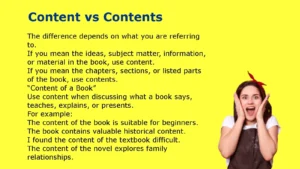
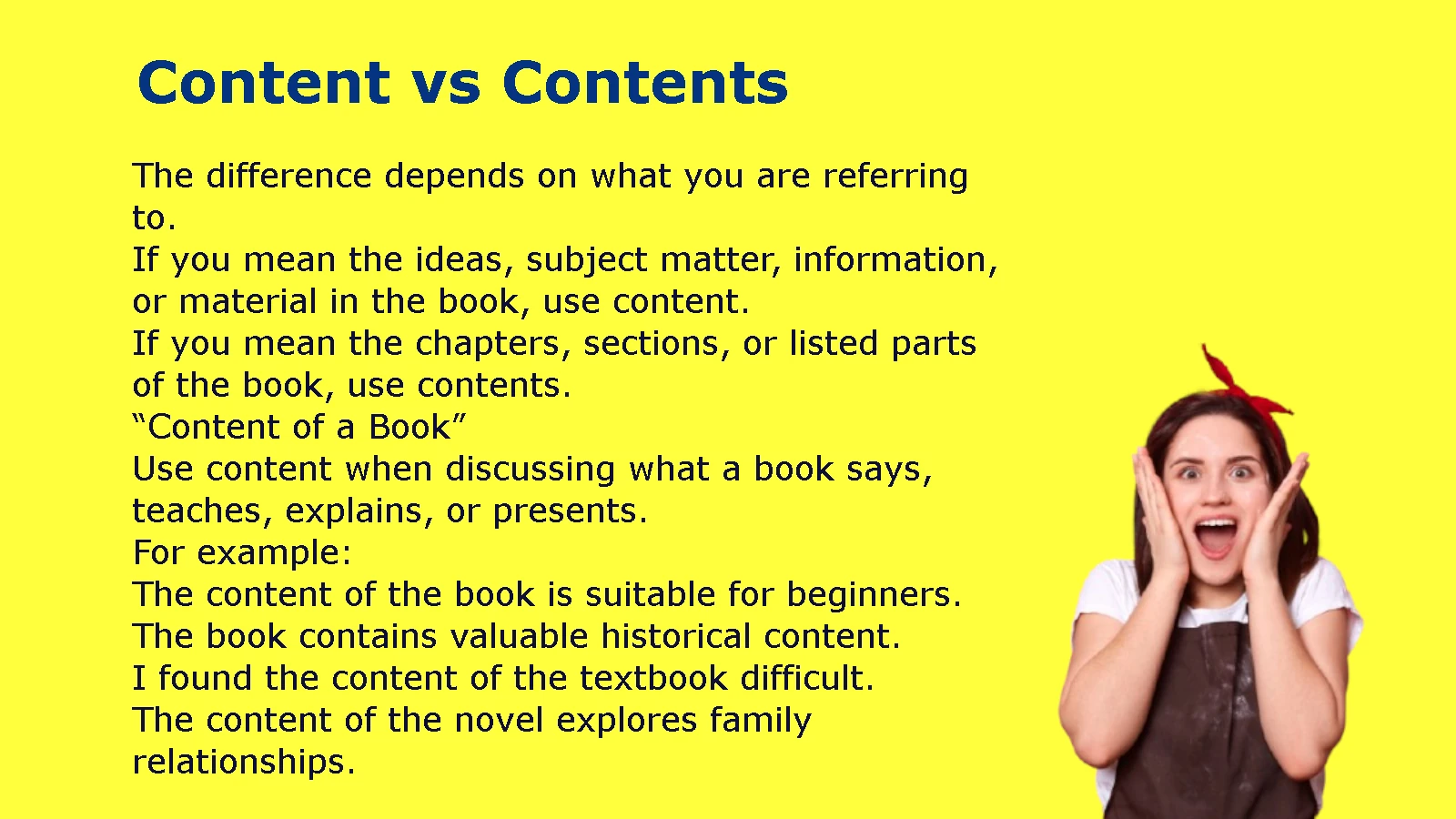
The difference depends on what you are referring to.
If you mean the ideas, subject matter, information, or material in the book, use content.
If you mean the chapters, sections, or listed parts of the book, use contents.
“Content of a Book”
Use content when discussing what a book says, teaches, explains, or presents.
For example:
- The content of the book is suitable for beginners.
- The book contains valuable historical content.
- I found the content of the textbook difficult.
- The content of the novel explores family relationships.
Here, content means the substance or subject matter of the book.
You could think of it as the answer to:
“What is this book about, and what does it contain in terms of ideas or information?”
The answer is its content.
Oxford defines this sense of content as the subject matter of a book, speech, program, or similar work.
“Contents of a Book”
Use contents when referring to the sections or parts that make up a book.
For example:
- The contents of the book are listed at the beginning.
- The contents include ten chapters and three appendices.
- I checked the contents to find the chapter about grammar.
In this use, contents focuses on the book’s component sections rather than its general subject matter.
Cambridge specifically uses contents for the articles, chapters, or parts contained in a book or magazine.
“Table of Contents”
The standard phrase is:
table of contents
Not:
table of content
A table of contents is a list of the chapters, sections, or other major parts of a book or document, usually with page numbers.
For example:
The table of contents appears after the title page.
Use the table of contents to find Chapter 7.
The report includes a detailed table of contents.
The expression is so established that it is best treated as a fixed phrase in ordinary English.
Cambridge defines a table of contents as a list showing the different parts of a book and where they begin.
Is “Content” Singular or Plural?
In the common meaning of information or material, content is an uncountable noun.
That means you normally do not use it as a regular countable noun when referring to material as a whole.
For example:
- The content is useful.
- The content was interesting.
- The content contains several useful examples.
Not:
- The content are useful.
- The content were interesting.
When content means information or subject matter, it normally takes a singular verb.
Cambridge explicitly identifies this meaning of content as uncountable.
Why “Content” Is Often Uncountable
Think about the word content as describing a mass or collection of information rather than individual objects.
Compare:
- The water is cold.
- The information is useful.
- The content is informative.
You can have many individual pieces of content, but when you talk about content as a general category, the noun is commonly uncountable.
For example:
The website has a lot of useful content.
This does not mean there is one physical object called “content.” It refers collectively to the information and material published on the website.
Why Do We Say “The Contents Are”?
Contents is different because it is normally treated as a plural noun when it means the things contained inside something.
For example:
The contents of the box are valuable.
The plural verb are works because contents refers to multiple things.
Likewise:
- The contents were scattered across the floor.
- The contents are listed on the label.
- The contents have been removed.
- The contents appear to be damaged.
Cambridge lists contents as a plural noun when it refers to everything contained inside something.
Content vs Contents and Verb Agreement
This is one of the easiest ways to identify which word you need.
| Sentence | Correct? | Reason |
| The content is interesting. | Yes | Content is uncountable here. |
| The contents are interesting. | Yes | Contents refers to multiple things. |
| The content are interesting. | No | Incorrect agreement in the usual noun sense. |
| The contents is interesting. | Usually no | Contents is normally plural in this meaning. |
| The content was updated. | Yes | Content refers to material as a whole. |
| The contents were updated. | Yes | Contents refers to multiple items or sections. |
A useful test is to look at the meaning before choosing the verb.
If you mean material or information as a whole, use content + is/was.
If you mean multiple things or sections, use contents + are/were.
Content vs Contents in Different Contexts
The correct choice becomes much easier when you look at common situations.
| Situation | Preferred word | Example |
| Website information | content | The website has useful content. |
| Social media material | content | She creates video content. |
| Article information | content | The content of the article is accurate. |
| Course material | content | The course content is detailed. |
| Video material | content | The video contains educational content. |
| Items inside a box | contents | The contents of the box were damaged. |
| Items inside a bag | contents | The contents of her bag spilled out. |
| Items inside a package | contents | The package contents were inspected. |
| Chapters in a book | contents | The contents list ten chapters. |
| Chapter list | table of contents | Check the table of contents. |
This distinction reflects actual dictionary usage rather than a simple rule that says one form is always singular and the other is always plural. Content has several noun senses, while contents has specific plural uses.
Content vs Contents Examples
The fastest way to learn the difference is to see the words in natural sentences.
Examples With “Content”
Here are common examples where content is the appropriate choice:
- The content of the article is easy to understand.
- The website publishes educational content.
- The course content covers basic grammar.
- The video contains mature content.
- She creates content for several social media platforms.
- The content of his speech was persuasive.
- The report contains useful content for researchers.
- The content needs to be updated.
- The book’s content is appropriate for young readers.
- The quality of the content has improved.
In every example, content refers to information, ideas, material, or subject matter.
Examples With “Contents”
Now compare those sentences with examples involving contents:
- The contents of the box were scattered.
- She emptied the contents of her purse onto the table.
- The contents of the package were damaged.
- The contents of the bottle were spilled.
- He checked the contents of the drawer.
- The contents of the letter surprised her.
- The contents of the report are confidential.
- The contents of the book are listed at the front.
Notice how the meaning changes.
Content focuses on the material or information itself.
Contents focuses on the things or sections contained within something.
Examples With “Table of Contents”
The phrase table of contents has a particularly clear function:
- The table of contents is on page three.
- I checked the table of contents before reading the report.
- The table of contents lists all twelve chapters.
- Use the table of contents to locate the relevant section.
- The editor added a detailed table of contents.
If you are talking about a list of chapters or sections, table of contents is the normal expression.
Content vs Contents in Digital Media
Modern English uses content extensively for digital material.
You will commonly see phrases such as:
- website content
- online content
- digital content
- video content
- social media content
- educational content
- marketing content
- written content
- visual content
- user-generated content
For example:
The company creates educational content for its website.
The platform hosts millions of pieces of digital content.
She produces video content for social media.
In these cases, content is being used as a broad, uncountable category for digital material.
Oxford specifically identifies content as an uncountable noun for information or other material contained on websites and digital media.
Should You Say “Social Media Content” or “Social Media Contents”?
The standard choice is social media content.
For example:
Correct:
She creates social media content for small businesses.
Unnatural in standard usage:
She creates social media contents for small businesses.
If you need to refer to individual items, you can make the noun countable in a different way:
- social media posts
- pieces of content
- videos
- articles
- images
- social media updates
For example:
She created five pieces of content this week.
This lets you count the individual units without turning content into an ordinary plural noun.
Common Mistakes With Content and Contents
The confusion between these words produces several recurring errors.
“Table of Content” vs “Table of Contents”
The established expression is table of contents.
Correct:
Please check the table of contents.
Incorrect in standard usage:
Please check the table of content.
Why? Because the table lists multiple chapters, sections, or parts. The phrase uses the plural contents.
Cambridge and Oxford both use table of contents in their definitions and examples.
“The Content Are” vs “The Content Is”
When content means information or material, use a singular verb.
Correct:
The content is informative.
Incorrect:
The content are informative.
You can remember it this way:
Content + is/was when content means information or material.
Examples:
- The content is original.
- The content was updated.
- The content has improved.
“The Contents Is” vs “The Contents Are”
When contents means multiple things contained inside something, use a plural verb.
Correct:
The contents are confidential.
Incorrect:
The contents is confidential.
More examples:
- The contents were removed.
- The contents have been inspected.
- The contents are listed below.
The plural form contents normally requires plural agreement in this sense.
Using “Contents” for Digital Material
Another common mistake is treating contents as the ordinary plural of digital content.
For example:
The website contains useful content.
This is the natural choice.
You generally would not write:
The website contains useful contents.
If you mean multiple individual pieces, use a countable expression such as:
The website contains several useful articles.
or:
The website contains several pieces of useful content.
The distinction is important because content is commonly uncountable when it refers to information or digital material.
Content vs Contents: A Useful Grammar Test
When you are unsure which word to choose, ask yourself one question:
Am I talking about the material itself, or the things/sections contained inside something?
If you mean the material, information, ideas, or subject matter, choose content.
The content of the report is detailed.
If you mean multiple things inside a container, choose contents.
The contents of the box are valuable.
If you mean the chapters or sections of a book, choose contents.
The contents are listed on the first page.
If you mean a list of those chapters or sections, use:
table of contents
This simple test handles most everyday situations.
Content vs Contents: Comparison Table
| Feature | Content | Contents |
| Basic meaning | Information, ideas, material, or subject matter | Things or sections contained inside something |
| Common grammatical status | Uncountable when meaning information/material | Plural noun |
| Verb agreement | Usually is/was | Usually are/were |
| Website material | Content | Usually not contents |
| Social media material | Content | Usually not contents |
| Article information | Content | Can be contents in certain contexts, but meaning changes |
| Items inside a box | Usually not content | Contents |
| Items inside a bag | Usually not content | Contents |
| Book’s subject matter | Content | Possible only with a different focus |
| Book’s chapters/sections | Contents | Contents |
| Chapter list | Table of contents | Table of contents |
| Example | The content is useful. | The contents are useful. |
One subtle point matters here: the two words are not simply “singular versus plural.” Content and contents can represent different meanings. Oxford’s dictionary entry separates the senses for subject matter, physical contents, book sections, substance amounts, and digital material.
What About “Content” Meaning Amount?
There is another legitimate use of content that is easy to overlook.
Content can mean the amount of a particular substance contained in something.
For example:
- The drink has a high sugar content.
- The food has a low fat content.
- The water has a high mineral content.
- The product has a high protein content.
- The alcohol content is listed on the label.
In this meaning, content is still normally singular.
Oxford gives examples such as fat content, alcohol content, and water content for this use.
So content does not only refer to articles and information. It can also describe the amount of a substance contained in something.
Content vs Contents in This Meaning
Compare:
The drink has a high sugar content.
Here, content means the amount of sugar.
But:
The contents of the bottle spilled onto the table.
Here, contents means everything inside the bottle.
These sentences are grammatically different because they describe two different relationships.
Sugar content = the amount of sugar.
Bottle contents = the things inside the bottle.
Can “Contents” Refer to Information?
Yes.
This is another point that makes content vs contents confusing.
Contents can refer to the information or material contained in a document, letter, will, report, or similar text.
For example:
The contents of the letter were surprising.
Here, contents does not mean physical objects. It means the information or statements contained in the letter.
Cambridge lists this use of contents for information or ideas written in a book, letter, document, or similar text.
Compare:
The content of the letter was surprising.
and:
The contents of the letter were surprising.
Both can be grammatical, but the focus can differ.
The content of the letter tends to emphasize the subject matter or information as a whole.
The contents of the letter emphasizes what the letter contains—the actual information, statements, or material inside it.
In ordinary writing, context usually makes the intended meaning clear.
Content vs Contents in Reports and Documents
Reports provide another useful example.
Use content when discussing the quality, subject matter, or information of a report:
The content of the report is well researched.
Use contents when referring to what the report contains:
The contents of the report are confidential.
You can also say:
The report contains financial data and market analysis.
And if you mean the section listing:
The table of contents appears after the executive summary.
The choice depends on what you want the reader to focus on.
A Practical Example
Imagine a 50-page business report.
You might say:
Overall material:
The content of the report is highly technical.
Information contained inside it:
The contents of the report include financial projections and customer data.
List of sections:
The table of contents lists eight major sections.
All three are possible because they describe different aspects of the same report.
Content vs Contents in Everyday English
The distinction also appears in ordinary situations.
Imagine someone gives you a sealed package.
You might say:
I don’t know the contents of the package.
Here, contents means the things inside it.
After opening it, you might say:
The contents included a book, two notebooks, and a pen.
Now imagine that you are reviewing a website.
You might say:
The website’s content is useful.
You would not normally say:
The website’s contents are useful.
The first sentence discusses digital material as a broad category. The second would sound as though you were treating the website as a container and identifying the things inside it.
This difference in perspective is often more useful than trying to memorize a rigid grammar rule.
A Simple Case Study: One Word, Three Meanings
Consider a book about American history.
You could correctly write:
Sentence 1:
The content of the book is fascinating.
Here, content means the ideas, information, and subject matter.
Sentence 2:
The contents of the book include twelve chapters and two appendices.
Here, contents refers to the parts contained in the book.
Sentence 3:
The table of contents appears on page five.
Here, table of contents refers to the list that tells readers where the chapters and sections are located.
The book itself has not changed. Only your focus has changed.
That is the central idea behind content vs contents.
Quick Rules to Remember
If you want a short reference, use these rules:
- Content = information, ideas, material, or subject matter.
- Content is commonly uncountable in this meaning.
- Contents = things contained inside something.
- Contents = sections or parts contained in a book.
- Table of contents = list of chapters or sections.
- Content is usually correct when referring to information.
- Contents are usually correct when referring to multiple things or sections.
- Website content is the normal expression.
- Social media content is the normal expression.
- Contents of a box is the normal expression.
- Contents of a book can refer to its sections or the material it contains.
- Content of a book normally focuses on its subject matter or ideas.
Frequently Asked Questions About Content vs Contents
Is it “content” or “contents”?
It depends on the meaning.
Use content for information, ideas, subject matter, or material.
Use contents for things contained inside something or the sections of a book or document.
What is the difference between content and contents?
Content usually refers to information or material as a whole, while contents refers to the things or sections contained inside something.
For example:
The content of the article is useful.
But:
The contents of the box were damaged.
Is “content” singular or plural?
When content means information or material, it is generally an uncountable noun and takes a singular verb.
For example:
The content is informative.
Cambridge identifies this meaning as uncountable.
Is “contents” plural?
Yes. Contents is normally used as a plural noun when it means the things contained inside something or the sections of a book.
For example:
The contents are listed below.
Should I say “content of a book” or “contents of a book”?
Both can be correct, but they emphasize different things.
Use content of a book when discussing its subject matter, ideas, or information:
The content of the book is educational.
Use contents of a book when referring to its sections or what it contains:
The contents of the book are listed at the beginning.
Is it “table of content” or “table of contents”?
The standard phrase is table of contents.
For example:
The table of contents lists all ten chapters.
Should I say “social media content” or “social media contents”?
Use social media content when referring to social media material generally.
For example:
She creates social media content for several brands.
If you want to count individual items, use terms such as posts, videos, articles, or pieces of content.
Should “content” take “is” or “are”?
When content means information or material, use is.
The content is useful.
When contents means multiple things or sections, use are.
The contents are useful.
Can “contents” refer to information?
Yes. Contents can refer to the information or material contained in a book, letter, document, or similar text.
For example:
The contents of the letter were confidential.
Cambridge explicitly includes this use of contents for information or ideas in written material.
Final Comparison: Content vs Contents
The difference between content and contents becomes straightforward once you focus on meaning rather than spelling.
Content usually describes information, ideas, subject matter, or material. It is commonly uncountable in this sense:
The content of the article is useful.
The website publishes educational content.
The content is easy to understand.
Contents normally describes the things contained inside something or the sections contained in a book or document:
The contents of the box were damaged.
The contents of the book are listed at the beginning.
And when you mean the list of chapters or sections, use the familiar expression:
table of contents
The most useful rule is therefore simple:
Use “content” for information or material. Use “contents” for things or sections contained inside something.
Once you understand that distinction, choosing between content vs contents becomes much easier in articles, books, reports, websites, social media, packages, and everyday English.