Changing is the correct spelling, while changeing is an incorrect spelling that often occurs when adding the suffix -ing to the verb change. If you’ve come across “changing” and “changeing” and wondered which spelling is correct, the difference comes down to a simple spelling rule involving verbs that end in a silent -e. The correct form, changing, is commonly used in contexts related to modifying, becoming different, replacing, adjusting, developing, and making changes.
The changing vs changeing distinction is important because English usually drops the final silent -e when a verb ending in -e takes the -ing suffix. Therefore, change + ing becomes changing, not changeing. The same pattern appears in words such as making, taking, writing, moving, and using. Understanding this rule can help you avoid similar spelling mistakes when forming present participles and gerunds.
In this guide, you’ll learn whether “changing” or “changeing” is correct, why “changing” is spelled without the extra “e,” how to use “changing” in sentences, and what spelling rule explains the difference. You’ll also see clear examples and related words to make the correct spelling easy to remember.
By the end, you’ll know exactly why changing is correct and changeing is incorrect, so you can use the word naturally and confidently in your writing.
Quick Answer: Changing or Changeing?
If you’re wondering whether to write changing or changeing, use changing.
| Spelling | Correct? | Example |
| changing | ✅ Yes | The weather is changing. |
| changeing | ❌ No | The weather is changeing. |
Changing is the standard English spelling in both American and British English. Changeing is not an alternative British spelling or an accepted American spelling variant.
The reason is that change ends in a silent e. When the -ing suffix is added, that final e is normally removed:
change → changing
This is the same pattern seen in:
- make → making
- take → taking
- write → writing
- move → moving
- love → loving
- hope → hoping
Cambridge’s spelling guidance gives examples such as hope → hoping, love → loving, lose → losing, and write → writing.
Why Is “Changing” Correct?
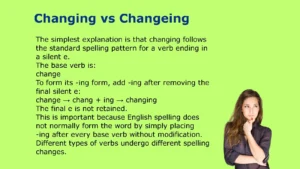
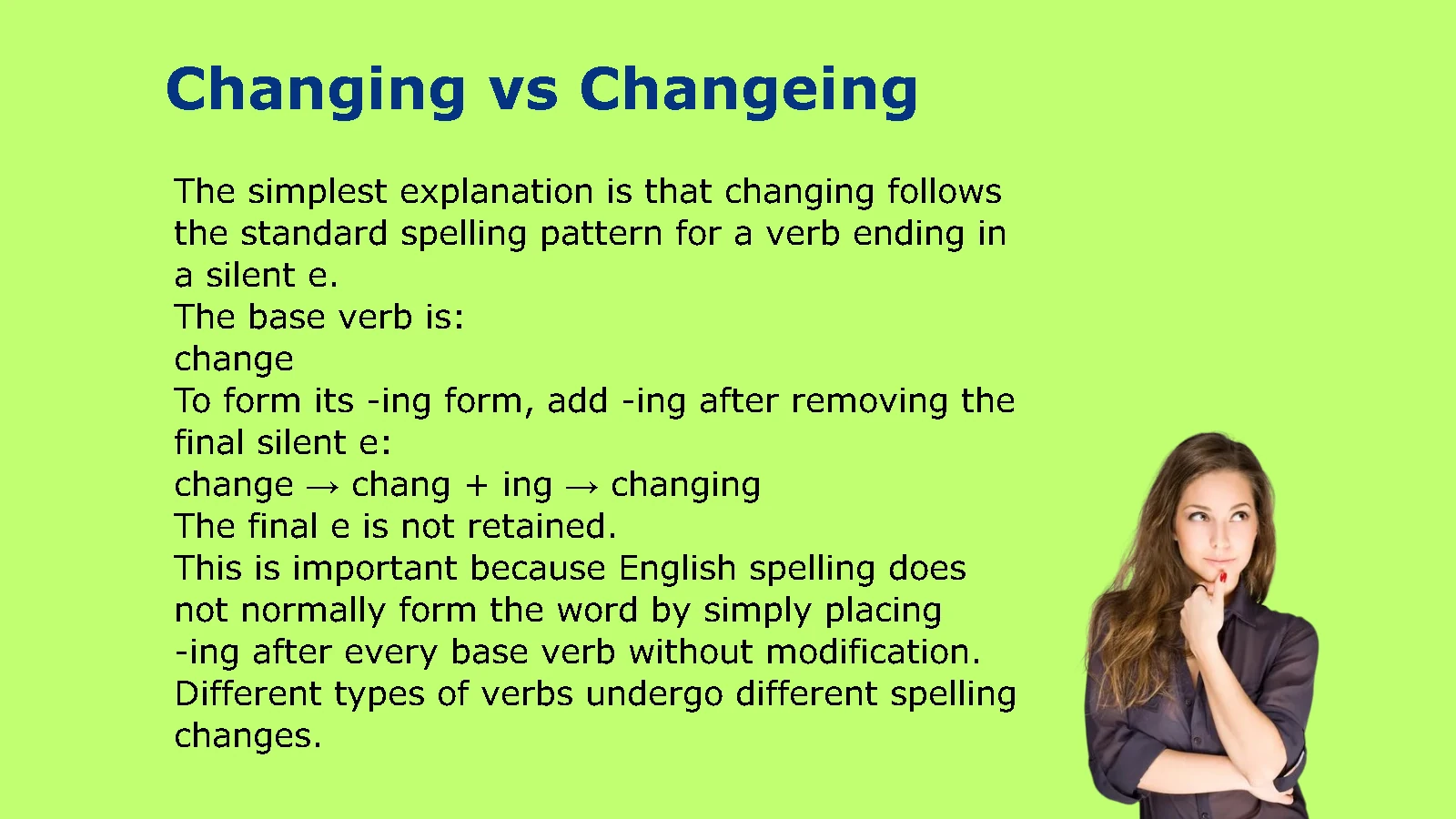
The simplest explanation is that changing follows the standard spelling pattern for a verb ending in a silent e.
The base verb is:
change
To form its -ing form, add -ing after removing the final silent e:
change → chang + ing → changing
The final e is not retained.
This is important because English spelling does not normally form the word by simply placing -ing after every base verb without modification. Different types of verbs undergo different spelling changes.
For example:
- walk → walking: simply add -ing
- play → playing: simply add -ing
- change → changing: remove final e, then add -ing
- run → running: double the final consonant, then add -ing
- lie → lying: change ie to y, then add -ing
So changing isn’t an irregular spelling. It follows a regular and widely used English spelling rule.
The basic formula
You can remember it this way:
Verb ending in silent e + -ing → usually remove the e
Therefore:
change + -ing → changing
The same principle applies to many everyday verbs:
| Base verb | Correct -ing form |
| change | changing |
| make | making |
| take | taking |
| write | writing |
| drive | driving |
| give | giving |
| save | saving |
| move | moving |
| hope | hoping |
| dance | dancing |
Why Is “Changeing” Incorrect?
Changeing is incorrect because it keeps the final e from the base verb before adding -ing.
The mistaken formation looks like this:
change + ing → changeing
But standard English spelling changes the word first:
change → chang + ing → changing
The mistake is understandable. If you think of -ing as a suffix that is always added unchanged to the complete base word, changeing can look logical.
However, English spelling rules often modify the base word when suffixes are attached.
The final e in change is a silent e. It helps establish the spelling and pronunciation of the base word, but it is not normally retained when -ing is attached.
Cambridge Dictionary describes this as a general spelling rule: when a suffix beginning with a vowel is added, a final -e is often dropped. For -ing specifically, it gives forms such as love → loving, lose → losing, and write → writing.
Why people write “changeing”
There are several reasons someone might produce changeing:
- They may simply add -ing to the complete spelling of change.
- They may remember that the word contains an e and incorrectly preserve it.
- They may be unfamiliar with the silent-e spelling rule.
- They may type quickly and make a spelling error.
- They may assume that all verbs form their -ing forms in exactly the same way.
None of these makes changeing a standard variant. In formal and edited English, use changing.
Changing vs Changeing Examples
The easiest way to understand the distinction is to see the correct form in ordinary sentences.
Correct Examples With “Changing”
Here are natural examples of changing:
- The weather is changing quickly.
- She is changing her plans.
- Technology is changing the way people communicate.
- I am changing my password today.
- The company is changing its policy.
- He is changing clothes before dinner.
- The situation is changing every day.
- Changing your routine can take time.
- They are changing the design of the website.
- The leaves are changing color.
In every example, changing is spelled without the e between the g and i.
Incorrect Examples With “Changeing”
These sentences contain the misspelling:
- ❌ The weather is changeing.
- ❌ She is changeing her plans.
- ❌ The company is changeing its policy.
- ❌ Technology is changeing rapidly.
- ❌ He is changeing his password.
The corrections are:
- ✅ The weather is changing.
- ✅ She is changing her plans.
- ✅ The company is changing its policy.
- ✅ Technology is changing rapidly.
- ✅ He is changing his password.
The grammatical structure doesn’t change. Only the spelling does.
The Spelling Rule for Verbs Ending in Silent E
The key rule behind changing vs changeing is the silent-e rule.
When a verb ends in a final silent e, the e is normally dropped before -ing.
Examples of the Rule
| Base verb | Add -ing | Correct form |
| change | change + ing | changing |
| make | make + ing | making |
| take | take + ing | taking |
| write | write + ing | writing |
| drive | drive + ing | driving |
| hope | hope + ing | hoping |
| love | love + ing | loving |
| move | move + ing | moving |
| save | save + ing | saving |
| dance | dance + ing | dancing |
Notice the consistent pattern.
The final e disappears:
make → making
write → writing
drive → driving
change → changing
This is why changeing doesn’t fit the standard pattern.
Why Is the Final E There in “Change”?
The e in change is not pointless. English spelling often uses a final silent e as part of the spelling of a word.
For example:
- tap and tape
- rid and ride
- hop and hope
- cut and cute
The final e can affect how the preceding vowel is represented or pronounced. But when certain suffixes are added, that final e is removed.
This means you should not assume that every letter in a base word remains when the word changes form.
Are There Exceptions to the Final-E Rule?
Yes. English spelling rules have exceptions and special cases.
The useful rule is “usually drop the final silent e before -ing,” not “always remove every final e.”
For example:
- see → seeing
- agree → agreeing
- dye → dyeing
Cambridge specifically notes that final e is retained in forms such as dyeing and singeing, partly to distinguish them from dying and singing. It also notes that verbs ending in -ee, -ye, or -oe retain the e in their -ing forms.
That distinction matters because spelling rules describe patterns rather than eliminating every exception.
However, change is not one of those exceptions.
Its standard -ing form is:
change → changing
Not changeing.
Changing vs Changeing: A Closer Look at the Word Formation
Let’s break the word down carefully.
Base Word: Change
Change is a common verb meaning to make something different, become different, exchange one thing for another, or move from one state or situation to another. Cambridge Dictionary lists several of these uses, including making or becoming different and exchanging one thing for another.
Examples include:
- change the plan
- change your clothes
- change jobs
- change the subject
- change your mind
Add the -ing Suffix
When the -ing form is required, the spelling changes:
change → changing
The final e is removed before -ing.
The Result
Changing can then function as a present participle or gerund, depending on how it is used in a sentence.
For example:
The weather is changing.
Here, changing is part of the verb phrase is changing.
Compare:
Changing your routine can be difficult.
Here, changing your routine functions as a noun-like phrase, commonly described as a gerund phrase.
Changing, Changed, Changes, and Change
It’s also useful to distinguish changing from the other forms of change.
| Form | Example | Use |
| change | I change my plans. | Base form |
| changes | She changes her plans. | Third-person singular present |
| changed | They changed their plans. | Past tense/past participle |
| changing | They are changing their plans. | -ing form |
These forms can look similar, but they serve different grammatical purposes.
Change
Use change as the base form:
I need to change my schedule.
Changes
Use changes with a third-person singular subject in the present tense:
The schedule changes every month.
Changed
Use changed as the regular past form:
The schedule changed yesterday.
Changing
Use changing when the -ing form is needed:
The schedule is changing now.
The spelling issue in changing vs changeing specifically concerns this last form.
When to Use “Changing”
Changing has several grammatical uses.
Understanding them can help you avoid both spelling and grammar mistakes.
Changing as a Present Participle
The most familiar use is in a progressive verb construction.
For example:
The climate is changing.
Prices are changing.
She is changing her plans.
The auxiliary verb is/are/was/were combines with the -ing form to create a progressive construction.
The British Council explains that English uses -ing forms in a range of grammatical structures, with the exact function determined by the surrounding sentence.
Changing as a Gerund
An -ing form can also behave like a noun.
For example:
Changing jobs can be stressful.
Here, changing jobs is the subject of the sentence.
Another example:
Changing the settings solved the problem.
The phrase changing the settings acts as the subject.
The spelling remains changing in both cases.
Changing as a Modifier
The word can also modify a noun:
changing conditions
changing weather
Here, changing describes something that is undergoing change.
Changing Pronunciation
The correct spelling is changing, and its pronunciation is based on the pronunciation of change plus the -ing ending.
Cambridge gives change as /tʃeɪndʒ/ in both its British and American dictionary entries.
The important point for spelling learners is that the silent e is not pronounced as a separate sound in change. Removing it in changing therefore does not mean you are deleting an audible syllable.
Compare:
- change
- changing
The word becomes longer because of -ing, but the final e isn’t pronounced as an independent sound.
This is one reason that writing changeing can be misleading: the extra e isn’t needed to represent the pronunciation.
Common Words That Follow the Same Spelling Pattern
One of the best ways to remember changing is to connect it with other familiar words.
Words Ending in Silent E
| Base form | -ing form |
| bake | baking |
| come | coming |
| dance | dancing |
| drive | driving |
| give | giving |
| hope | hoping |
| invite | inviting |
| make | making |
| move | moving |
| save | saving |
| take | taking |
| use | using |
| write | writing |
The pattern is easy to spot:
final silent e → remove e → add -ing
So:
change → chang + ing → changing
But Not Every -Ing Form Works This Way
Compare:
- see → seeing
- agree → agreeing
- study → studying
- run → running
- lie → lying
These forms follow different spelling patterns.
Cambridge notes that verbs ending in -ee, -ye, and -oe retain the final e, while verbs ending in -ie change ie to y before -ing.
That is why memorizing one mechanical formula for every verb can lead to new mistakes.
Changing vs Changeing in American and British English
There is no American-versus-British spelling difference between changing and changeing.
Both varieties use:
changing
Neither standard American English nor standard British English uses changeing as the regular spelling of the -ing form of change.
This is different from genuine regional spelling differences such as:
| British English | American English |
| organise | organize |
| colour | color |
| centre | center |
| neighbour | neighbor |
| programme | program |
Cambridge identifies several such British-American spelling differences.
But changing is not one of them.
So if you’re writing for an American audience, use changing. If you’re writing for a British audience, use changing as well.
Common Mistakes With “Changing”
Writing “Changeing”
This is the main error.
❌ The situation is changeing.
✅ The situation is changing.
The final e must be removed.
Confusing “Changing” With “Changed”
These forms describe different grammatical situations.
❌ The company is changed its policy.
✅ The company is changing its policy.
Here, is changing describes an action or process that is happening.
By contrast:
The company changed its policy last year.
That sentence describes a completed past action.
Assuming Every Verb Simply Takes -Ing
English spelling isn’t always as simple as:
word + ing
For change, the correct process is:
change → changing
For run, it is:
run → running
For lie, it is:
lie → lying
Recognizing these patterns will make your spelling much more reliable.
Keeping the E Because It Appears in the Base Word
This is the exact trap behind changeing.
A learner may reason:
change + ing = changeing
But suffixation sometimes changes the spelling of the base word.
The same thing happens with:
write → writing
make → making
hope → hoping
Once you recognize the pattern, changing becomes much easier to remember.
Changing vs Changeing: A Practical Comparison
| Feature | Changing | Changeing |
| Standard English | Yes | No |
| Correct spelling | Yes | No |
| Base verb | change | change |
| Suffix | -ing | -ing |
| Final e retained? | No | Yes |
| American English | Yes | No |
| British English | Yes | No |
| Suitable for formal writing | Yes | No |
| Example | She is changing her plans. | She is changeing her plans. |
The distinction is simple: changing follows the standard spelling rule; changeing does not.
Changing vs Changeing in Sentences
Seeing the word in different contexts can make the spelling pattern more natural.
Everyday Conversation
I’m changing my plans for tonight.
She’s changing her clothes.
Why are you changing the subject?
School and Academic Writing
The experiment demonstrates how temperature is changing over time.
Changing one variable can affect the results.
The researchers observed changing patterns in the data.
Workplace Writing
The company is changing its policies.
We are changing the meeting time.
The department is changing its approach to customer service.
Technology
The software is changing rapidly.
I’m changing my password.
The developer is changing the configuration.
Weather and Environment
The weather is changing quickly.
Changing conditions made the journey more difficult.
The seasons are changing.
In every context, the correct form remains changing.
A Simple Way to Remember “Changing”
Here’s the most useful memory trick:
Drop the silent e before -ing.
Start with:
change
Remove the final e:
chang
Add -ing:
changing
You can reinforce the pattern with three familiar examples:
make → making
write → writing
change → changing
If you remember these together, you’re less likely to write changeing.
A Quick Spelling Test
Try completing these mentally:
- make → ______
- write → ______
- drive → ______
- change → ______
- hope → ______
The answers are:
- making
- writing
- driving
- changing
- hoping
The same spelling principle appears repeatedly.
A Note About Other -Ing Spelling Rules
The changing example belongs to one of several common spelling patterns for -ing forms.
Most Regular Verbs
Simply add -ing:
- walk → walking
- play → playing
- read → reading
- work → working
Verbs Ending in Silent E
Usually remove the e:
- change → changing
- make → making
- write → writing
- use → using
Short Verbs With a Single Consonant Pattern
Some verbs double the final consonant:
- run → running
- sit → sitting
- stop → stopping
Verbs Ending in -ie
Change ie to y:
- lie → lying
- die → dying
- tie → tying
These patterns explain why spelling -ing forms requires more than simply attaching three letters to the base word.
Case Study: Why “Changing” Looks Unusual to Some Writers
Consider the word:
change
A writer who has learned to preserve the base word might naturally produce:
changeing
It appears visually logical because the letters of change are all still visible.
But compare it with another familiar verb:
make → making
Most English speakers recognize making immediately. The spelling doesn’t preserve the final e.
Now apply the same rule to change:
change → changing
The important insight is that the spelling transformation is not specific to change. It’s part of a broader pattern involving verbs that end in a silent e.
That makes changing easier to remember as a rule rather than as an isolated spelling fact.
Why the Mistake Is Easy to Make
Changeing is a particularly understandable misspelling because the pronunciation doesn’t necessarily make the spelling rule obvious.
English contains many words where spelling and pronunciation don’t map perfectly letter-for-letter. The final e in change is silent, so a learner may not realize that it belongs to a spelling pattern that disappears when -ing is added.
There is also a visual temptation to preserve the complete base word:
change + ing
But English morphology often involves spelling adjustments. The correct process is therefore:
change → chang + ing → changing
Learning the underlying pattern is more useful than simply memorizing that changeing is wrong.
Frequently Asked Questions
Is “changing” or “changeing” correct?
Changing is correct. Changeing is a misspelling.
The standard formation is:
change → changing
The final silent e is dropped before -ing.
Why is “changeing” wrong?
Changeing incorrectly retains the final e from change before adding -ing.
English normally drops the final silent e before this suffix:
change → changing
Cambridge’s grammar guidance explicitly describes this final-e rule for -ing forms.
What is the correct spelling of changing?
The correct spelling is:
C-H-A-N-G-I-N-G
There is no e between the g and i.
Does “change” lose the e before “-ing”?
Yes. The standard -ing form of change is changing.
The final silent e is removed before the -ing suffix.
Is “changing” spelled the same in American and British English?
Yes. Changing is standard in both American and British English.
This is not a regional spelling difference.
What is the difference between change and changing?
Change is the base form of the verb:
I want to change my plans.
Changing is the -ing form:
I am changing my plans.
The -ing form can occur in progressive verb constructions and can also function as a gerund or modifier, depending on the sentence.
What are some words similar to “changing”?
Other verbs that commonly drop a final silent e before -ing include:
- make → making
- take → taking
- write → writing
- drive → driving
- move → moving
- hope → hoping
- dance → dancing
- save → saving
Is “changeing” ever correct?
Not as the standard -ing form of the verb change. In standard English writing, use changing.
Changing vs Changeing: Quick Recap
Here’s everything you need to remember:
| Question | Answer |
| Correct spelling? | Changing |
| Incorrect spelling? | Changeing |
| Base verb? | Change |
| Suffix? | -ing |
| What happens to the e? | It is dropped |
| Correct formation? | change → changing |
| American English? | changing |
| British English? | changing |
The central rule is simple:
When a verb ends in a silent e, the e is usually dropped before -ing.
So:
change → changing
not:
change → changeing
Once you connect changing with examples such as making, writing, moving, and hoping, the spelling becomes much easier to recognize.
Conclusion
Changing is the correct spelling. Changeing is incorrect.
The reason is the standard spelling rule for verbs ending in a final silent e. When -ing is added to change, the final e is normally removed:
change + -ing → changing
The same pattern appears in many common verbs:
- make → making
- write → writing
- drive → driving
- move → moving
- hope → hoping
It’s also important to remember that changing is standard in both American and British English. There is no changeing variant used by one of those varieties.
So whenever you’re unsure between changing vs changeing, choose changing.
The rule to remember: drop the silent e before -ing.