Closing is the correct spelling, while closeing is a common misspelling that incorrectly adds an extra e before the -ing ending. If you’ve come across “closing” and “closeing” and wondered which form is correct, the difference comes down to how the verb close changes when the -ing suffix is added. This spelling pattern is closely connected to English spelling rules, suffixes, verb forms, present participles, and common spelling mistakes.
The closing vs closeing distinction is simple: closing is the standard and correct form, while closeing is incorrect in standard English. The word closing can refer to the act of shutting something, ending an activity or event, completing a business transaction, or bringing something to an end. Related forms include close, closed, closure, and closing, but each has a different grammatical function and meaning.
In this guide, you’ll learn why “closing” is correct, why “closeing” is incorrect, how the silent-e spelling rule works, and how to use “closing” correctly in sentences. You’ll also see clear examples, common mistakes, and comparisons with related forms to make the spelling easy to remember.
By the end, you’ll know exactly whether to use closing or closeing and how to apply the spelling rule correctly when adding -ing to verbs ending in a silent e.
Quick Answer: Closing or Closeing?
The correct spelling is closing.
| Spelling | Correct? | Explanation |
| closing | ✅ Yes | Standard spelling of the -ing form of close |
| closeing | ❌ No | Incorrectly retains the final e |
| close | ✅ Yes | Base verb |
| closed | ✅ Yes | Past tense and past participle |
| closure | ✅ Yes | Related noun, but a different word |
The simple rule
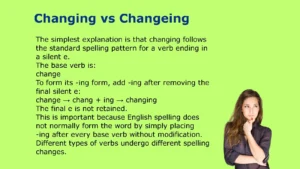
When close becomes an -ing form, remove the final silent e:
close → closing
Not:
close → closeing
For example:
- The shop is closing at 8 p.m.
- She is closing the window.
- We are closing the meeting with a short speech.
- The deadline for closing the account is Friday.
Closeing should not be used in standard English writing.
Why Is “Closing” Correct?
The reason is connected to the spelling pattern used when certain verbs ending in a silent e take -ing.
The base verb is:
close
When you add -ing, you do not simply attach the suffix to every letter unchanged. The final silent e is removed:
close + ing → closing
The result is pronounced naturally as closing, and the spelling reflects the conventional English form.
This is not an unusual rule limited to close. It occurs with many familiar verbs.
Common examples of the same pattern
| Base verb | + -ing | Correct form |
| make | make + ing | making |
| take | take + ing | taking |
| write | write + ing | writing |
| move | move + ing | moving |
| bake | bake + ing | baking |
| hope | hope + ing | hoping |
| use | use + ing | using |
| close | close + ing | closing |
The important point is that the final e in these words is not retained before -ing.
Therefore:
close → closing
is consistent with the broader spelling pattern.
Why Is “Closeing” Incorrect?
Closeing is incorrect because it keeps the final e from close before adding -ing.
Someone might reason:
close + ing = closeing
That looks mathematically logical, but English spelling does not always work by simply attaching endings to an unchanged base word.
In this case, the final e is removed.
So:
- close + ing → closing ✅
- close + ing → closeing ❌
The mistake is particularly understandable because the word close itself is spelled with an e. A writer who remembers the base word but does not apply the spelling change may accidentally produce closeing.
A useful way to remember it
Think of the transformation as:
CLOSE − E + ING = CLOSING
The e disappears before -ing is added.
This gives you:
close → closing
rather than:
close → closeing
Closing vs Closeing: Meaning and Grammar
There is an important grammatical difference between the two forms.
Closing is a real English word with several grammatical functions. Closeing is not the standard spelling of an English word.
Cambridge Dictionary records closing as an adjective and noun and gives several uses related to ending, stopping access, shutting something, and completing a business transaction.
What Does “Closing” Mean?
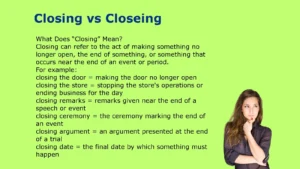
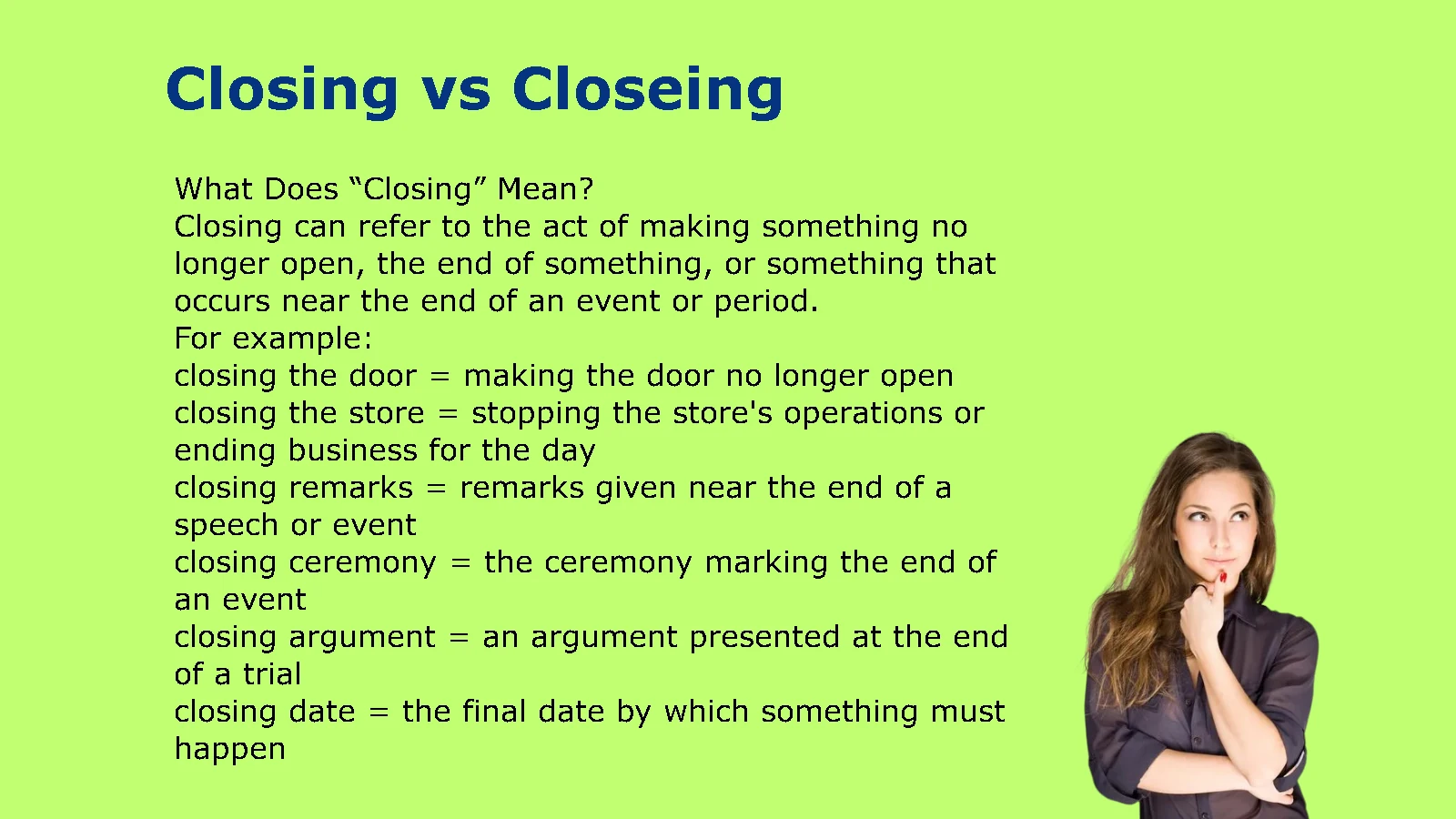
Closing can refer to the act of making something no longer open, the end of something, or something that occurs near the end of an event or period.
For example:
- closing the door = making the door no longer open
- closing the store = stopping the store’s operations or ending business for the day
- closing remarks = remarks given near the end of a speech or event
- closing ceremony = the ceremony marking the end of an event
- closing argument = an argument presented at the end of a trial
- closing date = the final date by which something must happen
The exact meaning depends on context.
Cambridge defines closing as an adjective for something that comes near the end of a speech, event, or activity. It also defines closing as a noun for the act or time of becoming no longer open and for various types of ending.
What Does “Closeing” Mean?
Closeing does not have a separate standard meaning.
It is simply an incorrect spelling of closing.
If you encounter closeing in a sentence, the intended word will normally be closing.
For example:
❌ The shop is closeing at six.
✅ The shop is closing at six.
The correction does not change the intended meaning. It simply fixes the spelling.
Closing as an Action
One of the most common uses of closing is as the -ing form of the verb close.
For example:
She is closing the door.
Here, closing describes an action that is happening.
The base verb is close:
She closes the door.
The continuous form is:
She is closing the door.
The spelling changes because the final e is removed before -ing.
More examples
- The employee is closing the store.
- Please stop closing the window.
- He is closing his laptop.
- They are closing the gate.
- The manager is closing the meeting.
- The company is closing the branch.
In each case, closing describes an action or ongoing process.
Closing as a Noun
Closing can also function as a noun.
For example:
The closing of the factory affected hundreds of workers.
Here, closing refers to the act or event of the factory stopping operations.
Cambridge lists this noun use for the ending or stopping of businesses and organizations, as well as the act of something becoming no longer open.
Other examples include:
- The closing of the store happened earlier than expected.
- The closing of the tunnel caused traffic delays.
- The closing of the exhibition marked the end of the event.
- The closing of the account requires additional paperwork.
The word remains closing, never closeing.
Closing as an Adjective
Closing can also describe something associated with the end of an event, speech, activity, or period.
For example:
The speaker gave her closing remarks.
Here, closing tells us that the remarks came at the end.
Other common expressions include:
- closing remarks
- closing statement
- closing argument
- closing ceremony
- closing minutes
- closing stages
- closing thoughts
- closing speech
Cambridge specifically identifies closing remarks, closing ceremony, and closing statements among established uses.
Closing vs Close: Understanding the Base Word
It helps to understand the relationship between close and closing.
Close is the base verb.
Closing is its present participle and gerund form.
Closed is its past tense and past participle form.
Closure is a related noun, but it is not simply another form of the verb.
| Word | Main role | Example |
| close | Base verb | Please close the door. |
| closing | -ing form | She is closing the door. |
| closed | Past form/adjective | The door is closed. |
| closure | Noun | The company announced the closure of the branch. |
Cambridge defines close as a verb meaning, among other things, to make something no longer open or to end something.
Close
Use close when you are talking about the base verb:
Please close the window.
Closing
Use closing for an ongoing action or an ending:
She is closing the window.
Closed
Use closed for the completed action or a state of being not open:
The window is closed.
Cambridge likewise distinguishes closed as an adjective meaning “not open.”
Closure
Use closure when you need a noun referring to the ending, stopping, or permanent shutdown of something, depending on context.
The company announced the closure of the factory.
Cambridge lists closure as a noun for the stopping of a business or organization and for the ending of something more generally.
The Spelling Rule Behind Closing
The key spelling principle is straightforward:
Drop the Final Silent E Before -ing
Many verbs ending in a silent e drop that e when -ing is added.
Examples include:
- make → making
- take → taking
- write → writing
- drive → driving
- move → moving
- hope → hoping
- use → using
- close → closing
This explains why closeing is not the standard form.
The transformation can be visualized like this:
C L O S E
↓
Remove the final E
↓
C L O S
↓
Add I N G
↓
C L O S I N G
Therefore:
close → closing
Why does English do this?
The final e in words such as close is part of the conventional spelling of the base word. It is not retained when the spelling pattern changes before -ing.
This allows English to maintain familiar spelling conventions without producing forms such as makeing, writeing, or closeing.
Words That Keep the E Before -ing
It is important not to turn the spelling rule into an absolute statement that every word ending in e always drops the letter.
English has exceptions and special patterns.
For example:
- see → seeing
- agree → agreeing
- flee → fleeing
These words already contain vowel combinations that require different treatment.
That is why the safest practical rule is:
Many verbs ending in silent -e drop the e before -ing, but spelling patterns have exceptions.
For the word in this article, however, there is no uncertainty:
close → closing
is the standard spelling.
Closing vs Closeing: Common Spelling Mistakes
The most common error is simply carrying the final e from the base word into the -ing form.
Common incorrect forms
❌ closeing
❌ closeing the door
Correct forms
✅ closing
✅ closing the door
The same mistake can occur with other verbs:
❌ makeing
✅ making
❌ takeing
✅ taking
❌ writeing
✅ writing
Recognizing this broader pattern makes closing easier to remember.
Closing vs Closeing in American and British English
There is no standard US-versus-UK spelling difference between closing and closeing.
Both American English and British English use:
closing
The pronunciation may be represented slightly differently in dictionaries because of differences in pronunciation notation and accent, but the spelling remains the same.
Cambridge gives closing as /ˈkloʊz.ɪŋ/ in US English and /ˈkləʊ.zɪŋ/ in UK English.
So you should not write:
- closeing in British English
- closing in American English
The correct distinction is not regional. Closing is the standard spelling in both.
Closing vs Closeing Pronunciation
The standard pronunciation of closing is approximately:
KLOH-zing
Cambridge gives the US pronunciation as /ˈkloʊz.ɪŋ/ and the UK pronunciation as /ˈkləʊ.zɪŋ/.
The word has two main parts:
close + ing
But the pronunciation of the ending does not mean the spelling should contain the extra e.
That is an important distinction for learners:
pronunciation does not determine the spelling letter-for-letter.
For example, a learner might hear the word and imagine close-ing. That does not mean closeing is the written form.
The correct written form remains:
closing
Closing in Different Contexts
One reason closing appears frequently in English is that close has several related meanings.
Closing a Door or Window
In physical contexts, closing describes something moving from open to not open.
Examples:
- She is closing the door.
- The automatic system is closing the gate.
- He was closing the window when the phone rang.
- The curtains are closing slowly.
Cambridge defines close in this sense as changing something from open to not open or causing that change.
Closing a Business or Store
Closing can also refer to a business stopping operations.
For example:
The company is closing its downtown store.
This can mean the business is ending operations at that particular location. It does not necessarily mean the entire company is shutting down.
Another example:
The restaurant is closing at 10 p.m.
Here, closing refers to the end of service for that day.
Cambridge distinguishes between the everyday closing of a public place and the permanent stopping of a business or organization.
Closing a Meeting or Conversation
Close can also mean to bring something to an end.
For example:
The chairperson is closing the meeting with a short statement.
Or:
She closed the conversation politely.
In this context, closing has nothing to do with physically shutting a door. The underlying idea is still the same: bringing something to an end.
Cambridge includes this “end” sense among the meanings of close.
Closing a Deal
In business English, closing a deal means completing a business arrangement.
For example:
The sales team is close to closing the deal.
Here, closing refers to bringing negotiations or the arrangement to a completed stage.
Cambridge also recognizes close a deal as a business expression meaning to complete a successful business arrangement.
Closing Remarks or Statements
Closing remarks are comments made near the end of a speech, meeting, or event.
For example:
The director thanked the staff in her closing remarks.
Likewise, closing statement can refer to a statement presented at the end of a formal proceeding.
These are established expressions, not informal inventions. Cambridge specifically lists closing remarks, closing statements, and related expressions.
Closing vs Closed vs Closure
These three words are related, but they should not be treated as interchangeable.
Closing
Closing generally emphasizes an action, process, or final stage.
The store is closing.
The closing ceremony begins tonight.
Closed
Closed generally describes a completed state.
The store is closed.
The difference is subtle but important:
- The store is closing. → The process is happening or is about to happen.
- The store is closed. → The store is not open.
Cambridge describes closed as meaning “not open” and gives examples involving stores, banks, roads, and buildings.
Closure
Closure is a noun referring to an ending, stopping, or permanent shutdown, depending on context.
The company announced the closure of the factory.
The word can also refer to a sense of resolution:
She finally found closure after the experience.
Cambridge records both the operational meaning and the broader sense of bringing something to an end.
A simple comparison
| Situation | Correct word |
| The store is in the process of ending operations. | closing |
| The store is not open. | closed |
| The company permanently stops operating a facility. | closure |
| Someone is shutting a door. | closing |
| A speech is reaching its final section. | closing |
Closing vs Closeing Examples
The following examples show how the correct spelling works in everyday writing.
| Incorrect | Correct |
| The shop is closeing early. | The shop is closing early. |
| She is closeing the door. | She is closing the door. |
| What time is closeing? | What time is closing? |
| His closeing remarks were brief. | His closing remarks were brief. |
| They are closeing the store. | They are closing the store. |
| We are closeing the account. | We are closing the account. |
| The company is closeing the branch. | The company is closing the branch. |
| The application closeing date is Friday. | The application closing date is Friday. |
More correct examples
The supermarket is closing at 9 p.m.
Please make sure you are not closing the application window accidentally.
The speaker delivered her closing remarks after the final presentation.
The company is closing one of its regional offices.
We are closing the meeting with a short question-and-answer session.
The closing ceremony will take place on Sunday.
They are working toward closing the deal.
Every example uses closing, never closeing.
A Practical Way to Remember the Spelling
If you regularly confuse closing and closeing, use this simple formula:
CLOSE − E + ING = CLOSING
You can apply the same visual idea to several common verbs:
- make − e + ing = making
- take − e + ing = taking
- write − e + ing = writing
- move − e + ing = moving
- close − e + ing = closing
This gives you a useful mental pattern instead of trying to memorize closing as an isolated spelling.
The one-second spelling test
When you write closeing, stop and ask:
“Does this verb normally drop its final silent e before -ing?”
For close, the answer is yes.
Therefore:
closeing ❌
closing ✅
A Real-World Usage Check
Suppose you are writing one of these sentences:
The store is ___ at 8 p.m.
The choices are:
- close
- closing
- closeing
- closed
If the sentence describes the store’s action at that time, closing is the natural choice:
The store is closing at 8 p.m.
Now consider:
The store is ___ today.
If you mean that customers cannot enter because it is not operating, closed may be appropriate:
The store is closed today.
This demonstrates why spelling and grammar should be considered together. Closing is not merely the correctly spelled version of closeing; it also has a specific grammatical role in a sentence.
Closing Date: An Important Common Expression
One particularly common phrase is closing date.
A closing date is generally the final date by which something can be done, such as submitting an application or entering a competition.
For example:
The closing date for applications is October 31.
Cambridge defines closing date as the last day on which someone is allowed to do something, such as enter a competition. In US property terminology, it can also refer to the date on which ownership of a property legally changes hands.
Notice the spelling:
closing date
not:
closeing date
This is another useful phrase to remember if you frequently encounter the word in applications, advertisements, forms, or business writing.
Closing Time and Closing Remarks
Two other very common expressions are closing time and closing remarks.
Closing time
Closing time refers to the time when a business or public place stops serving customers or operating for the day.
We arrived just before closing time.
Closing remarks
Closing remarks are comments made at the end of an event, meeting, speech, or presentation.
The chairperson thanked everyone during her closing remarks.
Both expressions use the same standard spelling:
closing
The final e from close does not return simply because the word is being used as a noun modifier or adjective.
Is “Closing” Always About Physically Shutting Something?
No.
This is an important point about meaning.
Closing can describe physical movement:
closing the door
But it can also describe the end of an event:
closing remarks
or the end of business activity:
closing the store
or completion of a transaction:
closing the deal
or the final part of a period:
closing minutes
The meanings are connected by the general idea of bringing something toward an end or making something no longer open.
Cambridge’s entries for close and closing reflect these different contexts, including physical closing, ending an activity, business transactions, and final stages of events.
Common Questions About Closing vs Closeing
Is “closing” or “closeing” correct?
Closing is correct. Closeing is a misspelling.
Why is “closeing” wrong?
Because the final silent e in close is dropped before the -ing ending:
close → closing
How do you spell closing?
The correct spelling is:
C-L-O-S-I-N-G
It contains no e between the s and i.
Why does close become closing?
The final silent e is removed before -ing is added.
close + ing → closing
Is “closing” the -ing form of close?
Yes. Closing is the present participle and gerund form of close.
For example:
She is closing the door.
Is “closeing” ever correct?
No. Closeing is not the standard English spelling. Use closing instead.
Is “closing” correct in American and British English?
Yes. Closing is the standard spelling in both American and British English. Cambridge provides US and UK pronunciations, but the spelling is the same.
What is the difference between closing and closed?
Closing usually describes an action, process, or final stage:
The store is closing.
Closed describes a state in which something is not open:
The store is closed.
What is the difference between closing and closure?
Closing can describe the action or process of ending or shutting something.
Closure is a noun referring to an ending, stopping, or permanent shutdown, depending on context.
The company is closing the branch.
The closure of the branch was announced yesterday.
Final Answer: Closing or Closeing?
Closing is the correct spelling. Closeing is incorrect.
The reason is simple: when close takes the -ing suffix, its final silent e is dropped.
close + ing → closing
Remember the pattern:
- make → making
- take → taking
- write → writing
- move → moving
- close → closing
So, whenever you are unsure whether to write closing or closeing, choose closing.
Correct: Closing
Incorrect: Closeing
Whether you are writing about closing a door, closing a store, closing a meeting, closing remarks, closing time, or closing a deal, the spelling remains closing.