Dancing is the correct spelling, while danceing is a common misspelling that incorrectly adds an extra e before the suffix -ing. If you’ve come across “dancing vs danceing” and wondered which spelling is right, the difference comes down to how the verb dance changes when -ing is added.
The dancing vs danceing distinction is important because dancing follows the standard English spelling rule for verbs ending in a silent e. When dance takes the -ing suffix, the final e is dropped, producing dancing. By contrast, danceing is not the standard English spelling. Similar examples include make → making, write → writing, and take → taking.
In this guide, you’ll learn whether “dancing” or “danceing” is correct, why the final “e” is removed, how to use “dancing” in sentences, and which spelling rules apply when adding -ing to verbs ending in silent e. You’ll also see clear examples to make the difference easy to understand.
By the end, you’ll know exactly why “dancing” is correct and “danceing” is incorrect, so you can use the right spelling confidently in everyday writing, schoolwork, emails, and professional communication.
Quick Answer: Dancing or Danceing?
If you’re wondering whether to write dancing or danceing, use dancing.
| Spelling | Status | Example |
| Dancing | ✅ Correct | She is dancing now. |
| Danceing | ❌ Incorrect | She is danceing now. |
The spelling rule is simple:
When a regular verb ends in a final silent e, usually drop the e before adding -ing.
So:
dance → dancing
Not:
dance → danceing
Cambridge’s grammar guidance gives the same general pattern for verbs such as move → moving, face → facing, and come → coming.
The important point is that dancing isn’t a different word from dance. It is the -ing form of the verb dance, formed according to the normal spelling rules for verbs ending in silent e.
Dancing vs Danceing at a Glance
Here is the distinction in one table:
| Feature | Dancing | Danceing |
| Standard English spelling | ✅ Yes | ❌ No |
| Base verb | dance | dance |
| Suffix | -ing | -ing |
| Final e removed | Yes | No |
| Grammatical form | -ing form | Incorrect formation |
| Example | They are dancing. | They are danceing. |
The basic formation
The word can be broken down as:
DANCE + ING
But English spelling rules change the written form:
DANCE → DANC + ING → DANCING
The final e is removed.
This is why the spelling contains dancing, not danceing.
What Does Dancing Mean?
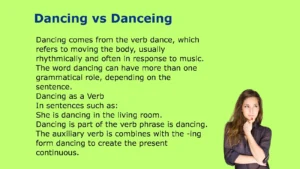
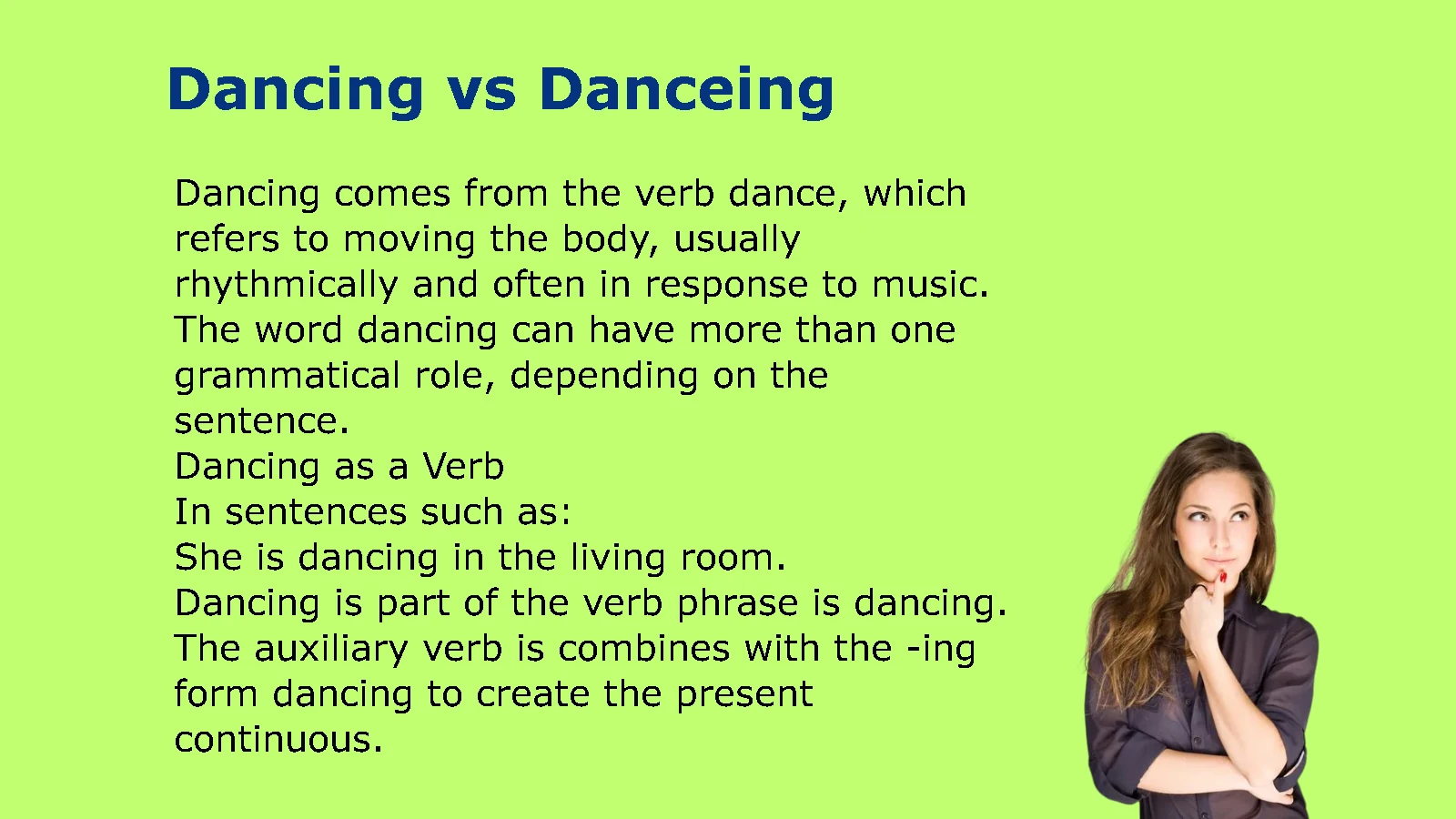
Dancing comes from the verb dance, which refers to moving the body, usually rhythmically and often in response to music.
The word dancing can have more than one grammatical role, depending on the sentence.
Dancing as a Verb
In sentences such as:
She is dancing in the living room.
Dancing is part of the verb phrase is dancing.
The auxiliary verb is combines with the -ing form dancing to create the present continuous.
The same pattern appears in:
- I am dancing.
- You are dancing.
- He is dancing.
- We are dancing.
- They are dancing.
The general structure is:
subject + am/is/are + -ing form
Cambridge describes the present continuous as am, are, or is + the -ing form.
Dancing as a Noun
Dancing can also function as a noun-like gerund when it refers to the activity itself.
For example:
Dancing takes practice.
Here, dancing is the subject of the sentence.
Another example is:
I enjoy dancing.
In this sentence, dancing refers to the activity that the speaker enjoys. Verbs such as enjoy are followed by an -ing form when another verb follows them.
So dancing isn’t limited to describing an action happening at this exact moment.
Compare:
She is dancing now.
with:
She enjoys dancing.
The first describes an action in progress. The second describes an activity she enjoys.
Why Is Dancing Correct and Danceing Wrong?
The key is the final silent e.
The base verb is:
dance
The ending is:
-ing
If you simply attach the suffix without changing anything, you might expect:
dance + ing = danceing
But English spelling rules don’t normally work that way for verbs ending in a final e.
Instead, the final e is dropped:
dance + ing → dancing
Cambridge’s spelling guidance states that a final -e is often dropped when a suffix beginning with a vowel is added. Its examples include hope → hoping, hate → hated, and, for -ing forms, love → loving, lose → losing, and write → writing.
The Silent E Rule
The final e in dance is not pronounced as a separate sound.
Compare:
- dance
- dancing
The written e disappears in the -ing form.
This isn’t an arbitrary change made specifically for dance. It’s part of a broader spelling pattern.
| Base verb | Correct -ing form |
| dance | dancing |
| make | making |
| take | taking |
| write | writing |
| hope | hoping |
| move | moving |
| use | using |
| smile | smiling |
| bake | baking |
| hike | hiking |
The pattern becomes easier to remember when you see several examples together.
Why You Shouldn’t Write Danceing
Danceing retains the final e before -ing.
That conflicts with the standard spelling pattern for this type of verb.
Compare:
❌ danceing
with:
✅ dancing
The incorrect version is understandable because it visually preserves the whole base word dance. However, English spelling changes the word when the suffix is attached.
The same problem occurs in other common misspellings:
❌ comeing
✅ coming
❌ makeing
✅ making
❌ writeing
✅ writing
❌ closeing
✅ closing
Cambridge specifically identifies forms such as comeing as mistakes and gives coming as the correct spelling.
Dancing: Correct Spelling and Word Forms
Understanding the other forms of dance makes the spelling of dancing easier to remember.
| Form | Word | Example |
| Base form | dance | I like to dance. |
| Third-person singular | dances | She dances well. |
| Past tense | danced | They danced yesterday. |
| -ing form | dancing | They are dancing now. |
Dance
Use dance as the base form.
Examples:
I dance every weekend.
They want to dance.
We can dance after dinner.
Dances
Use dances with a third-person singular subject in the present simple.
Examples:
She dances every Friday.
He dances professionally.
My sister dances at school.
The spelling remains dance plus -s here because the final e is retained in this form.
Danced
The past tense is danced, not danct or another altered form.
Examples:
We danced last night.
She danced at the competition.
For regular verbs ending in e, English normally adds -d rather than removing the e.
This creates an important contrast:
dance → danced
but:
dance → dancing
Dancing
The -ing form is:
dancing
not:
danceing
This is where the silent e rule matters.
Dancing vs Danceing in Sentences
Seeing the words in complete sentences is one of the quickest ways to recognize the correct form.
Correct Examples With Dancing
Here are several natural examples:
The children are dancing to the music.
She enjoys dancing with her friends.
We watched them dancing on stage.
He has always loved dancing.
They were dancing when the music stopped.
Dancing can be a demanding activity.
I saw my brother dancing at the party.
The couple kept dancing until the song ended.
Notice that dancing works in different grammatical structures.
It can appear after be:
They are dancing.
It can follow a verb such as enjoy:
They enjoy dancing.
It can function as the subject of a sentence:
Dancing requires coordination.
It can also occur after verbs of perception:
We watched them dancing.
Cambridge notes that the -ing form after verbs such as see, hear, watch, and notice can emphasize an action that is in progress.
Incorrect Examples With Danceing
The following sentences contain the common spelling error:
❌ She is danceing at the party.
Correct:
✅ She is dancing at the party.
❌ They were danceing together.
Correct:
✅ They were dancing together.
❌ I enjoy danceing.
Correct:
✅ I enjoy dancing.
❌ He likes danceing.
Correct:
✅ He likes dancing.
The issue in these examples isn’t the grammar of the sentence. It’s the spelling of the -ing form.
Common Words That Follow the Same Spelling Rule
Dancing becomes much easier to remember when you connect it to a wider spelling pattern.
Many verbs ending in silent e lose that e before -ing.
Common Examples
| Base verb | -ing form |
| dance | dancing |
| bake | baking |
| close | closing |
| drive | driving |
| give | giving |
| hike | hiking |
| hope | hoping |
| invite | inviting |
| make | making |
| move | moving |
| save | saving |
| smile | smiling |
| take | taking |
| use | using |
| write | writing |
The general pattern is:
Final silent e + -ing → remove e + -ing
So:
make → making
write → writing
dance → dancing
This rule is not universal for every English word ending in e, but it is the standard pattern for this group of regular verbs. Cambridge also notes exceptions involving endings such as -ee, -ye, and -oe, where the final e is retained, as in seeing, agreeing, and dyeing.
Common Mistakes With Dancing
The most obvious mistake is writing danceing, but there are several related errors worth understanding.
Writing Danceing
This is the central spelling mistake:
❌ danceing
✅ dancing
The error happens because the writer adds -ing without removing the final e.
Confusing Dancing With Danced
These two forms serve different grammatical purposes.
She danced yesterday.
She is dancing now.
Danced is the past tense.
Dancing is the -ing form.
They should not be used interchangeably.
Adding the Wrong Suffix
Another mistake is assuming that every sentence involving an activity should use dance or danced.
For example:
She is dancing.
not:
She is dance.
The structure is + verb-ing requires the -ing form.
Cambridge explains that the present continuous uses am/is/are + -ing form.
Treating Every Verb the Same Way
English has several different spelling changes when suffixes are added.
For example:
dance → dancing
but:
run → running
Here, run doesn’t lose an e. Instead, its final consonant is doubled.
Similarly:
study → studying
The y stays before -ing.
And:
lie → lying
The spelling changes differently because the base ends in -ie.
So the useful lesson isn’t simply “change every verb before adding -ing.” The spelling depends on the ending of the base verb.
When Do You Use Dancing?
Knowing how to spell dancing is only part of the picture. You also need to know when the word belongs in a sentence.
Use Dancing for an Action Happening Now
Use dancing in the present continuous when an action is happening around the current time.
She is dancing on the stage.
The children are dancing in the hall.
I am dancing with my partner.
The structure is:
am/is/are + dancing
This is one of the most common uses of the word.
Use Dancing for an Ongoing Activity
The -ing form can also describe an activity that continues over a period of time.
They spent the evening dancing.
She was dancing when the lights went out.
Here, dancing identifies an activity in progress.
Use Dancing as a Gerund
Dancing requires coordination.
Dancing takes practice.
In these sentences, the word behaves like a noun while retaining the -ing form.
Use Dancing After Certain Verbs
Some verbs are naturally followed by an -ing form.
For example:
I enjoy dancing.
They keep dancing.
She avoids dancing in crowded places.
We started dancing.
The exact grammar depends on the preceding verb. For example, Cambridge notes that enjoy is followed by an -ing form when another verb follows it.
Dancing vs Other Forms of Dance
A common source of confusion is treating dance, dances, danced, and dancing as interchangeable.
They aren’t.
| Word | Main grammatical use | Example |
| dance | Base form | I like to dance. |
| dances | Third-person singular present | She dances every week. |
| danced | Past tense | They danced yesterday. |
| dancing | -ing form | They are dancing now. |
Dance vs Dancing
Compare:
I like to dance.
with:
I like dancing.
Both can be grammatical, but they use different structures.
In the first sentence, to dance is an infinitive.
In the second, dancing is an -ing form functioning as the complement of like.
The spelling difference is important:
dance
and
dancing
The final e remains in the base form but disappears before -ing.
Danced vs Dancing
Compare:
They danced at the party.
They were dancing at the party.
The first sentence uses the simple past.
The second uses the past continuous:
were + dancing
The spelling of dancing remains the same regardless of whether it appears with is, are, was, or were.
A Closer Look at the Silent E Rule
The final e in words such as dance, make, and write has an important role in the base form.
But when -ing is added, that final e is generally removed.
Consider these transformations:
dance → dancing
make → making
write → writing
hope → hoping
move → moving
This is sometimes described as a silent-e deletion rule.
Why the Rule Matters
English spelling often represents a word differently when grammatical endings are added.
The base word isn’t necessarily copied letter-for-letter.
For example:
hope + ing does not become hopeing.
It becomes:
hoping
Likewise:
dance + ing does not become danceing.
It becomes:
dancing
The spelling system therefore requires you to consider both the base word and the suffix.
Exceptions and Similar Spelling Patterns
It’s useful to know that spelling rules have exceptions.
The rule for dropping final e applies broadly, but not universally.
Cambridge notes that when a word ends in -ee, -ye, or -oe, the final e is retained before -ing. Examples include agreeing, dyeing, and seeing.
Compare:
| Base | Correct -ing form |
| dance | dancing |
| hope | hoping |
| write | writing |
| agree | agreeing |
| see | seeing |
| dye | dyeing |
This is why memorizing only “remove e” isn’t enough for every English verb.
However, dance is not one of those exceptions.
Its standard form is unambiguously:
dancing
Why Danceing Looks Correct to Some Writers
There is a simple visual reason for this common mistake.
When you see:
dance
and need to add:
-ing
it can feel natural to place the two pieces side by side:
dance + ing = danceing
This preserves every letter from the original word.
But English spelling doesn’t always work by simple addition.
The spelling system changes the base before the suffix is attached:
danc + ing = dancing
The same principle explains why:
make + ing → making
rather than:
makeing
Once you recognize this pattern, danceing becomes easier to identify as an error.
Case Study: Why the Same Rule Appears in Closing
The spelling of dancing is closely related to another common spelling question: closing vs closeing.
The base verb is:
close
Add -ing:
close + ing
Remove the final e:
clos + ing
Result:
closing
The same process applies to:
dance → dancing
This gives you a useful pattern:
| Base verb | Incorrect | Correct |
| dance | danceing | dancing |
| close | closeing | closing |
| make | makeing | making |
| write | writeing | writing |
| move | moveing | moving |
Cambridge specifically lists closing among the regular -ing formations where the final e is removed.
How to Remember the Spelling of Dancing
The easiest memory trick is short:
Drop the silent e before -ing.
Then apply it directly:
dance → danc + ing → dancing
You can also remember the phrase:
The e dances away before -ing.
That isn’t a grammatical rule itself, but it’s a useful memory aid.
A Quick Three-Step Method
When you’re unsure, use these steps:
Start with the base verb:
dance
Add the suffix mentally:
dance + ing
Remove the final silent e:
dancing
That’s it.
You don’t need to memorize danceing as a competing spelling. You only need to remember the formation rule.
Dancing vs Danceing: Quick Comparison
| Question | Answer |
| Is dancing correct? | Yes |
| Is danceing correct? | No |
| What is the base verb? | dance |
| What suffix is added? | -ing |
| What happens to the final e? | It is dropped |
| Correct formation | dance → dancing |
| Is the rule specific to dance? | No |
| Does the rule apply to every English verb ending in e? | No; there are exceptions |
| Is dancing a valid English word? | Yes |
| Is danceing a standard spelling? | No |
Frequently Asked Questions
Is Dancing or Danceing Correct?
Dancing is correct. Danceing is a misspelling.
The correct formation is:
dance → dancing
The final silent e is dropped before -ing.
Why Is Danceing Incorrect?
Danceing is incorrect because the final e in dance should normally be removed before adding -ing.
Therefore:
❌ dance + ing → danceing
✅ dance + ing → dancing
This is the same spelling pattern found in make → making, write → writing, and close → closing.
Why Does Dance Drop the E Before -Ing?
Because verbs ending in a final e commonly lose that e when the -ing suffix is added.
Examples include:
- hope → hoping
- love → loving
- move → moving
- write → writing
- dance → dancing
This is a standard English spelling pattern, although there are exceptions.
Is Dancing a Verb or a Noun?
It can function in different ways.
In:
She is dancing.
it forms part of a verb phrase.
In:
Dancing is enjoyable.
it functions as a noun-like gerund.
In:
I enjoy dancing.
it is an -ing form following enjoy.
So the grammatical role depends on the sentence.
What Is the Past Tense of Dance?
The past tense is danced.
She danced yesterday.
The spelling is different from the -ing form:
dance → danced
dance → dancing
For the past tense, the final e remains and -d is added. For the -ing form, the final e is removed before -ing.
What Is the Difference Between Dance and Dancing?
Dance is the base form of the verb.
They like to dance.
Dancing is the -ing form.
They are dancing.
The spelling difference comes from the suffix rule:
dance → dancing
Is Dancing the Same in American and British English?
Yes. Dancing is spelled the same in standard American and British English.
Some English spelling differences occur between American and British English—for example, color/colour and center/centre—but dancing does not have a standard American/British spelling difference.
Final Verdict: Dancing Is Correct
When choosing between dancing vs danceing, the answer is clear:
Dancing is correct. Danceing is incorrect.
The reason comes down to a common English spelling rule. The verb dance ends in a final silent e, and that e is normally dropped before the -ing suffix.
So the correct formation is:
dance → dancing
Not:
dance → danceing
Remember the broader pattern:
- make → making
- write → writing
- close → closing
- hope → hoping
- move → moving
- dance → dancing
Once you recognize the silent-e pattern, the spelling becomes much easier to remember.
If you ever hesitate over dancing or danceing, choose dancing. It is the standard spelling used in formal writing, schoolwork, professional communication, and everyday English.