If you’ve ever paused while writing and wondered whether afterward or afterwards is correct, you’re not alone. The two words look almost identical, sound nearly the same, and usually carry exactly the same meaning.
So, is one wrong?
No. Both “afterward” and “afterwards” are correct.
The main difference is regional preference. American English generally favors afterward, while British English commonly uses afterwards. Major dictionaries, including Cambridge and Oxford, recognize this distinction.
For example:
- American English: We went home afterward.
- British English: We went home afterwards.
The meaning doesn’t change.
This guide explains exactly when to use afterward or afterwards, how the words differ from afterword, which form works best in American English, and how to use both forms naturally in everyday and formal writing.
Afterward or Afterwards: The Quick Answer
Afterward and afterwards are both correct adverbs meaning “at a later time” or “after something has happened.”
The most useful rule is:
Use “afterward” as the normal choice in American English. Use “afterwards” when following British English usage.
Cambridge labels afterward as US usage and identifies afterwards as mainly UK usage. Oxford similarly describes afterwards as especially British and notes that North American English usually uses afterward.
| Feature | Afterward | Afterwards |
| Part of speech | Adverb | Adverb |
| Basic meaning | At a later time | At a later time |
| Meaning difference | None | None |
| American English | Preferred/common | Used, but less typical |
| British English | Used | Preferred/common |
| Formality | Neutral | Neutral |
| Example | We talked afterward. | We talked afterwards. |
| Correct? | Yes | Yes |
The extra s in afterwards does not create a new meaning. It is primarily a matter of regional usage.
What Does “Afterward” Mean?
Afterward is an adverb that means at a later time, later, or after an event that has already been mentioned.
Cambridge defines afterward as referring to a time after the one already mentioned. It gives examples such as soon afterward and shortly afterward.
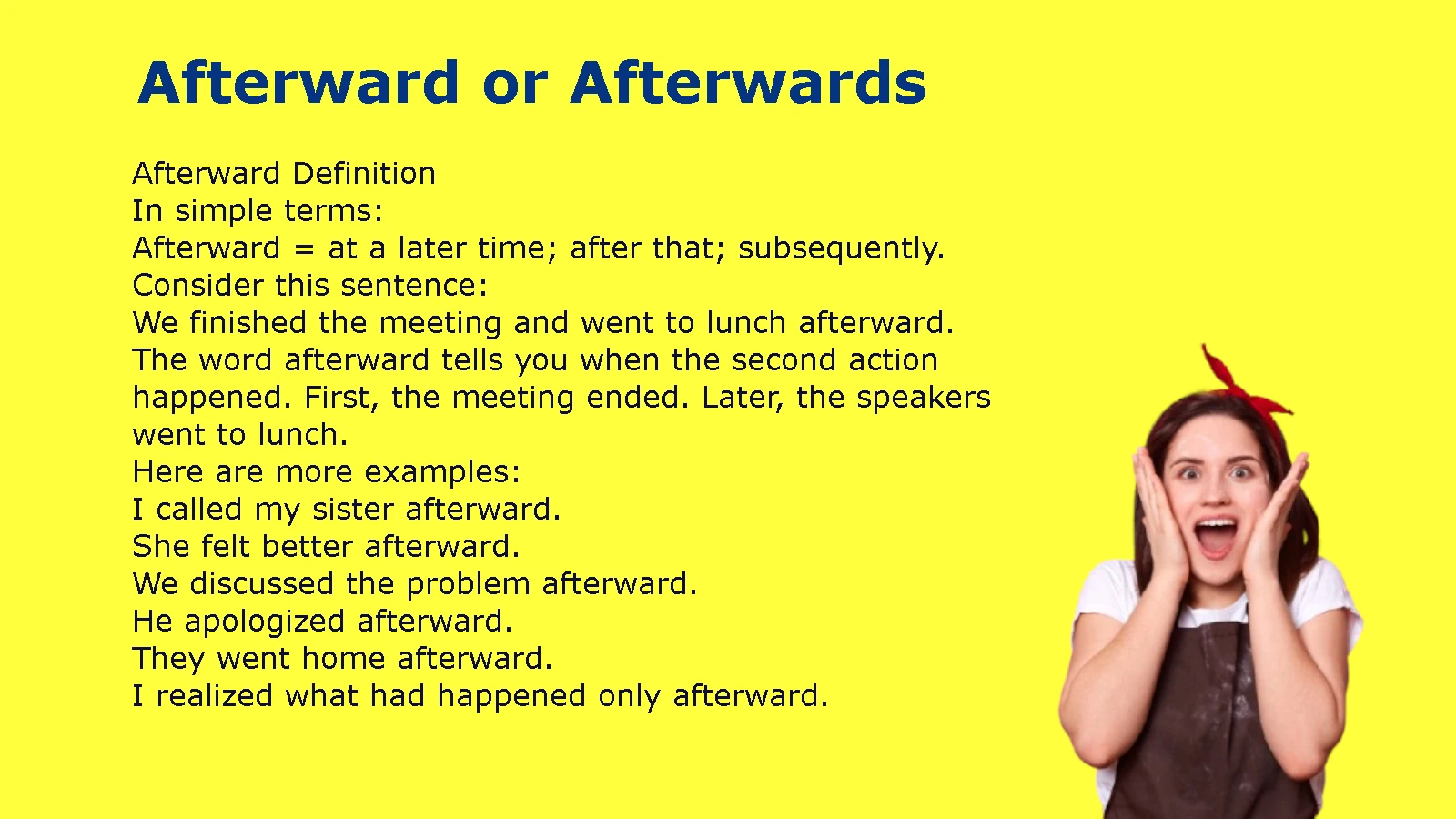
Afterward Definition
In simple terms:
Afterward = at a later time; after that; subsequently.
Consider this sentence:
We finished the meeting and went to lunch afterward.
The word afterward tells you when the second action happened. First, the meeting ended. Later, the speakers went to lunch.
Here are more examples:
- I called my sister afterward.
- She felt better afterward.
- We discussed the problem afterward.
- He apologized afterward.
- They went home afterward.
- I realized what had happened only afterward.
In each sentence, afterward connects an action or state to an earlier point in time.
What Part of Speech Is “Afterward”?
Afterward is an adverb.
An adverb can modify a verb, adjective, another adverb, or sometimes an entire clause. In this case, afterward provides information about time.
Compare:
We talked.
with:
We talked afterward.
The second sentence tells you when the conversation happened.
You can also place afterward at different points in a sentence:
Afterward, we went home.
We went home afterward.
We talked about the experience shortly afterward.
The position can change for emphasis or rhythm without changing the fundamental meaning.
What Does “Afterwards” Mean?
Afterwards is also an adverb meaning at a later time, after that, or subsequently.
Cambridge identifies afterwards as mainly UK usage and notes that US English usually uses afterward. Oxford likewise describes it as especially British English.
Afterwards Definition
In plain English:
Afterwards = at a later time; after something else has happened.
For example:
We had dinner and went for a walk afterwards.
The word tells us that the walk happened after dinner.
More examples include:
- She called me afterwards.
- We talked about it afterwards.
- He regretted the decision afterwards.
- They went out for coffee afterwards.
- I understood the situation better afterwards.
- The students discussed the lecture afterwards.
The meaning is essentially identical to afterward.
Is “Afterwards” Grammatically Correct?
Yes.
There is nothing grammatically wrong with afterwards. It is a standard English adverb.
The important point is that regional preference is not the same thing as grammatical correctness.
A US reader may find afterwards somewhat more British-sounding, but that doesn’t make it incorrect.
Likewise, a British reader can understand and use afterward, even though afterwards is more characteristic of British English.
Afterward vs. Afterwards: What Is the Difference?
The central difference between afterward and afterwards is not meaning.
It is primarily regional usage.
Both words describe something happening after a previously mentioned time or event.
Compare:
We finished the project and celebrated afterward.
We finished the project and celebrated afterwards.
There is no meaningful difference in what these sentences communicate.
In both cases:
- The project was finished.
- The celebration happened later.
The only visible difference is the final s.
Why Does One Have an “S”?
English has several pairs that follow a similar pattern:
| Form without -s | Form with -s |
| toward | towards |
| forward | forwards |
| backward | backwards |
| afterward | afterwards |
These forms can vary by region and style.
The important thing is not to invent a meaning difference where none exists. The s in afterwards doesn’t mean that something happened multiple times, and it doesn’t turn the word into a plural.
Afterward vs. Afterwards in American English
If you’re writing in American English, afterward is generally the better default.
Cambridge’s American English entry identifies afterward as the US form and notes afterwards as an alternative.
You will naturally see afterward in:
- American business writing
- School assignments
- College essays
- News writing
- Websites
- Emails
- Technical documents
- Everyday American speech
- Fiction and nonfiction
For example:
I’ll call you afterward.
We can discuss the details afterward.
She went home afterward.
The company issued a statement shortly afterward.
If your audience is primarily American, afterward is the safest and most natural choice.
Is “Afterwards” Wrong in American English?
No.
That’s an important distinction.
American English uses afterward more commonly, but afterwards is still recognizable and grammatical English.
So this isn’t a situation like choosing a genuinely incorrect spelling.
Compare:
- ❌ afterwrd — misspelled
- ❌ afterword when you mean “later” — wrong word
- ✅ afterward — correct
- ✅ afterwards — correct
The choice between the final two largely depends on regional preference and style.
Afterward vs. Afterwards in British English
In British English, afterwards is the more typical form.
Oxford identifies afterwards as especially British and says North American English usually uses afterward. Oxford Learner’s Dictionaries
For example:
We went to the pub afterwards.
She called me afterwards.
They discussed the issue afterwards.
Shortly afterwards, the situation changed.
These sentences sound entirely natural in British English.
That doesn’t mean afterward is forbidden in British English. It isn’t. It simply isn’t the regional form most strongly associated with British usage.
A Practical US vs. UK Rule
Think of it this way:
US English → afterward
UK English → afterwards
It’s a useful guideline, not an absolute grammatical law.
If you’re writing for an organization with a specific style guide, follow its preferred form.
Afterward or Afterwards: Which One Should You Use?
The answer depends mainly on your audience and your chosen variety of English.
Use “Afterward” When Writing for Americans
Choose afterward if your content follows American English.
For example:
The researchers reviewed the data afterward.
We can talk about the contract afterward.
She sent me an email afterward.
This is especially useful if your website, publication, or other writing already follows US conventions.
Use “Afterwards” for British English
Choose afterwards when you’re deliberately writing in British English.
For example:
The researchers reviewed the data afterwards.
We can talk about the contract afterwards.
She sent me an email afterwards.
The surrounding language can reinforce the regional choice.
For instance, British English might use:
The organisation reviewed the results afterwards.
American English would more typically use:
The organization reviewed the results afterward.
The point isn’t that one sentence is grammatically superior. It’s about maintaining the variety of English you’re using.
What If You Write for an International Audience?
Either form can work.
However, consistency is valuable.
If you’ve chosen American English for the rest of your content, use afterward.
If you’ve chosen British English, use afterwards.
This creates a smoother reading experience and prevents your writing from looking stylistically inconsistent.
How to Use “Afterward” in a Sentence
Afterward can appear at the beginning, middle, or end of a sentence.
Afterward at the Beginning
Afterward, we went home.
Starting with afterward places emphasis on what happened next.
Another example:
Afterward, she realized that she had misunderstood the instructions.
This construction works particularly well when you’re describing a sequence of events.
Afterward at the End
This is extremely common:
We went home afterward.
I’ll call you afterward.
They talked about the incident afterward.
Putting the adverb at the end often sounds natural and conversational.
Afterward After Another Adverb
You can combine afterward with words that give a more precise sense of time:
- soon afterward
- shortly afterward
- immediately afterward
- sometime afterward
- long afterward
- not long afterward
For example:
The company changed its policy shortly afterward.
We heard the news and spoke to her immediately afterward.
They remained friends for years afterward.
Cambridge specifically uses phrases such as soon afterward and shortly afterward in its examples.
How to Use “Afterwards” in a Sentence
The same sentence patterns work with afterwards.
Afterwards at the Beginning
Afterwards, we went back to the hotel.
Afterwards, she explained what had happened.
This placement is common when you’re narrating events in chronological order.
Afterwards at the End
We went back to the hotel afterwards.
She explained everything afterwards.
They talked about the problem afterwards.
The final position is particularly natural in everyday speech.
Common Expressions With Afterwards
You can use afterwards with time modifiers such as:
- soon afterwards
- shortly afterwards
- immediately afterwards
- long afterwards
- not long afterwards
For example:
The meeting ended, and shortly afterwards the announcement was made.
Oxford’s examples include expressions such as shortly afterwards and not long afterwards, showing how naturally the word combines with time expressions. Oxford Learner’s Dictionaries
“Shortly Afterward” vs. “Shortly Afterwards”
Both expressions are correct.
The choice again depends largely on regional preference.
American English
The company announced the change, and shortly afterward the new policy took effect.
British English
The company announced the change, and shortly afterwards the new policy took effect.
Both mean:
The new policy took effect soon after the announcement.
There is no difference in the amount of time implied by the final s.
You can apply the same principle to other combinations:
| American-leaning form | British-leaning form |
| soon afterward | soon afterwards |
| shortly afterward | shortly afterwards |
| immediately afterward | immediately afterwards |
| right afterward | right afterwards |
| long afterward | long afterwards |
Afterward vs. Afterwards vs. After: What’s the Difference?
Things become more interesting when after enters the picture.
Although after can also refer to later time, it doesn’t always behave grammatically like afterward or afterwards.
“After” as a Preposition
You can put a noun phrase after after:
We went home after dinner.
She called me after the meeting.
Here, after is a preposition.
“After” as a Conjunction
You can also use after before a clause:
We went home after the meeting ended.
She called me after she finished work.
Cambridge explains that after can function as both a preposition and a conjunction when referring to something later in time.
“Afterward” as an Adverb
You don’t need to attach a noun directly to afterward:
We went home afterward.
You could also say:
We went home after the meeting.
But the structures are different.
A useful comparison is:
After the meeting, we went home.
We went home afterward.
The first construction identifies the event that establishes the time relationship. The second assumes that event is already understood.
Afterward vs. Later vs. Subsequently
These words overlap, but they’re not always interchangeable in tone.
Afterward
Afterward usually refers to a time following a particular event.
We went for coffee afterward.
The reference point is clear: after the event just mentioned.
Later
Later is broader.
I’ll call you later.
This doesn’t necessarily specify which event serves as the reference point.
It can mean at some future time or at a time following the present or another point.
Subsequently
Subsequently is more formal.
The company subsequently changed its policy.
It works particularly well in academic, legal, business, and formal explanatory writing.
Compare:
| Word | Typical meaning | Tone |
| afterward | After the event just mentioned | Neutral |
| afterwards | After the event just mentioned | Neutral |
| later | At a later time | Neutral/casual |
| subsequently | After a preceding event | Formal |
| after that | Following the event | Conversational |
Example Comparison
We had dinner and afterward watched a movie.
We had dinner and later watched a movie.
We had dinner and subsequently watched a movie.
All three can describe a later event, but the style and emphasis differ.
Afterward is especially natural when the sequence is already established.
Afterward vs. Afterword: Don’t Mix Them Up
One of the most important spelling distinctions is afterward vs. afterword.
These are completely different words.
Afterward
Afterward is an adverb meaning later.
We discussed the book afterward.
Afterword
Afterword is a noun referring to a section at the end of a book or other written work.
The author included an afterword explaining how the book was written.
The spelling difference is only one letter, but the meanings are unrelated.
| Word | Part of speech | Meaning | Example |
| afterward | Adverb | At a later time | We talked afterward. |
| afterwards | Adverb | At a later time | We talked afterwards. |
| afterword | Noun | Concluding section of a book | The author wrote an afterword. |
An Easy Way to Remember
Think:
afterward = when
afterword = book section
If you’re talking about when something happened, use afterward or afterwards.
If you’re talking about something written at the end of a book, use afterword.
Common Mistakes With Afterward and Afterwards
These words are easy to use once you understand the regional difference, but several mistakes still appear frequently.
Mistake: Thinking “Afterwards” Is Wrong
Some writers assume that the final s makes afterwards incorrect.
That’s false.
Afterwards is a standard English word.
It’s particularly common in British English.
Mistake: Thinking “Afterward” Is Only American
That’s also too simplistic.
Afterward is strongly associated with American English, but it isn’t an exclusively American word.
The distinction is about preference, not a rigid border.
Mistake: Treating the Final “S” as Meaningful
The s in afterwards doesn’t change the meaning.
It isn’t a plural ending.
It doesn’t indicate that several later events occurred.
These two sentences have the same basic meaning:
She called me afterward.
She called me afterwards.
Mistake: Using “Afterword” for “Later”
This is a genuine word-choice error.
Don’t write:
❌ We talked about it afterword.
Write:
✅ We talked about it afterward.
But this is correct:
✅ The author included an afterword.
Afterward or Afterwards in Formal Writing
Neither form is inherently more formal.
That’s worth emphasizing because some writers mistakenly believe afterwards sounds more sophisticated or afterward sounds more casual.
The main distinction is regional, not formal versus informal.
For American formal writing, use afterward:
The committee reviewed the proposal and issued a statement shortly afterward.
For British formal writing, afterwards is perfectly appropriate:
The committee reviewed the proposal and issued a statement shortly afterwards.
If you’re writing an academic paper, professional report, or business document, the most important consideration is consistency with the required English variety or style guide.
Afterward or Afterwards: Examples in Different Contexts
Seeing the words in context makes the distinction easier to remember.
Everyday Conversation
I’ll see you afterward.
I’ll see you afterwards.
Both work.
The first is more typical of American English; the second is especially natural in British English.
Workplace Communication
Let’s discuss the budget afterward.
We can review the results afterwards.
Both are grammatically sound.
Academic Writing
The researchers analyzed the samples afterward.
The researchers analyzed the samples afterwards.
Again, the choice depends on the English variety being followed.
Storytelling
She left the restaurant and immediately regretted it afterward.
She left the restaurant and immediately regretted it afterwards.
Both describe a later reaction.
Historical Writing
The government introduced new regulations shortly afterward.
The government introduced new regulations shortly afterwards.
The meaning remains unchanged.
A Practical Case Study: Choosing the Right Form for a US Website
Imagine you’re editing an American English website.
Your draft contains these sentences:
We interviewed the customer afterwards.
The team reviewed the results afterward.
The company published an update afterwards.
Nothing here is grammatically disastrous. However, the page switches between the two forms.
If the website consistently uses American English, a cleaner editorial choice would be:
We interviewed the customer afterward.
The team reviewed the results afterward.
The company published an update afterward.
The improvement isn’t about correcting a grammatical error. It’s about creating a consistent editorial voice.
Now imagine the same article is written for a British publication. In that case, keeping afterwards throughout would be entirely reasonable.
This illustrates an important writing principle:
Consistency often matters more than choosing between two equally valid forms.
A Useful Memory Trick for Afterward vs. Afterwards
If you’re writing American English, remember:
American English → afterward
If you’re writing British English:
British English → afterwards
You can also remember the broader pattern:
- US: toward
- UK: towards
- US: forward
- UK: forwards
- US: backward
- UK: backwards
- US: afterward
- UK: afterwards
This isn’t a rule that applies perfectly to every English-speaking region or every publication. It’s simply a useful pattern for remembering common preferences.
Afterward or Afterwards: Quick Decision Guide
When you’re stuck, ask yourself three questions.
Are You Writing American English?
If yes, choose:
afterward
Are You Writing British English?
If yes, choose:
afterwards
Does Your Publication Have a Style Guide?
If yes, follow it.
A house style can override your personal preference because consistency across an entire publication matters.
What If You Already Used the Other Form?
Don’t panic.
If you wrote afterwards in an American-English article, you haven’t necessarily made a grammatical error.
If you wrote afterward in a British-English article, the word is still understandable and valid.
The goal is to match your audience and maintain consistency.
Afterward or Afterwards: Comparison Table
Here’s the entire distinction at a glance:
| Question | Afterward | Afterwards |
| Is it correct? | Yes | Yes |
| Meaning | At a later time | At a later time |
| Part of speech | Adverb | Adverb |
| US preference | Yes | Less common |
| UK preference | Less common | Yes |
| Formal? | Neutral | Neutral |
| Informal? | Can be used | Can be used |
| Meaning changes with the “s”? | No | No |
| Means “later”? | Yes | Yes |
| Confused with afterword? | Sometimes | Sometimes |
The simplest rule remains:
Afterward is the usual American form; afterwards is especially common in British English.
Practice Quiz: Afterward or Afterwards?
Test yourself with these examples.
Fill in the Blank
We went to the restaurant and had coffee ________.
Answer: afterward or afterwards
Both are correct. Choose according to your preferred English variety.
She called me shortly ________ to explain what happened.
Answer: afterward or afterwards
Both forms work.
The meeting ended, and everyone left ________.
Answer: afterward or afterwards
Again, either form is grammatically correct.
The author included an ________ at the end of the book.
Answer: afterword
This one is different. You’re referring to a concluding section of a book, not a later event.
We discussed the issue ________ the meeting.
Answer: after
Here, after is followed by the noun phrase the meeting. You could also say:
We discussed the issue afterward.
But the grammatical structures differ.
Frequently Asked Questions About Afterward or Afterwards
Is “afterward” or “afterwards” correct?
Both are correct. They are adverbs meaning “at a later time” or “after that.” The primary distinction is regional preference. American English generally favors afterward, while British English commonly uses afterwards.
Is “afterward” more common in American English?
Yes. Afterward is the usual American English form. Cambridge labels it as US usage and notes afterwards as mainly UK.
Is “afterwards” British English?
Afterwards is especially common in British English. Oxford identifies it as especially British, while Cambridge labels it mainly UK. Oxford Learner’s Dictionaries
Can Americans use “afterwards”?
Yes. Americans can use afterwards, and the meaning is clear. However, afterward is generally the more typical choice in American English.
Can British people use “afterward”?
Yes. Afterward is not grammatically forbidden in British English. Afterwards is simply the more characteristic British form.
Is “afterward” more formal than “afterwards”?
No. Neither word is inherently more formal.
The main difference is regional usage, not formality.
Do “afterward” and “afterwards” have the same meaning?
Yes. In ordinary usage, both mean later, after that, or at a later time.
For example:
We talked afterward.
and
We talked afterwards.
mean essentially the same thing.
Is “afterword” the same as “afterward”?
No.
Afterward means at a later time.
Afterword is a noun for a concluding section of a book or other written work.
Should I use “afterward” in an American English essay?
Yes. Afterward is the natural default for American English writing.
Should I use “afterwards” in a British English essay?
Yes. Afterwards is a natural choice for British English.
Which is better for SEO content?
If your content targets a US audience and follows American English, afterward is generally the better default. You can still mention afterwards naturally because people search for both forms.
For an article targeting the query “afterward or afterwards,” covering both forms is actually useful because the searcher is specifically trying to understand the distinction.
Final Verdict: Afterward or Afterwards?
The answer is refreshingly simple:
Afterward and afterwards are both correct.
They are both adverbs that mean “at a later time,” “after that,” or “subsequently.” The main distinction is regional.
- Afterward is generally preferred in American English.
- Afterwards is especially common in British English.
- Neither form is inherently more formal.
- The final s does not change the basic meaning.
- Both can appear at the beginning or end of a sentence.
- Afterword is different because it refers to a concluding section of a book.
If you’re writing in US English, use afterward as your default:
We discussed the issue afterward.
If you’re writing in British English, afterwards is often the more natural choice:
We discussed the issue afterwards.
Most importantly, don’t treat this as a battle between a “right” word and a “wrong” word. It’s mainly a matter of regional English and editorial consistency. Once you know your audience, the choice becomes easy.
Need a quick rule to remember?
US English: afterward.
UK English: afterwards.
Book section: afterword.
That three-part distinction will keep you out of trouble in almost every situation.