Backward and backwards are both correct English words, but their use can vary depending on the context, sentence structure, and variety of English you’re using. If you’ve come across “backward” and “backwards” and wondered which one is correct, the difference is mainly related to how the word functions and regional usage, especially in American and British English.
The backward or backwards meaning generally refers to moving, facing, or looking toward the rear or in the opposite direction. Backward can function as both an adjective and an adverb, while backwards is most commonly used as an adverb. In American English, “backward” is generally preferred, while “backwards” is also common and correct, particularly in British English. Related expressions include move backward, walk backward, step backward, backward movement, and backwards and forwards.
In this guide, you’ll learn the difference between “backward” and “backwards,” which spelling is correct, when to use each word, and whether “backward” or “backwards” is preferred in American and British English. You’ll also see clear examples to help you choose the right form naturally and confidently.
By the end, you’ll know exactly when to use backward or backwards and why both forms can be correct depending on the sentence and variety of English.
Backward or Backwards: Which One Is Correct?
Both “backward” and “backwards” are correct.
The main distinction comes from regional preference and grammatical function.
| Situation | Preferred form | Example |
| American English adverb | backward | She stepped backward. |
| British English adverb | backwards | She stepped backwards. |
| Adjective before a noun | backward | He took a backward step. |
| Reverse direction | Both | The car moved backward/backwards. |
| Reverse order | Both | Count backward/backwards. |
| Toward the past | Both | Looking backward/backwards can be useful. |
| Regressive movement | Both | The policy was a step backward/backwards. |
Cambridge identifies backward as mainly U.S. when used as an adverb and backwards as mainly U.K. The dictionary also recognizes backward as an adjective. Cambridge Dictionary
So if you’re writing for an American audience, backward is usually the safest default.
If you’re writing in British English, backwards is often more natural when the word functions as an adverb.
The Quick Rule
You can remember the distinction this way:
American English: usually backward
British English: usually backwards as an adverb
Before a noun: normally backward
For example:
- She moved backward. — American English
- She moved backwards. — British English
- She made a backward movement. — adjective
There is no need to treat backwards as an error. It is a standard English adverb, especially in British usage. Collins Dictionary
What Does “Backward” Mean?
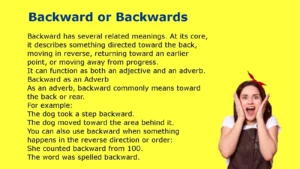
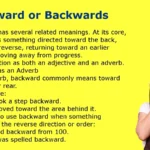
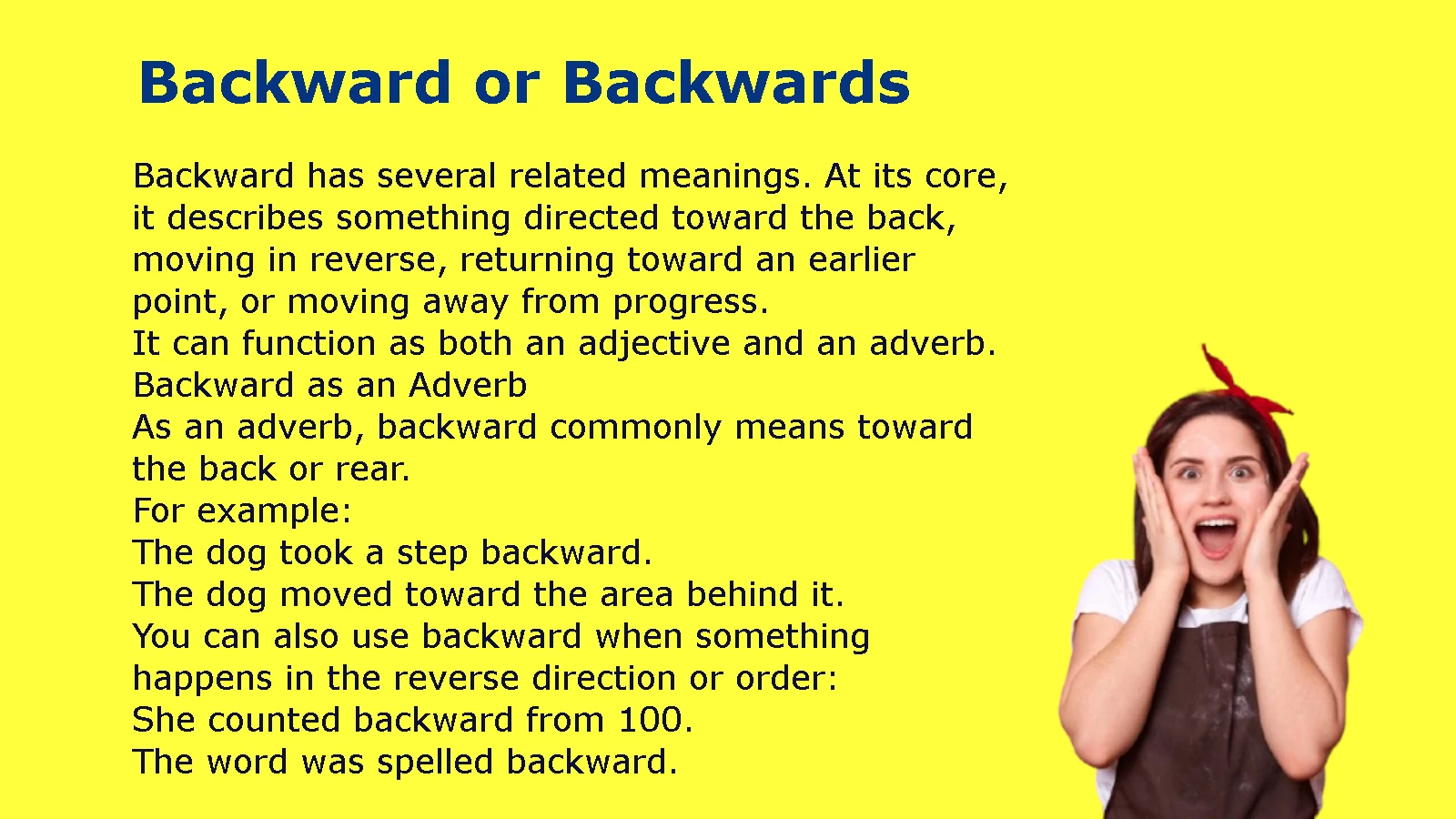
Backward has several related meanings. At its core, it describes something directed toward the back, moving in reverse, returning toward an earlier point, or moving away from progress.
It can function as both an adjective and an adverb.
Backward as an Adverb
As an adverb, backward commonly means toward the back or rear.
For example:
The dog took a step backward.
The dog moved toward the area behind it.
You can also use backward when something happens in the reverse direction or order:
- She counted backward from 100.
- The word was spelled backward.
- The movie moves backward through time.
- He leaned backward to avoid the ball.
- The car rolled backward down the driveway.
Cambridge defines the adverb as referring to movement in the direction opposite the one you’re facing or the usual direction. It also gives examples involving counting and reverse orientation. Cambridge Dictionary
Backward as an Adjective
Backward can also modify a noun.
Consider:
She gave him a backward glance.
Here, backward describes the noun glance. It tells you the direction of the glance.
Other examples include:
- a backward step
- a backward movement
- a backward glance
- a backward journey
- a backward somersault
- a backward look
- backward compatibility
Oxford lists backward as an adjective meaning directed or moving toward the back. It also recognizes figurative meanings associated with regression or a lack of progress. Oxford Learner’s Dictionaries
Backward Can Also Mean “Regressive”
The word isn’t limited to physical movement.
You can use backward metaphorically to describe something that represents a loss of progress.
For example:
The new policy was a backward step for the organization.
The organization hasn’t literally walked backward. Instead, the policy represents a move away from improvement.
Other examples include:
- The decision was a backward step.
- The country appeared to be moving backward economically.
- Cutting essential services could be a backward move.
- The company has taken a backward approach to technology.
Collins similarly lists backward for movement toward a less advanced or worse state. Collins Dictionary
A Note About Older Uses of “Backward”
You may encounter dictionaries that list an older sense of backward referring to someone having difficulty learning. Modern dictionaries mark this usage as offensive or old-fashioned. Oxford specifically recommends avoiding that terminology and using respectful, accurate language such as having a learning disability when appropriate. Oxford Learner’s Dictionaries
The word can still be perfectly ordinary when it describes direction, progress, technology, or development, but context matters.
What Does “Backwards” Mean?
Backwards is primarily used as an adverb. It has essentially the same core directional meanings as backward.
For example:
She walked backwards toward the door.
She moved toward the rear while facing in the opposite direction.
Oxford defines backwards as movement toward a position behind you and also uses it for doing something in the opposite direction or order. Oxford Learner’s Dictionaries
Backwards Means “Toward the Back”
This is probably the most common physical meaning.
Examples:
- He fell backwards.
- She stepped backwards.
- The child walked backwards.
- The dancer moved backwards across the stage.
- The chair tipped backwards.
- The car rolled backwards.
In American English, you could replace each of these with backward without changing the meaning:
- He fell backward.
- She stepped backward.
- The child walked backward.
The difference is primarily one of regional preference.
Backwards Means “In Reverse”
You can also use backwards when something occurs in the opposite order from normal.
For example:
The word “LIVE” is “EVIL” spelled backwards.
Other examples:
- The video was played backwards.
- She read the sentence backwards.
- The instructions were listed backwards.
- He counted backwards from 50.
- The story moves backwards through time.
Oxford specifically includes the sense of doing something in the opposite direction from the usual one. Oxford Learner’s Dictionaries
Backwards Can Describe Regression
Like backward, backwards can have a figurative meaning involving regression.
For example:
The decision feels like a step backwards.
Here, nobody is physically walking. The phrase means that the decision represents a loss of progress.
You might also say:
- The industry is moving backwards.
- The reforms could push the country backwards.
- Cutting the program would take us backwards.
- The company has gone backwards since the leadership change.
Again, American English commonly uses backward in these contexts instead.
Backward vs. Backwards: What’s the Difference?
The simplest way to understand backward vs. backwards is to separate grammar from regional usage.
The two forms are closely related and often interchangeable when they function as adverbs.
Comparison Table
| Feature | Backward | Backwards |
| Part of speech | Adjective and adverb | Primarily adverb |
| Basic meaning | Toward the back or in reverse | Toward the back or in reverse |
| American English | Very common | Less common |
| British English | Common as adjective; also used as adverb | Very common as adverb |
| Adjective use | Standard | Less typical |
| Physical movement | Correct | Correct |
| Reverse order | Correct | Correct |
| Figurative regression | Correct | Correct |
| Best U.S. default | Yes | Usually no need |
| Best U.K. adverbial default | Acceptable | Yes |
The American Heritage Dictionary notes that -ward and -wards variants are both accepted for many directional words, while the -ward form is more common in American English and -wards more common in British English. American Heritage Dictionary
That’s an important point: the extra s doesn’t automatically make a word incorrect.
Backward or Backwards in American English
If you’re writing American English, choose backward as your default adverb.
For example:
The truck moved backward.
She took a step backward.
He looked backward before crossing the street.
The children counted backward from ten.
The company appears to be moving backward.
Cambridge labels the adverb backward as mainly U.S. and lists backwards as the mainly U.K. equivalent. Cambridge Dictionary
This doesn’t mean an American speaker will misunderstand backwards. They won’t. It simply means backward fits conventional American usage more naturally.
Why American English Prefers “Backward”
American English frequently favors the shorter -ward form in directional words.
You can see the same pattern in:
- toward
- upward
- downward
- forward
- backward
British English often uses:
- towards
- upwards
- downwards
- forwards
- backwards
But don’t turn this into an absolute rule. English usage varies from word to word and from speaker to speaker. The American Heritage Dictionary notes that the distinction is a tendency rather than a rigid grammatical law. American Heritage Dictionary
Backward or Backwards in British English
In British English, backwards is especially common when the word functions as an adverb.
For example:
She walked backwards toward the door.
He fell backwards into the chair.
They counted backwards from 100.
The car rolled backwards.
She looked backwards over her shoulder.
Cambridge labels backwards as mainly UK and explicitly notes that U.S. English usually uses backward. Cambridge Dictionary
British English speakers can still use backward as an adverb. It isn’t an error. Collins describes the British adverb backward as a variant of backwards. Collins Dictionary
British English Example
Consider:
The boy stepped backwards.
This sounds completely natural in British English.
An American writer would more likely write:
The boy stepped backward.
Neither sentence changes the underlying meaning.
Is “Backwards” Grammatically Correct?
Yes.
This is one of the biggest misconceptions surrounding the word.
Some people assume that because backward doesn’t have an s, it must be the only grammatically correct form. That’s not true.
Backwards is a standard adverb, particularly in British English. Cambridge, Oxford, and Collins all recognize it. Cambridge Dictionary
So these are all grammatical:
- She walked backward.
- She walked backwards.
- He fell backward.
- He fell backwards.
- They counted backward.
- They counted backwards.
The best choice depends largely on the variety of English you’re using.
Is “Backward” an Adjective or an Adverb?
It can be either.
This is an important distinction because many explanations oversimplify the issue.
“Backward” as an Adjective
When backward modifies a noun, it functions as an adjective:
a backward glance
a backward somersault
backward compatibility
Oxford identifies this adjectival use for something directed or moving toward the back. Oxford Learner’s Dictionaries
“Backward” as an Adverb
When it modifies a verb or describes how an action occurs, it can function as an adverb:
She stepped backward.
He leaned backward.
The car rolled backward.
They counted backward.
This dual function is one reason backward is so useful in American English.
Can “Backwards” Be an Adjective?
This question has a slightly more complicated answer.
In traditional usage, backward is the normal adjective:
a backward glance
a backward step
However, dictionaries also record backwards in some attributive uses. Collins, for example, gives “a backwards glance” as an adjective use. Collins Dictionary
So saying that backwards can never modify a noun is too absolute.
Still, if you’re writing polished, formal English and want the least controversial choice, backward is the safer adjective:
a backward glance
rather than:
a backwards glance
This is especially useful for professional, academic, and edited writing.
“Step Backward” or “Step Backwards”?
Both are correct.
The choice depends mainly on regional English.
American English
Take a step backward.
British English
Take a step backwards.
The word functions adverbially in these sentences because it describes the direction of the stepping action.
However, compare that with:
It was a backward step.
Here, backward modifies step, so the adjective form is the standard choice.
This gives you a useful contrast:
| Sentence | Function |
| Take a step backward. | Adverb |
| Take a step backwards. | Adverb |
| It was a backward step. | Adjective |
| It was a backwards step. | Less conventional; avoid in formal writing |
“Move Backward” or “Move Backwards”?
Again, both are correct.
The car moved backward.
The car moved backwards.
The first is especially natural in American English. The second is especially natural in British English.
Neither changes the basic meaning.
You can apply the same principle to other verbs:
- walk backward/backwards
- step backward/backwards
- fall backward/backwards
- lean backward/backwards
- move backward/backwards
- roll backward/backwards
- slide backward/backwards
- jump backward/backwards
Example in Context
Imagine a basketball coach telling a player:
“Move backward and keep your eyes on the ball.”
That sounds natural in American English.
A British coach could just as naturally say:
“Move backwards and keep your eyes on the ball.”
The instruction is identical.
“Look Backward” or “Look Backwards”?
Both are possible.
She looked backward.
She looked backwards.
Again, American English generally favors backward, while British English often favors backwards as an adverb. Cambridge Dictionary
But there’s another construction worth learning:
She gave him a backward glance.
Here, backward is an adjective.
That makes the distinction easy to see:
- look backward → adverb
- backward glance → adjective
Backward vs. Backwards vs. Back
Don’t confuse backward or backwards with simply back.
Although these words overlap, they can express different ideas.
“Walk Backward”
This describes the direction of movement.
She walked backward down the hallway.
She is moving in reverse rather than walking forward.
“Walk Back”
This often means return.
She walked back to the office.
The person returned to the office.
That doesn’t necessarily mean she walked backward. She could have walked normally, facing forward.
This is an important distinction:
Backward describes direction or orientation.
Back can describe returning to a previous place or state.
“Go Backward” vs. “Go Back”
Consider these examples:
The car went backward.
The car moved toward the rear.
The driver went back to the garage.
The driver returned to the garage.
The two constructions aren’t interchangeable in every context.
Backward or Backwards When Something Is Reversed?
Both forms can describe something arranged in reverse.
Examples:
- The word is spelled backward.
- The word is spelled backwards.
- The image appears backward.
- The image appears backwards.
- The instructions seem to be written backward.
- The instructions seem to be written backwards.
Oxford gives examples such as words being written or spelled backwards and journeys moving backwards through time. Oxford Learner’s Dictionaries
Example: Reading in Reverse
Suppose the word is:
STRESSED
Spelled backward, it becomes:
DESSERTS
The action is happening in reverse order, so either backward or backwards can describe it:
“STRESSED” is “DESSERTS” spelled backward.
“STRESSED” is “DESSERTS” spelled backwards.
For American English, the first version is the more natural choice.
Backward or Backwards When Talking About Time?
Both words can describe movement toward the past.
For example:
The documentary moves backward through history.
British English can use:
The documentary moves backwards through history.
You can also say:
- looking backward at history
- looking backwards at history
- moving backward through time
- moving backwards through time
- thinking backward from the result
- thinking backwards from the result
The underlying concept is the same: you’re moving mentally or chronologically toward an earlier point.
Backward or Backwards for Regression?
Both forms can also describe a decline in progress.
For example:
The decision was a step backward.
Or, especially in British English:
The decision was a step backwards.
Cambridge gives “a step backward” as an example of something returning to an older or less effective state, while Oxford gives “a step backwards” with the same basic meaning. Cambridge Dictionary
This usage appears frequently in discussions about:
- politics
- technology
- education
- business
- social policy
- scientific progress
- economic development
Examples
Cutting the research budget could be a backward step.
Removing the safety standards would take the industry backwards.
The company has taken a backward step in customer service.
The decision could push the project backwards by several months.
The choice again reflects regional preference more than a difference in meaning.
Backward Compatibility: Why the Short Form Matters
One particularly common expression is backward compatibility.
In technology, backward compatibility means that a newer system can work with older software, hardware, files, formats, or standards.
For example:
The new console offers backward compatibility with older games.
Here, backward is an adjective modifying compatibility.
You would not normally replace it with backwards in this established technical expression.
Other examples include:
- backward-compatible software
- backward-compatible hardware
- backward-compatible systems
- backward-compatible formats
This is a useful example because it demonstrates why learning the adjective/adverb distinction matters.
Backward and Backwards in Common Expressions
Several established expressions use these words.
Backward and Forward
You may see:
back and forth
or the more formal:
backward and forward
In British English, you may encounter:
backwards and forwards
Oxford lists backwards and forwards as an expression for moving repeatedly between positions or directions. Oxford Learner’s Dictionaries
Bend Over Backward
American English commonly uses:
bend over backward
meaning to make a very great effort to help someone or accomplish something.
For example:
We bent over backward to accommodate the customer.
British English commonly uses:
bend over backwards
Both are established forms.
Know Something Backwards
British English frequently uses:
I know the play backwards.
This means knowing something extremely well.
The expression can also appear as:
know something backward
particularly in American usage, although regional preferences apply.
Backward vs. Backwards: Common Mistakes
Mistake: “Backwards Is Wrong”
Incorrect assumption.
Backwards is a standard English word. It is especially common as an adverb in British English. Cambridge Dictionary
Mistake: “Backward Is Only an Adjective”
Also incorrect.
Backward can be an adjective or an adverb.
a backward glance — adjective
look backward — adverb
Cambridge explicitly identifies both functions. Cambridge Dictionary
Mistake: Using “Backwards” Everywhere in American English
This isn’t grammatically wrong, but it can sound less natural in standard American usage.
If you’re writing for a U.S. audience, backward is usually the better default.
Mistake: Assuming the Extra “S” Changes the Meaning
Usually, it doesn’t.
Compare:
She stepped backward.
She stepped backwards.
The meaning is essentially identical.
The major distinction is regional usage, not a major semantic difference.
Backward or Backwards: Examples in Sentences
Here are practical examples showing how the words work in different contexts.
Physical Movement
- The boy stepped backward.
- The boy stepped backwards.
- She fell backward onto the grass.
- She fell backwards onto the grass.
- The vehicle rolled backward.
- The vehicle rolled backwards.
Reverse Order
- Count backward from 100.
- Count backwards from 100.
- The machine was running backward.
- The video was playing backwards.
- The letters were written backward.
Time
- The story moves backward through time.
- The story moves backwards through time.
- Looking backward can help us understand the mistake.
- Looking backwards can reveal patterns in history.
Figurative Progress
- The decision was a step backward.
- The decision was a step backwards.
- The company seems to be moving backward.
- The company seems to be moving backwards.
Adjective Use
- He gave her a backward glance.
- It was a backward step.
- The gymnast performed a backward somersault.
- The system provides backward compatibility.
- They took a backward approach to the problem.
Backward or Backwards: A Simple Decision Guide
When you’re unsure, use this quick process.
If You’re Writing American English
Choose backward in most cases:
She walked backward.
He fell backward.
They counted backward.
If You’re Writing British English
Use backwards naturally when it functions as an adverb:
She walked backwards.
He fell backwards.
They counted backwards.
If the Word Modifies a Noun
Prefer backward:
a backward glance
a backward step
backward compatibility
If You’re Writing for an International Audience
Consistency matters more than obsessing over the choice.
If the rest of your article uses American English, choose backward.
If you’re deliberately writing in British English, backwards may be the more natural adverb.
A Useful Comparison With Other -Ward Words
The backward/backwards distinction becomes easier when you see the broader pattern.
| Short form | -s form | Common U.S. preference | Common U.K. preference |
| backward | backwards | backward | backwards |
| toward | towards | toward | towards |
| forward | forwards | forward | forwards |
| upward | upwards | upward | upwards |
| downward | downwards | downward | downwards |
The pattern is real, but it isn’t an inflexible rule. The American Heritage Dictionary notes that individual words ending in -ward/-wards can have different usage patterns. American Heritage Dictionary
That’s why it’s better to learn backward/backwards as a usage pair rather than assuming every -ward word behaves identically.
A Quick Memory Trick for Backward vs. Backwards
Here’s an easy way to remember the distinction:
American English usually drops the S: backward.
British English often keeps the S: backwards.
Then add one more rule:
Before a noun, think “backward.”
So:
- backward glance
- backward step
- backward movement
- backward compatibility
For actions:
- move backward — American
- move backwards — British
This isn’t a perfect rule for every speaker, but it’s a reliable practical guide.
Backward or Backwards Quiz
Let’s see whether you’ve got it.
Fill in the Blank
She took a step ______ when the dog barked.
Answer: backward or backwards
Both are correct. Backward is more typical of American English, while backwards is more typical of British English.
The company made a ______ move by abandoning the project.
Answer: backward
Here, backward modifies move, so the adjective form is the natural choice.
The children counted ______ from twenty.
Answer: backward or backwards
Both are correct.
He gave the door a ______ glance.
Answer: backward
Here, backward modifies glance.
The dancer fell ______ onto the stage.
Answer: backward or backwards
Both are grammatically acceptable. Regional preference determines which sounds more natural.
Frequently Asked Questions About Backward or Backwards
Is “backward” or “backwards” correct?
Both are correct. Backward is generally more common as an adverb in American English, while backwards is more common as an adverb in British English. Cambridge Dictionary
Is “backwards” grammatically correct?
Yes. Backwards is a standard adverb, particularly in British English. Major dictionaries such as Cambridge, Oxford, and Collins recognize it. Cambridge Dictionary
Should I use “backward” in American English?
Usually, yes. Backward is the standard American preference for the adverb.
For example:
She stepped backward.
Should I use “backwards” in British English?
Usually, yes when you’re using it as an adverb.
For example:
She stepped backwards.
British English also accepts backward as an adverb, so backwards isn’t mandatory. Collins Dictionary
Is “backward” an adjective?
Yes. For example:
It can also function as an adverb.
Is “backwards” an adjective?
It is primarily an adverb, but dictionaries record some adjective use, such as a backwards glance. Collins Dictionary
For formal writing, however, backward remains the safer adjective choice.
Is “step backward” correct?
Yes.
Take one step backward.
Step backwards is also correct, especially in British English.
Is “move backward” correct?
Yes.
Move backward slowly.
Move backwards is equally correct, with the latter particularly common in British English.
Is “look backwards” correct?
Yes. Look backwards is grammatically correct, especially in British English.
American English more commonly uses:
look backward
Is “backward” or “backwards” more common in America?
Backward is generally more common in American English when used as an adverb. Cambridge explicitly labels backward as mainly U.S. and backwards as mainly U.K. Cambridge Dictionary
Is “backward” or “backwards” more common in the UK?
Backwards is generally more common as an adverb in British English. Backward remains standard, especially as an adjective. Cambridge Dictionary
Is “backward” more formal than “backwards”?
Not necessarily. The difference is primarily regional and grammatical, not a simple formal-versus-informal distinction.
If you’re writing American English, backward is natural and standard. If you’re writing British English, backwards is often the natural adverb.
Final Takeaway: Backward or Backwards?
The answer is straightforward once you separate meaning, grammar, and regional preference.
Backward and backwards generally express the same ideas when they function as adverbs: moving toward the rear, moving in reverse, returning toward the past, or moving toward a less advanced state.
The biggest difference is regional:
- American English: backward is usually preferred as an adverb.
- British English: backwards is usually preferred as an adverb.
- Adjective before a noun: backward is the safest standard choice.
- Neither form is inherently wrong.
Think about these examples:
She walked backward. — American English
The company took a step backward. — American English
The company took a step backwards. — British English
The key isn’t to memorize a complicated rule. Instead, ask two questions: What variety of English am I writing? and Is the word describing an action or modifying a noun?
Once you make that distinction, backward vs. backwards becomes much easier to handle.
And if you’re writing for a U.S. audience, you can confidently make backward your default.