Tore vs torn comes down to one simple grammar rule: tore is the simple past tense of tear, while torn is its past participle. You use tore to describe an action that happened in the past, but you use torn with helping verbs such as have, has, had, and forms of be. Understanding the difference between tear, tore, and torn will help you write correct sentences, describe damaged paper, avoid common spelling mistakes, and distinguish the verb tear from the noun tear, which refers to a drop from the eye.
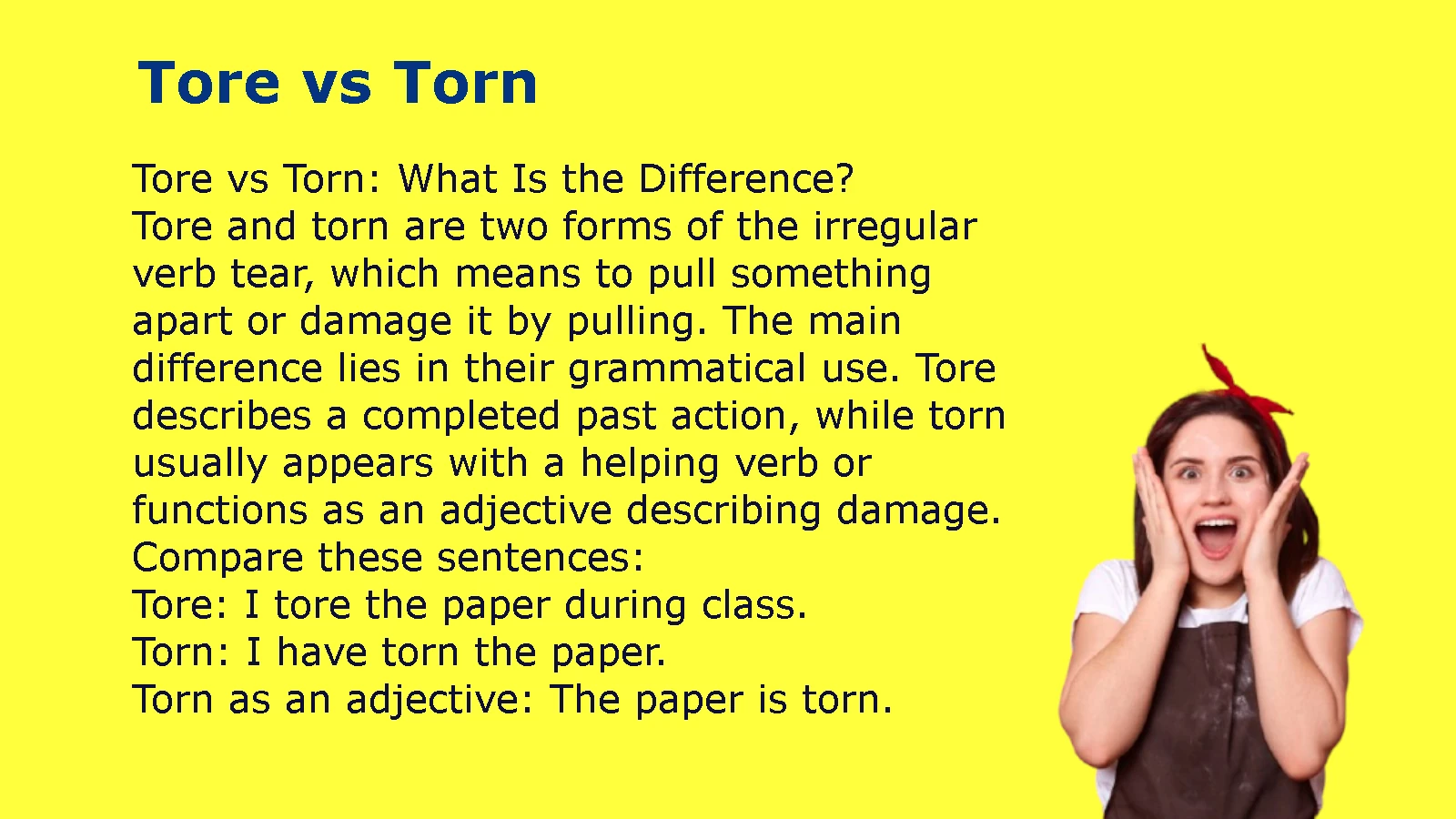
Tore vs Torn: What Is the Difference?
Tore and torn are two forms of the irregular verb tear, which means to pull something apart or damage it by pulling. The main difference lies in their grammatical use. Tore describes a completed past action, while torn usually appears with a helping verb or functions as an adjective describing damage.
Compare these sentences:
- Tore: I tore the paper during class.
- Torn: I have torn the paper.
- Torn as an adjective: The paper is torn.
All three sentences describe the same general action, but each uses a different grammatical structure.
| Word | Verb form | Meaning or function | Example |
| Tear | Base form (V1) | The basic action of ripping | I tear the paper. |
| Tore | Simple past (V2) | An action completed in the past | I tore the paper yesterday. |
| Torn | Past participle (V3) | Used with helping verbs or in passive constructions | I have torn the paper. |
| Torn | Adjective | Describes something ripped or damaged | The paper is torn. |
Tore Meaning and Examples
Tore is the simple past tense of tear. It describes an action that happened and finished in the past. You generally use it when you want to explain who ripped something, what they damaged, or how an object became separated.
For example, imagine that you accidentally rip a page while turning it. You could explain what happened by saying, “I tore the page while reading.”
Here are more examples:
- I tore the envelope while opening it.
- Sarah tore the photograph into two pieces.
- The dog tore my notebook during the night.
- He tore the old poster off the wall.
- The strong wind tore a hole in the tent.
- Maya tore the wrapping paper before opening her gift.
Notice that tore does not need a helping verb in these sentences. It works as the main verb in the simple past tense.
You can use tore with different subjects without changing its form:
- I tore the page.
- You tore the page.
- She tore the page.
- They tore the page.
The subject changes, but the past-tense form remains tore.
Torn Meaning and Examples
Torn is the past participle of tear. You usually use it with helping verbs to form perfect tenses or passive constructions. You can also use torn as an adjective when you want to describe something that has been ripped or damaged.
For example, “I have torn the page” uses torn with the helping verb have. The sentence connects a past action to the present situation.
Consider these examples:
- I have torn the paper by accident.
- She has torn the last page of the book.
- They had torn the contract before the meeting.
- The letter was torn into several pieces.
- His shirt is torn at the shoulder.
- The old map had been torn along the edges.
The word torn can also describe emotional conflict rather than physical damage.
For example:
- She felt torn between two career opportunities.
- He was torn between helping his friend and meeting his deadline.
In these expressions, torn means divided between competing feelings, choices, or responsibilities. The word comes from the same underlying idea of being pulled in different directions, although the meaning is figurative rather than physical.
Tore vs Torn Comparison Table
Use this table when you need to choose between the two words quickly.
| Sentence | Correct form | Why? |
| Yesterday, I ___ the paper. | Tore | The sentence uses the simple past tense. |
| I have ___ the paper. | Torn | The helping verb have requires a past participle. |
| The paper was ___. | Torn | The sentence uses a passive construction or describes a condition. |
| She had ___ the letter already. | Torn | The past perfect tense uses had plus a past participle. |
| The dog ___ my homework. | Tore | The sentence describes a completed past action. |
| My sleeve is ___. | Torn | The word describes the sleeve’s condition. |
Quick rule: If you are describing a completed past action without a helping verb, use tore. If the sentence calls for a past participle, use torn.
Tear, Tore, Torn: All Three Verb Forms Explained
The verb tear, tore, torn follows an irregular pattern. Unlike regular verbs such as walk, walked, walked, the verb tear changes its form rather than adding -ed to create the past tense and past participle.
Learning the three forms together makes it easier to use the verb correctly in everyday writing.
Tear (V1): Present Tense and Base Form
Tear is the base form of the verb. It means to rip, split, or pull something apart. You can use it in the simple present tense, after to, and after modal verbs such as will, can, and should.
Examples:
- I tear old documents before throwing them away.
- Please do not tear the pages from this book.
- She might tear the wrapping paper.
- They will tear down the damaged structure.
- He wants to tear the label off the bottle.
The simple present form changes to tears when the subject is a third-person singular noun or pronoun.
Compare:
- I tear the paper.
- You tear the paper.
- We tear the paper.
- She tears the paper.
- The machine tears the paper.
This rule applies to the present tense, not the simple past. You would say “She tears the paper every morning,” but “She tore the paper yesterday.”
Remember that tear has more than one meaning. In this article, the verb refers to ripping something, not the noun meaning a drop of liquid from the eye.
Tore (V2): Simple Past Tense
Tore is the second principal form of tear. Use it when an action happened in the past and you are presenting that action in the simple past tense.
Examples:
- I tore my notes while removing them from my bag.
- The child tore the paper into tiny pieces.
- We tore down the old decorations after the event.
- The cat tore a hole in the curtain.
- She tore the receipt by mistake.
You will often see tore alongside time expressions such as:
- Yesterday
- Last night
- Two days ago
- Last week
- During the meeting
- When I opened the package
For example, “I tore the paper yesterday” clearly identifies a past event.
However, you do not always need a time expression. The surrounding conversation may already establish when the action happened.
Important: Do not use torn as the simple past tense in a sentence such as “Yesterday, I torn the page.” The correct sentence is “Yesterday, I tore the page.”
Torn (V3): Past Participle
Torn is the third principal form of tear. It appears in perfect tenses, passive constructions, and some adjective phrases.
The past participle does not normally stand alone as the main verb in a standard simple past sentence. It needs the grammatical structure required by the sentence.
Examples with perfect tenses:
- I have torn the document.
- She has torn her notebook cover.
- They had torn the agreement before the lawyer arrived.
- We will have torn the old papers by tomorrow.
with passive constructions:
- The document was torn during the move.
- The pages were torn from the notebook.
- The banner has been torn by the wind.
Examples with adjectives:
- The torn paper lay on the floor.
- He wore a torn jacket.
- A torn page was missing from the book.
A useful distinction is that a past participle can help build a verb tense, while an adjective describes a quality or condition. In “I have torn the page,” torn forms part of the verb phrase. In “The torn page was on the desk,” it describes the page.
Tear Verb Forms V1, V2, V3 Table
Here is a complete reference for the three principal forms.
| Form | Grammar name | Example |
| V1: Tear | Base form | I tear the paper carefully. |
| V2: Tore | Simple past | I tore the paper yesterday. |
| V3: Torn | Past participle | I have torn the paper. |
| Present, third-person singular: Tears | Simple present | She tears the paper. |
| Present participle: Tearing | -ing form | She is tearing the paper. |
The principal forms remain tear – tore – torn. Other forms, such as tears and tearing, follow the normal rules for present-tense agreement and participles.
When Should You Use Tore vs Torn?
The easiest way to choose between tore and torn is to examine the structure around the word. Use torn when the sentence needs a past participle, such as after have, has, or had, or in a passive construction with a form of be.
Tore for a Completed Past Action
The simple past pattern is usually:
Subject + tore + object
The subject performs the action, and the object receives it.
Examples:
- Emma tore the letter after reading it.
- I tore my jeans on a sharp branch.
- The child tore the drawing by accident.
- The workers tore down the old fence.
- He tore the paper into four equal pieces.
You can also use tore without a direct object when the object is obvious from the context or when the verb is used intransitively.
For example, “The fabric tore when I pulled it.” Here, the fabric itself split. The sentence does not identify an external object that received the action.
The main point remains the same: tore expresses the simple past.
Use Torn With Have, Has, or Had
Use torn after have, has, or had when forming a perfect tense.
| Helping verb | Tense | Example |
| Have | Present perfect | I have torn the paper. |
| Has | Present perfect | She has torn the paper. |
| Had | Past perfect | He had torn the paper before I arrived. |
The present perfect often connects a past action to the present. For instance, “I have torn the paper” tells the listener that the paper has been ripped, without necessarily specifying when it happened.
The past perfect shows that one past event happened before another. “He had torn the paper before I arrived” places the tearing before the speaker’s arrival.
Compare these sentences:
- Simple past: She tore the letter this morning.
- Present perfect: She has torn the letter.
- Past perfect: She had torn the letter before the meeting.
Each sentence uses the correct form for its tense.
Use Torn in Passive Sentences
A passive construction changes the focus from the person performing an action to the person or thing affected by it.
A common pattern is:
Subject + form of be + torn
Examples:
- The paper was torn during the lesson.
- The documents were torn before anyone could read them.
- The letter has been torn into pieces.
- The poster is torn along one edge.
Compare the active and passive versions:
| Active sentence | Passive sentence |
| Liam tore the page. | The page was torn by Liam. |
| The wind tore the flag. | The flag was torn by the wind. |
| Someone tore the envelope. | The envelope was torn. |
The active sentence emphasizes the person or force that performed the action. The passive sentence emphasizes the damaged object or the result.
You do not always need to mention who caused the damage. “The page was torn” is complete and natural when the identity of the person responsible does not matter.
Is It Tore or Torn Apart?
Both tore apart and torn apart are correct, but they belong in different grammatical structures.
Use tore apart for a simple past action:
- The storm tore apart the roof.
- The dog tore apart the cushion.
- The argument tore apart their friendship.
Use torn apart when the sentence requires a past participle or an adjective:
- The roof was torn apart by the storm.
- The cushion had been torn apart.
- The family felt torn apart by the disagreement.
The phrase can describe physical destruction or emotional distress. In “The storm tore apart the roof,” the meaning is literal. In “The disagreement tore the family apart,” it is figurative.
The same grammar rule applies in both cases. The surrounding words determine whether you need tore or torn.
What Does Tore the Paper Mean?
Tore the paper means ripped or pulled the paper apart in the past. The phrase describes a completed action that damages the paper, creates a split, or separates it into pieces. The word tore identifies the past action, while the paper identifies the object affected.
For example, if someone accidentally rips a page while removing it from a notebook, you could say, “I tore the paper while taking it out.”
Tore the Paper in Everyday Sentences
Here are original examples that show how the phrase works in different situations.
- Accidental damage: I tore the paper when I pulled it out of my backpack.
- Deliberate action: She tore the paper into four pieces before throwing it away.
- Craft project: We tore the paper into strips for the art activity.
- Opening a package: He tore the paper wrapping to reveal the gift.
- Classroom situation: The student tore the paper while erasing a mistake.
- Office task: I tore the outdated document before putting it in the recycling bin.
Each sentence describes an action that happened in the past. That is why tore works in all six examples.
The phrase can also describe a more specific action. For instance, “She tore the paper in half” means she split it into two pieces, while “She tore the paper along the fold” identifies where the paper split.
Tore the Paper vs Torn Paper
The difference between tore the paper and torn paper involves both grammar and meaning.
| Phrase | Grammatical role | Example |
| Tore the paper | Simple past verb phrase | She tore the paper during class. |
| Has torn the paper | Perfect-tense verb phrase | She has torn the paper. |
| Was torn | Passive construction or description | The paper was torn yesterday. |
| Torn paper | Adjective plus noun | She used torn paper for the collage. |
Use “tore the paper” when the sentence describes what someone did. Use “torn paper” when you want to identify or describe paper that has already been ripped.
Consider this short example:
“Daniel tore the paper while making a model. He placed the torn paper on the table and used it to decorate the box.”
The first sentence describes Daniel’s action. The second describes the condition of the paper.
Is It Tare or Tear Paper?
Tear paper is the correct phrase when you mean to rip paper. Tare is a different word, commonly used to describe the weight of a container or packaging without its contents.
These words sound alike in some accents and contexts, but their meanings differ.
| Word | Meaning | Example |
| Tear | To rip or split something | Please do not tear the paper. |
| Tore | Past tense of tear | I tore the paper yesterday. |
| Torn | Past participle of tear | The paper is torn. |
| Tare | The weight of a container or packaging | The scale accounts for the tare weight of the empty box. |
In shipping, food production, and weighing applications, tare weight helps separate the weight of a container from the weight of its contents.
For example, if an empty container weighs 200 grams and the container plus its contents weighs 1,200 grams, the contents weigh 1,000 grams. The 200-gram container weight is the tare weight.
That meaning has nothing to do with ripping paper. If you want to describe damaging a sheet, use tear, tore, or torn according to the sentence structure.
Tear vs Tear: Why Does the Same Word Have Two Meanings?
The word tear has two common meanings in English. As a verb, it means to rip or pull something apart. As a noun, it refers to a drop of liquid produced by the eye. Although both words share the same spelling, they have different pronunciations and grammatical roles.
Tear Meaning To Rip
The verb tear, meaning to rip, is commonly pronounced /ter/ in American English. It describes pulling, splitting, or damaging something by force.
Examples:
- Please do not tear the book’s pages.
- I might tear the wrapping paper.
- The child likes to tear scrap paper into small shapes.
- Strong winds can tear fabric if it is already damaged.
Its irregular forms are:
- Present/base form: tear
- Simple past: tore
- Past participle: torn
For example, “I tear paper for crafts,” “I tore paper yesterday,” and “I have torn paper for this project” all use the same verb in different grammatical forms.
Tear Meaning a Drop From the Eye
The noun tear, meaning a drop of liquid from the eye, is commonly pronounced /tɪr/ in American English. It often appears in sentences about sadness, joy, irritation, or strong emotion.
Examples:
- A tear rolled down her cheek.
- He wiped a tear from his eye.
- The film brought a tear to my eye.
- A single tear fell onto the letter.
This noun does not follow the verb sequence tear, tore, torn. When you discuss an emotional response, you are generally talking about a tear or tears, not the action of ripping something.
Compare:
- “I tear the paper.” Here, tear is a verb meaning to rip.
- “A tear fell from her eye.” Here, tear is a noun referring to liquid from the eye.
The surrounding words make the intended meaning clear.
How Context Helps You Identify the Meaning
Context often reveals the meaning of tear even when the spelling stays the same.
| Sentence | Meaning | Part of speech |
| I tear old papers before recycling them. | Rip or split | Verb |
| A tear formed in her eye. | Drop of liquid | Noun |
| The paper tore when I pulled it. | Split or ripped | Verb, simple past |
| The torn paper covered the desk. | Damaged by ripping | Past participle used as an adjective |
The difference becomes easier to spot when you pay attention to sentence structure. If tear describes an action, it is a verb. If it names a drop from the eye, it is a noun.
Pronunciation can also help. However, when reading silently, grammar and context are often the fastest ways to determine the intended meaning.
Common Mistakes With Tore, Torn, and Tear
The most common errors happen when writers use the past tense and past participle interchangeably. Although tore and torn describe related actions, they do not serve the same grammatical purpose.
Using Torn Instead of Tore
Incorrect: Yesterday, I torn the page.
Correct: Yesterday, I tore the page.
The word yesterday places the action in the simple past. The sentence does not need a past participle, so tore is the correct choice.
More examples:
- Incorrect: She torn the envelope last night.
- Correct: She tore the envelope last night.
- Incorrect: The dog torn my notebook yesterday.
- Correct: The dog tore my notebook yesterday.
A quick way to check your sentence is to remove the time expression and look at the verb structure. If you are describing a completed past action without a helping verb, tore will usually be the correct form.
Using Tore Instead of Torn
Incorrect: I have tore the paper.
Correct: I have torn the paper.
The helping verb have requires the past participle in the present perfect tense. That form is torn, not tore.
More examples:
- Incorrect: She has tore her shirt.
- Correct: She has torn her shirt.
- Incorrect: They had tore the contract.
- Correct: They had torn the contract.
- Incorrect: The paper was tore.
- Correct: The paper was torn.
The same principle applies to has and had. Whenever these verbs form a perfect tense with tear, use torn.
Confusing Tare With Tear
Incorrect: Please tare this sheet of paper.
Correct: Please tear this sheet of paper.
Use tear when the intended action is ripping or splitting paper. Use tare when referring to the weight of an empty container or a related weighing adjustment.
For example, a shipping company might record the tare weight of a box before adding products. A teacher might ask students to tear colored paper into shapes for an art project.
The spelling depends on the meaning, not simply on how the word sounds.
Forgetting Subject–Verb Agreement
In the simple present tense, tear changes to tears with a third-person singular subject.
Correct examples:
- I tear the paper.
- You tear the paper.
- We tear the paper.
- They tear the paper.
- She tears the paper.
- The machine tears the paper.
However, tore does not change according to the subject in the simple past tense.
- I tore the paper.
- She tore the paper.
- The machine tore the paper.
- They tore the paper.
This makes the past tense easier to use. You only need to remember the irregular form tore, regardless of who performed the action.
Quick Rules for Remembering Tear, Tore, and Torn
If you often confuse these words, focus on the grammatical pattern instead of trying to memorize every possible sentence. The three principal forms each have a distinct role.
The Three-Form Memory Trick
Remember this simple sequence:
Tear → Tore → Torn
- Tear: The base form. “I tear paper for crafts.”
- Tore: The simple past. “I tore paper yesterday.”
- Torn: The past participle. “I have torn the paper.”
You can also use these quick checks:
- Does the sentence describe an action that happened yesterday? Consider tore.
- Does the sentence contain have, has, or had as part of a perfect tense? Use torn.
- Does the sentence describe a damaged object, as in “The page is torn”? Use torn.
- Does the sentence use the present tense with they? Use tears.
One caution: a form of be does not always signal the same meaning. In “The paper is torn,” torn describes a condition. In “The paper is being torn,” the phrase describes an action in progress. The correct form depends on the full structure, not just one word.
Practice: Choose Tore or Torn
Test your understanding with these five sentences. Fill each blank with tore or torn.
- She ___ the letter yesterday.
- I have ___ the receipt.
- The flag was ___ by the wind.
- They ___ the paper during class.
- He had ___ the envelope before I arrived.
Answer key
| Sentence | Correct answer | Explanation |
| She ___ the letter yesterday. | Tore | The sentence uses the simple past tense. |
| I have ___ the receipt. | Torn | Have requires the past participle. |
| The flag was ___ by the wind. | Torn | The sentence uses a passive construction. |
| They ___ the paper during class. | Tore | The sentence describes a past action. |
| He had ___ the envelope before I arrived. | Torn | Had forms the past perfect tense with the past participle. |
If you answered all five correctly, you understand the main distinction between the two forms. If you missed one, identify the helping verb or the tense before choosing your answer.
Frequently Asked Questions
Is It Tore or Torn?
Both words are correct, but they serve different grammatical roles. Tore is the simple past tense of tear, as in “I tore the page.” Torn is the past participle, as in “I have torn the page” or “The page is torn.”
Is Torn the Past Tense of Tear?
No. Tore is the simple past tense of tear, while torn is the past participle. You would write “She tore the letter yesterday” but “She has torn the letter.” The correct form depends on the sentence’s grammatical structure.
What Are the V1, V2, and V3 Forms of Tear?
The three principal forms are tear – tore – torn. V1 is the base form, V2 is the simple past, and V3 is the past participle. For example: “I tear paper,” “I tore paper,” and “I have torn paper.”
Is It Tore the Paper or Torn the Paper?
Use tore the paper to describe a simple past action, as in “He tore the paper yesterday.” Use torn the paper with an appropriate helping verb, as in “He has torn the paper.” You can also say “The paper is torn” to describe its condition.
Is It Tare or Tear Paper?
Use tear paper when you mean to rip it. Tare usually refers to the weight of a container or packaging without its contents. For example, “Please tear this page” is correct, while “Record the tare weight of the box” uses the other word correctly.
What Is the Difference Between Tear and Tear?
The word tear has two common meanings. As a verb, pronounced /ter/ in common American English, it means to rip something. As a noun, pronounced /tɪr/, it means a drop of liquid from the eye. Context and pronunciation distinguish the two meanings.
Conclusion: Remember the Difference Between Tore and Torn
The difference between tore vs torn becomes simple once you recognize the role each word plays in a sentence. Tore is the simple past tense of tear, while torn is the past participle used in perfect tenses, passive constructions, and adjective phrases.
Keep these examples in mind:
- Tear: I tear the paper.
- Tore: I tore the paper yesterday.
- Torn: I have torn the paper.
- Torn as a description: The paper is torn.
When you are unsure, check the words around the verb. If you are describing a simple past action, use tore. If the sentence needs a past participle, use torn. Also remember that tare has a separate meaning related to weight, while tear can refer either to ripping something or to a drop from the eye.