Could vs would is a common English grammar question because both words express ideas that are not always certain or direct. However, could usually describes ability, possibility, or an available option, while would often describes hypothetical results, willingness, or imagined situations. Understanding the difference helps you write clearer sentences, ask polite questions, and use conditional sentences correctly.
The difference between could vs would vs should becomes easier when you connect each modal verb to its purpose. Could expresses what is possible, would explains what might happen under a condition, and should gives advice or describes what is expected. Related comparisons, including could vs can, will vs would, and could vs might, follow the same principle: each modal verb adds a different meaning to the main verb.
This guide explains the meaning of could and would, provides original sentence examples, compares similar modal verbs, and shows you how to choose the right word in questions, everyday conversations, and hypothetical situations.
Could vs Would: What Is the Difference?
Could expresses ability, possibility, permission, or a polite request. Would expresses hypothetical results, willingness, past habits, or future events viewed from a past perspective. Although both verbs can make requests sound polite, they are not interchangeable in every sentence.
| Feature | Could | Would |
| Main meaning | Ability, possibility, or an option | Hypothetical result or willingness |
| Past use | Past ability in suitable contexts | Repeated past actions or future in the past |
| Possibility | We could take the train. | I would take the train if it were cheaper. |
| Polite request | Could you help me? | Would you help me? |
| Conditional sentence | If we left now, we could arrive early. | If we left now, we would arrive before noon. |
| Common question | Could this work? | Would this work better? |
The simplest way to remember the difference is to ask what the sentence communicates. Does it describe something possible, an ability, or an available choice? Could may fit. Does it describe an imagined result, a willingness to act, or what someone would do under certain circumstances? Would may fit.
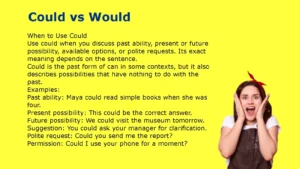
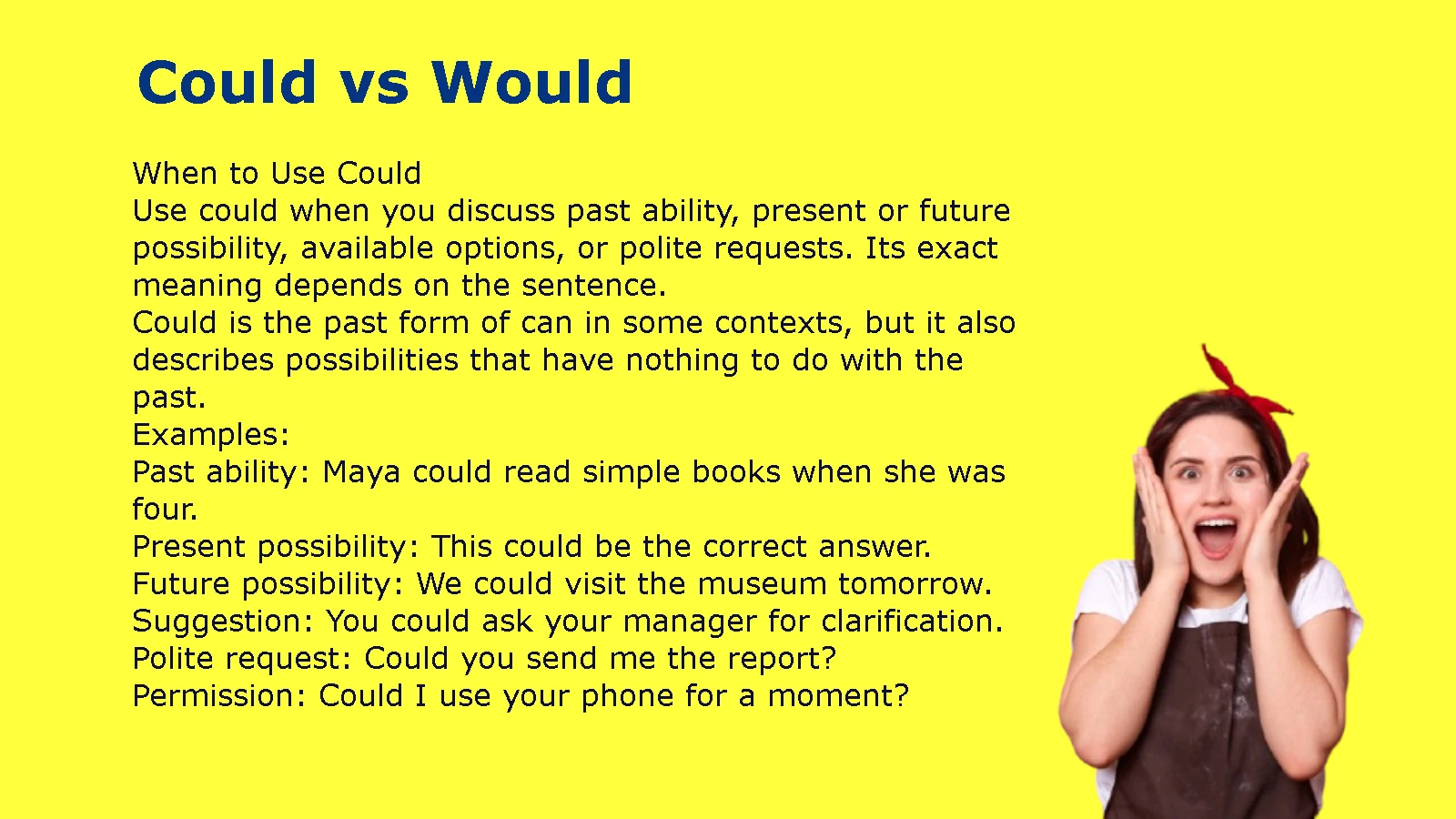
When to Use Could
Use could when you discuss past ability, present or future possibility, available options, or polite requests. Its exact meaning depends on the sentence.
Could is the past form of can in some contexts, but it also describes possibilities that have nothing to do with the past.
Examples:
- Past ability: Maya could read simple books when she was four.
- Present possibility: This could be the correct answer.
- Future possibility: We could visit the museum tomorrow.
- Suggestion: You could ask your manager for clarification.
- Polite request: Could you send me the report?
- Permission: Could I use your phone for a moment?
Notice that could does not always refer to something that happened before now. In “We could visit the museum tomorrow,” it presents a possible future plan.
When you want to emphasize a general ability in the present, use can instead.
- I can drive a car.
- I could drive a car when I was 17.
- I could drive there tomorrow if I had access to a car.
These sentences describe present ability, past ability, and a possible future action under a condition.
When to Use Would
Use would to describe hypothetical situations, willingness, polite requests, repeated past actions, and future events viewed from a past point in time.
Examples:
- Hypothetical situation: I would move abroad if I found a suitable job.
- Willingness: She would gladly help you.
- Polite request: Would you close the door?
- Future in the past: Daniel said he would arrive before lunch.
- Past habit: Every summer, we would visit our grandparents.
- Imagined result: A larger desk would make this room more comfortable.
In conditional sentences, would often describes the result of an imagined situation.
For example, “I would buy that laptop if I had enough money” describes a purchase that depends on a condition. The speaker is not simply saying that buying the laptop is possible. The speaker is explaining what they would do if the circumstances allowed it.
Could vs Would Examples in Everyday English
Comparing the two words in similar situations makes their differences easier to understand.
| With could | With would | Difference |
| We could eat outside. | We would eat outside if it stopped raining. | An available option versus a conditional action |
| I could help you tomorrow. | I would help you if I had more time. | Ability or availability versus willingness under a condition |
| Could you explain this rule? | Would you explain this rule? | A polite request that asks about possibility or willingness |
| This could solve the problem. | This would solve the problem if we applied it correctly. | A possible solution versus a predicted conditional result |
| She could join the meeting. | She would join the meeting if she were invited. | An available possibility versus a conditional response |
Consider a workplace example. Your colleague needs help preparing a presentation.
You might say, “I could review your slides this afternoon.” This presents reviewing the slides as an option.
However, you might say, “I would review your slides if I had enough time.” This emphasizes willingness but makes the action dependent on having enough time.
The surrounding words determine the precise meaning. Both verbs can express polite intentions, but could often emphasizes feasibility, while would often emphasizes willingness or a hypothetical outcome.
Could vs Would vs Should
Could describes ability, possibility, or an option. Would describes a hypothetical action, result, or willingness. Should expresses advice, expectation, or an appropriate course of action. These three modal verbs often appear in the same conversation, but each serves a different purpose.
| Modal verb | Main purpose | Example |
| Could | Possibility or available choice | We could leave early. |
| Would | Hypothetical action or result | I would leave early if I finished my work. |
| Should | Advice or expectation | We should leave early to avoid traffic. |
Imagine that you have an important examination tomorrow.
- You could study another chapter. This identifies an option.
- You would study another chapter if you had more energy. This describes a hypothetical action.
- You should study the main topics before the examination. This gives advice.
The words are related, but replacing one with another changes the meaning.
When to Use Could, Would, and Should
Choose could when you want to discuss what is possible or what someone has the ability to do.
Example: “We could finish the project today if everyone helps.”
Choose would when you want to describe an imagined action or the result of a condition.
Example: “We would finish the project today if everyone helped.”
Choose should when you want to recommend an action or describe what is expected.
Example: “We should finish the project today because the deadline is tomorrow.”
The first sentence presents an opportunity. The second imagines an outcome under a condition. The third expresses a recommendation or expectation.
Should, Would, Could Examples
The following examples show how all three modal verbs work in everyday English.
| Sentence | Meaning |
| You could ask your teacher for help. | Asking is one possible option. |
| You would understand the lesson if you practiced more. | Understanding is presented as a conditional result. |
| You should review your notes before the exam. | Reviewing is recommended. |
| We could take a taxi to the airport. | Taking a taxi is an available choice. |
| We would take a taxi if the buses stopped running. | Taking a taxi depends on a condition. |
| We should leave now to avoid missing the flight. | Leaving now is advisable. |
| He could apply for the position. | Applying is possible. |
| He would apply if the company offered remote work. | Applying depends on a condition. |
| He should update his résumé first. | Updating the résumé is recommended. |
These examples also reveal an important grammar distinction. Should does not automatically mean an obligation. It can express advice, expectation, or a reasonable prediction.
For example, “The package should arrive tomorrow” expresses an expectation rather than a direct instruction.
Common Mistakes With Could, Would, and Should
Writers often confuse these modal verbs because their meanings overlap in some situations.
Mistake: Using would to express ordinary past ability
Incorrect for the intended meaning: “I would swim when I was five.”
Better: “I could swim when I was five.”
The second sentence describes an ability the speaker had as a child. Would swim can describe a repeated past habit, but it does not normally express a simple past ability.
Mistake: Using should for a mere possibility
Less suitable: “It should rain tomorrow,” if you only mean that rain is one possible outcome.
Better: “It could rain tomorrow.”
The word should often suggests an expectation. Could simply presents a possibility.
Mistake: Using could when you mean a hypothetical result
Compare these sentences:
- If I had more money, I could buy a car.
- If I had more money, I would buy a car.
The first emphasizes the ability or opportunity to buy a car. The second expresses the action the speaker would take under that condition.
Could vs Can: Ability, Possibility, and Permission
Can usually describes present ability, general possibility, or permission. Could can describe past ability, a tentative possibility, or a more polite request. The right choice depends on the time, meaning, and tone of the sentence.
| Feature | Can | Could |
| Present ability | I can speak Spanish. | Not usually the first choice for direct present ability |
| Past ability | Not normally used for a general past ability in this pattern | I could speak Spanish as a child. |
| General possibility | Too much heat can damage the device. | Too much heat could damage the device. |
| Polite request | Can you help me? | Could you help me? |
| Permission | Can I leave early? | Could I leave early? |
Both forms can be correct in similar situations. The difference often involves time, certainty, or politeness rather than a completely different meaning.
Can vs Could Examples
Present ability
- I can swim 500 meters.
- I could swim 500 meters when I was younger.
The first sentence describes present ability. The second describes ability in the past.
Possibility
- A faulty cable can cause the screen to flicker.
- A faulty cable could cause the screen to flicker.
The first sentence can describe a general cause. The second presents a possible explanation for a particular problem.
Requests
- Can you check this document?
- Could you check this document?
Both are natural requests. Could you often sounds more tentative or courteous, especially in professional situations.
One useful detail: could does not always mean that something is less certain. In many contexts, it simply presents an option without committing to it.
Could vs Would vs Can
These three verbs can describe different intentions even when the main verb stays the same.
| Sentence | Meaning |
| I can help you. | I have the ability or availability to help. |
| I could help you. | Helping is a possible option. |
| I would help you. | I am willing to help, or I would do so under the stated circumstances. |
| I can attend the meeting. | I am able to attend. |
| I could attend the meeting. | Attending is possible, but not necessarily confirmed. |
| I would attend the meeting if I were available. | Attendance depends on a condition. |
Consider a friend who asks whether you can help them move house.
“I can help you on Saturday” gives a direct answer about availability.
“I could help you on Saturday” presents the help as a possibility, perhaps because you have not finalized your plans.
“I would help you if I were in town” expresses willingness while making the action dependent on a condition.
When Can and Could Are Not Interchangeable
Use can for direct statements about present ability.
- Correct: She can solve this equation.
- Different meaning: She could solve this equation when she was in school.
Use could for past general ability.
- Correct: My grandfather could speak three languages.
- Less suitable for the same meaning: My grandfather can speak three languages, unless he still has that ability.
Use could when you want to soften a request.
- Can you send me the file?
- Could you send me the file?
Both are correct, but the second may sound more courteous.
For a specific successful action in the past, English often uses was able to rather than could.
- I was able to repair the computer yesterday.
In many contexts, this sounds more natural than “I could repair the computer yesterday” when you mean that you actually completed the repair.
Could vs Would in Questions
Could and would both appear in polite questions, but they often focus on different things. Could commonly asks about ability, possibility, or permission, while would often asks about willingness or an imagined response. Context can change this distinction.
Could You vs Would You
Compare the following questions:
- Could you help me with this report?
- Would you help me with this report?
Both questions can request help. The first often asks whether the person can help, while the second can emphasize whether the person is willing to help.
In everyday conversation, however, both are conventional polite requests. A speaker does not necessarily expect the listener to analyze ability and willingness separately.
More examples:
| Question | Typical purpose |
| Could you open the window? | A polite request |
| Would you open the window? | A polite request that may emphasize willingness |
| Could you attend the meeting tomorrow? | Asking about availability or possibility |
| Would you attend the meeting if we moved it to Friday? | Asking about a hypothetical response |
| Could you explain the process again? | Asking someone to explain something |
| Would you be willing to explain the process again? | Explicitly asking about willingness |
When you ask a direct favor, either could you or would you can sound natural. When you introduce a condition with if, the difference becomes easier to see.
Could I vs Would I
These forms serve different purposes because the subject changes the question’s meaning.
Could I often asks about permission, ability, or possibility.
- Could I borrow your notebook?
- Could I leave work early today?
- Could I qualify for this scholarship?
Would I commonly asks about a hypothetical result or expected consequence.
- Would I qualify if I applied?
- Would I need a visa if I traveled there?
- Would I feel better if I got more sleep?
For permission, “Could I leave early today?” sounds natural. “Would I leave early today?” generally asks about a hypothetical decision or outcome rather than permission.
Could or Would in Polite Requests
Both verbs can soften a request, which makes them useful in workplaces, schools, and customer service.
Could you is a good choice when you want to ask someone to perform an action politely.
- Could you review this email before I send it?
- Could you explain the last step?
- Could you wait here for a moment?
Would you also works well when requesting an action or asking whether someone is willing to do something.
- Would you review this email before I send it?
- Would you mind checking these figures?
- Would you be able to attend the meeting?
A particularly useful structure is Would you mind + verb-ing?
For example, “Would you mind closing the door?” is a polite request. Remember to use the -ing form after mind: “Would you mind to close the door?” is not the standard construction.
Could vs Would vs Might
Could often presents an available possibility or option, would describes a hypothetical result or expected action under a condition, and might emphasizes uncertainty. The three verbs sometimes overlap, particularly when speakers discuss future events, so the surrounding context matters.
| Modal verb | Typical emphasis | Example |
| Could | An available possibility | We could visit the coast this weekend. |
| Would | A hypothetical outcome | We would visit the coast if we had a car. |
| Might | An uncertain possibility | We might visit the coast this weekend. |
Could vs Might
Both could and might can describe uncertain events.
- The train could be delayed.
- The train might be delayed.
Both sentences are correct. The first presents a possible event, while the second emphasizes that the event is uncertain. In ordinary conversation, their meanings overlap considerably.
Compare another pair:
- We could order pizza tonight.
- We might order pizza tonight.
The first presents ordering pizza as an available option. The second suggests that ordering pizza is one possible future decision.
Choose the word that best fits your intention rather than assuming that one always expresses greater certainty.
Would vs Might
Use would for an imagined action or result and might for an uncertain possibility.
- She would join us if she finished work early.
- She might join us later.
The first sentence connects her attendance to a condition. The second simply describes a possible event.
Another example makes the distinction clearer:
- I would accept the offer if the salary were higher.
- I might accept the offer tomorrow.
The first expresses a conditional decision. The second describes an uncertain future decision.
Could, Would, and Might Examples
Consider three friends discussing a weekend trip.
- “We could drive to the mountains.” This identifies an option.
- “We would drive to the mountains if the weather improved.” This describes a conditional plan.
- “We might drive to the mountains on Saturday.” This expresses uncertainty about the plan.
The words do not provide exact numerical probabilities. Avoid treating them as fixed percentages of certainty. Their meaning depends on the speaker’s intention and the situation.
Will vs Would: What Changes?
Will commonly expresses future actions, decisions, predictions, and willingness. Would often expresses hypothetical actions, polite requests, past habits, and future events viewed from a past point in time. The choice depends on whether the speaker describes a direct expectation or a conditional idea.
| Feature | Will | Would |
| Future action | I will call tonight. | I would call if I had your number. |
| Decision | I will take the earlier train. | I would take the earlier train if it were available. |
| Willingness | I will help you. | I would help you if I could. |
| Future in the past | — | She said she would return. |
| Polite request | Will you help me? | Would you help me? |
Would vs Will Examples
Compare these examples:
Direct future: “I will send the invoice tomorrow.”
The speaker presents the action as a future commitment or intention.
Hypothetical action: “I would send the invoice today if the client approved it.”
The action depends on a condition.
Future in the past: “The manager said she would send the invoice.”
The manager’s statement happened in the past, and sending the invoice was in the future relative to that statement.
Past habit: “During the summer, we would eat dinner outside.”
Here, would describes a repeated past action, not a hypothetical event.
When to Use Will Instead of Would
Use will when you want to communicate a direct future intention, prediction, or decision.
- I will call you after the meeting.
- The package will arrive tomorrow.
- I will help you carry those boxes.
- We will discuss the proposal next week.
These sentences present future actions or expectations without making them dependent on an unreal condition.
Use will carefully when making predictions. A sentence such as “The package will arrive tomorrow” expresses an expectation, but it does not guarantee that the delivery will occur.
When Would Is More Appropriate
Use would when a condition shapes the result, when you report a past statement about the future, or when you want to make a request sound polite.
- I would travel more if I had longer vacations.
- She promised she would call.
- Would you like some coffee?
- Every winter, my family would visit our relatives.
The last example describes a repeated past action. It does not mean that the family is merely imagining a visit.
Could and Would Grammar Rules
Both could and would are modal auxiliary verbs. They come before the base form of the main verb, do not take -s with third-person singular subjects, and form questions by moving the modal verb before the subject.
Could and Would With Base Verbs
The basic pattern is:
Subject + could/would + base verb
Examples:
- She could finish the assignment.
- He would prefer a quieter room.
- They could arrive before noon.
- My colleague would appreciate your feedback.
Do not add to or use the past form of the main verb immediately after a modal.
| Incorrect | Correct |
| She could to help. | She could help. |
| He would went home. | He would go home. |
| They could finishes early. | They could finish early. |
| She would likes the idea. | She would like the idea. |
The modal verb already carries the grammatical function, so the main verb remains in its base form.
Could and Would in Negative Sentences
Add not after the modal verb to make a negative statement.
- I could not attend the meeting.
- I couldn’t attend the meeting.
- She would not accept the offer.
- She wouldn’t accept the offer.
The contractions couldn’t and wouldn’t are common in everyday speech and informal writing. The full forms can suit formal contexts or situations where you want to emphasize the negative meaning.
Notice the difference between these sentences:
- I couldn’t attend because I was sick.
- I wouldn’t attend because I disagreed with the decision.
The first typically expresses inability or lack of opportunity. The second commonly expresses unwillingness or a hypothetical refusal, depending on the context.
Could and Would in Conditional Sentences
Conditional sentences describe situations in which one event depends on another.
A common pattern for hypothetical present or future situations is:
If + past simple, subject + would/could + base verb
Examples:
- If I had more time, I would learn Italian.
- If I had more time, I could learn Italian.
- If we left now, we would arrive before dark.
- If we left now, we could arrive before dark.
Although the verb in the if clause uses the past form, the sentence often refers to an imagined present or future situation.
The difference between could and would remains important.
“I would learn Italian if I had more time” expresses what the speaker would do under the condition.
“I could learn Italian if I had more time” emphasizes the opportunity or ability that the extra time would provide.
Could and Would in the Past
Use could have + past participle to describe a past possibility, ability, or opportunity that may not have happened.
Use would have + past participle to describe a hypothetical past result or action that depended on a condition.
| Structure | Example | Meaning |
| Could have + past participle | I could have won the race. | Winning was possible. |
| Would have + past participle | I would have won if I had trained harder. | Winning is presented as a conditional past result. |
| Could have + past participle | You could have called me. | Calling was an available option. |
| Would have + past participle | I would have called you if I had known. | The call depended on knowing. |
A common mistake is to assume that could have always means an action did not happen. It often suggests an unrealized possibility, but context determines whether the action actually occurred.
For example, “She could have taken either road” may simply describe the options available to her. The sentence alone does not establish which road she chose.
Common Mistakes When Using Could and Would
The biggest mistakes occur when writers choose a modal verb based only on how a sentence sounds. Instead, identify whether you want to express ability, possibility, willingness, a condition, or a past event.
Using Would for Ability
Use could to describe general past ability.
- Less suitable: I would speak French when I was six, if you mean ability.
- Better: I could speak French when I was six.
However, would can describe repeated past behavior.
- Every evening, I would read a story before bed.
The second sentence describes a habit, not simply an ability. This distinction helps you decide which modal verb fits.
Confusing Could Have With Would Have
Compare these examples:
- I could have finished the project yesterday.
- I would have finished the project yesterday if I had received the missing data.
The first sentence says that finishing was possible. Depending on context, the project may or may not have been finished.
The second sentence connects the imagined result to a condition: receiving the missing data.
Another pair illustrates the difference:
- She could have won the competition.
- She would have won the competition if she had prepared more carefully.
The first expresses a possible outcome. The second presents a hypothetical result and identifies a condition that was not met.
Using Could or Would After If
Both modal verbs can appear in conditional sentences, but they usually emphasize different meanings.
If I had enough money, I could buy a car.
This sentence emphasizes the ability or opportunity to buy the car.
If I had enough money, I would buy a car.
This sentence expresses what the speaker would choose to do under that condition.
You can also use both verbs in the same sentence:
“If I had enough money, I would buy a car that I could drive on long road trips.”
Here, would buy describes the hypothetical decision, while could drive describes the car’s possible use.
Quick Reference: How to Choose Between Could and Would
Use this table when you need to select a modal verb quickly. Focus on the meaning you want to communicate rather than memorizing a single definition for each word.
| Your intended meaning | Modal verb | Example |
| Present ability | Can | I can drive. |
| General past ability | Could | I could drive at 16. |
| An available option | Could | We could take a taxi. |
| A hypothetical result | Would | I would go if I were free. |
| Willingness | Would | I would be happy to help. |
| Advice | Should | You should get some rest. |
| Uncertain possibility | Might | It might snow tonight. |
| Direct future intention | Will | I will call tomorrow. |
| Polite request | Could / Would | Could you check this? |
| Hypothetical past result | Would have | I would have gone if I had known. |
| Past possibility | Could have | I could have gone yesterday. |
A Simple Test for Choosing the Right Modal Verb
Before choosing could or would, ask yourself these questions:
Am I describing ability?
Use can for present ability and could for general past ability.
Example: “I could ride a bicycle when I was five.”
Am I presenting a possible option?
Use could when you want to identify something someone may do.
Example: “We could book a later flight.”
Am I describing what someone would do under a condition?
Use would to express the hypothetical action or result.
Example: “I would book a later flight if it cost less.”
Am I asking someone to do something politely?
Both could and would can work.
Example: “Could you check this figure?” or “Would you check this figure?”
Am I giving advice?
Use should.
Example: “You should double-check the figures before submitting the report.”
This method works because it connects each modal verb to its communicative purpose. You do not need to memorize dozens of isolated rules when you understand what the sentence is trying to say.
Frequently Asked Questions
What Is the Main Difference Between Could and Would?
Could generally expresses ability, possibility, or an available option. Would commonly expresses willingness, hypothetical actions, or conditional results. For example, “We could travel tomorrow” presents a possibility, while “We would travel tomorrow if we had enough money” describes a conditional plan.
Is Could More Polite Than Would?
Neither word is always more polite. Both can soften requests, and the most natural choice depends on the sentence. “Could you help me?” often sounds like a courteous request about someone’s ability or availability. “Would you help me?” can emphasize willingness, although both are common polite requests in everyday English.
Should I Use Could or Would in a Question?
Use could when asking about ability, possibility, permission, or making a polite request. Use would when asking about willingness or a hypothetical result. For example, “Could I leave early?” asks about permission, while “Would I qualify if I applied?” asks about a possible outcome.
What Is the Difference Between Could, Would, and Should?
Could describes an ability, possibility, or option. Would describes a hypothetical action, conditional result, or willingness. Should expresses advice, expectation, or what is appropriate. For example, “You could call,” “You would call if you had the number,” and “You should call today” communicate three different intentions.
Can I Use Could and Would in the Same Sentence?
Yes. You can use both modal verbs in one sentence when each expresses a different meaning. For example, “I would help you if I could” means that you are willing to help, but your ability or circumstances prevent you from doing so. Both modal verbs take the base form of the main verb that follows them.
What Is the Difference Between Could Have and Would Have?
Could have + past participle describes a past possibility, ability, or opportunity. Would have + past participle commonly describes a hypothetical past action or result. “I could have won” means winning was possible, while “I would have won if I had trained harder” presents winning as a conditional outcome.
Conclusion: Choose Could or Would Based on Meaning
The difference between could vs would comes down to the idea you want to express. Use could for ability, possibility, and available options. Use would for hypothetical actions, willingness, and conditional results. When you need to give advice, choose should; when you describe a direct future intention, choose will.
Remember these three examples:
- Could: We could go out for dinner.
- Would: We would go out for dinner if we finished work early.
- Should: We should go out for dinner to celebrate.
The more you compare modal verbs in real sentences, the easier it becomes to recognize their differences. Practice by writing three sentences about the same situation with could, would, and should. Then explain how each word changes the meaning.
For more practice, explore related grammar topics such as can vs. could, will vs. would, and conditional sentences. These comparisons will help you build confidence and make more precise choices in everyday English.