Creek vs Crick is a common English usage question because both words can refer to a small waterway, but they differ in spelling conventions, regional usage, and meaning. Creek is the standard spelling in most contexts, while crick is a regional term used by some speakers for a creek or small stream. The word crick also appears in the expression “a crick in the neck,” which describes neck stiffness or discomfort.
Understanding the difference between creek and crick, creek vs. stream, creek vs. brook, and creek vs. river helps you choose the right word in everyday conversation and formal writing. These terms describe related types of waterways, but they do not follow one universal size classification. Regional dialects, local place names, and geographic naming practices can influence which word people use.
What Is the Difference Between Creek and Crick?
Creek and crick can refer to the same general type of waterway. Creek is the standard spelling used in most American English writing, while crick is a regional variant found in some dialects and geographic names. However, crick has another common meaning: a stiff or painful neck.
The distinction usually comes down to context rather than a fixed difference in the size or shape of a waterway. If you are writing an article, school assignment, report, or general message, creek is usually the appropriate choice for a body of water.
Creek Meaning and Definition
A creek is a small waterway, often a natural channel that carries flowing water. Depending on the region, the word can describe a small stream, a tributary of a larger river, or a tidal inlet connected to a larger body of water.
People use creek in everyday conversation, geographic descriptions, outdoor activities, and place names.
For example:
- We followed the trail until we reached a quiet creek.
- Heavy rain caused the creek to rise overnight.
- The children built a small bridge across the creek.
- A narrow creek flows through the forest and joins the main river.
The exact meaning can vary by location. In some parts of the United States, a creek usually means a small freshwater stream. In other places, particularly in Australia, the word can describe a watercourse that flows only after rain and remains dry during much of the year.
Key point: Creek is a widely accepted word for a waterway, but it does not have one universal size or flow requirement.
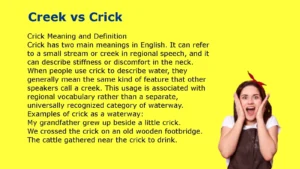
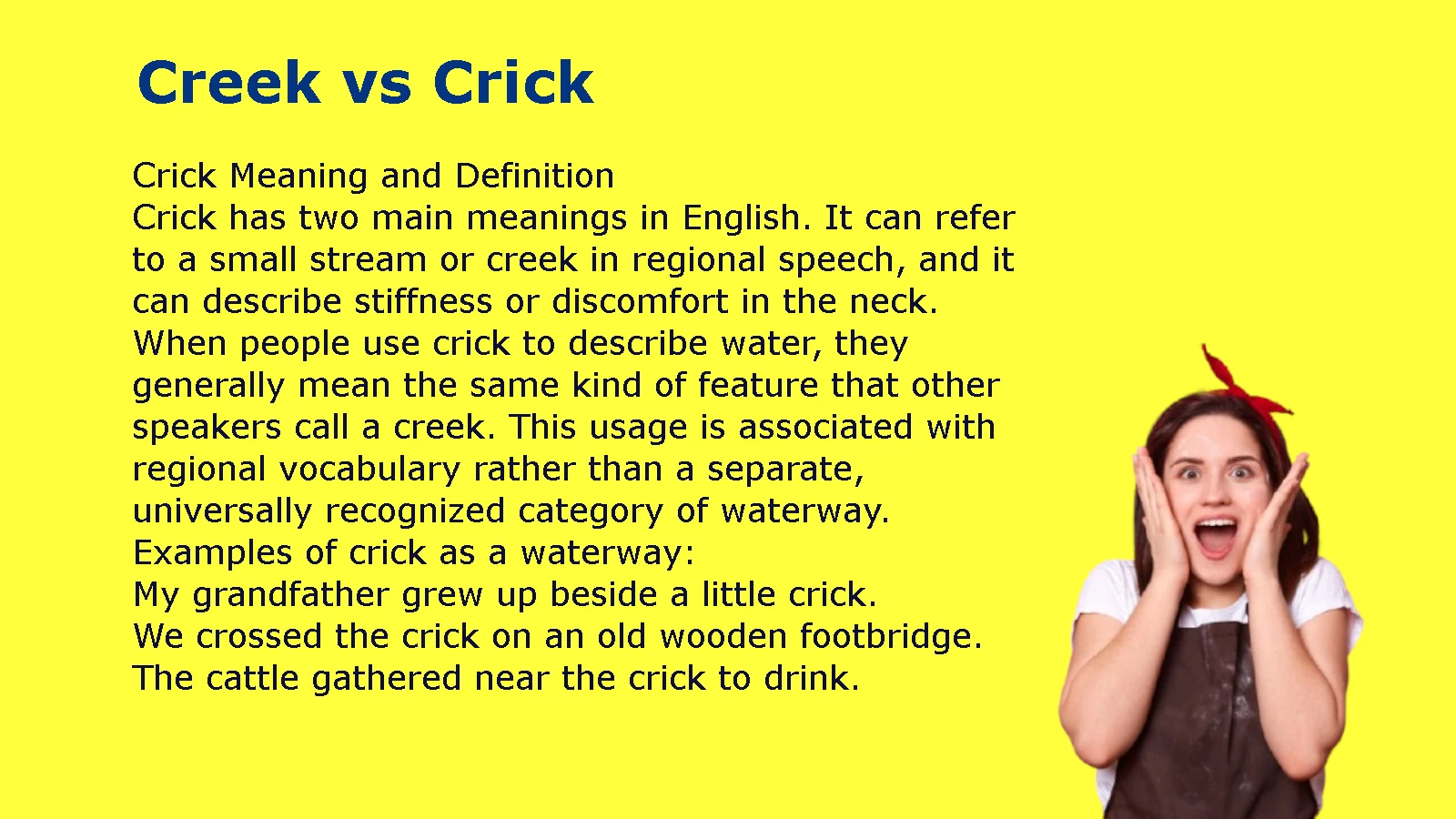
Crick Meaning and Definition
Crick has two main meanings in English. It can refer to a small stream or creek in regional speech, and it can describe stiffness or discomfort in the neck.
When people use crick to describe water, they generally mean the same kind of feature that other speakers call a creek. This usage is associated with regional vocabulary rather than a separate, universally recognized category of waterway.
Examples of crick as a waterway:
- My grandfather grew up beside a little crick.
- We crossed the crick on an old wooden footbridge.
- The cattle gathered near the crick to drink.
Examples of crick as neck stiffness:
- I woke up with a crick in my neck.
- Looking at my laptop all day gave me a crick in the neck.
- She turned her head slowly because of a painful crick.
The surrounding words make the intended meaning clear. A crick that runs through a field refers to water, while a crick in the neck describes a physical sensation.
Is Crick a Misspelling of Creek?
Crick is not always a misspelling of creek. It is an established regional word for a small waterway in some varieties of English. However, creek is the standard spelling for general writing when you mean a small watercourse.
Use creek when writing for a broad audience, especially in educational, professional, or geographic contexts. Use crick when it appears in an official place name, when you are representing a speaker’s regional vocabulary, or when you mean neck stiffness.
Compare these sentences:
- Standard writing: A narrow creek runs behind the house.
- Regional speech: We used to fish in the little crick near the farm.
- Neck stiffness: I have a crick in my neck.
The second sentence can reflect a speaker’s natural dialect. It does not automatically indicate poor spelling or grammar.
Creek vs Crick: Quick Comparison
| Feature | Creek | Crick |
| Main waterway meaning | A small waterway | A regional term for a small waterway |
| Standard writing | Commonly preferred | Depends on context |
| Regional use | Widely used | Varies by dialect |
| Geographic names | Common in place names | Appears in some local names |
| Neck stiffness meaning | Not the usual term | Common in the phrase “a crick in the neck” |
| Best general choice | Use for a waterway | Use for regional wording or neck stiffness |
The most useful rule is simple: write creek for a waterway in general English, and use crick when the context specifically calls for the regional term or the expression about neck stiffness.
Why Do Some People Say Crick Instead of Creek?
Some English speakers say crick instead of creek because regional dialects preserve different pronunciations and vocabulary. People often learn these patterns from family members, neighbors, and their local communities. As a result, two speakers can describe the same kind of waterway with different words without either person misunderstanding the other.
Regional speech is a normal part of English. Words can vary across states, towns, and even neighboring communities.
Where Is Crick Commonly Used?
The waterway meaning of crick appears in some regional varieties of American English. Its use is not uniform, and not every speaker in a particular state or region will prefer it.
You may encounter the word in:
- Informal conversations about rural waterways.
- Stories that reproduce a character’s regional speech.
- Family expressions passed down through generations.
- Local geographic names that preserve traditional wording.
- Conversations about fishing, farming, hiking, or growing up near a stream.
For example, one person might say, “Let’s walk down to the creek,” while another says, “Let’s go down to the crick.” Both may be referring to the same place.
The spelling also matters in written dialogue. If a writer uses crick to represent a character’s regional vocabulary, the word can help establish the speaker’s voice. However, writers should avoid assuming that every person from a rural community speaks this way.
Is Crick More Common in Certain American Regions?
The use of crick varies across American communities, and broad regional labels do not capture every speaker’s vocabulary. Some speakers associate it with rural or family speech, while others may have heard it mainly in stories or place names.
Several factors influence which word a person uses:
- Family background: People often adopt expressions used by parents and grandparents.
- Local speech: Neighbors and community members reinforce familiar vocabulary.
- Geographic naming: A local waterway may retain a traditional name even when nearby speakers use creek in ordinary conversation.
- Personal preference: Some people use crick naturally, while others consistently use creek.
It is also important to separate pronunciation from spelling. A speaker might pronounce a word in a way that sounds different from the pronunciation you expect but still write creek in a formal document.
Should You Write Creek or Crick?
Choose the word that matches your meaning and audience.
Use creek when writing general informational content, schoolwork, business documents, travel descriptions, or geographic explanations. It is the most widely understood spelling for a small waterway.
Use crick when:
- You are writing the exact name of a place that uses the word.
- You are quoting someone who said crick.
- You want to preserve a character’s regional speech.
- You are describing neck stiffness in the expression a crick in the neck.
For example, write “The creek passes behind the school” in a general report. If an official geographic name contains Crick, preserve that spelling rather than changing it to Creek.
The goal is not to eliminate regional vocabulary. It is to choose the form that communicates your intended meaning clearly.
Creek vs Crick Map: Do They Refer to Different Waterways?
A Creek vs Crick map comparison does not reveal two universally distinct types of waterway. In most cases, the difference comes from local naming conventions or regional vocabulary. A map labeled with Creek and another labeled with Crick may show similar geographic features, even though their names differ.
A map’s label identifies a named feature. It does not automatically establish the feature’s size, depth, water volume, or flow pattern.
How to Read Creek and Crick on a Map
When you encounter a creek or crick on a map, consider the location and the map’s purpose. A road map, hiking map, and topographic map may present different levels of geographic detail.
Follow these steps to understand the feature:
- Read the full name. Determine whether Creek or Crick forms part of the official geographic name.
- Check the map legend. Look for symbols that identify streams, rivers, lakes, and other water features.
- Inspect the surrounding terrain. Contour lines and elevation changes can help you understand the watercourse’s location and the shape of the valley.
- Look for connections. A small waterway may flow into a larger stream or river.
- Check the source’s geographic information. Official maps and local geographic records can clarify a feature’s established name.
A thin blue line on a map often represents a small watercourse, but map symbols differ by provider and scale. Some maps omit minor waterways entirely.
Why Do Some Maps Use Crick Instead of Creek?
A map may use Crick because that spelling forms part of the waterway’s established local name. Geographic names often preserve historical wording, local pronunciation, and traditional usage.
For example, a community may refer to a waterway as Mill Crick, while a nearby community calls a similar feature Mill Creek. The different labels do not necessarily indicate that the waterways belong to different geographic categories.
When searching for a particular location, try both spellings if your first search fails. This is especially useful when an older map, local sign, or family account uses a name that differs from modern everyday vocabulary.
Important distinction: A regional word used to describe a waterway is not necessarily the official name of that waterway. Always preserve the spelling shown in an authoritative geographic source when accuracy matters.
Can You Find a Creek or Crick Near You?
You can search digital maps using creek, crick, or the waterway’s known name. If you know the nearby town, road, park, or landmark, include it in your search to narrow the results.
For example, searches such as “creeks near Springfield” or “Crick near Mill Road” may return different results depending on the location and the names recorded by the map provider.
For outdoor trips, do not rely on a name alone to determine whether a waterway is safe to cross. Water depth, current speed, recent rainfall, terrain, and access restrictions matter more than whether the map calls it a creek or crick.
Creek vs. Stream: What Is the Difference?
A creek is commonly understood as a small waterway, while a stream is a broad term for flowing water in a natural channel. The words overlap because a creek can be classified as a stream. However, local naming practices may determine whether people call a particular watercourse a creek, stream, brook, or another name.
The difference is mainly one of common usage rather than a strict scientific boundary.
Is a Creek a Type of Stream?
Yes. In many geographic contexts, a creek is a type of stream. The word stream can describe flowing water across a wide range of sizes, while creek commonly identifies a smaller watercourse.
A stream may flow throughout the year or only during certain seasons. A creek can behave the same way, depending on the local climate, geology, and water supply.
Consider these examples:
- A small stream flows down a hillside after heavy rain.
- A creek passes through a wooded park and joins a larger river.
- A seasonal stream carries water during spring but dries up during summer.
Each example describes flowing water, but the chosen term reflects how the speaker or geographic authority identifies the feature.
Creek vs. Stream: Size, Flow, and Usage
| Feature | Creek | Stream |
| General meaning | A small waterway | A natural channel carrying flowing water |
| Typical size | Often small | Can range from small to relatively large |
| Flow pattern | Permanent or seasonal | Permanent or seasonal |
| Relationship | Often considered a type of stream | Broad term covering many waterways |
| Geographic naming | Common in local place names | Common in descriptive and scientific contexts |
| Universal size limit | None | No single size limit implied by the word alone |
A stream does not have to be larger than a creek. In fact, a small creek is also a stream in many descriptions.
For practical writing, use stream when you want a broad term for flowing water. Choose creek when that is the familiar local name or the more natural description of the feature.
Creek vs. Brook: What Sets Them Apart?
A creek and a brook both commonly refer to small waterways. People often imagine a brook as a particularly small or gentle stream, while a creek may suggest a more substantial channel. However, English does not impose a universal size rule that separates every brook from every creek.
The terms can overlap, and local naming practices often determine which one people use.
Is a Brook Smaller Than a Creek?
A brook is often associated with a small stream, sometimes one that runs through a meadow, forest, or residential area. A creek can also be small, so the distinction is not always measurable.
For example, a writer might describe a narrow, shallow watercourse in a garden as a brook. Another speaker might call a similar feature a creek because that term is more familiar in their region.
Neither choice automatically establishes the watercourse’s precise width, depth, or flow rate.
The actual characteristics of a waterway depend on factors such as:
- The amount of rainfall and groundwater feeding it.
- The shape and slope of the land.
- The size of its drainage basin.
- Seasonal changes in precipitation.
- Human modifications, including dams and drainage channels.
These factors describe the waterway more accurately than its name alone.
Creek vs. Brook in Everyday English
The difference often becomes clearer through context.
Creek: “We followed the creek along the edge of the hiking trail.”
Brook: “A gentle brook flowed through the garden behind the cottage.”
Both sentences are natural. The word brook may create a softer or more picturesque impression in descriptive writing, while creek is common in everyday American English.
However, these impressions are stylistic rather than scientific. A brook can have a strong current, and a creek can be shallow and peaceful.
When writing about a named waterway, use its established name. When describing an unnamed watercourse, choose whichever word fits the audience and context.
Creek vs. River: Which Is Bigger?
A river is generally understood as a larger natural watercourse, while a creek usually describes a smaller one. Rivers often collect water from tributaries, including smaller streams and creeks. However, there is no universal measurement that makes every creek smaller than every river in every naming system.
The distinction reflects common geographic usage rather than a single worldwide size threshold.
Main Differences Between a Creek and a River
| Feature | Creek | River |
| Typical size | Small waterway | Generally larger watercourse |
| Water volume | Often lower | Often higher |
| Drainage area | Commonly smaller | Often drains a larger area |
| Role in a drainage network | May feed into a larger waterway | May collect water from many tributaries |
| Navigation | Depends on local conditions | Some rivers support boats and ships |
| Naming rules | Vary by region | Vary by region |
These are general patterns, not universal rules. A creek may carry substantial water after a storm, and some rivers are too shallow or narrow for navigation.
Water volume also changes over time. A river may rise during the rainy season, while a creek may shrink during a drought. To assess a waterway, consider its actual dimensions, flow, and drainage system rather than relying on its name.
Can a Creek Flow Into a River?
Yes. A creek can flow into a river, just as a small stream can feed a larger waterway. The smaller watercourse is often called a tributary of the larger one.
The location where two flowing waterways meet is called a confluence.
Imagine a wooded hillside where rainwater collects in small channels. These channels combine into a creek, which then joins a larger river farther downstream. The water moves through a connected drainage network rather than remaining in isolated features.
A simplified sequence might look like this:
Rainfall → Small channels → Creek → River → Larger river system
Real drainage networks are more complex. A creek can receive water from multiple tributaries, and a river can split into channels or flow into a lake, estuary, or ocean.
Understanding this relationship helps explain why a creek can be an important part of a much larger watershed.
Crick Water Meaning: What Does Crick Mean as a Body of Water?
The crick water meaning refers to a regional use of crick for a small stream or creek. In this context, the word describes a watercourse rather than a physical problem. The exact feature may vary by location, and the word does not define a separate scientific category of waterway.
People may encounter this meaning in conversation, local names, regional writing, or stories about rural life.
Is Crick a Real Word for a Waterway?
Yes. Crick is an established regional word in some varieties of English. Although creek is the more widely accepted spelling in general writing, crick can be a legitimate choice when it reflects local usage or an established name.
For example:
“My grandparents used to fish in the crick behind their farmhouse.”
This sentence communicates that the grandparents fished in a small waterway. A different speaker might naturally say creek in the same situation.
The distinction matters when interpreting older writing or listening to someone describe a familiar place. A reader should not assume that every occurrence of crick represents a spelling error.
Is a Crick Different From a Creek?
Usually, no physical difference is implied by the words alone. In their waterway meanings, crick and creek can refer to similar features. The difference generally reflects regional vocabulary, pronunciation, or the established spelling of a geographic name.
For example:
- “The creek runs behind the barn.”
- “The crick runs behind the barn.”
Both sentences can describe the same kind of location.
However, if the word appears in an official name, the spelling is part of that name. You should not automatically change Crick to Creek simply because the latter is more familiar.
Also remember that crick has a separate meaning in the expression a crick in the neck. Context determines which meaning applies.
Is It Crick or Creek in the Neck?
Crick is the usual word in the expression “a crick in the neck.” It describes stiffness, soreness, or discomfort that makes turning or moving the neck unpleasant. Creek refers to a waterway, so “a creek in the neck” is not the standard expression.
The word crick in this phrase is informal and common in everyday English.
What Does Crick in the Neck Mean?
A crick in the neck is an everyday expression for neck stiffness or discomfort. People often use it when their neck feels tight after sleeping in an awkward position, sitting for a long time, or holding their head at an uncomfortable angle.
The expression describes a sensation, not a specific medical diagnosis.
Examples include:
- I woke up with a crick in my neck.
- After a long flight, he had a crick in his neck.
- She stretched gently to ease the crick in her neck.
- Working at a poorly positioned desk gave me a crick in the neck.
The phrase usually refers to temporary discomfort, but the cause can vary. The word itself does not tell you whether the problem comes from muscle tension, a joint, an injury, or another condition.
Why Do People Get a Crick in Their Neck?
Neck stiffness can develop for several reasons. Common possibilities include muscle tension, prolonged posture, sleeping in an awkward position, or straining the neck during an activity.
For example, someone who spends several hours looking down at a laptop may develop tightness in the neck and shoulders. Another person may wake up stiff after sleeping with the head turned to one side.
Simple measures that may help mild stiffness include:
- Changing position regularly instead of remaining still for long periods.
- Adjusting the screen so it sits at a comfortable viewing height.
- Moving the neck gently within a comfortable range.
- Applying a comfortable warm or cold compress, depending on what feels helpful.
- Avoiding forceful stretching or sudden neck movements.
Seek medical advice if the pain persists, repeatedly returns, or limits normal activity. Get urgent medical care if neck stiffness occurs with a high fever, severe headache, confusion, weakness, numbness, or following a significant injury.
These warning signs should not be dismissed as an ordinary crick.
Crick in the Neck: Example Sentences
The following examples show how to use the expression naturally.
Everyday conversation: “I can’t turn my head comfortably because I have a crick in my neck.”
Workplace context: “I adjusted my monitor because I kept getting a crick in my neck.”
After sleeping: “My pillow was uncomfortable, and I woke up with a crick.”
Explaining discomfort: “He moved his head carefully because of the crick in his neck.”
In all these sentences, crick refers to stiffness or discomfort. Replacing it with creek would change the word into the name of a waterway and make the expression incorrect.
Creek vs Crick: Examples in Sentences
The easiest way to understand Creek vs Crick is to compare the words in complete sentences. The waterway meanings overlap, but the neck-related expression uses crick. The examples below show how context affects the correct choice.
Examples of Creek in a Sentence
- A narrow creek winds through the forest behind our campsite.
- The children watched small fish swimming in the creek.
- Heavy rainfall caused the creek to overflow its banks.
- We followed the creek until it joined the river.
- The map shows a creek running along the eastern side of the property.
- A wooden bridge crosses the creek near the entrance to the park.
These sentences use creek as a general term for a waterway. It works in conversation, descriptions, educational writing, and geographic explanations.
Examples of Crick in a Sentence
Crick as a regional waterway term:
- We spent the afternoon fishing in the crick.
- An old footbridge crosses the crick near the farm.
- After the rain, the crick carried more water than usual.
Crick as neck stiffness:
- I woke up with a crick in my neck.
- Turning my head made the crick more noticeable.
- She took a break from her desk to ease the stiffness in her neck.
The surrounding words help readers understand the meaning. Expressions such as fishing in the crick point toward water, while in my neck signals the physical meaning.
Common Mistakes to Avoid
Even though these words can overlap, a few mistakes can confuse readers.
Mistake: Treating crick as universally incorrect.
Correction: Crick is an established regional term for a waterway in some varieties of English. It is not automatically a misspelling.
Mistake: Assuming a creek must always be smaller than a stream.
Correction: Stream is a broad term, and a creek can be a type of stream. The words do not follow a universal size hierarchy.
Mistake: Writing “creek in the neck.”
Correction: The standard expression is crick in the neck.
Mistake: Assuming every creek flows throughout the year.
Correction: Some waterways flow year-round, while others depend on seasonal rain or other changing water sources.
Mistake: Assuming map labels establish a waterway’s exact size.
Correction: Names reflect local and historical naming practices. Physical measurements and geographic data provide better information about a waterway’s characteristics.
Frequently Asked Questions
Is Creek or Crick the Correct Spelling?
Creek is the standard spelling for a small waterway in most general English writing. Crick is an established regional variant in some dialects and place names. It is also the usual word in the expression a crick in the neck, which describes stiffness or discomfort.
Does Crick Mean a Small River?
Crick can refer to a small stream or creek in regional usage, but it does not define a separate, universally recognized type of river. The word usually reflects local vocabulary rather than a specific waterway classification.
What Is the Difference Between Creek and Crick on a Map?
The difference usually comes from the name assigned to the geographic feature. A map labeled Creek and another labeled Crick may show similar waterways. Check the full name and geographic records instead of assuming the labels indicate different sizes or types.
Is a Creek Bigger Than a Brook?
People often associate a brook with a particularly small waterway, but no universal size boundary separates brooks from creeks. Both terms commonly describe small waterways, and local naming practices influence which word people use.
What Is the Difference Between a Creek, Stream, and River?
A stream is a broad term for flowing water, a creek commonly refers to a smaller waterway, and a river generally describes a larger watercourse. These meanings overlap, and no single size rule applies to every waterway worldwide.
Why Is It Called a Crick in the Neck?
The expression a crick in the neck describes stiffness or discomfort that makes neck movement unpleasant. It is an informal expression rather than a precise medical diagnosis. The word creek is not used in this standard phrase.
Conclusion: Should You Use Creek or Crick?
The difference between Creek vs Crick depends mainly on meaning, regional usage, and context. Creek is the standard general term for a small waterway, while crick can serve as a regional alternative. The word crick also has a separate meaning in the familiar expression a crick in the neck.
When comparing a creek vs. stream, remember that a creek can be a type of stream. A creek vs. brook comparison involves two overlapping terms for small waterways, while a creek vs. river comparison usually contrasts a smaller watercourse with a larger one. None of these terms follows a universal size rule in every region.
Use these practical guidelines:
- Choose creek for general writing about a waterway.
- Preserve crick when it forms part of an established local name or represents regional speech.
- Write crick in the neck when describing neck stiffness.
- Check geographic records when you need the official name of a waterway.
- Focus on actual geographic conditions rather than a waterway’s name when assessing its size or flow.
If you are writing an article, school assignment, or geographic description, use creek as your default. If you encounter crick in conversation or on a map, consider the context before deciding what it means.