Fell vs fallen is a common English grammar question because both words come from the verb fall, but they serve different purposes in a sentence. Fall is the base form, fell is the simple past tense, and fallen is the past participle. Understanding these three verb forms helps you choose the correct expression in sentences such as “I fell down,” “I have fallen,” and “They fell in love.”
The main difference depends on verb tense, sentence structure, and auxiliary verbs. You use fell to describe a completed action in the past, while fallen usually appears with helping verbs such as have, has, and had. The words also appear in common expressions, including fall down, fell down, and fall in love, which can change form depending on the time and meaning you want to express.
This guide explains the difference between fell and fallen, the past tense and past participle of fall, common grammar mistakes, and practical examples to help you use each form correctly.
Fell vs Fallen: What’s the Difference?
Fell is the simple past tense of fall, while fallen is its past participle. Use fell for a completed past action, such as “She fell yesterday.” Use fallen with a helping verb in perfect tenses, as in “She has fallen.” The correct choice depends on the grammatical structure of your sentence.
Fell Meaning and Usage
Fell is the simple past tense of the irregular verb fall. It describes an action or change that happened in the past.
You generally use fell without a helping verb in an ordinary affirmative sentence.
Examples:
- The child fell while running across the yard.
- Temperatures fell overnight.
- He fell asleep during the movie.
- The company’s profits fell last year.
- She fell in love with her childhood friend.
In each example, fell describes a past event or change. The action might have happened seconds ago or many years earlier.
You can also use fell in figurative expressions. For example, “The plan fell apart” means the plan failed or stopped working. Similarly, “Silence fell over the room” means the room suddenly became quiet.
Remember that fell can also function as a separate verb meaning to cut down a tree. In “They felled the old oak,” the word felled is the past tense of that different verb, not the past tense of fall.
Fallen Meaning and Usage
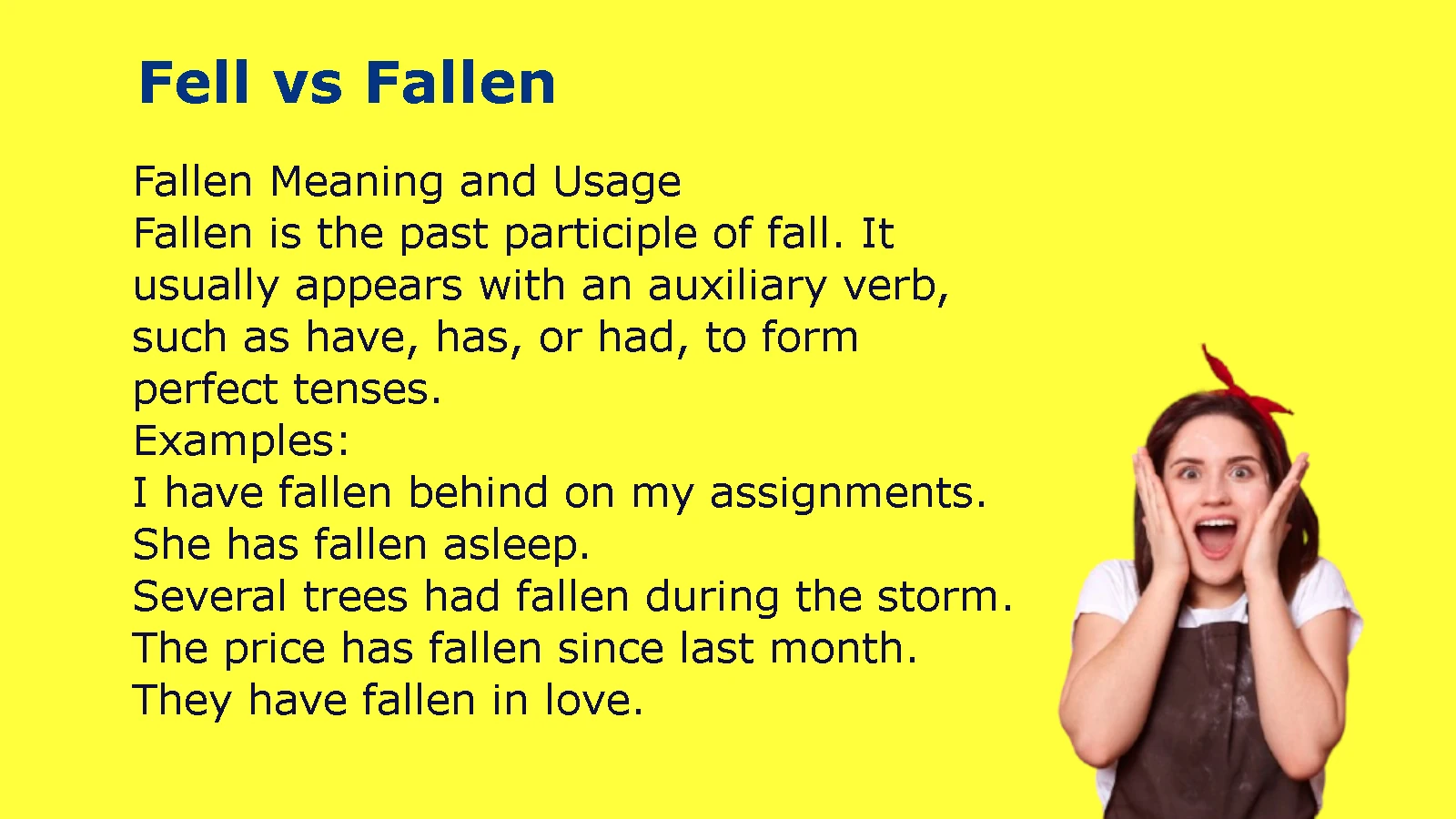
Fallen is the past participle of fall. It usually appears with an auxiliary verb, such as have, has, or had, to form perfect tenses.
Examples:
- I have fallen behind on my assignments.
- She has fallen asleep.
- Several trees had fallen during the storm.
- The price has fallen since last month.
- They have fallen in love.
The word fallen can describe physical movement, emotional changes, declining numbers, or a loss of status.
For example, “The fallen leaves covered the sidewalk” uses fallen as an adjective describing leaves that have dropped from a tree. In “The empire had fallen,” the word appears as part of a past perfect verb phrase describing the collapse of an empire.
Although fallen often follows a helping verb, it can also modify a noun directly. Expressions such as fallen leaves, fallen soldiers, and a fallen tree use the past participle adjectivally.
Fell vs Fallen Comparison Table
The following table summarizes the three principal forms of the verb.
| Verb form | Grammatical role | Example sentence |
| Fall | Base form or present tense | Leaves fall in autumn. |
| Falls | Third-person singular present | The temperature falls at night. |
| Fell | Simple past tense | The temperature fell yesterday. |
| Fallen | Past participle | The temperature has fallen. |
| Falling | Present participle or gerund | The leaves are falling. |
The easiest rule to remember is fall – fell – fallen. Each form has a distinct grammatical role, so you cannot freely substitute one for another.
Fall, Fell, Fallen: All Three Verb Forms Explained
The verb fall is irregular because it does not form its past tense by simply adding -ed. Instead, its principal forms change from fall to fell to fallen.
Knowing how these forms work makes it easier to construct sentences in the present, past, and perfect tenses.
Fall as the Present Tense
Fall is the base form of the verb. You use it for present-tense actions, general truths, repeated events, and actions that follow modal verbs or certain other verbs.
Examples:
- Leaves fall from trees in autumn.
- I sometimes fall asleep while reading.
- Be careful not to fall on the wet floor.
- They may fall behind if they miss another class.
- She wants to fall in love again.
For third-person singular subjects such as he, she, and it, the present simple form becomes falls.
Examples:
- He falls asleep quickly.
- The value of the property falls when demand decreases.
- She falls whenever she tries to skate too fast.
However, the base form remains fall after modal verbs such as can, could, may, might, should, and will.
Correct: “You might fall if you run on the ice.”
Incorrect: “You might fell if you run on the ice.”
The modal verb already establishes the grammatical structure, so the main verb stays in its base form.
Fell as the Past Tense of Fall
Fell describes an action or change that occurred in the past. It commonly appears with past-time expressions such as yesterday, last week, two hours ago, and in 2024.
Examples:
- I fell while climbing the stairs.
- The glass fell off the table.
- Sales fell by 12% last quarter.
- She fell asleep before the movie ended.
- They fell in love during college.
The simple past form does not change according to the subject. You say I fell, she fell, we fell, and they fell.
Negative sentences and questions require special attention because English uses the auxiliary verb did.
Examples:
- Correct: He did not fall.
- Incorrect: He did not fell.
- Correct: Did she fall?
- Incorrect: Did she fell?
The reason is simple: did already marks the past tense. The main verb therefore returns to its base form, fall.
You can use fell in both literal and figurative sentences.
- Literal: “The boy fell off his bicycle.”
- Figurative: “The negotiations fell apart.”
- Emotional: “She fell in love unexpectedly.”
- Financial: “The stock price fell after the announcement.”
These examples share the same past-tense structure, even though the meanings differ.
Fallen as the Past Participle of Fall
Fallen is the past participle used in perfect tenses and other participial constructions. Unlike fell, it generally needs a helping verb when it functions as part of a perfect-tense verb phrase.
Examples:
- I have fallen behind on my work.
- She has fallen twice today.
- They had fallen asleep before midnight.
- The building has fallen into disrepair.
- The number of visitors has fallen significantly.
The helping verb determines the perfect tense.
| Construction | Example | Use |
| Have + fallen | I have fallen. | Present perfect with I, you, we, or they. |
| Has + fallen | She has fallen. | Present perfect with he, she, or it. |
| Had + fallen | They had fallen. | Past perfect with any subject. |
| Will have + fallen | Prices will have fallen. | Future perfect. |
| May have + fallen | He may have fallen. | Possible past event. |
You can also use fallen without an auxiliary verb when it modifies a noun.
For example, “The fallen branches blocked the road” describes branches that had dropped. Here, fallen acts as an adjective rather than the main verb of a perfect-tense construction.
Fall Past Tense and Past Participle at a Glance
The following reference table covers the most useful forms of fall.
| Form | Example |
| Base form | I fall asleep easily. |
| Third-person singular | She falls asleep early. |
| Simple past | She fell asleep yesterday. |
| Past participle | She has fallen asleep. |
| Present participle | She is falling asleep. |
| Past perfect | She had fallen asleep before I arrived. |
| Future | She will fall asleep soon. |
| Future perfect | She will have fallen asleep by midnight. |
One important distinction is that fell is not the past participle of fall. The past participle is fallen.
Also, do not confuse the verb fall with the separate verb fell, which means to cut down a tree.
- Present: They fell trees for a living.
- Past: They felled three trees yesterday.
- Past participle: They have felled several trees.
In these examples, fell, felled, and felled belong to a different verb. Context tells you which meaning applies.
Have Fallen or Have Fell: Which Is Correct?
Have fallen is the standard grammatical form in English. The present perfect tense uses have or has followed by the past participle, which is fallen. Although some speakers use “have fell” in regional or informal speech, standard written English requires have fallen.
When to Use Have Fallen
Use have fallen when an event happened in the past and has a connection to the present. This structure is called the present perfect tense.
Examples:
- I have fallen behind on my reading.
- You have fallen for a common trick.
- We have fallen short of our target.
- They have fallen asleep already.
- The prices have fallen since last month.
The present perfect often emphasizes a result, experience, or change rather than a specific completed time in the past.
Compare these sentences:
- “I fell yesterday.” This identifies a past event.
- “I have fallen before.” This describes a past experience without specifying when it happened.
- “I have fallen behind.” This describes a past development that affects the present.
The difference matters because English speakers generally use the simple past with a finished past-time expression.
For example, “I fell yesterday” is standard. “I have fallen yesterday” is generally incorrect in standard English because yesterday identifies a completed past time.
Has Fallen vs. Had Fallen
Both has fallen and had fallen use the past participle, but they describe different time relationships.
Has fallen uses the present perfect. It connects a past event to the present.
Example: “The temperature has fallen considerably.”
This sentence suggests that the temperature dropped earlier and that the change matters now.
Had fallen uses the past perfect. It describes an event that happened before another past event or reference point.
Example: “The temperature had fallen before the sun came up.”
The temperature dropped first. The sun came up later.
| Verb phrase | Tense | Example |
| Has fallen | Present perfect | The price has fallen this week. |
| Have fallen | Present perfect | Prices have fallen this week. |
| Had fallen | Past perfect | Prices had fallen before the store opened. |
| Will have fallen | Future perfect | Prices will have fallen by Friday. |
Use has with third-person singular subjects, including he, she, and it. Use have with I, you, we, and they. The past perfect uses had with every subject.
Why Have Fell Is Incorrect in Standard English
The mistake happens when writers treat fell as though it were the past participle. However, fell is the simple past form, while fallen is the past participle.
Compare the following examples.
| Incorrect in standard English | Correct form |
| I have fell down. | I have fallen down. |
| She has fell asleep. | She has fallen asleep. |
| They have fell behind. | They have fallen behind. |
| He had fell before. | He had fallen before. |
The rule applies to other perfect-tense constructions, too.
- Correct: “The leaves have fallen.”
- Correct: “The leaves had fallen.”
- Incorrect in standard English: “The leaves have fell.”
You may hear “have fell” in some dialects, songs, or informal conversations. Recognizing that usage can help you understand speakers, but it does not make the form appropriate for standard academic writing, professional communication, or grammar tests.
When in doubt, check the word immediately before the verb. If the sentence uses have, has, or had to form a perfect tense, choose fallen.
Fell Down or Fall Down: Which Is Correct?
Both “fell down” and “fall down” are correct, but they serve different grammatical purposes. Use fall down for the base form, present-tense statements, instructions, and actions following modal verbs. Use fell down to describe a completed past event, such as “He fell down yesterday.”
When to Use Fall Down
Fall down describes the action in its base form or present tense. You can use it for general statements, repeated events, warnings, and possible future actions.
Examples:
- Be careful not to fall down the stairs.
- Children sometimes fall down while learning to walk.
- I might fall down if I wear these shoes on ice.
- People can fall down when they lose their balance.
- Try not to fall down while carrying that box.
For third-person singular subjects in the present simple, use falls down.
Examples:
- He falls down whenever he tries to skate.
- The old tree falls down during severe storms.
- She sometimes falls down when she runs too quickly.
The expression also works in warnings and advice. For example, “Watch your step so you don’t fall down” describes a possible future accident, not a past event.
When to Use Fell Down
Use fell down when someone or something dropped to the ground in the past.
Examples:
- I fell down while running in the park.
- The little boy fell down and started crying.
- She fell down the stairs yesterday.
- Several branches fell down during the storm.
- He fell down when the floor became slippery.
You do not need an auxiliary verb in a regular affirmative sentence because fell already marks the past tense.
However, questions and negatives use did followed by the base form.
- Correct: “She fell down yesterday.”
- Correct: “She did not fall down yesterday.”
- Correct: “Did she fall down yesterday?”
- Incorrect: “Did she fell down yesterday?”
The same rule applies whether the expression appears alone or as part of a longer sentence.
Fell Down Meaning and Common Expressions
Fell down usually means that someone or something moved downward and landed on the ground or another surface. It can describe an accident, a loss of balance, or the collapse of an object.
Examples:
- “The child fell down.” The child lost balance and landed on the ground.
- “The shelf fell down.” The shelf dropped or collapsed.
- “The old wall fell down.” The wall collapsed.
- “He fell down laughing.” He laughed so hard that he dropped toward the ground or lost his balance.
The expression can also appear in figurative contexts, though the intended meaning depends on the sentence.
For example, “The system fell down at the final stage” might mean that the system failed. In many contexts, however, broke down, failed, or fell apart would sound more natural.
It helps to distinguish fall down, fall over, and fall off.
| Expression | Meaning | Example |
| Fall down | Move downward or land on the ground | He fell down on the path. |
| Fall over | Lose balance and tip onto a side or surface | The chair fell over. |
| Fall off | Drop from something | The book fell off the shelf. |
| Fall apart | Break into pieces or stop functioning | The old box fell apart. |
| Fall behind | Fail to keep up with progress or a schedule | She fell behind in class. |
These expressions share the verb fall, but the particle changes the meaning. Choosing the right one helps your sentence sound more precise.
Fell or Fall in Love: Which Form Should You Use?
Fall in love is the base form, fell in love is the simple past, and fallen in love is the past participle. Use fall in love for general statements or future possibilities, fell in love for a past event, and have fallen in love when the present perfect structure fits the meaning.
Fall in Love in the Present or Future
Use fall in love when discussing a general possibility, a habit, or a future event. The base form also follows modal verbs and certain other verbs.
Examples:
- People can fall in love at any age.
- You might fall in love when you least expect it.
- They want to fall in love without rushing.
- She hopes to fall in love again.
- Some people fall in love quickly, while others take more time.
The expression describes the process of developing romantic feelings for someone. It does not necessarily mean that two people have already started a relationship.
For a third-person singular present-tense statement, use falls in love.
Example: “He falls in love easily.”
This sentence describes a general tendency. It does not identify one specific past event.
Fell in Love for Past Events
Use fell in love to describe a romantic connection that began in the past.
Examples:
- They fell in love during their first year at college.
- She fell in love with him after they worked together.
- My grandparents fell in love when they were young.
- He fell in love with the city during his first visit.
- We fell in love with the house as soon as we saw it.
The expression can describe romantic love, but it can also appear figuratively with places, activities, or ideas.
For instance, “She fell in love with painting” means that she developed a strong interest in painting.
Notice the difference between fell in love and was in love.
- “They fell in love in college” emphasizes the beginning of their feelings.
- “They were in love in college” describes their emotional state during that period.
Both sentences are correct, but they focus on different aspects of the relationship.
Fallen in Love in Perfect Tenses
Use fallen in love with the appropriate helping verb when the sentence calls for a perfect tense.
Examples:
- They have fallen in love.
- She has fallen in love with her best friend.
- We had fallen in love before we realized how different we were.
- By the end of the summer, they will have fallen in love.
The present perfect can connect a past development to the present. For example, “They have fallen in love” describes a change in their feelings that has occurred by now.
The past perfect establishes an earlier point in the past. “They had fallen in love before they moved abroad” tells readers that the relationship developed before the move.
Avoid the nonstandard construction “They have fell in love” in formal writing. The correct expression is “They have fallen in love.”
Fell vs. Feel: What’s the Difference?
Fell and feel are different words with different meanings. The past tense of feel is felt, not fell.
Fell Meaning and Examples
The word fell describes an event or change that happened in the past when it comes from the verb fall.
Examples:
- The glass fell off the table.
- She fell asleep during the lecture.
- He fell in love with his neighbor.
- The temperature fell below freezing.
- The team fell behind in the second half.
In each sentence, fell describes a past event, movement, or change.
The word can also function as a noun in other contexts, such as a name for a high, open area of upland in parts of northern England. It also appears as a separate verb meaning to cut down a tree. These meanings are distinct from the common past-tense use of fell.
Feel Meaning and Examples
Feel is a verb that describes a physical sensation, an emotional state, or an impression.
Examples:
- I feel tired after work.
- She feels happy about the result.
- This fabric feels soft.
- I feel that we should leave early.
- They feel nervous before an interview.
The verb changes form depending on tense and grammatical structure.
| Verb form | Example |
| Feel | I feel cold. |
| Feels | She feels better. |
| Felt | I felt tired yesterday. |
| Felt | They have felt nervous before. |
| Feeling | He is feeling much better. |
The past tense and past participle of feel are both felt.
Compare:
- Present: “I feel tired.”
- Past: “I felt tired yesterday.”
- Present perfect: “I have felt tired all week.”
By contrast, the corresponding forms of fall are fall, fell, and fallen.
Fell vs. Feel Comparison Table
| Feature | Fell | Feel |
| Main meaning | Past action of falling | Experience a sensation or emotion |
| Base verb | Fall | Feel |
| Simple past | Fell | Felt |
| Past participle | Fallen | Felt |
| Example | He fell down. | He felt nervous. |
| Present-tense example | I fall often. | I feel fine. |
A common mistake is writing “I fell sad” when you mean that you experienced sadness. The standard expression is “I felt sad.”
However, “I fell asleep” is correct because fell forms part of the expression fall asleep, meaning to enter a sleeping state.
The quickest way to decide is to ask what you want to describe. If you mean a physical or figurative fall, use the appropriate form of fall. If you mean an emotion, sensation, or impression, use the appropriate form of feel.
Common Mistakes With Fall, Fell, and Fallen
Most mistakes involving fall, fell, and fallen happen when writers confuse the simple past with the past participle. Other errors occur when a helping verb already marks the tense but the main verb also appears in its past form.
Using Fell After Have, Has, or Had
The most common mistake is using fell after a perfect-tense helping verb.
Incorrect: “She has fell down.”
Correct: “She has fallen down.”
The same rule applies to have and had.
More examples:
- Incorrect: “They have fell behind.”
- Correct: “They have fallen behind.”
- Incorrect: “He had fell asleep.”
- Correct: “He had fallen asleep.”
- Incorrect: “The leaves have fell.”
- Correct: “The leaves have fallen.”
Remember that the auxiliary verb and the past participle work together to form a perfect tense. In standard English, you need fallen in these constructions.
Using Fell After Did
Another common error occurs in questions and negative statements.
Incorrect: “Did he fell?”
Correct: “Did he fall?”
The auxiliary did carries the past-tense marking, so the main verb returns to its base form.
Use the same pattern in negative statements.
- Incorrect: “She did not fell.”
- Correct: “She did not fall.”
- Incorrect: “They didn’t fell down.”
- Correct: “They didn’t fall down.”
This principle applies to regular and irregular verbs alike. For example, you say “Did she go?” rather than “Did she went?”
Confusing Fallen With Fell in Past Narratives
Both forms can describe past events, but their grammatical roles differ.
Consider these examples:
- “The tree fell during the storm.”
- “The tree has fallen across the road.”
- “The tree had fallen before the crew arrived.”
The first sentence uses the simple past to report an event. The second uses the present perfect to describe a past event with a present result. The third uses the past perfect to show that the tree fell before another past event.
The choice depends on the time relationship you want to express, not simply on whether the event happened in the past.
| Sentence | Correct? | Reason |
| She fell yesterday. | Yes | Simple past describes a completed past event. |
| She has fallen. | Yes | Present perfect uses the past participle. |
| She had fallen before noon. | Yes | Past perfect uses the past participle. |
| She has fell. | No, in standard English | The perfect tense requires fallen. |
| She did fell. | No, in standard English | The main verb must be fall after did. |
A Quick Decision Guide for Choosing the Correct Form
When you’re unsure which word to use, check the structure of the sentence before deciding.
| If your sentence describes… | Use | Example |
| A general action or base verb | Fall | I might fall. |
| A present habit with he, she, or it | Falls | She falls asleep quickly. |
| A completed past action | Fell | She fell yesterday. |
| An action in the present perfect | Fallen | She has fallen. |
| An action before another past event | Fallen | She had fallen before I arrived. |
| An ongoing action | Falling | She is falling asleep. |
| A physical sensation or emotion | Feel or felt | I felt nervous. |
Use this three-step method for a quick grammar check:
Step 1: Look for a helping verb. If the sentence uses have, has, or had to form a perfect tense, you generally need fallen.
Step 2: Check for did. If the sentence uses did in a question or negative statement, use the base form fall.
Step 3: Identify the time relationship. Use fell for a simple past event and choose the appropriate perfect tense when the sentence needs to connect two time points or emphasize a past result.
Practical Example: Correcting a Short Paragraph
Consider this paragraph:
“Yesterday, Alex has fell while running to the bus stop. He did fell hard, but he was able to stand up. Since the accident, his knee has felt sore.”
The first two sentences contain errors. A corrected version reads:
“Yesterday, Alex fell while running to the bus stop. He did fall hard, but he was able to stand up. Since the accident, his knee has felt sore.”
Why does this version work?
- Fell reports the completed past event.
- Did fall uses the base form after the auxiliary did.
- Has felt uses the past participle of feel, which is felt.
This example also demonstrates why you need to distinguish fall from feel. Their forms overlap in appearance, but their grammatical patterns differ.
Frequently Asked Questions
Is Fell the Past Tense of Fall?
Yes. Fell is the simple past tense of fall. Use it to describe a completed past action.
Example: “The child fell while playing outside.”
The past participle is fallen, as in “The child has fallen.”
Is It Have Fallen or Have Fell?
Have fallen is the correct form in standard English. The present perfect tense uses have or has followed by the past participle, fallen.
Correct: “They have fallen behind.”
Incorrect in standard English: “They have fell behind.”
Is It Fell Down or Fall Down?
Both expressions are correct. Use fall down for the base form, general statements, instructions, and constructions following modal verbs. Use fell down for completed past actions.
Examples: “Be careful not to fall down” and “He fell down yesterday.”
Should I Say Fell or Fallen in a Sentence?
Use fell for the simple past and fallen as the past participle. For example, “She fell yesterday” is correct, as is “She has fallen.”
The presence of a helping verb such as have, has, or had usually signals that you need fallen in a perfect-tense construction.
Is Fell the Same as Feel?
No. Fell is the past tense of fall, while feel describes sensations, emotions, or impressions. The past tense of feel is felt.
Examples: “He fell down” and “He felt tired.”
What Is the Past Tense and Past Participle of Fall?
The three principal forms are fall – fell – fallen.
- Present/base form: “Leaves fall in autumn.”
- Simple past: “The leaves fell yesterday.”
- Past participle: “The leaves have fallen.”
These forms are irregular, so you should memorize them rather than add -ed to create the past tense.
Conclusion: Remember the Difference Between Fell and Fallen
The difference between fell vs fallen becomes much easier once you understand their grammatical roles. Fall is the base form, fell is the simple past tense, and fallen is the past participle. The correct form depends on how your sentence expresses time and whether it contains a helping verb.
Keep these rules in mind:
- Use fall for the base form, present-tense actions, and verbs following modal verbs.
- Use fell to describe a completed past action.
- Use fallen with have, has, or had in perfect-tense constructions.
- Say fall down for the base form and fell down for a completed past event.
- Use fell in love for a past event and have fallen in love for the present perfect.
- Don’t confuse fell with feel. The past tense of feel is felt.
The best way to remember these forms is to practice them in original sentences. Write one sentence with fall, another with fell, and a third with fallen. Then check whether each verb matches the sentence structure.