Shook vs Shaken is a common English grammar question because both words come from the verb shake, but they serve different purposes in a sentence. Shook is the simple past tense, while shaken is the past participle. You use shook to describe a past action, whereas shaken usually appears with helping verbs such as have, has, had, or was.
Understanding the difference between shook meaning, shaken meaning, and the correct past tense of shake helps you write more naturally. It also clears up common mistakes such as shakened, shooken, and I have shook. You’ll also learn what shaken up means, how to pronounce shook, and how to choose the correct word in everyday conversations.
Shook vs Shaken: What’s the Difference?
Shook is the simple past tense of shake, while shaken is its past participle. Use shook for a completed action in the past, such as “She shook the bottle.” Use shaken with a helping verb or as an adjective, such as “She has shaken the bottle” or “She felt shaken by the news.”
The main difference comes down to grammar, not just meaning. Both forms describe the same underlying action, but they fit different sentence structures.
| Feature | Shook | Shaken |
| Grammatical form | Simple past tense | Past participle |
| Main use | Describes a past action | Forms perfect tenses and passive constructions |
| Helping verb required | Usually no | Usually yes when used as a verb |
| Example | He shook my hand. | He has shaken my hand. |
| Emotional meaning | The event affected someone | Someone feels affected or unsettled |
| Common mistake | Using it after have in standard English | Adding an unnecessary -ed ending |
Shook vs Shaken in Example Sentences
Compare these examples to see how the two words work.
- Shook: I shook the bottle before pouring the juice.
- Shaken: I have shaken the bottle several times.
- Shook: The unexpected announcement shook the entire team.
- Shaken: The entire team was shaken by the announcement.
- Shook: She shook her head when she heard the suggestion.
- Shaken: She had shaken her head before anyone responded.
Notice that shook can stand alone as the main verb in the simple past. In contrast, shaken typically needs a helping verb when it functions as part of a verb phrase.
However, shaken can also function as an adjective. For example, “He looked shaken after the argument” describes his emotional state rather than emphasizing the grammatical action of shaking.
A Simple Trick to Remember Shook and Shaken
Remember this three-part pattern:
Shake → Shook → Shaken
- Shake: Present or base form. “I shake the bottle.”
- Shook: Simple past. “I shook the bottle yesterday.”
- Shaken: Past participle. “I have shaken the bottle.”
A useful shortcut is to check whether the sentence contains have, has, or had.
If you’re describing a completed action with one of these helping verbs, use shaken in standard English.
- Correct: She has shaken the box.
- Incorrect: She has shook the box.
For passive constructions, look for a form of be followed by the past participle.
- Correct: The bottle was shaken before use.
- Incorrect: The bottle was shook before use.
This trick works for many other irregular verbs, including take, write, break, and speak. Their past participles also differ from their simple past forms.
What Does Shook Mean?
Shook is the simple past tense of shake. It describes an action that happened in the past, such as moving an object back and forth, trembling, or moving something through a repeated motion. The word can also describe the effect of a surprising or upsetting event on a person.
The exact meaning depends on the context. Sometimes shook describes physical movement; in other sentences, it expresses a strong emotional reaction.
Shook Meaning in Everyday English
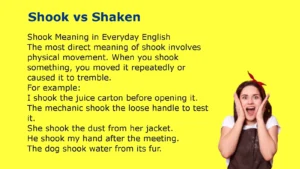
The most direct meaning of shook involves physical movement. When you shook something, you moved it repeatedly or caused it to tremble.
For example:
- I shook the juice carton before opening it.
- The mechanic shook the loose handle to test it.
- She shook the dust from her jacket.
- He shook my hand after the meeting.
- The dog shook water from its fur.
In each sentence, shook describes an action that occurred in the past.
The word can also describe a person’s physical reaction. Someone might shake because they feel cold, frightened, nervous, or physically weak.
Examples include:
- His hands shook after the difficult exam.
- She shook with laughter when she heard the joke.
- The child shook with fear during the thunderstorm.
In these examples, shook communicates a physical response rather than an intentional action.
Shook Meaning in Emotional and Informal Contexts
In figurative language, shook can mean deeply surprised, shocked, upset, or emotionally affected. The word suggests that an event disrupted someone’s usual sense of calm.
Consider these examples:
- The sudden resignation shook the company.
- Her honest confession shook him more than he expected.
- The disturbing news shook the entire family.
- I was shook when I learned what had happened.
The last example uses shook informally as an expression of shock. In casual conversation, social media posts, and internet slang, people sometimes use shook to mean extremely surprised or emotionally overwhelmed.
For example:
That plot twist left me shook.
This sentence means the plot twist surprised the speaker so much that they struggled to process it.
In formal writing, you might choose shocked, stunned, unsettled, or deeply affected instead. However, shook works naturally in informal dialogue and conversational writing.
One important distinction: the slang use doesn’t change the standard verb forms. Shook remains the simple past tense of shake, even when it describes an emotional reaction.
Shook in Example Sentences
Here are additional examples showing how shook works in different contexts.
| Context | Example sentence | Meaning |
| Physical movement | I shook the container. | I moved it back and forth. |
| Greeting | He shook my hand. | He greeted me with a handshake. |
| Disbelief | The announcement shook her. | It surprised or disturbed her. |
| Fear | The frightened child shook. | The child trembled. |
| Informal slang | That ending had me shook. | The ending left me extremely surprised. |
| Structure or stability | The earthquake shook the building. | The earthquake caused the building to vibrate. |
A good way to understand the word is to identify the subject and action. Ask yourself: Who or what shook, and what caused the movement or reaction?
That question often makes the meaning clear.
How to Pronounce Shook
The word shook is pronounced /ʃʊk/. It rhymes with book and look in accents that use the same vowel sound.
To pronounce it:
- Start with the “sh” sound, as in ship.
- Use the short vowel sound found in book.
- Finish with a clear “k” sound.
The vowel in shook differs from the vowel in shake. The word shake has a long A sound, while shook uses the shorter vowel /ʊ/.
Compare these words:
| Word | IPA | Example |
| Shake | /ʃeɪk/ | Shake the bottle. |
| Shook | /ʃʊk/ | She shook the bottle. |
| Shaken | /ˈʃeɪkən/ | The bottle has been shaken. |
In shaken, the stress falls on the first syllable. The final syllable has an unstressed vowel sound, similar to the ending in open.
Practicing all three forms together can help you connect pronunciation with grammar.
What Does Shaken Mean?
Shaken is the past participle of shake. It appears in perfect tenses, passive constructions, and descriptions of a person’s emotional condition. For example, “They have shaken the bottle” uses the perfect tense, while “She was shaken by the experience” describes someone affected by an upsetting event.
Unlike shook, which commonly stands alone as a past-tense verb, shaken often appears with another verb or works as an adjective.
Shaken Meaning in Everyday English
In its literal sense, shaken describes something that someone or something has moved back and forth.
Examples:
- The ingredients have been shaken together.
- The package was shaken during transportation.
- The paint needs to be shaken before use.
- The bottle had been shaken before it reached the counter.
These sentences use shaken in perfect or passive verb constructions.
For instance, “The paint needs to be shaken” uses a passive construction. It focuses on what must happen to the paint rather than identifying the person who will shake it.
You can also use shaken to describe a physical condition resulting from movement or an impact. The meaning depends on the surrounding words.
Shaken Meaning in Emotional Contexts
One of the most common figurative uses of shaken describes someone who feels upset, shocked, frightened, or unsettled.
Examples:
- She was shaken by the unexpected accident.
- He looked visibly shaken after the argument.
- The witnesses were deeply shaken by what they saw.
- The experience left the family emotionally shaken.
In these examples, shaken describes the effect of an event on a person’s emotions.
The word often suggests more than a brief surprise. It can imply that someone has temporarily lost their confidence, composure, or sense of security.
Compare these sentences:
- Surprised: I was surprised by the unexpected gift.
- Shaken: I was shaken by the frightening phone call.
The first sentence suggests an unexpected reaction that could be positive or negative. The second usually suggests distress or emotional disturbance.
Still, context matters. A person can feel shaken by a sudden realization, a major life change, or a powerful piece of news without experiencing physical danger.
Shaken in Example Sentences
The following examples demonstrate the word’s different uses.
| Sentence | How shaken is used |
| I have shaken the bottle twice. | Present perfect tense |
| She had shaken the blanket before folding it. | Past perfect tense |
| The mixture was shaken thoroughly. | Passive construction |
| He was shaken by the criticism. | Emotional condition |
| The incident left her deeply shaken. | Adjective describing an emotional state |
| The team has shaken off its early mistakes. | Part of the expression shake off in a perfect-tense construction |
The last example highlights an important point: shaken also appears in phrasal verbs and expressions, such as shake off. In “The team has shaken off its early mistakes,” the team has overcome or moved beyond those mistakes.
Learning these patterns helps you recognize shaken even when the sentence doesn’t describe physical movement.
What Is the Past Tense of Shake?
The past tense of shake is shook, and the past participle is shaken. The base form is shake, the present participle is shaking, and the third-person singular present form is shakes. These forms belong to an irregular verb, so you shouldn’t create the standard past tense by simply adding -ed.
The verb shake follows a pattern that English speakers learn through usage and repetition.
Shake Verb Forms and Grammar Table
| Verb form | Correct word | Example sentence |
| Base form | Shake | Please shake the bottle. |
| Third-person singular | Shakes | He shakes the bottle before pouring. |
| Present participle | Shaking | She is shaking the container. |
| Simple past | Shook | I shook the bottle yesterday. |
| Past participle | Shaken | I have shaken the bottle already. |
These forms serve different grammatical purposes.
The base form appears after to and after modal verbs such as can, should, and will. The present participle appears in continuous tenses. The simple past describes a past action, while the past participle helps form perfect tenses and passive constructions.
When to Use Shook
Use shook when you want to describe a completed action in the past.
Examples:
- I shook the tree to loosen the fruit.
- The teacher shook her head in disagreement.
- He shook the rug to remove the dust.
- The news shook the community.
- We shook hands before leaving.
Each sentence describes an action or event that happened in the past.
You can also use shook in questions and negative sentences. When you use did or didn’t, however, the main verb returns to its base form.
- Correct: Did you shake the bottle?
- Incorrect: Did you shook the bottle?
- Correct: She didn’t shake the container.
- Incorrect: She didn’t shook the container.
Why? The auxiliary did already marks the sentence as past tense. Adding shook would mark the past twice.
This principle applies to regular and irregular verbs alike:
- Did you go? Not Did you went?
- Did she write? Not Did she wrote?
- Did they shake it? Not Did they shook it?
When to Use Shaken
Use shaken when a sentence requires the past participle.
The most common pattern involves have, has, or had.
Present perfect:
- I have shaken the bottle.
- She has shaken the blanket.
- They have shaken hands.
Past perfect:
- I had shaken the container before the lid came loose.
- She had shaken the rug before vacuuming.
- They had shaken hands before the negotiations began.
The perfect tenses connect an action to a particular time or event. The present perfect often connects a past action to the present, while the past perfect places one past action before another past event.
You also use shaken in passive constructions.
- The bottle was shaken before use.
- The ingredients were shaken together.
- The entire community was shaken by the incident.
In these sentences, was or were combines with shaken to describe an action or its effect.
Finally, shaken can function as an adjective:
- He seemed shaken after the interview.
- The passengers were shaken but safe.
- Her confidence remained shaken for several days.
When shaken describes a condition rather than an action, it often works like other adjectives that describe a resulting state.
Is Shake a Regular or Irregular Verb?
Shake is an irregular verb because its simple past and past participle don’t follow the usual pattern of adding -ed to the base form.
A regular verb follows a pattern such as:
- Walk → walked → walked
- Clean → cleaned → cleaned
- Open → opened → opened
An irregular verb changes in a different way:
- Shake → shook → shaken
- Take → took → taken
- Write → wrote → written
- Speak → spoke → spoken
- Break → broke → broken
This distinction explains why shaked isn’t the standard simple past tense of shake. English has many irregular verbs, and their forms often need to be learned individually.
One helpful learning technique is to practice irregular verbs in groups. For example, take/took/taken and shake/shook/shaken share a similar pattern, which can make the forms easier to remember.
Is It Shaken or Shakened?
Shaken is the correct standard English form, not shakened. The verb shake is irregular, so its past participle is shaken. You shouldn’t add another -ed ending. Use shook for the simple past and shaken after helping verbs such as have or has.
Although people sometimes produce shakened by mistake, it isn’t the standard form used in edited English.
Why Shakened Is Incorrect
English speakers sometimes apply regular verb rules to irregular verbs. This process can produce forms such as shaked, shakeded, or shakened.
The problem is that shake already has an established irregular pattern:
- Base form: shake
- Simple past: shook
- Past participle: shaken
The word shaken already serves as the past participle. Adding -ed creates a form that standard English doesn’t use.
Compare the incorrect and correct versions:
| Incorrect sentence | Correct sentence |
| The news has shakened her. | The news has shaken her. |
| He was shakened by the experience. | He was shaken by the experience. |
| I shakened the bottle yesterday. | I shook the bottle yesterday. |
| They had shakened the mixture. | They had shaken the mixture. |
Pay attention to the last two examples. The correct replacement depends on the grammatical role of the word.
If the sentence uses the simple past, choose shook. If it requires a past participle, choose shaken.
Shaken vs. Shakened in Sentences
Here are additional examples to reinforce the difference.
Incorrect: The sudden noise has shakened the children.
Correct: The sudden noise has shaken the children.
Incorrect: She was shakened after the frightening experience.
Correct: She was shaken after the frightening experience.
Incorrect: He shakened the bottle before pouring the drink.
Correct: He shook the bottle before pouring the drink.
Incorrect: The paint had been shakened before application.
Correct: The paint had been shaken before application.
A useful editing trick is to look for the ending -ened when checking sentences that contain shake. If you see shakened, replace it with the form that the sentence requires.
However, don’t assume every word ending in -ened is wrong. Words such as shortened and brightened are standard. The issue is specific to the established verb forms of shake.
Is Shooken a Word?
Shooken is not the standard past tense or past participle of shake. Standard English uses shook for the simple past and shaken for the past participle. You might encounter shooken in playful speech, jokes, or nonstandard usage, but it isn’t the appropriate choice for formal writing or standard grammar exercises.
The confusion often comes from the fact that many irregular English verbs use similar patterns.
Why Do People Say Shooken?
English speakers sometimes create new verb forms by applying a familiar pattern to a word that doesn’t follow it.
For example, someone who knows the forms take, took, taken or break, broke, broken might mistakenly invent shooken. The form can sound plausible because it resembles other irregular past participles.
Informal speech also encourages wordplay. A person might use shooken deliberately to sound humorous, exaggerate a reaction, or imitate an unusual expression.
For instance:
That plot twist has me shooken.
A reader may understand the intended meaning, but the sentence doesn’t use the standard past participle.
For ordinary writing, use:
That plot twist has left me shaken.
Or, in informal slang:
That plot twist has me shook.
The best choice depends on the tone you want. Shaken sounds more standard and descriptive, while shook can sound conversational or slangy.
Shooken vs. Shook vs Shaken
| Word | Standard form? | Grammatical role | Example |
| Shook | Yes | Simple past tense | The explosion shook the windows. |
| Shaken | Yes | Past participle or adjective | The explosion left residents shaken. |
| Shooken | No, not in standard English | Nonstandard or playful form | Avoid it in formal writing. |
| Shakened | No, not in standard English | Incorrect form of the past participle | Use shaken instead. |
The difference becomes easier to remember when you connect each word with its grammatical purpose.
- Shook: An event or person performed the action in the past.
- Shaken: Someone or something has experienced the action, or a person now feels affected by it.
- Shooken: A nonstandard form to avoid in ordinary writing.
- Shakened: An incorrect extension of the standard past participle.
If you’re writing an essay, work email, report, or school assignment, stick with shook and shaken.
What Does Shaken Up Mean?
Shaken up means emotionally disturbed, shocked, frightened, or unsettled after an upsetting or unexpected event. The expression commonly describes someone who feels nervous or distressed after an accident, argument, frightening experience, or sudden piece of news. It can also describe a temporary disruption to someone’s usual emotional balance.
The phrase usually communicates more than ordinary surprise. It suggests that an event has affected someone strongly enough to disturb their composure.
Shaken Up Meaning in Everyday Conversations
People often use shaken up when discussing events that cause a strong emotional reaction.
For example, imagine someone experiences a minor car accident. Even if nobody suffers a serious injury, the sudden impact may leave the driver anxious, unsettled, or reluctant to drive immediately afterward.
You could say:
- She was shaken up after the car accident.
- He felt shaken up by the unexpected confrontation.
- The children were shaken up by the loud explosion.
- I’m still shaken up by what happened yesterday.
- The passengers were shaken up but grateful that everyone was safe.
The phrase doesn’t necessarily imply a long-term emotional problem. It often describes an immediate reaction that may ease as the person processes what happened.
You can also use it in less serious situations.
For example, a student might feel shaken up after receiving unexpected criticism before an important presentation. The experience may affect their confidence for a short time, even though no physical danger occurred.
Shaken Up in Example Sentences
The following examples show how the expression fits different situations.
| Situation | Example sentence | Intended meaning |
| Accident | She was shaken up after the collision. | She felt upset or frightened. |
| Unexpected news | The family was shaken up by the announcement. | The news disturbed them emotionally. |
| Argument | He seemed shaken up after the confrontation. | The argument affected him. |
| Frightening experience | I was badly shaken up by the incident. | I felt deeply unsettled. |
| Workplace stress | The sudden resignation shook up the team. | The event disrupted the team’s routine or stability. |
Notice the difference between shaken up and shook up.
- Shaken up: Often describes a person’s emotional condition. “She was shaken up by the accident.”
- Shook up: Can describe the action of disturbing someone or disrupting a situation. “The accident shook up the neighborhood.”
The distinction follows the same verb pattern: shook is the simple past, while shaken is the past participle.
Shaken Up vs. Shook
Although the words are related, they don’t always communicate the same thing.
Consider these examples:
The announcement shook him.
This sentence focuses on the effect of the announcement. It describes the event that caused the emotional reaction.
He was shaken by the announcement.
This sentence emphasizes his resulting condition. It tells readers how the announcement affected him.
He was shaken up by the announcement.
This version sounds conversational and emphasizes that he felt emotionally unsettled.
Here is another comparison:
- The earthquake shook the building.
- The earthquake left the residents shaken.
- The earthquake left the residents shaken up.
The first sentence describes physical movement. The other two describe the emotional effect on people.
This distinction is useful in storytelling because you can choose a verb form that focuses either on the event or on the resulting condition.
Common Mistakes When Using Shook and Shaken
Most mistakes involving shook and shaken happen because writers confuse the simple past tense with the past participle. Others arise when people apply regular verb endings to an irregular verb. You can avoid these errors by checking the helping verb, identifying the intended tense, and choosing the matching form.
Using Shook After Have, Has, or Had
In standard English, have, has, and had generally require the past participle when they form a perfect tense.
Incorrect: I have shook the bottle.
Correct: I have shaken the bottle.
Incorrect: She has shook his hand.
Correct: She has shaken his hand.
Incorrect: They had shook the container before the test.
Correct: They had shaken the container before the test.
The same principle applies to other irregular verbs.
- Incorrect: I have wrote the letter.
- Correct: I have written the letter.
- Incorrect: She has took the keys.
- Correct: She has taken the keys.
When you see have, has, or had followed by a verb, check whether the sentence requires the past participle.
Using Shaken Without the Right Verb Structure
The reverse mistake occurs when writers use shaken as though it were the simple past.
Incorrect: I shaken the bottle yesterday.
Correct: I shook the bottle yesterday.
Incorrect: She shaken her head during the meeting.
Correct: She shook her head during the meeting.
Incorrect: He shaken the dust from the rug.
Correct: He shook the dust from the rug.
The word yesterday often signals a simple past action, although the time expression alone doesn’t determine the grammar. In these examples, the sentence has no helping verb, so shook is the appropriate form.
Compare this with a sentence that uses a helping verb:
- I had shaken the bottle before the meeting.
- She has shaken her head several times.
Both sentences correctly use shaken because the verb phrase requires a past participle.
Confusing Shaken With Shakened or Shooken
These errors occur when someone tries to create a past participle without knowing the verb’s established forms.
Incorrect: The experience has shakened him.
Correct: The experience has shaken him.
Incorrect: The event left her shooken.
Correct: The event left her shaken.
Incorrect: He shooken the bottle before pouring.
Correct: He shook the bottle before pouring.
A simple correction process helps:
- Find the verb shake or its attempted variation.
- Determine whether the sentence describes a simple past action or requires a past participle.
- Replace the incorrect form with shook or shaken.
Don’t replace every incorrect form with shaken. In “He shook the bottle,” the sentence needs the simple past, so shook is correct.
Confusing Emotional and Literal Meanings
The words shook and shaken can describe physical movement or emotional reactions. Confusion arises when writers ignore the context.
Compare the following sentences:
| Sentence | Meaning |
| The earthquake shook the building. | Physical movement |
| The earthquake left the residents shaken. | Emotional disturbance |
| She shook the bottle before opening it. | Intentional physical action |
| She was shaken by the unexpected news. | Emotional reaction |
| The wind shook the windows. | Physical movement |
| The frightening experience left him shaken. | Emotional condition |
When editing your writing, ask whether the sentence describes an action, a result, or a state of mind. This question helps you select both the correct verb form and the intended meaning.
Shook vs Shaken: Quick Comparison Table
Use this table as a quick reference whenever you need to choose between shook and shaken.
| Feature | Shook | Shaken |
| Standard spelling | Shook | Shaken |
| Verb form | Simple past | Past participle |
| Can stand alone as a simple past verb? | Yes | No, not in standard verb constructions |
| Common helping verbs | Not usually needed | Have, has, had, is, was, were, depending on the construction |
| Perfect-tense example | Not used as the past participle | She has shaken the bottle. |
| Passive example | Not standard in this role | The bottle was shaken. |
| Emotional example | The news shook him. | He was shaken by the news. |
| Adjective example | Informal: He was shook. | He looked shaken. |
| Common incorrect form | Shaked | Shakened |
| Another nonstandard form | Shooken | Shooken |
The most reliable rule is to learn the three principal forms together: shake, shook, shaken.
If you can identify the tense and sentence structure, choosing between shook and shaken becomes much easier.
Frequently Asked Questions
Is It Shook or Shaken?
Both words are correct, but they serve different grammatical purposes. Shook is the simple past tense of shake, while shaken is the past participle. Write “I shook the bottle yesterday” but “I have shaken the bottle already.”
Is Shaken the Past Tense of Shake?
No. Shook is the simple past tense, and shaken is the past participle. For example, “She shook the container” describes a past action, while “She has shaken the container” uses the present perfect tense.
Is It Shaken or Shakened?
Shaken is the correct standard form. Shakened isn’t the standard past participle of shake. Write “The experience has shaken him” rather than “The experience has shakened him.”
Is Shooken a Real Word?
Shooken sometimes appears in jokes, playful language, or nonstandard speech, but it isn’t the standard past tense or past participle of shake. Use shook for the simple past and shaken for the past participle.
What Does Shaken Up Mean?
Shaken up means emotionally disturbed, frightened, shocked, or unsettled after an event. For example, “She was shaken up after the accident” means that the experience left her feeling distressed or anxious.
How Do You Pronounce Shook?
Shook is pronounced /ʃʊk/. It begins with the “sh” sound, uses the vowel sound in book for accents that rhyme those words, and ends with a “k” sound.
Conclusion: Remember the Difference Between Shook and Shaken
The difference between Shook vs Shaken becomes simple once you understand the role each word plays. Shook is the simple past tense of shake, while shaken is the past participle used in perfect tenses, passive constructions, and descriptions of emotional states.
Keep these rules in mind:
- Use shook for a completed past action: “I shook the bottle.”
- Use shaken with a helping verb: “I have shaken the bottle.”
- Write shaken, not shakened.
- Avoid shooken in standard English.
- Use shaken up when describing someone who feels emotionally unsettled.
The best way to master these forms is to practice them in complete sentences. Write a few examples of your own, check the helping verbs, and pay attention to how the meaning changes with the context.