Cancellation vs cancelation is a common spelling question in American and British English. The standard spelling is cancellation, with two Ls, in both varieties of English. However, cancelation is also an accepted but much less common variant, particularly in American English. The difference becomes more noticeable when you compare canceled vs cancelled, because American English usually uses one L in canceled, while British English uses two.
Understanding these spelling differences helps you write accurate emails, business documents, appointment reminders, refund messages, and event announcements. It also explains why cancellation policy, cancellation notice, canceled order, and canceled appointment follow different-looking spelling patterns even though they belong to the same word family.
If you want a simple rule, use cancellation for the noun in both US and UK English. Choose canceled for American audiences and cancelled for British audiences. The sections below explain each form, show how to use it in real sentences, and help you avoid common spelling mistakes.
Cancellation vs Cancelation: What’s the Difference?
Cancellation and cancelation have the same meaning: the act of canceling something or the state of being canceled. However, cancellation is the standard spelling used in both American and British English. Cancelation is a recognized but far less common alternative, so most writers should choose cancellation for everyday, academic, and professional writing.
The distinction concerns spelling, not meaning. Neither form describes a different kind of cancellation.
| Word | Meaning | Recommended usage |
| Cancellation | The act of calling something off | Standard spelling in US and UK English |
| Cancelation | The act of calling something off | Less common variant, especially in American English |
| Canceled | Called off in the past | Standard American English |
| Cancelled | Called off in the past | Standard British English |
For example:
- The cancellation of the conference surprised the attendees.
- The company announced the cancelation of its promotional event.
- The airline canceled the flight because of severe weather.
- The organizer cancelled the meeting after the speaker withdrew.
All four sentences communicate a cancellation. However, the first spelling is the safest choice when writing the noun, while the choice between canceled and cancelled usually depends on your regional audience.
Is Cancellation or Cancelation Correct?
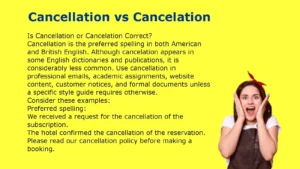
Cancellation is the preferred spelling in both American and British English. Although cancelation appears in some English dictionaries and publications, it is considerably less common. Use cancellation in professional emails, academic assignments, website content, customer notices, and formal documents unless a specific style guide requires otherwise.
Consider these examples:
Preferred spelling:
- We received a request for the cancellation of the subscription.
- The hotel confirmed the cancellation of the reservation.
- Please read our cancellation policy before making a booking.
Less common alternative:
- We received a request for the cancelation of the subscription.
- The company issued a statement about the cancelation of its services.
The alternative is understandable, but readers will encounter cancellation much more often. That makes it the more familiar and consistent option.
If you are writing for a business website, spelling consistency matters. A page that uses cancellation policy in one section and cancelation policy in another may look poorly edited, even when both forms are understood.
Why Does Cancellation Have Two Ls?
The word cancellation contains two Ls because English spelling preserves the doubled consonant in this established noun form. The verb cancel has one L, but adding certain endings changes how the word is written.
The important point is that English does not apply one identical spelling rule to every form of a word. The noun cancellation retains two Ls in standard usage, while the American past-tense form canceled uses one.
Compare the forms:
| Word | Part of speech | Spelling pattern |
| Cancel | Verb | One L |
| Cancellation | Noun | Two Ls |
| Cancelation | Noun variant | One L in the middle |
| Canceling | Present participle, US | One L |
| Cancelling | Present participle, UK | Two Ls |
| Canceled | Past tense or past participle, US | One L |
| Cancelled | Past tense or past participle, UK | Two Ls |
This difference can seem inconsistent if you expect every word to follow the same pattern. However, the accepted spelling of each form depends on established usage and regional conventions.
For example, an American writer can correctly write, “We canceled the meeting because of the cancellation.” The two spellings are not contradictory. Each follows the conventional spelling of its particular word form.
Is Cancelation a Real Word?
Yes. Cancelation is an accepted spelling variant of cancellation, but it is much less common. Its existence does not mean you should use it interchangeably with the standard form in every document. Most readers will recognize cancellation more readily.
You might encounter cancelation in older texts, particular publications, or documents that follow a specific house style. If you are editing an existing document, check whether the organization consistently uses that form before changing it.
For new content, the practical approach is straightforward:
- Use cancellation in general writing.
- Use cancellation policy in business terms and conditions.
- Use cancellation notice when communicating that something has been called off.
- Keep the same spelling throughout the document.
- Follow an organization’s official style guide when it specifies a preferred variant.
Choosing the standard form helps readers focus on your message instead of an unfamiliar spelling.
Canceled vs Cancelled: Which Spelling Should You Use?
Canceled and cancelled have the same meaning, but they follow different regional spelling conventions. American English usually uses canceled, with one L, while British English usually uses cancelled, with two. Both forms are correct in their respective varieties, and neither indicates a difference in the reason or circumstances for canceling something.
For example, an American company might write, “Your order has been canceled.” A British company would commonly write, “Your order has been cancelled.”
The message remains the same.
Canceled or Cancelled in American English
In American English, canceled is the standard past-tense and past-participle spelling of cancel. The related present participle is usually canceling, also with one L.
American writers use these forms in business correspondence, news reports, customer service messages, and everyday conversations.
Examples:
- The airline canceled the flight after the storm intensified.
- We canceled our hotel reservation before the deadline.
- Your appointment has been canceled.
- The school is canceling classes because of the weather.
- The manager canceled the meeting at the last minute.
Notice that the noun still uses two Ls:
- The cancellation took effect immediately.
- Please review the cancellation policy before placing your order.
- We received a cancellation notice from the supplier.
This is one of the most important distinctions to remember. American English does not generally change cancellation to cancelation simply because it uses canceled.
Cancelled or Canceled in British English
British English usually uses cancelled for the past tense and past participle. The present participle normally takes two Ls as well: cancelling.
These forms appear in British business writing, government communications, school notices, and everyday messages.
Examples:
- The airline cancelled the flight because of strong winds.
- The customer cancelled the order before dispatch.
- Your appointment has been cancelled.
- The company is cancelling its afternoon meetings.
- The organizer cancelled the event due to low attendance.
The noun remains cancellation, with two Ls.
For example:
“The cancellation of the train service caused delays across the region.”
A British writer would not normally change that noun to cancelation. The double-L spelling is standard on both sides of the Atlantic.
Canceled vs Cancelled: Quick Comparison Table
Use this table when you need to check the correct spelling quickly.
| American English | British English |
| Cancel | Cancel |
| Canceled | Cancelled |
| Canceling | Cancelling |
| Cancellation | Cancellation |
| Cancellation policy | Cancellation policy |
| Cancellation notice | Cancellation notice |
| Canceled order | Cancelled order |
| Canceled appointment | Cancelled appointment |
| Canceled event | Cancelled event |
The table highlights a useful pattern: the regional difference mainly affects the verb forms, not the standard noun.
However, spelling conventions can vary across publications and English-speaking regions. Australian English, for example, commonly follows the double-L pattern in cancelled and cancelling. When writing for a particular audience, follow its established conventions.
Cancellation UK Spelling: Is It Different From US English?
The standard UK spelling of cancellation is the same as the standard US spelling: two Ls. The main difference appears in related verb forms. British English normally uses cancelled and cancelling, while American English normally uses canceled and canceling.
This means you do not need to create separate versions of the noun for British and American readers.
How to Spell Cancellation in the UK
In British English, write cancellation when referring to the act of canceling something or the state of being canceled.
Examples include:
- The cancellation of the train service affected commuters.
- We received a cancellation notice from the venue.
- Please check the company’s cancellation policy before booking.
- The hotel confirmed the cancellation of our reservation.
- A last-minute cancellation allowed another customer to book the appointment.
British spelling typically changes the verb forms:
- The event was cancelled.
- The company is cancelling the service.
- The customer has cancelled the booking.
The noun remains unchanged across these examples. This is why searching for “cancellation UK spelling” can be confusing if you have seen canceled and assumed that the noun should also have one L.
Cancellation in American English
American English also uses cancellation as the standard noun. Although cancelation is an accepted alternative, cancellation remains the more familiar form.
Examples:
- The cancellation fee applies to late changes.
- We sent a cancellation notice to all customers.
- The cancellation policy allows refunds within 24 hours.
- A flight cancellation left several passengers waiting for new arrangements.
American writers normally use one L in the past-tense and present-participle forms:
- The flight was canceled.
- The company is canceling the service.
A useful rule is to remember the noun separately rather than trying to build it from the American verb form.
Common UK and US Spelling Mistakes
One frequent mistake is assuming that every related word must contain the same number of Ls.
For example, an American writer might incorrectly change cancellation to cancelation because they write canceled. A British writer might assume that the American form is wrong because it uses one L in the past tense.
Neither assumption reflects standard regional usage.
Avoid these mistakes by remembering the following:
- Cancellation is standard in both US and UK English.
- Canceled is the usual American past-tense form.
- Cancelled is the usual British past-tense form.
- Canceling is the usual American present-participle form.
- Cancelling is the usual British present-participle form.
- Cancelation is a less common noun variant.
If your audience includes readers from several countries, use cancellation for the noun and choose the verb spelling that best matches your publication’s style.
How to Use Cancellation and Canceled in Everyday Writing
The spelling choice becomes easier when you see the words in context. The noun cancellation describes the act or result of canceling something, while canceled and cancelled describe an action in the past or a resulting state.
Business writing often combines these forms with words such as order, appointment, event, notice, and policy. The correct regional spelling helps your message look consistent and professional.
Canceled Order or Cancelled Order
A canceled order is an order that a customer or business has called off. American English normally uses canceled order, while British English normally uses cancelled order.
The phrase often appears in online stores, shipping notifications, refund updates, and customer service emails.
American examples:
- Your canceled order will not be shipped.
- We have processed your refund for the canceled order.
- The system marked the order as canceled after payment verification failed.
British examples:
- Your cancelled order will not be dispatched.
- We have issued a refund for the cancelled order.
- The order was marked as cancelled after the payment failed.
A useful customer service message should explain what happened and what the customer should expect next.
For example:
“Your order has been canceled because the item is no longer available. We have issued a full refund to your original payment method.”
This message works well for an American audience. A British company could replace canceled with cancelled without changing the rest of the message.
Canceled Appointment or Cancelled Appointment
A canceled appointment is a scheduled meeting or service visit that will no longer take place. Use canceled for standard American English and cancelled for standard British English.
The phrase commonly appears in healthcare, salons, consulting services, business meetings, and personal scheduling.
Examples:
- Your canceled appointment can be rescheduled through our online portal.
- The clinic notified patients about their canceled appointments.
- A cancelled appointment became available at short notice.
- Please contact reception if you need to cancel your appointment.
The last example uses cancel as a verb, so its spelling does not change by region.
When notifying someone about an appointment, make the action and next step clear.
Sample appointment notice:
“Your appointment scheduled for Tuesday at 10 a.m. has been canceled. Please contact our office to choose another available time.”
For a British audience, write cancelled instead. If you are communicating with patients or clients, include the appointment date, time, and rescheduling instructions to prevent confusion.
Canceled Event or Cancelled Event
A canceled event is an event that will no longer take place as planned. Common examples include concerts, conferences, sporting events, school activities, fundraisers, and community gatherings.
American English uses canceled event, while British English typically uses cancelled event.
Examples:
- The canceled event will not be rescheduled this year.
- Organizers announced the cancellation of the outdoor concert.
- The school canceled the sports day because of heavy rain.
- The festival was cancelled after the venue became unavailable.
When announcing a canceled event, give readers the information they need rather than simply stating that the event will not happen.
A clear announcement should include:
- The event’s name.
- The original date and location.
- The reason for the cancellation, if appropriate.
- Whether organizers plan to reschedule it.
- Refund or ticket-transfer instructions.
For example:
“Due to severe weather, Saturday’s outdoor concert has been canceled. Ticket holders will receive refund instructions by email. We will announce any rescheduled date on our official website.”
This format reduces follow-up questions and helps attendees understand their options.
Cancellation Notice
A cancellation notice is a message that informs someone that an appointment, booking, agreement, service, or event has been canceled or will be canceled. The phrase uses the noun cancellation, so the spelling stays the same in American and British English.
Cancellation notices appear in many settings, including:
- Hotel and travel bookings.
- Subscription services.
- Business contracts.
- Medical appointments.
- Event registrations.
- Utility or service agreements.
For example:
“We have received your cancellation notice and will end your subscription on November 30.”
In another context, a business might send a notice to customers:
“Please be advised that the scheduled maintenance visit has been canceled. We apologize for the inconvenience and will contact you to arrange a new date.”
A good cancellation notice should identify what has been canceled, when the change takes effect, and what happens next. If the cancellation involves money, explain any refund, fee, or remaining obligation in plain language.
Do not confuse a cancellation notice with a cancellation policy. A notice communicates a specific change; a policy explains the rules that govern such changes.
Cancellation Policy, Cancellation List, and Related Terms
The word cancellation appears in several common business phrases. Although these expressions share the same noun, each serves a different purpose. A cancellation policy sets expectations, a cancellation list helps fill newly available slots, and a cancellation notice communicates a specific cancellation.
Knowing these differences makes your writing more precise.
Cancellation Policy or Cancelation Policy
A cancellation policy explains the rules that apply when a customer cancels a booking, appointment, order, subscription, or service. It may cover deadlines, fees, refunds, deposits, and exceptions.
The standard spelling is cancellation policy in both American and British English. Although cancelation policy is understandable, the standard two-L noun is the better choice for professional writing.
Examples:
- Please review our cancellation policy before booking.
- The hotel has a 48-hour cancellation policy.
- Our cancellation policy explains when customers qualify for a refund.
- The service provider updated its cancellation policy to clarify late fees.
A well-written policy should answer practical questions:
- How late can a customer cancel?
- Does the customer receive a full or partial refund?
- Are deposits refundable?
- Does the business charge a cancellation fee?
- What happens if the business cancels the service?
- Are there exceptions for emergencies or unexpected disruptions?
For example, a salon might state that customers must cancel at least 24 hours before an appointment to avoid a late cancellation fee. A hotel may use a different deadline based on the booking rate and travel dates.
These rules vary by business and agreement. Writers should not present a particular deadline or fee as a universal standard.
What Is a Cancellation List?
A cancellation list is a list of people who want to take an appointment, reservation, or place that becomes available when someone else cancels. Businesses often use cancellation lists to fill open slots without leaving their schedules empty.
For example, a dental clinic may have no appointments available until Friday. If a patient cancels a Wednesday appointment, the clinic can contact someone on its cancellation list and offer the newly available time.
Other examples include:
- A salon contacting clients when an earlier appointment opens.
- A restaurant contacting diners when a reservation becomes available.
- A medical practice offering a newly available consultation.
- A training provider filling a seat after a participant withdraws.
A cancellation list can resemble a waiting list, but the terms are not always identical.
A waiting list generally records people waiting for an opportunity or place. A cancellation list often focuses on filling openings created by cancellations. Some organizations use the terms interchangeably, so the exact meaning depends on their process.
Example sentence:
“Would you like us to add your name to the cancellation list in case an earlier appointment becomes available?”
This wording is clear because it explains why someone would join the list.
Cancellation Notice vs. Cancellation Policy
A cancellation notice tells someone that a cancellation has occurred or will take effect. A cancellation policy explains the rules that apply when a cancellation happens.
| Feature | Cancellation notice | Cancellation policy |
| Main purpose | Communicates a specific cancellation | Explains cancellation rules |
| Typical content | Date, affected service, next steps | Deadlines, fees, refunds, conditions |
| Common location | Email, text message, letter | Website, contract, booking terms |
| Example | “Your appointment has been canceled.” | “Appointments canceled within 24 hours may incur a fee.” |
A business may need both.
For example, a hotel website can publish a cancellation policy that explains when guests qualify for a refund. If a guest cancels a reservation, the hotel may then send a cancellation confirmation or notice.
Keeping the two concepts separate helps prevent vague wording in customer communications.
Cancel, Canceled, Cancelling, and Cancellation: Grammar Rules
The word family includes a verb, a noun, and several verb forms. The spelling differences become easier to remember when you identify the grammatical role of each word.
The Base Verb: Cancel
Cancel is a verb meaning to call something off, revoke it, or decide that it will not proceed.
Examples:
- I need to cancel my reservation.
- Please cancel the duplicate order.
- The organizer may cancel the event if the weather worsens.
- You can cancel your subscription through your account settings.
The base form uses one L in both American and British English.
It can appear with different subjects and auxiliary verbs:
- I cancel the booking.
- She cancels the booking.
- We need to cancel the booking.
- They decided to cancel the booking.
Notice that cancels also has one L. The regional difference appears in forms such as canceling and canceled.
Canceled vs. Cancelled
Canceled and cancelled are past-tense and past-participle forms of the verb cancel. American English generally uses canceled, while British English generally uses cancelled.
The past tense describes an action that happened earlier:
- The manager canceled the meeting.
- The organizer cancelled the event.
The past participle often appears with auxiliary verbs:
- We have canceled your reservation.
- The company has cancelled the service.
- The appointment was canceled.
- The train was cancelled.
Both forms communicate the same action. The correct choice depends on the regional spelling convention you follow.
Canceling vs. Cancelling
Canceling is the usual American spelling of the present participle, while cancelling is the usual British spelling. Both forms describe an action in progress or an action used in a grammatical construction.
Examples:
- We are canceling the afternoon meeting. (US)
- We are cancelling the afternoon meeting. (UK)
- The customer is canceling the subscription. (US)
- The customer is cancelling the subscription. (UK)
These forms can also function as gerunds:
- Canceling at the last minute may result in a fee. (US)
- Cancelling at the last minute may result in a fee. (UK)
In both sentences, the word acts as the subject of the sentence. The meaning remains the same.
Cancellation vs. Cancelation
Cancellation is a noun. It refers to the act or result of canceling something. Cancelation is a less common variant of the same noun.
Compare the grammatical roles:
- Verb: We decided to cancel the booking.
- Past tense: We canceled the booking.
- Present participle: We are canceling the booking.
- Noun: The cancellation surprised us.
A common editing mistake is changing the noun to cancelation merely to match the American spelling canceled. That change is unnecessary. The usual American forms are canceled, canceling, and cancellation.
Common Mistakes When Writing Cancellation
Small spelling inconsistencies can make an article, website, or customer message look unfinished. Most errors occur because writers apply one spelling pattern to every word in the family or mix American and British forms without a clear reason.
Using Cancelation in Formal Business Writing
Because cancelation is a less common variant, it may look unfamiliar to many readers. In most business contexts, cancellation is the safer and more recognizable choice.
Prefer:
- Cancellation policy
- Cancellation fee
- Cancellation confirmation
- Cancellation request
- Cancellation notice
- Cancellation of service
Use the less common variant only when a specific publication, organization, or established document style calls for it.
For website owners, this also makes editing easier. Using one standard spelling throughout your site helps maintain a consistent style across service pages, booking forms, FAQs, and customer support templates.
Mixing American and British Spellings
Mixing regional spellings can make a document appear inconsistent.
For example:
“The company cancelled the order, and the customer is canceling the replacement.”
The sentence is understandable, but it mixes the usual British past-tense form with the usual American present-participle form.
If you are writing in American English, prefer:
“The company canceled the order, and the customer is canceling the replacement.”
For British English, prefer:
“The company cancelled the order, and the customer is cancelling the replacement.”
This rule does not mean that every variation is incorrect in every setting. International publications sometimes follow their own style guides. The practical goal is to use a consistent convention that fits your audience.
Confusing Cancellation With Canceled
Cancellation is a noun, while canceled and cancelled are verb forms. They cannot always replace one another because they serve different grammatical purposes.
Compare:
- Correct: The cancellation affected several customers.
- Correct: The company canceled the service.
- Incorrect: The company cancellation the service.
- Incorrect: The canceled of the service affected several customers.
Use cancellation when referring to the event or process. Use cancel, canceled, or cancelled when describing the action.
Here is a quick grammatical guide:
| Word | Part of speech | Example |
| Cancel | Verb | Please cancel the order. |
| Cancels | Verb | She cancels the booking. |
| Canceled | Verb form, US | He canceled the appointment. |
| Cancelled | Verb form, UK | He cancelled the appointment. |
| Canceling | Verb form, US | We are canceling the event. |
| Cancelling | Verb form, UK | We are cancelling the event. |
| Cancellation | Noun | The cancellation caused delays. |
| Cancelation | Noun variant | The cancelation was announced. |
Quick Reference: Which Cancellation Spelling Is Correct?
When you need a quick answer, use the following table to choose the right spelling.
| If you mean… | Recommended spelling |
| The act of calling something off | Cancellation |
| A less common variant of the noun | Cancelation |
| Something called off in US English | Canceled |
| Something called off in UK English | Cancelled |
| The ongoing action in US English | Canceling |
| The ongoing action in UK English | Cancelling |
| Rules for canceling a service | Cancellation policy |
| A message communicating a cancellation | Cancellation notice |
| A list of people waiting for an opening | Cancellation list |
| An order called off in US English | Canceled order |
| An appointment called off in UK English | Cancelled appointment |
| An event called off in US English | Canceled event |
Practical Examples for Different Situations
Use these sample sentences as a reference when writing business messages, website content, or everyday communications.
For online shopping:
“Your order has been canceled. We will send a refund confirmation once the payment has been processed.”
For appointments:
“Your appointment has been cancelled. Please contact our office to arrange another time.”
For events:
“The event has been canceled due to unexpected circumstances. Registered guests will receive further details by email.”
For subscriptions:
“Your cancellation request has been received. Your subscription will remain active until the end of the current billing period.”
For booking policies:
“Please review our cancellation policy before confirming your reservation.”
These examples demonstrate why it helps to distinguish the noun from the verb forms. Cancellation policy uses the standard noun, while canceled and cancelled reflect regional verb spelling.
Frequently Asked Questions
Is cancellation or cancelation correct?
Cancellation is the standard, preferred spelling in both American and British English. Cancelation is an accepted but much less common variant. For general writing, business documents, and website content, choose cancellation.
Is cancellation spelled differently in the UK?
No. Cancellation is the standard spelling in both the UK and the US. The main regional difference appears in the verb forms: British English usually uses cancelled and cancelling, while American English usually uses canceled and canceling.
Should I write canceled or cancelled?
Use canceled in standard American English and cancelled in standard British English. Both spellings have the same meaning. Choose the form that matches your audience or the style guide you follow.
Is it canceled appointment or cancelled appointment?
Both forms are correct, depending on the regional convention. Canceled appointment is standard in American English, while cancelled appointment is standard in British English. The phrase refers to an appointment that will no longer take place as scheduled.
Is it cancellation policy or cancelation policy?
Cancellation policy is the standard and widely preferred form in both American and British English. It describes the rules that apply when someone cancels a booking, appointment, order, or service. Cancelation policy is less common.
Why does cancellation have two Ls but canceled has one?
The words follow different established spelling patterns. Cancellation is conventionally spelled with two Ls in both US and UK English. American English uses one L in canceled and canceling, while British English generally uses two in cancelled and cancelling.
Final Thoughts on Cancellation vs Cancelation
The difference between cancellation vs cancelation is easier to remember once you separate the noun from the verb forms. Cancellation is the standard spelling in both American and British English, while cancelation is a much less common alternative.
For the past tense, follow your audience’s regional convention: use canceled and canceling in American English, or cancelled and cancelling in British English.
Keep these rules in mind when writing a canceled order, canceled appointment, canceled event, cancellation policy, or cancellation notice. If you are unsure which noun spelling to choose, use cancellation.