Wore vs worn can be confusing because both forms come from the verb wear, but they are used in different grammatical situations. If you’ve come across “wore” and “worn” and wondered which one is correct, the difference is closely connected to past tense, past participles, helping verbs, and sentence structure.
The wore vs worn difference is simple once you understand their grammatical roles. Wore is the simple past tense of wear, while worn is the past participle and normally appears with a helping verb such as have, has, had, or be. For example, “She wore a red dress yesterday” is correct, while “She has worn that dress before” uses the past participle correctly.
In this guide, you’ll learn the difference between wore and worn, when to use each form, how they work in sentences, and why “wore” cannot always replace “worn.” You’ll also see clear examples, sentence comparisons, and common mistakes to make the distinction easy to understand.
By the end, you’ll know exactly when to use wore or worn and how to choose the correct form naturally and correctly in everyday and formal writing.
Wore vs Worn: Quick Answer
The simplest way to remember the difference is this:
- Wore = the simple past of wear.
- Worn = the past participle of wear.
- Wore normally works as the main verb in a simple past sentence.
- Worn normally appears with a helping verb such as have, has, had, or be.
- Worn can also work as an adjective when it describes something damaged or aged through use.
Quick examples
| Word | Grammatical role | Example |
| wear | Base form | I wear sneakers every day. |
| wore | Simple past | I wore sneakers yesterday. |
| worn | Past participle | I have worn these sneakers before. |
| worn | Adjective | These are worn shoes. |
The important point is that wore and worn are not interchangeable.
You cannot normally replace wore with worn simply because both refer to the past.
For example:
- Correct: I wore my jacket yesterday.
- Incorrect: I worn my jacket yesterday.
But:
- Correct: I have worn my jacket before.
- Incorrect: I have wore my jacket before.
The helping verb determines which form you need.
What Is the Difference Between Wore and Worn?
The difference between wore and worn is primarily a difference in verb form.
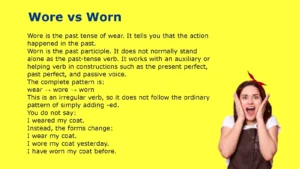
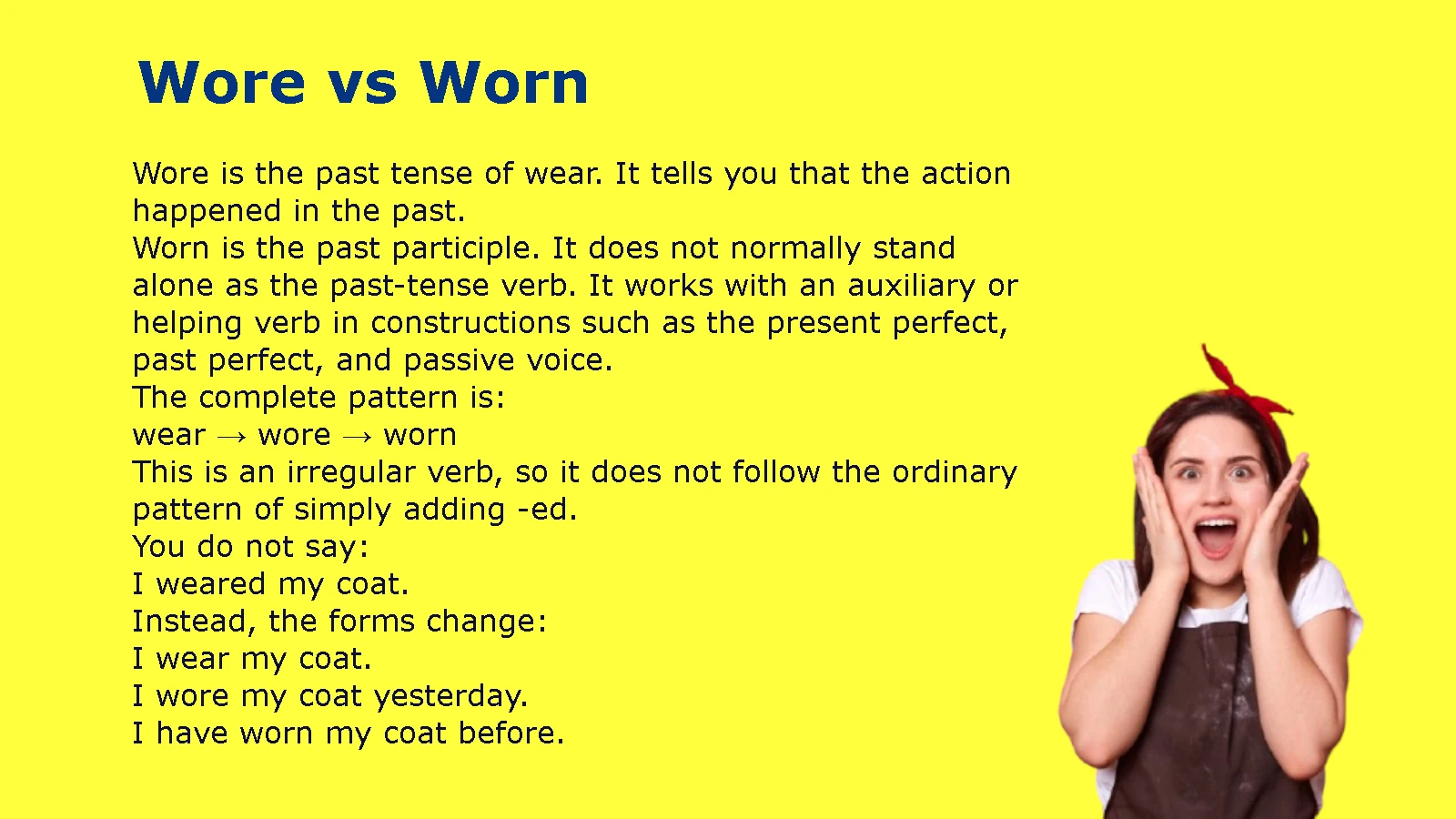
Wore is the past tense of wear. It tells you that the action happened in the past.
Worn is the past participle. It does not normally stand alone as the past-tense verb. It works with an auxiliary or helping verb in constructions such as the present perfect, past perfect, and passive voice.
The complete pattern is:
wear → wore → worn
This is an irregular verb, so it does not follow the ordinary pattern of simply adding -ed.
You do not say:
I weared my coat.
Understanding this pattern solves most wore vs worn questions.
Wore Meaning
Wore is the simple past form of wear.
Use it when you are describing an action that happened at a definite or completed time in the past.
For example:
I wore a blue shirt yesterday.
The action happened yesterday, so wore is appropriate.
You can also use wore when the exact time is understood from the context:
She wore her favorite dress to the wedding.
The sentence describes something that happened at a past event. You do not need to state the date because the context already places the action in the past.
Wore examples
- I wore my new shoes to school.
- She wore a black jacket yesterday.
- He wore glasses when he was younger.
- We wore matching shirts for the event.
- They wore uniforms during the competition.
- Maria wore a red dress to dinner.
- I wore that hat last weekend.
- He wore his old boots during the hike.
In each example, wore is the main verb describing a completed past action.
Wore with specific past-time expressions
Words and phrases that clearly refer to a completed past period commonly appear with wore:
- yesterday
- last night
- last week
- last month
- last year
- two days ago
- an hour ago
- when I was a child
- during the ceremony
- at the party
- on Monday
For example:
I wore that jacket last week.
She wore those shoes two days ago.
He wore a uniform when he worked at the school.
The important idea is not simply that the clothing was worn in the past. The sentence is presenting wearing as a completed past action.
Worn Meaning
Worn is the past participle of wear.
Unlike wore, it normally needs a helping verb when it functions as part of a verb phrase.
Common combinations include:
- have worn
- has worn
- had worn
- was worn
- were worn
- is worn
- are worn
- will have worn
For example:
I have worn this jacket before.
Here, have is the helping verb and worn is the past participle.
Another example is:
She had worn the dress before.
Here, had introduces the past perfect construction.
Worn examples
- I have worn these shoes before.
- She has worn that dress several times.
- He had worn the uniform earlier.
- We have worn matching outfits before.
- They had worn costumes for the performance.
- The shoes were worn by the actor.
- The jacket has been worn many times.
Notice the pattern. Worn does not simply replace wore because the event happened in the past.
The surrounding grammar determines the correct form.
Wear, Wore, and Worn: The Three Forms
The easiest way to understand wore vs worn is to learn the entire verb.
| Verb form | Word | Example |
| Base form | wear | I wear glasses every day. |
| Third-person singular | wears | She wears glasses. |
| Simple past | wore | She wore glasses yesterday. |
| Past participle | worn | She has worn glasses for years. |
| -ing form | wearing | She is wearing glasses now. |
The three forms most relevant to this article are:
wear → wore → worn
Think of them as three different grammatical tools rather than three interchangeable versions of the same word.
Present: Wear
Use wear for present habits, routines, general facts, and actions described in the present.
I wear sneakers to work.
She wears glasses.
Past: Wore
Use wore for a completed past action.
I wore sneakers yesterday.
Past participle: Worn
Use worn with an appropriate helping verb.
I have worn these sneakers many times.
That small distinction is responsible for most mistakes involving these words.
When to Use Wore
Use wore when you are using the simple past tense of wear.
The sentence usually describes an action that happened and ended in the past.
Completed past actions
I wore my favorite shirt yesterday.
She wore a beautiful dress at the ceremony.
He wore his old boots during the trip.
The action is viewed as a finished event.
You can often add a specific past-time expression:
I wore my new coat last winter.
She wore the uniform on Monday.
He wore those shoes at the party.
Wore does not need “have”
A common mistake is adding have and then using wore.
Incorrect:
I have wore this shirt before.
Correct:
I have worn this shirt before.
But without have, simple past is fine:
I wore this shirt yesterday.
This gives you a useful rule:
Wore can stand as the simple past verb. Worn usually needs a grammatical structure that licenses the past participle.
When to Use Worn
Use worn when the grammar calls for the past participle of wear.
The most common situation is after have, has, or had.
Present perfect: Have or Has + Worn
The present perfect connects a past action to the present in some way.
I have worn this jacket before.
She has worn that dress several times.
We have worn these uniforms for years.
The exact time may not matter. The speaker is focusing on experience, repetition, or a connection to the present.
Compare:
I wore the jacket yesterday.
with:
I have worn the jacket before.
The first sentence identifies a completed past event.
The second focuses on previous experience rather than simply identifying one completed event.
Past perfect: Had + Worn
Use had worn when one past event happened before another past event.
I had worn the jacket before I bought it.
She had worn the dress once before the ceremony.
They had worn the uniforms before the photographs were taken.
The word had creates the past perfect structure, so the following verb must use its past participle form:
had + worn
Not:
had + wore
Passive voice: Be + Worn
Worn can also appear in passive constructions.
For example:
The dress was worn by the actress.
The uniforms were worn by the students.
The costume has been worn many times.
Here, worn is part of a passive construction.
The important pattern is:
be + worn
Depending on the tense, be can appear as is, are, was, were, been, and so on.
Wore vs Worn With Shoes
The phrase wore vs worn shoes creates another common point of confusion.
Consider these two sentences:
I wore these shoes yesterday.
These are worn shoes.
They look similar, but wore and worn perform completely different grammatical jobs.
In the first sentence, wore is the past-tense verb. It tells us what the person did.
In the second sentence, worn describes the condition of the shoes.
Wore shoes
Use wore when you are talking about the action.
I wore these shoes to work.
She wore her new shoes to the party.
He wore those shoes during the hike.
Worn shoes
Worn can describe shoes that have become damaged, faded, thin, or otherwise changed through repeated use.
These shoes look worn.
He donated his old worn shoes.
The soles were badly worn.
This meaning is different from the past participle in:
I have worn these shoes many times.
In that sentence, worn is part of the verb phrase have worn.
In:
These are worn shoes.
worn is functioning adjectivally to describe the shoes.
That distinction is worth remembering.
Wore vs Worn With Clothing
The same principle applies to clothes.
Wore clothing
Use wore when you are describing a past action:
I wore a blue shirt yesterday.
She wore a red dress to the wedding.
He wore a suit to the interview.
Have worn clothing
Use worn after have or has:
I have worn this shirt before.
She has worn that dress several times.
He has worn the same style for years.
Worn clothing
Use worn as an adjective when the clothing shows the effects of repeated use.
He was wearing a worn leather jacket.
The old shirt looked worn.
She packed several worn sweaters for the trip.
The difference can be summarized like this:
| Phrase | Meaning |
| I wore the shirt. | I put it on and used it in the past. |
| I have worn the shirt. | I have used it before. |
| The shirt is worn. | The shirt shows signs of use or damage. |
This is one of the most useful distinctions for understanding wore vs worn clothing.
Wore vs Worn Out
The phrase worn out deserves special attention because it combines worn with out and has meanings beyond ordinary clothing.
Wore out
Wore out is the simple past form of the phrasal verb wear out.
It means that something caused an object to become damaged or unusable through repeated use.
Years of use wore out the carpet.
The constant friction wore out the machine.
Walking every day wore out my old shoes.
Here, wore is the simple past form.
Worn out
Worn out is the past participle form and can also function as an adjective.
My shoes are worn out.
The carpet has become worn out.
The old machine is completely worn out.
In these examples, repeated use has caused something to become badly damaged or no longer useful.
Worn out can describe people
Worn out can also mean extremely tired.
I am completely worn out after work.
She was worn out after taking care of the children all day.
This meaning is not about clothing or physical damage to an object. It describes a person’s exhaustion.
So:
- wore out = simple past action
- worn out = past participle or adjective
- worn out can also mean extremely tired
That makes wore out vs worn out another useful grammar distinction.
Wore vs Worn: Sentence Examples
The following examples show how the two words work in different grammatical environments.
| Sentence | Explanation |
| I wore my jacket yesterday. | Simple past |
| She wore a red dress. | Completed past action |
| He wore glasses as a child. | Past habit or situation |
| I have worn this jacket before. | Present perfect |
| She has worn the dress several times. | Present perfect |
| He had worn the shoes earlier. | Past perfect |
| The uniform was worn by the students. | Passive voice |
| These shoes look worn. | Adjective |
| The carpet is worn in places. | Adjective describing condition |
| The heavy use wore out the shoes. | Simple past phrasal verb |
| The shoes are worn out. | Past participle/adjective |
| I am worn out after the trip. | Extremely tired |
Notice how wore appears when the verb itself is in the simple past, while worn appears in other grammatical structures.
Common Mistakes With Wore and Worn
“I Have Wore” vs “I Have Worn”
This is probably the most common mistake.
Incorrect:
I have wore this jacket before.
Correct:
I have worn this jacket before.
Why?
Because have is being used as an auxiliary verb in the present perfect. The structure is:
have/has + past participle
The past participle of wear is worn.
So:
have + worn
not:
have + wore
The same rule applies to:
She has worn it before.
and:
They have worn these uniforms for years.
“I Worn It Yesterday” vs “I Wore It Yesterday”
Incorrect:
I worn it yesterday.
Correct:
I wore it yesterday.
The word yesterday points to a completed past event, and the simple past form is required.
The sentence does not contain have, has, or another construction that calls for the past participle.
Therefore:
I wore it yesterday.
“I Had Wore” vs “I Had Worn”
Incorrect:
I had wore the jacket before the event.
Correct:
I had worn the jacket before the event.
The past perfect uses:
had + past participle
Since worn is the past participle, the correct form is:
had worn
This is exactly the same grammatical principle as:
had eaten
rather than had ate,
or:
had gone
rather than had went.
“She Has Wore” vs “She Has Worn”
Incorrect:
She has wore that dress several times.
Correct:
She has worn that dress several times.
Again, has requires the past participle in this construction.
The correct pattern is:
has + worn
I Have Worn or Wore: Which Is Correct?
Both “I have worn” and “I wore” can be correct, but they are used differently.
I wore
Use I wore for a completed past action.
I wore the jacket yesterday.
I wore those shoes at the wedding.
The speaker is presenting the event as a past occurrence.
I have worn
Use I have worn when using the present perfect.
I have worn this jacket before.
I have worn those shoes several times.
The present perfect often emphasizes experience, repetition, or a connection between the past and present rather than simply identifying one completed event.
Compare these examples
I wore that shirt last Saturday.
The speaker identifies a particular past occasion.
I have worn that shirt many times.
The speaker emphasizes past experience or repeated use.
A useful shortcut is:
Specific finished past time → wore
Experience or past action connected to the present → have worn
There are more detailed rules governing the present perfect, but this distinction works well for ordinary examples involving clothing.
Wore or Worn? A Simple Rule to Remember
When you are unsure, look at the structure of the sentence.
Choose Wore when:
- You need the simple past.
- The action happened at a completed time in the past.
- There is no auxiliary requiring the past participle.
Examples:
I wore it yesterday.
She wore the dress last night.
We wore uniforms at school.
Choose Worn when:
- It follows have.
- It follows has.
- It follows had.
- It forms part of a passive construction.
- It functions as an adjective describing something affected by use.
Examples:
I have worn it before.
She has worn the dress twice.
He had worn the shoes earlier.
The shoes were worn by the player.
The soles look worn.
The quickest memory trick is:
Yesterday? Wore.
Have/has/had? Worn.
It is not a rule for every possible sentence, but it is an excellent starting point for ordinary uses of these two forms.
Wore vs Worn Comparison Table
| Feature | Wore | Worn |
| Base verb | Wear | Wear |
| Verb form | Simple past | Past participle |
| Usually used alone as the main past verb | Yes | No |
| Used after have/has | No | Yes |
| Used after had | No | Yes |
| Used in passive constructions | No | Yes |
| Can describe a worn-out condition | No | Yes |
| Example | I wore it yesterday. | I have worn it before. |
| Example with shoes | I wore these shoes yesterday. | These shoes look worn. |
| Example with clothing | She wore a dress. | She has worn that dress. |
Pronunciation of Wore and Worn
The words are also different in pronunciation.
In standard American English, wore is commonly pronounced approximately like “war” in many accents.
Worn contains an additional n sound:
wore → /wɔr/
worn → /wɔrn/
Pronunciation varies somewhat by accent, particularly between American and British English.
There is another useful pronunciation point: worn should not be pronounced exactly like wore.
The final n distinguishes the two words when spoken carefully.
Wore and war
Wore and war are homophones in many varieties of English, meaning they are pronounced alike even though they have completely different meanings.
She wore a blue coat.
The country was affected by war.
The spelling tells you which meaning is intended.
Wore and Worn Beyond Clothing
The verb wear is not limited to shirts, pants, dresses, and shoes.
English also uses it for things such as:
- glasses
- jewelry
- makeup
- hairstyles
- expressions
- smiles
- uniforms
- accessories
- protective equipment
For example:
She wore glasses at school.
He wore a confident smile.
She has worn the same hairstyle for years.
The workers wore protective equipment.
This broader usage explains why wore vs worn appears in many contexts beyond fashion.
The same grammar applies regardless of what is being worn.
I wore glasses yesterday.
I have worn glasses before.
The object changes, but the grammatical distinction remains the same.
A Practical Way to Choose Between Wore and Worn
Imagine you are filling a blank:
I ___ my new shoes yesterday.
The word yesterday identifies a completed past time.
So:
I wore my new shoes yesterday.
Now change the sentence:
I have ___ my new shoes before.
The word have tells you that you need a past participle.
So:
I have worn my new shoes before.
Change it again:
I had ___ my new shoes before the race.
Because had introduces the past perfect, you need:
I had worn my new shoes before the race.
And now:
These shoes look ___.
Here, worn can work as an adjective describing their condition:
These shoes look worn.
This simple exercise shows why you should not decide between the two words based only on whether the event happened in the past.
Both forms can refer to past events. Their grammatical roles are different.
Mini Case Study: Choosing the Correct Form
Consider this short paragraph:
Last Saturday, Daniel wore his new hiking boots. He had never worn them before, so he wasn’t sure how comfortable they would be. By the end of the trip, the boots looked slightly worn, but they were still in good condition.
Three forms appear in just three sentences.
Wore is used for the completed Saturday action:
Daniel wore his new hiking boots.
Worn follows had never:
He had never worn them before.
Worn then describes the condition of the boots:
The boots looked slightly worn.
This is an important example because it shows that the correct choice depends on grammar and meaning, not simply on whether something happened in the past.
Quick Grammar Checklist
Before choosing wore or worn, ask yourself these questions:
- Am I using the simple past? → wore
- Does the sentence contain have? → worn
- Does it contain has? → worn
- Does it contain had? → worn
- Is the construction passive? → often worn
- Am I describing an object that shows signs of use? → worn
- Am I describing a completed past action? → usually wore
Quick examples
I wore it yesterday. ✅
I had worn it before the event. ✅
The shoes look worn. ✅
I worn it yesterday. ❌
I had wore it before. ❌
FAQs About Wore vs Worn
Is “wore” the past tense of “wear”?
Yes. Wore is the simple past form of wear.
I wear a uniform every day.
I wore a uniform yesterday.
The third form is worn, which is the past participle.
Is “worn” the past tense of “wear”?
No. Worn is the past participle, not the simple past tense.
The forms are:
wear → wore → worn
For simple past, use wore:
She wore a coat.
For a perfect construction, use worn:
She has worn the coat before.
Should I say “I wore” or “I have worn”?
Both can be correct.
Use I wore for a simple past event:
I wore the jacket yesterday.
Use I have worn for a present perfect construction:
I have worn the jacket before.
The surrounding context determines which one is appropriate.
Is it “I have wore” or “I have worn”?
The correct form is:
I have worn.
Not:
I have wore.
The reason is that have + past participle requires the past participle of wear, which is worn.
Is it “I wore these shoes” or “I have worn these shoes”?
Both are grammatical, but the meaning and context differ.
I wore these shoes yesterday.
This refers to a particular completed past event.
I have worn these shoes before.
This emphasizes previous experience.
What is the difference between “wore out” and “worn out”?
Wore out is the simple past form:
The constant use wore out my shoes.
Worn out is the past participle or adjective:
My shoes are worn out.
It can also describe extreme tiredness:
I am worn out after the long trip.
Is “worn” an adjective?
Yes. Worn can function as an adjective when it describes something that has become damaged or changed through repeated use.
a worn jacket
worn shoes
a worn carpet
It can also describe a person who looks very tired:
She looked worn after the difficult week.
However, worn is also the past participle of wear, so its grammatical role depends on the sentence.
What are the three forms of “wear”?
The three principal forms are:
wear → wore → worn
For example:
I wear boots.
I have worn these boots before.
Conclusion: Wore vs Worn
The difference between wore vs worn becomes straightforward once you remember that they are different forms of the verb wear.
Wore is the simple past:
I wore my jacket yesterday.
Worn is the past participle:
I have worn my jacket before.
The basic verb pattern is:
wear → wore → worn
Use wore when you need the simple past form for a completed past action. Use worn after structures such as have, has, and had, and in passive constructions. Worn can also function as an adjective when something shows the effects of repeated use.
The same distinction applies to shoes, clothing, uniforms, glasses, accessories, and other things people wear.
If you remember only one shortcut, make it this:
I wore it yesterday.
I have worn it before.
Once you recognize the difference between simple past and past participle, choosing between wore and worn becomes much easier.