Modeler vs modeller: Both spellings are correct, but the preferred form depends on the variety of English you use. American English generally uses modeler with one L, while British English typically uses modeller with two Ls. Both words describe someone who creates, designs, or works with models, and neither spelling changes the word’s meaning or pronunciation.
The difference comes from regional English spelling conventions, particularly the rule for doubling the final consonant when adding the suffix -er. This distinction also appears in related words such as modeling and modelling, modeled and modelled, and professional terms such as BIM modeler and BIM modeller. Understanding these patterns helps writers, students, editors, and industry professionals choose consistent spelling.
| Question | Answer |
| Is it modeler or modeller? | Both are correct English spellings. |
| Which spelling is American? | Modeler, with one L. |
| Which spelling is British? | Modeller, with two Ls. |
| Do modeler and modeller mean the same thing? | Yes. Both describe someone who creates or works with models. |
| Is it BIM modeler or modeller? | Both are acceptable; choose according to regional and company spelling conventions. |
Modeler vs Modeller: Which Spelling Is Correct?
Both modeler and modeller are standard English nouns. The main difference involves regional spelling preferences rather than grammar, definition, or pronunciation.
American English favors modeler, while British English generally prefers modeller. Writers in other English-speaking countries may follow either convention, depending on local dictionaries, professional standards, and editorial preferences.
For example:
- American English: The modeler created a detailed digital representation of the building.
- British English: The modeller created a detailed digital representation of the building.
Both sentences communicate exactly the same information.
Modeler: The American English Spelling
Modeler is the preferred American English spelling. It refers to a person who creates, develops, designs, or works with models.
The word appears in several professional and creative fields, including:
- Architecture and engineering
- Computer graphics and animation
- Product design
- Mathematical modeling
- Scientific research
- Video game development
- Industrial design
American publications and workplaces generally use modeler when describing these professionals.
For example:
- The company hired an experienced 3D modeler to develop digital product designs.
- Our lead modeler created a detailed representation of the proposed building.
- The mathematical modeler developed a simulation to predict future demand.
- She works as a character modeler for a video game studio.
Notice that American English also uses modeling rather than modelling and modeled rather than modelled.
These related forms follow the same general spelling preference.
Modeller: The British English Spelling
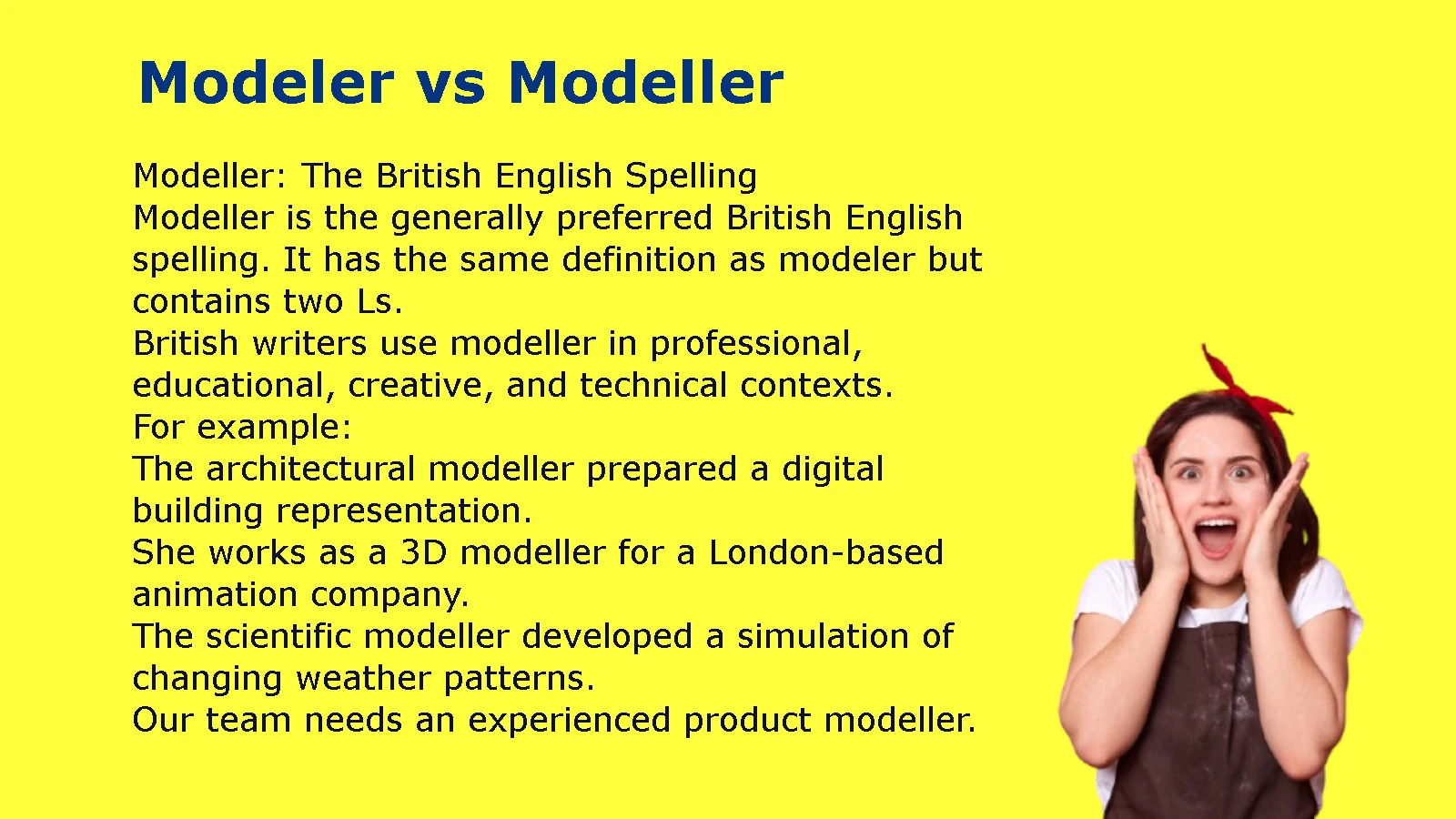
Modeller is the generally preferred British English spelling. It has the same definition as modeler but contains two Ls.
British writers use modeller in professional, educational, creative, and technical contexts.
For example:
- The architectural modeller prepared a digital building representation.
- She works as a 3D modeller for a London-based animation company.
- The scientific modeller developed a simulation of changing weather patterns.
- Our team needs an experienced product modeller.
The doubled L also appears in related British forms:
- Modelling
- Modelled
- Remodelling
- Remodelled
These spellings follow common British English conventions.
Are Modeler and Modeller Interchangeable?
Yes. Modeler and modeller are interchangeable in meaning, but writers should consider their target audience when choosing between them.
You can use either form to describe someone who creates physical, mathematical, architectural, or digital models.
However, switching between the two spellings without a clear reason can make a document look inconsistent.
Consider these examples:
| Consistent American English | Consistent British English |
| The modeler created a new design. | The modeller created a new design. |
| She specializes in 3D modeling. | She specializes in 3D modelling. |
| The modeler updated the file. | The modeller updated the file. |
| The project was modeled digitally. | The project was modelled digitally. |
Practical rule: Choose one English spelling convention and apply it throughout your article, report, website, resume, or professional portfolio.
Modeler or Modeller Meaning: What Does Each Word Mean?
A modeler or modeller is a person who creates, develops, or works with a model. The term applies to people who produce physical objects, digital designs, mathematical representations, or simulations. Although the spelling changes between American and British English, the meaning remains identical.
The exact responsibilities depend on the industry. A 3D modeller may create digital characters, while an architectural modeller may develop building representations. A mathematical modeler, meanwhile, uses equations and data to represent real-world systems.
Modeler as a Person Who Creates Models
The noun modeler describes someone who produces or develops a model.
A model is a representation of something that exists or could exist. It may represent a physical object, a proposed design, a scientific process, or an abstract idea.
Modelers use different methods depending on their work.
For example:
- A clay modeler shapes physical objects from clay.
- A 3D modeler creates digital objects using specialized software.
- A mathematical modeler develops equations to explain real-world behavior.
- An architectural modeler represents buildings and construction projects.
- A product modeler develops representations of products before manufacturing.
The word does not describe one specific profession. Instead, it identifies a broad category of people who work with models.
Modeler in Art, Design, and 3D Modeling
In art and digital design, a 3D modeler creates three-dimensional representations of objects, characters, environments, and products.
These professionals work with computer software to develop digital geometry, surfaces, shapes, and details.
Their work supports several industries:
Animation: Character modelers create digital people, animals, and objects for animated productions.
Video games: Game modelers build characters, weapons, vehicles, buildings, and environments.
Product design: Product modelers create digital representations of items before manufacturers produce physical versions.
Architecture: Architectural modelers develop digital building representations that help designers and construction teams understand a project.
A 3D modeler’s responsibilities may include:
- Creating objects from reference images or design specifications.
- Developing accurate shapes and proportions.
- Adding surface details and textures.
- Optimizing models for animation or real-time applications.
- Revising designs based on feedback.
- Preparing digital assets for rendering or production.
For example, a game studio might hire a character modeler to create a detailed digital character from concept artwork. The modeler transforms a two-dimensional drawing into a three-dimensional asset that animators can use.
British studios may advertise the same position as a character modeller.
Modeler in Science, Engineering, and Business
Modelers also work in fields that do not involve visual design.
A mathematical modeler uses mathematical concepts to represent real-world systems. These models help researchers understand relationships, test assumptions, and predict possible outcomes.
Common applications include:
- Financial forecasting
- Population growth analysis
- Weather simulations
- Engineering calculations
- Supply chain planning
- Business demand forecasting
- Scientific research
For example, a business modeler might create a forecasting model that estimates future sales using historical revenue, customer demand, seasonal trends, and market conditions.
An engineer might develop a mathematical representation of a bridge to examine how it responds to different loads.
In both cases, the professional creates a model that simplifies a complicated real-world situation.
Modeler vs Model: Understanding the Difference
Although model and modeler share the same root, they serve different grammatical functions.
A model is the representation itself. A modeler is the person who creates or works with that representation.
| Word | Part of speech | Meaning | Example |
| Model | Noun | A representation or design | The model shows the building layout. |
| Modeler | Noun | A person who creates models | The modeler designed the building. |
| Modeller | Noun | British spelling of modeler | The modeller designed the building. |
| Modeling | Noun/gerund | The process of creating models | Modeling takes several hours. |
| Modelling | Noun/gerund | British spelling of modeling | Modelling takes several hours. |
The distinction becomes clearer when you use these words in sentences:
- The model contains the building’s structural information.
- The modeler created the digital building.
- The modeling process required accurate measurements.
Each word identifies a different part of the activity.
Why Does Modeler Have One L While Modeller Has Two?
The difference between modeler and modeller comes from regional spelling conventions. American English generally keeps one L when adding the suffix -er to model, producing modeler. British English usually doubles the final L before a vowel-initial suffix, producing modeller.
This difference belongs to a broader pattern involving consonant doubling in English.
The American English Rule for Adding -er
American English often retains the final consonant without doubling it when adding certain suffixes to words ending in L.
For example:
- Model + er = modeler
- Model + ing = modeling
- Model + ed = modeled
This spelling convention also appears in other American English words.
| American spelling | British spelling |
| Modeler | Modeller |
| Modeling | Modelling |
| Modeled | Modelled |
| Traveler | Traveller |
| Traveling | Travelling |
| Canceled | Cancelled |
| Canceling | Cancelling |
| Labeling | Labelling |
These examples show a common difference between the two English varieties.
However, do not assume that every word ending in L follows this exact pattern. English spelling includes exceptions, and some words use different conventions depending on their history and pronunciation.
The British English Rule for Doubling the Final L
British English commonly doubles a final L when adding a suffix that begins with a vowel.
The word model becomes modeller because the suffix -er follows the final L.
The same pattern appears in other forms:
- Model + er = modeller
- Model + ing = modelling
- Model + ed = modelled
The doubled consonant does not create a different pronunciation. It reflects a spelling convention.
For example, British English uses traveller, while American English generally uses traveler.
The same regional pattern appears in words such as labelling and cancelling.
Modeler vs Modeller: Spelling Pattern Comparison
The following table shows how the two regional conventions affect related words.
| Base word | American English | British English |
| Model | Modeler | Modeller |
| Model | Modeling | Modelling |
| Model | Modeled | Modelled |
| Travel | Traveler | Traveller |
| Travel | Traveling | Travelling |
| Label | Labeling | Labelling |
| Label | Labeled | Labelled |
| Cancel | Canceling | Cancelling |
Important: These examples illustrate common spelling differences, not an absolute rule for every English word. Always check the established spelling of a particular word when its form is uncertain.
Modeler or Modeller in American, British, Canadian, and Australian English
English spelling preferences vary across countries. American English generally favors modeler, while British English favors modeller. Canadian and Australian English commonly use British-style spelling for this word, although professional organizations and individual publications may establish their own preferences.
Modeler or Modeller in American English
American English uses modeler as the standard spelling.
You will commonly see this form in:
- American job advertisements
- Technical documentation
- University publications
- Software development materials
- Engineering reports
- Business websites
For example:
“The company is looking for a senior BIM modeler with experience in commercial construction projects.”
An American resume would generally use modeler when describing this occupation.
Related American forms include:
- 3D modeling
- Architectural modeling
- Mathematical modeling
- Digital modeling
- Computer modeling
If you write for a primarily American audience, modeler is the natural choice.
Modeler or Modeller in British English
British English generally prefers modeller.
This spelling appears in British educational materials, professional descriptions, technical documents, and creative industries.
For example:
“The architectural modeller prepared a detailed representation of the proposed development.”
British English also uses:
- 3D modelling
- Architectural modelling
- Mathematical modelling
- Digital modelling
- Computer modelling
If you are writing for readers in the United Kingdom, modeller is usually the better option.
Modeler or Modeller in Canadian English
Canadian English combines features of British and American spelling. It often follows British conventions for words such as colour and centre, while adopting some American forms in other contexts.
For modeler vs modeller, the doubled-L form, modeller, is a common Canadian choice.
However, Canadian spelling practices can vary between publications, workplaces, and technical industries.
A Canadian company may use modeler in its official job title, particularly if it follows an American corporate style guide.
For example:
“The modeller prepared the digital representation for the construction team.”
When writing for Canadian readers, check the organization’s preferred spelling rather than assuming that every company follows one convention.
Modeler or Modeller in Australian English
Australian English generally follows British spelling conventions.
Therefore, modeller is the preferred form in standard Australian writing.
Related forms commonly include:
- Modelling
- Modelled
- Remodelling
- Remodelled
For example:
“The 3D modeller created a detailed digital representation of the proposed building.”
Australian professionals should generally use modeller in formal documents unless an employer or publication specifies another spelling.
Which Spelling Should International Writers Choose?
International writers should select the spelling that matches their primary audience.
Consider these guidelines:
| Target audience | Recommended spelling |
| United States | Modeler |
| United Kingdom | Modeller |
| Canada | Modeller is a common choice |
| Australia | Modeller |
| New Zealand | Modeller |
| International audience | Follow the publication’s style guide |
If your content targets readers across multiple countries, consistency matters more than trying to alternate between regional forms.
For example, an international software company might choose American English for its entire website. Its writers should then use modeler, modeling, and modeled consistently.
A British construction consultancy would generally prefer modeller, modelling, and modelled.
BIM Modeler or Modeller: Which Spelling Should You Use?
Both BIM modeler and BIM modeller are acceptable professional expressions. They describe someone who develops and manages digital building models using Building Information Modeling (BIM) processes. American organizations generally prefer BIM modeler, while British organizations commonly use BIM modeller.
The choice usually reflects regional spelling conventions rather than differences in professional responsibilities.
What Is a BIM Modeler or Modeller?
A BIM modeler or modeller is a professional who creates and develops digital representations of buildings and infrastructure.
BIM stands for Building Information Modeling in American usage and Building Information Modelling in British usage.
BIM involves more than producing a three-dimensional building image. A BIM model can contain detailed information about building components, materials, dimensions, systems, and construction requirements.
BIM professionals help architects, engineers, contractors, and other construction specialists coordinate project information.
Their responsibilities may include:
- Developing 3D building models.
- Creating architectural and structural components.
- Adding dimensions and technical information.
- Coordinating models across different disciplines.
- Identifying design conflicts.
- Updating models after design revisions.
- Preparing drawings and documentation.
- Supporting construction planning.
For example, a BIM modeller working on an office building might create the architectural model and coordinate it with structural and mechanical models.
This process helps project teams identify potential conflicts before construction begins.
BIM Modeler vs BIM Modeller in Job Titles
The spelling in professional job titles often depends on the employer’s location and language conventions.
American companies commonly advertise positions such as:
- BIM Modeler
- Senior BIM Modeler
- Architectural Modeler
- Structural Modeler
- Revit Modeler
British and Australian employers commonly use:
- BIM Modeller
- Senior BIM Modeller
- Architectural Modeller
- Structural Modeller
- Revit Modeller
These titles can describe similar responsibilities.
Example job description:
An American company might advertise:
“Seeking an experienced BIM modeler with strong Autodesk Revit skills and knowledge of architectural documentation.”
A British company might advertise:
“We are looking for a skilled BIM modeller to support architectural and structural coordination.”
The spelling differs, but the underlying occupation may be almost identical.
When applying for a position, consider matching the spelling used in the employer’s official job advertisement.
This also helps maintain consistency between your resume, cover letter, and professional profile.
BIM Modeling vs BIM Modelling
The same regional distinction affects the word describing the process.
| American English | British English |
| BIM Modeling | BIM Modelling |
| BIM Modeler | BIM Modeller |
| BIM Modeled Project | BIM Modelled Project |
| Architectural Modeling | Architectural Modelling |
| Digital Modeling | Digital Modelling |
For example:
- American: The BIM modeler completed the building modeling process.
- British: The BIM modeller completed the building modelling process.
Both sentences are correct within their respective spelling conventions.
Examples of BIM Modeler and BIM Modeller in Sentences
Here are several examples showing how these professional terms appear in practical writing.
American English examples:
- The BIM modeler prepared the architectural model using Autodesk Revit.
- Our senior BIM modeler coordinates structural and mechanical information.
- The company needs a BIM modeler with experience in commercial buildings.
- A skilled BIM modeler can identify design conflicts during project development.
British English examples:
- The BIM modeller prepared the architectural model using Autodesk Revit.
- Our senior BIM modeller coordinates structural and mechanical information.
- The company needs a BIM modeller with experience in commercial buildings.
- An experienced BIM modeller supports accurate construction documentation.
Both sets of sentences describe the same type of work.
Modeler vs Modeller: Examples in Everyday and Professional Writing
Modeler and modeller can appear in ordinary conversations, professional documents, technical reports, and educational materials. The correct form depends on the regional spelling convention. The following examples show how to use both words naturally without changing their meanings.
Examples Using Modeler
These sentences follow American English spelling conventions.
- The modeler created a digital representation of the new product.
- Our team hired a professional modeler to develop the architectural design.
- She became a successful character modeler after completing her design training.
- The mathematical modeler used historical data to predict future demand.
- A skilled modeler can turn a simple concept into a detailed 3D object.
- The company needs a modeler who understands industrial design.
- He works as a freelance modeler for several video game studios.
Examples Using Modeller
These sentences follow British English spelling conventions.
- The modeller created a digital representation of the new product.
- Our team hired a professional modeller to develop the architectural design.
- She became a successful character modeller after completing her design training.
- The mathematical modeller used historical data to predict future demand.
- A skilled modeller can turn a simple concept into a detailed 3D object.
- The company needs a modeller who understands industrial design.
- He works as a freelance modeller for several video game studios.
The examples demonstrate that the two forms occupy the same grammatical position.
Examples in Technical and Professional Contexts
The following examples show how the terms work across different industries.
| Industry | American English | British English |
| Animation | Character modeler | Character modeller |
| Architecture | Architectural modeler | Architectural modeller |
| Construction | BIM modeler | BIM modeller |
| Gaming | Game modeler | Game modeller |
| Product design | Product modeler | Product modeller |
| Mathematics | Mathematical modeler | Mathematical modeller |
| Engineering | Engineering modeler | Engineering modeller |
Case study: Choosing a spelling for an international design portfolio
Imagine a freelance 3D professional who creates architectural visualizations and digital product designs for clients in the United States and the United Kingdom.
The professional maintains one online portfolio and wants to describe their occupation accurately.
A practical approach would be:
- Choose the primary audience for the website.
- Use modeler if the portfolio primarily targets American clients.
- Use modeller if it primarily targets British clients.
- Keep related terms consistent, including modeling or modelling.
- Match the spelling in individual job applications when submitting proposals to companies with established preferences.
For example, an American-focused portfolio could use this description:
“I am a professional 3D modeler specializing in architectural visualization, product design, and digital environments.”
A British-focused version could say:
“I am a professional 3D modeller specializing in architectural visualisation, product design, and digital environments.”
This approach also accounts for other regional differences, such as visualization and visualisation.
The main lesson is simple: regional consistency makes professional writing clearer and more polished.
Common Spelling Mistakes to Avoid
Writers sometimes confuse modeler and modeller because both forms appear online.
Avoid these common mistakes:
Mistake 1: Assuming modeller is incorrect.
Modeller is a standard British English spelling. It is not a misspelling of modeler.
Mistake 2: Assuming modeler is incorrect.
Modeler is the standard American form. It is perfectly acceptable in American writing.
Mistake 3: Mixing regional spelling conventions.
Using modeler in one paragraph and modelling in another may create inconsistency if you are following American English.
Mistake 4: Treating the two words as different occupations.
A modeler and a modeller can perform exactly the same work. Their spelling does not establish different professional qualifications.
Mistake 5: Changing official job titles unnecessarily.
If a company officially uses the title BIM Modeller, preserve that wording when referring to the position. Official titles, quotations, and company names may retain their original spelling.
Modeler or Modeller in Other Languages: What Do These Comparisons Mean?
Searches such as modeler eller modeller, modeler atau modeller, modeler hay modeller, and modeler ou modeller combine English spelling alternatives with words meaning “or” in other languages. These searches generally reflect multilingual users trying to determine which English spelling is appropriate.
The spelling distinction remains the same regardless of the language used to ask the question.
Modeler eller Modeller
The word eller means “or” in Swedish, Norwegian, and Danish.
Therefore, a search for modeler eller modeller can represent a question about which English spelling is correct.
The answer remains:
- Modeler: American English.
- Modeller: British English.
For example, someone writing an English technical document may search this phrase to determine which spelling suits their intended audience.
Modeler atau Modeller
The word atau means “or” in Indonesian and Malay.
A search for modeler atau modeller therefore expresses a choice between the two English spelling forms.
The correct selection depends on the English variety used in the document.
For example:
- Use modeler in American English documentation.
- Use modeller in British English documentation.
The Indonesian or Malay wording does not change the spelling rules of English.
Modeler hay Modeller
The word hay means “or” in Vietnamese.
A search for modeler hay modeller may indicate that a Vietnamese-speaking user wants to understand the difference between the two English terms.
The explanation is straightforward: both words have the same meaning, but they follow different regional conventions.
Modeler ou Modeller
The word ou means “or” in French and Portuguese.
Users searching modeler ou modeller may be comparing the English spelling alternatives.
The English distinction remains:
- American English: modeler.
- British English: modeller.
French and Portuguese translations of the question do not create additional English spelling variants.
Modeler vs Modeller: Quick Comparison Table
The following table summarizes the most important differences between the two forms.
| Feature | Modeler | Modeller |
| Number of Ls | One | Two |
| Regional preference | American English | British English |
| Meaning | Person who creates models | Person who creates models |
| Pronunciation | Same | Same |
| Part of speech | Noun | Noun |
| Related -ing form | Modeling | Modelling |
| Related past-tense form | Modeled | Modelled |
| BIM job title | BIM modeler | BIM modeller |
| 3D profession | 3D modeler | 3D modeller |
| Usage | US professional writing | UK professional writing |
There is no difference in grammatical function or basic meaning.
Both words identify someone who works with models. The spelling simply reflects the English variety used by the writer.
How to Choose Between Modeler and Modeller
Choosing between modeler and modeller becomes easier when you consider your audience, professional environment, and preferred writing convention.
You do not need to memorize complicated spelling rules every time you use the word. A few practical guidelines will help you make the right decision.
Follow Your Target Audience
Your readers should influence your spelling choice.
If your article targets American readers, use modeler. If it targets British readers, use modeller.
For example:
- An American software company should generally use 3D modeler in its job descriptions.
- A British architecture firm would generally use 3D modeller.
- An Australian construction consultancy would generally prefer BIM modeller.
This approach makes your content feel natural to its intended audience.
Follow Your Company’s or Publication’s Style Guide
Many organizations maintain a style guide that establishes spelling, punctuation, capitalization, and terminology preferences.
These guidelines help different writers produce consistent content.
If your employer specifies American English, follow modeler even when working with international colleagues.
If your publication uses British English, use modeller unless an official title or quotation requires different wording.
A style guide should also establish related forms, such as:
- Modeling or modelling
- Modeled or modelled
- Remodelling or remodeling
Following one system prevents unnecessary variation across documents.
Keep Your Resume and Professional Profiles Consistent
Spelling can affect how polished your resume and professional profiles appear.
If you apply for jobs in the United States, using modeler may align better with the employer’s terminology.
For British, Australian, or other British-style job markets, modeller may be more appropriate.
For example:
American resume headline:
“Senior BIM Modeler | Autodesk Revit | Architectural Design”
British resume headline:
“Senior BIM Modeller | Autodesk Revit | Architectural Design”
The professional skills remain the same. Only the regional spelling changes.
One additional tip: When applying for a specific vacancy, mirror the official job title where appropriate. If the advertisement says BIM Modeler, use that wording when referring to the position.
Use the Same Spelling Throughout Your Content
Consistency is especially important for websites, technical documentation, and long-form articles.
If you select American English, use:
- Modeler
- Modeling
- Modeled
If you select British English, use:
- Modeller
- Modelling
- Modelled
Apply the same preference to headings, paragraphs, image descriptions, captions, and supporting materials.
For SEO content, you can still address both spellings on one page. However, establish one primary regional form and explain the alternative naturally.
For example, an American article can use modeler as its primary spelling while including a section explaining that British English uses modeller.
This allows the page to address both search variations without making the writing inconsistent.
Conclusion: Modeler or Modeller – Which One Should You Use?
The answer to modeler vs modeller is straightforward: both spellings are correct, but they belong to different regional English conventions.
Use modeler when writing in American English. Choose modeller when following British English conventions. Canadian and Australian writers commonly use modeller, although individual organizations may establish different preferences.
Both words describe someone who creates, develops, or works with models. They share the same meaning, grammatical function, and pronunciation.
Remember these simple rules:
- American English: Modeler, modeling, modeled.
- British English: Modeller, modelling, modelled.
- BIM professionals: Choose the spelling used by the employer or target market.
- International writing: Follow one consistent English style throughout the document.