Enroll vs enrol are two correct spellings of the same English verb. The main difference comes from regional spelling conventions: enroll is standard in American English, while enrol is preferred in British and Australian English. Canadian English generally favors enrol, although enrollment and enrolment both appear in Canadian usage.
Both words mean to officially register someone or yourself in a school, university, course, program, or organization. They have the same meaning and pronunciation. The difference becomes important when choosing between American English, British English, Canadian English, and Australian English for academic writing, business communication, school applications, and website content.
The distinction also affects related words such as enrollment, enrolment, enrolled, and enrolling. Understanding these spelling patterns helps you maintain consistent grammar and avoid mistakes in formal documents.
| Question | Answer |
| Is it enroll or enrol? | Both are correct. Enroll is American English; enrol is British English. |
| Is it enroll or enrol in the UK? | Enrol is the preferred British spelling. |
| Is it enroll or enrol in Canada? | Enrol is commonly preferred, although both noun spellings occur. |
| Is it enrolled or enroled? | Enrolled is the standard spelling in both American and British English. |
| Is it enrollment or enrolment? | Enrollment is American English; enrolment is British English. |
Enroll vs Enrol: Which Spelling Is Correct?
Both enroll and enrol are grammatically correct. They describe the same action: officially registering someone or yourself in an educational institution, course, membership, or organized activity. American English uses enroll, while British English generally uses enrol. The choice depends on your audience and the spelling convention you follow.
Enroll or Enrol: Quick Difference
The main distinction between these words is their spelling, not their meaning or pronunciation.
- Enroll: The preferred spelling in the United States.
- Enrol: The preferred spelling in the United Kingdom and Australia.
- Enrol: Commonly used in Canadian English as well.
- Meaning: To officially register or sign up for something.
Here are some examples:
- American English: I want to enroll in a business management course.
- British English: I want to enrol in a business management course.
- Australian English: Students must enrol before the academic year begins.
- Canadian English: You can enrol in the program through the university website.
Notice that the meaning stays exactly the same. Only the spelling changes.
Enroll or Enrol: Which One Should You Use?
Choose the spelling that matches your intended audience.
If you write for American readers, use enroll. If your audience lives in the UK or Australia, use enrol. For Canadian readers, enrol is a familiar and widely accepted choice, but check the preferred spelling of the institution or publication.
Consistency matters more than choosing one version as universally correct.
For example, an American university website should generally use:
- Enroll today.
- Enrollment requirements.
- Enrolled students.
- Enrolling for the fall semester.
A British university website would generally use:
- Enrol today.
- Enrolment requirements.
- Enrolled students.
- Enrolling for the autumn term.
Do not switch between American and British spelling conventions without a good reason. Consistent spelling makes your writing look professional and easier to understand.
Enroll vs Enrol in American, British, Canadian, and Australian English
The spelling of enroll vs enrol depends largely on the English variety used in a particular country. American English generally doubles the final L in the base verb, while British and Australian English use one L. Canada often follows British spelling in this word, although American influence creates some variation.
Enroll or Enrol in American English
Enroll is the standard American English spelling.
American writers use this form when discussing school registration, university admission, professional training, online courses, and membership programs.
Common American word forms include:
- Enroll
- Enrolled
- Enrolling
- Enrollment
Examples:
- I plan to enroll in college next year.
- She enrolled in a computer science program.
- The university is enrolling new students.
- Student enrollment increased this semester.
American English follows the double-L spelling in the base verb and its common related forms.
If you write for a US audience, use enroll consistently in articles, application instructions, advertisements, and educational documents.
Enroll or Enrol in British English
Enrol is the standard British English spelling.
British writers use it when describing registration for schools, universities, professional courses, and organized activities.
Common British word forms include:
- Enrol
- Enrolled
- Enrolling
- Enrolment
Examples:
- You can enrol in the course online.
- She enrolled at a local college.
- The school is enrolling new pupils.
- Student enrolment increased this year.
One important detail often causes confusion: British English uses enrol, but the past-tense form is still enrolled, with two Ls.
The spelling does not become enroled simply because British English uses one L in the base verb.
Enroll or Enrol in Canadian English
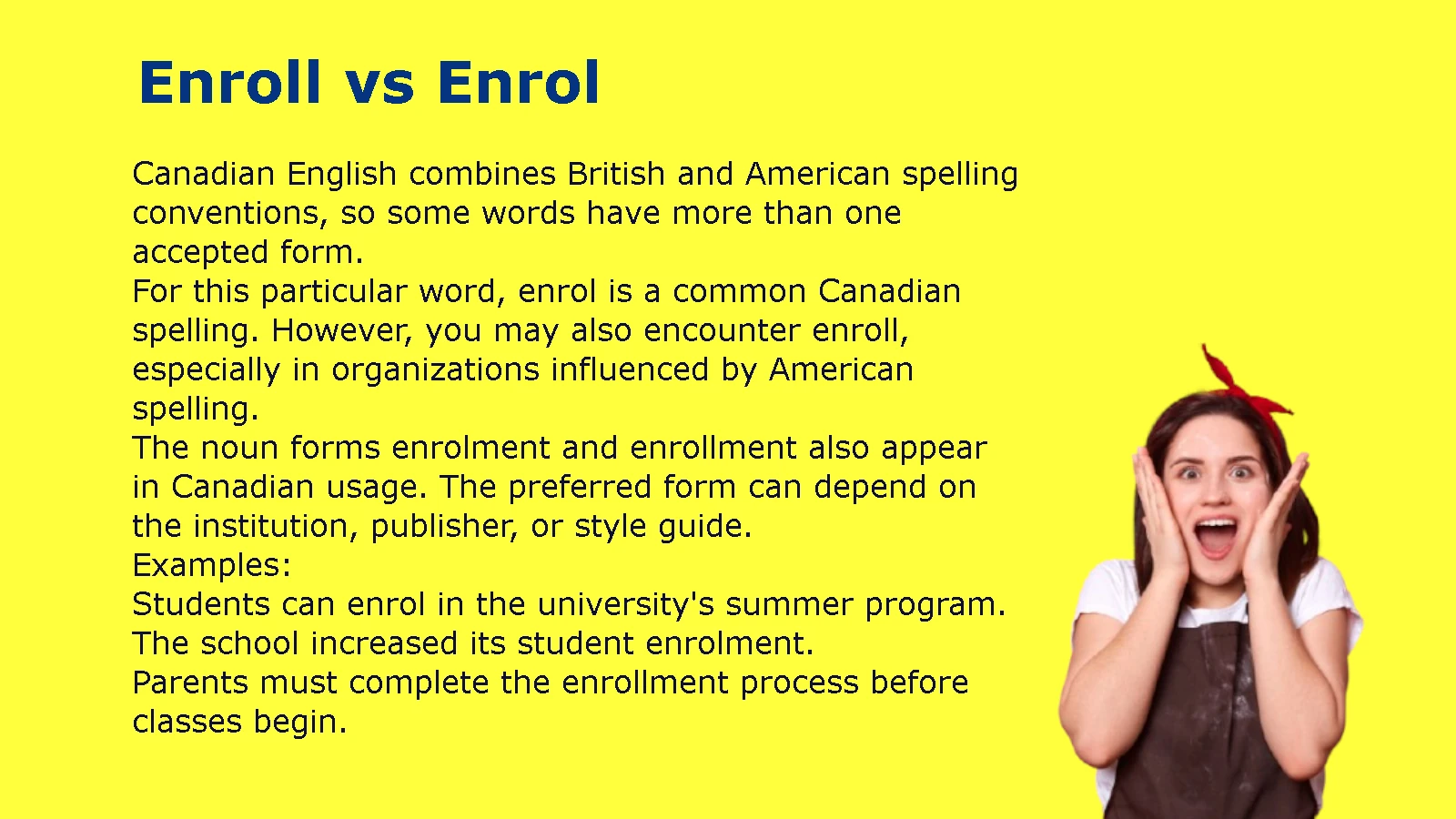
Canadian English combines British and American spelling conventions, so some words have more than one accepted form.
For this particular word, enrol is a common Canadian spelling. However, you may also encounter enroll, especially in organizations influenced by American spelling.
The noun forms enrolment and enrollment also appear in Canadian usage. The preferred form can depend on the institution, publisher, or style guide.
Examples:
- Students can enrol in the university’s summer program.
- The school increased its student enrolment.
- Parents must complete the enrollment process before classes begin.
For Canadian academic or professional writing, check the institution’s official spelling. If you follow a Canadian style guide, apply its preferred form throughout the document.
Practical tip: Do not assume that every Canadian word follows British English. Canadian spelling has its own conventions, and individual words can follow different patterns.
Enroll or Enrol in Australian English
Enrol is the preferred Australian English spelling.
Australian schools, universities, and training organizations commonly use this form in registration instructions and official communication.
Common Australian word forms include:
- Enrol
- Enrolled
- Enrolling
- Enrolment
Examples:
- Parents must enrol their children before the school year starts.
- He enrolled in a vocational training course.
- The university is enrolling international students.
- Student enrolment opens in October.
Australian English generally follows British spelling conventions for this word.
If you create educational content for Australian readers, use enrol and enrolment unless the organization follows a different house style.
Regional Spelling Comparison Table
The following table summarizes the main differences.
| Country | Preferred verb | Common noun form | Example |
| United States | Enroll | Enrollment | Enroll in college |
| United Kingdom | Enrol | Enrolment | Enrol in university |
| Canada | Enrol (also enroll) | Enrolment and enrollment | Enrol in a course |
| Australia | Enrol | Enrolment | Enrol at school |
The safest approach is to follow the spelling used by the organization you are writing for. This is especially important when preparing international applications, university documents, and educational website content.
Enroll vs Enrol Meaning
The words enroll and enrol mean to officially register someone or yourself in an institution, educational course, membership, or organized activity. They describe the process of adding a person to an official list of participants or members. The two spellings have no meaningful difference in definition or grammatical function.
What Does Enroll Mean?
Enroll is a verb that means to register or officially sign up for something.
American English uses this spelling. The word commonly appears in education, professional development, membership programs, and online services.
For example:
- I want to enroll in a university.
- Parents can enroll their children in public schools.
- She decided to enroll in an online marketing course.
- Employees must enroll in the company’s training program.
The verb can describe registering yourself or registering another person.
Compare these sentences:
- I enrolled in the course.
- My parents enrolled me in the course.
In the first sentence, the subject registers themselves. In the second, the parents complete the registration for someone else.
What Does Enrol Mean?
Enrol has the same definition as enroll. It means to register officially or add someone’s name to an institutional or organizational list.
British, Australian, and many Canadian writers prefer this spelling.
Examples:
- I want to enrol at a British university.
- She will enrol her son in primary school.
- You can enrol in the training program online.
- New members must enrol before attending the event.
The word can also describe formal registration in professional associations, clubs, and other organizations.
Enroll vs Enrol: Meaning and Usage Examples
The following examples show how both spellings work in everyday communication.
| American English | British English |
| I will enroll in college. | I will enrol in college. |
| She wants to enroll her son in school. | She wants to enrol her son in school. |
| Students can enroll online. | Students can enrol online. |
| He enrolled in a training program. | He enrolled in a training program. |
| The university accepts new enrollment applications. | The university accepts new enrolment applications. |
The sentences communicate the same information. The spelling changes according to regional conventions.
Enroll Now vs Enrol Now: Which Phrase Is Correct?
Both enroll now and enrol now are correct expressions. The first follows American English spelling, while the second follows British and Australian spelling. Both phrases encourage someone to register immediately for a course, school, membership, or program. Businesses and educational institutions use them as calls to action.
What Does Enrol Now Mean?
Enrol now is an instruction that encourages someone to complete a registration process immediately.
Schools, colleges, universities, and online learning platforms often use this expression to attract students.
For example, an Australian training provider might display:
“Enrol now for our upcoming business management course.”
This message tells prospective students that registration is available and encourages them to secure a place.
The American equivalent is:
“Enroll now for our upcoming business management course.”
Both expressions communicate the same message.
The word now creates urgency. It suggests that the reader should take action rather than postpone registration.
Enroll Now or Enrol Now: Examples in Marketing and Education
Here are some practical examples showing how organizations use these phrases.
American English:
- Enroll now and start learning today.
- Enroll now to secure your place.
- Enroll in our online course before registration closes.
- Enroll today and receive access to all learning materials.
British and Australian English:
- Enrol now and begin your studies.
- Enrol today to secure your place.
- Enrol in our professional development course.
- Enrol before applications close.
These expressions work particularly well in:
- University application pages.
- Online course advertisements.
- School registration campaigns.
- Professional training websites.
- Membership registration pages.
- Educational email campaigns.
Which Version Should Websites and Schools Use?
Your website should use the spelling that matches its primary audience.
For example, an American online learning platform should use Enroll Now on its registration buttons. A British education provider should generally use Enrol Now.
Apply the same spelling across the entire registration experience:
- Homepage calls to action.
- Course descriptions.
- Registration forms.
- Confirmation emails.
- Frequently asked questions.
- Payment and checkout instructions.
Imagine a British university website that displays “Enrol Now” on its homepage but uses “Enrollment Requirements” on its application page. The wording remains understandable, but the inconsistent spelling can make the website appear poorly edited.
Choose one regional convention and apply it consistently.
Enrolled vs Enroled: Which Spelling Is Correct?
Enrolled is the standard spelling in both American and British English. Although the base verb changes from enroll to enrol depending on the region, the past-tense form keeps two Ls. Enroled is generally considered a nonstandard or uncommon variant and should usually be avoided in formal writing.
Enrolled in American English
American English uses enrolled as the past tense and past participle of enroll.
Examples:
- She enrolled in a nursing program.
- Thousands of students enrolled at the university.
- I have enrolled in an online course.
- He was enrolled in the wrong class.
The double L remains when adding the -ed ending.
Enroled in British English
British English generally uses enrolled, not enroled.
This point is worth remembering because people sometimes assume that removing one L from enrol should also remove one L from every related form.
However, British spelling follows a doubling pattern when adding certain suffixes to this verb.
The correct British forms are:
- Enrol
- Enrolled
- Enrolling
- Enrolment
Examples:
- She enrolled at the local college.
- He has enrolled in a postgraduate program.
- Several new students enrolled this week.
Therefore, do not automatically use enroled just because your audience follows British English.
Enrolling vs Enroling
The correct present participle is enrolling in both American and British English.
Examples:
- The university is enrolling new students.
- Parents are enrolling their children for the next academic year.
- I am enrolling in a professional training course.
The spelling enroling is generally incorrect in standard modern English.
Enrollment vs Enrolment
The noun form follows a different regional pattern.
- Enrollment: Standard American English.
- Enrolment: Standard British and Australian English.
- Canadian English: Both forms occur, with enrolment commonly preferred in traditional Canadian usage.
The noun refers to the process or state of officially registering, or to the number of people registered.
Examples:
- The school reported an increase in student enrollment. (US)
- The school reported an increase in student enrolment. (UK)
- University enrolment increased this year. (Common Canadian usage)
Here is a complete comparison:
| Word form | American English | British English |
| Base verb | Enroll | Enrol |
| Past tense | Enrolled | Enrolled |
| Past participle | Enrolled | Enrolled |
| Present participle | Enrolling | Enrolling |
| Noun | Enrollment | Enrolment |
This table highlights an important distinction: the base verb and noun change their spelling, but the common -ed and -ing forms retain the double L.
How to Use Enrol in a Sentence
Enrol functions as a verb. You can use it to describe registering yourself, another person, or a group in an educational institution, course, program, or organization. It commonly appears with the preposition in, although other sentence structures also work depending on the context.
Enrol in a Sentence: Everyday Examples
Here are original examples showing how to use enrol correctly.
Education:
- I plan to enrol in a computer science degree next year.
- She wants to enrol at the University of Oxford.
- Students must enrol before attending their first class.
- My brother decided to enrol in an engineering program.
School registration:
- Parents should enrol their children before the new academic year.
- The school allows families to enrol students online.
- We need to enrol our daughter in primary school.
Online learning:
- You can enrol in the course from anywhere.
- Thousands of learners enrol in online training programs every month.
- I want to enrol in a digital marketing course.
Professional development:
- Employees must enrol in the workplace safety program.
- She decided to enrol in a leadership training course.
- Professionals can enrol in the certification program.
These examples demonstrate that enrol works in both formal and everyday communication.
Enrolment in School: Meaning and Examples
School enrolment refers to the process of officially registering a child or student at an educational institution.
Parents usually complete this process before the student starts attending classes. Schools may request documents, application forms, personal information, and proof of eligibility.
A typical school enrolment process involves:
- Selecting a suitable school.
- Checking the admission requirements.
- Completing the registration form.
- Providing the student’s required documents.
- Submitting the application.
- Receiving confirmation from the school.
For example:
“Parents must complete their children’s enrolment before the start of the academic year.”
This sentence uses enrolment as a noun. It refers to the registration process rather than the action of registering.
It is also useful to understand the difference between enrolment and admission.
| Term | Meaning | Example |
| Enrolment | Official registration as a student | Enrolment opens in January. |
| Admission | Permission to enter an institution | She received admission to the university. |
| Registration | Recording information to establish participation | Complete your registration online. |
| Application | A formal request to join or enter | Submit your application before the deadline. |
These terms are related, but they do not always describe the same stage.
A student might apply to a university, receive an admission offer, and then complete enrolment.
Common Grammar Mistakes When Using Enrol
Writers sometimes confuse the different forms of enrol.
Here are common mistakes and their corrections:
| Incorrect | Correct | Explanation |
| She will enroled tomorrow. | She will enrol tomorrow. | Use the base verb after will. |
| I am enrol in college. | I am enrolling in college. | Use the -ing form after am. |
| He has enroled. | He has enrolled. | Use the standard past participle. |
| The school is enroling students. | The school is enrolling students. | The correct form doubles the L. |
| Student enrol. | Students enrol. | Match the verb to the subject. |
Remember these three basic rules:
- Use enrol for the base verb in British English.
- Use enrolled for the past tense and past participle.
- Use enrolling for the present participle.
For American English, change the base verb to enroll.
Enrol Pronunciation
Enrol and enroll have the same pronunciation. The spelling difference between American and British English does not change how speakers say the word. Both forms have two syllables, with the stress on the second syllable.
- IPA: /ɪnˈrəʊl/ (British English)
- IPA: /ɪnˈroʊl/ (American English)
- Syllables: Two
- Stress: Second syllable
The main vowel sound varies slightly between standard British and American pronunciation.
Is Enroll Pronounced Differently From Enrol?
No. Both spellings represent the same verb and have essentially the same pronunciation within a given English accent.
The final L does not create an additional sound. You do not pronounce enroll with a longer ending simply because it contains two written Ls.
For example:
- American speakers pronounce enroll with a typical American English vowel.
- British speakers pronounce enrol with a typical British English vowel.
- Australian speakers generally follow the British-style pronunciation.
The pronunciation difference comes from regional accents, not the number of Ls in the spelling.
Enrol Etymology: Where Does the Word Come From?
The word enrol comes from an older French expression related to entering names or information on a roll, which means a written list or register. English adopted the word to describe officially recording someone as a member, participant, or student.
Historically, a roll referred to a list of names or an official record. To enrol someone meant adding that person’s name to such a list.
Over time, the word developed a broader meaning. Today, it commonly describes registering for:
- Schools and universities.
- Professional training programs.
- Online courses.
- Membership organizations.
- Government programs.
- Organized activities.
The modern spellings enrol and enroll reflect regional spelling conventions rather than different historical meanings.
Why Does American English Use a Double L?
American English generally uses enroll with two Ls.
The spelling follows an American convention that retains or doubles the final consonant in related word forms.
For example:
- Enroll
- Enrolled
- Enrolling
- Enrollment
The double L appears throughout the American word family.
You can see a similar pattern in other American English words:
| American spelling | British spelling |
| Travel | Travel |
| Traveled | Travelled |
| Traveling | Travelling |
| Enroll | Enrol |
| Enrollment | Enrolment |
Notice that the spelling rules can differ from word to word. Do not assume that every British word with one L must have two Ls in American English.
Why Does British English Use One L?
British English uses enrol as the base verb.
The spelling reflects a traditional British convention that differs from the American form.
However, British English still doubles the L when forming the past tense and present participle:
- Enrol
- Enrolled
- Enrolling
- Enrolment
This explains why enroled and enroling are not the standard British forms.
The noun enrolment retains one L because it uses a different suffix.
Enrol Synonyms: Other Words You Can Use
Several words can replace enrol, but the best synonym depends on the situation. Register and sign up work well in everyday communication, while join often describes becoming a member. In formal education, register for a course is usually a natural alternative.
Common Synonyms for Enrol
Here are useful alternatives with their meanings and examples.
| Synonym | Meaning | Example |
| Register | Officially record participation | Register for a course. |
| Sign up | Agree to participate | Sign up for the workshop. |
| Join | Become a member or participant | Join the university program. |
| Enter | Become part of a competition or program | Enter the training program. |
| Apply | Formally request admission | Apply for a university course. |
| Subscribe | Sign up for a continuing service | Subscribe to the learning platform. |
| Register for | Complete formal registration | Register for the examination. |
These alternatives are not always interchangeable.
For example, apply describes requesting permission to join, while enrol generally describes completing the registration process.
A student can apply to a university without being enrolled yet.
Enrol Synonyms in Educational Contexts
When discussing schools, colleges, and universities, these alternatives work particularly well:
- Register: Students must register for their classes before Monday.
- Sign up: I signed up for an advanced English course.
- Apply: She applied for a place at the university.
- Join: He joined a professional development program.
- Enter: Students can enter the academic competition.
Choose a synonym based on the action you want to describe.
For instance, “I enrolled in the course” means you officially registered. “I applied for the course” means you submitted a request to participate.
Enrol Synonyms in Professional and Business Contexts
In professional settings, enrol often describes joining a training program, employee benefits scheme, or membership organization.
Consider these examples:
- Employees can register for workplace training.
- New professionals can join the association.
- Staff members can sign up for the development workshop.
- Eligible employees can enrol in the company’s benefits program.
- Customers can subscribe to the online learning service.
The most suitable alternative depends on the type of registration.
For formal documents, register is often the closest general synonym. For marketing messages, sign up sounds more conversational.
Enroll vs Enrol vs Other English Spelling Differences
The difference between enroll and enrol is part of a wider pattern in English spelling. American, British, Canadian, and Australian English sometimes use different spellings for the same words. These variations rarely change the meaning, but they can affect formal writing and regional preferences.
Colour vs Color: A Similar American and British Spelling Difference
Colour and color provide another familiar example of regional English spelling.
- Color: American English.
- Colour: British, Australian, and commonly Canadian English.
Both words describe the same visual property.
Examples:
- American English: My favorite color is blue.
- British English: My favourite colour is blue.
- Australian English: The wall has a beautiful colour.
- Canadian English: The artist selected a bright colour.
The comparison works similarly to enroll and enrol because the spelling changes while the meaning stays the same.
However, not every regional spelling difference follows the same pattern.
Here are some additional examples:
| American English | British English |
| Color | Colour |
| Favor | Favour |
| Center | Centre |
| Theater | Theatre |
| Organize | Organise (also organize in British usage) |
| Traveling | Travelling |
| Enrollment | Enrolment |
These examples show why regional consistency matters when writing for an international audience.
How to Maintain Consistent American or British English Spelling
You can avoid spelling inconsistencies by following a simple editing process.
Choose your target audience.
Decide whether your article is intended for American, British, Canadian, or Australian readers.
Select a spelling convention.
Use the relevant regional forms throughout your document.
Check related word forms.
Do not check only the main keyword. Review related words such as:
- Enroll or enrol.
- Enrollment or enrolment.
- Enrolled.
- Enrolling.
Review your headings and calls to action.
A spelling inconsistency in an H1, button, or page title can make an otherwise polished article look careless.
Use a consistent editing tool.
Set your spellchecker to the appropriate English variety. For example, select English (United States) for American content or English (United Kingdom) for British content.
This approach helps maintain consistent spelling across blog posts, academic assignments, business documents, and website pages.
Final Verdict: Should You Write Enroll or Enrol?
Both enroll and enrol are correct. The right choice depends on your audience and the English spelling convention you follow.
Use this simple guide:
- United States: Write enroll.
- United Kingdom: Write enrol.
- Canada: Enrol is common, with both enrolment and enrollment appearing in use.
- Australia: Write enrol.
Remember that the related forms do not all follow the same spelling pattern. Both American and British English use enrolled and enrolling, while the noun changes to enrollment in American English and enrolment in British English.
If you are writing an article, preparing a school application, or creating an educational website, match your spelling to your readers.
Your next step: Check your document for enroll, enrol, enrollment, and enrolment. Choose the appropriate regional forms and use them consistently from the title to the final paragraph.
Practical Case Study: Choosing the Right Spelling for an International Education Website
Consider an online education company that offers courses to students in the United States, United Kingdom, Canada, and Australia.
The company initially uses Enroll Now across every regional version of its website. American visitors recognize the wording, but the British and Australian versions would read more naturally with Enrol Now.
The company decides to localize its registration pages.
| Website audience | Call to action | Related noun |
| US | Enroll Now | Enrollment |
| UK | Enrol Now | Enrolment |
| Canada | Enrol Now | Enrolment |
| Australia | Enrol Now | Enrolment |
This approach makes the wording more familiar to regional readers while maintaining the same registration process.
The lesson is simple:
Good spelling choices do more than prevent errors. They help your writing feel natural to the people reading it.