Sergeant or Sargent is a common spelling question, especially when discussing military ranks, police officers, and law enforcement positions. The correct spelling is sergeant when referring to a military or police rank. Sargent is generally a surname or proper name, not an alternative spelling of the rank. Although both forms sound similar, they have different uses in written English.
The word sergeant refers to a noncommissioned military officer or a supervisory police officer. It also appears in titles such as sergeant at arms. Its unusual pronunciation explains why many people write it as sargent. However, neither American nor British English recognizes sargent as the standard spelling of the rank.
| Question | Answer |
| Is it sergeant or sargent? | Sergeant is the correct spelling for the military and police rank. |
| Is sargent ever correct? | Yes. Sargent is a surname and can appear as a proper name. |
| Is sergeant spelled differently in the UK? | No. British and American English both use sergeant. |
| What is the abbreviation for sergeant? | The standard abbreviation is Sgt. |
| How do you pronounce sergeant? | It is commonly pronounced SAR-jənt in American English. |
Sergeant or Sargent: Which Spelling Is Correct?
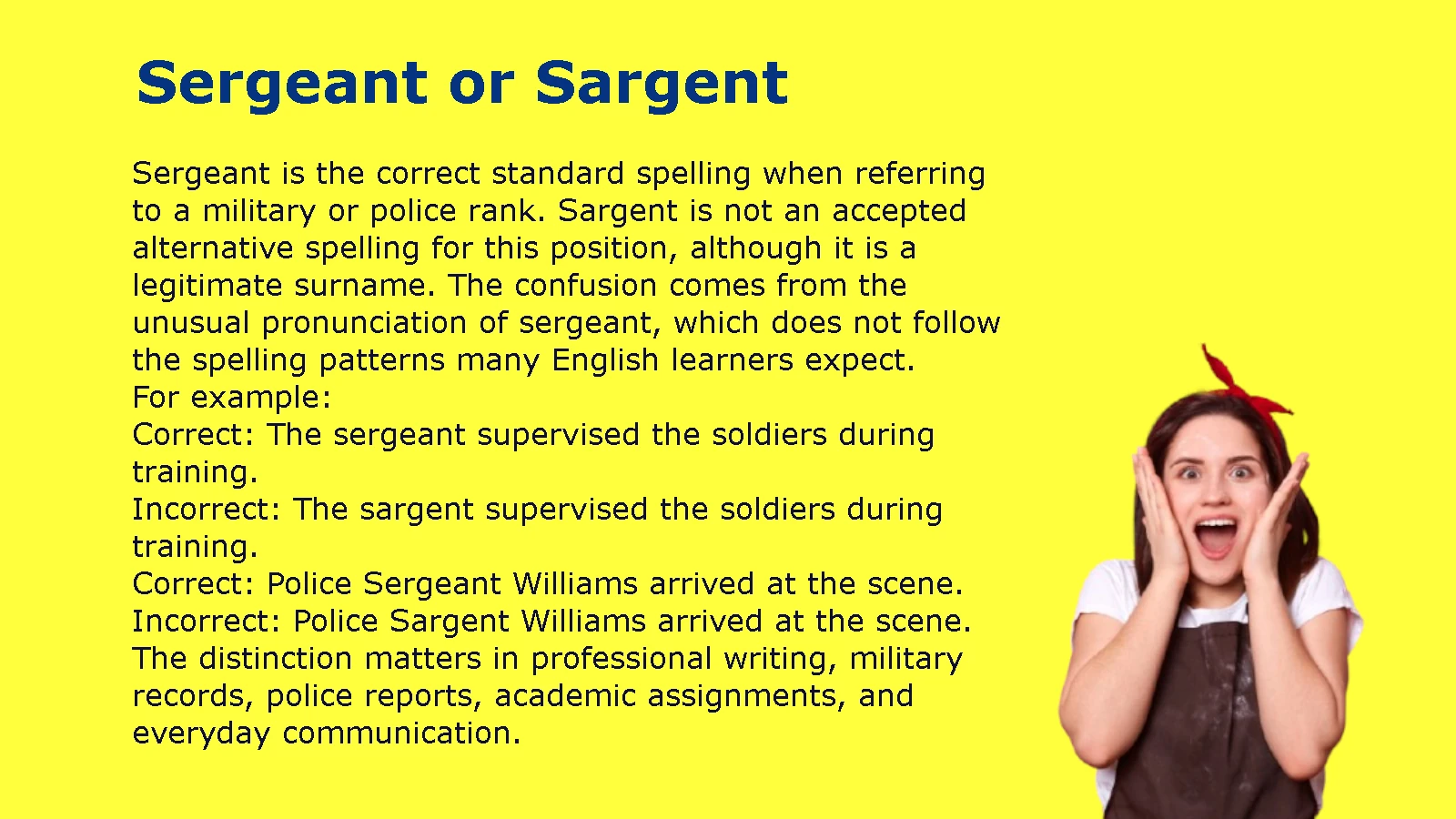
Sergeant is the correct standard spelling when referring to a military or police rank. Sargent is not an accepted alternative spelling for this position, although it is a legitimate surname. The confusion comes from the unusual pronunciation of sergeant, which does not follow the spelling patterns many English learners expect.
For example:
- Correct: The sergeant supervised the soldiers during training.
- Incorrect: The sargent supervised the soldiers during training.
- Correct: Police Sergeant Williams arrived at the scene.
- Incorrect: Police Sargent Williams arrived at the scene.
The distinction matters in professional writing, military records, police reports, academic assignments, and everyday communication.
When you refer to someone’s military or police rank, always write sergeant. When you refer to a person whose actual family name is Sargent, retain that spelling.
Sergeant vs. Sargent: The Main Difference
The main difference between sergeant and sargent concerns their accepted meanings and grammatical uses. Sergeant identifies a recognized military or police rank. Sargent generally functions as a family name or another proper noun.
| Comparison | Sergeant | Sargent |
| Standard spelling of the rank | Yes | No |
| Military usage | Correct | Incorrect |
| Police usage | Correct | Incorrect |
| Common grammatical role | Noun and title | Proper noun |
| Can be a surname? | Occasionally | Yes |
| Pronunciation | Commonly SAR-jənt | Usually similar, depending on the person |
| Standard abbreviation | Sgt. | No standard rank abbreviation |
Consider these examples:
Correct use of sergeant:
- The army sergeant organized the morning inspection.
- A police sergeant interviewed the witnesses.
- She received a promotion to staff sergeant.
Correct use of Sargent as a surname:
- Mr. Sargent attended the meeting.
- The Sargent family moved to another city.
- John Sargent submitted his application.
The important point is that spelling depends on meaning. A person’s surname does not change simply because it resembles the name of a military rank.
Is Sargent Ever a Correct Word?
Yes. Sargent is a legitimate English surname. It can also appear in business names, historical records, institutional names, and other proper nouns.
However, it is not the standard spelling of the military or police rank.
For example:
- Correct: Sergeant Miller inspected the equipment.
- Correct: Mr. Sargent inspected the equipment.
- Incorrect: Sargent Miller inspected the equipment, if Sargent is intended as the rank.
There is also a historical connection between the surname and the occupational word. Both forms developed from older naming traditions associated with the term sergeant. However, their modern uses differ.
A useful writing rule is to check whether you are identifying a person’s name or describing their position.
If you mean the rank, use sergeant. If you mean someone’s established surname, use the spelling that person actually uses.
Why Do People Spell Sergeant as Sargent?
People often write sargent because the pronunciation of sergeant does not closely match its written appearance.
English contains many words whose spelling preserves historical forms even when pronunciation changes. Sergeant is one of them.
Several factors contribute to the confusion:
- Unexpected pronunciation: The word sounds closer to SAR-jənt than its spelling might suggest.
- Unfamiliar letter combinations: The sequence of letters does not follow common pronunciation patterns.
- Phonetic spelling: People sometimes write words according to how they hear them.
- Limited exposure: Someone who rarely encounters military or police terminology may not recognize the standard spelling.
- Autocorrect mistakes: Spell-check tools may not always recognize surnames or specialized names correctly.
The easiest solution is to remember the standard title and its abbreviation: sergeant = Sgt.
Sergeant or Sargent in the Military and Army
Sergeant is the correct spelling for a military rank in the army and other armed services. A sergeant generally serves as a noncommissioned officer (NCO), providing leadership, supervising personnel, maintaining discipline, and helping carry out operational instructions.
The exact responsibilities depend on the country, military branch, and specific grade of sergeant.
In many military organizations, sergeants connect senior leadership with enlisted personnel. They help translate orders into practical tasks and make sure soldiers understand their responsibilities.
For example, a sergeant may:
- Lead a small group of soldiers.
- Organize training exercises.
- Check equipment and readiness.
- Maintain discipline within a unit.
- Monitor soldiers’ performance.
- Report operational issues to senior officers.
The word remains sergeant, regardless of whether the person serves in the army, navy, air force, or another military organization.
What Does Sergeant Mean in the Army?
An army sergeant is generally an experienced enlisted leader who supervises soldiers and supports military operations. Sergeants often manage small teams, enforce standards, coordinate training, and help junior personnel develop their skills.
Their position requires practical knowledge, communication skills, discipline, and the ability to make decisions under pressure.
For example, imagine an infantry unit preparing for a field exercise.
The commanding officer provides the overall instructions. The sergeant then organizes the soldiers, checks their equipment, assigns responsibilities, and ensures everyone understands the plan.
This relationship shows why sergeants play an important role in military operations.
Their duties commonly include:
- Personnel supervision: Monitoring soldiers’ conduct, attendance, and performance.
- Training: Teaching military procedures, equipment handling, and operational skills.
- Discipline: Maintaining standards within the assigned unit.
- Communication: Passing instructions between officers and enlisted personnel.
- Operational readiness: Checking whether personnel and equipment meet requirements.
A sergeant does not simply hold a title. The position carries practical leadership responsibilities.
Is Sergeant a High Military Rank?
A sergeant is generally a noncommissioned officer rank rather than a commissioned officer rank. Its seniority depends on the military system.
In the United States Army, for example, the rank of sergeant (E-5) sits above corporal (E-4) and below staff sergeant (E-6).
Here is a simplified section of the US Army enlisted rank structure:
| Rank | Pay grade |
| Private | E-1 |
| Private | E-2 |
| Private First Class | E-3 |
| Specialist / Corporal | E-4 |
| Sergeant | E-5 |
| Staff Sergeant | E-6 |
| Sergeant First Class | E-7 |
| Master Sergeant / First Sergeant | E-8 |
| Sergeant Major | E-9 |
This structure helps explain where a sergeant fits within the US Army.
However, other countries use different rank systems. A British Army sergeant, for example, operates within a different organizational structure from a US Army sergeant.
Therefore, avoid assuming that every country assigns identical responsibilities or seniority to the same rank title.
Sergeant vs. Lieutenant: What’s the Difference?
A sergeant and a lieutenant are different military ranks with different leadership responsibilities. A sergeant is generally a noncommissioned officer, while a lieutenant is a commissioned officer.
In common military rank structures, a lieutenant holds a higher position in the chain of command than a sergeant.
| Feature | Sergeant | Lieutenant |
| Rank category | Noncommissioned officer | Commissioned officer |
| Main responsibility | Supervises enlisted personnel | Leads a unit or platoon, depending on the service |
| Leadership focus | Daily supervision and practical execution | Planning, command, and coordination |
| Typical experience | Often substantial enlisted experience | Usually receives officer training |
| Position in hierarchy | Below commissioned officers | Above sergeant ranks |
For example, a lieutenant might lead a platoon and establish operational objectives. The sergeant helps organize soldiers and ensure they carry out assigned responsibilities.
Both positions involve leadership, but their authority and duties differ.
The distinction also matters when writing about army ranks. Do not use sergeant and lieutenant interchangeably.
Where Does Sergeant Fit in Army Ranks?
The sergeant rank generally sits within the noncommissioned officer section of a military hierarchy.
NCOs supervise enlisted personnel and help maintain the operational standards of their units.
A simplified US Army hierarchy includes:
Enlisted personnel:
- Private
- Private First Class
- Specialist
- Corporal
- Sergeant
- Staff Sergeant
- Sergeant First Class
- Master Sergeant
- Sergeant Major
Commissioned officers:
- Second Lieutenant
- First Lieutenant
- Captain
- Major
- Lieutenant Colonel
- Colonel
- General officer ranks
This is a simplified comparison, not a complete list of every grade, appointment, or special position.
A useful distinction is that a sergeant generally leads through experience and noncommissioned authority, while a lieutenant exercises commissioned command authority.
Sergeant or Sargent in Police Departments
Sergeant is also the correct spelling for a supervisory police rank. A police sergeant typically oversees officers, coordinates daily activities, reviews reports, and helps maintain professional standards within a department.
The spelling does not change when the word refers to law enforcement rather than the military.
For example:
- Correct: The police sergeant reviewed the incident report.
- Incorrect: The police sargent reviewed the incident report.
- Correct: She was promoted to sergeant after several years of service.
Police departments use different rank structures, but the term sergeant commonly identifies a supervisory position above the regular police officer rank.
What Does a Police Sergeant Do?
A police sergeant supervises officers and helps ensure that department procedures are followed during daily operations.
The position combines leadership, administration, communication, and practical decision-making.
Common responsibilities include:
- Supervising officers: Monitoring performance and providing guidance.
- Coordinating patrols: Assigning officers to shifts, areas, and duties.
- Reviewing reports: Checking incident reports and documentation.
- Responding to incidents: Helping manage complex or serious situations.
- Training personnel: Supporting the development of junior officers.
- Maintaining standards: Addressing misconduct and enforcing department policies.
For example, suppose several officers respond to a traffic accident involving multiple vehicles.
The sergeant may coordinate the officers, help manage the scene, communicate with other emergency services, and ensure that the necessary reports receive proper attention.
This supervisory role distinguishes a sergeant from an ordinary patrol officer.
Is Sargent Ever Correct in Police Writing?
No, not when you intend to describe the police rank. Sergeant remains the standard spelling in police departments.
However, Sargent can be correct when it represents an officer’s surname.
Compare these examples:
| Sentence | Correct or incorrect? | Explanation |
| The sergeant arrived at the station. | Correct | Refers to the police rank. |
| The sargent arrived at the station. | Incorrect | Misspells the rank. |
| Officer Sargent filed the report. | Correct if that is the officer’s surname | Uses a proper name. |
| Sergeant Davis interviewed the witness. | Correct | Uses the proper rank title. |
In formal police documents, accuracy matters because rank titles identify an individual’s professional position.
A spelling mistake may create confusion, especially when someone prepares reports, official correspondence, or departmental records.
Sergeant vs. Police Officer
A police officer and a police sergeant have different levels of responsibility.
A police officer generally performs frontline law enforcement duties. A sergeant usually supervises officers and helps coordinate their work.
| Responsibility | Police Officer | Police Sergeant |
| Patrol duties | Common | May perform when needed |
| Responding to calls | Yes | May respond or supervise |
| Supervising personnel | Usually limited | Main responsibility |
| Reviewing reports | Prepares reports | Often reviews reports |
| Assigning duties | Usually follows assignments | Often coordinates assignments |
| Training junior staff | May assist | Often supervises training |
Consider a police station with several patrol officers working during the same shift.
The officers respond to calls, conduct patrols, and investigate incidents. The sergeant monitors their activities, addresses problems, and ensures the team follows department procedures.
This difference explains why a sergeant generally holds a supervisory position within a police department.
Sergeant or Sargent in UK English
Sergeant is the correct spelling in British English. The United Kingdom does not replace the word with sargent. Both British and American English use the same standard spelling for the military and police rank.
This is an important distinction because English spelling varies across countries.
For example:
- American English: color
- British English: colour
- American English: organize
- British English: organise
- American English: center
- British English: centre
However, sergeant does not follow this spelling variation.
Whether you write for a British newspaper, a US military document, or an English-language school assignment, use sergeant.
Is Sergeant Spelled Differently in British English?
No. British English uses sergeant, just like American English.
The spelling remains the same in:
- British Army terminology.
- British police ranks.
- Official military titles.
- Professional correspondence.
- Educational writing.
For example:
- The British Army sergeant inspected the equipment.
- A police sergeant supervised the officers.
- The sergeant attended a training session.
These sentences use the correct spelling in British English.
The confusion may arise because people assume every word has a British and American spelling variation. However, many English words retain the same spelling across both varieties.
How Is Sergeant Used in the British Army and Police?
In the British Army, sergeant is a noncommissioned rank. It generally sits above corporal and below staff sergeant in the British Army rank structure.
A British Army sergeant may supervise soldiers, manage training, maintain discipline, and support unit operations.
In British policing, a sergeant is a supervisory rank above constable.
The role commonly involves:
- Supervising constables.
- Coordinating operational activities.
- Reviewing police work.
- Supporting investigations.
- Maintaining professional standards.
Although military and police sergeants share the same spelling, their responsibilities and organizational structures differ.
Example:
“The sergeant instructed the officers to secure the area before the investigation continued.”
This sentence uses the correct British English spelling and describes a police supervisory role.
Sergeant Meaning, Definition, and Word Usage
Sergeant is a noun that identifies a rank in the military or police. It generally describes a person who holds a position of authority and supervises other personnel.
The word appears in several professional settings, including armed forces, police departments, and certain institutional titles.
Its meaning depends on the context.
For example, a military sergeant supervises soldiers, while a police sergeant supervises law enforcement officers.
What Does Sergeant Mean?
A sergeant is a military or police official who holds a recognized rank, usually with supervisory or leadership responsibilities.
In military organizations, sergeants commonly serve as noncommissioned officers. In police departments, they generally supervise constables or other officers.
The word can refer to:
- A military rank.
- A police rank.
- A person holding that rank.
- Part of a formal title, such as sergeant at arms.
Examples:
- The sergeant trained the new recruits.
- A police sergeant reviewed the case.
- The army sergeant led the inspection.
- The sergeant received recognition for outstanding service.
The meaning stays connected to an official position rather than a general description of someone who gives orders.
Sergeant as a Noun
The word sergeant functions as a noun.
It identifies a person rather than an action, quality, or description.
Its singular and plural forms are:
| Form | Word |
| Singular | Sergeant |
| Plural | Sergeants |
The plural follows the standard English rule of adding -s to many regular nouns.
Examples:
- One sergeant supervised the team.
- Three sergeants attended the meeting.
- The sergeants discussed the training schedule.
You can also use the word with an article or another determiner.
Examples:
- A sergeant arrived at the station.
- The sergeant addressed the soldiers.
- Several sergeants participated in the exercise.
When you use the title before a person’s name, capitalize it as part of the formal title.
For example:
- Sergeant Brown attended the ceremony.
- Sgt. Brown attended the ceremony.
However, use lowercase when referring to the rank generically.
For example:
- The sergeant attended the ceremony.
Sergeant in a Sentence: Examples
The following examples show how to use sergeant naturally in different contexts.
Military examples:
- The sergeant inspected the soldiers before the training exercise.
- A senior sergeant explained the new safety procedures.
- The army promoted him to sergeant after years of service.
- Every soldier followed the sergeant’s instructions.
Police examples:
- The police sergeant interviewed the witnesses.
- A sergeant supervised the evening patrol.
- The sergeant reviewed the officers’ incident reports.
- Police Sergeant Adams addressed the department.
Formal and professional examples:
- The report identified the supervising officer as a sergeant.
- Sergeant Wilson received an award for his service.
- The commanding officer consulted the sergeant before making the decision.
Plural examples:
- Several sergeants attended the annual military conference.
- The police department appointed two new sergeants.
- Senior sergeants helped organize the training program.
These examples demonstrate that sergeant works as a regular noun and as part of a formal title.
Sergeant vs. Other Military and Police Titles
Sergeant is one of several rank titles used in military and law enforcement organizations.
Understanding related ranks helps readers distinguish their responsibilities and positions.
| Rank or title | General meaning |
| Private | Entry-level enlisted military rank in many armies |
| Corporal | Junior noncommissioned officer rank |
| Sergeant | Noncommissioned officer with supervisory duties |
| Staff Sergeant | More senior NCO rank in several military systems |
| Lieutenant | Commissioned officer rank |
| Captain | Commissioned officer rank above lieutenant |
| Police Officer / Constable | Frontline law enforcement position |
| Police Sergeant | Supervisory police rank |
These titles are not interchangeable.
A corporal, sergeant, and lieutenant may all have leadership responsibilities, but their authority and organizational positions differ.
Similarly, a police constable and police sergeant perform different roles within law enforcement.
How to Pronounce Sergeant
Sergeant has an unusual pronunciation that often surprises English learners. In American English, it is commonly pronounced SAR-jənt, with the first syllable receiving the main stress.
The spelling contains letters that do not correspond to the pronunciation many readers initially expect.
This unusual sound pattern explains why people sometimes write sargent instead.
The pronunciation does not change the correct spelling.
Sergeant Pronunciation in American English
In American English, the standard pronunciation is commonly represented as:
SAR-jənt
IPA: /ˈsɑːrdʒənt/
The word has two syllables, with the main stress on the first.
Break it down into its main sounds:
- The first syllable contains the prominent vowel sound.
- The second syllable has a soft, unstressed sound.
- The ending contains the sound commonly heard in words such as agent.
A common mistake is to pronounce every written letter separately.
Instead, learn the complete spoken form as one familiar word.
For example:
“The sergeant instructed the soldiers to return to their positions.”
Sergeant Pronunciation in British English
British English also uses the pronunciation commonly represented as SAR-jənt.
A broad IPA representation is /ˈsɑːdʒənt/.
The exact vowel quality can vary with regional accents, but the standard pronunciation remains recognizable across British English varieties.
Most importantly, the spelling remains unchanged.
Whether you hear an American or British speaker say the word, the written form is sergeant.
Why Is Sergeant Pronounced Differently From How It Looks?
The unusual pronunciation comes from the word’s historical development.
English adopted sergeant through Old French forms connected to the Latin word serviens, meaning a serving person or attendant.
Over time, the spelling and pronunciation developed along different paths.
The word eventually became associated with military and administrative roles, including positions involving service and authority.
Its historical spelling remained even as English pronunciation changed.
This development explains why:
- The written form contains an unexpected letter combination.
- The spoken form does not sound like a straightforward reading of the letters.
- People sometimes use phonetic spellings such as sargent.
- The accepted modern spelling remains sergeant.
A helpful way to remember the word is to connect it with the abbreviation Sgt.
Once you recognize that abbreviation, you can more easily recall the full spelling.
Sergeant Abbreviation: How Do You Shorten Sergeant?
The standard abbreviation for sergeant is Sgt. It appears in military documents, police titles, official correspondence, and other professional writing.
For example:
- Sergeant Robert Brown
- Sgt. Robert Brown
- Sergeant Davis
- Sgt. Davis
The abbreviation makes titles shorter without changing their meaning.
However, writers should follow the formatting conventions of the relevant organization or publication.
What Is the Correct Abbreviation for Sergeant?
The standard abbreviation is Sgt.
It is widely recognized in military and police contexts.
Examples:
| Full form | Abbreviated form |
| Sergeant Brown | Sgt. Brown |
| Sergeant Miller | Sgt. Miller |
| Sergeant Williams | Sgt. Williams |
| Sergeant Davis | Sgt. Davis |
The abbreviation usually appears before a person’s surname or full name.
For example:
“Please contact Sgt. Brown before the inspection begins.”
In ordinary prose, you can write the complete word when no abbreviation is necessary.
Is It Sgt. or Sargent?
Sgt. is the correct abbreviation for sergeant. Sargent is not a recognized abbreviation of the rank.
This distinction is important because the two forms serve different purposes.
- Sergeant: Full rank title.
- Sgt.: Standard abbreviation.
- Sargent: Usually a family name.
Correct examples:
- Sgt. Miller reviewed the report.
- The sergeant attended the meeting.
- Sergeant Adams supervised the operation.
Incorrect example:
- Sargent Miller reviewed the report, if Sargent is intended to represent the rank.
Remember that abbreviations shorten words according to established conventions. They do not necessarily follow the pronunciation of the original word.
How to Write Sergeant Before a Name
When using sergeant as an official title before someone’s name, capitalize it.
Examples:
- Sergeant John Smith
- Sergeant Robert Miller
- Sergeant James Wilson
You can also use the abbreviation:
- Sgt. John Smith
- Sgt. Robert Miller
- Sgt. James Wilson
When the word appears without a person’s name, lowercase is generally appropriate.
Examples:
- The sergeant inspected the equipment.
- A sergeant attended the meeting.
- The department promoted three sergeants.
This distinction follows the general English capitalization rule for professional titles.
What Is a Sergeant at Arms?
A sergeant at arms is an official responsible for maintaining order, security, and proper procedures within a legislative body or other formal institution.
Despite sharing the word sergeant, the position is not necessarily a conventional military or police rank.
The role often involves enforcing institutional rules, managing security arrangements, supporting formal proceedings, and carrying out ceremonial responsibilities.
The title appears in legislative organizations, government institutions, and certain professional associations.
Sergeant at Arms Meaning and Responsibilities
A sergeant at arms helps maintain order within an organization.
The exact duties depend on the institution, but the position commonly includes:
- Maintaining order: Ensuring that meetings and proceedings follow established rules.
- Security: Supporting security arrangements for members and visitors.
- Enforcing procedures: Helping officials maintain proper conduct.
- Ceremonial duties: Supporting formal events and official functions.
- Administrative responsibilities: Carrying out instructions from institutional leadership.
For example, in a legislative chamber, the sergeant at arms may help maintain order during formal proceedings and assist with security responsibilities.
The role differs from that of an ordinary military sergeant because its authority comes from the institution’s rules and procedures.
Is Sergeant at Arms a Military Rank?
Not necessarily.
Although the title contains the word sergeant, a sergeant at arms is often an institutional position rather than a conventional military rank.
The distinction depends on the organization.
For example:
- In a legislature, the sergeant at arms may manage security and procedural duties.
- In a professional association, the position may help maintain order during meetings.
- In certain historical or military settings, similar titles may have different responsibilities.
Therefore, do not automatically assume that every person called a sergeant at arms holds the same military rank as an army sergeant.
Common Sergeant vs. Sargent Spelling Mistakes
The most common mistake is writing sargent when referring to a military or police rank.
Although the spelling may seem logical because of the pronunciation, it is not the standard written form.
The correct word is sergeant.
Writers should also distinguish between the rank and the surname Sargent.
Incorrect and Correct Examples
| Incorrect sentence | Correct sentence |
| He became a sargent. | He became a sergeant. |
| The police sargent arrived. | The police sergeant arrived. |
| She serves as an army sargent. | She serves as an army sergeant. |
| The sargent inspected the soldiers. | The sergeant inspected the soldiers. |
| Contact Sargent Brown about the report. | Contact Sgt. Brown about the report. |
The last example assumes that Brown holds the rank of sergeant. If Sargent Brown is the person’s actual name, the spelling should remain Sargent.
Here are a few additional examples:
Incorrect:
“The sargent instructed the officers to return to the station.”
Correct:
“The sergeant instructed the officers to return to the station.”
Correct use of the surname:
“Mr. Sargent instructed the employees to return to the office.”
The difference becomes clear when you identify the intended meaning before choosing the spelling.
Easy Ways to Remember the Correct Spelling
You do not need to memorize a complicated spelling rule to remember sergeant.
A few simple techniques can help:
- Remember the abbreviation: Sgt. is the accepted shortened form of sergeant.
- Connect it with the military: Army and police ranks use sergeant.
- Check the meaning: If you mean a supervisory rank, choose sergeant.
- Recognize surnames: Sargent can be correct when it represents a person’s actual family name.
- Use a spelling checker: Review formal documents before submitting them.
One useful memory trick is to associate the word with the abbreviation rather than trying to spell it phonetically.
For example:
“Every Sgt. is a sergeant, but not every Sargent is a sergeant.”
This sentence highlights the distinction between a rank and a surname.
A Practical Example: Choosing Between Sergeant and Sargent
Imagine that you are preparing a report about a police department.
You need to mention an officer who supervises a group of constables.
You write:
“Police Sargent James Brown reviewed the incident.”
At first glance, the sentence may look correct because sargent resembles the spoken word.
However, the correct version is:
“Police Sergeant James Brown reviewed the incident.”
Now consider a different situation.
You are writing about a person whose family name is Sargent.
The sentence reads:
“Mr. Sargent reviewed the incident.”
In this case, Sargent is correct because it represents the person’s surname.
The practical rule: Identify whether the word refers to a professional rank or a person’s name. That decision determines the correct spelling.
Conclusion: Sergeant or Sargent?
The correct spelling is sergeant when referring to a military or police rank. The spelling sargent is generally incorrect in these contexts, although it remains a legitimate surname and proper name.
Both American and British English use sergeant. The word also has a standard abbreviation, Sgt., which appears in military documents, police titles, and formal correspondence.
Remember these essential differences:
- Sergeant: Correct spelling for the military and police rank.
- Sargent: A surname or proper name, not the standard spelling of the rank.
- Sgt.: Standard abbreviation for sergeant.
- Sergeants: Correct plural form.
- Sergeant at arms: An institutional title associated with maintaining order and security.
When writing about an army officer, police supervisor, or military rank, choose sergeant every time.
Before publishing a report, completing an assignment, or sending professional correspondence, check the spelling carefully. A small correction can make your writing more accurate and professional.