Sympathize vs sympathise is a spelling comparison that often confuses English learners because both versions are correct. The difference comes down to regional spelling conventions: American English generally uses sympathize, while British English commonly uses sympathise. Both words have the same meaning, pronunciation, and grammatical function.
However, understanding this word involves more than choosing between the endings -ize and -ise. You should also understand sympathy, empathy, apathy, compassion, and emotional understanding. These related terms describe different ways people respond to someone else’s difficulties.
Whether you’re writing for an American audience, following British English conventions, or learning how to use sympathize in a sentence, this guide explains the spelling differences, meanings, grammar rules, and practical examples.
Quick Answer: Sympathize vs Sympathise
| Question | Answer |
| Is it sympathize or sympathise? | Both spellings are correct. |
| Which spelling is American? | Sympathize is the standard American spelling. |
| Which spelling is British? | Sympathise is common in British English, although sympathize is also accepted. |
| Do sympathize and sympathise mean the same thing? | Yes. Both mean to understand or express concern for another person’s difficulties. |
| What is the difference between sympathy and empathy? | Sympathy involves concern for someone’s suffering, while empathy involves understanding their feelings or perspective. |
Sympathize vs Sympathise: What’s the Difference?
Sympathize and sympathise have exactly the same meaning. Both are verbs that describe understanding, sharing, or expressing concern about another person’s suffering or difficult circumstances. The only difference is their spelling. American English generally prefers sympathize, while British English commonly uses sympathise. Neither version is inherently incorrect.
Sympathize vs Sympathise at a Glance
The easiest way to understand this spelling difference is to compare the two forms side by side.
| Feature | Sympathize | Sympathise |
| Spelling style | -ize | -ise |
| Common usage | American English | British English |
| Meaning | To feel or express sympathy | To feel or express sympathy |
| Pronunciation | Same | Same |
| Part of speech | Verb | Verb |
| Grammatical function | Same | Same |
| Correctness | Correct | Correct |
For example:
- American English: I sympathize with your situation.
- British English: I sympathise with your situation.
Both sentences communicate the same message. Neither spelling changes the speaker’s feelings or the sentence’s meaning.
Why Do Sympathize and Sympathise Have Different Spellings?
The difference comes from two established spelling conventions in English. The endings -ize and -ise developed through different historical influences and became associated with different publishing and regional preferences.
The -ize ending has roots in Greek-derived word formation through Latin and French. It appears in words such as:
- Organize
- Realize
- Recognize
- Apologize
- Sympathize
American English generally standardized the -ize spelling in these words. However, British English developed two accepted conventions. Many British publications prefer -ise, while other British publishers use -ize.
This explains why both sympathize and sympathise appear in British writing.
The important distinction is that -ise is not always more British, and -ize is not exclusively American. The preferred form depends on the country’s spelling conventions and the publication’s style guide.
Sympathize or Sympathise: Which One Should You Use?
Your intended audience should determine which spelling you choose.
Use sympathize when writing for:
- American readers.
- US schools and universities.
- American newspapers and publications.
- Businesses following American English.
- Websites targeting the United States.
Use sympathise when writing for:
- British readers who follow -ise conventions.
- UK publications using traditional British spelling.
- Organizations whose style guides prefer -ise.
- Educational materials following a British English spelling standard.
Practical writing tip: Choose one spelling convention and maintain it throughout your document. Switching between sympathize and sympathise can make your writing look inconsistent, even though both forms are correct.
Is Sympathise or Sympathize the UK Spelling?
Sympathise is a widely used British English spelling, particularly among publications that prefer the -ise ending. However, sympathize is also accepted in British English under the -ize convention. Therefore, both versions can be correct in the UK. Your choice should follow the spelling style used by your publisher, school, or organization.
Sympathise or Sympathize in British English
British English recognizes both spellings, but many UK writers prefer sympathise.
This preference appears in several familiar words:
| -ise spelling | -ize spelling |
| Sympathise | Sympathize |
| Organise | Organize |
| Realise | Realize |
| Recognise | Recognize |
| Apologise | Apologize |
| Specialise | Specialize |
| Analyse | Analyze |
One important detail is that not every word ending in -ise has a corresponding -ize alternative. For example, advertise, exercise, and surprise retain their standard spellings.
The choice between sympathise and sympathize follows a broader spelling convention, not a rule that allows writers to change every -ise ending into -ize.
Sympathize or Sympathise in American English
American English generally uses sympathize.
The same preference applies to many related words:
- Organize
- Realize
- Recognize
- Apologize
- Specialize
- Sympathize
For example:
- Correct for standard American English: I sympathize with families affected by the disaster.
- Less typical in American English: I sympathise with families affected by the disaster.
American readers will usually understand sympathise, but sympathize is the conventional choice for American publications.
Sympathize or Sympathise in Canadian English
Canadian English commonly uses sympathize, although Canadian spelling includes influences from both British and American English.
Canadian publications often prefer -ize in words such as organize, realize, and sympathize. However, some organizations follow different house styles, so you should not assume that every Canadian publication uses exactly the same convention.
For Canadian writing, sympathize is a reliable choice unless your institution or publisher specifies otherwise.
Which Spelling Is More Common Internationally?
The preferred spelling depends on the English variety used in a particular country or organization.
| Region | Common preference | Alternative |
| United States | Sympathize | Sympathise |
| United Kingdom | Sympathise in many publications | Sympathize |
| Canada | Sympathize | Sympathise |
| Australia | Sympathise in many publications | Sympathize |
| New Zealand | Sympathise in many publications | Sympathize |
These are general tendencies, not universal rules. Individual dictionaries, publishers, universities, and government organizations can adopt different conventions.
If you’re writing for an international audience, consistency matters more than choosing one version as universally correct.
Sympathise Meaning: Definition, Pronunciation, and Usage
Sympathise means to understand, share, or express concern for another person’s suffering, disappointment, or difficult situation. It is a verb that describes a compassionate response to someone’s experiences. You can sympathise with someone without experiencing the same problem yourself. The American spelling is sympathize, and both forms have identical meanings.
What Does Sympathize Mean?
To sympathize means to recognize another person’s difficulties and feel concern, compassion, or sorrow about their situation.
When you sympathize with someone, you acknowledge that they are experiencing something unpleasant or painful. You may not know exactly how they feel, but you recognize their struggle and care about their well-being.
For example:
“After hearing about her father’s illness, I sympathized with her.”
This sentence means the speaker understood that the woman was going through a difficult experience and felt concern for her.
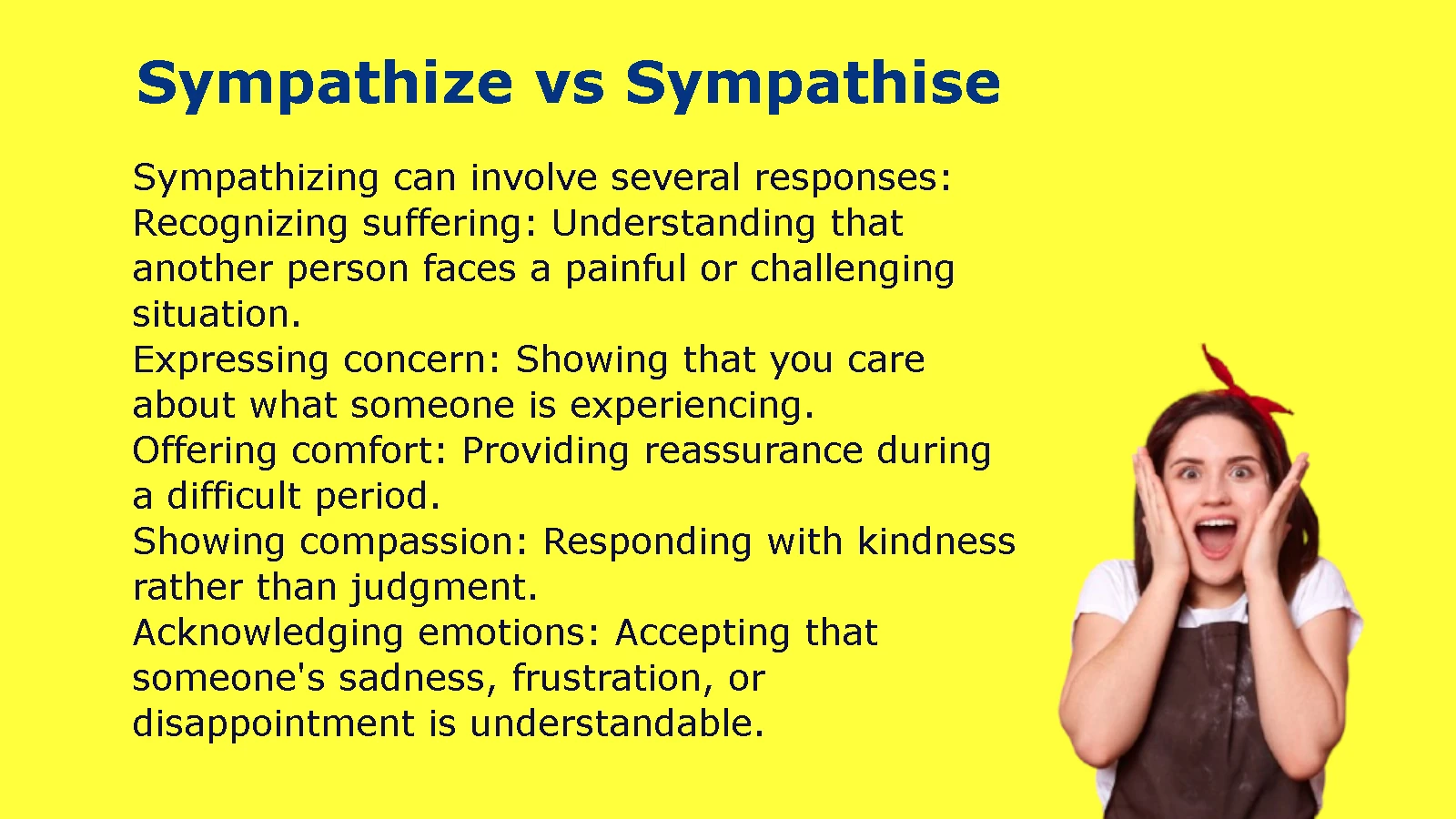
Sympathizing can involve several responses:
- Recognizing suffering: Understanding that another person faces a painful or challenging situation.
- Expressing concern: Showing that you care about what someone is experiencing.
- Offering comfort: Providing reassurance during a difficult period.
- Showing compassion: Responding with kindness rather than judgment.
- Acknowledging emotions: Accepting that someone’s sadness, frustration, or disappointment is understandable.
Sympathy does not require identical personal experiences. You can sympathize with someone who loses a job even if you have never been unemployed.
Sympathize Pronunciation
Both sympathize and sympathise have the same pronunciation.
The word contains three syllables, with the primary stress on the first syllable.
American and British spelling variants share the same spoken form.
The spelling difference affects the written word, not its pronunciation.
Sympathize Word Forms and Grammar
Sympathize is a regular verb. It follows standard English conjugation patterns, although its spelling changes slightly when you add certain endings.
| Word form | American English | British -ise style |
| Base form | Sympathize | Sympathise |
| Third-person singular | Sympathizes | Sympathises |
| Past tense | Sympathized | Sympathised |
| Past participle | Sympathized | Sympathised |
| Present participle | Sympathizing | Sympathising |
| Noun | Sympathy | Sympathy |
| Adjective | Sympathetic | Sympathetic |
Examples:
- I sympathize with people facing financial difficulties.
- She sympathizes with her colleagues.
- They sympathized with the injured passengers.
- We are sympathizing with the families affected by the incident.
Notice that the noun sympathy and adjective sympathetic do not change between American and British spelling conventions.
Common Phrases Using Sympathize
The verb sympathize frequently appears with the preposition with. This construction identifies the person or group receiving sympathy.
Here are some natural expressions:
| Phrase | Example |
| Sympathize with someone | I sympathize with your family. |
| Deeply sympathize | We deeply sympathize with everyone affected. |
| Sympathize with someone’s situation | I sympathize with your financial situation. |
| Sympathize with someone’s feelings | She sympathizes with his frustration. |
| Sympathize over a loss | They sympathized with the family over its loss. |
The most common construction is sympathize with.
For example, say:
“I sympathize with your difficulties.”
Avoid writing:
“I sympathize your difficulties.”
The second sentence omits the preposition required by the standard construction.
How to Use Sympathize in a Sentence
Sympathize describes an act of understanding or expressing concern for another person’s difficulties. Writers commonly use it with with to identify the person they care about. The verb works in personal conversations, professional communication, and formal writing when someone wants to acknowledge another person’s suffering.
10 Examples of Sympathize in a Sentence
The following examples show how to use sympathize naturally in different situations.
- I sympathize with anyone who has lost a loved one because grief can be difficult to overcome.
- She sympathizes with her coworkers who struggle to balance their professional and personal responsibilities.
- We sympathize with the families who lost their homes during the devastating storm.
- My teacher sympathized with me after I explained why I missed the examination.
- I genuinely sympathize with students who feel overwhelmed by academic pressure.
- The manager sympathized with the employee who experienced unexpected financial difficulties.
- He sympathized with his friend after hearing about the end of his relationship.
- Many people sympathize with individuals who face discrimination or unfair treatment.
- Our organization sympathizes with everyone affected by the recent tragedy.
- Although I have never experienced unemployment, I sympathize with people who struggle to find work.
Each sentence uses the verb to communicate concern, compassion, or an understanding of another person’s circumstances.
Sympathize vs Sympathise in Different Sentence Contexts
The spelling changes depending on the English convention, but the sentence structure remains identical.
| American English | British English |
| I sympathize with your situation. | I sympathise with your situation. |
| She sympathizes with the victims. | She sympathises with the victims. |
| They sympathized with our family. | They sympathised with our family. |
| We are sympathizing with the workers. | We are sympathising with the workers. |
| He sympathized with her disappointment. | He sympathised with her disappointment. |
These examples demonstrate an important principle: regional spelling differences do not necessarily create grammatical differences.
You can replace one spelling with the other without changing the sentence’s meaning, tense, or structure.
Common Mistakes When Using Sympathize
Even though sympathize is a relatively straightforward verb, writers sometimes confuse its meaning or grammatical usage.
Here are five mistakes to avoid.
1. Treating sympathise as an incorrect spelling
Incorrect assumption: “Sympathise is a misspelling of sympathize.”
Correction: Both versions are accepted. The appropriate choice depends on the spelling convention.
2. Confusing sympathize with empathize
Sympathizing means showing concern for another person’s difficulties. Empathizing involves understanding their emotional experience or perspective.
3. Forgetting the preposition with
Incorrect: I sympathize your situation.
Correct: I sympathize with your situation.
4. Confusing the verb with the noun
- Sympathize: I sympathize with your difficulties.
- Sympathy: I feel sympathy for your difficulties.
Both sentences are grammatical, but they use different parts of speech.
5. Mixing spelling conventions
A document that uses organize, realise, sympathize, and apologise may appear inconsistent.
Choose an English spelling standard and apply it throughout your writing.
Difference Between Sympathize and Empathize
Sympathize and empathize both describe responses to another person’s experiences, but they emphasize different forms of emotional understanding. To sympathize means to feel concern for someone’s difficulties. To empathize means to understand their feelings or see a situation from their perspective. Sympathy expresses compassion, while empathy focuses on emotional understanding.
What Does Empathize Mean?
To empathize means to understand another person’s emotions, thoughts, or experiences by considering their perspective.
Empathy involves recognizing what someone feels and making an effort to understand why they feel that way.
For example:
“After experiencing a similar loss, I could empathize with my friend.”
The speaker understands the friend’s grief partly because of a comparable personal experience.
However, you do not need to experience the exact same event to empathize with someone. You can understand another person’s emotions through careful listening, observation, and perspective-taking.
Psychologists commonly discuss two forms of empathy:
- Cognitive empathy: Understanding another person’s thoughts, feelings, and perspective.
- Emotional empathy: Experiencing an emotional response that reflects another person’s feelings.
These concepts help explain why empathy can involve more than simply feeling sorry for someone.
Sympathize vs Empathize: Key Differences
| Comparison | Sympathize | Empathize |
| Main meaning | Feel concern for someone | Understand someone’s feelings |
| Emotional response | Compassion or concern | Emotional understanding or shared feelings |
| Personal experience | Not required | Not required |
| Main focus | Another person’s difficult situation | Another person’s emotional perspective |
| Typical response | “I’m sorry you’re going through this.” | “I can understand why this hurts.” |
| Common expression | I sympathize with you. | I empathize with you. |
Consider someone who has recently lost a job.
A sympathetic response might be:
“I’m sorry you lost your job. I hope you find another opportunity soon.”
An empathetic response might be:
“I understand how stressful this must feel, especially when you have financial responsibilities.”
The first response communicates concern. The second makes a more direct effort to understand the person’s emotional experience.
Neither response is automatically better. The most helpful approach depends on what the person needs.
3 Differences Between Sympathy and Empathy
Although people sometimes use sympathy and empathy interchangeably, the terms have distinct meanings.
Here are three practical differences.
1. Emotional understanding
Sympathy involves recognizing another person’s suffering and responding with concern.
Empathy involves understanding the feelings behind that suffering.
For example, you might feel sympathy for someone who failed an examination without fully understanding the disappointment they experience.
Empathy requires a stronger effort to understand that disappointment from their perspective.
2. Personal connection
Sympathy does not require you to have experienced a similar situation.
You can sympathize with someone who faces a challenge you have never encountered.
Empathy can involve connecting someone’s experience with your own memories, although personal experience is not necessary. Perspective-taking can also help you understand unfamiliar situations.
3. Communication
Sympathy often appears through expressions of care, reassurance, or support.
Empathy often involves active listening, acknowledging emotions, and responding to what someone actually feels.
For example:
- Sympathy: “I’m sorry you’re having such a difficult time.”
- Empathy: “It sounds like you’ve been carrying a lot of pressure, and I can understand why you’re exhausted.”
The difference lies in how each response addresses the other person’s emotional experience.
4 Differences Between Sympathy and Empathy
A fourth distinction involves how people respond to someone else’s needs.
4. Practical response
Sympathy may encourage someone to offer help, comfort, or reassurance.
Empathy can help someone identify what kind of support would actually be useful.
For example, imagine a friend struggling with a demanding work schedule.
A sympathetic person might say, “I’m sorry your job has become so stressful.”
An empathetic person might ask, “Would it help if I listened while you explained what’s making work so difficult?”
The second response makes room for the friend’s perspective before offering a solution.
This distinction matters in workplaces, healthcare, education, friendships, and family relationships.
5 Differences Between Sympathy and Empathy
The following table combines the five differences into one practical reference.
| Difference | Sympathy | Empathy |
| Meaning | Concern about another person’s suffering | Understanding another person’s feelings |
| Emotional connection | Compassion toward someone | Perspective-taking or shared emotional experience |
| Personal experience | Not necessary | Not necessary |
| Communication | Expressing concern | Listening and acknowledging feelings |
| Practical response | Offering comfort or assistance | Tailoring support to someone’s emotional needs |
Remember that sympathy and empathy can work together.
A person can understand someone’s feelings, feel compassion for their situation, and offer practical assistance. These responses are complementary rather than competing emotional abilities.
Sympathy vs Empathy Examples in Real-Life Situations
Real-life examples make the distinction easier to understand than definitions alone.
Example: A Friend Loses a Family Member
Sympathetic response:
“I’m so sorry for your loss. My thoughts are with you and your family.”
Empathetic response:
“I can imagine how difficult this period must be. If you want to talk or need someone to spend time with, I’m here.”
Difference: The sympathetic response expresses sorrow and concern. The empathetic response makes an effort to acknowledge the person’s emotional experience and offer appropriate support.
Example: A Colleague Loses Their Job
Sympathetic response:
“I’m sorry to hear that you lost your position. I hope you find another opportunity soon.”
Empathetic response:
“That must be difficult, especially when you weren’t expecting it. How are you managing everything right now?”
Difference: Sympathy communicates concern about the job loss. Empathy explores the personal and emotional consequences.
Example: A Student Fails an Important Examination
Sympathetic response:
“I feel sorry that you didn’t get the result you wanted.”
Empathetic response:
“I understand how disappointing this must feel after all the time you spent preparing.”
Difference: The empathetic response recognizes the student’s effort and disappointment rather than focusing only on the unsuccessful result.
Example: Someone Experiences a Breakup
Sympathetic response:
“I’m sorry your relationship ended. I hope things get better.”
Empathetic response:
“Ending a relationship can be painful, especially when you invested so much in it. Do you want to talk about what happened?”
Difference: The second response acknowledges the emotional complexity of the experience and gives the person room to express their feelings.
Example: A Person Experiences Financial Difficulties
Sympathetic response:
“I sympathize with your financial situation. I hope you can find a solution.”
Empathetic response:
“I understand that financial pressure can affect many parts of life. Would it help to talk through the options available to you?”
Difference: Sympathy expresses concern, while empathy encourages a deeper understanding of the person’s circumstances.
A practical lesson from these examples: You do not need to choose between sympathy and empathy. A thoughtful response can communicate both concern and understanding.
Sympathy vs Apathy: Understanding the Difference
Sympathy and apathy describe very different attitudes toward another person’s experiences. Apathy means showing little or no interest, concern, or emotional involvement. One reflects compassion, while the other describes indifference.
What Does Apathy Mean?
Apathy is a lack of interest, enthusiasm, motivation, or concern about something.
When someone demonstrates apathy toward another person’s difficulties, they show little emotional involvement or interest in what happens.
For example:
“His apathy toward the struggling community disappointed the volunteers.”
This sentence suggests that the person showed little concern for the community’s problems.
Apathy can appear in different situations:
- Social situations: Ignoring another person’s difficulties.
- Workplaces: Showing little interest in team problems or responsibilities.
- Education: Displaying a lack of interest in learning or academic progress.
- Relationships: Showing little emotional involvement in another person’s experiences.
- Community issues: Remaining unconcerned about problems affecting other people.
Apathy should not automatically be confused with temporary exhaustion or emotional overload. Someone who appears quiet or withdrawn may be tired, overwhelmed, or unsure how to respond rather than genuinely indifferent.
Sympathy vs Apathy: Key Differences
| Feature | Sympathy | Apathy |
| Meaning | Concern for another person | Lack of concern |
| Emotional response | Compassion | Indifference |
| Interest in others | Recognizes their difficulties | Shows little interest |
| Typical behavior | Offering comfort | Remaining unconcerned |
| Example | Supporting a grieving friend | Ignoring their suffering |
Sympathy vs Apathy Examples
Consider these situations to understand how the two attitudes differ.
Situation 1: A friend experiences a personal loss
- Sympathy: “I’m sorry for what happened. Let me know if you need anything.”
- Apathy: “That’s your problem. I don’t care.”
2: A colleague struggles with work responsibilities
- Sympathy: “I understand you’re under pressure. Is there anything I can help with?”
- Apathy: Ignoring the colleague’s difficulties despite having an opportunity to help.
Situation 3: A community faces a serious problem
- Sympathy: Expressing concern and supporting efforts to improve the situation.
- Apathy: Showing no interest in the problem or the people affected.
These examples demonstrate that sympathy involves concern, while apathy involves indifference.
Sympathy vs Empathy vs Apathy: A Complete Comparison
Sympathy involves compassion, empathy involves understanding another person’s feelings or perspective, and apathy involves indifference. Knowing the differences helps you describe emotional reactions accurately and choose the right word in personal, academic, and professional communication.
Sympathy vs Empathy vs Apathy Comparison Table
| Feature | Sympathy | Empathy | Apathy |
| Meaning | Concern for another person’s suffering | Understanding another person’s feelings | Lack of interest or concern |
| Emotional response | Compassion | Emotional understanding | Indifference |
| Personal connection | Not required | Not required | Not central |
| Main focus | Someone’s difficulties | Someone’s emotional experience | Lack of involvement |
| Typical expression | “I’m sorry you’re going through this.” | “I understand how difficult this feels.” | “I don’t care.” |
| General attitude | Caring | Understanding | Unconcerned |
When Should You Use Sympathy, Empathy, or Apathy?
Choose the word that accurately describes the person’s attitude or emotional response.
Use sympathy when:
- You want to express concern about someone’s suffering.
- You feel sorry for someone facing difficulties.
- You want to communicate compassion.
- You want to acknowledge an unfortunate situation.
Example: “I sympathize with families affected by the natural disaster.”
Use empathy when:
- You understand another person’s emotional experience.
- You want to describe perspective-taking.
- You can relate to someone’s feelings.
- You want to acknowledge how a situation affects someone emotionally.
Example: “A good counselor needs to empathize with clients.”
Use apathy when:
- Someone demonstrates a lack of concern.
- A person shows little interest in an important issue.
- You want to describe emotional indifference.
- Someone appears unconcerned about another person’s difficulties.
Example: “The manager’s apathy toward employee concerns damaged team morale.”
A Practical Case Study: Three Responses to the Same Problem
Imagine that a student fails an important examination after studying for several months.
Three classmates respond differently.
Classmate A: Sympathy
“I’m sorry you didn’t pass. I know you worked hard.”
(Compassion)
This person recognizes the student’s disappointment and expresses concern.
Classmate B: Empathy
“I know how frustrating it feels to work hard and not get the result you expected. Do you want to talk about it?”
(Understanding)
This person acknowledges the emotional experience and tries to understand the student’s perspective.
Classmate C: Apathy
“I don’t care whether you pass or fail.”
(Indifference)
This person shows no concern about the student’s experience.
The situation remains the same, but each response reflects a different attitude.
This example also shows why understanding these words matters. They describe more than emotions; they help explain how people relate to one another.
Conclusion: Sympathize vs Sympathise
The difference between sympathize and sympathise is simply a matter of spelling preference. Both words are correct and carry the same meaning. American English generally favors sympathize, while British English commonly uses sympathise. Canadian English also frequently uses sympathize.
However, understanding the related words sympathy, empathy, and apathy helps you communicate more accurately.
Remember these distinctions:
- Sympathize: Recognize someone’s suffering and express concern.
- Empathize: Understand another person’s feelings or perspective.
- Apathy: Show little or no interest or concern.
When writing, choose the spelling that matches your target audience and follow that convention consistently. If you’re writing for American readers, use sympathize. For British readers following the -ise convention, choose sympathise.
Your next step: Review your writing for regional spelling consistency, and make sure you use sympathy, empathy, and apathy according to their actual meanings. This small improvement can make your English clearer, more accurate, and more natural.