Have you ever wandered somewhere and suddenly realized you were wondering about something completely different? Wander vs Wonder can be confusing because the two words look and sound similar, but they describe very different ideas.
Wander means to move around without a clear direction or purpose, while wonder means to think about something with curiosity or uncertainty. In simple terms, you can wander through a park, but you wonder why someone left early.
Examples:
- We wandered around the city until we found a quiet café.
- I wonder why she decided to leave so early.
The confusion is understandable. People often search for wander vs wonder, wander or wonder, what is the difference between wander and wonder, or wander and wonder meaning because the words are easy to mix up in writing and speech. And here’s the kicker: changing just one letter can completely change the meaning of the sentence.
In this guide, you’ll learn the complete difference between Wander vs Wonder, including their meanings, pronunciation, word origins, and correct usage. You’ll also see clear examples, simple memory tricks, and common mistakes to help you know exactly when to use wander and when to use wonder.
Wander vs Wonder: What’s the Difference?
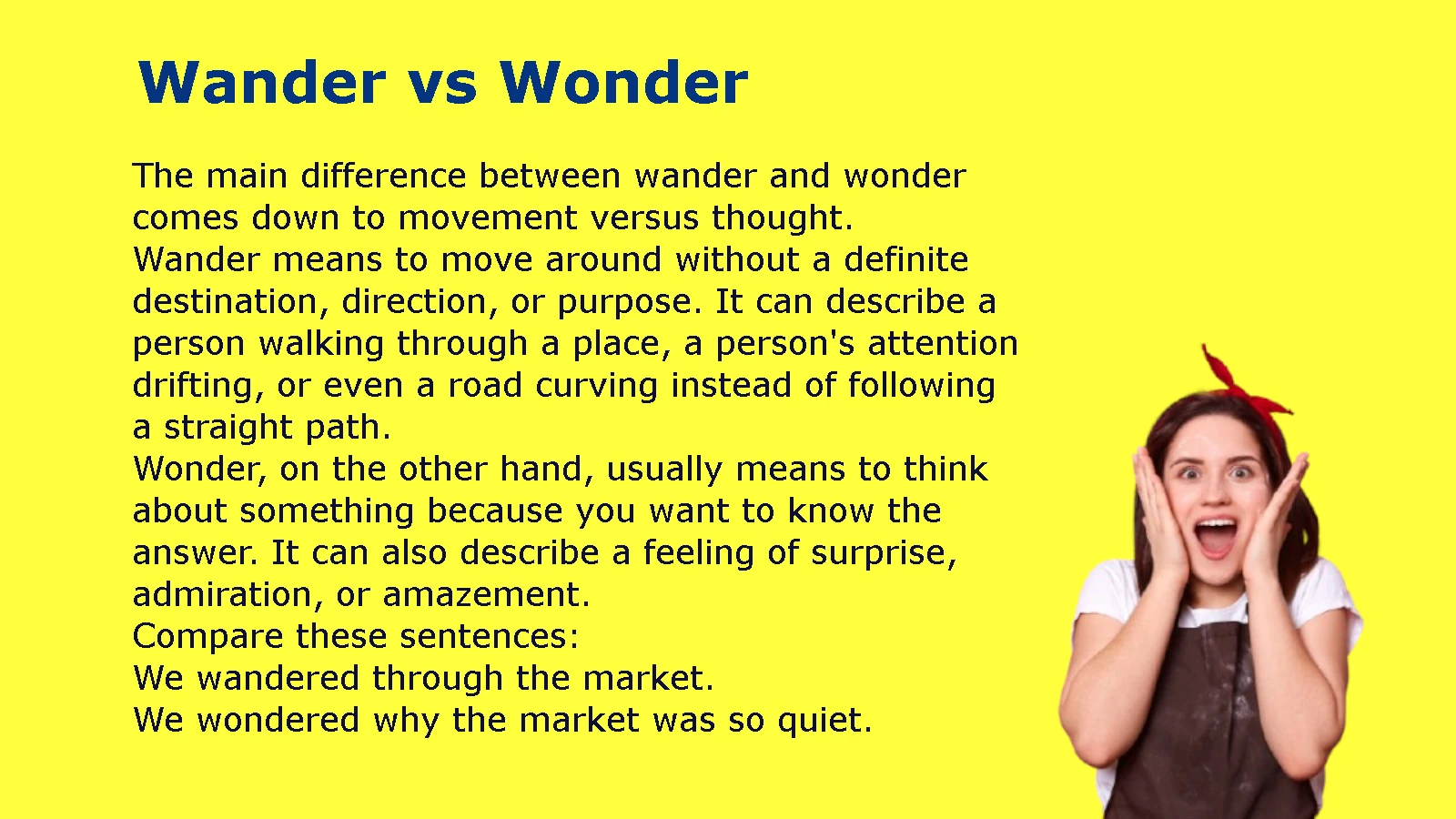
The main difference between wander and wonder comes down to movement versus thought.
Wander means to move around without a definite destination, direction, or purpose. It can describe a person walking through a place, a person’s attention drifting, or even a road curving instead of following a straight path.
Wonder, on the other hand, usually means to think about something because you want to know the answer. It can also describe a feeling of surprise, admiration, or amazement.
Compare these sentences:
- We wandered through the market.
- We wondered why the market was so quiet.
In the first sentence, the people are moving around.
In the second, they’re thinking about something.
Here’s another pair:
- My mind wandered during the meeting.
- I wondered when the meeting would end.
The first sentence describes attention drifting away. The second describes curiosity about the meeting’s ending.
Quick rule for wander vs wonder
Use wander when you mean:
- Move around
- Roam
- Drift
- Stray from a path
- Lose focus
- Move away from a subject
Use wonder when you mean:
- Ask yourself a question
- Feel curious
- Be uncertain
- Think about what might happen
- Feel amazement or admiration
This distinction covers most everyday uses of the two words.
What Does Wander Mean?
Wander means to move around slowly or casually without a particular destination, direction, or purpose.
For example:
We wandered around the old part of town for an hour.
The sentence doesn’t suggest that the people followed a strict route. They simply moved around and explored.
The word can describe purposeful-looking movement that still lacks a fixed destination. You might wander through a bookstore, wander around a neighborhood, or wander along a beach.
According to the Cambridge Dictionary, wander can mean walking around slowly in a relaxed way or without a clear purpose or direction. It can also describe thoughts, conversations, eyes, roads, and other forms of movement or drifting.
Wander as a verb
The most common use of wander is as a verb.
You can use it to describe physical movement:
- We wandered through the gardens.
- She wandered around the mall.
- The tourists wandered along the narrow streets.
- He wandered into the café without planning to stop.
- The child wandered away from the group.
Notice how often wander appears with a preposition or adverb. Expressions such as wander around, wander through, wander into, and wander away make the direction or situation clearer.
The word doesn’t always imply that someone is lost. A person can wander deliberately for enjoyment.
For example:
After dinner, we wandered through the neighborhood and looked at the old houses.
Nobody necessarily got lost. They simply walked without following a strict plan.
Wander can describe thoughts, too
Physical movement isn’t the only type of wandering.
Your mind, thoughts, attention, or conversation can wander when they move away from the subject at hand. Oxford describes this use as thoughts or attention moving away from what you should be focusing on.
Consider these examples:
- My mind wandered during the lecture.
- Her thoughts wandered back to her childhood.
- Try not to let your attention wander.
- His conversation wandered away from the original topic.
Here, nobody is physically walking anywhere.
The underlying idea remains the same, though: something moves away from its original point.
Wander can describe eyes and roads
English also uses wander for things that move or extend in an unfixed way.
For example:
Her eyes wandered toward the painting.
A road can also wander when it curves rather than taking a straight route.
You might write:
The narrow road wandered through the hills.
That doesn’t mean the road literally chooses where to go. It means its route curves and meanders through the landscape.
Wander as a noun
Wander can also function as a noun, especially in informal English.
It means a relaxed walk without a particular purpose or destination. Cambridge gives examples such as have a wander around and take a wander through a place.
Examples include:
- Let’s have a wander around the park.
- I went for a wander after lunch.
- We took a wander through the old town.
This noun use is less central than the verb, but it’s useful to recognize when you encounter it.
What Does Wonder Mean?
Wonder has several closely related meanings, but its most common everyday use involves curiosity or uncertainty.
When you wonder about something, you think about it because you don’t know the answer or want to know more.
For example:
I wonder where James went.
The speaker doesn’t necessarily ask James directly. Instead, the speaker is expressing curiosity about his location.
You can wonder:
- Why something happened
- Where someone went
- What will happen next
- How something works
- Whether something is true
- Who someone is
- When something will happen
Oxford defines this use as thinking about something and trying to decide what is true, what will happen, or what you should do.
Wonder as a verb
As a verb, wonder often appears before a question word.
Common patterns include:
- wonder why
- wonder where
- wonder when
- wonder how
- wonder who
- wonder what
- wonder whether
- wonder if
Examples:
- I wonder why she left.
- We wondered where they had gone.
- He wondered whether the plan would work.
- She wondered how they built the bridge.
- They wondered what would happen next.
These structures are extremely common in everyday English.
Wonder can make a request more polite
There’s another useful construction worth knowing.
English speakers often use I wonder if… or I was wondering if… to make a request sound more indirect and polite.
For example:
I wonder if you could help me.
Or:
I was wondering if you could send me the report.
This doesn’t mean the speaker is literally asking themselves whether help is possible. It functions as a polite way to introduce a request. Both Oxford and Cambridge recognize this use.
Compare:
- Can you help me?
- I wonder if you can help me.
- I was wondering if you could help me.
All three can request assistance. The latter versions sound more indirect.
Wonder can express amazement
Wonder has another important meaning: a feeling of great surprise, admiration, or awe.
For example:
The children stared at the fireworks in wonder.
Here, wonder doesn’t mean asking a question. It describes an emotional reaction.
You can also say:
- She looked at the painting in wonder.
- The beauty of the mountains filled him with wonder.
- The child watched the magician with wonder.
Oxford defines this noun sense as a feeling of surprise and pleasure caused by something beautiful, unusual, or unexpected.
Wonder as a noun
As a noun, wonder can refer to either a feeling or something that causes amazement.
For example:
The audience watched the performance in wonder.
Here, wonder means a feeling.
In this sentence:
The ancient structure is an architectural wonder.
Wonder refers to something remarkable.
The word also appears in phrases such as:
- a natural wonder
- a technological wonder
- a modern wonder
- a sense of wonder
- a feeling of wonder
The noun has a wide range of uses because English speakers can describe both the emotion and the thing that creates the emotion as wonder.
Wander vs Wonder: Key Differences
The clearest way to understand wander vs wonder is to compare their meanings side by side.
| Feature | Wander | Wonder |
| Core idea | Moving without a fixed direction | Thinking with curiosity |
| Typical part of speech | Verb and noun | Verb and noun |
| Physical movement | Yes | No |
| Curiosity | No | Yes |
| Amazement | No | Yes |
| Mental drifting | Yes | Not usually |
| Example | We wandered through the streets. | I wonder where they went. |
| Common phrase | wander around | wonder why |
A useful mental picture makes the distinction even clearer.
Imagine someone walking through a new city without a map. They’re wandering.
Now imagine that person looking at a strange building and thinking, Who built this? They’re wondering.
One word describes the journey. The other describes the question in the mind.
Wander vs Wonder in Sentences
Side-by-side examples can make the difference much easier to spot.
Movement vs curiosity
- We wandered around the village.
- We wondered why the village was so quiet.
Physical direction vs mental question
- The dog wandered into the garden.
- I wondered whether the dog belonged to someone.
Drifting attention vs curiosity
- My mind wandered during the movie.
- I wondered how the movie would end.
Exploring vs asking yourself
- They wandered through the museum.
- They wondered about the history of the exhibits.
Leaving a path vs questioning a decision
- The hikers wandered off the trail.
- They wondered if they had taken the wrong route.
These examples reveal a useful pattern. Wander often works with places, paths, movement, and attention. Wonder often works with questions, uncertainty, ideas, and amazement.
Wander and Wonder Pronunciation
The spelling difference between wander and wonder is small, but the pronunciation difference matters.
In US English:
- Wander: /ˈwɑːndɚ/
- Wonder: /ˈwʌndɚ/
Cambridge lists these US pronunciations for the two words.
The first vowel is the key difference.
In wander, the first vowel has the sound represented by /ɑː/ in the Cambridge US pronunciation.
In wonder, the first vowel is /ʌ/, as in words such as sun and cup.
That means wander and wonder aren’t simply two spellings for the same sound. They have different pronunciations and different meanings.
For many learners, listening for the first vowel can help prevent confusion.
Common Phrases With Wander
Learning common word combinations makes wander easier to use naturally.
Wander around
Wander around means to move casually through an area without following a strict route.
We wandered around downtown after dinner.
Wander through
Wander through describes moving casually through a place.
We wandered through the market for an hour.
Wander off
Wander off means to move away from a person, group, place, or expected route.
The child wandered off while his parents were talking.
Wander away
Wander away has a similar meaning and emphasizes moving away from the original location.
She wandered away from the group.
Wander into
Wander into means entering a place casually or without a clear plan.
We wandered into a small café and ordered coffee.
Wander aimlessly
This phrase emphasizes the lack of a specific destination or purpose.
He spent the afternoon wandering aimlessly around the city.
Let your mind wander
This common expression means to allow your thoughts to move freely rather than concentrating on one subject.
After finishing the assignment, she sat quietly and let her mind wander.
Oxford and Cambridge both recognize this figurative use of wander for thoughts and attention.
Common Phrases With Wonder
Wonder appears in several extremely common English structures.
Wonder why
Use this when you’re curious about a reason.
I wonder why she hasn’t called.
Wonder where
Use this when you’re curious about a person’s or thing’s location.
I wonder where my keys are.
Wonder what
Use this when you’re curious about an unknown thing or outcome.
I wonder what they’ll decide.
Wonder how
Use this when you’re curious about the way something happens.
I wonder how this machine works.
Wonder if
Use this to express uncertainty or introduce a question.
I wonder if he’ll come tonight.
It can also introduce a polite request:
I wonder if you could check this for me.
Wonder whether
Wonder whether is another way to express uncertainty about two possibilities or an unknown outcome.
She wondered whether she had made the right decision.
Wonder about
Use wonder about when thinking or asking yourself about a particular subject.
I’ve been wondering about your plans for next year.
No wonder
No wonder means something is not surprising.
You worked all day, so no wonder you’re tired.
Cambridge and Oxford both recognize this idiomatic use.
Wander vs Wonder: Common Mistakes
Because both words are legitimate English words, spelling software won’t necessarily catch a mistake between them.
That makes context especially important.
Mistake: “I wander why”
❌ I wander why she left.
✅ I wonder why she left.
The sentence expresses curiosity about the reason, so wonder is correct.
Mistake: “We wondered around”
❌ We wondered around the city.
✅ We wandered around the city.
The sentence describes people walking around without a fixed route, so wandered is correct.
Mistake: “My mind wondered”
❌ My mind wondered during the lecture.
✅ My mind wandered during the lecture.
The idea here is that attention drifted away from the lecture.
Mistake: “I wandered if”
❌ I wandered if they were coming.
✅ I wondered if they were coming.
The phrase wonder if expresses uncertainty or curiosity.
Mistake: “We wandered what happened”
❌ We wandered what happened.
✅ We wondered what happened.
The person is asking themselves a question mentally, so wondered fits.
Why Do People Confuse Wander and Wonder?
The confusion is understandable because the words share several visual features.
Both begin with w and contain n-d-e-r in the same order. Only the vowel in the first syllable changes:
W A N D E R
W O N D E R
That small spelling difference creates two separate words.
The meanings also have no simple one-to-one relationship. Wander developed from Old English wandrian, while wonder comes from Old English wundor and wundrian. Oxford traces their origins separately.
So, treating one as a variation of the other can lead to mistakes.
How to Remember Wander vs Wonder
A simple memory trick can make this distinction stick.
Wander = Away
Think of the A in wander as standing for away.
When you wander, you may move away from a path, destination, group, or subject.
The child wandered away from the playground.
My thoughts wandered away from the topic.
Wonder = Question
Think of wonder as something that happens when a question pops into your mind.
I wonder why the store is closed.
She wondered what would happen next.
The shortcut is:
Wander = move. Wonder = question.
It’s not a complete explanation of every possible use, but it works extremely well for everyday writing.
A Practical Wander vs Wonder Test
When you’re unsure which word to use, ask yourself one question:
Is something moving, or is someone thinking?
If the answer is moving, choose wander.
We wandered through the park.
If the answer is thinking or questioning, choose wonder.
We wondered why the park was empty.
There’s one extra detail to remember: wander can describe thoughts when they drift away from the subject.
My mind wandered during class.
That’s still connected to the basic idea of movement. The “movement” simply happens in your thoughts rather than with your feet.
Wander vs Wonder: A Real-Life Comparison
Consider this short situation.
A traveler arrives in an unfamiliar town with several hours to spare. She doesn’t have a schedule, so she walks down side streets, looks through shop windows, and explores a nearby park.
She wanders around the town.
Later, she sees an old building with no sign outside. She starts thinking about who built it and how long it has been there.
She wonders about its history.
The same person can wander and wonder during the same afternoon.
She wandered through the quiet streets while wondering who had lived there years ago.
This sentence is a useful way to see the two words working together. Wander describes her physical movement. Wondering describes her mental curiosity.
Wander vs Wonder: Which Word Should You Use?
The choice becomes straightforward when you focus on the intended meaning.
| If you mean… | Use | Example |
| Walk without a fixed destination | Wander | We wandered around the park. |
| Move away from a group | Wander | The child wandered off. |
| Lose concentration | Wander | My mind wandered during class. |
| Drift away from a topic | Wander | The discussion wandered from the main issue. |
| Ask yourself a question | Wonder | I wonder why she left. |
| Feel uncertain | Wonder | He wondered whether it was true. |
| Feel amazement | Wonder | She looked at the view in wonder. |
| Describe something remarkable | Wonder | The bridge is an engineering wonder. |
| Make a polite request | Wonder | I wonder if you could help me. |
The safest shortcut is still:
Wander = movement or drifting.
Wonder = curiosity, uncertainty, or amazement.
Wander vs Wonder: Synonyms
Looking at related words can also help reinforce the distinction.
Synonyms for wander
Depending on the context, wander can relate to:
- Roam
- Stroll
- Meander
- Drift
- Ramble
- Stray
- Mosey
- Explore
These aren’t perfect substitutes in every sentence.
For example, roam can suggest moving freely across a large area, while stroll usually emphasizes relaxed walking. Meander can describe both physical movement and an indirect course.
Synonyms for wonder
Depending on the meaning, wonder can relate to:
- Question
- Consider
- Ponder
- Wonder about
- Be curious
- Marvel
- Admire
- Be amazed
Again, context matters.
Ponder usually suggests deeper or more deliberate thought. Wonder often sounds more natural when someone is simply curious or uncertain.
Wander vs Wonder in Writing
Writers often use these words to describe both external action and internal thought.
Wander can create a sense of movement without a rigid plan:
The narrow trail wandered between the trees.
It can also create a sense of mental drift:
His thoughts wandered back to the summer he spent there.
Wonder can introduce curiosity:
She wondered what the old house looked like inside.
It can also add emotion:
He stood in wonder beneath the enormous night sky.
This difference makes the two words useful in descriptive writing. One can move the reader through a scene, while the other can reveal what a character is thinking or feeling.
Frequently Asked Questions About Wander vs Wonder
Is it “wander” or “wonder”?
Both words are correct, but they have different meanings.
Use wander for moving or drifting without a fixed direction. Use wonder for thinking, questioning, uncertainty, or amazement.
What is the difference between wander and wonder?
Wander generally means to move around without a definite direction or purpose. Wonder generally means to think about something because you’re curious or uncertain. Wonder can also mean to feel amazement.
Is “I wander” or “I wonder” correct?
Both can be correct, depending on what you mean.
Wandering means moving around without a fixed destination.
After work, I wander around the neighborhood.
Wondering means thinking about something or asking yourself a question.
Sometimes, I wonder where everyone went.
Is “I wander why” correct?
No, not when you mean “I want to know why.”
The correct phrase is:
I wonder why.
For example:
I wonder why he left early.
Is “wondered around” correct?
Usually not when you’re describing walking around casually.
The correct expression is:
wandered around
For example:
We wandered around the city for several hours.
Can your mind wander?
Yes. Mind wander and thoughts wander are common expressions.
They describe your attention moving away from the subject you’re supposed to be focusing on.
For example:
My mind started to wander during the long meeting.
Can you wander into a place?
Yes.
Wander into means to enter a place casually, often without a specific plan.
We wandered into a little bookstore and stayed for an hour.
Can wonder be a noun?
Yes. Wonder can be a noun meaning a feeling of amazement or something that causes amazement.
For example:
The children watched the fireworks in wonder.
Or:
The bridge is a modern engineering wonder.
Can wander be a noun?
Yes. In informal English, a wander can mean a relaxed walk without a particular purpose or destination.
For example:
Let’s go for a wander around the park.
Are wander and wonder pronounced the same?
No. In US English, wander and wonder have different first vowel sounds. Cambridge gives wander as /ˈwɑːn.dɚ/ and wonder as /ˈwʌn.dɚ/.
Is wonder related to wander?
They are separate words with different historical origins. Oxford traces wander to Old English wandrian and wonder to Old English wundor and wundrian.
What does “no wonder” mean?
No wonder means that something isn’t surprising.
No wonder she was tired. She had been working all day.
It can also introduce an explanation for something that has happened.
Final Difference Between Wander and Wonder
The difference between wander vs wonder is small in spelling but significant in meaning.
Wander is mainly about movement or drifting. You can wander through a city, wander away from a group, or let your mind wander.
Wonder is mainly about curiosity, uncertainty, or amazement. You can wonder why something happened, wonder what will happen next, or look at something in wonder.
Remember the simplest rule:
Wander means to move. Wonder means to think or feel amazement.
So, if you’re walking without a clear destination, you wander. If you’re asking yourself a question, you wonder.
And sometimes, you can do both at once:
You can wander through a new place while wondering about everything you see.
That single distinction is enough to keep these two commonly confused words apart in most everyday writing.