Have you ever confused descent with dissent because the two words look and sound so similar? While Descent vs Dissent can be tricky at first glance, these words have completely different meanings, uses, and contexts.
Descent refers to a downward movement, a decline, or a person’s ancestry or family origin. Dissent, on the other hand, means disagreement with an opinion, decision, or commonly accepted view. Although both words contain similar letters and are often confused in writing, they describe very different ideas.
Examples:
- The hikers began their descent from the mountain.
- The senator expressed dissent from the proposed policy.
The confusion is understandable. People often search for descent vs dissent, descent or dissent, which spelling is correct, or dissent meaning in English because the words look remarkably similar. And here’s the kicker: changing just a few letters completely changes the meaning of the sentence.
In this guide, you’ll learn the complete difference between Descent vs Dissent, including their meaning, pronunciation, origin, correct usage, and examples. You’ll also see how to remember the difference and avoid confusing these two commonly mixed-up words.
Descent vs Dissent at a Glance
The simplest way to separate descent and dissent is to focus on what the sentence describes.
| Word | Part of Speech | Main Meaning | Example |
| Descent | Noun | Movement downward | The plane began its descent. |
| Descent | Noun | Family origin or ancestry | She is of Irish descent. |
| Descent | Noun | A downward slope or route | The descent was steep. |
| Dissent | Noun | Disagreement | The proposal faced dissent. |
| Dissent | Verb | To disagree | Several members dissented from the decision. |
Both words are pronounced /dɪˈsent/ in US English, so pronunciation won’t help you distinguish them when speaking. Context and spelling do the heavy lifting. Cambridge Dictionary lists the same US pronunciation for both words.
A useful visual trick is to look at the middle of each word:
- deSCENT → think descend → move down
- deSCENT → think ancestry or where someone descends from
- diSSENT → think disagree → have a different opinion
That small spelling difference carries a big difference in meaning.
What Does Descent Mean?
Descent is a noun with several established meanings. The two most important ones are movement downward and ancestry or family origin.
Cambridge Dictionary also records related uses involving a downward slope, an unwanted arrival, and a decline into a worse condition.
Descent Meaning: Moving Downward
When descent describes movement, it means the act or process of going from a higher position to a lower one.
You might use it when talking about:
- An airplane coming down toward an airport
- A person walking down a mountain
- A climber moving toward the ground
- A spacecraft entering a lower position
- A path or road that slopes downward
For example:
The pilot began the aircraft’s final descent into the airport.
Here, descent describes the downward movement of the airplane.
Another example:
The hikers began their descent from the mountain just before sunset.
The hikers aren’t necessarily falling. They are simply moving downward from a higher elevation.
This meaning connects directly to the verb descend:
- Descend = to move downward
- Descent = the act or process of moving downward
That relationship provides one of the easiest ways to remember the spelling.
Descent Meaning: Family Origin or Ancestry
Descent can also describe a person’s family background or ancestry.
This is the meaning you see in phrases such as:
- of Irish descent
- of African descent
- of European descent
- of Asian descent
- of mixed descent
- of Japanese descent
For example:
She is of Korean descent.
This means her family ancestry comes from Korea or includes Korean ancestors. It doesn’t mean she is physically moving downward.
Cambridge defines this sense as the state or fact of being related to people from the past and gives examples involving African, European, and Asian descent.
You can also use descent from:
The family claims descent from a common ancestor.
Or:
Researchers traced his descent from a 17th-century family.
In these sentences, descent refers to lineage or ancestry.
Descent Meaning: A Downward Slope
There is another literal use that appears in travel, geography, hiking, and outdoor writing.
A descent can mean a route, surface, or slope that goes downward.
For example:
The trail has a steep descent toward the valley.
Here, the word describes the downward section of the trail.
This meaning is closely related to the movement sense. The difference is that the focus shifts from the act of going down to the way or surface that goes down. Cambridge specifically lists a downward-sloping surface as one meaning of descent.
Descent Meaning: A Decline Into Something Worse
In more figurative writing, descent can describe a movement from a better condition to a worse one.
For example:
The novel follows his descent into crime.
Nobody is physically walking downward into crime. The phrase uses downward movement as a metaphor for deterioration.
Other examples include:
- a descent into chaos
- a descent into poverty
- a descent into violence
- a descent into disorder
Cambridge includes this figurative sense as a change in behavior or circumstances from good to bad.
What Does Dissent Mean?
Dissent has a completely different meaning. It concerns disagreement.
As a noun, it describes a difference of opinion. As a verb, it means to disagree with someone or something.
Cambridge describes the noun as a strong difference of opinion, particularly concerning an official proposal, plan, or popular belief. It also identifies dissent as a verb meaning to disagree.
Dissent as a Noun
When dissent functions as a noun, it means disagreement or opposition to a particular idea, decision, proposal, or accepted position.
For example:
The new proposal faced considerable dissent.
That means many people disagreed with the proposal.
Another example:
The committee allowed room for dissent.
Here, dissent means disagreement or differing views.
Common phrases include:
- voice of dissent
- public dissent
- political dissent
- strong dissent
- widespread dissent
- open dissent
- dissenting opinion
The word often appears in formal writing because it can sound more precise than simply saying disagreement.
Dissent as a Verb
Dissent can also function as a verb.
When someone dissents, that person disagrees with an opinion, proposal, decision, or position.
For example:
Several members dissented from the committee’s decision.
The common construction is dissent from something.
You might also see:
She dissented from the majority view.
This means she did not agree with the majority position.
Unlike some verbs, dissent usually doesn’t take a direct object in ordinary formal usage. That’s why dissent from the proposal works naturally while dissent the proposal does not.
Cambridge specifically gives dissent from as a standard construction.
Dissent in Legal Contexts
The word dissent has a particularly important meaning in law.
A judge can issue a dissenting opinion when the judge disagrees with the court’s majority opinion.
For example:
The judge wrote a dissenting opinion explaining why she disagreed with the majority.
In this context, dissent doesn’t mean that the judge refused to participate in the case. It means the judge reached a different legal conclusion from the majority.
Cambridge’s American Dictionary specifically defines a legal dissent as a judge’s opinion that differs from the opinion of most other judges on the court.
This is one reason dissent frequently appears in legal reporting, court documents, and discussions of judicial decisions.
Descent vs Dissent: Key Differences
The words become much easier to remember when you compare them by meaning, grammar, and context.
| Feature | Descent | Dissent |
| Main idea | Going down or ancestry | Disagreement |
| Part of speech | Noun | Noun and verb |
| Related word | Descend | Disagree |
| Family context | Yes | No |
| Movement context | Yes | No |
| Opinion context | Usually no | Yes |
| Legal context | Rarely relevant | Common |
| Example | The plane began its descent. | The judge issued a dissent. |
The biggest difference is simple: descent deals with direction or ancestry, while dissent deals with disagreement.
If you’re talking about a mountain, airplane, slope, or family tree, descent is probably the word you need.
If you’re talking about an opinion, decision, proposal, or disagreement, dissent is the better choice.
Descent vs Dissent Examples
Examples make this distinction much easier to recognize in real sentences.
Examples With Descent
Here are several common uses of descent:
- The airplane began its final descent.
- The hikers started their descent before dark.
- The road has a steep descent toward the river.
- She is of Irish descent.
- He is of Japanese descent.
- The family traced its descent to a common ancestor.
- The story describes his descent into poverty.
- The climber prepared for the long descent from the summit.
Notice how every sentence connects descent with either downward movement, ancestry, or a figurative decline.
Examples With Dissent
Now compare those sentences with examples of dissent:
- The proposal attracted considerable dissent.
- Several employees expressed dissent.
- The judge wrote a dissenting opinion.
- The board faced strong dissent from its members.
- She dissented from the committee’s conclusion.
- The report acknowledged growing dissent.
- One member openly dissented from the majority view.
- The referee penalized the player for dissent.
Every example involves disagreement or a differing position.
Descent and Dissent in One Sentence
Putting both words in the same sentence creates a useful memory exercise:
During the plane’s descent, the passengers expressed dissent about the airline’s new policy.
The first word describes going down.
The second describes disagreement.
Try another:
Her descent from the mountain was peaceful despite the dissent among the members of her group.
Again, the meanings stay completely separate.
Descent vs Dissent Pronunciation
Here’s an interesting twist: descent and dissent are pronounced the same way in standard US English.
Both are pronounced:
/dɪˈsent/
The stress falls on the second syllable.
That makes these words homophones in standard pronunciation. In other words, they sound alike even though they have different spellings and meanings.
This is why listening alone may not tell you which word someone means. Context becomes essential.
Consider the sentence:
The group began its descent.
If you hear this sentence, the meaning comes from the context. A sentence about an airplane, mountain, or slope points toward descent.
Now consider:
The group expressed dissent.
The surrounding discussion about opinions or decisions makes the intended meaning clear.
Because the pronunciation is identical, spelling is especially important when you’re writing.
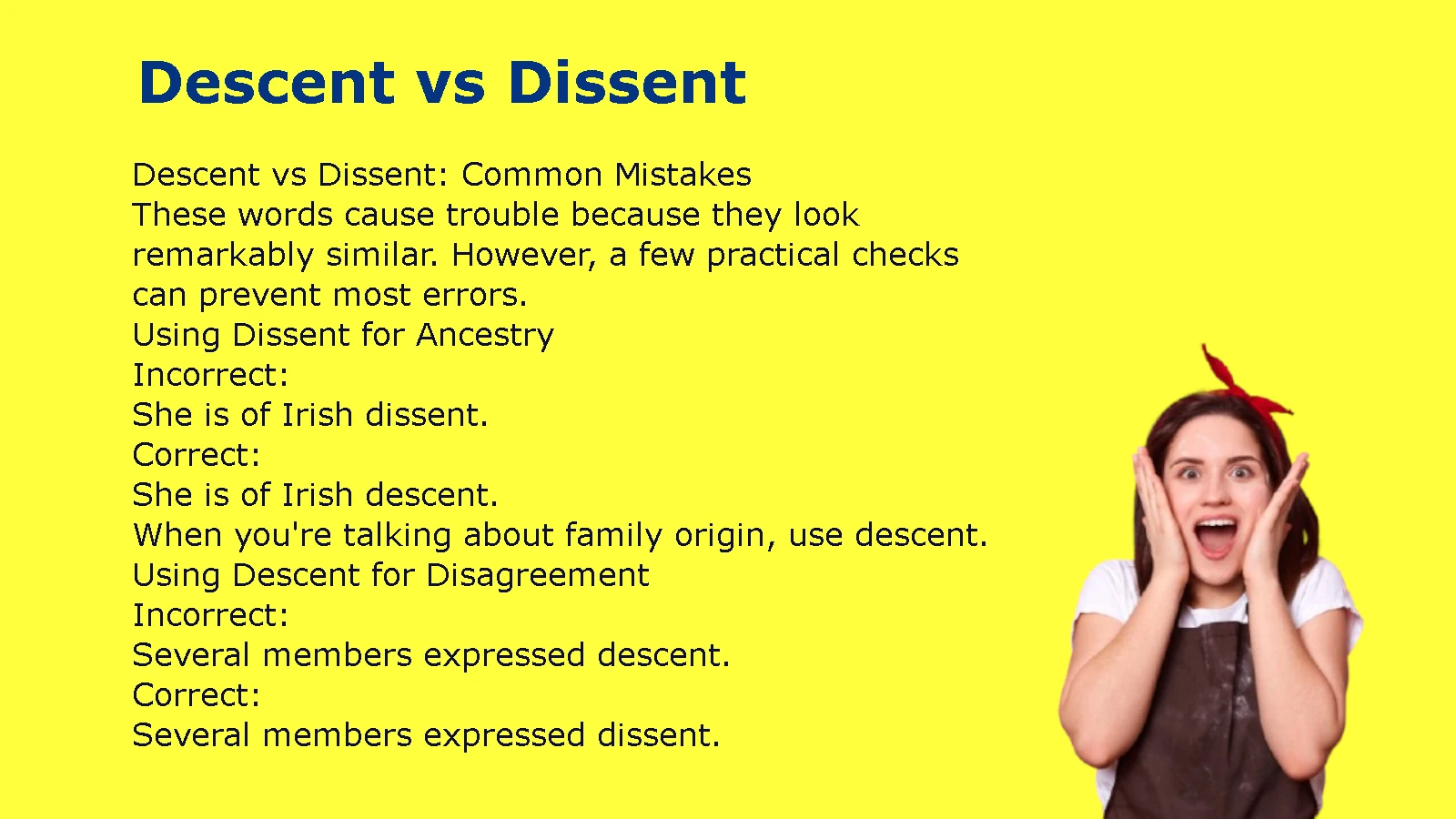
Descent vs Dissent: Common Mistakes
These words cause trouble because they look remarkably similar. However, a few practical checks can prevent most errors.
Using Dissent for Ancestry
Incorrect:
She is of Irish dissent.
Correct:
She is of Irish descent.
When you’re talking about family origin, use descent.
Using Descent for Disagreement
Incorrect:
Several members expressed descent.
Correct:
Several members expressed dissent.
When people disagree with a decision or opinion, use dissent.
Confusing Descent With Descend
Descent is a noun.
Descend is a verb.
Compare:
The plane began its descent.
The plane will descend soon.
The first sentence names the downward movement. The second describes the action.
This distinction is useful because descent and descend belong to the same word family. Cambridge also lists descend among the related words associated with the ancestry sense of descent.
Writing “Dissent” When You Mean “Descent”
This mistake often happens in phrases involving ancestry.
Remember:
of Italian descent
not:
of Italian dissent
The phrase of [nationality or ethnic group] descent is a standard way to describe family origin.
How to Remember Descent vs Dissent
A good memory trick should connect the spelling to the meaning instead of forcing you to memorize two unrelated definitions.
Remember Descent With “Descend”
The easiest connection is:
Descent → descend → down
If someone descends, they move downward.
A descent is the act or process of going down.
For example:
The plane will descend.
The plane’s descent was smooth.
You can also extend this idea to ancestry. Someone’s descent describes the line from which that person comes.
Remember Dissent With “Disagree”
For dissent, think:
Dissent → disagree → different opinion
Both words involve the idea of not agreeing.
For example:
She dissented from the decision.
She disagreed with the decision.
That connection makes the spelling easier to recall.
A Quick Memory Table
| If you’re talking about… | Use |
| Moving downward | Descent |
| A downward slope | Descent |
| Family ancestry | Descent |
| A decline into something worse | Descent |
| Disagreement | Dissent |
| Opposition to an opinion | Dissent |
| A judge’s differing opinion | Dissent |
| The act of disagreeing | Dissent |
Descent Synonyms
Because descent has several meanings, its synonyms change depending on the context.
Synonyms for Descent Meaning “Going Down”
Depending on the sentence, possible alternatives include:
- decline
- fall
- drop
- lowering
- downward movement
- decrease
These aren’t always interchangeable. For example, descent sounds natural when describing an airplane’s approach, while drop can suggest a sudden or steep decrease.
Synonyms for Descent Meaning “Ancestry”
In the ancestry sense, related words include:
- ancestry
- lineage
- heritage
- origin
- family background
- genealogy
- bloodline
For example:
She is of Irish descent.
could be expressed as:
She has Irish ancestry.
However, genealogy has a somewhat different focus. It usually refers to the study or record of family history rather than simply someone’s ancestral background.
Dissent Synonyms
Dissent also has several close synonyms, although each can carry a slightly different tone.
Common alternatives include:
- disagreement
- opposition
- objection
- disapproval
- protest
- difference of opinion
- nonconformity
For example, disagreement is broad and ordinary. Dissent often sounds more formal and can suggest disagreement with an established position, authority, or official decision.
Synonyms for Dissent as a Verb
When dissent functions as a verb, related words include:
- disagree
- object
- oppose
- differ
- protest
Consider the difference:
She disagreed with the proposal.
This sounds natural in everyday conversation.
She dissented from the proposal.
This sounds more formal.
That difference in register matters when choosing the most natural word.
Descent vs Dissent vs Descend
A third word deserves attention because it looks almost identical to descent.
| Word | Part of Speech | Meaning | Example |
| Descent | Noun | Downward movement or ancestry | The descent was difficult. |
| Dissent | Noun/Verb | Disagreement | They expressed dissent. |
| Descend | Verb | To move downward | The plane will descend. |
The spelling pattern tells you something important.
Descend is the action:
The hikers descend the mountain.
Descent names the process:
The hikers begin their descent.
Dissent has nothing to do with physical downward movement:
The hikers expressed dissent about the route.
That three-way comparison can prevent several common spelling mistakes at once.
A Practical Case Study: Choosing the Right Word
Imagine you’re editing three sentences:
Sentence A:
The aircraft began its final ___ toward the runway.
The context involves an airplane moving downward. The correct word is descent.
Sentence B:
She is of Indian ___.
The sentence describes family origin. Again, the correct word is descent.
Sentence C:
Several committee members expressed ___ over the proposal.
This sentence concerns disagreement. The correct word is dissent.
The decision becomes almost automatic once you identify the underlying idea:
- Going down? Descent.
- Coming from ancestors? Descent.
- Disagreeing? Dissent.
Frequently Asked Questions About Descent vs Dissent
Is it descent or dissent for disagreement?
Use dissent for disagreement.
For example:
The committee faced strong dissent over the proposed changes.
Descent doesn’t mean disagreement.
Is it descent or dissent for ancestry?
Use descent.
For example:
He is of Nigerian descent.
Here, descent refers to family origin or ancestry.
What is the difference between descent and dissent?
Descent means a downward movement, a downward slope, ancestry, or a figurative decline. Dissent means disagreement with an opinion, decision, proposal, or accepted position.
The two words are pronounced alike in standard US English, which makes their spelling especially important.
Is descent related to descend?
Yes.
Descent and descend belong to the same word family and share the idea of moving downward.
Compare:
The plane will descend.
The plane’s descent will begin shortly.
The first is a verb. The second is a noun.
Can dissent be a verb?
Yes.
Dissent can function as both a noun and a verb.
As a noun:
There was considerable dissent.
As a verb:
Several members dissented from the decision.
Cambridge identifies both uses and specifically gives dissent from as a standard construction.
What does “of descent” mean?
The phrase of descent usually refers to ancestry or family origin.
For example:
She is of Mexican descent.
This means her family background includes Mexican ancestry.
What does “dissenting opinion” mean?
A dissenting opinion is an opinion that disagrees with the majority opinion in a court. The term is especially common in legal writing.
For example:
The judge issued a dissenting opinion.
The judge’s opinion differs from the position adopted by the majority of the court.
Are descent and dissent pronounced the same?
Yes. In standard US English, both are pronounced /dɪˈsent/. That makes them homophones.
Because they sound alike, you need to rely on context and spelling when distinguishing them in writing.
Is “descent” always about physically going down?
No.
Although descent commonly refers to downward movement, it also means ancestry or family origin. It can also appear in figurative expressions such as descent into crime or descent into chaos.
Is “dissent” the same as “disagreement”?
They’re very close.
Dissent means disagreement, but it often appears in more formal contexts. It can refer to opposition to an official decision, proposal, established belief, or majority position.
For everyday conversation, disagreement is usually more common.
Final Takeaway: Descent vs Dissent
The difference between descent vs dissent looks complicated at first because the words are nearly identical in spelling and identical in standard US pronunciation. Their meanings, however, are easy to separate once you focus on the idea behind each word.
Descent refers to going down, a downward slope, ancestry, or a figurative decline.
Dissent refers to disagreement or opposition to an opinion, decision, or accepted position.
Keep these three connections in mind:
- Descent → descend → go down
- Descent → ancestors → family origin
- Dissent → disagree → different opinion
And don’t forget the third word that often joins the mix:
- Descend = to move downward
- Descent = the downward movement or ancestry
- Dissent = disagreement
Once you connect each spelling with its meaning, descent and dissent stop looking like interchangeable words. One points downward or backward through a family line. The other points toward a difference of opinion.