Unvisible vs Invisible is a common spelling confusion because both words appear to describe something that cannot be seen. However, invisible is the correct and standard English word. It means something cannot be seen or noticed, while unvisible is generally considered nonstandard in modern English.
The confusion often comes from English prefixes such as un- and in-, which can both express negation. However, they are not interchangeable in every word. Understanding this distinction also helps you use related expressions such as invisible text, invisible character, and invisible space correctly.
This guide explains the meaning of both terms, their grammatical differences, correct sentence usage, and the technology behind invisible Unicode characters. You’ll also find practical examples to help you avoid spelling mistakes.
| Question | Answer |
| Is unvisible a word? | It may appear in historical or unusual usage, but it is not standard modern English. |
| Is invisible or unvisible correct? | Invisible is the correct standard spelling. |
| What does invisible mean? | Unable to be seen or noticed. |
| What is invisible text? | Text containing characters that appear blank or have no visible symbol. |
| What is an invisible character? | A Unicode character that may not display a visible mark. |
Unvisible vs Invisible: Quick Answer
Invisible is the correct word to use in standard English. It describes something that cannot be seen, such as an invisible object, invisible ink, or an invisible barrier. Unvisible is generally a nonstandard alternative and should be avoided in everyday writing, academic work, and professional communication.
The two spellings may look similar, but only one is the conventional choice.
| Feature | Invisible | Unvisible |
| Standard English | Yes | No |
| Meaning | Unable to be seen | Intended to mean unable to be seen |
| Part of speech | Adjective | Intended adjective |
| Common usage | Very common | Rare and nonstandard |
| Recommended spelling | Yes | No |
For example:
- Correct: The stars became invisible behind the thick clouds.
- Nonstandard: The stars became unvisible behind the thick clouds.
The word invisible works in both literal and figurative situations. You can describe an object that cannot be seen, a hidden problem, or a person who feels unnoticed by others.
What Does Invisible Mean?
Invisible means impossible or difficult to see, either because something cannot be detected by the human eye or because it is hidden from ordinary observation. It is an adjective that describes objects, people, substances, or conditions that are not visually noticeable.
The word has several applications in everyday English. It can describe something physically hidden, something too small to observe, or something that exists but receives little attention.
For example, a transparent gas may be invisible to the naked eye. Similarly, an employee who receives no recognition at work might feel invisible even though everyone can physically see that person.
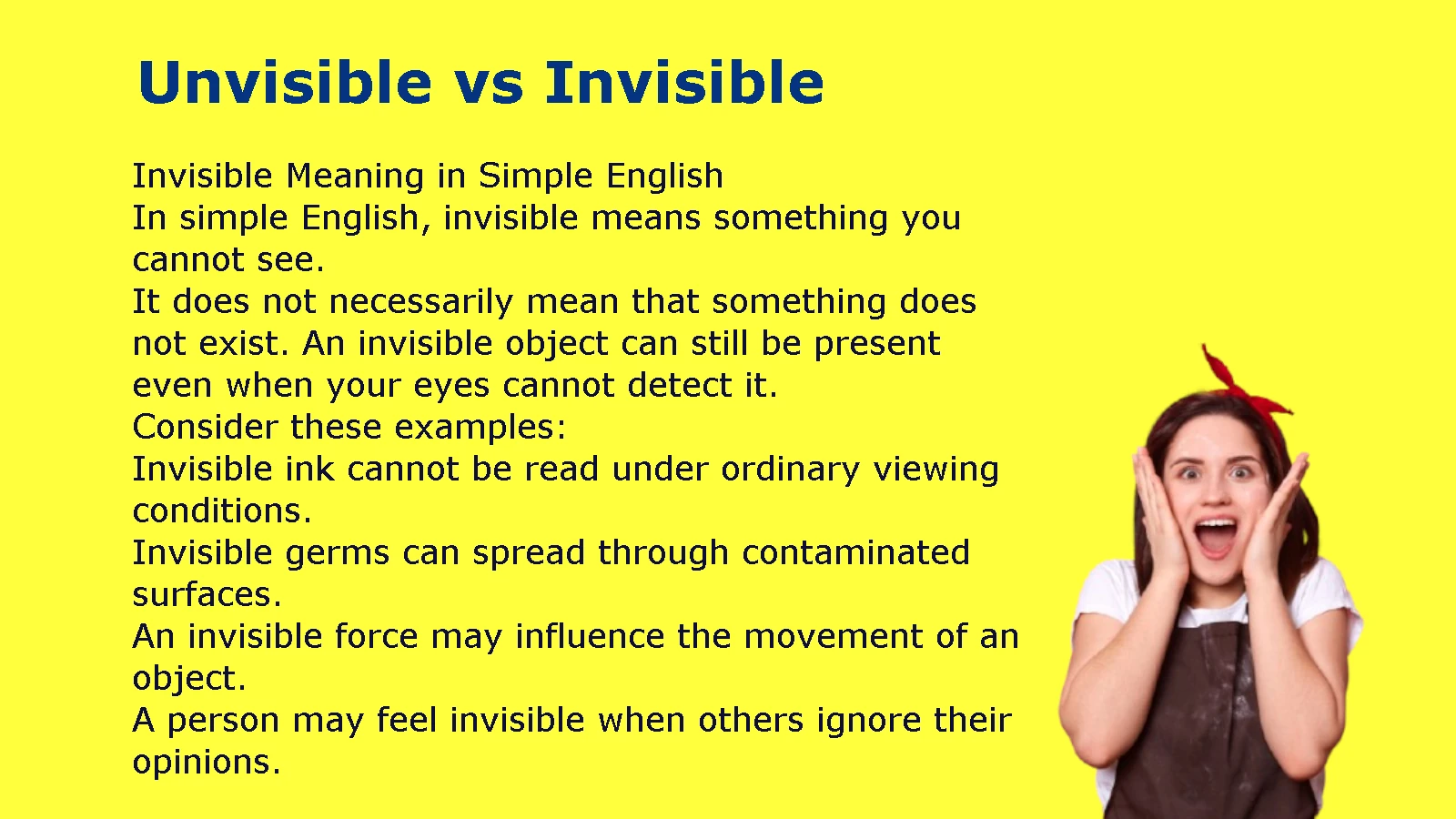
Invisible Meaning in Simple English
In simple English, invisible means something you cannot see.
It does not necessarily mean that something does not exist. An invisible object can still be present even when your eyes cannot detect it.
Consider these examples:
- Invisible ink cannot be read under ordinary viewing conditions.
- Invisible germs can spread through contaminated surfaces.
- An invisible force may influence the movement of an object.
- A person may feel invisible when others ignore their opinions.
Think of the air around you. You cannot normally see the individual gases that make up the atmosphere, but they are still present.
That is the basic idea behind invisibility: something exists, but you cannot see it clearly or at all.
Invisible Meaning in Different Contexts
The word invisible changes slightly depending on the situation in which you use it.
Here are four common contexts.
Physical invisibility
Physical invisibility describes something that cannot be seen under normal viewing conditions.
Examples include:
- Certain gases
- Clear liquids in suitable containers
- Extremely small particles
- Objects hidden behind other objects
Figurative invisibility
Figurative invisibility describes something that exists but receives no attention or recognition.
For example:
“Despite working hard for years, she felt invisible in the company.”
The employee is physically visible, but her contributions go unnoticed.
Digital invisibility
Digital invisibility refers to content or characters that do not appear visibly on a screen.
Examples include:
- Invisible Unicode characters
- Zero-width spaces
- Hidden formatting characters
- Blank-looking text
Social invisibility
Social invisibility describes the experience of being overlooked, excluded, or ignored.
For example:
“New students sometimes feel invisible when they struggle to make friends.”
This usage focuses on social recognition rather than physical appearance.
Example Sentences With Invisible
Understanding a word becomes easier when you see it in different situations.
Here are some original sentences using invisible:
- The magician made the coin appear invisible inside the glass.
- Some bacteria are invisible without a microscope.
- An invisible line separated the two sections of the drawing.
- The small scratches were almost invisible under normal lighting.
- She felt invisible during the entire meeting because nobody listened to her ideas.
- The software detected an invisible character inside the text.
- The transparent material created an almost invisible barrier.
- His contribution remained invisible despite helping the entire team.
- The ink became visible after exposure to ultraviolet light.
- The tiny particles were invisible to the naked eye.
Notice how the word works naturally with nouns such as character, ink, barrier, object, and force.
What Does Unvisible Mean?
Unvisible is an uncommon, generally nonstandard form intended to mean something that cannot be seen. People sometimes create it by combining the prefix un- with visible. However, standard modern English uses invisible for this meaning.
Although you may encounter unvisible in unusual, historical, or creative writing, it is not the recommended spelling for ordinary communication.
Is Unvisible a Word?
The question “Is unvisible a word?” comes from the way English creates new words using prefixes.
Technically, people can form unusual expressions that communicate an understandable idea. However, a word being understandable does not automatically make it standard English.
Unvisible is an example of this distinction.
It follows a pattern that might seem logical:
- Visible = able to be seen.
- Un + visible = not able to be seen.
However, English does not allow speakers to attach un- to every adjective to create its opposite.
For example:
| Correct word | Nonstandard alternative |
| Invisible | Unvisible |
| Impossible | Unpossible |
| Incorrect | Uncorrect |
| Inactive | Unactive |
The left column contains the conventional words used in standard English.
Therefore, if you are writing an essay, article, email, or professional document, choose invisible rather than unvisible.
Why Do People Write Unvisible Instead of Invisible?
People often write unvisible because they recognize the meaning of the prefix un- but do not know which negative prefix belongs to a particular word.
English contains several negative prefixes, including:
- Un-: Unhappy, unknown, unseen, unable.
- In-: Invisible, incorrect, inactive.
- Im-: Impossible, impatient, imperfect.
- Il-: Illegal, illogical, illegitimate.
- Ir-: Irregular, irrelevant, irresponsible.
These prefixes can express opposite meanings, but their use depends on established word formation.
For example, you say unhappy, not inhappy. Similarly, you say invisible, not unvisible in standard English.
Another reason for the confusion is that unseen is a perfectly correct word. People may assume that because unseen and visible have related meanings, unvisible must also be correct.
However, English vocabulary develops through established usage, not just mathematical combinations of prefixes.
Example Sentences With Unvisible
The following examples demonstrate how someone might incorrectly use unvisible and how to correct the sentence.
| Nonstandard sentence | Correct sentence |
| The object became unvisible. | The object became invisible. |
| The writing is unvisible in the dark. | The writing is invisible in the dark. |
| There was an unvisible mark on the wall. | There was an invisible mark on the wall. |
| The character turned unvisible. | The character turned invisible. |
| The barrier was almost unvisible. | The barrier was almost invisible. |
Writing tip: If you want to express that something cannot be seen, use invisible. If you mean that something is difficult to notice, words such as unnoticeable or imperceptible may be more precise.
Unvisible or Invisible: Which Is Correct?
Invisible is the correct spelling, while unvisible is generally considered nonstandard. Use invisible when describing something that cannot be seen, detected, or noticed. The spelling is established in modern English, so it is the appropriate choice for school assignments, business writing, websites, and everyday conversations.
The difference is not simply a matter of preference. It comes from how English forms words using negative prefixes.
Invisible vs Unvisible: Main Differences
Both expressions may communicate a similar intended meaning, but their acceptance in standard English differs.
| Comparison | Invisible | Unvisible |
| Correct standard spelling | Yes | No |
| Dictionary-style meaning | Unable to be seen | Intended to mean unable to be seen |
| Grammatical role | Adjective | Intended adjective |
| Frequency in modern English | Common | Extremely uncommon |
| Suitable for formal writing | Yes | No |
| Suitable for everyday conversation | Yes | No |
| Recommended usage | Use it | Avoid it |
The important distinction is standard usage. You should not select a spelling simply because its construction appears logical.
For example, English speakers use invisible because that is the established adjective. Creating unvisible by adding a familiar prefix does not make it an equally acceptable alternative.
Unvisible or Invisible in a Sentence
The easiest way to remember the correct spelling is to compare complete sentences.
Here are some examples:
Incorrect: The invisible ink became unvisible after a few minutes.
Correct: The invisible ink became difficult to see after a few minutes.
Incorrect: There is an unvisible character between these two words.
Correct: There is an invisible character between these two words.
Incorrect: The magician made himself unvisible.
Correct: The magician made himself invisible.
Incorrect: The tiny crack was completely unvisible.
Correct: The tiny crack was almost invisible.
These examples also show that invisible can describe physical objects, digital characters, and things that are difficult to notice.
Why Is Invisible Correct but Unvisible Is Not?
The main reason is conventional English word formation.
The prefix in- appears in several established English adjectives that express negation. Examples include:
- Invisible
- Inaccurate
- Incomplete
- Inactive
- Incorrect
- Inappropriate
The prefix un- also creates negative meanings, but it follows different established patterns.
For instance:
- Visible → Invisible
- Happy → Unhappy
- Known → Unknown
- Certain → Uncertain
- Fair → Unfair
You cannot freely exchange these prefixes. Each word has an accepted form that English speakers recognize.
There is another important detail: the prefix in- has historical connections to Latin. Its form also changes in some words, producing variations such as im-, il-, and ir-.
For example:
- Impossible
- Illegal
- Irregular
These variations help explain why English spelling sometimes seems inconsistent.
The practical rule is simple: Learn the established opposite of a word instead of trying to create one by adding un- or in- yourself.
Invisible vs Invisible: Is There Any Difference?
There is no spelling difference between invisible and invisible. Both expressions contain exactly the same letters in the same order and have the same meaning.
However, someone searching for “invisible vs invisible” may have accidentally entered the same word twice or intended to compare invisible with another expression.
For example, these are meaningful comparisons:
- Invisible vs unseen
- Invisible vs hidden
- Invisible vs imperceptible
- Invisible vs unnoticeable
Context can also change how the word is understood.
Consider these examples:
- “The invisible ink appeared under ultraviolet light.”
- “The invisible problem affected the entire business.”
The first sentence describes something that cannot be seen under ordinary conditions. The second uses invisible figuratively to describe an overlooked problem.
The spelling remains unchanged, but the intended meaning depends on the surrounding words.
Invisible Text: What Is It and How Does It Work?
Invisible text is text that contains characters or formatting elements that do not produce an obvious visible mark when displayed. It can include zero-width Unicode characters, special spacing characters, and other nonprinting elements. People use it for text formatting, digital communication, and software testing.
Unlike ordinary blank spaces, some invisible characters have specific functions that affect how text behaves.
For example, a message may appear completely empty even though it contains a Unicode character. A computer can recognize that character even when a person cannot see a symbol on the screen.
What Is an Invisible Character?
An invisible character is a character that may not display a visible symbol in ordinary text.
Computers process text using character encodings. Unicode provides a standard system for representing characters from many writing systems, along with symbols, formatting controls, and other special characters.
Some Unicode characters do not have an ordinary visible shape.
Examples include:
- Zero-width space
- Zero-width non-joiner
- Zero-width joiner
- Certain invisible formatting controls
These characters can influence text layout without looking like ordinary letters or punctuation.
For instance, a zero-width space can provide a possible line-breaking point without displaying a normal space.
Practical example: Imagine copying a sentence from a website into a text editor. The sentence looks normal, but a hidden formatting character may exist between two words. That character can affect searching, text processing, or copying.
This is why invisible characters matter in programming, document formatting, and digital communication.
What Is an Invisible Space?
An invisible space usually refers to a blank-looking Unicode character or spacing character that does not look like a normal letter or symbol.
However, not all invisible spaces work the same way.
Some create actual spacing. Others have zero width and do not produce a visible gap.
Consider these distinctions:
| Character type | Visible appearance | Main function |
| Ordinary space | Blank gap | Separates words |
| Non-breaking space | Blank gap | Prevents certain line breaks |
| Zero-width space | No visible gap | Provides a line-breaking opportunity |
| Zero-width non-joiner | No visible mark | Prevents character joining |
| Zero-width joiner | No visible mark | Joins certain characters |
A common mistake is assuming that every blank-looking character is simply an empty space.
In reality, different characters can behave differently when copied, searched, edited, or processed by software.
Invisible Text Copy and Paste
People sometimes search for invisible text because they want to copy a blank-looking character and use it in a digital application.
This can be useful for testing text fields, understanding Unicode behavior, or experimenting with formatting.
Here is a simple example of a zero-width space:
ZERO-WIDTH SPACE — U+200B
Invisible character
Unicode
The following character has no ordinary visible symbol between the brackets.
[]
Copy character
Some common applications include:
- Text testing: Checking whether an application accepts zero-width characters.
- Document formatting: Understanding how hidden formatting characters affect text.
- Unicode experiments: Learning how computers represent nonprinting characters.
- Text processing: Testing how search tools and text editors handle unusual characters.
Keep in mind that platforms may remove, replace, or reject invisible characters. Their behavior depends on the application and its rules.
Do not use hidden characters to bypass username restrictions, impersonate other users, or conceal malicious content.
Invisible Text vs Invisible Characters vs Invisible Spaces
These expressions are closely related, but they do not describe exactly the same thing.
| Term | Definition | Example |
| Invisible text | Text that appears blank or contains hidden formatting | A string with zero-width characters |
| Invisible character | A specific Unicode character without an obvious visible symbol | Zero-width joiner |
| Invisible space | A blank-looking spacing character | Zero-width space |
| Blank space | An empty-looking area between content | Ordinary keyboard space |
The difference matters because a string of invisible characters is not necessarily the same as an empty string.
For example, a text box containing zero-width characters may look empty, but its character count may be greater than zero.
Is Invisible Text the Same as a Blank Space?
No. Invisible text and a blank space are not necessarily the same thing.
An ordinary space creates a visible gap between words. An invisible character may have no visible width or may perform a formatting function without appearing as a normal symbol.
For example:
- An ordinary space separates two words.
- A non-breaking space keeps certain words together on the same line.
- A zero-width space provides a possible line-break position.
- A zero-width joiner can influence how certain characters combine.
This distinction is especially useful when working with HTML, programming languages, spreadsheets, and text editors.
Common Types of Invisible Unicode Characters
Unicode includes several characters that influence text without displaying an ordinary visible symbol. Understanding them helps explain why invisible text sometimes behaves differently across applications.
Here are four useful examples.
Zero-Width Space (ZWSP)
The zero-width space, represented by U+200B, is a Unicode character that has no visible width.
Its main purpose is to provide an optional line-breaking opportunity without inserting an ordinary visible space.
For example, some writing systems and text-layout situations require additional opportunities for line breaks. A zero-width space can help software determine where a line may break.
Common uses include:
- Text layout
- Word-breaking support
- Digital typography
- Certain text-processing operations
It is important not to confuse a zero-width space with a regular keyboard space. They have different Unicode values and different behavior.
Zero-Width Non-Joiner (ZWNJ)
The zero-width non-joiner, represented by U+200C, is a formatting character that prevents certain neighboring characters from joining.
It is especially useful in writing systems where letters can change shape depending on the characters around them.
For example, Persian uses ZWNJ in certain words to control joining behavior. It can help maintain the intended appearance and structure of written text.
Its common applications include:
- Persian typography
- Arabic-script text processing
- Character formatting
- Linguistic text representation
Although the character is invisible, removing it can change how a word appears or how its letters connect.
Zero-Width Joiner (ZWJ)
The zero-width joiner, represented by U+200D, performs a function opposite to the zero-width non-joiner in relevant writing systems.
It encourages certain neighboring characters to form a joined presentation.
One familiar use appears in emoji sequences.
For example, some family and profession emojis combine multiple individual Unicode characters using zero-width joiners. A compatible application displays the sequence as a single combined emoji.
Common uses include:
- Emoji combinations
- Complex script formatting
- Joined character sequences
- Digital typography
The ZWJ has no ordinary visible symbol, but its effect can be obvious when an application displays the combined result.
Non-Breaking Space (NBSP)
A non-breaking space, represented by U+00A0, looks similar to an ordinary space but behaves differently.
Its main purpose is to prevent a line break between two connected pieces of text.
For example, you may want a number and its unit to remain together rather than appearing on separate lines.
Examples include:
- 25 kg
- $100
- 10 km
- A person’s title and surname
A non-breaking space helps keep connected content together during text wrapping.
Unlike a zero-width space, NBSP has visible spacing. However, it is still considered a special spacing character rather than an ordinary keyboard space.
Common Expressions and Searches Related to Invisible
The word invisible also appears in entertainment, online searches, games, and everyday expressions. However, its meaning depends on the phrase surrounding it.
Some searches involving invisible fruit, invisible songs, and invisible lyrics may refer to specific entertainment content rather than the dictionary meaning.
Invisible Fruit: What Does It Mean?
Invisible fruit generally describes fruit that cannot be seen or appears to be missing from view. The exact meaning depends on the context, such as a game, fictional story, visual joke, or online meme.
The phrase can describe several situations:
- Games: Fruit that is hidden, transparent, or represented by a visual glitch.
- Stories: Fictional fruit with magical invisibility properties.
- Memes: A joke involving someone pretending to hold or eat nonexistent fruit.
- Visual effects: Fruit that has been edited out of an image or video.
For example:
“The character searched the garden for invisible fruit after drinking a mysterious potion.”
Here, invisible describes the fruit’s unusual appearance rather than its physical existence.
If you encounter this phrase in a particular game or video, the surrounding context determines its exact meaning.
Invisible Song: Meaning and Context
An invisible song can refer to a song title, a musical theme involving invisibility, or a composition that explores the idea of being unseen or unnoticed.
The word invisible often carries an emotional meaning in music.
For example, a song about feeling invisible might explore:
- Being ignored by friends or family.
- Feeling unappreciated in a relationship.
- Struggling to gain recognition.
- Experiencing loneliness.
- Wanting someone to notice your presence.
The phrase can also refer to a specific track titled Invisible. Several musical works can share similar titles, so identifying the artist is important when searching for a particular song.
Invisible Lyrics: What Are People Searching For?
People searching for invisible lyrics usually want the words of a song with Invisible in its title or lyrics that contain the word.
There are two common interpretations:
Searching for a song titled Invisible
A person may remember the title but forget the artist. Adding the artist’s name, album, or another identifying detail can help locate the correct track.
Searching for lyrics about invisibility
Someone may be looking for a song that discusses feeling unseen, forgotten, ignored, or unimportant.
These meanings are related but do not represent the same search intent.
If you are searching for a particular song, include the artist’s name to narrow down the results.
Common Mistakes When Using Invisible and Unvisible
Many spelling mistakes happen because people apply familiar grammar rules to words that follow different patterns. The confusion between unvisible and invisible is a good example.
Here are common mistakes and ways to avoid them.
Using Unvisible Instead of Invisible
This is the most direct spelling mistake.
Some writers assume that adding un- to visible creates the correct opposite. However, standard English uses invisible.
- Incorrect: The writing became unvisible.
- Correct: The writing became invisible.
Remember the established word rather than creating a new form.
Confusing Invisible With Unseen
Invisible and unseen have similar meanings, but they are not always interchangeable.
Invisible describes something that cannot be seen or noticed. Unseen generally describes something that has not been seen or observed.
Compare these examples:
- The gas is invisible to the human eye.
- The visitor remained unseen throughout the night.
The first sentence describes a visual property. The second describes something that nobody observed.
Assuming Un- and In- Are Interchangeable
English has several negative prefixes, but you cannot freely exchange them.
For example:
| Base word | Correct negative form |
| Visible | Invisible |
| Happy | Unhappy |
| Possible | Impossible |
| Legal | Illegal |
| Regular | Irregular |
| Known | Unknown |
The best approach is to learn each established word individually.
Using Invisible When You Mean Hidden
Sometimes invisible is not the most precise word.
Consider the difference:
- Invisible: Cannot be seen.
- Hidden: Deliberately or naturally placed out of sight.
- Obscured: Difficult to see because something blocks the view.
- Unnoticed: Not attracting someone’s attention.
- Unseen: Not observed or viewed.
For example:
“The document was hidden inside the drawer.”
This sentence does not necessarily mean the document was invisible. It simply means someone placed it where others could not easily see it.
Choosing the right word makes your writing clearer and more accurate.
Invisible Synonyms and Related Words
If you want to avoid repeating invisible in every sentence, several alternatives can express similar ideas.
However, each synonym has a slightly different meaning. The best choice depends on whether you are describing physical appearance, visibility, or a lack of attention.
Synonyms for Invisible
Here are useful alternatives:
| Synonym | Meaning | Example |
| Unseen | Not observed | The visitor remained unseen. |
| Imperceptible | Too subtle to detect | There was an imperceptible movement. |
| Unnoticeable | Difficult to notice | The small mark was unnoticeable. |
| Indiscernible | Impossible or difficult to distinguish | The writing was indiscernible. |
| Hidden | Kept out of sight | The key was hidden beneath the book. |
| Obscured | Blocked from view | The mountain was obscured by clouds. |
| Concealed | Deliberately kept secret or out of sight | The message was concealed inside the box. |
Imperceptible is particularly useful when something exists but is too small, subtle, or weak for ordinary observation.
For example:
“The difference between the two colors was almost imperceptible.”
This sounds more precise than simply saying the difference was invisible.
Invisible vs Unseen vs Hidden
These three words are related, but their meanings are slightly different.
| Word | Main meaning | Example |
| Invisible | Unable to be seen | The gas was invisible. |
| Unseen | Not observed | The bird remained unseen. |
| Hidden | Placed out of sight | The money was hidden in a drawer. |
Use invisible when something cannot be seen.
Use hidden when something is concealed or kept away from view.
Understanding these differences helps you select the most accurate word instead of using similar expressions interchangeably.
Frequently Asked Questions About Unvisible vs Invisible
Is Unvisible a Real English Word?
Unvisible is an uncommon form that may appear in historical or unusual writing, but it is not considered standard modern English. If you want to describe something that cannot be seen, use invisible. It is the conventional and widely accepted spelling.
Should I Write Unvisible or Invisible?
You should write invisible. It is the standard English adjective for something that cannot be seen or noticed. For example, write “The tiny particles are invisible” rather than “The tiny particles are unvisible.”
What Is the Meaning of Unvisible?
Unvisible is generally intended to mean something that cannot be seen. However, it is a nonstandard alternative to invisible. In ordinary writing, use invisible to communicate this meaning clearly and correctly.
What Is an Invisible Character?
An invisible character is a Unicode character that does not display an obvious visible symbol. Examples include the zero-width space (U+200B), zero-width non-joiner (U+200C), and zero-width joiner (U+200D). These characters can affect text formatting and digital presentation.
How Do You Type an Invisible Space?
You can insert an invisible spacing character by copying a Unicode character or using a character-insertion method supported by your device or application. The zero-width space (U+200B) is one example. However, remember that it behaves differently from an ordinary keyboard space.
Is Invisible Text the Same as Invisible Characters?
No. Invisible text describes a complete string or text content that appears blank or hidden. An invisible character is an individual character that may not display a visible symbol. A text string can contain one or several invisible characters.
Conclusion: Unvisible vs Invisible
When comparing unvisible vs invisible, the correct choice in standard modern English is invisible. It means something cannot be seen, noticed, or detected under ordinary conditions. Although unvisible may seem logical because English uses the prefix un- in many negative words, it is not the conventional spelling.
Remember these key points:
- Invisible is the standard and recommended spelling.
- Unvisible is generally nonstandard in modern English.
- The prefixes un- and in- cannot be freely exchanged.
- Invisible text can contain special Unicode characters.
- An invisible character may affect digital text without displaying a visible symbol.
- An invisible space can behave differently from an ordinary space.