Unregular or irregular: Which spelling should you use? The correct standard English word is irregular, meaning something that does not follow a normal rule, pattern, schedule, or expected structure. Although unregular may look like a logical alternative, it is generally considered nonstandard in modern English.
The word irregular has several uses in everyday English, grammar, and professional communication. You can use it to describe an unusual schedule, an uneven shape, unpredictable behavior, or a verb that does not follow the usual past-tense pattern. Understanding its meaning, pronunciation, part of speech, synonyms, and antonyms will help you use it accurately.
| Question | Answer |
| Is it unregular or irregular? | Irregular is the correct standard English spelling. |
| What does irregular mean? | It describes something that does not follow a normal rule or pattern. |
| What does irregular mean when describing a person? | It can describe someone with unusual, unpredictable, or unconventional habits or behavior. |
| What is an irregular verb? | A verb that does not form its past tense and past participle by simply adding -ed. |
| What is the opposite of irregular? | Regular is the most direct antonym. |
Unregular or Irregular: Which One Is Correct?
Irregular is the correct and widely accepted spelling in standard English. It means not regular, consistent, or in accordance with an established rule. Unregular occasionally appears as a nonstandard formation, but you should use irregular in academic writing, professional communication, and everyday English.
For example:
- Correct: The company follows an irregular payment schedule.
- Incorrect in standard usage: The company follows an unregular payment schedule.
Both forms appear to express the opposite of regular. However, English does not form every negative word by simply adding un- to its opposite.
Unregular vs. Irregular: Quick Comparison
The following table explains the difference between these two spellings.
| Feature | Irregular | Unregular |
| Standard spelling | Yes | No |
| Dictionary usage | Established English word | Generally nonstandard |
| Meaning | Not regular or following a normal pattern | Intended to mean not regular |
| Prefix | ir- | un- |
| Common usage | Everyday and formal English | Rare or nonstandard usage |
| Recommended choice | Yes | No |
Irregular works in many contexts, including grammar, mathematics, daily routines, shapes, and behavior. For example, you can describe an irregular verb, an irregular schedule, or an irregular surface.
The word unregular does not serve as a standard substitute in these expressions.
Why Is Irregular the Correct Spelling?
The word irregular combines the negative prefix ir- with regular.
The prefix ir- is a variant of the negative prefix in-. It appears before certain words beginning with r. It changes the meaning of the original word to its opposite or expresses the absence of a particular quality.
Consider these examples:
| Original word | Negative form | Meaning |
| Regular | Irregular | Not following a normal pattern |
| Responsible | Irresponsible | Not showing responsibility |
| Relevant | Irrelevant | Not connected to the subject |
| Rational | Irrational | Not based on reason |
| Reversible | Irreversible | Cannot be reversed |
These examples show why you cannot freely exchange negative prefixes.
English uses different prefixes according to word history, pronunciation, and established spelling conventions. Although un- is common, it does not automatically create the correct opposite of every adjective.
For instance:
- Unhappy is correct.
- Unfair is correct.
- Irregular is correct.
- Irresponsible is correct.
The best approach is to learn established word forms rather than create negative words by guessing.
Is Unregular Ever Used in English?
You may occasionally encounter unregular in informal writing, older material, or nonstandard English. Someone might use it because they know that un- often means not.
However, occasional use does not make a spelling standard.
If you are writing an essay, business email, report, article, or examination answer, choose irregular.
For example:
- The student has an irregular attendance record.
- The machine produces irregular movements.
- English contains several irregular verbs.
These sentences use the established form and sound natural to English readers.
Irregular Meaning and Definition
Irregular means not following a normal, expected, consistent, or established pattern. It describes something that differs from a standard rule, structure, schedule, or arrangement. The word can refer to physical shapes, repeated activities, human behavior, grammar, and many other situations where something does not follow a regular pattern.
In simple terms, something is irregular when it does not happen or appear in the usual way.
For example, a person who works different hours each day has an irregular schedule. A shape with uneven sides has an irregular shape. A verb that changes its form without following the usual -ed rule is an irregular verb.
Irregular Meaning in Simple English
The simplest meaning of irregular is not regular.
Something regular follows a predictable arrangement or established pattern. Something irregular does not.
Think about a daily routine.
If you wake up at 7 a.m. every morning, your waking schedule is regular. If you wake up at 6 a.m. one day, 9 a.m. the next, and noon the day after, your schedule is irregular.
Here are more examples:
- Irregular attendance: Someone does not attend consistently.
- Irregular payments: Money arrives at unpredictable intervals.
- Irregular shape: An object does not have an even or standard shape.
- Irregular pattern: Something does not repeat consistently.
- Irregular behavior: Someone acts in an unusual or unpredictable way.
The exact meaning depends on the noun that irregular describes.
Irregular Meaning in Different Contexts
The word has several related meanings. Understanding its context helps you choose the right interpretation.
| Context | Meaning | Example |
| Everyday life | Not following a consistent routine | He works irregular hours. |
| Grammar | Not following standard grammatical rules | Go is an irregular verb. |
| Shape | Uneven or not symmetrical | The rock has an irregular shape. |
| Health-related language | Not following an expected pattern | The report describes an irregular rhythm. |
| Behavior | Unusual or unpredictable actions | His behavior seemed irregular. |
| Business | Not occurring at fixed intervals | The supplier receives irregular orders. |
| Mathematics | Not following a uniform structure | The figure has an irregular boundary. |
Notice that the central idea remains the same: a departure from an established pattern.
However, the word does not always suggest something negative. An irregular shape can be attractive, an irregular schedule can be necessary, and an irregular design can be creative.
What Does Irregular Person Mean?
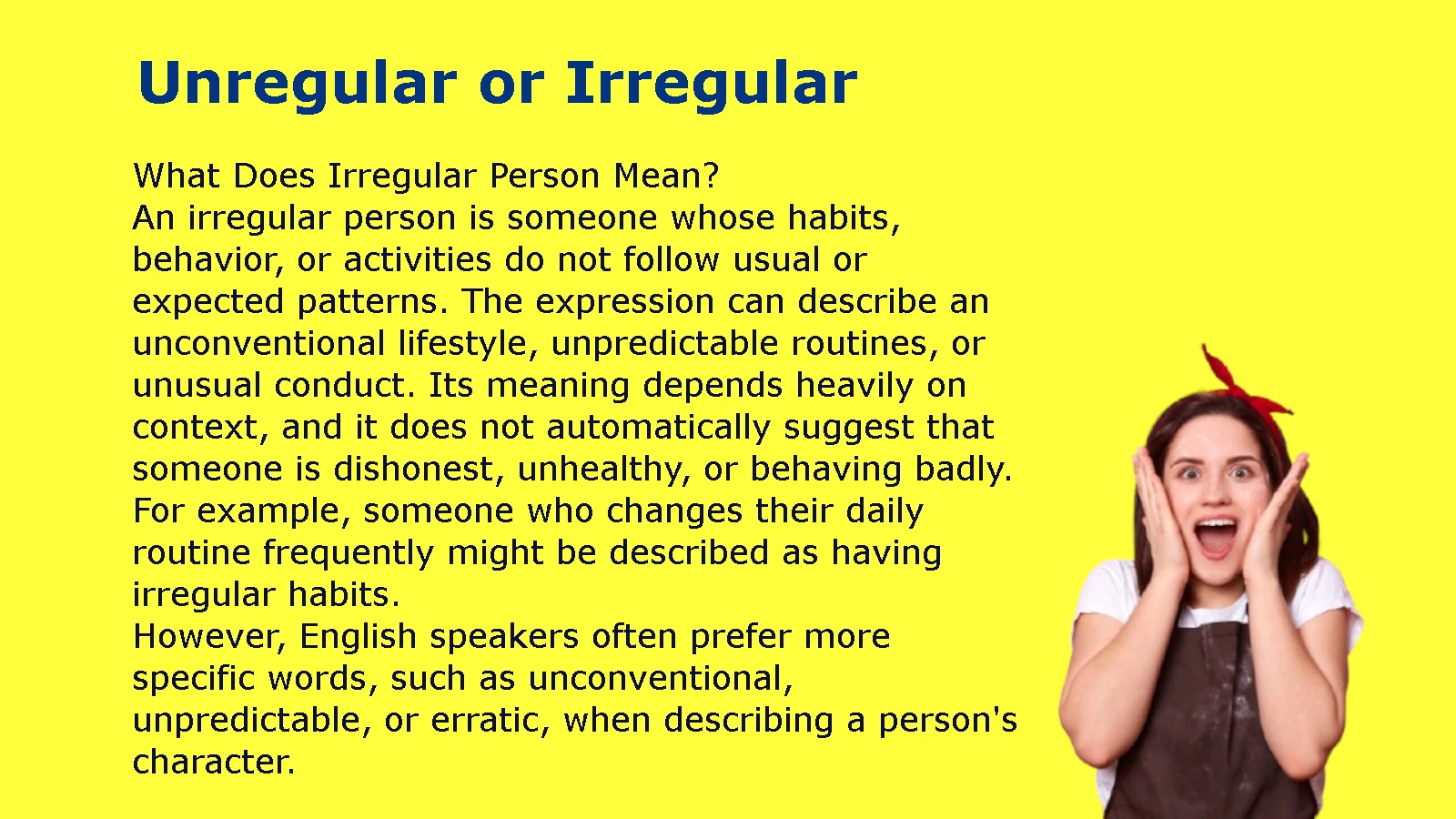
An irregular person is someone whose habits, behavior, or activities do not follow usual or expected patterns. The expression can describe an unconventional lifestyle, unpredictable routines, or unusual conduct. Its meaning depends heavily on context, and it does not automatically suggest that someone is dishonest, unhealthy, or behaving badly.
For example, someone who changes their daily routine frequently might be described as having irregular habits.
However, English speakers often prefer more specific words, such as unconventional, unpredictable, or erratic, when describing a person’s character.
Characteristics of an Irregular Person
When someone describes a person as irregular, they may be referring to one or more of these characteristics:
Unusual habits: The person follows routines that differ from common expectations.
Example: Daniel has irregular sleeping habits because he goes to bed at different times every night.
Unpredictable behavior: Their actions do not follow a consistent pattern.
Example: His irregular behavior makes it difficult for his colleagues to plan group activities.
Unconventional decisions: The person chooses methods or lifestyles that differ from traditional expectations.
Example: She follows an irregular career path, moving between different industries and creative projects.
Inconsistent routines: Their daily activities change frequently.
Example: An irregular work schedule makes it difficult for him to maintain a fixed exercise routine.
These descriptions focus on specific behavior rather than making a broad judgment about someone’s personality.
Irregular Person Examples in Everyday Life
Here are some original examples showing how the expression might appear in different situations.
- His irregular working hours make it difficult to arrange family dinners.
- She has an irregular routine because her job requires frequent travel.
- The teacher noticed the student’s irregular attendance.
- His irregular habits often affect his ability to meet deadlines.
- They described the artist as unconventional because he rarely followed traditional methods.
Each sentence gives readers a clearer idea of the person’s behavior.
Is Irregular a Positive or Negative Description of a Person?
The word irregular is generally neutral, but it can sound negative when it refers to something that should follow a predictable standard.
For example:
- “She has an irregular schedule” is a neutral description.
- “His behavior has become erratic” suggests instability.
- “She has an unconventional approach to business” may express admiration.
If you want to describe someone positively, unconventional, independent-minded, or original may communicate your meaning more clearly.
When you want to describe inconsistency, unpredictable or erratic may be more appropriate.
The important point is to choose a word that accurately describes the person’s actions instead of relying on a vague label.
How to Pronounce Irregular
The word irregular is pronounced with four syllables, with the main stress on the second syllable. Its standard pronunciation is /ɪˈreɡjələr/. The stress pattern helps distinguish it from similar-looking words and makes the pronunciation easier to remember.
Pronunciation: ih-REG-yuh-ler
The syllable breakdown is:
- ih
- REG
- yuh
- ler
The second syllable receives the strongest emphasis.
Irregular Pronunciation in American and British English
American and British English speakers pronounce irregular with the same general stress pattern, although the final vowel sounds may differ slightly.
| Feature | American English | British English |
| Syllables | Four | Four |
| Main stress | Second syllable | Second syllable |
| IPA | /ɪˈreɡjələr/ | /ɪˈreɡjələ(r)/ |
| General sound | ih-REG-yuh-ler | ih-REG-yuh-luh |
In non-rhotic British accents, the final r is generally not pronounced unless another vowel follows. American English usually pronounces the final r.
Common Pronunciation Mistakes
English learners sometimes make these mistakes when saying irregular:
- Putting stress on the first syllable: The strongest emphasis belongs on the second syllable.
- Leaving out a syllable: The standard word has four syllables.
- Confusing it with regular: The initial sound distinguishes the two words.
- Rushing the middle sounds: Pronounce the middle syllables clearly instead of blending them together.
A useful practice method is to say the word slowly, emphasize the second syllable, and then gradually increase your speaking speed.
What Does Irregular Verb Mean?
An irregular verb is a verb that does not form its simple past tense and past participle by following the usual -ed pattern. Instead, it may change its spelling, vowel sound, or entire form. Common examples include go–went–gone, eat–ate–eaten, and write–wrote–written.
English contains many irregular verbs, and learners usually need to memorize their different forms.
Regular vs. Irregular Verbs
The main difference between regular and irregular verbs is how they form their past-tense forms.
Regular verbs generally add -ed or -d to the base form.
Irregular verbs follow different patterns and may change completely.
| Base form | Regular past tense | Irregular past tense |
| Walk | Walked | — |
| Play | Played | — |
| Clean | Cleaned | — |
| Go | — | Went |
| Eat | — | Ate |
| Write | — | Wrote |
| See | — | Saw |
| Take | — | Took |
Compare these sentences:
- Regular: She walked to school yesterday.
- Irregular: She went to school yesterday.
The regular verb walk takes the familiar -ed ending. The irregular verb go changes to went.
Common Irregular Verbs and Their Forms
Learning common irregular verbs will improve your writing, reading, and speaking skills.
The following table includes 20 useful examples.
| Base form | Simple past | Past participle |
| Be | Was/Were | Been |
| Become | Became | Become |
| Begin | Began | Begun |
| Break | Broke | Broken |
| Bring | Brought | Brought |
| Buy | Bought | Bought |
| Come | Came | Come |
| Do | Did | Done |
| Drink | Drank | Drunk |
| Eat | Ate | Eaten |
| Find | Found | Found |
| Give | Gave | Given |
| Go | Went | Gone |
| Know | Knew | Known |
| Make | Made | Made |
| See | Saw | Seen |
| Speak | Spoke | Spoken |
| Take | Took | Taken |
| Think | Thought | Thought |
| Write | Wrote | Written |
You can use these three forms in different grammatical situations.
For example:
- Base form: I write articles every week.
- Simple past: I wrote an article yesterday.
- Past participle: I have written several articles this month.
The past participle usually appears with helping verbs such as have, has, and had.
Why Are Some Verbs Irregular?
Irregular verbs exist because English developed from older Germanic languages with different verb-conjugation patterns.
In earlier stages of English, verbs followed several historical patterns. Some changed their internal vowel sounds to express past tense rather than adding a suffix.
These older patterns remain in modern English.
For example:
- Sing → Sang → Sung
- Drink → Drank → Drunk
- Swim → Swam → Swum
These verbs show a vowel-change pattern.
Other verbs have different changes:
- Buy → Bought → Bought
- Teach → Taught → Taught
- Bring → Brought → Brought
Some verbs keep the same form throughout all three stages:
- Cut → Cut → Cut
- Put → Put → Put
- Let → Let → Let
The historical development of English explains why irregular verbs do not follow one universal pattern.
How to Identify an Irregular Verb
You can identify an irregular verb by comparing its base form, simple past, and past participle.
Follow these steps:
Check the base form.
Start with the original verb.
Example: Go.
Find the simple past form.
Ask whether the verb uses the regular -ed ending.
Example: Go becomes went, not goed.
Check the past participle.
Look at the form used with helping verbs.
Example: Gone appears in “I have gone home.”
Compare all three forms.
If the verb does not follow the usual -ed pattern, it is irregular.
A practical comparison:
| Base form | Past tense | Past participle | Verb type |
| Work | Worked | Worked | Regular |
| Talk | Talked | Talked | Regular |
| Go | Went | Gone | Irregular |
| Break | Broke | Broken | Irregular |
This method helps students recognize irregular verbs without relying on guesswork.
Irregular Part of Speech
Irregular is primarily an adjective. It describes a noun that does not follow a usual rule, pattern, arrangement, or standard. You can place it before a noun, as in irregular schedule, or after a linking verb, as in the pattern is irregular.
The word also has related forms, including the noun irregularity and the adverb irregularly.
Irregular as an Adjective
An adjective gives more information about a noun.
The word irregular performs this function in the following examples:
- The company has an irregular payment schedule.
- We noticed an irregular pattern in the results.
- The artist created an irregular design.
- His attendance record is irregular.
- The road has an irregular surface.
In each sentence, irregular describes a person, object, activity, or situation.
You can also use it after linking verbs such as is, was, seems, and looks.
Examples:
- The schedule is irregular.
- The pattern looks irregular.
- His attendance seems irregular.
Related Word Forms
Several related words come from irregular. Learning them helps you express the same general idea in different grammatical structures.
| Word | Part of speech | Meaning | Example |
| Irregular | Adjective | Not following a normal pattern | The schedule is irregular. |
| Irregularity | Noun | A deviation from a normal pattern | We noticed an irregularity in the report. |
| Irregularly | Adverb | In an irregular manner | The machine operates irregularly. |
| Regular | Adjective | Following a normal pattern | She follows a regular routine. |
| Regularity | Noun | The quality of being regular | The system operates with regularity. |
| Regularly | Adverb | In a consistent or repeated manner | He exercises regularly. |
These forms allow you to build more varied and accurate sentences.
For example:
- Adjective: The payments are irregular.
- Noun: There is an irregularity in the payments.
- Adverb: The payments arrive irregularly.
How to Use Irregular Grammatically
You can use irregular in several common sentence structures.
Before a noun:
Place the adjective directly before the noun it describes.
Examples:
- Irregular attendance
- Irregular payments
- Irregular behavior
- Irregular movements
After a linking verb:
Use the adjective after a linking verb when describing the subject.
Examples:
- The results are irregular.
- His working hours seem irregular.
- The shape looks irregular.
With intensifiers:
You can use words such as very, quite, and extremely to strengthen the description.
Examples:
- The pattern is extremely irregular.
- Her attendance has become quite irregular.
- The machine produces very irregular movements.
Remember that irregular is an adjective, not a noun. If you need a noun, use irregularity.
Irregular in a Sentence: Examples and Usage
You can use irregular in a sentence to describe something that does not follow a consistent schedule, standard, rule, or physical pattern. The adjective works in everyday conversations, professional writing, academic discussions, and grammar explanations. Choose the surrounding noun carefully because it determines the specific meaning.
10 Simple Sentences Using Irregular
Here are ten original examples that demonstrate everyday usage.
- His work schedule is irregular because he works different shifts every week.
- The road has an irregular surface that makes driving difficult.
- She noticed an irregular pattern in the monthly sales figures.
- The machine makes an irregular noise during operation.
- English contains many irregular verbs that students must learn.
- The building has an irregular shape with several uneven corners.
- His attendance became irregular after he changed schools.
- The report identified an irregular distribution of resources.
- Payments arrived at irregular intervals throughout the year.
- The artist used irregular lines to create a unique design.
Each sentence uses irregular to describe a departure from an expected pattern.
Irregular in Different Sentence Contexts
The word becomes more useful when you understand how it works in different situations.
Everyday conversations
- My sleep schedule has become irregular since I started working night shifts.
- We receive irregular deliveries from the supplier.
- Her exercise routine is irregular because she travels frequently.
Academic writing
- The research identified an irregular distribution of observations.
- Students often struggle with irregular English verbs.
- The study examined irregular patterns in the collected data.
Professional communication
- The accounting team discovered an irregular transaction.
- Our supplier has maintained an irregular delivery schedule.
- The manager requested an explanation for the irregular attendance record.
Grammar
- The verb take has an irregular past-tense form.
- Many irregular nouns form their plurals without adding -s.
- The adjective describes something that does not follow a standard pattern.
Scientific and technical descriptions
- The material developed an irregular surface after heating.
- The instrument detected an irregular signal.
- Researchers observed an irregular distribution across the sample.
Common Mistakes When Using Irregular
Even though irregular is a common adjective, writers sometimes use it incorrectly.
Mistake: Confusing irregular with incorrect
Irregular does not always mean wrong.
For example, an irregular shape may be perfectly acceptable. It simply differs from a standard geometric form.
Mistake: Using unregular instead of irregular
Incorrect: The employee follows an unregular schedule.
Correct: The employee follows an irregular schedule.
Mistake: Using irregular as a noun
Incorrect: The irregular caused problems in the report.
Better: The irregularity caused problems in the report.
Mistake: Treating every unusual event as irregular
An unusual event is simply uncommon. An irregular event specifically differs from an expected pattern, rule, or arrangement.
For example, a surprise birthday party is unusual, but it is not necessarily irregular.
Choosing the right adjective makes your writing more precise.
Irregular Synonyms
Common synonyms for irregular include unusual, abnormal, uneven, inconsistent, unpredictable, erratic, unconventional, sporadic, and nonuniform. However, the best synonym depends on the context. A word describing an irregular shape may not work when describing a person’s behavior or an inconsistent work schedule.
Common Synonyms for Irregular
| Synonym | Meaning | Best context |
| Unusual | Different from what is common | Everyday situations |
| Abnormal | Outside an expected standard | Technical or medical contexts |
| Uneven | Not smooth or balanced | Surfaces and shapes |
| Inconsistent | Not remaining stable | Performance and behavior |
| Unpredictable | Difficult to anticipate | Events and routines |
| Erratic | Unstable or inconsistent | Actions and movements |
| Unconventional | Different from traditional norms | People and methods |
| Asymmetrical | Not balanced on both sides | Shapes and designs |
| Sporadic | Happening occasionally | Events and activities |
| Random | Without an obvious predictable pattern | Data and events |
| Nonuniform | Not consistent throughout | Distribution and structure |
| Unsystematic | Not following an organized method | Processes and activities |
Best Synonyms for Irregular in Different Contexts
Some synonyms fit particular situations better than others.
Irregular behavior
Suitable alternatives include:
- Erratic
- Unpredictable
- Unconventional
- Inconsistent
- Unusual
Example: His unpredictable behavior made it difficult to organize the event.
Irregular schedule
Suitable alternatives include:
- Inconsistent
- Unpredictable
- Unfixed
- Sporadic
- Variable
Example: She works an inconsistent schedule during the busy season.
Irregular shape
Suitable alternatives include:
- Uneven
- Asymmetrical
- Unequally formed
- Nonuniform
Example: The designer selected an asymmetrical shape for the building.
Irregular pattern
Suitable alternatives include:
- Erratic
- Inconsistent
- Nonuniform
- Unpredictable
Example: The researchers identified an inconsistent pattern in the data.
Irregular attendance
Suitable alternatives include:
- Inconsistent
- Sporadic
- Unreliable
Example: The student’s sporadic attendance affected classroom participation.
How to Choose the Right Synonym
Before replacing irregular, identify what you want to describe.
Ask yourself:
- Does it happen at unpredictable times? Use sporadic or unpredictable.
- Does it lack consistency? Use inconsistent.
- Does it have an uneven physical appearance? Use uneven or asymmetrical.
- Does it differ from traditional expectations? Use unconventional.
- Does it behave in an unstable way? Use erratic.
This simple approach helps you avoid using synonyms that change the meaning of your sentence.
Irregular Antonyms
The most direct antonym of irregular is regular. Other useful opposites include normal, consistent, uniform, even, predictable, systematic, standard, and orderly. Each word expresses a different aspect of regularity, so the correct choice depends on whether you are describing a schedule, shape, behavior, process, or pattern.
Common Antonyms for Irregular
| Antonym | Meaning | Example |
| Regular | Following an established pattern | She has a regular work schedule. |
| Normal | Conforming to what is usual | The machine is operating normally. |
| Consistent | Remaining stable over time | He maintains consistent attendance. |
| Uniform | Having the same characteristics throughout | The surface has a uniform texture. |
| Even | Smooth, balanced, or level | The table has an even surface. |
| Predictable | Easy to anticipate | The delivery schedule is predictable. |
| Systematic | Following an organized method | The team follows a systematic process. |
| Standard | Conforming to accepted rules | The product meets standard requirements. |
| Orderly | Arranged in a structured way | The files are stored in an orderly manner. |
| Regularly occurring | Happening at consistent intervals | The meetings occur regularly. |
Irregular vs. Regular: Understanding the Opposites
The word regular is the clearest opposite of irregular, but the two adjectives can describe different qualities depending on the situation.
Compare these examples:
| Irregular | Regular |
| Irregular working hours | Regular working hours |
| Irregular attendance | Regular attendance |
| Irregular payments | Regular payments |
| Irregular patterns | Regular patterns |
| Irregular movements | Regular movements |
| Irregular shapes | Regular shapes |
Consider a business that receives customer orders at unpredictable intervals. You could describe its order pattern as irregular.
If customers place orders every Monday and Thursday, the business has a regular order pattern.
The distinction is straightforward: irregular describes a lack of consistency, while regular describes an established or repeated pattern.
Irregular vs. Unusual vs. Abnormal: What’s the Difference?
Irregular, unusual, and abnormal all describe something that differs from what people normally expect. However, their meanings are not identical. Irregular focuses on a lack of consistency or an established pattern, unusual describes something uncommon, and abnormal suggests a departure from an accepted or expected standard.
| Word | Main meaning | Example |
| Irregular | Not following a consistent pattern | He has irregular working hours. |
| Unusual | Different from what is commonly seen | She suggested an unusual solution. |
| Abnormal | Deviating from a typical or expected standard | The test identified an abnormal result. |
When Should You Use Irregular?
Use irregular when something does not follow an established arrangement or repeated pattern.
Examples:
- The company has an irregular payment system.
- His attendance is irregular.
- The machine produces irregular sounds.
- The verb has an irregular past-tense form.
The word works especially well when you can identify a pattern that something fails to follow.
When Is Unusual More Appropriate?
Use unusual when something is uncommon, surprising, or different from what people typically encounter.
Examples:
- She has an unusual way of solving problems.
- The restaurant serves an unusual combination of ingredients.
- We saw an unusual bird in the garden.
An unusual event does not necessarily involve inconsistency or a broken pattern.
For example, a rare painting style may be unusual but perfectly consistent.
When Does Abnormal Fit Better?
Use abnormal when something differs from a recognized standard, expected condition, or typical range.
Examples:
- The laboratory report identified an abnormal result.
- The technician noticed an abnormal reading.
- The inspection revealed abnormal wear on the equipment.
The word can sound more serious than irregular, especially in technical or medical contexts.
Choose it carefully when the distinction matters.
Real-Life Examples: How Irregular Differs Across Situations
Understanding a word becomes easier when you see how people use it in realistic situations.
Consider these three examples.
Case Study: An Irregular Work Schedule
A restaurant employee works from 8 a.m. to 4 p.m. on Monday, from 2 p.m. to 10 p.m. on Tuesday, and from 10 p.m. to 6 a.m. on Wednesday.
Their working hours change from day to day.
You could describe this arrangement as an irregular work schedule.
The word does not mean the employee is doing anything wrong. It simply describes a schedule that does not follow a consistent daily pattern.
Case Study: An Irregular Shape
A designer creates a decorative mirror with one curved side, one straight edge, and several uneven corners.
The mirror does not have a standard rectangular, circular, or square shape.
You could describe it as an irregular shape.
In this situation, irregular refers to physical form rather than behavior or consistency over time.
Case Study: An Irregular Verb
A student learns the verb write.
They initially assume its past tense should be writed, following the regular verb pattern.
However, the correct forms are:
- Base form: Write
- Simple past: Wrote
- Past participle: Written
The student learns that write is an irregular verb because it does not follow the standard -ed formation rule.
These examples demonstrate why context matters. The word retains its central meaning, but the exact interpretation changes according to what it describes.
Frequently Asked Questions
Is Unregular a Real Word?
Unregular occasionally appears in nonstandard English, but it is not the accepted spelling for the ordinary meaning of not regular. Use irregular in formal writing, professional communication, schoolwork, and everyday English.
What Is the Meaning of Unregular?
Unregular is generally intended to mean not regular or not following a consistent pattern. However, standard English uses irregular for this meaning. For example, write “irregular schedule” rather than “unregular schedule.”
What Does Irregular Mean When Describing a Person?
When describing a person, irregular can refer to unusual habits, inconsistent routines, or unpredictable behavior. For example, someone who changes their working hours frequently may have an irregular schedule. The expression does not automatically imply negative behavior.
What Is an Irregular Verb in Simple Words?
An irregular verb is a verb that does not form its past tense and past participle by simply adding -ed. For example, go becomes went and gone, while eat becomes ate and eaten.
What Is Another Word for Irregular?
Common alternatives include unusual, inconsistent, uneven, erratic, unpredictable, sporadic, and unconventional. The right synonym depends on the context. Use uneven for a physical surface and inconsistent for a schedule or repeated activity.
What Is the Opposite of Irregular?
Regular is the most direct opposite of irregular. Other antonyms include consistent, normal, uniform, predictable, systematic, and orderly. For example, an irregular schedule lacks consistency, while a regular schedule follows an established routine.
Conclusion: Unregular or Irregular?
When choosing between unregular or irregular, always use irregular in standard English. It is the accepted spelling for something that does not follow an established rule, pattern, schedule, or expected structure.
The word also has several useful applications. You can describe an irregular schedule, an irregular shape, unusual behavior, or an irregular verb. Its related forms include irregularity and irregularly, while its most direct opposite is regular.
Remember these key points:
- Irregular is the correct standard spelling.
- Unregular is generally nonstandard.
- Irregular is primarily an adjective.
- An irregular verb does not follow the usual -ed past-tense pattern.
- Common synonyms include unusual, inconsistent, uneven, and erratic.
- Regular is the most direct antonym.
If you are unsure which form to use, choose irregular. Understanding its meaning and grammatical function will help you write more clearly and avoid a common English spelling mistake.