Unpolite or impolite? The correct standard English word is impolite, which means rude, discourteous, or lacking good manners. Although some people use unpolite to mean the opposite of polite, it is not the accepted standard form in modern English. You should use impolite in everyday conversations, academic writing, emails, and professional communication.
Understanding why impolite is correct requires looking at English prefixes, word formation, and common usage. This guide explains the difference between unpolite and impolite, defines the word, explores its synonyms, and provides practical sentence examples. You’ll also learn how to pronounce impolite, use its adverb form impolitely, and translate it into Spanish.
| Question | Answer |
| Is it unpolite or impolite? | Impolite is the standard and correct spelling. |
| What does impolite mean? | It means rude, discourteous, or lacking good manners. |
| Is unpolite a correct word? | It is a rare or nonstandard formation; impolite is preferred in modern English. |
| What is a synonym for impolite? | Rude, discourteous, disrespectful, and ill-mannered. |
| What does impolitely mean? | It describes someone speaking or behaving in a rude manner. |
Unpolite or Impolite: Which Spelling Is Correct?
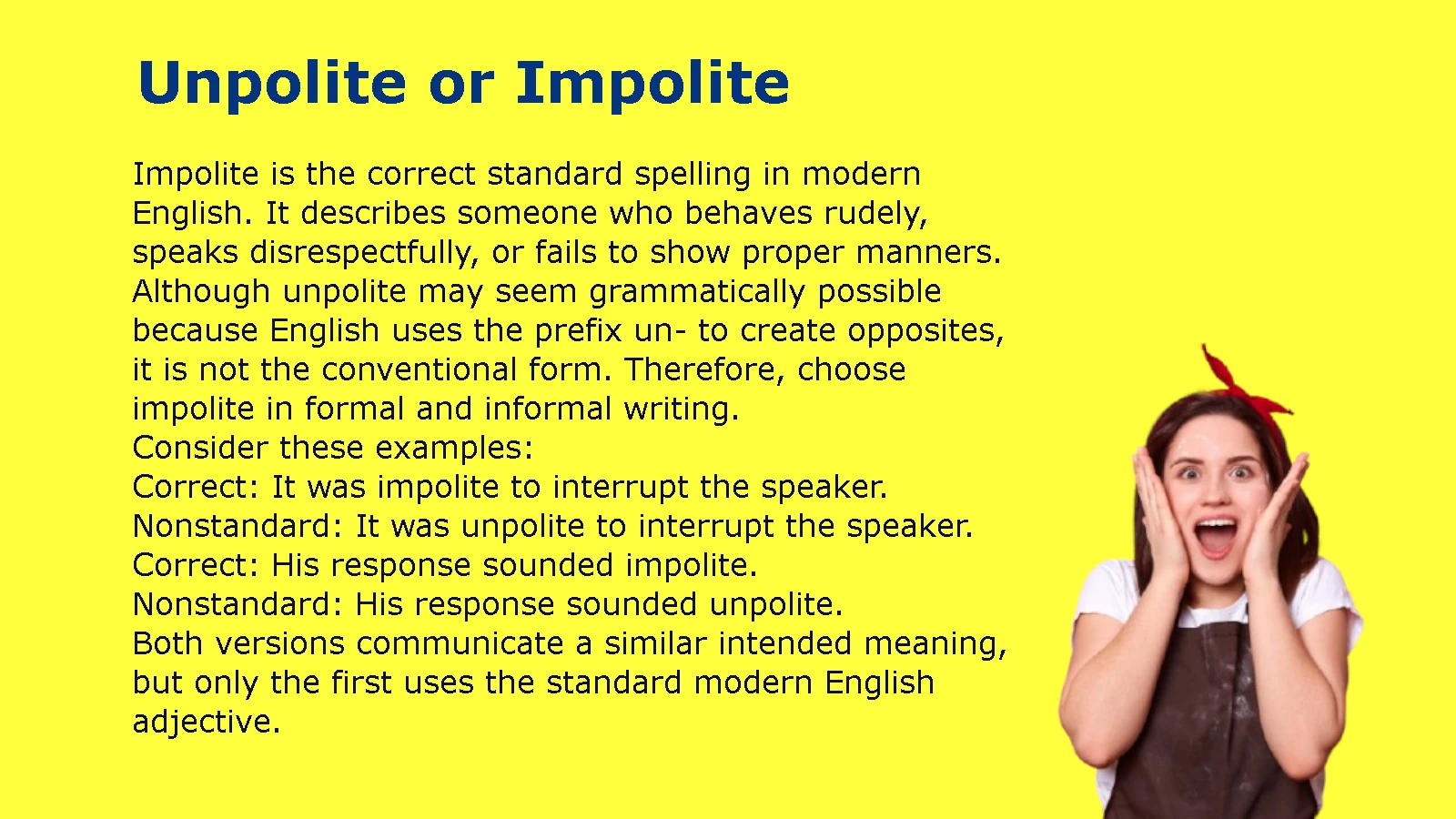
Impolite is the correct standard spelling in modern English. It describes someone who behaves rudely, speaks disrespectfully, or fails to show proper manners. Although unpolite may seem grammatically possible because English uses the prefix un- to create opposites, it is not the conventional form. Therefore, choose impolite in formal and informal writing.
Consider these examples:
- Correct: It was impolite to interrupt the speaker.
- Nonstandard: It was unpolite to interrupt the speaker.
- Correct: His response sounded impolite.
- Nonstandard: His response sounded unpolite.
Both versions communicate a similar intended meaning, but only the first uses the standard modern English adjective.
The distinction matters because English does not form every negative adjective by simply adding un-. Some words use other prefixes, such as im-, in-, ir-, and dis-.
For example:
| Positive word | Correct negative form |
| Polite | Impolite |
| Possible | Impossible |
| Patient | Impatient |
| Mature | Immature |
| Responsible | Irresponsible |
| Honest | Dishonest |
| Complete | Incomplete |
The correct negative form depends on established English usage and word history, not simply on which prefix seems logical.
Is Unpolite a Correct Word?
Unpolite is not the standard modern English spelling of the opposite of polite. Although readers can understand what someone intends by using it, established English usage favors impolite. Writers should avoid unpolite in professional documents, school assignments, business communication, and other polished writing.
This distinction involves two separate ideas:
- Understandable formation: A reader can recognize that unpolite probably means not polite.
- Standard usage: English speakers conventionally use impolite for this meaning.
A word can look grammatically reasonable without becoming an accepted everyday expression. English contains many examples of this pattern.
For instance, someone might construct an unfamiliar word by attaching un- to an adjective. However, that construction does not automatically make the result a conventional English word.
If you want to describe someone’s poor manners, use impolite.
Example:
- Avoid: The waiter was unpolite to the customers.
- Prefer: The waiter was impolite to the customers.
The second sentence sounds natural and follows standard English conventions.
Why Is Impolite Correct?
The word impolite combines the negative prefix im- with the adjective polite. The prefix im- expresses negation, giving the word the opposite meaning of polite.
The prefix im- is a form of the negative prefix in-. English often changes the form of this prefix to make pronunciation easier before particular consonants.
For example:
| Prefix | Word | Meaning |
| im- | Impolite | Not polite |
| im- | Impossible | Not possible |
| im- | Immature | Not mature |
| im- | Impatient | Not patient |
| in- | Incomplete | Not complete |
| in- | Inaccurate | Not accurate |
| ir- | Irregular | Not regular |
| il- | Illogical | Not logical |
Notice that the negative prefix changes according to the word that follows it.
The spelling impolite follows an established English word pattern. The letter m appears before the p in polite, creating a natural combination.
This is why impolite is the accepted form rather than unpolite.
Unpolite vs. Impolite: Quick Comparison
The following table highlights the differences between these two forms.
| Feature | Unpolite | Impolite |
| Standard spelling | No | Yes |
| Intended meaning | Not polite | Rude or discourteous |
| Modern usage | Rare or nonstandard | Common and accepted |
| Appropriate for formal writing | No | Yes |
| Recommended alternative | Impolite | Impolite |
Remember: When you need the opposite of polite, choose impolite. It is the established form that readers expect in standard English.
Impolite Meaning and Definition
Impolite means behaving or speaking without proper manners, courtesy, or consideration for other people. An impolite person may interrupt conversations, make disrespectful comments, ignore social expectations, or communicate in an unnecessarily harsh manner. The word describes behavior that fails to show the respect and consideration normally expected in a particular situation.
Impolite is an adjective, meaning it describes a person, action, comment, response, or behavior.
For example:
- She received an impolite reply.
- His behavior during the meeting was impolite.
- It is impolite to interrupt someone repeatedly.
- The customer complained about the impolite service.
The word does not always describe someone as a permanently rude person. Sometimes, an individual behaves impolitely in one situation without having a generally disrespectful personality.
For example, a normally considerate employee might give an impolite response after misunderstanding a colleague. The behavior was inappropriate, but that single incident does not necessarily define the employee’s character.
What Does Impolite Mean in Simple Words?
In simple English, impolite means not showing good manners. It describes actions or words that may make another person feel ignored, disrespected, embarrassed, or uncomfortable.
Think about a conversation between two friends.
One friend explains an important problem while the other repeatedly interrupts, laughs, and refuses to listen. That behavior is impolite because it shows little consideration for the speaker.
Here are some everyday examples:
- Talking over someone who is speaking.
- Making fun of another person’s appearance.
- Ignoring someone who greets you.
- Using insulting language during a disagreement.
- Making unnecessary negative comments.
- Refusing to acknowledge someone’s contribution.
However, politeness depends partly on social expectations. A behavior considered impolite in one setting may seem perfectly normal in another.
For instance, speaking loudly may be acceptable at a sporting event but inappropriate during a quiet business meeting.
The important point is that impolite behavior generally involves a lack of courtesy or consideration for others.
What Does Not Polite Mean?
Not polite means lacking politeness or failing to behave in a courteous manner. It communicates nearly the same basic idea as impolite, but the two expressions can differ slightly in tone, emphasis, and sentence structure.
Not polite is a phrase containing the adverb not and the adjective polite. Impolite is a single adjective formed with the negative prefix im-.
Compare these sentences:
- His response was not polite.
- His response was impolite.
Both sentences describe a response that lacks courtesy.
However, not polite can sound more conversational or deliberately emphatic. Impolite is generally more concise and direct.
Consider another comparison:
| Expression | Example | Explanation |
| Impolite | His comment was impolite. | Directly describes the comment as rude. |
| Not polite | That was not a polite thing to say. | Emphasizes that the comment failed to meet expectations. |
| Not very polite | She was not very polite to the waiter. | Softens the criticism slightly. |
| Not particularly polite | His email was not particularly polite. | Offers a more restrained criticism. |
When should you use each expression?
Use impolite when you want a concise description of rude behavior.
Use not polite when you want to emphasize the negative quality of a particular action or make your criticism sound less direct.
For professional communication, either expression can work, depending on the sentence.
Examples of Impolite Behavior in Everyday Life
Impolite behavior can occur in almost any social environment. It may involve something as simple as interrupting someone or something more serious, such as deliberately humiliating another person.
Here are common situations that demonstrate the meaning of impolite:
1. Interrupting conversations
Someone repeatedly interrupts a colleague before they finish explaining an idea.
This behavior is impolite because it prevents the other person from expressing their thoughts.
2. Ignoring greetings
A neighbor says hello, but the other person deliberately looks away without acknowledging the greeting.
Although people do not need to engage in every conversation, intentionally ignoring a friendly greeting may appear discourteous.
3. Making personal comments
A person criticizes someone’s appearance, financial situation, or personal choices without being invited to comment.
Such remarks can make the conversation uncomfortable.
4. Using an insulting tone
A customer speaks aggressively to a service employee who is trying to solve a problem.
The customer can express dissatisfaction without being disrespectful.
5. Using a phone during conversations
Someone repeatedly checks messages while another person shares something important.
This behavior may communicate a lack of interest or consideration.
These examples demonstrate that impoliteness is not limited to offensive words. Actions, gestures, tone, and timing can also communicate disrespect.
Impolite Synonyms: What Are Other Words for Impolite?
Common impolite synonyms include rude, discourteous, disrespectful, ill-mannered, inconsiderate, uncivil, and bad-mannered. Although these words share a connection with poor manners, they do not always have identical meanings. The best alternative depends on whether you want to describe someone’s behavior, attitude, language, or lack of consideration.
Choosing the right synonym can make your writing more precise.
For example, rude describes generally offensive behavior, while inconsiderate emphasizes a failure to think about other people’s feelings.
Common Synonyms for Impolite
Here are useful alternatives with their meanings and original sentence examples.
| Synonym | Meaning | Example |
| Rude | Showing poor manners or disrespect | His response was rude. |
| Discourteous | Lacking courtesy or consideration | It was discourteous to interrupt her. |
| Disrespectful | Showing insufficient respect | His disrespectful comment upset the team. |
| Ill-mannered | Having poor social manners | The ill-mannered guest interrupted everyone. |
| Inconsiderate | Ignoring other people’s feelings or needs | Leaving without saying goodbye was inconsiderate. |
| Uncivil | Lacking courtesy or politeness | His uncivil remarks ended the discussion. |
| Offensive | Causing hurt, anger, or insult | That joke was offensive. |
| Bad-mannered | Behaving without proper manners | The bad-mannered child shouted at the waiter. |
| Tactless | Lacking sensitivity when speaking | Her tactless question embarrassed him. |
| Uncourteous | Failing to show courtesy | The employee’s response seemed uncourteous. |
These words offer different levels of criticism.
For example, calling someone tactless suggests that the person lacks sensitivity or judgment. Calling someone offensive suggests that their words or actions caused significant discomfort or insult.
You should select synonyms based on the specific behavior rather than replacing impolite with the same alternative in every sentence.
Formal and Professional Synonyms for Impolite
In professional writing, some alternatives sound more measured and appropriate than the word rude.
Consider these options:
Discourteous: Use this word when someone fails to demonstrate basic courtesy.
Example: The manager considered interrupting the client discourteous.
Unprofessional: Use this word when someone’s behavior violates workplace expectations.
Example: Sending an insulting email to a colleague is unprofessional.
Disrespectful: Choose this word when an action shows insufficient respect for another person.
Example: Making personal remarks during a presentation is disrespectful.
Inappropriate: Use this alternative when behavior does not fit a particular situation.
Example: His joke was inappropriate for a formal business meeting.
Uncivil: This word describes behavior that lacks basic courtesy, especially during disagreements or discussions.
Example: The debate became uncivil after both participants started making personal attacks.
Here is a quick guide:
| Situation | Recommended word |
| Workplace misconduct | Unprofessional |
| Lack of basic courtesy | Discourteous |
| Insulting another person | Disrespectful |
| Behavior unsuitable for a setting | Inappropriate |
| Aggressive or discourteous discussion | Uncivil |
These alternatives help you communicate criticism without making every sentence sound unnecessarily harsh.
Mild and Strong Alternatives to Impolite
Not every impolite action deserves the same level of criticism.
Someone forgetting to say thank you is different from someone deliberately insulting a colleague. Your word choice should reflect the seriousness of the behavior.
Mild alternatives:
- Unfriendly
- Tactless
- Inconsiderate
- Thoughtless
- Unpleasant
Moderate alternatives:
- Rude
- Discourteous
- Ill-mannered
- Disrespectful
- Uncivil
Strong alternatives:
- Offensive
- Insulting
- Abusive
- Contemptuous
- Degrading
For example:
- Mild: His comment was a little tactless.
- Moderate: His response was discourteous.
- Strong: His remarks were deeply insulting.
This distinction is especially useful in business emails, workplace reports, academic writing, and situations where you want to criticize an action without exaggerating it.
Impolite vs. Rude vs. Disrespectful
Impolite, rude, and disrespectful share similar meanings, but each word emphasizes a different aspect of behavior.
Example: It is impolite to speak while someone else is presenting.
Rude often describes behavior that feels unpleasant, offensive, or unnecessarily harsh.
Example: The customer was rude to the receptionist.
Disrespectful emphasizes a lack of respect toward another person, their position, feelings, or beliefs.
Example: It was disrespectful to laugh at his presentation.
Compare their meanings:
| Word | Main emphasis | Example situation |
| Impolite | Poor manners | Interrupting a conversation |
| Rude | Offensive or unpleasant behavior | Insulting a stranger |
| Disrespectful | Lack of respect | Mocking someone’s beliefs |
| Discourteous | Lack of courtesy | Ignoring a formal greeting |
| Inconsiderate | Lack of thought for others | Making excessive noise late at night |
The words can overlap. However, understanding their differences helps you choose a more accurate description.
Impolite Pronunciation
The word impolite is pronounced /ˌɪm.pəˈlaɪt/. It contains three syllables, with the primary stress on the final syllable. English speakers pronounce the opening sound like the beginning of important, while the ending sounds like the word light without the initial /l/ sound.
How Many Syllables Are in Impolite?
Impolite has three syllables: im-po-lite.
Breaking the word into syllables makes pronunciation easier, particularly for English learners.
| Syllable | Sound | Explanation |
| First | im | Short opening sound |
| Second | po | Unstressed middle syllable |
| Third | lite | Main stressed syllable |
The final syllable receives the strongest emphasis.
This stress pattern is important because English speakers use changes in syllable stress to distinguish natural pronunciation from awkward or incorrect speech.
How to Pronounce Impolite Correctly
Follow these steps to pronounce impolite naturally:
- Begin with the short opening sound /ɪm/.
- Move into the softer middle syllable /pə/.
- Finish with /ˈlaɪt/, giving the final syllable the strongest stress.
IPA: /ˌɪm.pəˈlaɪt/
A common mistake is placing too much emphasis on the first syllable. The final syllable should carry the primary stress.
Practice using these sentences:
- It is impolite to interrupt.
- His behavior was impolite.
- Please don’t be impolite to the guests.
Reading these examples aloud helps you understand how the word sounds in ordinary conversation.
Impolite Examples in Sentences
The best way to understand impolite is to examine how it works in different contexts. The word commonly describes people, comments, actions, responses, and behavior that lack proper courtesy. It functions as an adjective and usually appears before a noun or after a linking verb.
Here are examples from everyday English.
Simple Sentences With Impolite
- It is impolite to interrupt someone during an important conversation.
- His impolite response surprised everyone in the room.
- She apologized for her impolite behavior.
- Making personal comments about strangers can be impolite.
- The customer complained about the impolite service.
- It would be impolite to leave without thanking your host.
- His tone sounded unnecessarily impolite.
- The teacher explained why the student’s remarks were impolite.
- Speaking loudly during a quiet presentation is impolite.
- Ignoring someone’s question can seem impolite.
- She considered his comment impolite and inappropriate.
- It is impolite to use insulting language during a disagreement.
Notice how impolite appears in different grammatical positions.
For example:
- Before a noun: An impolite remark.
- After a linking verb: His comment was impolite.
- After a linking verb describing behavior: The guests seemed impolite.
Impolite in Professional and Workplace Situations
Professional environments require communication that demonstrates respect, cooperation, and consideration.
An employee can disagree with a manager, question a decision, or express dissatisfaction without behaving impolitely.
Here are examples of workplace situations:
| Situation | Impolite behavior | Better approach |
| Team meeting | Interrupting colleagues | Wait for them to finish speaking. |
| Email communication | Using insulting language | Explain concerns professionally. |
| Workplace disagreement | Mocking another person’s ideas | Offer constructive criticism. |
| Customer service | Speaking aggressively | Address the complaint calmly. |
| Performance feedback | Embarrassing an employee publicly | Discuss concerns privately. |
Example of a workplace case study:
Imagine that a marketing team is discussing a new advertising campaign. One employee suggests a strategy that another colleague considers ineffective.
The second employee responds, “That’s a inconsiderate idea. You clearly don’t understand marketing.”
This response is impolite because it attacks the colleague rather than evaluating the proposal.
A more professional response would be:
“I understand your suggestion, but I think we should consider a different approach because the current data points in another direction.”
Both responses communicate disagreement. However, the second demonstrates courtesy and keeps the discussion focused on the work.
The lesson is simple: Disagreement is not impolite, but the way you express disagreement can be.
Impolite in Social Situations
Social interactions involve expectations about courtesy, respect, and communication.
People may consider certain actions impolite because they interrupt conversations, ignore others, or create unnecessary discomfort.
Examples include:
- It is impolite to interrupt someone who is sharing an important story.
- Leaving a dinner party without thanking the host may seem impolite.
- Making jokes about someone’s personal problems is impolite.
- Checking your phone repeatedly while someone speaks can appear impolite.
- Asking intrusive questions about someone’s finances may be considered impolite.
- Speaking disrespectfully to service workers is impolite.
However, social etiquette can vary between cultures and communities.
For example, some cultures place particular importance on formal greetings, while others prefer a more relaxed communication style.
The best approach is to pay attention to the expectations of the people and environment around you.
Impolite vs. Not Polite in Example Sentences
Both expressions communicate a lack of politeness, but they can create slightly different effects.
| Impolite | Not polite |
| His reply was impolite. | His reply was not polite. |
| It is impolite to interrupt. | It is not polite to interrupt. |
| Her behavior seemed impolite. | Her behavior did not seem polite. |
| That was an impolite question. | That was not a polite question. |
Which one should you choose?
Use impolite when you want a concise adjective.
Use not polite when you want to emphasize the negative meaning or create a more conversational sentence.
Both are grammatically acceptable in their appropriate sentence structures.
What Does Impolitely Mean?
Impolitely is the adverb form of impolite. It describes an action performed without proper manners, courtesy, or consideration. When someone speaks impolitely, they communicate in a rude or discourteous way. The word explains how an action happens rather than describing the person or thing itself.
For example:
- He spoke impolitely to his manager.
- She impolitely interrupted the conversation.
- The customer responded impolitely to the receptionist.
In each sentence, impolitely modifies a verb and explains how someone performed an action.
Impolite vs. Impolitely
The main difference between impolite and impolitely is their grammatical function.
Impolite is an adjective. It describes a person, action, object, or situation.
Impolitely is an adverb. It describes how someone performs an action.
Compare these examples:
| Impolite (adjective) | Impolitely (adverb) |
| He is impolite. | He speaks impolitely. |
| That was an impolite remark. | She responded impolitely. |
| His behavior was impolite. | He behaved impolitely. |
| The customer was impolite. | The customer complained impolitely. |
The difference becomes easier to understand when you identify the word being described.
In the sentence “She gave an impolite answer,” the adjective impolite describes the noun answer.
In “She answered impolitely,” the adverb impolitely describes the verb answered.
Grammar tip: Many English adverbs form by adding -ly to adjectives. For example:
- Polite → Politely
- Impolite → Impolitely
- Careful → Carefully
- Respectful → Respectfully
- Considerate → Considerately
Impolitely Examples in Sentences
Here are original examples showing how to use impolitely correctly:
- He spoke impolitely to the receptionist.
- The customer impolitely rejected the employee’s explanation.
- She impolitely interrupted her colleague during the presentation.
- The guest responded impolitely when the host offered help.
- He impolitely dismissed the suggestion without considering it.
- The student answered the teacher impolitely.
- They impolitely criticized the speaker’s appearance.
- She impolitely ended the conversation before anyone could respond.
These examples show that impolitely generally modifies action verbs such as spoke, rejected, interrupted, responded, dismissed, and criticized.
Other Grammatical Forms of Impolite
The word family includes several related forms. Understanding them helps you avoid common grammatical mistakes.
| Word | Part of speech | Meaning | Example |
| Polite | Adjective | Showing good manners | She is polite to everyone. |
| Impolite | Adjective | Showing poor manners | His reply was impolite. |
| Politely | Adverb | In a courteous manner | She politely declined the offer. |
| Impolitely | Adverb | In a rude manner | He answered impolitely. |
| Politeness | Noun | The quality of being polite | Her politeness impressed the guests. |
| Impoliteness | Noun | The quality or behavior of being impolite | His impoliteness caused tension. |
These forms serve different purposes.
For example, use impoliteness when discussing the general quality of rude behavior.
Example: The manager addressed the impoliteness displayed during the meeting.
Use impolitely when describing a specific action.
Example: The employee spoke impolitely to a customer.
Understanding the word family makes your English more accurate and varied.
Impolite in Spanish: Meaning and Translation
The English word impolite has several Spanish translations, including grosero, descortés, and maleducado. Each alternative describes a lack of courtesy or good manners, but the best choice depends on the context, tone, and regional usage. These Spanish words can describe rude comments, disrespectful behavior, or someone who does not follow social expectations.
Here is a quick comparison:
| Spanish word | English meaning | Common context |
| Grosero | Rude or coarse | Offensive language or behavior |
| Descortés | Discourteous or impolite | Lack of courtesy |
| Maleducado | Bad-mannered | Poor manners or upbringing |
| Poco educado | Not very well-mannered | Mild criticism |
| Insolente | Insolent or disrespectful | Defiant or openly disrespectful behavior |
Impolite in Spanish With Examples
Here are practical examples of how to translate impolite into Spanish.
Example 1:
English: He is an impolite person.
Spanish: Es una persona grosera.
Example 2:
English: It was impolite to interrupt.
Spanish: Fue descortés interrumpir.
Example 3:
English: Don’t be impolite.
Spanish: No seas maleducado.
Example 4:
English: Her response was impolite.
Spanish: Su respuesta fue descortés.
Example 5:
English: That was an impolite comment.
Spanish: Ese fue un comentario grosero.
The translations may change depending on the intended level of criticism.
Difference Between Grosero, Descortés, and Maleducado
Although these words can translate impolite, they carry slightly different meanings.
Grosero often describes rude, offensive, or coarse language and behavior.
Example: His comments were rude.
Spanish: Sus comentarios fueron groseros.
Descortés focuses more directly on a lack of courtesy or consideration.
Example: It was discourteous to leave without saying goodbye.
Spanish: Fue descortés irse sin despedirse.
Maleducado often describes someone who demonstrates poor manners or behaves without proper social consideration.
Example: The child was badly behaved.
Spanish: El niño fue maleducado.
Choosing the right translation depends on what you want to communicate. For a general lack of courtesy, descortés is often a suitable choice. For more openly rude behavior, grosero may be more appropriate.
How to Use Impolite Correctly in Everyday English
Use impolite when you want to describe a person, action, comment, or behavior that does not demonstrate proper manners. The adjective works in casual conversations, formal writing, workplace communication, and academic contexts. However, the surrounding sentence should make the specific behavior clear.
Here are practical ways to use the word naturally.
When Should You Use Impolite?
You can use impolite in several situations.
1. Describing someone’s behavior
Example: His behavior toward the restaurant staff was impolite.
This sentence identifies a lack of courtesy without describing the person as permanently rude.
2. Discussing inappropriate communication
Example: Sending an impolite message can damage a professional relationship.
Here, the word describes the nature of the message.
3. Giving constructive feedback
Example: Interrupting your colleagues may come across as impolite.
This phrasing communicates a concern without directly attacking someone’s personality.
4. Explaining social expectations
Example: It is generally considered impolite to speak loudly during a formal presentation.
This sentence explains a social rule.
5. Describing a negative interaction
Example: The receptionist apologized after receiving an impolite response from a visitor.
The word communicates the tone of the interaction.
Common Mistakes to Avoid
English learners sometimes confuse impolite with other forms or assume that any negative prefix can create the correct opposite of a word.
Avoid these common mistakes:
| Incorrect or problematic usage | Better usage | Explanation |
| He is unpolite. | He is impolite. | Impolite is the standard form. |
| She spoke impolite. | She spoke impolitely. | Use the adverb to modify spoke. |
| His impolitely was obvious. | His impoliteness was obvious. | Use the noun form. |
| He behaved impolite. | He behaved impolitely. | The adverb describes how he behaved. |
| She gave an impolitely answer. | She gave an impolite answer. | The adjective describes the noun answer. |
One useful way to avoid these errors is to identify the grammatical role of the word.
Ask yourself:
- Am I describing a person or thing? Use impolite.
- Am I describing how someone performs an action? Use impolitely.
- Am I referring to the general quality of rude behavior? Use impoliteness.
This simple check will help you choose the correct form.
Better Ways to Say Someone Is Impolite
Sometimes, repeating impolite can make your writing sound limited. Using suitable alternatives helps you communicate more accurately.
Consider these expressions:
| Instead of saying | You could say |
| You are impolite. | Your behavior is discourteous. |
| That was impolite. | That comment was inappropriate. |
| He is impolite to others. | He often behaves disrespectfully. |
| Her response was impolite. | Her response sounded unnecessarily harsh. |
| That person is impolite. | That person seems inconsiderate. |
| Your message was impolite. | Your message came across as unprofessional. |
You can also make criticism sound more constructive.
For example:
Instead of saying, “You were rude during the meeting,” try:
“I felt that some of your comments came across as disrespectful during the meeting.”
The second sentence identifies the problem without turning the discussion into a personal attack.
This approach is particularly useful in professional emails, performance reviews, customer service, and difficult conversations.
Final Verdict: Unpolite or Impolite?
Impolite is the correct standard English spelling, while unpolite is a rare or nonstandard formation that writers should generally avoid. If you want to describe someone who lacks good manners, behaves rudely, or communicates without courtesy, impolite is the appropriate word.
Remember these important distinctions:
- Impolite: An adjective meaning rude or lacking manners.
- Impolitely: An adverb describing a rude manner of speaking or behaving.
- Impoliteness: A noun referring to the quality or behavior of being impolite.
- Not polite: A phrase that communicates a similar meaning using separate words.
- Unpolite: A nonstandard alternative that should generally be replaced with impolite.
You can also use synonyms such as rude, discourteous, disrespectful, inconsiderate, and ill-mannered when the context calls for a different expression.
The easiest way to remember the correct spelling is to associate impolite with other established negative-prefix words, such as impossible, impatient, and immature.
The next time you write a sentence about poor manners, choose impolite instead of unpolite. This small spelling decision will make your English clearer, more natural, and more consistent with standard usage.