Unperfect vs imperfect: Imperfect is the correct and widely accepted word in modern English when describing something that is not perfect, has flaws, or falls short of an ideal standard. Although unperfect exists as an uncommon and largely outdated alternative, imperfect is the natural choice in everyday, academic, and professional writing.
Both words relate to the idea of lacking perfection, but they do not have the same place in contemporary English. Understanding their spelling, meaning, grammatical function, and usage will help you choose the right word. Related expressions such as imperfection, imperfections, perfectly imperfect, and imperfectly perfect also help explain how English expresses the idea that something can have flaws and still be valuable.
| Question | Answer |
| Is it unperfect or imperfect? | Imperfect is the standard and preferred modern English word. |
| Is unperfect a real word? | Yes. It is an uncommon, largely historical alternative. |
| What is the difference between imperfect and unperfect? | Both relate to a lack of perfection, but imperfect is much more established in modern usage. |
| What is the noun form of imperfect? | Imperfection; its plural form is imperfections. |
| What does perfectly imperfect mean? | It describes something whose flaws make it special, authentic, or appealing. |
Unperfect or Imperfect: Which Is Correct?
Imperfect is the correct choice in standard contemporary English. It describes something that is not flawless, has defects, or does not meet an expected standard. Unperfect is also an attested English word, but it is rare and generally sounds old-fashioned or unusual. In ordinary communication, choose imperfect.
Imperfect Is the Standard English Word
The adjective imperfect describes a person, object, situation, process, or result that does not meet the standard of perfection.
It can refer to physical flaws, incomplete work, grammatical structures, personal characteristics, or situations that fall short of an ideal.
For example:
- The handmade vase has an imperfect shape.
- Nobody expects a perfect performance from a beginner.
- Her first draft was imperfect, but the final version was excellent.
- Every relationship has imperfect moments.
- The painting contains small imperfections that make it unique.
Notice that imperfect does not always suggest something is bad. A handmade product can have an imperfect finish and still be attractive. A student can produce imperfect work while making excellent progress.
The word gives you a way to describe something honestly without automatically suggesting that it has no value.
Is Unperfect a Real Word?
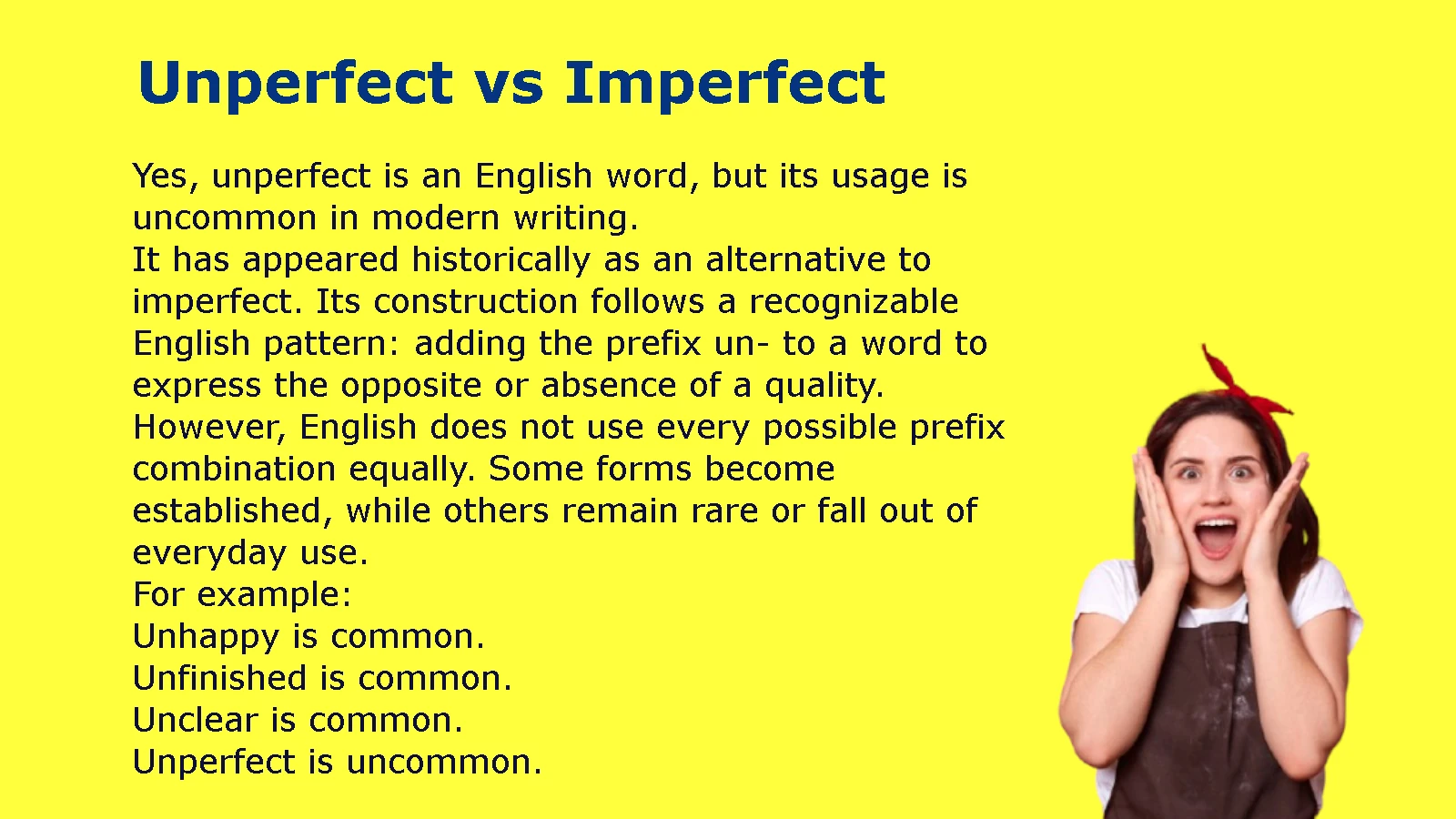
Yes, unperfect is an English word, but its usage is uncommon in modern writing.
It has appeared historically as an alternative to imperfect. Its construction follows a recognizable English pattern: adding the prefix un- to a word to express the opposite or absence of a quality.
However, English does not use every possible prefix combination equally. Some forms become established, while others remain rare or fall out of everyday use.
For example:
- Unhappy is common.
- Unfinished is common.
- Unclear is common.
- Unperfect is uncommon.
Although readers may understand what unperfect means, they generally expect imperfect in ordinary sentences.
Consider these examples:
Unusual: The sculpture is unperfect.
Natural: The sculpture is imperfect.
The second sentence sounds more familiar and follows established modern usage.
Why Do People Confuse Unperfect and Imperfect?
The confusion comes from their similar meanings and the way English forms negative adjectives.
The prefix un- often changes a word into its opposite. Meanwhile, im- is a variant of the negative prefix in-, which also expresses negation.
For example:
| Positive word | Negative form |
| Possible | Impossible |
| Patient | Impatient |
| Mature | Immature |
| Perfect | Imperfect |
| Happy | Unhappy |
| Finished | Unfinished |
Because both un- and im- can express the opposite of a quality, someone learning English might assume that unperfect and imperfect are equally common.
However, spelling and vocabulary depend on established usage, not just logical word formation. Imperfect is the conventional form that English speakers recognize and use.
Unperfect vs Imperfect: Understanding the Difference
Imperfect is the established adjective for describing something that lacks perfection, while unperfect is a rare alternative with a similar basic meaning. The main difference involves modern acceptance, frequency, and natural usage rather than a major difference in definition.
Imperfect Meaning and Definition
The word imperfect means not perfect, not complete, or containing flaws.
It describes something that falls short of an ideal condition. The word can apply to physical objects, human behavior, artistic work, systems, and even abstract ideas.
Here are several ways to understand its meaning:
1. Having flaws or defects
An object is imperfect when it contains physical marks, irregularities, or defects.
Example: The glass has an imperfect surface because the manufacturing process left small marks.
2. Not meeting an ideal standard
A result can be imperfect even when it is acceptable or useful.
Example: The team delivered an imperfect solution, but it addressed the client’s main concerns.
3. Incomplete or unfinished
In certain contexts, imperfect can describe something that has not reached its intended or complete state.
Example: The historical record provides an imperfect account of the event.
4. Having human limitations
People use imperfect to describe ordinary human weaknesses, mistakes, and shortcomings.
Example: We are all imperfect, and learning from mistakes helps us grow.
These meanings share one central idea: something does not fully meet a standard of perfection.
Unperfect Meaning and Definition
Unperfect refers to something that is not perfect or lacks perfection. However, it is not the usual adjective in contemporary English.
You may encounter it in older texts, historical discussions, or deliberate creative writing. Its meaning is generally understandable because the prefix un- communicates negation.
For example:
- The old manuscript describes an unperfect arrangement.
- The writer uses unperfect to create an unusual historical tone.
These examples illustrate possible usage rather than recommended everyday expressions.
If you are writing a business email, school assignment, article, or professional document, imperfect is the better choice.
Key Differences Between Imperfect and Unperfect
The following comparison highlights the most useful distinctions.
| Feature | Imperfect | Unperfect |
| Part of speech | Adjective | Adjective |
| Basic meaning | Not perfect | Not perfect |
| Modern usage | Common | Rare |
| Standard writing | Preferred | Generally avoided |
| Everyday conversations | Natural | Unusual |
| Academic writing | Appropriate | Usually unsuitable |
| Creative writing | Appropriate | Possible for stylistic effect |
| Recommendation | Use it | Avoid it in ordinary writing |
The important distinction is not that one word means something completely different. Both relate to a lack of perfection.
The difference lies in how English speakers have established their vocabulary.
Imperfect is the conventional word. Unperfect is an uncommon alternative.
Which Word Should You Use in Everyday Writing?
Choose imperfect whenever you want to describe something that is not flawless.
It works in almost every situation where you might consider using unperfect.
For example:
- In schoolwork: The answer is imperfect but demonstrates a good understanding of the topic.
- In business: Our current process is imperfect, so we are introducing improvements.
- In creative writing: The character’s imperfect personality makes the story more realistic.
- In everyday conversation: My handwriting is imperfect, but I can still read it.
- In personal development: Accepting your imperfect qualities can help you become more confident.
You should generally avoid unperfect unless you have a specific historical, literary, or stylistic reason to use it.
Unperfect vs Imperfect Examples in Sentences
Imperfect appears naturally in everyday English when describing mistakes, flaws, incomplete results, or human limitations. Although unperfect can communicate a similar idea, it usually sounds unusual to modern readers. Comparing the two forms in sentences makes the difference easier to recognize.
Examples of Imperfect in Everyday English
Here are ten original examples showing how to use imperfect correctly.
- The painting is imperfect, but its unusual details make it beautiful.
- Nobody expects an imperfect student to understand every lesson immediately.
- Our first business plan was imperfect, so we revised it before presenting it.
- The handmade table has an imperfect surface that gives it character.
- She accepted her imperfect appearance instead of comparing herself with others.
- The research contains imperfect information because some historical records are missing.
- His imperfect pronunciation did not prevent people from understanding him.
- Every relationship has imperfect moments, but communication can help resolve disagreements.
- The machine produced an imperfect result during its initial testing.
- An imperfect beginning does not mean you cannot achieve something meaningful.
These examples demonstrate that imperfect works with both concrete and abstract nouns.
You can describe a physical object, a person’s abilities, a business process, or an emotional experience using the same adjective.
Examples of Unperfect and Its Limited Usage
Unperfect is much less common, so you should be careful when using it.
The following examples demonstrate its possible meaning in historical or deliberately unusual writing:
- The author described the unfinished structure as an unperfect creation.
- The old passage referred to an unperfect system of government.
- The poet used unperfect to describe a world that lacked harmony.
In contemporary writing, these sentences would sound more natural with imperfect.
For example:
Less natural: The author described the unfinished structure as an unperfect creation.
More natural: The author described the unfinished structure as an imperfect creation.
The second version communicates the idea without distracting the reader with an unusual word choice.
Correct and Incorrect Usage Compared
| Sentence | Assessment | Explanation |
| The design is imperfect. | Correct | Standard modern English. |
| Her performance was imperfect. | Correct | Natural adjective usage. |
| Everyone has imperfections. | Correct | Correct plural noun. |
| The result is unperfect. | Unusual | Imperfect is preferred. |
| His work contains an imperfection. | Correct | Correct singular noun. |
| She completed the task imperfectly. | Correct | Correct adverb form. |
| Her work is imperfections. | Incorrect | The adjective or a different sentence structure is needed. |
A useful editing technique is to replace unperfect with imperfect whenever you encounter it in ordinary writing. Then check whether the sentence still communicates the intended meaning.
In most situations, it will.
What Does Imperfect Mean?
Imperfect means having one or more flaws, limitations, or qualities that prevent something from being completely perfect. It does not necessarily mean useless, unsuccessful, or unacceptable. The word simply indicates that something falls short of an ideal standard.
Imperfect as an Adjective
An adjective describes or provides additional information about a noun. Imperfect functions as an adjective because it tells readers about the condition or quality of something.
Examples:
- An imperfect solution
- An imperfect drawing
- An imperfect relationship
- An imperfect memory
- An imperfect system
- An imperfect person
- An imperfect result
In each phrase, imperfect describes the noun that follows it.
You can also use it after linking verbs such as is, are, was, and seems.
Examples:
- The solution is imperfect.
- These measurements are imperfect.
- Her memory seems imperfect.
- The original design was imperfect.
The adjective can appear in different positions without changing its fundamental meaning.
Imperfect Meaning in Everyday Conversations
In everyday conversations, imperfect often describes something that has flaws but remains acceptable, meaningful, or valuable.
For instance, someone might say:
“My English is imperfect, but I can communicate confidently.”
This sentence acknowledges a limitation without suggesting that the speaker cannot communicate.
Another person might say:
“Our plans are imperfect, but we can improve them.”
Here, imperfect suggests that the plans need adjustments rather than complete replacement.
People also use the word when discussing personal growth.
Examples include:
- I am imperfect, and I am still learning.
- Nobody has an entirely perfect life.
- An imperfect decision can still teach you something valuable.
The word is useful because it separates having flaws from having no worth.
Imperfect Meaning in Art, Relationships, and Personal Development
The meaning of imperfect becomes especially interesting when people use it beyond literal descriptions.
In art
An imperfect painting may contain irregular brushstrokes, uneven proportions, or unusual shapes. Those features can make the artwork feel personal and distinctive.
For example, a handmade ceramic bowl might have an uneven rim. Although it does not meet the standards of mass production, its irregular shape can make it more appealing.
In relationships
An imperfect relationship contains disagreements, misunderstandings, and differences between two people.
However, recognizing those imperfections can encourage realistic expectations.
For example, a couple may disagree about finances but still maintain a supportive relationship through communication and compromise.
In personal development
People use imperfect to acknowledge that personal growth does not require complete mastery.
A beginner learning photography may take poorly framed pictures. Those early mistakes provide experience that helps improve future work.
The key idea is that imperfection does not automatically eliminate value or potential.
Imperfect vs Flawed vs Incomplete
These three words have related meanings, but they are not always interchangeable.
| Word | Meaning | Example |
| Imperfect | Not completely perfect | The painting is imperfect. |
| Flawed | Containing a noticeable weakness or defect | The argument is flawed. |
| Incomplete | Missing something necessary or not finished | The application is incomplete. |
Imperfect is the broadest choice. It can describe almost anything that falls short of an ideal.
Flawed often emphasizes a specific weakness, defect, or problem.
Incomplete focuses on missing parts or unfinished work.
Consider a business proposal:
- An imperfect proposal may contain small weaknesses.
- A flawed proposal may contain a serious error in its reasoning.
- An incomplete proposal may be missing its financial projections.
Understanding these distinctions makes your writing more precise.
Imperfect and Imperfections: What’s the Difference?
Imperfect is an adjective that describes something lacking perfection, while imperfection is a noun referring to a specific flaw or defect. Imperfections is the plural form of imperfection and refers to multiple flaws. These words belong to the same word family but perform different grammatical functions.
Imperfect as an Adjective
Use imperfect when you want to describe a person, object, action, or situation.
Examples:
- The design is imperfect.
- She has an imperfect understanding of the subject.
- His first attempt was imperfect.
- The system produces imperfect results.
You can usually identify an adjective by asking what kind of thing the sentence describes.
For example:
“What kind of design?”
An imperfect design.
Here, imperfect describes the design.
Imperfection as a Singular Noun
Imperfection is the singular noun form. It refers to one flaw, defect, weakness, or limitation.
Examples:
- The artist noticed an imperfection in the painting.
- One imperfection does not ruin the entire product.
- The photographer removed a small imperfection from the image.
- Her confidence helped her accept every imperfection.
The word can refer to physical defects as well as abstract weaknesses.
For example, a small scratch on a phone screen is a physical imperfection. A mistake in an argument is a logical imperfection.
Imperfections as a Plural Noun
Imperfections is the plural form of imperfection.
Use it when discussing two or more flaws or limitations.
Examples:
- The antique table has several imperfections.
- Everyone has imperfections that make them human.
- The editor corrected the most noticeable imperfections in the article.
- Small imperfections can distinguish handmade products from factory-made items.
Remember the singular and plural distinction:
- One imperfection
- Two imperfections
- Several imperfections
- Many imperfections
Do not use imperfections when you need an adjective.
Incorrect: The painting is imperfections.
Correct: The painting is imperfect.
Also correct: The painting has several imperfections.
How to Use Imperfect and Imperfections in Sentences
The following table shows how the word family works in practical situations.
| Word | Part of speech | Meaning | Example |
| Imperfect | Adjective | Not perfect | The design is imperfect. |
| Imperfection | Singular noun | One flaw | The design has an imperfection. |
| Imperfections | Plural noun | Multiple flaws | The design has several imperfections. |
| Imperfectly | Adverb | In an imperfect manner | The design was assembled imperfectly. |
You can remember the difference through a simple rule:
- Use imperfect to describe something.
- Use imperfection to identify one flaw.
- Use imperfections to identify multiple flaws.
- Use imperfectly to describe how an action happens.
Perfectly Imperfect vs Imperfectly Perfect
Perfectly imperfect describes something that is appealing, meaningful, or valuable despite its flaws. Imperfectly perfect expresses a similar idea but places more emphasis on achieving a kind of perfection through an imperfect process or condition. Both are figurative expressions rather than strict technical descriptions.
What Does Perfectly Imperfect Mean?
The expression perfectly imperfect combines two apparently contradictory words.
Perfectly means completely or in an ideal manner. Imperfect means not flawless.
When people put these words together, they create a phrase that celebrates the beauty of something that does not meet conventional standards of perfection.
For example:
“Her perfectly imperfect home reflects her personality.”
This sentence suggests that the home has unusual decorations, mismatched furniture, or small flaws that make it personal and welcoming.
Other examples include:
- Our family is perfectly imperfect.
- The old photograph captures a perfectly imperfect moment.
- His perfectly imperfect personality makes him interesting.
- The handmade necklace is perfectly imperfect because every piece is unique.
- Their imperfect but honest relationship feels perfectly imperfect.
The expression is especially common in conversations about self-acceptance, relationships, creativity, and individuality.
Its message is simple: Something does not have to be flawless to be special.
What Does Imperfectly Perfect Mean?
Imperfectly perfect is another expression that combines opposite ideas.
It describes something that is perfect in a particular sense, even though it contains flaws or does not meet every conventional standard.
For example:
“The evening was imperfectly perfect.”
This could describe an evening with unexpected rain, a delayed dinner, and a few minor problems that still created a memorable experience.
Other examples:
- Their imperfectly perfect friendship has lasted for years.
- The photograph captured an imperfectly perfect moment.
- The small café has an imperfectly perfect atmosphere.
- The celebration was imperfectly perfect because everyone enjoyed themselves despite the delays.
The expression emphasizes the relationship between imperfections and an experience that still feels complete or meaningful.
Are Perfectly Imperfect and Imperfectly Perfect the Same?
They are closely related, but the emphasis can differ.
| Expression | Main emphasis | Example |
| Perfectly imperfect | Flaws are part of what makes something special. | Her perfectly imperfect artwork feels authentic. |
| Imperfectly perfect | Something achieves a special kind of perfection despite its flaws. | It was an imperfectly perfect evening. |
The distinction is subtle, and everyday speakers may use the phrases interchangeably.
Neither expression has a rigid technical definition. Context determines the intended meaning.
Perfectly imperfect is generally the more familiar expression in discussions about self-acceptance and individuality.
Examples of Perfectly Imperfect in Everyday English
Here are several ways to use the phrase naturally:
For personal growth:
“I am perfectly imperfect, and I do not need to meet everyone else’s expectations.”
For relationships:
“We have a perfectly imperfect relationship built on honesty, patience, and understanding.”
For creativity:
“The handmade artwork is perfectly imperfect, with every uneven line adding character.”
For family life:
“Our perfectly imperfect family does not always agree, but we support one another.”
For photography:
“The picture captures a perfectly imperfect moment that we will always remember.”
These examples show why the phrase works well in informal writing, captions, personal essays, and creative content.
When Should You Use Each Expression?
Choose the phrase that best communicates your intended message.
Use perfectly imperfect when you want to celebrate flaws as part of someone’s identity or an object’s charm.
Use imperfectly perfect when you want to describe an experience or outcome that feels special despite not going according to plan.
For example:
- Social media caption: Perfectly imperfect and proud of it.
- Personal essay: Learning to appreciate my perfectly imperfect self.
- Travel description: An imperfectly perfect weekend filled with unexpected adventures.
- Relationship message: We are perfectly imperfect, and that makes our connection real.
Avoid treating either expression as a replacement for the adjective imperfect in formal technical writing. They are figurative phrases with a more expressive tone.
Is Unperfect Ever Correct in English?
Unperfect can be considered a real English word because it has historical usage and an understandable meaning. However, it is not the established modern alternative to perfect. Writers generally use imperfect because it is more familiar, widely accepted, and appropriate across different writing styles.
Historical and Uncommon Uses of Unperfect
English vocabulary has developed through centuries of linguistic change.
Words that were once more familiar can become uncommon as other forms gain wider acceptance.
Unperfect belongs to this category of unusual vocabulary. It has appeared in older English usage, but it does not hold the same position as imperfect in contemporary communication.
This is not unusual.
English contains many words that remain recognizable but rarely appear in everyday writing.
For example, historical vocabulary may survive in literature, religious texts, older documents, and discussions of language development.
When reading older material, you may encounter unperfect without it necessarily being a spelling error.
However, recognizing a historical word does not mean you should use it in modern professional communication.
Why Imperfect Is Preferred in Modern English
There are several reasons why imperfect is the better choice.
1. Established vocabulary
English speakers commonly recognize imperfect and understand its meaning immediately.
2. Natural sentence construction
Phrases such as imperfect condition, imperfect result, and imperfect design sound natural.
3. Wider writing applications
The word works in academic, professional, creative, and informal contexts.
4. Related vocabulary
Imperfect connects naturally with other established words, including imperfection, imperfections, and imperfectly.
5. Reader expectations
Most readers expect imperfect when discussing something that lacks perfection.
These factors make imperfect the safer and more effective choice.
Can You Use Unperfect in Creative Writing?
Yes, you can use unperfect deliberately in creative writing.
Writers sometimes choose unusual vocabulary to create a historical atmosphere, develop a distinctive voice, or make a character’s language sound different.
For example:
“The unperfect world seemed to resist every attempt at order.”
A writer might choose this construction for stylistic reasons.
However, unusual wording should serve a clear purpose.
If you are writing a modern novel, blog post, advertisement, or personal essay, imperfect will usually communicate the intended idea more naturally.
Is Unperfect a Misspelling of Imperfect?
Not necessarily.
Unperfect is an attested but uncommon word, so calling it an automatic spelling mistake would be inaccurate.
However, in ordinary contemporary English, using unperfect when you mean imperfect is generally an unsuitable word choice.
Compare:
- Recommended: The result is imperfect.
- Unusual: The result is unperfect.
The first sentence follows established modern usage.
If your goal is clear communication, use imperfect.
Common Mistakes When Using Imperfect and Unperfect
Writers sometimes confuse imperfect with related grammatical forms or use an uncommon alternative where a familiar word would work better. Understanding these mistakes helps you improve spelling, sentence structure, and vocabulary choices.
Using Unperfect in Formal Writing
One common mistake is choosing unperfect because it appears logically correct.
For example:
Incorrect for ordinary modern usage: The company delivered an unperfect product.
Better: The company delivered an imperfect product.
The second sentence sounds natural and communicates the same basic idea.
In formal documents, academic assignments, reports, and professional emails, prefer established vocabulary.
Confusing Imperfect With Imperfection
Imperfect and imperfection belong to the same word family, but they serve different grammatical purposes.
Incorrect: The product has imperfect.
Correct: The product is imperfect.
Also correct: The product has an imperfection.
The first correct sentence uses an adjective after the linking verb is. The second uses a noun after the article an.
Using Imperfectly When You Need Imperfect
Imperfectly is an adverb, not an adjective.
An adverb usually modifies a verb, adjective, or another adverb.
Compare:
- The painting is imperfect.
- The artist painted the image imperfectly.
In the first sentence, imperfect describes the painting.
In the second sentence, imperfectly describes how the artist painted the image.
Using the correct form keeps your sentence grammatically clear.
Confusing Imperfect With Incomplete
Imperfect and incomplete have overlapping meanings, but they describe different conditions.
An imperfect object may be finished but contain flaws.
An incomplete object has not reached its intended finished state or lacks necessary parts.
For example:
- The report is imperfect because it contains several factual errors.
- The report is incomplete because it does not include the financial section.
A finished report can be imperfect. An unfinished report is incomplete.
Understanding this distinction helps you choose the most accurate adjective.
How to Remember the Difference Between Unperfect and Imperfect
The easiest way to remember the difference is to associate imperfect with standard modern English. Although unperfect exists, it is rarely used in everyday communication. When describing something that is not flawless, choose imperfect.
A Simple Rule for Choosing the Correct Word
Remember this straightforward rule:
Use imperfect when you mean not perfect.
You can apply it to almost every everyday situation.
| If you want to describe… | Use this expression |
| A flawed object | Imperfect object |
| A person with limitations | Imperfect person |
| A result that needs improvement | Imperfect result |
| A relationship with challenges | Imperfect relationship |
| A product with small defects | Imperfect product |
| A process with weaknesses | Imperfect process |
You can also remember the related word forms:
- Imperfect = adjective
- Imperfection = singular noun
- Imperfections = plural noun
- Imperfectly = adverb
Learning this small group of words makes it easier to use them correctly.
Quick Examples to Test Your Understanding
Try these questions to check whether you understand the difference.
Question 1: Which sentence uses the standard modern English word?
A. The design is unperfect.
B. The design is imperfect.
Correct answer: B.
Imperfect is the established modern English adjective.
Question 2: Which sentence uses the correct noun form?
A. Everyone has imperfections.
B. Everyone has imperfect.
Correct answer: A.
Imperfections is the plural noun referring to multiple flaws.
Question 3: Which sentence uses the adverb correctly?
A. She completed the task imperfect.
B. She completed the task imperfectly.
Correct answer: B.
Imperfectly describes how she completed the task.
These examples demonstrate the difference between spelling, word choice, and grammar.
A Short Practice Exercise
Complete the following sentences using imperfect, imperfection, imperfections, or imperfectly.
- The handmade bowl has one small __________.
- Nobody expects a beginner’s work to be __________.
- The machine performed __________ during its first test.
- Every person has strengths and __________.
- The artist considers the unusual shape an attractive __________.
Answers:
- Imperfection
- Imperfect
- Imperfectly
- Imperfections
- Imperfection
Pay attention to the noun and verb structure in each sentence. The correct word depends on what the sentence needs, not simply on which form sounds familiar.
Conclusion: Should You Use Unperfect or Imperfect?
When choosing between unperfect vs imperfect, use imperfect in standard modern English. It is the widely recognized adjective for describing something that has flaws, limitations, or qualities that fall short of perfection.
Although unperfect exists as an uncommon historical alternative, it is rarely appropriate in everyday conversations, academic assignments, professional documents, or modern online content.
Remember the related word forms:
- Imperfect: An adjective describing something that is not perfect.
- Imperfection: A noun describing one flaw or defect.
- Imperfections: The plural form referring to multiple flaws.
- Imperfectly: An adverb describing an action performed in an imperfect manner.
You can also use expressions such as perfectly imperfect and imperfectly perfect when you want to communicate that something can be meaningful, attractive, or valuable despite its flaws.
The simplest rule is to choose imperfect whenever you want to express the idea of not being perfect.
Next time you are unsure whether to write unperfect or imperfect, choose imperfect. It is the natural, standard, and widely accepted option.