Have you ever wondered whether trouble or troubles is the correct form? While Trouble vs Troubles may look like a simple difference between singular and plural, the two forms can have slightly different meanings and uses depending on the context, grammar, and type of problem being described.
Trouble and troubles are both correct forms of the word. Trouble commonly refers to difficulty, problems, worry, or a difficult situation in a general or uncountable sense, while troubles usually refers to specific problems, difficulties, or worries, especially when talking about several separate issues.
Examples:
- She has been having trouble sleeping lately.
- He shared his troubles with his closest friend.
The confusion is understandable. People often search for trouble vs troubles, trouble or troubles, which is correct, trouble or troubles, or trouble meaning in English because the word can work as both an uncountable noun and a plural noun. The key difference is that trouble often describes difficulty in a broad sense, while troubles points to particular problems or difficulties.
In this guide, you’ll learn the complete difference between Trouble vs Troubles, including their meaning, grammar, pronunciation, usage, and correct sentence structure. You’ll also discover when to use trouble and when to use troubles, along with clear examples to help you choose the right form in everyday and formal English.
Quick Answer: Trouble vs Troubles
The difference between trouble and troubles mainly comes down to how you view the difficulty you are describing.
Trouble is very often used as an uncountable noun when you mean difficulty, problems, inconvenience, or a problematic situation in general. For example, we say, “I’m having trouble sleeping” and “She got into trouble at school.”
Troubles is the plural form used when you are talking about separate, specific, or ongoing difficulties, especially personal, financial, or emotional problems. For example, “He shared his troubles with his family.”
| Word | Typical use | Example |
| Trouble | General difficulty or problems | I’m having trouble understanding this. |
| Troubles | Multiple or specific difficulties | She talked about her financial troubles. |
The important point is that trouble does not automatically become troubles just because there is more than one problem. English often treats trouble as an uncountable idea. Cambridge describes trouble as referring to “problems, difficulties, or worries” and notes common constructions such as have trouble + -ing.
So, “I have trouble with my computer” can describe several technical problems without requiring the plural troubles.
What Does “Trouble” Mean?
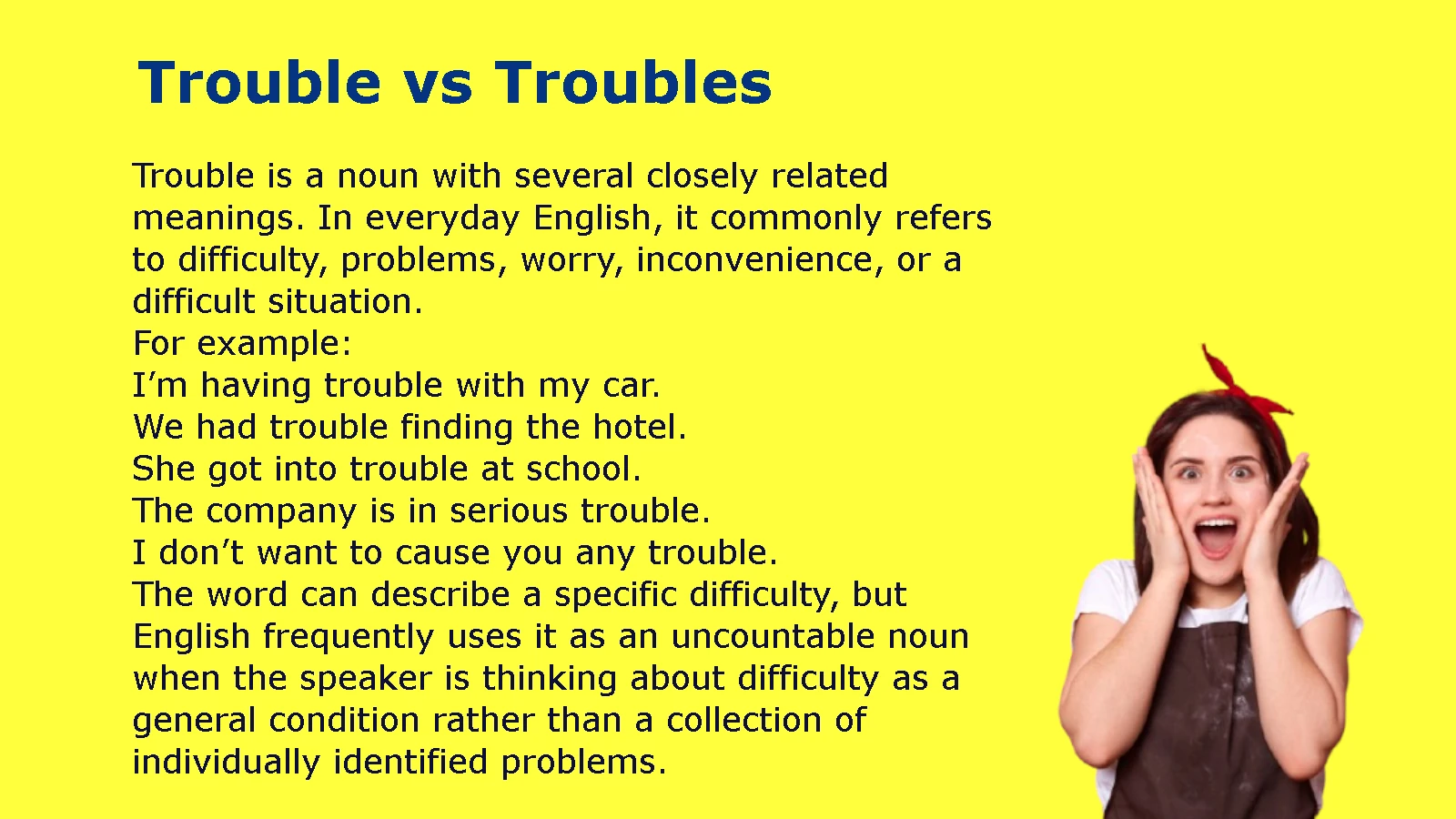
Trouble is a noun with several closely related meanings. In everyday English, it commonly refers to difficulty, problems, worry, inconvenience, or a difficult situation.
For example:
- I’m having trouble with my car.
- We had trouble finding the hotel.
- She got into trouble at school.
- The company is in serious trouble.
- I don’t want to cause you any trouble.
The word can describe a specific difficulty, but English frequently uses it as an uncountable noun when the speaker is thinking about difficulty as a general condition rather than a collection of individually identified problems.
Cambridge lists trouble as both countable and uncountable in its dictionary, while its grammar guidance emphasizes that trouble is almost always uncountable when it means problems or difficulties in a general sense.
Trouble as an Uncountable Noun
This is the most important usage for English learners.
When trouble means general difficulty, it normally does not take a/an and does not need a plural ending.
For example:
- I’m having trouble sleeping.
- We had trouble finding a parking space.
- She has trouble understanding the instructions.
- They ran into trouble during the project.
- He is in trouble with his boss.
Notice that none of these sentences requires troubles.
You might have five different things going wrong with your computer, but you can still say:
I’m having trouble with my computer.
The speaker is presenting the situation as difficulty with the computer, not counting each malfunction separately.
Cambridge’s grammar guidance makes this distinction especially clear by comparing countable problem/problems with generally uncountable trouble.
Trouble as a Countable Noun
Although trouble is commonly uncountable, dictionaries also recognize countable uses.
Oxford lists trouble as uncountable and countable, with plural uses such as financial troubles and her troubles.
This matters because the simple rule “trouble is always uncountable” is too absolute.
Instead, think about the meaning.
When the word describes a general state of difficulty, trouble is usually uncountable:
We had trouble getting there.
When it refers to distinct problems or hardships, troubles can be appropriate:
She has faced many troubles in her life.
That difference in meaning is the key to understanding trouble vs troubles.
What Does “Troubles” Mean?
Troubles is the plural form of trouble when the noun is being used in a countable sense.
It commonly refers to several specific problems, hardships, worries, or difficulties.
For example:
- He talked about his troubles.
- The company is experiencing financial troubles.
- She has had many troubles over the years.
- They are trying to overcome their troubles.
- His personal troubles affected his work.
The plural form often appears when the speaker views difficulties as separate experiences or identifiable sources of concern.
Oxford specifically gives examples such as financial troubles and her troubles, while Collins describes troubles as the things someone is worried about.
When Is “Troubles” More Natural?
You are more likely to see troubles when the sentence talks about a person’s or organization’s difficulties as a collection of separate hardships.
Common combinations include:
- personal troubles
- financial troubles
- family troubles
- marital troubles
- domestic troubles
- legal troubles
- political troubles
- emotional troubles
- troubles at work
For example:
The business has been dealing with financial troubles.
Here, troubles suggests a collection of financial difficulties rather than one general instance of inconvenience.
By contrast:
The business is having trouble paying its employees.
Here, trouble describes the general difficulty involved in paying them.
Both forms can be grammatically correct, but they frame the situation differently.
Trouble vs Troubles: The Key Difference
The easiest way to understand trouble vs troubles is to ask:
Am I describing difficulty in general, or am I treating the difficulties as separate problems?
Use trouble when the idea is general:
I’m having trouble concentrating.
Use troubles when the difficulties are viewed as separate or specific:
He told me about his troubles.
The distinction becomes clearer in the following table.
| Situation | Natural form | Example |
| General difficulty | trouble | I’m having trouble sleeping. |
| Difficulty doing something | trouble | She had trouble finding the address. |
| A dangerous or difficult situation | trouble | The company is in trouble. |
| Getting into a problematic situation | trouble | He got into trouble at school. |
| Several personal difficulties | troubles | She discussed her personal troubles. |
| Several financial difficulties | troubles | The company has financial troubles. |
| Multiple hardships | troubles | He has experienced many troubles. |
The Important Grammar Point
Do not assume that one problem = trouble and two problems = troubles.
That rule does not work.
English can use trouble as an uncountable noun even when many individual problems exist.
For example:
We had trouble with the new software.
The sentence could involve several bugs, errors, and compatibility problems. Yet trouble remains natural because the speaker is describing the overall difficulty.
Cambridge explains that trouble is generally used to discuss problems in a more general way, whereas problem is countable and can directly take plural forms such as problems.
When to Use “Trouble”
There are several extremely common structures where trouble is the natural choice.
“Have Trouble” + Verb-ing
One of the most important patterns is:
have trouble + verb-ing
Examples:
- I have trouble remembering names.
- She has trouble sleeping.
- We had trouble finding the entrance.
- He is having trouble understanding the lesson.
- They had trouble completing the project on time.
This construction means experience difficulty doing something.
Cambridge specifically gives have trouble + -ing as a standard pattern.
A common learner mistake is to replace trouble with troubles:
❌ I have troubles understanding English.
In ordinary English, the more natural sentence is:
I have trouble understanding English.
The plural would change the focus and would usually require a context in which separate difficulties are being discussed.
“Trouble With” Something
Another common structure is:
have trouble with + noun
Examples:
- I’m having trouble with my computer.
- She has trouble with math.
- He has trouble with his car.
- We had trouble with the new system.
- They are having trouble with the instructions.
Again, trouble describes the difficulty generally.
“In Trouble”
In trouble is a fixed and extremely common expression.
It means that someone is in a difficult, dangerous, or potentially punishable situation.
Examples:
- You’ll be in trouble if you miss the deadline.
- He is in trouble with the police.
- The company is in serious trouble.
- She knew she was in trouble when the car stopped.
The plural troubles is not used in this standard expression.
❌ He is in troubles.
✅ He is in trouble.
Oxford lists in trouble, in serious trouble, and in trouble with somebody among established patterns with the noun.
“Get Into Trouble”
Get into trouble means to become involved in a difficult, dangerous, or punishable situation.
Examples:
- The kids got into trouble at school.
- He got into trouble with the police.
- Try not to get into trouble.
- She got into financial trouble after losing her job.
The standard expression is get into trouble, not get into troubles.
“Cause Trouble”
Cause trouble means to create problems, conflict, inconvenience, or difficulty.
Examples:
- I don’t want to cause trouble.
- The delay could cause trouble for the company.
- He is always causing trouble at work.
- The new rule may cause trouble for customers.
Here, trouble represents problems generally.
When to Use “Troubles”
The plural form becomes useful when you want to identify or emphasize multiple difficulties.
Personal Troubles
Personal troubles is a natural phrase for several problems affecting someone’s personal life.
Example:
She took some time away from work because of personal troubles.
The plural suggests a range of personal difficulties rather than one isolated issue.
Financial Troubles
Financial troubles is another established plural expression.
Examples:
- The company is facing financial troubles.
- His financial troubles began after he lost his job.
- The family experienced serious financial troubles.
However, financial trouble is also possible when the focus is on the general condition:
The company is in financial trouble.
This creates an important contrast:
financial trouble = a general financial difficulty or bad financial condition
financial troubles = several financial problems or hardships
Both can be correct.
Family Troubles
Family troubles refers to difficulties involving family relationships or circumstances.
For example:
He didn’t want to discuss his family troubles at work.
The plural frames the situation as a set of personal or family problems.
Troubles With Someone or Something
The plural can also occur when the speaker treats the difficulties as identifiable problems.
For example:
The company has had several troubles with its suppliers.
However, has trouble with is often more natural when describing a general difficulty:
The company has trouble with its suppliers.
The difference is subtle, but useful.
“Trouble” vs “Troubles” in Common Expressions
Some expressions strongly favor trouble.
| Expression | Natural? | Meaning |
| have trouble | Yes | Experience difficulty |
| have trouble doing something | Yes | Find an action difficult |
| have trouble with something | Yes | Experience difficulty with something |
| in trouble | Yes | In a difficult or risky situation |
| get into trouble | Yes | Become involved in a difficult situation |
| cause trouble | Yes | Create problems |
| run into trouble | Yes | Encounter difficulties |
| financial trouble | Yes | General financial difficulty |
| personal troubles | Yes | Multiple personal difficulties |
| financial troubles | Yes | Multiple financial difficulties |
| in troubles | Usually not | Not the standard idiom |
| get into troubles | Usually not | Not the normal expression |
This distinction is worth remembering because fixed expressions often determine the form more strongly than simple singular-versus-plural logic.
“Run Into Trouble”
Run into trouble means to encounter difficulties.
Examples:
We ran into trouble when the weather changed.
The project ran into trouble after the main supplier closed.
The expression normally uses trouble, not troubles.
“The Trouble With”
Another common structure is:
the trouble with + person/thing
Examples:
- The trouble with this plan is the cost.
- The trouble with the car is the engine.
- The trouble with him is that he never listens.
This means the main problem or disadvantage associated with something.
Cambridge and Oxford both identify the trouble with as an established construction.
Is “Trouble” Singular or Plural?
The answer depends on how trouble is being used.
When it means general difficulty, trouble is normally uncountable.
For example:
I’m having trouble with my homework.
You would not normally say:
❌ I’m having a trouble with my homework.
Cambridge’s grammar reference specifically says that trouble is almost always uncountable when used to mean problems or difficulties in general.
However, dictionaries also recognize countable uses of trouble.
That means the most accurate answer is:
Trouble can be countable or uncountable, depending on the meaning and construction.
When used as a countable noun, its plural is troubles.
Why “Trouble” Can Refer to Several Problems
Consider this sentence:
The company is having trouble with its software.
The company might have ten software bugs.
The noun remains trouble because the sentence presents those difficulties collectively.
Compare:
The company has identified several troubles affecting its software.
This treats the difficulties as separate issues. However, in modern everyday English, problems would often sound more natural here:
The company has identified several problems affecting its software.
That is an important usage point. A grammatically possible plural is not necessarily the most idiomatic choice.
Trouble vs Troubles in American English
American English commonly uses trouble in everyday expressions involving general difficulty.
Examples include:
- have trouble
- get into trouble
- be in trouble
- cause trouble
- run into trouble
- financial trouble
- car trouble
- back trouble
Cambridge’s American Dictionary gives examples such as “I’m having trouble with my new computer” and “He would have been in real trouble if he had been caught.”
American English also uses troubles when the speaker refers to several distinct problems:
- personal troubles
- financial troubles
- family troubles
- his troubles
The central distinction therefore remains semantic rather than a simple American-versus-British spelling or grammar difference.
Trouble vs Troubles in British English
British English follows essentially the same broad distinction.
You will find trouble in expressions such as:
- have trouble doing something
- in trouble
- get into trouble
- cause trouble
- run into trouble
British English also uses plural troubles in contexts involving distinct hardships.
Cambridge’s British dictionary, for example, includes examples such as “She thought her troubles would be over” and “Most of the current troubles stem from our new computer system.”
There is therefore no useful rule saying that trouble belongs to American English while troubles belongs to British English. Both forms occur in both varieties.
Common Mistakes With Trouble and Troubles
Understanding the difference becomes much easier when you know which mistakes to avoid.
Using “Troubles” Automatically for Multiple Problems
This is perhaps the biggest misconception.
Suppose your computer has several problems. You can still say:
I’m having trouble with my computer.
You do not need to count the individual problems before choosing the plural.
The word trouble can describe the entire experience of difficulty.
Saying “I Have Troubles” in Every Context
Consider:
❌ I have troubles understanding this chapter.
For a general difficulty, the natural construction is:
✅ I have trouble understanding this chapter.
The trouble + -ing pattern is well established in English.
Saying “In Troubles”
This is a common learner error.
❌ She is in troubles.
✅ She is in trouble.
The expression in trouble is fixed in standard English.
Using “A Trouble” for General Difficulty
Another common mistake is:
❌ I had a trouble finding the station.
The natural sentence is:
✅ I had trouble finding the station.
Cambridge explicitly contrasts a problem with uncountable trouble in this kind of construction.
If you need a countable noun, problem is often the better choice:
I had a problem finding the station.
Assuming Every Plural Is Equally Natural
English grammar and English usage are not always identical.
Troubles is a legitimate plural, but sometimes problems or difficulties sounds more natural.
For example:
The engineers identified several problems.
is more ordinary than:
The engineers identified several troubles.
Meanwhile:
She shared her troubles with her sister.
sounds natural because troubles is well established for personal worries and hardships.
Trouble vs Problem vs Difficulty
The words trouble, problem, and difficulty overlap, but they do not work exactly the same way.
| Word | Main idea | Example |
| Trouble | General difficulty or problematic situation | I’m having trouble with the software. |
| Problem | A specific matter that needs solving | There is a problem with the software. |
| Difficulty | A challenging task, condition, or obstacle | I had difficulty installing the software. |
Cambridge explains that problem is a countable noun, while trouble generally refers to problems or difficulties in a broader way.
This gives you a useful practical rule.
If you can clearly identify an individual issue, problem often works well:
We found three problems.
If you’re talking about the overall experience of struggling, trouble is often more natural:
We had trouble installing the software.
If you’re emphasizing the challenge involved in an activity, difficulty works naturally:
We had difficulty installing the software.
Trouble vs Difficulty
Both can describe challenges, but their grammar differs in useful ways.
Compare:
I had trouble finding the address.
I had difficulty finding the address.
Both are natural.
However, trouble is especially common in everyday phrases such as:
- in trouble
- get into trouble
- cause trouble
- run into trouble
Meanwhile, difficulty frequently appears in formal or technical contexts:
- technical difficulties
- financial difficulties
- breathing difficulties
- learning difficulties
Oxford lists difficulty as both countable and uncountable, with plural uses such as technical difficulties and practical difficulties.
Trouble vs Troubles: Real-World Examples
The following examples show how the choice changes depending on what the speaker wants to communicate.
Example: Learning
I have trouble understanding fast speakers.
This describes a general difficulty with listening.
Now compare:
I have had several troubles during my language course.
The second sentence treats the difficulties as separate experiences.
For everyday English, the first sentence is much more natural if the speaker simply means that listening is difficult.
Example: Work
We are having trouble meeting the deadline.
This describes a general difficulty completing the work on time.
Compare:
The manager has been dealing with several troubles within the department.
Here, troubles presents multiple problems as separate issues.
In many professional contexts, however, problems would be a more straightforward alternative:
The manager has been dealing with several problems within the department.
Example: Money
Consider these two sentences:
The company is in financial trouble.
The company is dealing with financial troubles.
The first emphasizes the company’s overall financial condition.
The second draws attention to multiple financial difficulties.
Both are possible.
Example: Personal Life
She has trouble trusting people.
This describes a general difficulty.
She has experienced many personal troubles.
This refers to several hardships or problems in her life.
The distinction becomes much clearer when you stop thinking of trouble and troubles as simple grammatical opposites.
Case Study: Why “I Have Trouble” Is Usually Better Than “I Have Troubles”
Imagine a student learning English.
The student struggles with pronunciation, vocabulary, and listening.
They want to say:
I have trouble learning English.
That sentence is natural even though the student has several different difficulties.
Why?
Because trouble here represents the overall experience of difficulty.
Now imagine the student is describing separate events:
I’ve had several troubles during my English course, including a missed exam, a broken laptop, and a registration problem.
Here, the speaker is treating the difficulties as separate experiences.
However, even in this situation, problems might be the more natural everyday choice:
I’ve had several problems during my English course.
This demonstrates an important lesson:
Plural “troubles” is grammatical, but context determines whether it is the most natural word.
That is why replacing every occurrence of trouble with troubles is not a reliable grammar strategy.
Can “Trouble” Be a Countable Noun?
Yes.
Although learners often encounter trouble as an uncountable noun, major dictionaries recognize countable uses as well.
Oxford labels the noun uncountable, countable and provides plural examples such as financial troubles and her troubles.
Cambridge likewise identifies countable and uncountable uses in its dictionary entries.
The practical distinction is:
Uncountable trouble
I’m having trouble with my car.
Countable troubles
He told me about his troubles.
So the statement “trouble is always uncountable” is too broad.
A better rule is:
Trouble is usually uncountable when it means general difficulty, but it can be countable when it refers to separate problems or hardships.
Is “Troubles” Grammatically Correct?
Yes. Troubles is a grammatically correct plural form of trouble.
The question is not whether troubles is grammatical. The real question is whether it fits the intended meaning and sounds natural in the sentence.
Natural Uses of “Troubles”
- personal troubles
- financial troubles
- family troubles
- marital troubles
- his troubles
- their troubles
- several troubles
For example:
She eventually overcame her troubles.
Here, the plural makes sense because the sentence refers to several hardships.
When “Trouble” Is Better
Use trouble in common general-difficulty expressions:
- have trouble
- have trouble doing something
- have trouble with something
- in trouble
- get into trouble
- run into trouble
- cause trouble
- the trouble with something
These are established patterns rather than simple choices between singular and plural.
Trouble vs Troubles: Quick Grammar Rules
If you need a fast reference, remember these rules.
Use “Trouble” When:
- You mean difficulty in general.
- You use have trouble + -ing.
- You use have trouble with + noun.
- Someone is in trouble.
- Someone gets into trouble.
- Someone or something causes trouble.
- You mean general financial difficulty with in financial trouble.
- You are describing a broad problem with a machine, body part, or system.
Use “Troubles” When:
- You mean several distinct difficulties.
- You refer to someone’s personal troubles.
- You describe financial troubles as a collection of difficulties.
- You discuss someone’s troubles as separate hardships or worries.
- The context clearly treats the difficulties as countable experiences.
For example:
We found three problems with the machine.
This is usually clearer than:
We found three troubles with the machine.
Trouble vs Troubles: A Simple Decision Test
When you’re unsure which word to use, ask yourself three questions.
First: Am I talking about difficulty generally?
Use trouble.
I’m having trouble concentrating.
Second: Am I talking about several identifiable hardships?
Troubles may be appropriate.
She discussed her personal troubles.
Third: Am I counting individual issues?
Consider problems instead.
Frequently Asked Questions About Trouble vs Troubles
Is “troubles” the plural of “trouble”?
Yes. Troubles is the plural form of trouble when trouble is being used as a countable noun.
For example:
He has experienced many troubles.
However, trouble is also commonly used as an uncountable noun, so a sentence can refer to many difficulties while still using singular-looking trouble:
He has had a lot of trouble.
Should I say “I have trouble” or “I have troubles”?
For a general difficulty, use I have trouble.
For example:
I have trouble sleeping.
I have troubles is possible when you mean several specific difficulties, but it is less common in ordinary constructions where have trouble is the established pattern.
Is “I am in troubles” correct?
No, not in standard everyday English.
Use:
I am in trouble.
The expression in trouble is a fixed construction meaning that someone is in a difficult, dangerous, or potentially punishable situation.
Is “have troubles” grammatically correct?
Yes, but context matters.
For example:
She has had many troubles in her life.
is grammatical.
But for a general difficulty:
She has trouble sleeping.
is the natural choice.
What is the plural of trouble?
The plural form is troubles.
However, trouble is often uncountable, so English frequently does not use the plural even when several difficulties are involved.
Is “trouble” an uncountable noun?
It can be.
In its common meaning of general difficulty or problems, trouble is normally uncountable.
For example:
We had trouble finding the hotel.
But dictionaries also recognize countable uses, so it is not accurate to say that the noun is always uncountable.
What is the difference between “trouble” and “problem”?
Trouble often describes difficulty or problems in a general sense, while problem commonly refers to a specific issue that needs to be dealt with.
Compare:
I’m having trouble with my computer.
There is a problem with my computer.
Both can be correct, but problem is more naturally countable:
There are three problems with the computer.
Cambridge specifically identifies problem as countable and trouble as generally uncountable when used in this broad sense.
Is “financial trouble” different from “financial troubles”?
Yes.
Financial trouble generally describes an overall difficult financial condition:
The company is in financial trouble.
Financial troubles emphasizes multiple financial problems or hardships:
The company has been dealing with financial troubles.
Both forms are used in English.
Final Takeaway: Trouble vs Troubles
The difference between trouble vs troubles is more subtle than simply singular versus plural.
Trouble is usually the better choice when you mean difficulty in general. It appears in some of the most common English expressions, including have trouble, have trouble doing something, in trouble, get into trouble, run into trouble, and cause trouble. Cambridge and Oxford both document these patterns.
Troubles is the plural form used when difficulties are treated as separate hardships, worries, or problems. Expressions such as personal troubles, financial troubles, and his troubles are natural examples.
The most useful rule is simple:
Use “trouble” for general difficulty and “troubles” for distinct or multiple hardships.
But don’t force that rule mechanically. English often uses trouble even when several individual problems are involved.
If you mean “I am experiencing difficulty,” choose trouble.
If you mean “I am dealing with several specific hardships,” troubles may fit.
And if you want to clearly identify individual issues, problems will often be the most natural choice.