Discretion is the correct spelling. It refers to the ability to make sensible decisions, especially when you need to act carefully or keep something private. Discression is a common misspelling of discretion, usually caused by the way the word sounds when spoken.
Examples:
- She handled the sensitive matter with great discretion.
- The manager used his discretion to approve the request.
The confusion is understandable. People often search for discretion vs discression, discretion or discression, which spelling is correct, or discression meaning because the extra s can make the incorrect form look convincing. And here’s the kicker: discression isn’t an alternative spelling of discretion. It’s simply a misspelling.
In this guide, you’ll learn the complete difference between Discretion vs Discression, including their meaning, pronunciation, origin, correct spelling, and usage. You’ll also see why discression is incorrect, how to remember the correct spelling of discretion, and clear examples to help you avoid this common spelling mistake.
Discretion vs Discression: What’s the Difference?
The simplest way to understand the difference is to separate the correct word from the spelling error.
| Word | Status | Meaning |
| discretion | Correct | Careful judgment or freedom to make a decision |
| discression | Incorrect | Misspelling of discretion |
| disgression | Historical/obsolete English form | Older spelling related to digression |
| digression | Correct modern word | A departure from the main subject |
The key distinction is between discretion and discression. Only the first one is the standard spelling for the meaning most people intend.
For example:
Correct: She handled the confidential information with discretion.
Incorrect: She handled the confidential information with discression.
The second sentence doesn’t introduce a different meaning. It simply contains a spelling error.
The Correct Spelling Is Discretion
The correct spelling is:
D-I-S-C-R-E-T-I-O-N
The part that often causes trouble is -cretion.
Think of the word as:
dis + cretion
not:
dis + cression
That extra s in discression doesn’t belong there.
The standard pronunciation is /dɪˈskreʃən/, with the main stress on the second syllable. Cambridge and Oxford both give this pronunciation for American English.
Discression Is a Misspelling
When someone writes discression, they generally mean discretion.
The error is understandable because English spelling doesn’t always follow pronunciation in an obvious way. The middle of discretion sounds roughly like -skresh-, which can make the spelling feel less predictable.
However, the standard written form remains discretion.
This matters most in formal writing. A reader may understand discression immediately, but that doesn’t make the spelling acceptable in polished English.
What Does Discretion Mean?
Discretion is a noun with two main uses.
First, it can mean careful judgment about what you say or do, especially when privacy, sensitivity, or social consequences matter. Second, it can mean the freedom or authority to make a decision according to your own judgment.
These meanings look different at first, but they share the same basic idea: judging what is appropriate in a particular situation.
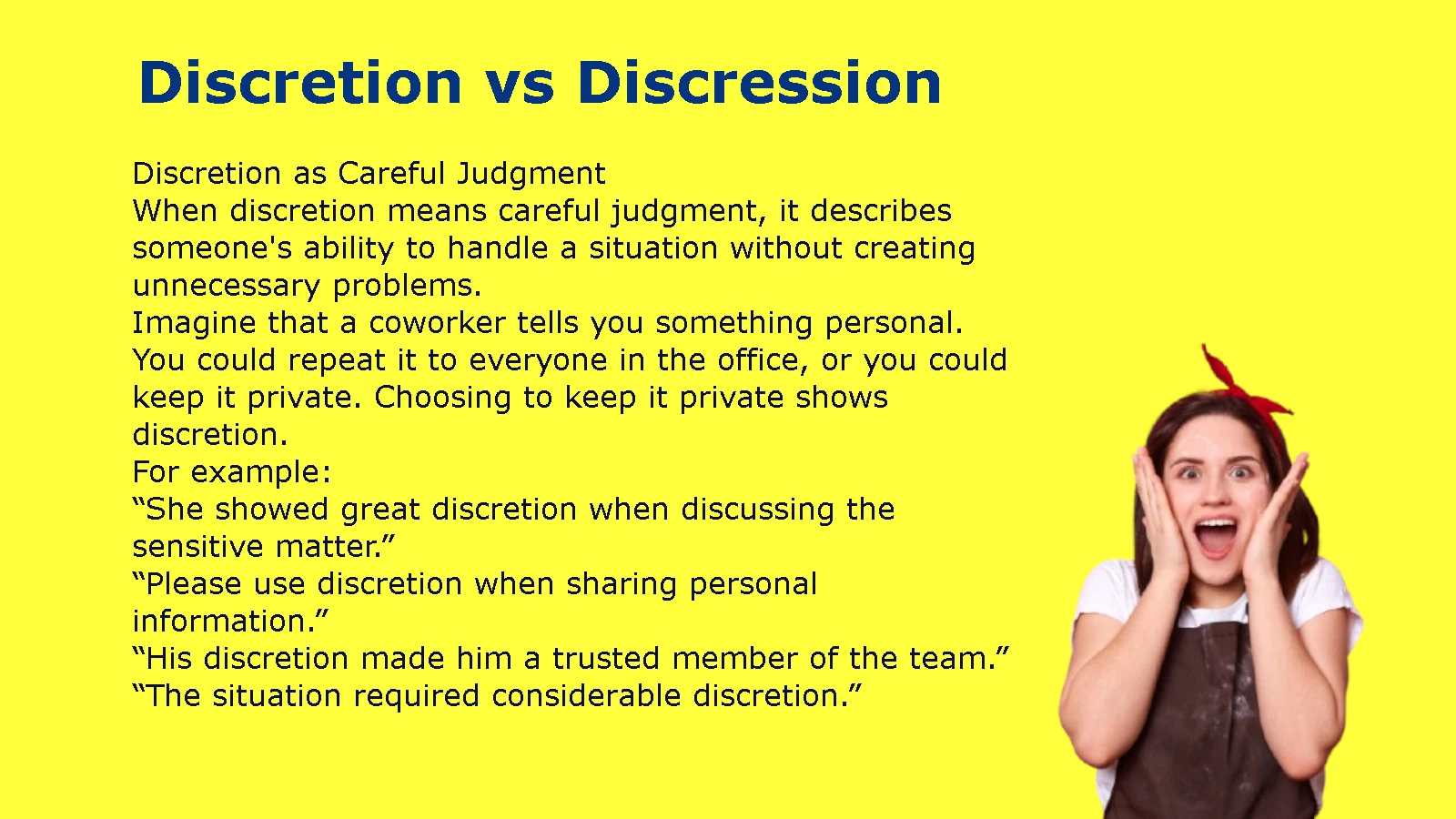
Discretion as Careful Judgment
When discretion means careful judgment, it describes someone’s ability to handle a situation without creating unnecessary problems.
Imagine that a coworker tells you something personal. You could repeat it to everyone in the office, or you could keep it private. Choosing to keep it private shows discretion.
For example:
- “She showed great discretion when discussing the sensitive matter.”
- “Please use discretion when sharing personal information.”
- “His discretion made him a trusted member of the team.”
- “The situation required considerable discretion.”
Oxford defines this sense as taking care in what you say or do to keep something secret, avoid difficulty, or prevent embarrassment.
Discretion doesn’t necessarily mean silence. Sometimes it means knowing what to say, when to say it, and what not to say.
That’s an important distinction.
Someone can speak openly and still act with discretion if they understand the circumstances and respect appropriate boundaries.
Discretion as Freedom or Authority to Decide
The second major meaning involves decision-making power.
If someone has discretion over a matter, that person has some freedom to decide what happens rather than simply following one fixed outcome.
For example:
The manager has discretion over how the department’s budget is spent.
Here, discretion doesn’t mean secrecy. It means the manager has some authority to make the decision.
Cambridge describes this sense as the right or ability to decide something. Oxford similarly defines it as the freedom or power to decide what should be done in a particular situation.
This meaning appears frequently in professional, administrative, and legal language.
Discretion Examples in Sentences
Seeing the word in different contexts makes the distinction much easier to remember.
Everyday Examples of Discretion
- Please use discretion when discussing your friend’s personal situation.
- She handled the embarrassing moment with discretion.
- He showed remarkable discretion during the conversation.
- You should exercise discretion when posting private information online.
- The receptionist treated the matter with discretion.
In each example, discretion refers to careful behavior or judgment.
Professional Examples of Discretion
The word also appears often in workplaces.
- The supervisor has discretion over employee scheduling.
- The company gave the department manager discretion to approve small expenses.
- Employees should use discretion when discussing confidential projects.
- The director exercised discretion when reviewing the request.
Notice that the meaning can change slightly depending on context.
In “employees should use discretion,” the word suggests careful judgment.
In “the director has discretion,” it suggests decision-making authority.
Legal Examples of Discretion
The legal meaning is especially important because discretion often refers to authority exercised within established boundaries.
For example, a judge may have discretion when deciding between legally available options. A public official may also have discretion to make certain decisions within the authority granted by law.
Cornell’s Legal Information Institute describes legal discretion as the power of a judge, public official, or private party to act according to their judgment within applicable legal principles.
That doesn’t mean unlimited freedom.
Legal discretion operates within rules, laws, and standards. Cornell specifically notes that courts can review decisions when someone claims that a lower court abused its discretion.
What Does Discretion Mean in a Sentence?
Discretion usually appears as an uncountable noun. Several common sentence patterns make its use easier to understand.
Use Discretion
Use discretion means to make careful choices about how you behave or what you say.
Please use discretion when discussing the matter.
Exercise Discretion
Exercise discretion means to actively use your judgment when making a decision.
Managers must exercise discretion when handling unusual requests.
This phrase is especially common in professional and legal contexts. Oxford lists exercise discretion among the common collocations associated with the word.
At Your Discretion
At your discretion means that you can decide according to your own judgment.
You may take a break at your discretion.
The decision belongs to you.
At the Discretion of
At the discretion of identifies the person or organization with the authority to decide.
Refunds are issued at the discretion of the store manager.
The manager has the relevant decision-making authority.
Leave It to Your Discretion
This phrase means that someone is giving you the responsibility for deciding.
I’ll leave the timing to your discretion.
In plain English, it means “You decide.”
Discretion Synonyms
The best synonym depends on which meaning of discretion you have in mind.
Synonyms for Discretion as Good Judgment
When discretion means careful or sensible judgment, possible synonyms include:
- judgment
- prudence
- wisdom
- discernment
- tact
- caution
- good sense
These words overlap, but they aren’t perfect substitutes.
For example, tact focuses heavily on handling people and sensitive situations without causing offense. Prudence emphasizes sensible caution. Discernment focuses on recognizing important differences and making sound judgments.
So replacing discretion with one of these words requires attention to context.
Synonyms for Discretion as Decision-Making Authority
When discretion means freedom or authority to decide, useful alternatives include:
- choice
- authority
- freedom
- latitude
- option
- decision-making power
Consider this sentence:
The manager has discretion over the schedule.
Here, authority or decision-making power may preserve the meaning better than tact or prudence.
That’s why a thesaurus list alone isn’t enough. A good synonym needs to match the particular sense of the word.
What Is Disgression?
This is where the spelling confusion gets more interesting.
Disgression has appeared in English, but it isn’t the normal modern spelling you should use for this meaning. Wiktionary identifies disgression as an obsolete spelling of “digression.”
A digression is a departure from the main subject of a conversation, speech, essay, or discussion.
For example:
The speaker made a brief digression about the history of the building.
The speaker temporarily moved away from the main topic.
If you’re writing modern English, digression is the standard word to choose.
Disgression vs. Discretion
These words aren’t interchangeable.
| Word | Modern usage | Meaning |
| discretion | Standard | Careful judgment or freedom to decide |
| disgression | Obsolete/historical | Older spelling of digression |
| digression | Standard | A departure from the main subject |
Compare these sentences:
She used discretion when answering the question.
This means she answered carefully.
The speaker made a digression before returning to the main topic.
This means the speaker temporarily moved away from the subject.
The meanings have nothing to do with each other.
Discression vs. Disgression
The visual similarity between discression and disgression can make the confusion worse.
However, neither should be treated as a modern alternative spelling of discretion.
Discression is the misspelling you should correct to discretion.
Disgression is a historical form associated with digression.
That gives you three different situations:
| Form | What to do |
| discretion | Use it when you mean careful judgment or decision-making freedom |
| discression | Correct it to discretion |
| disgression | Usually replace it with digression in modern English |
A Simple Example
Suppose you want to write:
She kept the information private and handled the situation carefully.
The appropriate word is:
She handled the situation with discretion.
Not:
She handled the situation with discression.
And not:
She handled the situation with disgression.
The first sentence uses the correct modern word.
Discretion vs. Discrete
Another common confusion involves discrete.
Although discretion and discrete look similar, they don’t mean the same thing.
Discretion is a noun referring to judgment or decision-making freedom.
Discrete is an adjective meaning separate, distinct, or individually identifiable.
Consider these examples:
The manager used discretion when approving the request.
The experiment consisted of three discrete stages.
The first sentence concerns judgment.
The second describes separate stages.
Discretion vs. Discrete Examples
| Word | Part of Speech | Meaning | Example |
| discretion | Noun | Careful judgment or freedom to decide | “The manager used discretion.” |
| discrete | Adjective | Separate or distinct | “The system has three discrete components.” |
A useful memory trick is to focus on the endings:
- discretion → judgment or choice
- discrete → separate or distinct
They may look related, but you can’t swap them.
Discretion vs. Discreet
Discreet creates another common spelling and meaning problem.
Discreet is an adjective. It describes someone who is careful about privacy, attention, or sensitive information.
She was discreet about the private conversation.
Discretion, by contrast, is a noun.
She handled the private conversation with discretion.
The two words are closely related, which explains why they often appear together in discussions about spelling and vocabulary.
Here’s the simplest comparison:
| Word | Part of Speech | Meaning |
| discreet | Adjective | Careful, private, or unobtrusive |
| discretion | Noun | Careful judgment or freedom to decide |
A quick test can help.
If you’re describing a person or their behavior, discreet may be the right choice.
If you’re naming the quality or judgment itself, discretion is likely the correct word.
Discretion vs. Discretionary
The adjective discretionary comes directly from discretion.
Discretionary means something is determined by individual choice or judgment rather than being fixed or required by a rule.
Cambridge defines it as something that can be decided by a particular person or group in a particular situation.
For example:
The manager has discretionary authority to approve the request.
Here, the authority involves judgment rather than an automatic outcome.
Another common example is:
The company offers discretionary bonuses.
That means the bonuses depend on the company’s decision rather than being automatically owed under the stated arrangement.
Discretion vs. Discretionary
| Word | Part of Speech | Meaning |
| discretion | Noun | Judgment or freedom to decide |
| discretionary | Adjective | Based on or subject to that judgment |
The relationship is straightforward:
discretion → discretionary
The first names the concept.
The second describes something connected to that concept.
Common Phrases With Discretion
Certain expressions appear repeatedly in everyday, business, academic, and legal English.
At Your Discretion
This means according to your own choice or judgment.
You can adjust the settings at your discretion.
You have the freedom to decide.
At the Discretion of
This means according to the decision of a particular person or authority.
Additional support may be provided at the discretion of the supervisor.
The supervisor decides whether to provide it.
Use Your Discretion
This means use your own judgment.
Use your discretion when deciding whether the information should be shared.
The phrase doesn’t tell you exactly what to do. Instead, it gives you responsibility for making the appropriate decision.
Exercise Discretion
This is a more formal expression for actively applying judgment.
Employees should exercise discretion when dealing with confidential records.
It is common in professional and institutional writing.
Discretion Is Advised
You may see this wording in notices, warnings, or descriptions of potentially sensitive material.
It means that readers should use their judgment about whether to proceed or how to respond.
For example:
Viewer discretion is advised.
Here, discretion refers to the viewer’s judgment about whether the material is appropriate for them.
How to Spell Discretion Correctly
If you repeatedly mix up discretion and discression, focus on the middle of the word.
The correct spelling is:
dis-CRE-tion
The incorrect form adds an unnecessary s:
disc-RESS-ion ❌
The correct form contains:
-cretion
not:
-cression
One practical way to remember it is to connect discretion with discreet and discrete. All three begin with discre-, although their meanings and endings differ.
Spelling Breakdown
| Part | Correct form |
| Beginning | dis- |
| Middle | cre |
| Ending | -tion |
| Full word | discretion |
So if you’re proofreading a sentence and see discression, stop there. The standard spelling you’re looking for is discretion.
Why Is Discretion Often Misspelled as Discression?
The mistake isn’t completely random.
English contains many words in which the sound of -tion follows a spelling pattern that isn’t obvious from pronunciation alone. In discretion, the middle sounds like skresh, which can make the written form harder to reconstruct from sound.
The words discretion, discreet, and discrete also look similar while behaving differently in sentences.
That creates a perfect environment for spelling errors.
Another source of confusion is digression. Its meaning is unrelated to discretion, but its spelling contains a similar sequence of letters. Historical forms such as disgression add another layer of confusion. Modern dictionaries and usage guides distinguish these forms rather than treating them as interchangeable.
The safest approach is simple: when you mean careful judgment or decision-making freedom, write discretion.
Discretion Pronunciation
In American English, discretion is pronounced:
/dɪˈskrɛʃən/
The main stress falls on the second syllable. Cambridge and Collins both give American English pronunciations consistent with this pattern.
The pronunciation explains part of the spelling difficulty. The word doesn’t sound exactly like its individual letters might suggest.
A useful learning strategy is to connect the sound to the complete written word instead of trying to spell it entirely from pronunciation.
When proofreading, look for:
discretion
rather than attempting to reconstruct the spelling from how the word sounds.
Related Words: Discreet, Discrete, Discretionary, and Indiscretion
These words are worth learning together because they are visually related but serve different grammatical and semantic roles.
| Word | Meaning | Example |
| discreet | Careful about privacy or attention | “She was discreet about the matter.” |
| discrete | Separate or distinct | “The report contains four discrete sections.” |
| discretion | Careful judgment or freedom to decide | “He used discretion.” |
| discretionary | Based on choice or judgment | “The payment is discretionary.” |
| indiscretion | Poor judgment or an inappropriate act | “His indiscretion caused embarrassment.” |
Learning the family as a group can make the spelling differences much easier to recognize.
Discreet and Discretion
These two are particularly close.
She was discreet.
Adjective.
She showed discretion.
Noun.
The first describes her behavior.
The second names the quality or judgment behind that behavior.
Discrete and Discretion
These are less closely related in meaning.
The company operates through several discrete divisions.
Here, discrete means separate.
The manager has considerable discretion over the budget.
Here, discretion means decision-making freedom.
The difference becomes obvious once you look at the entire sentence instead of the spelling alone.
What Is the Opposite of Discretion?
One important opposite is indiscretion.
An indiscretion is an act or instance of poor judgment, especially when someone says or does something inappropriate.
For example:
His indiscretion revealed information that should have remained private.
The relationship is straightforward:
discretion → careful judgment
indiscretion → poor judgment
Other words can serve as opposites depending on context, including imprudence, carelessness, and recklessness. However, indiscretion is especially useful when discussing inappropriate speech, behavior, or disclosure.
Discretion vs. Indiscretion
| Word | Meaning | Example |
| discretion | Careful judgment | “She handled the matter with discretion.” |
| indiscretion | Poor or inappropriate judgment | “His indiscretion caused a problem.” |
This distinction also explains why discretion isn’t simply another word for silence. Someone can speak openly while still exercising discretion. The key is whether the person uses sound judgment about what to say and do.
A Practical Case Study: Choosing the Right Word
Consider a workplace situation.
An employee learns that a coworker is dealing with a private personal issue. During lunch, another colleague asks about it.
The employee has several choices. They could reveal the information, make a vague comment, or politely refuse to discuss it.
Choosing not to reveal private information demonstrates discretion.
Now imagine that the employee accidentally reveals the information to several coworkers.
That action could be described as an indiscretion.
If the employee then starts discussing an unrelated topic instead, that change of subject could be a digression.
Notice how three different concepts emerge:
- Discretion = careful judgment
- Indiscretion = poor judgment
- Digression = moving away from the main topic
None of these meanings requires discression.
That’s why understanding the meanings is more useful than memorizing the spellings in isolation.
A Quick Comparison of the Confusing Words
If you frequently mix these terms up, keep this table handy.
| Word | Correct modern English? | Main meaning |
| discretion | ✅ | Careful judgment or freedom to decide |
| discression | ❌ | Misspelling |
| disgression | ⚠️ Historical/obsolete | Older spelling of digression |
| digression | ✅ | Departure from the main topic |
| discreet | ✅ | Careful about privacy or attention |
| discrete | ✅ | Separate or distinct |
| discretionary | ✅ | Based on individual choice or judgment |
| indiscretion | ✅ | Poor or inappropriate judgment |
This is the core distinction to remember.
Frequently Asked Questions About Discretion vs Discression
Is It Discretion or Discression?
Discretion is correct.
Discression is a misspelling. Use discretion when you mean careful judgment, prudence, or the freedom to make a decision.
Is Discression a Word?
Discression is not the standard spelling of the English word discretion.
If you see discression in ordinary modern writing, it should generally be corrected to discretion.
Is Disgression a Word?
Disgression has existed as an English form, but it is considered an obsolete spelling of digression. Modern writers should normally use digression instead.
What Does Discretion Mean?
Discretion means either careful judgment about what to say or do or the freedom or authority to make a decision based on your judgment.
What Is a Synonym for Discretion?
Depending on the context, synonyms can include judgment, prudence, tact, wisdom, discernment, authority, choice, and latitude.
No single synonym works perfectly in every sentence.
What Is the Difference Between Discretion and Discrete?
Discretion is a noun meaning careful judgment or freedom to decide.
Discrete is an adjective meaning separate or distinct.
“The manager used discretion.”
“The system contains three discrete components.”
What Does Discretionary Mean?
Discretionary means determined by someone’s choice or judgment rather than being automatically required by a fixed rule.
For example:
The manager has discretionary authority.
How Do You Use Discretion in a Sentence?
Common patterns include:
- use discretion
- exercise discretion
- at your discretion
- at the discretion of
- with discretion
- leave it to someone’s discretion
For example:
Please use discretion when sharing confidential information.
How Do You Spell Discretion?
The correct spelling is:
D-I-S-C-R-E-T-I-O-N
Remember -cretion, not -cression.
Discretion vs Discression: Quick Answer
When choosing between discretion and discression, use discretion.
Discretion is the correct modern English word. It means careful judgment about what to say or do, and it can also mean the freedom or authority to make a decision.
Discression is a misspelling and shouldn’t be used in standard formal English.
Don’t confuse it with disgression, either. That form has historical usage as an obsolete spelling of digression, while digression is the standard modern word for moving away from the main subject.
The easiest spelling reminder is:
Discretion = -cretion
Once that pattern sticks, the extra s in discression becomes much easier to spot.
If the word describes careful judgment, privacy-conscious behavior, or freedom to decide, discretion is the word you want.