Have you ever paused when writing a sentence because you weren’t sure whether to use threw or through? Although Threw vs Through differ by only a few letters, these words have completely different meanings and grammatical uses. Knowing the difference can help you avoid one of the most common spelling and word-choice mistakes in English.
Threw and through are not interchangeable. Threw is the past tense of the verb throw, meaning to send or propel something through the air. Through is usually a preposition or adverb that describes movement from one side or point to another, passage within something, or completion of a process.
Examples:
- She threw the ball across the yard.
- We walked through the park after lunch.
The confusion is understandable. People often search for threw vs through, threw or through, which spelling is correct, or threw and through meaning because the two words look and sound similar, yet they serve different purposes in a sentence. And here’s the kicker: threw describes an action, while through usually describes movement, position, or a path.
In this guide, you’ll learn the complete difference between Threw vs Through, including their meaning, pronunciation, part of speech, origin, and usage. You’ll also see clear examples of threw and through in sentences, along with simple tips to help you choose the right word every time.
Threw vs Through: Quick Difference
The easiest way to separate these words is to focus on what the sentence means, not how the words sound.
| Word | Meaning | Grammatical role | Example |
| Threw | Past action of throwing | Verb | Jake threw the ball. |
| Through | From one side or end to another | Preposition/adverb | We walked through the tunnel. |
| Through | From the beginning to the end of a period | Preposition/adverb | She worked through the night. |
| Through | By means of or using something | Preposition | He learned about it through a friend. |
| Thrown | Past participle of throw | Verb form | She has thrown the ball. |
The key point is simple:
Threw = throw in the past.
Through = passage, movement, duration, method, or another related meaning.
Cambridge identifies threw as the past tense of throw and thrown as its past participle.
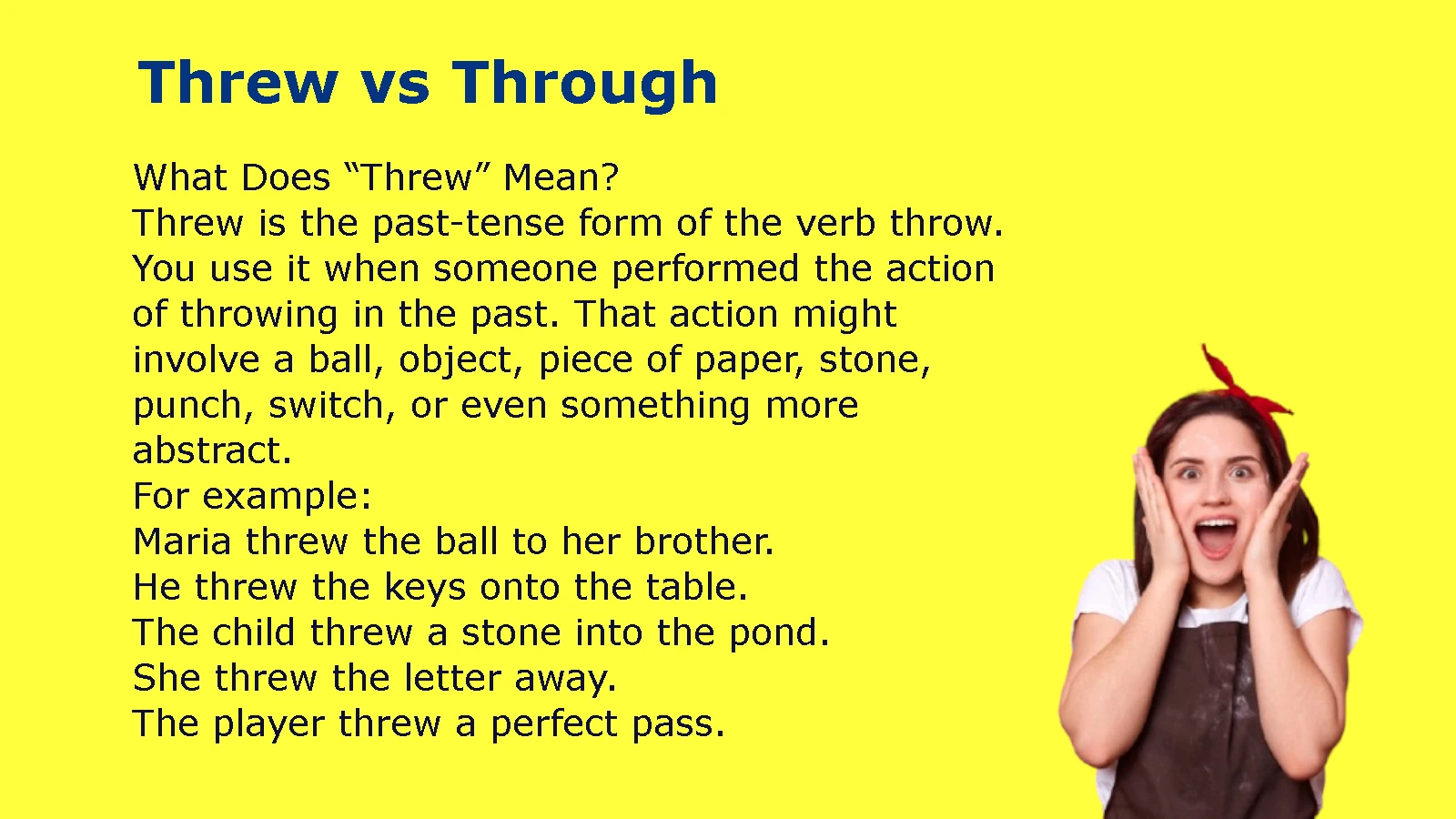
What Does “Threw” Mean?
Threw is the past-tense form of the verb throw.
You use it when someone performed the action of throwing in the past. That action might involve a ball, object, piece of paper, stone, punch, switch, or even something more abstract.
For example:
- Maria threw the ball to her brother.
- He threw the keys onto the table.
- The child threw a stone into the pond.
- She threw the letter away.
- The player threw a perfect pass.
Cambridge defines throw as sending something through the air, often with a sudden movement of the arm. Its American English entry gives threw as the past tense and thrown as the past participle.
Threw as the Past Tense of Throw
Think of throw as a three-part verb:
| Form | Verb form | Example |
| Present | throw | I throw the ball. |
| Past | threw | I threw the ball. |
| Past participle | thrown | I have thrown the ball. |
This pattern matters because threw cannot replace thrown in every sentence.
Compare:
- I threw the ball. ✓
- I have thrown the ball. ✓
- I have threw the ball. ✗
The first sentence uses the simple past, so threw works.
The second uses have, which requires the past participle thrown.
Examples of Threw in a Sentence
Here are several natural examples:
- The pitcher threw the ball across the field.
- Sarah threw her jacket onto the sofa.
- He threw the empty bottle into the recycling bin.
- The child threw the toy across the room.
- She threw a coin into the fountain.
- The quarterback threw the ball to his teammate.
- He threw the door open.
- She threw her hands into the air in frustration.
Notice that threw always points back to the action of throwing.
That gives you a useful test: if you can replace the word with throw in the past, threw is probably the word you need.
What Does “Through” Mean?
Through has several meanings, which is why it appears in far more sentence patterns than threw.
Its most common meaning involves movement from one side, end, or part of something to another.
For example:
- We walked through the forest.
- The train passed through the tunnel.
- Light came through the window.
- She ran through the door.
Cambridge also lists uses involving time, range, methods, results, completion, and other contexts.
Through as a Preposition
One major use of through is as a preposition that describes movement within or across something.
Consider:
The hikers walked through the forest.
The hikers moved within the forest from one point to another.
Likewise:
The train traveled through the tunnel.
The train entered the tunnel and moved through it before reaching the other side.
Other examples include:
- We drove through the city.
- She walked through the crowd.
- The dog ran through the open gate.
- Sunlight streamed through the curtains.
- Water flowed through the pipe.
This meaning often involves something surrounding or containing the movement.
Through as an Adverb
Through can also work as an adverb.
For example:
The door was open, so we walked through.
Here, through doesn’t directly introduce a noun. Instead, it tells you where the person moved.
Other examples include:
- Come through.
- The train passed through.
- The bullet went through.
- She looked through and found the missing page.
It can also appear in expressions such as think something through, meaning to consider something carefully from beginning to end.
He thought the decision through before responding.
Through and Time
Another important use involves a period of time.
You can use through to mean that something continues from the beginning to the end of a period.
For example:
- She worked through the night.
- We stayed there through the winter.
- He studied through the weekend.
- The store remains open Monday through Friday.
Cambridge specifically recognizes through for movement from the beginning to the end of a period. In American English, it can also mark a range such as Monday through Friday.
Through as a Way or Method
Through can also describe the method or channel by which something happens.
For example:
- She found the job through a friend.
- They communicated through an interpreter.
- The company sells its products through local stores.
- He learned the news through social media.
In these examples, through doesn’t describe physical movement.
Instead, it explains how something happened or how something was achieved.
Cambridge includes this use under the meaning of by or using something.
Through as a Meaning of Completion
You may also see through used to describe being finished with something.
For example:
Are you through with that book?
Here, through with means finished using or doing something.
You might also hear:
I’m through with this project.
In this context, the speaker means the project is finished from their perspective or they have finished dealing with it.
Cambridge also records through as an adjective in this sense.
Threw vs Through: Key Differences
The biggest difference between threw and through is grammatical.
Threw is a verb form.
Through has several grammatical roles and meanings, but it is not a past-tense form of throw.
Difference in Meaning
Threw refers to an action:
David threw the ball.
Through describes a relationship, route, period, method, or state:
David walked through the park.
These meanings don’t overlap.
Difference in Grammar
Look at the structure of each sentence:
She threw the ball.
Here, threw is the main verb.
Now compare:
She walked through the park.
The main verb is walked. Through introduces the route or place involved in the movement.
That distinction makes the words much easier to identify.
Difference in Spelling
The spellings look similar:
- threw
- through
But the extra gh in through isn’t pronounced.
That’s one reason English learners often find the word frustrating. English spelling doesn’t always give you a reliable clue about pronunciation.
Difference in Pronunciation
Here’s the twist: threw and through are pronounced the same in standard US English.
Cambridge gives the US pronunciation of both words as /θruː/.
So you can’t reliably distinguish them by sound alone.
You have to use context and meaning.
Are Threw and Through Homophones?
Yes.
Threw and through are homophones because they have the same pronunciation but different spellings and meanings.
Both are pronounced /θruː/ in standard American English.
This is where the confusion starts.
When someone says:
“She threw the ball through the window.”
You hear two words that sound identical:
threw / through
Yet they perform completely different jobs.
The first describes what she did.
The second describes where the ball went.
A Simple Homophone Test
When two words sound alike, don’t choose the spelling based on sound.
Instead, ask:
What does the word mean in this sentence?
If it means performed the action of throwing, use threw.
If it means from one side to another, inside something, during a period, or by means of, use through.
Threw vs Through Examples
The fastest way to understand the difference is to see the words in real sentences.
Sentences With Threw
- He threw the ball to his sister.
- She threw the paper in the trash.
- The boy threw a rock into the lake.
- The pitcher threw the ball toward home plate.
- He threw his backpack onto the floor.
- She threw the keys across the room.
- The player threw a long pass.
- The angry customer threw the receipt on the counter.
Every example refers to a past action involving throwing.
Sentences With Through
- We walked through the park.
- The car drove through the tunnel.
- She looked through the window.
- The river flows through the valley.
- He worked through the night.
- They stayed open Monday through Friday.
- I heard about the opportunity through a friend.
- The sunlight came through the curtains.
Here, through expresses a route, duration, range, method, or passage.
Threw and Through in the Same Sentence
Here’s a particularly useful trick: both words can appear in the same sentence.
She threw the ball through the window.
Why?
Threw tells you what she did.
Through tells you where the ball traveled.
Consider a few more:
He threw the paper through the open door.
The child threw the toy through the doorway.
The player threw the ball through the hoop.
These examples make the distinction almost impossible to miss.
| Sentence | Why it works |
| She threw the ball. | Threw describes the past action. |
| She walked through the park. | Through describes movement within the park. |
| He threw the ball through the window. | Threw = action; through = route. |
| We drove through the tunnel. | Through describes movement from one end to another. |
| He threw the keys onto the table. | Threw describes a completed past action. |
Threw vs Thrown vs Through
A third word often enters the conversation: thrown.
Although threw and thrown both come from throw, they don’t have the same grammatical function.
Threw
Threw is the simple past tense.
She threw the ball yesterday.
Thrown
Thrown is the past participle.
She has thrown the ball before.
Cambridge identifies thrown as the past participle of throw.
Through
Through isn’t a form of throw at all.
She walked through the park.
Here’s the full comparison:
| Word | What it is | Example |
| Throw | Present/base form | I throw the ball. |
| Threw | Simple past | I threw the ball. |
| Thrown | Past participle | I have thrown the ball. |
| Through | Separate word | I walked through the park. |
A quick grammar test helps:
- Yesterday, I ___ the ball. → threw
- I have ___ the ball. → thrown
- I walked ___ the tunnel. → through
Why Do People Confuse Threw and Through?
The main reason is pronunciation.
Both words sound like /θruː/ in standard American English.
Their spellings also look related:
- threw
- through
Yet their histories and meanings don’t make them interchangeable.
Another source of confusion comes from fast typing. When you’re writing quickly, your brain may retrieve the sound before it retrieves the spelling. Since both words share the same sound, the wrong spelling can slip onto the page.
This happens especially often in:
- Text messages
- School assignments
- Emails
- Social media posts
- Informal writing
- Speech-to-text software
The solution isn’t to memorize a complicated rule.
Instead, connect each spelling to its meaning.
Threw = throw happened in the past.
Through = movement, passage, duration, method, or completion.
Common Mistakes With Threw and Through
Using Through Instead of Threw
Incorrect:
He through the ball across the field.
Correct:
He threw the ball across the field.
The sentence describes an action that happened in the past. Therefore, you need the past tense of throw.
Using Threw Instead of Through
Incorrect:
We walked threw the tunnel.
Correct:
We walked through the tunnel.
The sentence describes movement from one end of the tunnel to another. It doesn’t describe someone throwing something.
Confusing Threw With Thrown
Incorrect:
She has threw the ball.
Correct:
She has thrown the ball.
The helping verb has requires the past participle thrown.
Compare:
She threw the ball yesterday.
She has thrown the ball before.
The time and grammar change the verb form.
Writing Through When You Mean Throw
Incorrect:
He through the stone into the lake.
Correct:
He threw the stone into the lake.
Try changing the sentence to present tense:
He throws the stone into the lake.
That immediately reveals that threw is the correct past form.
How to Remember Threw vs Through
A simple memory trick can save you from repeatedly checking a dictionary.
Remember “Threw” With “Throw”
The word threw belongs to the verb family:
throw → threw → thrown
If the sentence describes someone tossing or launching something, think throw first.
She threw the ball.
Remember “Through” With Passage
Think of through as describing something that goes in one side and out another.
The train went through the tunnel.
We walked through the forest.
The idea doesn’t have to involve physical movement, either. You can move through a difficult period or work through a problem.
The Two-Question Test
When you’re unsure, ask two questions:
Question 1: Is this the past action of throwing?
If yes, use threw.
Question 2: Does the word describe passage, duration, method, or another meaning associated with “through”?
If yes, use through.
This works better than trying to remember how the words sound because their pronunciation won’t help you.
A Quick Case Study: “He Threw the Ball Through the Window”
Consider this sentence:
He threw the ball through the window.
It contains both words, so it’s a perfect example of how context separates them.
Step One: Identify the Action
What did he do?
He threw something.
Therefore, threw is the past tense of throw.
Step Two: Identify the Route
Where did the ball go?
It went through the window.
Therefore, through describes the path the ball took.
Step Three: Remove the Confusion
Now replace each word with its meaning:
He [past action of throwing] the ball [from one side of the window to the other].
The sentence becomes clear.
This same technique works with many confusing homophones. Look at the role each word plays instead of relying on pronunciation.
Threw vs Through in Everyday English
Both words appear often in ordinary conversation and writing, but they usually appear in very different sentence structures.
When to Use Threw
Use threw when the subject performed a past throwing action.
Common patterns include:
- Someone threw something.
- Someone threw something at someone.
- Someone threw something to someone.
- Someone threw something into something.
- Someone threw something across something.
Examples:
Marcus threw the ball to Jake.
She threw the letter into the trash.
The child threw the toy across the room.
When to Use Through
Use through when you need to describe:
- Movement from one side to another
- Movement within an enclosed or surrounding area
- Movement from the beginning to the end of a period
- A method or channel
- A result or cause in certain constructions
- Completion
- A direct route or connection
Examples:
We walked through the museum.
She worked through the weekend.
He found the information through a colleague.
The train went through the city.
Cambridge documents these uses, including place, time, method, result, and completion.
Threw vs Through: A Practical Comparison
| If you mean… | Use | Example |
| Past action of throwing | threw | She threw the ball. |
| Moving inside something | through | We walked through the forest. |
| Moving from one end to another | through | The train went through the tunnel. |
| Continuing during a period | through | He worked through the night. |
| Using a person or method | through | She heard about it through a friend. |
| Simple past of throw | threw | He threw the keys. |
| Past participle of throw | thrown | He has thrown the keys. |
Is “Threw Through” Ever Correct?
Yes.
The phrase “threw through” can be grammatically correct when threw describes the action and through describes the route.
For example:
She threw the ball through the hoop.
The two words have different functions.
Threw is the verb.
Through is the preposition that introduces the route or opening.
Another example:
He threw the paper through the open window.
Again, there’s no contradiction.
The first word tells you what happened. The second tells you where the object traveled.
Threw vs Through: Common Sentence Patterns
Recognizing sentence patterns can make the difference automatic.
Patterns With Threw
Subject + threw + object
She threw the ball.
Subject + threw + object + to + person
He threw the ball to Mike.
Subject + threw + object + into + place
She threw the paper into the trash.
Subject + threw + object + across + place
He threw the keys across the room.
Patterns With Through
Subject + verb + through + place
We walked through the park.
Subject + verb + through + opening
The dog ran through the gate.
Subject + verb + through + period
She worked through the night.
Subject + verb + through + person/method
He found the job through a friend.
Seeing these structures gives you another practical way to choose the correct spelling.
Is “Through” Ever Related to Throw?
No.
Although threw and through look and sound similar, through is not another form of the verb throw.
The forms of throw are:
throw → threw → thrown
Through belongs to a different word family.
That distinction is important because spelling similarities can create a false connection.
For example:
- I threw the ball. ✓
- I have thrown the ball. ✓
- I walked through the park. ✓
- I through the ball. ✗
- I have through the ball. ✗
Is “Threw” Always a Verb?
In standard modern English, threw is the simple past form of the verb throw.
It doesn’t function like through, which can take several grammatical roles.
For example:
She threw the ball.
Here, threw is the verb describing the action.
By contrast:
She walked through the park.
Here, through introduces the location or route.
This difference is one of the clearest grammatical ways to separate the two.
Is “Through” Always About Physical Movement?
No.
Physical movement is one of its most familiar meanings, but through has several broader uses.
For example:
We worked through the night.
This refers to time.
She got the information through a friend.
This refers to a method or source.
He made it through the difficult period.
This refers to successfully reaching the end of a situation.
Are you through with the book?
This refers to completion.
Cambridge records these broader meanings, including time, method, result, completion, and progression.
Frequently Asked Questions About Threw vs Through
Is “threw” the past tense of “throw”?
Yes. Threw is the simple past tense of throw.
Present: I throw the ball.
Past: I threw the ball.
Past participle: I have thrown the ball.
Cambridge confirms threw as the past-tense form and thrown as the past participle.
What is the difference between threw and through?
Threw means someone performed the action of throwing in the past.
Through usually describes passage, movement, duration, method, or completion.
He threw the ball.
He walked through the park.
Are threw and through pronounced the same?
Yes. In standard American English, both are pronounced /θruː/.
That makes them homophones.
Are threw and through homophones?
Yes. They have the same pronunciation but different spellings and meanings.
Is “threw” a verb?
Yes. Threw is the simple past form of the verb throw.
She threw the ball.
Is “through” a preposition?
Yes, through commonly functions as a preposition. It can also function as an adverb and adjective in different contexts.
What is the past tense of throw?
The past tense is threw.
Yesterday, he threw the ball.
What is the past participle of throw?
The past participle is thrown.
He has thrown the ball before.
Can threw and through appear in the same sentence?
Absolutely.
She threw the ball through the window.
They perform different grammatical jobs in the sentence.
Is “threw” the same as “thrown”?
No.
Threw is the simple past tense.
Thrown is the past participle.
She threw the ball yesterday.
She has thrown the ball before.
Is “through” a verb?
No. In standard English, through functions as a preposition, adverb, or adjective depending on the sentence.
How can you remember the difference between threw and through?
Use this quick rule:
Threw = past of throw.
Through = passage, movement, time, method, or completion.
If someone threw something, they performed an action.
If something moved through a place, it passed from one point to another.
Final Takeaway: Threw vs Through
The difference between threw vs through becomes simple once you stop relying on sound.
Both words are pronounced /θruː/ in standard American English, but they have completely different meanings.
Remember these three forms:
Throw → Threw → Thrown
And keep through in its own category.
- Threw = the past tense of throw
- Thrown = the past participle of throw
- Through = movement, passage, duration, method, completion, and related meanings
The easiest example to remember is:
She threw the ball through the window.
Threw tells you what she did.
Through tells you where the ball went.
Once you understand that difference, this commonly confused pair is much easier to use correctly.