Disgusting is the correct spelling. Discusting is a common misspelling and isn’t the standard English form.
The confusion is understandable because disgusting doesn’t look exactly the way it sounds. When people hear the word quickly, the middle g can be easy to miss or replace with a c. However, the correct spelling comes directly from the word disgust:
disgust + -ing = disgusting
So, if you’re writing an email, school assignment, article, message, or any other standard English text, use disgusting, not discusting.
The word itself has several useful meanings. You can use disgusting for something physically unpleasant, such as a terrible smell or spoiled food. You can also use it for behavior, language, or actions that you consider deeply offensive or unacceptable. Cambridge defines the adjective as meaning “extremely unpleasant or unacceptable.”
Disgusting vs Discusting: The Quick Answer
| Spelling | Correct? | Meaning |
| disgusting | ✅ Correct | Extremely unpleasant, offensive, or unacceptable |
| discusting | ❌ Incorrect | Common misspelling of disgusting |
Here are two examples:
- Correct: The smell from the garbage was disgusting.
- Incorrect: The smell from the garbage was discusting.
The second sentence doesn’t use the standard spelling. The word should contain the g from disgust.
How to Remember the Correct Spelling
Think of the word in two parts:
DISGUST + ING = DISGUSTING
That simple connection is more useful than trying to memorize all nine letters separately.
If you’re unsure while writing, remove -ing mentally. What remains?
disgust
Once you recognize the base word, the spelling becomes much easier to reconstruct.
Why Is Disgusting Spelled With a G?
The spelling disgusting comes from the base word disgust followed by the suffix -ing. Dictionary sources trace the adjective directly to disgust + -ing.
That gives you a straightforward word-building pattern:
| Base word | Added ending | Result |
| disgust | -ing | disgusting |
| disgust | -ed | disgusted |
| disgust | -ly | disgustingly |
The important point is that the g doesn’t disappear when you add -ing.
Disgust + -ing = Disgusting
The word disgust can function as both a noun and a verb.
As a noun, disgust refers to a strong feeling of dislike or revulsion. As a verb, disgust means to cause someone to feel extreme dislike or disapproval.
Adding -ing creates the adjective disgusting, which describes something that produces that reaction.
For example:
- The rotten eggs caused disgust.
- The rotten eggs were disgusting.
- I felt disgusted by the smell.
Notice how the three forms work together. They aren’t interchangeable.
Why Do People Spell Disgusting as Discusting?
The most obvious reason is pronunciation.
When people say disgusting, the word can move quickly in ordinary conversation. The spelling contains g, while the sound may not make that letter obvious to someone who has only heard the word rather than seen it written.
Cambridge gives the pronunciation as /dɪsˈɡʌs.tɪŋ/. The stress falls on the second syllable.
This creates a familiar spelling trap. Someone may know exactly which word they want to use but reconstruct its spelling from sound. That can produce forms such as discusting.
The problem becomes easier to solve once you connect the adjective to its base word:
disgust → disgusting
Rather than asking, “Does discusting sound right?” ask, “What is the base word?”
The answer is disgust.
Pronunciation Does Not Always Reveal Spelling
English has plenty of words whose spelling can’t be reliably reconstructed from pronunciation alone.
That doesn’t mean disgusting has an unusual spelling history. It simply means that spoken English and written English don’t always give you the same clues.
For this particular word, the base-word method is especially useful because disgust is a familiar word in its own right.
Disgusting vs Discusting
Physical Meaning of Disgusting
The most obvious use describes something that makes you feel physically repelled.
Common examples include:
- spoiled food
- rotten smells
- dirty surroundings
- unpleasant bodily substances
- contaminated or decaying material
- foul-tasting food
For example:
The garbage had been sitting outside for days, and the smell was disgusting.
Here, disgusting describes the smell because it creates a strong physical reaction.
Figurative Meaning of Disgusting
You can also use disgusting for behavior, comments, treatment, or actions.
Oxford notes that the word can describe something unacceptable or shocking as well as something physically unpleasant.
Consider these examples:
- His disgusting behavior embarrassed everyone.
- That was a disgusting comment.
- They described the treatment as disgusting.
- The language in the message was disgusting.
In these cases, the word doesn’t necessarily mean that something smells bad or makes you physically sick. Instead, it expresses strong disapproval.
Disgusting Pronunciation
The standard pronunciation of disgusting is:
/dɪsˈɡʌstɪŋ/
The stress falls on the middle syllable. Cambridge and Oxford both give this pronunciation.
The word has three main syllable beats:
dis-gust-ing
The pronunciation helps explain why some people may be uncertain about the spelling. The spoken form moves smoothly through the middle of the word, while the written form clearly contains the sequence gust.
Disgusting Synonyms
Several English words can replace disgusting, but they don’t all carry exactly the same tone.
Oxford groups disgusting with words such as foul, revolting, repulsive, offensive, and gross.
Synonyms for Physically Disgusting Things
- gross
- revolting
- repulsive
- nauseating
- sickening
- foul
- vile
For example:
- The smell was disgusting.
- The smell was revolting.
- The smell was foul.
These sentences are similar, but the tone and emphasis can change.
Gross is especially common in informal American English. Repulsive sounds more formal. Foul often works particularly well with smells, tastes, or dirty conditions.
Synonyms for Offensive Behavior
When disgusting describes conduct rather than a physical sensation, different synonyms may fit better:
- offensive
- repugnant
- despicable
- appalling
- shameful
- outrageous
For example:
His behavior was disgusting.
Depending on the exact context, you might instead say:
His behavior was appalling.
or:
His behavior was offensive.
The choice depends on how strongly you want to express the reaction and what aspect of the behavior you’re emphasizing.
Disgusting vs Gross
Gross is often more casual than disgusting.
You might say:
That sandwich looks gross.
In a more formal context, you might write:
The food appeared disgusting.
Neither sentence is automatically better. The right choice depends on your audience and tone.
What Does Disgusting Person Mean?
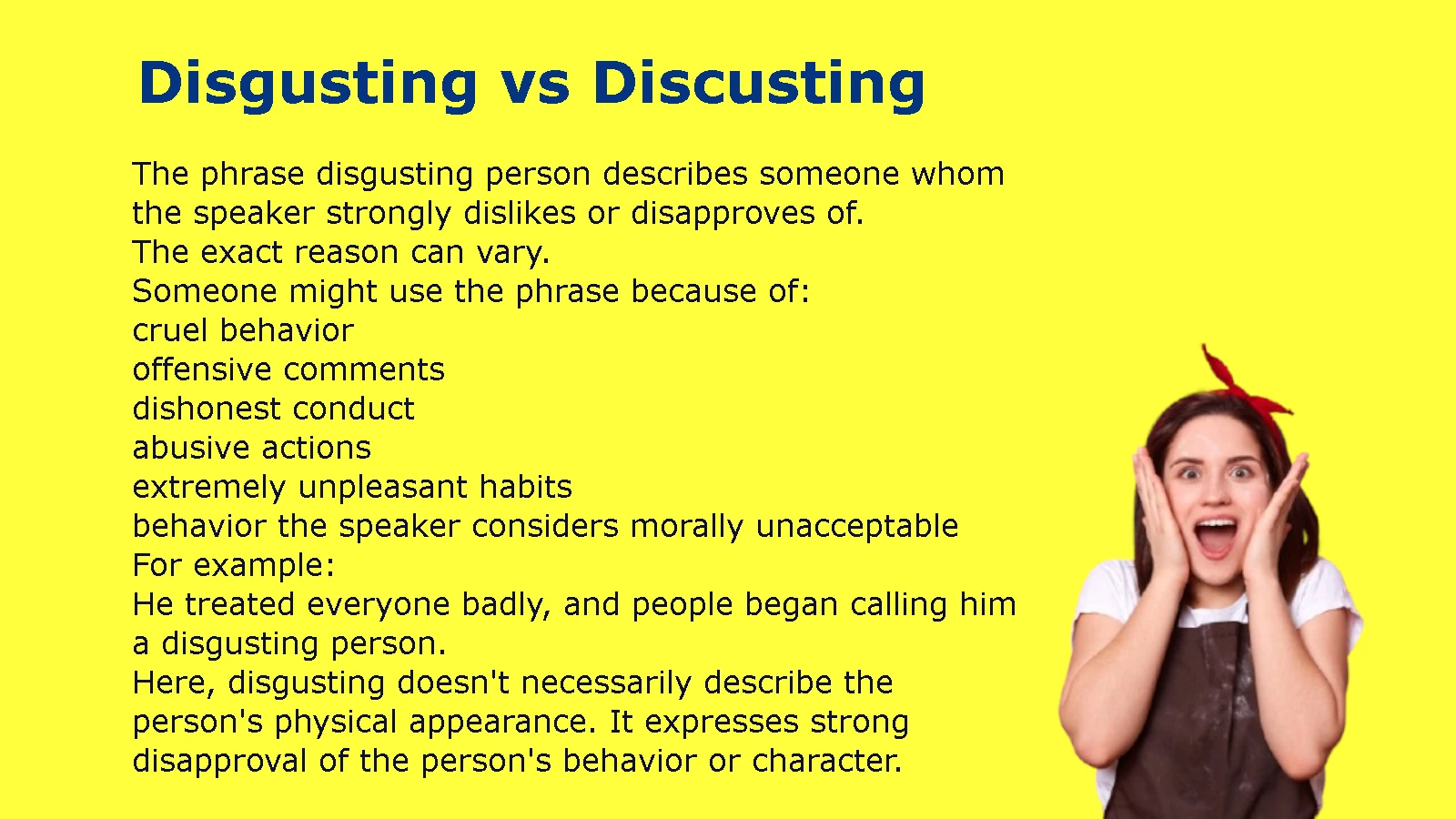
The phrase disgusting person describes someone whom the speaker strongly dislikes or disapproves of.
The exact reason can vary.
Someone might use the phrase because of:
- cruel behavior
- offensive comments
- dishonest conduct
- abusive actions
- extremely unpleasant habits
- behavior the speaker considers morally unacceptable
For example:
He treated everyone badly, and people began calling him a disgusting person.
Here, disgusting doesn’t necessarily describe the person’s physical appearance. It expresses strong disapproval of the person’s behavior or character.
That’s an important distinction.
Calling someone a disgusting person is a strong negative judgment. The phrase often communicates more than simple dislike.
Is Disgusting Person Always About Appearance?
No.
Someone can say:
She’s a disgusting person.
without referring to appearance at all.
The phrase may instead refer to conduct, attitude, language, or actions.
Compare:
- disgusting appearance → focuses on how something looks
- disgusting smell → focuses on smell
- disgusting behavior → focuses on conduct
- disgusting person → usually expresses strong disapproval of the person or their conduct
Context determines the intended meaning.
Disgusting vs Disgusted
This is one of the most important distinctions to understand because disgusting and disgusted come from the same base word but perform different jobs.
Disgusting Describes the Cause
Use disgusting when something causes a feeling of disgust.
The rotten meat was disgusting.
The meat causes the reaction.
More examples:
- The smell was disgusting.
- The movie contained some disgusting scenes.
- That habit is disgusting.
- The food tasted disgusting.
Disgusted Describes the Reaction
Use disgusted when you describe the person experiencing the feeling.
I was disgusted by the rotten meat.
The person feels the reaction.
More examples:
- She was disgusted by the smell.
- They were disgusted by his behavior.
- I felt disgusted after seeing the mess.
- He looked disgusted when he opened the container.
The Easiest Way to Remember the Difference
Think about cause versus reaction:
| Word | What it describes | Example |
| disgusting | Something that causes disgust | The smell was disgusting. |
| disgusted | Someone experiencing disgust | I was disgusted by the smell. |
This pattern appears in many English adjectives ending in -ing and -ed.
Compare:
- The movie was boring. → The movie causes boredom.
- I was bored. → I experienced boredom.
- The news was shocking. → The news caused shock.
- She was shocked. → She experienced shock.
- The smell was disgusting. → The smell caused disgust.
- He was disgusted. → He experienced disgust.
Once you understand that pattern, the difference becomes much easier to remember.
Common Misspellings of Disgusting
The most important incorrect form is:
discusting ❌
The correct form is:
disgusting ✅
Other errors can occur when someone tries to spell the word purely by sound. However, discusting is the spelling that creates the specific disgusting vs discusting confusion.
| Word | Status |
| disgusting | ✅ Standard spelling |
| discusting | ❌ Misspelling |
| disgusted | ✅ Correct related word |
| disgust | ✅ Correct base word |
| disgustingly | ✅ Correct adverb |
The easiest correction strategy is to return to the base:
disgust → disgusting
How to Spell Disgusting
If you need to spell the word aloud or type it correctly, use:
D-I-S-G-U-S-T-I-N-G
A better long-term method, however, is to remember its structure:
DISGUST + ING = DISGUSTING
That gives you the correct sequence:
D-I-S-G-U-S-T-I-N-G
The crucial middle section is GUST, not CUST.
So:
- disgusting ✅
- discusting ❌
The base word makes the difference obvious.
Disgusting in Everyday Sentences
Seeing the word in different contexts is one of the quickest ways to understand how it works.
Disgusting Food
The chicken had been left out all day and tasted disgusting.
Here, disgusting describes the unpleasant quality of the food.
Disgusting Smell
A disgusting smell was coming from the trash can.
The adjective describes the smell.
Disgusting Appearance
The abandoned refrigerator was covered in disgusting mold.
The word describes an unpleasant visual condition.
Disgusting Behavior
His disgusting behavior made everyone uncomfortable.
Here, the word has a moral or social meaning rather than a physical one.
Disgusting Comment
That was a disgusting comment to make.
The adjective expresses strong disapproval of what someone said.
Disgusting Condition
The apartment was left in a disgusting condition.
The word describes an extremely unpleasant state.
Disgusting Habit
Picking food out of your teeth at the dinner table can look disgusting to other people.
This example shows why context matters. Something may be considered disgusting because of social expectations as well as physical unpleasantness.
When Should You Use Disgusting?
Use disgusting when you want to communicate a strong reaction of unpleasantness, revulsion, or disapproval.
It works particularly well with nouns such as:
- smell
- taste
- food
- mess
- habit
- behavior
- language
- comment
- condition
- sight
- scene
- practice
- treatment
Merriam-Webster’s usage data also shows disgusting commonly occurring with nouns such as habit, substances, sights, mess, language, odor, stench, and behavior-related terms.
That range demonstrates how flexible the adjective is.
When Should You Avoid Disgusting?
Although disgusting is common, it is a strong word.
You wouldn’t normally use it for something that is merely slightly inconvenient or mildly unpleasant.
For example:
The room was a little uncomfortable.
is much weaker than:
The room was disgusting.
The second sentence suggests a much stronger reaction.
Choosing the right adjective matters because disgusting carries emotional weight. If something is merely untidy, messy may be more accurate. If something smells slightly unpleasant, unpleasant or foul might fit better.
Disgusting vs Unpleasant
These words overlap, but disgusting is generally stronger.
| Word | Typical strength | Example |
| unpleasant | Mild to moderate | The smell was unpleasant. |
| foul | Strong, especially for smell/taste | There was a foul odor. |
| gross | Strong and informal | That looks gross. |
| disgusting | Strong physical or moral reaction | The spoiled food was disgusting. |
| revolting | Very strong | The sight was revolting. |
These aren’t fixed levels for every situation. Context matters. Still, the comparison helps show why disgusting shouldn’t be treated as a neutral synonym for bad.
The History of the Word Disgusting
Disgusting isn’t a modern internet spelling or newly created slang term.
Dictionary sources trace it back to the verb disgust, with the adjective formed using the -ing suffix. The Oxford English Dictionary records an early example of disgusting from 1754, while Etymonline also dates the adjective to 1754.
The underlying word disgust has an older history. Etymonline traces the verb to French desgouster, associated with distaste or strong dislike.
That history reinforces the spelling structure used today:
disgust → disgusting
The modern adjective has been part of English for centuries.
A Simple Spelling Case Study
Imagine three people hear the same sentence:
That smell is disgusting.
One person has never seen the word written down. They might try to spell it from sound.
Another person recognizes the base word disgust.
The second person has a much easier route to the correct spelling:
disgust → disgusting
This illustrates a useful general spelling strategy. When an unfamiliar adjective comes from a familiar base word, identify the base before guessing the spelling.
For disgusting, that approach eliminates the discusting error immediately.
Disgusting vs Discusting in Formal Writing
If you’re writing something formal, always use disgusting.
This includes:
- academic assignments
- essays
- professional emails
- reports
- websites
- blog posts
- applications
- business communication
- formal social media posts
The misspelling discusting can make otherwise polished writing look careless.
For example:
Incorrect:
The article described the conditions as discusting.
Correct:
The article described the conditions as disgusting.
The correction is simple, but it changes the sentence from a spelling error to standard English.
Frequently Asked Questions About Disgusting vs Discusting
Is Disgusting or Discusting Correct?
Disgusting is correct.
Discusting is a misspelling. The correct form comes from disgust + -ing.
Is Discusting a Word?
Discusting isn’t the standard English spelling of this adjective. If you mean something extremely unpleasant or unacceptable, use disgusting.
How Do You Spell Disgusting?
The correct spelling is:
D-I-S-G-U-S-T-I-N-G
Remember:
DISGUST + ING = DISGUSTING
Why Do People Write Discusting?
The error likely comes from spelling the word according to how it sounds. The spoken form doesn’t make every letter obvious, so someone may substitute c for the g in the middle.
Remembering the base word disgust prevents this mistake.
What Is the Meaning of Disgusting?
Disgusting means extremely unpleasant or unacceptable. It can describe something physically revolting, such as a smell or spoiled food, or something deeply offensive, such as behavior or language.
What Is the Meaning of Disgusting Person?
A disgusting person is someone the speaker strongly disapproves of or finds deeply unpleasant. The phrase usually refers to behavior, character, actions, or conduct rather than simply physical appearance.
What Is the Difference Between Disgusting and Disgusted?
Disgusting describes something that causes disgust.
Disgusted describes someone who experiences disgust.
For example:
The smell was disgusting, and I was disgusted by it.
What Is a Synonym for Disgusting?
Depending on the context, synonyms include:
- gross
- revolting
- repulsive
- nauseating
- foul
- sickening
- offensive
- repugnant
No synonym works perfectly in every sentence, so choose one that matches the context and level of intensity.
How Do You Remember the Spelling of Disgusting?
Remember the base word:
disgust + ing = disgusting
The g stays in the word.
Is Disgusting a Verb or an Adjective?
Disgusting is an adjective.
It describes something that causes disgust.
The related verb is disgust:
The smell disgusted me.
The related adjective disgusted describes the person experiencing the reaction:
I was disgusted by the smell.
Final Answer: Disgusting or Discusting?
When choosing between disgusting vs discusting, the answer is straightforward:
Disgusting is the correct spelling.
Discusting is a misspelling.
The easiest way to remember the difference is to start with the base word disgust and add -ing:
DISGUST + ING = DISGUSTING
The adjective means extremely unpleasant or unacceptable. You can use it for physical things such as bad smells, spoiled food, and filthy conditions. You can also use it for behavior, comments, language, and actions that provoke strong disapproval.
The related form disgusted has a different job. Something disgusting causes the feeling, while a person becomes disgusted by it.
So, when you’re writing the word, keep one thing in mind:
disgust → disgusting
That single connection makes the correct spelling much easier to remember.