Subsidizing vs subsidising is a spelling difference between American and British English. Both words have exactly the same meaning: providing financial assistance to reduce the cost of a product, service, or activity. American English uses subsidizing, while British English uses subsidising. The difference involves spelling, not meaning, pronunciation, or grammatical function.
The word subsidizing describes the act of providing financial support, often through government funding, business assistance, educational grants, or housing programs. Understanding this term also helps explain related expressions such as subsidize meaning, substantial subsidies, subsidised housing, and subsidized vs unsubsidized loans.
| Question | Answer |
| Is it subsidizing or subsidising? | Subsidizing is American English; subsidising is British English. |
| What does subsidizing mean? | It means providing financial assistance to reduce costs or support an activity. |
| Is subsidise a noun or a verb? | Subsidise is a verb. Subsidy and subsidies are nouns. |
| What is a synonym for subsidize? | Fund, finance, support, sponsor, and underwrite are common alternatives. |
| What does subsidised housing mean? | It refers to housing made more affordable through financial assistance. |
Subsidizing vs Subsidising: What’s the Difference?
Subsidizing and subsidising have the same definition, pronunciation, and grammatical function. The only difference is the spelling convention used in different varieties of English. American English generally uses the letter Z, whereas British English uses S. Both forms are correct, so your choice should depend on your intended audience.
Subsidizing Is the American English Spelling
Subsidizing is the standard American English spelling of the present participle and gerund form of the verb subsidize.
American writers use this spelling in newspapers, academic papers, government publications, business documents, and everyday communication.
For example:
- The government is subsidizing public transportation to make commuting more affordable.
- The university is subsidizing accommodation for students from low-income families.
- Several companies are subsidizing employee healthcare plans.
- The state is subsidizing renewable energy projects to encourage cleaner electricity production.
- The organization is subsidizing food distribution in underserved communities.
Notice that the Z remains in every example. This spelling follows the American convention of using -ize rather than -ise in words such as organize, recognize, and authorize.
Subsidising Is the British English Spelling
Subsidising is the standard British English spelling of the same word. It follows the British spelling convention that commonly uses -ise instead of -ize.
Writers in the United Kingdom generally use this form in formal documents, educational materials, news articles, and everyday writing.
For example:
- The government is subsidising public transport to reduce travel expenses.
- The council is subsidising affordable housing projects.
- The university is subsidising accommodation for eligible students.
- Local authorities are subsidising renewable energy installations.
- The organization is subsidising essential services for vulnerable households.
The meaning remains identical to the American spelling. Only the written form changes.
British English also uses related forms such as subsidised, subsidises, and subsidisation.
Subsidizing vs Subsidising: Side-by-Side Comparison
The following table highlights the main differences and similarities.
| Feature | American English | British English |
| Base verb | Subsidize | Subsidise |
| Present participle | Subsidizing | Subsidising |
| Past tense | Subsidized | Subsidised |
| Past participle | Subsidized | Subsidised |
| Third-person singular | Subsidizes | Subsidises |
| Noun form | Subsidization | Subsidisation |
| Meaning | Financially support | Financially support |
| Pronunciation | Same | Same |
| Grammatical function | Verb form | Verb form |
The most important point is that neither spelling is more correct than the other. Each belongs to a different English spelling convention.
Subsidize vs Subsidise: Which Spelling Should You Use?
Choose subsidize when writing for an American audience and subsidise when writing for a British audience.
For example, an American financial publication would generally write:
“The government is subsidizing small businesses.”
A British publication would generally write:
“The government is subsidising small businesses.”
Both sentences communicate the same information.
Consistency matters more than choosing one spelling over the other. Avoid switching between American and British forms within the same article unless you are directly comparing the two.
What Is Subsidizing? Meaning and Definition
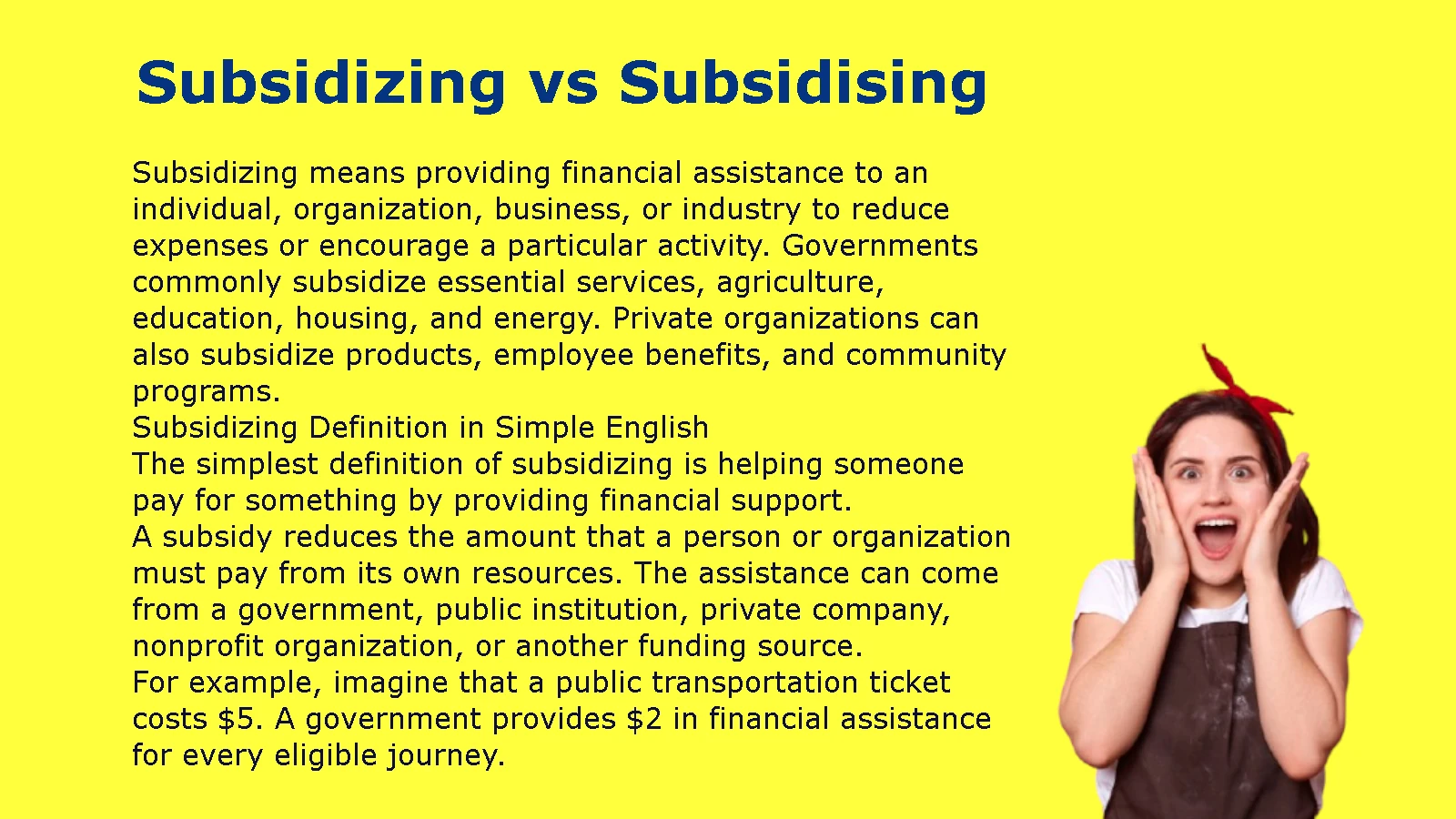
Subsidizing means providing financial assistance to an individual, organization, business, or industry to reduce expenses or encourage a particular activity. Governments commonly subsidize essential services, agriculture, education, housing, and energy. Private organizations can also subsidize products, employee benefits, and community programs.
Subsidizing Definition in Simple English
The simplest definition of subsidizing is helping someone pay for something by providing financial support.
A subsidy reduces the amount that a person or organization must pay from its own resources. The assistance can come from a government, public institution, private company, nonprofit organization, or another funding source.
For example, imagine that a public transportation ticket costs $5. A government provides $2 in financial assistance for every eligible journey.
The passenger pays only $3, while the subsidy covers the remaining $2.
This is an example of subsidizing because an outside organization helps reduce the actual cost of a service.
Here are some important related terms:
- Subsidy: Financial assistance provided to reduce costs or support an activity.
- Subsidize: To provide financial assistance.
- Subsidizing: The ongoing act of providing financial assistance.
- Subsidized: Something that receives financial assistance.
- Subsidization: The process of providing financial support.
These words belong to the same word family, but they perform different grammatical functions.
What Does Subsidize Mean in Different Contexts?
The meaning of subsidize remains consistent across industries, but the way organizations provide financial support can differ.
Here are some common contexts.
Government and public policy
Governments subsidize services and industries to achieve economic or social objectives.
For example, a government might provide financial assistance to farmers so they can afford seeds, fertilizers, irrigation systems, and agricultural equipment.
This support can help maintain food production and protect agricultural businesses from certain financial risks.
Business and industry
Companies sometimes subsidize products, services, or employee benefits.
For example, an employer might cover 50% of an employee’s health insurance premium. The employee pays the remaining amount.
This arrangement makes healthcare more affordable while helping the company attract and retain workers.
Education
Universities, governments, and educational organizations may subsidize tuition, textbooks, transportation, or student accommodation.
A student who receives financial assistance pays less than the standard price.
Healthcare
Public healthcare systems and private organizations may subsidize medicines, medical treatments, insurance premiums, or preventive care.
The goal is to reduce the financial barriers that prevent people from receiving necessary medical services.
Transportation
Governments may subsidize buses, trains, ferries, and other public transportation services.
This support can keep ticket prices affordable and encourage people to use public transport instead of private vehicles.
What Does Substantial Subsidies Mean?
Substantial subsidies means significant or considerable amounts of financial assistance provided to support a person, business, industry, or service.
The word substantial describes the size, importance, or financial value of the assistance. It does not necessarily mean that the support covers every expense.
For example:
“The agricultural industry receives substantial subsidies from the government.”
This means the government provides a considerable amount of financial assistance to agricultural producers.
Consider these additional examples:
- The renewable energy sector received substantial subsidies to encourage investment in solar and wind power.
- The university provides substantial subsidies to students who cannot afford accommodation.
- Farmers benefit from substantial subsidies that help reduce production expenses.
- The government introduced substantial subsidies to make essential medicines more affordable.
Substantial subsidies can take different forms, including:
- Direct financial payments.
- Tax credits and tax reductions.
- Reduced interest rates.
- Discounted public services.
- Government-backed loans.
- Financial assistance for specific operating expenses.
The exact value and structure depend on the program providing the support.
How Does Subsidizing Work?
Subsidizing generally involves one organization providing financial assistance so another party can afford a product, service, or activity.
The process often follows these steps:
Step 1: Identify the financial need
A government or organization identifies an expense that creates a financial barrier.
For example, low-income households may struggle to afford electricity or housing.
Step 2: Establish a subsidy program
The funding organization creates a program that explains who qualifies, what expenses receive support, and how much assistance recipients can receive.
Step 3: Provide financial assistance
The organization distributes money, offers discounts, covers eligible expenses, or provides another form of financial support.
Step 4: Reduce the recipient’s costs
The individual or organization pays less because the subsidy covers part of the expense.
Step 5: Monitor the results
The funding organization may review the program to determine whether it achieves its intended objectives.
The following example shows how the process works.
| Expense | Amount |
| Original electricity bill | $150 |
| Government subsidy | $40 |
| Amount paid by household | $110 |
In this example, the household saves $40 because the government covers part of the electricity cost.
However, subsidies do not always appear as direct payments. Some programs reduce taxes, provide discounted services, or compensate suppliers instead.
Subsidizing and Subsidising Examples in Sentences
Examples make it easier to understand how subsidizing and subsidising work in everyday writing.
Both spellings follow the same grammatical rules. You only need to select the form that matches your preferred English variety.
Examples of Subsidizing in American English
Here are original sentences using the American spelling:
- The government is subsidizing electric vehicle purchases to encourage cleaner transportation.
- The company started subsidizing employee meals during working hours.
- Local authorities are subsidizing childcare services for eligible families.
- The university is subsidizing tuition for students with financial difficulties.
- The state plans to continue subsidizing public transportation next year.
- Several organizations are subsidizing community health programs.
- The agricultural department is subsidizing farmers affected by rising production costs.
- The nonprofit is subsidizing vocational training for unemployed adults.
- The government considered subsidizing essential food products during the economic crisis.
- The organization stopped subsidizing the program after its funding expired.
Examples of Subsidising in British English
These examples use the British spelling:
- The government is subsidising electricity costs for eligible households.
- The council is subsidising local bus services.
- The university is subsidising student accommodation.
- Several charities are subsidising educational programs.
- The company is subsidising employee travel expenses.
- The government plans to continue subsidising agricultural production.
- The organization is subsidising healthcare services in rural communities.
- Local authorities are subsidising childcare for working parents.
- The department discussed subsidising renewable energy installations.
- The charity stopped subsidising the project when its funding ended.
Examples in Business, Government, and Everyday Life
Subsidizing appears in many situations because financial assistance can support almost any activity that an organization wants to make more affordable.
| Context | Example | Purpose |
| Agriculture | Subsidizing crop production | Support farmers and food production |
| Education | Subsidizing tuition fees | Reduce education expenses |
| Healthcare | Subsidizing medicine | Improve affordability |
| Housing | Subsidizing rent | Help eligible households |
| Transportation | Subsidizing bus fares | Reduce commuting costs |
| Energy | Subsidizing electricity | Lower energy expenses |
| Business | Subsidizing employee benefits | Support workers |
| Environment | Subsidizing solar panels | Encourage cleaner energy |
Practical case study: A company subsidizing employee transportation
Imagine a company employs 200 people, many of whom travel to work by public transportation.
The average monthly transportation expense is $80 per employee. The company decides to subsidize 40% of the cost.
The calculation looks like this:
| Item | Amount |
| Monthly transportation cost per employee | $80 |
| Company subsidy (40%) | $32 |
| Employee payment | $48 |
| Total monthly company contribution | $6,400 |
The company spends $6,400 per month to make transportation more affordable for its employees.
This is an example of private subsidization. The company provides financial assistance without changing the basic meaning of the word.
Subsidize Meaning, Synonyms, and Related Words
Subsidize means to provide financial support to reduce someone’s expenses or help an activity continue. It is the base verb behind subsidizing and subsidising. Several related words can express similar ideas, but their meanings and appropriate contexts are not always identical.
What Is the Meaning of Subsidize?
The verb subsidize describes an action rather than the financial assistance itself.
When an organization subsidizes something, it contributes money or another financial benefit to reduce the recipient’s costs.
For example:
“The government decided to subsidize public transportation.”
In this sentence, the government performs the action of providing financial assistance.
Compare the following expressions:
- The government provides a subsidy.
- The government subsidizes public transportation.
- The government is subsidizing public transportation.
- Public transportation is subsidized by the government.
Each sentence describes a related part of the same financial arrangement.
The word can also appear in economic discussions involving market prices, production expenses, consumer demand, and public spending.
Subsidize Synonyms
Several words can replace subsidize, depending on the situation.
| Synonym | Meaning | Example |
| Fund | Provide money for something | The council funds local housing projects. |
| Finance | Supply financial resources | The company finances employee training. |
| Support | Provide assistance | The government supports small businesses. |
| Sponsor | Provide financial backing | The organization sponsors educational programs. |
| Underwrite | Accept financial responsibility for costs or risks | The institution underwrites the project. |
| Assist | Help someone financially or practically | The charity assists low-income families. |
| Supplement | Add to an existing amount | The grant supplements school funding. |
| Contribute | Give money or resources | The company contributes to healthcare expenses. |
| Back | Provide support or financial backing | Investors back the development project. |
Important distinction: These synonyms are not interchangeable in every sentence.
For example, fund often suggests providing money for an entire project, while subsidize usually emphasizes reducing the cost paid by another party.
Similarly, sponsor often refers to financial backing in exchange for recognition or another benefit. A subsidy does not necessarily involve such an arrangement.
Subsidize vs Support vs Finance
These three words overlap, but they communicate different ideas.
Subsidize specifically emphasizes financial assistance that reduces costs or encourages an activity.
Example: The government subsidizes agricultural production.
Support has a broader meaning. It can involve money, practical assistance, resources, encouragement, or other forms of help.
Example: The organization supports local farmers.
Finance focuses on providing or arranging the money needed for an activity, purchase, or project.
Example: The bank finances the construction project.
Use the words according to the meaning you want to communicate:
- Choose subsidize when someone covers part of another party’s expenses.
- Choose support when describing general assistance.
- Choose finance when discussing how an activity or purchase receives funding.
Subsidise Meaning, Pronunciation, and Word Forms
The British verb subsidise has the same meaning as the American verb subsidize. Both forms describe providing financial assistance. Their related word forms follow regional spelling conventions, although some related noun forms have different endings that writers should learn separately.
How Do You Pronounce Subsidised?
The word subsidised is pronounced approximately:
IPA: /ˈsʌb.sɪ.daɪzd/
The word has three syllables, with the main stress on the first syllable.
The final sound is a Z sound, even though British English writes the word with an S.
This distinction matters because English spelling does not always represent pronunciation directly.
The related forms are:
| Word | IPA pronunciation |
| Subsidize | /ˈsʌb.sɪ.daɪz/ |
| Subsidise | /ˈsʌb.sɪ.daɪz/ |
| Subsidizing | /ˈsʌb.sɪ.daɪ.zɪŋ/ |
| Subsidising | /ˈsʌb.sɪ.daɪ.zɪŋ/ |
| Subsidized | /ˈsʌb.sɪ.daɪzd/ |
| Subsidised | /ˈsʌb.sɪ.daɪzd/ |
The pronunciation stays essentially the same across the American and British spellings.
Is Subsidise a Noun or a Verb?
Subsidise is a verb, not a noun. It describes the action of providing financial assistance. The corresponding noun is subsidy, while its plural form is subsidies.
Consider these examples:
| Word | Part of speech | Example |
| Subsidise | Verb | The government will subsidise transport. |
| Subsidy | Noun | The business received a subsidy. |
| Subsidies | Plural noun | Farmers received several subsidies. |
| Subsidising | Verb form / gerund | Subsidising education can improve access. |
| Subsidised | Past participle / adjective | The subsidised service costs less. |
| Subsidisation | Noun | The subsidisation of public transport reduced fares. |
The distinction between a verb and a noun is particularly useful when writing formal financial or economic content.
For example:
Incorrect: “The government provided a subsidise.”
Correct: “The government provided a subsidy.”
Incorrect: “The company will subsidy employee healthcare.”
Correct: “The company will subsidise employee healthcare.”
Different Forms of Subsidize and Subsidise
Understanding the word family helps you use the correct spelling in different grammatical situations.
| Word form | American English | British English |
| Base verb | Subsidize | Subsidise |
| Third-person singular | Subsidizes | Subsidises |
| Present participle | Subsidizing | Subsidising |
| Past tense | Subsidized | Subsidised |
| Past participle | Subsidized | Subsidised |
| Noun | Subsidization | Subsidisation |
The spelling difference appears mainly in the verb’s -ize and -ise forms and in the corresponding noun endings.
The past forms also follow the same regional distinction.
Examples:
- The government subsidizes public transportation.
- The government subsidises public transportation.
- The government was subsidizing public transportation.
- The government was subsidising public transportation.
- The government subsidized the project.
- The government subsidised the project.
Subsidise UK Spelling Rules
British English commonly uses -ise in words that American English spells with -ize.
This pattern appears in several familiar words:
| American English | British English |
| Subsidize | Subsidise |
| Organize | Organise |
| Recognize | Recognise |
| Authorize | Authorise |
| Apologize | Apologise |
| Realize | Realise |
However, British English does not always require -ise. The -ize spelling is also accepted in some British English publishing styles and dictionaries.
Therefore, it is more accurate to describe subsidise as the common British spelling rather than claim that every British publication must use it.
If you follow a British house style, use the spelling specified by that publication. The same principle applies to American English.
What Does Subsidised Housing Mean?
Subsidised housing refers to residential accommodation that receives financial assistance from a government or another organization to make housing more affordable. The assistance may reduce rent, support construction, provide housing vouchers, or help eligible households obtain suitable accommodation at a lower cost.
How Does Subsidised Housing Work?
Subsidised housing programs aim to reduce the financial burden of accommodation.
Housing can become expensive because of limited supply, high property prices, rising construction costs, or household income limitations.
A housing subsidy helps address these problems by covering part of the cost.
Different programs use different methods.
Rent assistance: An eligible household receives financial support that reduces its monthly rent.
Public housing: A government or public housing authority provides residential accommodation at an affordable rental rate.
Affordable housing development: Governments provide financial incentives or assistance to developers who build housing for eligible households.
Housing vouchers: Qualified tenants receive assistance that can help cover rent in approved private rental properties.
For example, imagine a household rents an apartment for $1,000 per month. A housing program provides $300 in monthly assistance.
The household pays $700, while the program covers the remaining $300.
This is one possible example of subsidised housing.
Who Qualifies for Subsidised Housing?
Eligibility depends on the country, local authority, and specific housing program.
Common eligibility factors include:
- Household income.
- Number of people living in the property.
- Local residency requirements.
- Housing needs.
- Employment or financial circumstances.
- Disability or other qualifying circumstances under the program.
- Availability of suitable housing.
Some programs prioritize households with very low incomes, while others support people who fall within a broader income range.
Applicants may need to provide income statements, household details, identification, and other documents required by the housing authority.
There is no universal income threshold for subsidised housing. Each program establishes its own requirements.
Subsidised Housing Examples
Here are some common forms of housing assistance:
| Housing type | How it works |
| Public housing | A public authority provides affordable rental accommodation. |
| Rent assistance | A program covers part of a tenant’s rent. |
| Housing vouchers | Eligible tenants receive help paying rent. |
| Affordable housing | Financial assistance helps create lower-cost residential properties. |
| Social housing | Housing is provided to eligible households based on specific social and financial needs. |
Practical example: A city wants to increase the availability of affordable homes for working families.
It offers financial incentives to developers who build apartments that meet specific affordability requirements.
The developers receive support that helps reduce project costs. In return, they provide apartments at rents below the standard market rate for eligible residents.
This is another example of subsidization, even though the assistance goes to housing developers rather than directly to tenants.
Subsidized vs Unsubsidized Loans: What’s the Difference?
Subsidized and unsubsidized loans differ mainly in how interest costs are handled. With eligible US federal Direct Subsidized Loans, the government covers interest during certain qualifying periods. Direct Unsubsidized Loans generally accrue interest from disbursement, and the borrower remains responsible for it.
What Is a Subsidized Loan?
A subsidized loan is a type of loan in which an outside organization covers some interest costs or provides another form of financial assistance.
In the United States, a Direct Subsidized Loan is a federal student loan available to eligible undergraduate students who demonstrate financial need.
The federal government generally pays the interest:
- While the student attends school at least half-time.
- During the applicable grace period after leaving school.
- During qualifying deferment periods.
This interest benefit can reduce the total amount a borrower must repay.
For example, imagine a student receives a $5,000 Direct Subsidized Loan.
During an eligible period, the government covers the applicable interest rather than allowing it to accumulate as a cost the student must pay.
The student still needs to repay the original loan principal, but the interest subsidy can make the borrowing arrangement less expensive.
What Is an Unsubsidized Loan?
An unsubsidized loan does not provide the same government-paid interest benefit.
In the United States, a Direct Unsubsidized Loan is available to eligible undergraduate and graduate students. Financial need is not required for eligibility.
Interest generally begins accumulating when the loan is disbursed.
Borrowers can choose to pay the interest while attending school. If they do not, unpaid interest may be added to the principal in certain circumstances, increasing the amount on which future interest accrues.
For example, a student borrows $5,000 through a Direct Unsubsidized Loan.
Interest begins accumulating after the loan is disbursed. If the student does not pay that interest, the total cost of borrowing may increase over time.
Subsidized vs Unsubsidized Loans Comparison
| Feature | Subsidized Loan | Unsubsidized Loan |
| Financial need | Required for Direct Subsidized Loans | Not required |
| Eligible students | Undergraduate students | Undergraduate and graduate students |
| Interest during eligible school periods | Government generally pays | Borrower is responsible |
| Interest during applicable grace period | Government generally pays | Borrower is responsible |
| Interest during qualifying deferment | Government generally pays | Borrower is responsible |
| Overall borrowing cost | Can be lower | Can be higher |
| Repayment responsibility | Borrower repays principal | Borrower repays principal and applicable interest |
The distinction is important because the interest subsidy can save eligible students money over the life of a loan.
Which Loan Is Better?
For an eligible student who qualifies for both options, a Direct Subsidized Loan is generally more affordable because the government covers interest during specified qualifying periods.
However, the best borrowing decision depends on the amount needed, eligibility, interest rate, repayment terms, and total borrowing costs.
Consider these points before choosing:
- Check whether you qualify for a subsidized loan.
- Compare the amount available under each loan type.
- Understand when interest begins accumulating.
- Consider paying unsubsidized loan interest while attending school if financially possible.
- Review repayment terms before borrowing.
- Avoid borrowing more than you need.
A subsidized loan does not mean free money. The borrower must still repay the principal and follow the loan’s repayment conditions.
Common Mistakes When Using Subsidizing and Subsidising
Although both spellings are straightforward, writers sometimes confuse their grammatical forms or use American and British conventions inconsistently.
Understanding these common mistakes will help you write more accurately.
Mixing American and British Spellings
One common mistake is switching between American and British spelling conventions within the same document.
For example:
Incorrect: “The government is subsidizing public services and subsidising housing.”
This sentence mixes the American and British forms.
Better American English:
“The government is subsidizing public services and housing.”
Better British English:
“The government is subsidising public services and housing.”
Choose one spelling convention and apply it consistently.
Confusing Subsidizing With Subsidies
Subsidizing describes the action of providing financial assistance, while subsidies refers to the financial assistance itself.
Compare:
- The government is subsidizing public transportation.
- The government provides subsidies for public transportation.
The first sentence describes an action. The second describes financial support.
Using Subsidize When Subsidy Is Required
Another common error involves confusing the verb with the noun.
For example:
Incorrect: “The company received a subsidize.”
Correct: “The company received a subsidy.”
Incorrect: “The government will subsidy farmers.”
Correct: “The government will subsidize farmers.”
Remember that subsidize is a verb, while subsidy is a noun.
Confusing Subsidized and Unsubsidized Financial Support
The terms subsidized and unsubsidized do not mean the same thing.
A subsidized product, service, or loan receives some form of financial assistance. An unsubsidized arrangement does not receive that particular subsidy.
For student loans, the distinction specifically concerns who pays interest during qualifying periods.
Avoid assuming that every subsidized loan has no interest or that every unsubsidized loan has a higher interest rate. The actual cost depends on the loan’s terms.
Conclusion: Subsidizing vs Subsidising
The difference between subsidizing vs subsidising comes down to regional spelling preferences. American English uses subsidizing, while British English generally uses subsidising. Both forms have the same meaning and grammatical function.
The word describes providing financial assistance to reduce costs or support an activity. It appears in many contexts, including government spending, agriculture, education, healthcare, transportation, and affordable housing.
Understanding related terms makes the distinction even clearer:
- Subsidize: The base verb meaning to provide financial assistance.
- Subsidizing: The ongoing act of providing financial support.
- Subsidy: Financial assistance itself.
- Subsidised housing: Housing made more affordable through financial support.
- Subsidized loan: A loan that receives qualifying financial assistance, such as government-paid interest during specified periods.
When writing for an American audience, choose subsidizing. For a British audience, use subsidising. Most importantly, maintain consistent spelling throughout your content.
Want to improve your English spelling and word usage? Explore more American vs British English spelling comparisons to understand regional differences and choose the right form for every audience.
Frequently Asked Questions
Is It Subsidizing or Subsidising?
Both spellings are correct. Subsidizing is the standard American English form, while subsidising is the common British English form. They have the same meaning and pronunciation. Choose the spelling that matches your intended audience.
What Is the Simple Meaning of Subsidizing?
Subsidizing means providing financial assistance to reduce the cost of something. Governments, businesses, and organizations may subsidize housing, education, transportation, healthcare, and other services to make them more affordable.
Is Subsidise a Noun or a Verb?
Subsidise is a verb. It describes the action of providing financial assistance. The corresponding noun is subsidy, and its plural form is subsidies. For example, a government may subsidise transportation by providing subsidies.
What Is Another Word for Subsidize?
Common synonyms for subsidize include fund, finance, support, sponsor, underwrite, assist, and contribute. The best alternative depends on the context. Fund and finance emphasize providing money, while support can describe broader forms of assistance.
What Does Substantial Subsidies Mean?
Substantial subsidies refers to significant or considerable amounts of financial assistance. For example, a government providing substantial subsidies to farmers contributes considerable financial resources to support agricultural production and reduce certain operating costs.
What Is the Difference Between Subsidized and Unsubsidized Loans?
The main difference concerns interest payments. With eligible US Direct Subsidized Loans, the government covers interest during certain qualifying periods. Direct Unsubsidized Loans generally accrue interest from disbursement, and borrowers remain responsible for that interest.