Chiseled vs Chiselled comes down to one simple spelling difference: chiseled is the standard American English spelling, while chiselled is the standard British English spelling. Both words have the same meaning and pronunciation. They describe something carved with a chisel or, figuratively, something with sharply defined features, such as a chiseled face, chiseled jawline, or chiseled body.
However, the word has more than one use. You might encounter it in discussions about sculpture, facial appearance, fitness, and physical attractiveness. Understanding these meanings helps you choose the correct spelling and use the word naturally in different situations.
| Question | Answer |
| Is it chiseled or chiselled? | Chiseled is American English; chiselled is British English. |
| Do chiseled and chiselled mean the same thing? | Yes. Both describe something carved, sculpted, or sharply defined. |
| How do you pronounce chiseled? | CHIZ-uhld, with stress on the first syllable. |
| What does a chiseled face mean? | A face with defined cheekbones, an angular appearance, and a prominent jawline. |
| What does chiseled body mean? | A lean, muscular physique with noticeable muscle definition. |
Chiseled vs Chiselled: What’s the Difference?
Chiseled and chiselled are two accepted spellings of the same word. The difference comes from regional spelling conventions, not meaning, pronunciation, or grammar. American English generally drops the extra L when forming the past tense of certain verbs, while British English often keeps the final consonant doubled.
Both spellings refer to the action of shaping something with a chisel or describing an appearance that looks sculpted and sharply defined.
Chiseled Is the American English Spelling
Chiseled is the preferred spelling in the United States. It follows the American convention of using one L when adding certain endings to verbs that end in L.
For example:
- The sculptor chiseled a detailed pattern into the stone.
- The actor has a chiseled jawline.
- His chiseled features made him stand out in the portrait.
- The artist chiseled the design carefully into the marble.
- Years of training helped him develop a well-defined, muscular appearance.
American publications, schools, newspapers, and businesses generally use chiseled.
Related American English forms include:
- Chisel
- Chiseling
- Chiseled
- Chiseler
The spelling remains consistent in ordinary American writing.
Chiselled Is the British English Spelling
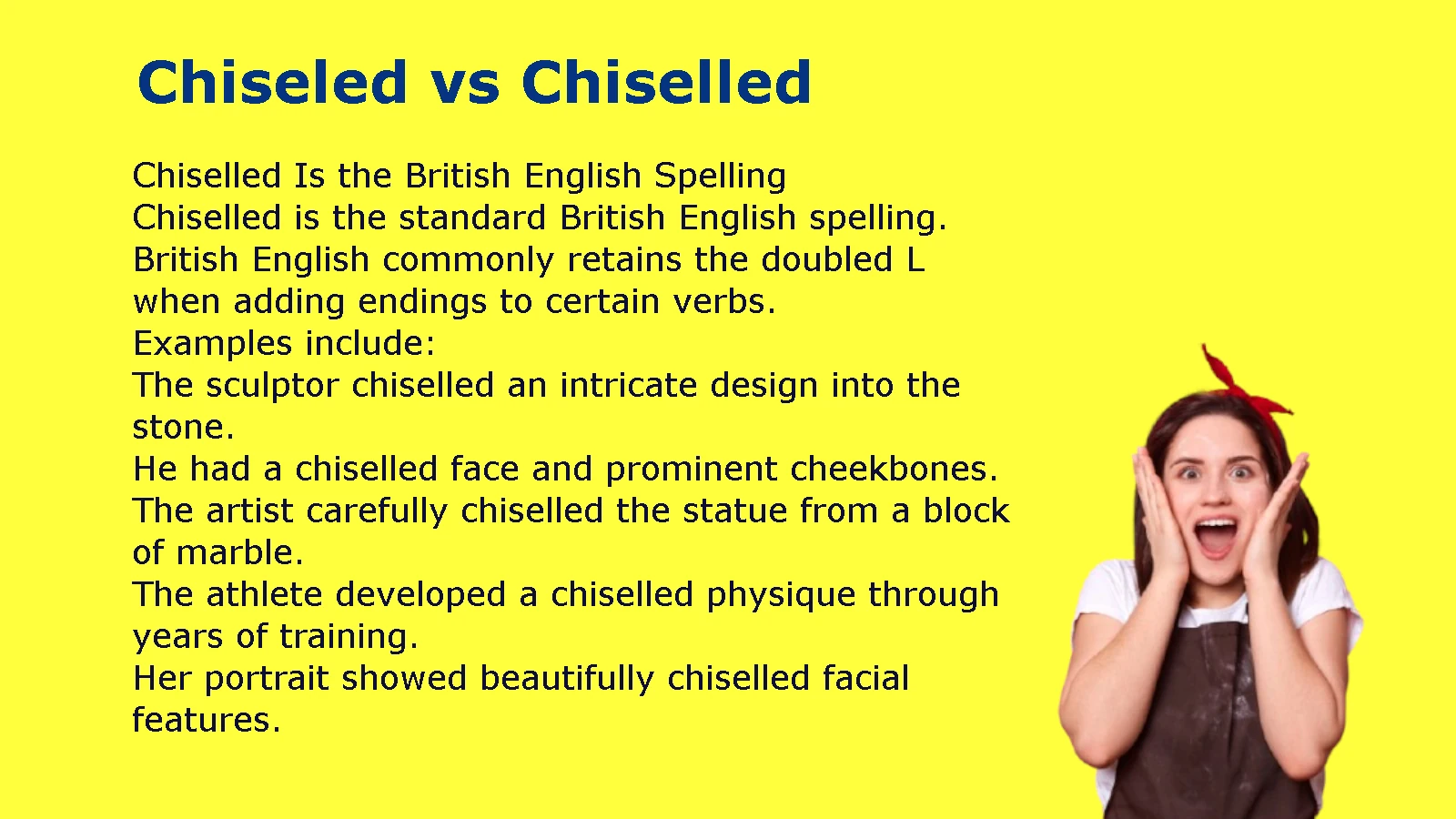
Chiselled is the standard British English spelling. British English commonly retains the doubled L when adding endings to certain verbs.
Examples include:
- The sculptor chiselled an intricate design into the stone.
- He had a chiselled face and prominent cheekbones.
- The artist carefully chiselled the statue from a block of marble.
- The athlete developed a chiselled physique through years of training.
- Her portrait showed beautifully chiselled facial features.
This spelling also appears in other English varieties that follow British spelling conventions, including many publications in Australia and New Zealand.
Related British English forms include:
- Chisel
- Chiselling
- Chiselled
- Chiseller
Chiseled vs Chiselled Comparison Table
| Feature | Chiseled | Chiselled |
| English variety | American English | British English |
| Number of Ls | One | Two |
| Meaning | Carved or sharply defined | Carved or sharply defined |
| Pronunciation | Same | Same |
| Grammar | Past tense and past participle | Past tense and past participle |
| Common usage | United States | United Kingdom |
| Example | A chiseled face | A chiselled face |
The key point is that neither spelling is incorrect. Your choice should depend on the English variety you want to follow.
Which Spelling Should You Use?
Choose the spelling that matches your target audience.
If you write for American readers, use chiseled. If your article targets British readers, use chiselled. The same rule applies to other words that follow similar spelling patterns.
Consider these examples:
| American English | British English |
| Chiseled | Chiselled |
| Canceled | Cancelled |
| Traveled | Travelled |
| Labeled | Labelled |
| Modeling | Modelling |
| Canceling | Cancelling |
These examples illustrate a common spelling pattern, although English has exceptions and variations.
For SEO content, consistency matters. If your website targets the United States, use the American spelling in the title, headings, examples, and body text. You can still mention the British alternative to capture searches for both versions.
Examples of Chiseled and Chiselled in Sentences
The following sentences demonstrate how both forms work in everyday English.
| Chiseled (US) | Chiselled (UK) |
| The artist chiseled a figure into the stone. | The artist chiselled a figure into the stone. |
| He has a chiseled jawline. | He has a chiselled jawline. |
| The sculpture features chiseled details. | The sculpture features chiselled details. |
| The athlete has a chiseled body. | The athlete has a chiselled body. |
Notice that the sentence structure and meaning remain identical. Only the spelling changes.
What Does Chiseled Mean?
Chiseled means shaped, carved, or cut using a chisel. It also works as an adjective describing something with sharply defined or sculpted features. In descriptions of people, it often refers to prominent cheekbones, a defined jawline, angular facial features, or a lean and muscular physique.
The word has both literal and figurative meanings. Its intended meaning depends on the subject being described.
Chiseled as an Adjective
As an adjective, chiseled describes something that looks carefully shaped or sharply defined.
Its literal meaning connects to sculpture and craftsmanship. A sculptor uses a chisel to remove small pieces of stone, wood, or another material until the desired shape appears.
For example:
- The museum displayed a beautifully chiseled marble statue.
- The sculpture had chiseled details around its eyes.
- The artist created a chiseled pattern across the stone surface.
The figurative meaning applies the same idea to physical appearance.
For example:
- The model had chiseled cheekbones.
- His face looked angular and well-defined.
- The athlete had a chiseled physique.
In these sentences, nobody literally used a chisel on the person’s body. The word compares the person’s appearance to a carefully sculpted object.
Chiseled as a Description of a Person
When someone describes a person as chiseled, they usually mean that the person has sharply defined physical features.
The expression commonly refers to two things:
1. Facial definition
A chiseled face may have:
- Prominent cheekbones
- A clearly defined jawline
- An angular chin
- Noticeable facial contours
- A distinct transition between the jaw and neck
2. Muscular definition
A chiseled physique may feature:
- Noticeable muscle separation
- Developed shoulders and arms
- Visible abdominal muscles
- A defined chest
- A relatively lean appearance
Context determines which meaning the speaker intends.
For example, the sentence “He has a chiseled appearance” may refer to facial structure, while “He has a chiseled body” usually describes muscular development.
Chiseled vs. Sculpted vs. Defined
These words have related meanings, but they are not always interchangeable.
| Word | Meaning | Example |
| Chiseled | Sharply shaped or defined | He has a chiseled jaw. |
| Sculpted | Carefully shaped or developed | She has sculpted shoulders. |
| Defined | Clearly visible or distinguishable | He has defined abdominal muscles. |
| Angular | Having noticeable angles or edges | His face has angular features. |
| Carved | Cut or shaped from a material | The design was carved into wood. |
Chiseled often creates a stronger visual impression than simply saying someone has defined features. It suggests sharpness, structure, and a sculpted appearance.
How Do You Pronounce Chiseled?
The word chiseled is pronounced CHIZ-uhld. It has two syllables, with the main stress on the first syllable. The British spelling, chiselled, has the same pronunciation. The extra L changes the written form, not the spoken sound.
Chiseled Pronunciation in American English
The American pronunciation is:
- Simple pronunciation: CHIZ-uhld
- IPA: /ˈtʃɪzəld/
- Syllables: Two
- Stress: First syllable
The opening sound is the same as the beginning of the word “chicken.” The second syllable is shorter and unstressed.
Example:
“He has a chiseled face and a strong jawline.”
Chiselled Pronunciation in British English
British English uses the same basic pronunciation.
Although the written word contains an additional L, speakers do not pronounce it as an extra syllable.
| Feature | American English | British English |
| Written form | Chiseled | Chiselled |
| Syllables | Two | Two |
| Main stress | First syllable | First syllable |
| Pronunciation | CHIZ-uhld | CHIZ-uhld |
Regional accents can affect small details of vowel quality, but the additional L does not create a different word pronunciation.
Common Pronunciation Mistakes
Some readers assume that the two Ls in chiselled require a longer or different sound. They do not.
Common mistakes include:
- Pronouncing the word as three separate syllables.
- Giving the second syllable equal stress.
- Assuming that American and British spellings have different meanings or sounds.
- Confusing the pronunciation with the noun “chisel.”
Remember that chiseled and chiselled are pronounced alike in their standard forms.
What Does a Chiseled Face Mean?
A chiseled face is a face with prominent, sharply defined features that create a sculpted or angular appearance. People commonly use the expression to describe visible cheekbones, a distinct jawline, a defined chin, and noticeable facial contours. It describes appearance rather than a specific medical or anatomical category.
The expression often appears in fashion, fitness, entertainment, photography, and everyday conversations about physical attractiveness.
Characteristics of a Chiseled Face
A chiseled face generally has several recognizable visual features.
1. Defined cheekbones
Prominent cheekbones create visible contours across the middle of the face. Their appearance depends on facial bone structure and the surrounding soft tissue.
2. A visible jawline
A defined jawline creates a noticeable boundary between the lower face and neck.
3. An angular facial shape
The face may have clear angles around the cheeks, temples, and jaw.
4. A distinct chin
The chin may appear prominent or well-proportioned relative to the rest of the face.
5. Noticeable facial contours
Light and shadow can make facial structures appear more prominent, particularly in photographs and portraits.
Not everyone with a chiseled face has every feature. Facial structure varies naturally from person to person.
What Makes a Face Look Chiseled?
Several factors influence how defined someone’s face appears.
Genetics and bone structure
Genetics play a major role in facial proportions. The shape of the cheekbones, jawbone, and chin develops through natural growth and differs between individuals.
Facial fat distribution
The amount and distribution of soft tissue around the cheeks, chin, and jaw affect facial contours. Two people with similar bone structures may have different-looking jawlines because their facial fat distribution differs.
Skin and soft tissue
Skin elasticity and the underlying soft tissues also influence facial definition. Changes associated with aging can affect how clearly the jawline and cheekbones appear.
Age and facial development
Facial proportions change during growth and adulthood. The appearance of the lower face can also change with age.
Lighting and photography
Lighting can emphasize shadows around the cheekbones and jawline. A photograph may make someone’s face appear more sculpted than it looks under ordinary lighting.
This is why a chiseled appearance cannot be explained by body weight alone. Bone structure, soft tissue, age, and presentation all contribute.
Chiseled Face vs. Slim Face
A slim face and a chiseled face are related descriptions, but they do not mean the same thing.
| Feature | Chiseled Face | Slim Face |
| Main characteristic | Angular, defined features | Narrow or relatively lean appearance |
| Cheekbones | Often prominent | May or may not be prominent |
| Jawline | Usually well-defined | May be soft or defined |
| Chin | Often distinct | Depends on facial structure |
| Bone structure | Strongly influences appearance | Influences width and proportions |
| Overall impression | Sculpted and angular | Narrower or less full |
A person can have a slim face without prominent cheekbones or an angular jawline. Similarly, someone can have a naturally chiseled face without having an especially thin appearance.
What Is a Chiseled Chin and Chiseled Jaw?
A chiseled chin is a chin with a distinct, well-defined appearance, while a chiseled jaw describes a sharply visible jawline. Both expressions refer to facial contours that look prominent and sculpted. Their appearance depends on bone structure, soft tissue, and the proportions of the lower face.
What Is a Chiseled Chin?
A chiseled chin has a noticeable shape and clear definition.
People may use the expression to describe a chin that:
- Has a distinct outline.
- Projects noticeably from the lower face.
- Looks proportionate to the nose and lips.
- Creates a clear transition into the jawline.
- Contributes to an angular facial appearance.
A chiseled chin does not have to be extremely large or square. Some people have narrow or rounded chins that still look well-defined.
The important distinction is between chin shape and chin definition. Shape describes the chin’s overall form, while definition describes how clearly its contours appear.
What Does a Chiseled Jawline Look Like?
A chiseled jawline has a noticeable outline along the lower edge of the face.
The jawline generally extends from the area near the ears toward the chin. When its contours are prominent, the lower face can appear more angular.
Common characteristics include:
- A visible jawbone outline.
- A distinct angle near the back of the jaw.
- A clear transition between the jaw and neck.
- Balanced proportions between the chin and lower face.
People often associate this appearance with models, athletes, and actors, but a defined jawline is not limited to one gender or body type.
Chiseled Jaw vs. Square Jaw
These expressions describe different aspects of facial structure.
| Feature | Chiseled Jaw | Square Jaw |
| Main emphasis | Definition and sharpness | Overall jaw shape |
| Appearance | Clearly outlined | Broad and angular |
| Jaw corners | May be prominent | Often more noticeable |
| Chin | Can have different shapes | Often appears broad |
| Facial impression | Sculpted | Strong and geometric |
A person can have a chiseled jaw without having a square jaw. Likewise, someone can have a square jaw with softer contours.
Can Everyone Have a Naturally Chiseled Jaw?
No. Natural jawline definition varies because facial anatomy differs between people.
The shape and projection of the jawbone, chin, and surrounding tissues are largely influenced by genetics and development.
Healthy lifestyle habits can affect overall appearance, but they cannot guarantee a particular jaw shape.
For example, someone may improve their general body composition and still have a naturally rounded jawline. Another person may have a prominent jawline without following a specialized fitness routine.
A realistic goal is to support overall health and find grooming or styling choices that complement your natural facial structure.
How Can I Make My Face More Chiseled?
You can make your face look more defined through healthy lifestyle habits, suitable grooming, and styling choices. Overall body composition may influence facial fullness, while hairstyles and facial hair can emphasize existing contours. However, genetics and bone structure strongly affect facial shape, and no exercise or diet can guarantee a permanently sculpted jawline.
Maintain a Healthy Body Composition
Overall body composition can influence facial fullness.
Some people notice changes in their cheeks and jawline when their body composition changes. However, fat distribution is individual, and the face does not always change in the same way as other body areas.
Practical habits include:
- Eating a balanced diet with adequate protein, fiber, and essential nutrients.
- Following a sustainable physical activity routine.
- Maintaining consistent sleep habits.
- Drinking enough water.
- Avoiding extreme dieting and rapid weight-loss methods.
Important: You cannot choose where your body loses fat. Facial exercises and targeted routines do not reliably remove fat from the cheeks or chin.
If you are already at a healthy weight, trying to become thinner simply to change your facial appearance may not be beneficial.
Improve Your Grooming and Hairstyle
Grooming can create a noticeable difference without changing your facial anatomy.
Facial hair
A well-maintained beard can emphasize the lower face and create the impression of a more defined jawline.
For example:
- A short boxed beard can highlight the jaw.
- A carefully shaped goatee can draw attention to the chin.
- Clean-shaven grooming can reveal the natural jawline.
- Defined beard edges can create a sharper visual outline.
The best option depends on beard growth, face shape, and personal preference.
Hairstyle
Hair can influence how wide, long, or angular the face appears.
Some useful styling considerations include:
- Shorter sides can emphasize facial proportions.
- A hairstyle with balanced volume can complement a longer face.
- Textured styles can soften angular features.
- Side-parted hairstyles can change the visual balance of the forehead and cheeks.
A skilled barber or hairstylist can recommend a look that complements your natural features.
Improve Posture and Head Position
Posture influences how your jawline appears, especially in photographs.
Slouching and bringing the head forward can change the visible relationship between the chin, neck, and lower face.
Try these basic habits:
- Keep your head aligned over your shoulders.
- Avoid constantly leaning forward toward a screen.
- Relax your neck and shoulders.
- Maintain a comfortable, upright sitting position.
Good posture supports musculoskeletal health. It may also improve the way your facial contours appear in certain positions.
However, posture does not permanently reshape your jawbone.
Follow a Balanced Fitness and Nutrition Routine
Regular exercise supports overall health and can help maintain a healthy body composition.
A balanced routine may include:
Strength training
Resistance exercises help develop muscle and support physical strength.
Examples include:
- Squats
- Push-ups
- Rows
- Lunges
- Shoulder presses
Cardiovascular exercise
Activities such as brisk walking, cycling, swimming, and running support cardiovascular fitness.
Balanced nutrition
A healthy eating pattern should provide:
- Adequate protein.
- Fruits and vegetables.
- Whole grains.
- Healthy fats.
- Essential vitamins and minerals.
Sleep and recovery
Consistent sleep supports recovery and general well-being. Poor sleep may also contribute to temporary facial puffiness in some people.
These habits support health, not a guaranteed chiseled face.
Do Jawline Exercises and Facial Massage Actually Work?
Jawline exercises and facial massage are popular because people hope they will create sharper facial contours. However, evidence does not establish that these techniques can permanently reshape the jawbone or selectively remove facial fat.
It helps to understand what each approach can and cannot do.
| Method | Potential effect | Limitation |
| Facial exercises | May engage facial muscles | Cannot reliably reshape facial bones |
| Jaw exercises | Work muscles involved in chewing | Do not guarantee a sharper jawline |
| Facial massage | May temporarily reduce the appearance of puffiness | Does not remove facial fat permanently |
| Good posture | Can improve the appearance of the neck and jaw in certain positions | Does not change anatomy |
| Healthy lifestyle | Supports overall health and body composition | Cannot control where fat is lost |
Avoid excessive chewing exercises or devices that place unnecessary strain on the jaw. They can cause discomfort or aggravate existing jaw-joint problems.
What About Cosmetic Treatments?
Some people consider professional cosmetic treatments to change the appearance of their chin, jawline, or lower face.
Options may include:
- Dermal fillers: Injectable products used by qualified professionals to alter facial contours temporarily.
- Chin implants: Surgical procedures that change chin projection and shape.
- Orthognathic surgery: Jaw surgery used in selected cases involving skeletal or bite-related problems.
- Other facial procedures: Treatments selected according to individual anatomy and medical suitability.
Each procedure has different indications, limitations, recovery requirements, and risks.
A consultation with a qualified medical professional is important before considering any treatment. Cosmetic procedures are not necessary to have an attractive or healthy appearance.
What Does Chiseled Man Mean?
A chiseled man is a descriptive expression for a man with sharply defined facial features, a prominent jawline, or a lean and muscular physique. The phrase often appears in conversations about physical attractiveness, fitness, modeling, and entertainment. Its exact meaning depends on whether the speaker is describing the face or the body.
Chiseled Man Meaning in Everyday Language
In everyday English, people often use chiseled man to describe someone whose physical appearance resembles a carefully sculpted figure.
The description may refer to:
- Strong cheekbones.
- A defined chin.
- A prominent jawline.
- An angular face.
- Noticeable muscle definition.
- A lean, athletic physique.
The expression is descriptive rather than a formal physical classification.
For example:
“The magazine featured a chiseled man with a sharply defined jawline.”
Here, the word emphasizes facial appearance.
Another example:
“The actor looked like a chiseled man after months of strength training.”
In this sentence, the description may refer to both his face and overall physique.
Chiseled Man vs. Handsome Man
A chiseled man and a handsome man are not necessarily the same thing.
| Expression | Meaning |
| Chiseled man | A man with sharply defined facial features or muscular appearance |
| Handsome man | A man considered attractive in appearance |
| Muscular man | A man with noticeable muscle development |
| Athletic man | A man with a physically active or sporty appearance |
| Well-groomed man | A man who maintains a neat personal appearance |
Someone can be handsome without having a sharply defined jawline. Similarly, a man can have a chiseled face without having a muscular body.
Example Sentences Using Chiseled Man
- The photographer chose a chiseled man for the men’s fashion campaign.
- His chiseled features gave the portrait a dramatic appearance.
- The actor was known for his strong jawline and athletic build.
- The advertisement showed a chiseled man wearing a tailored suit.
- His appearance combined a defined face with a lean physique.
These examples show how the phrase works in different contexts.
What Does Chiseled Body Mean?
A chiseled body describes a lean, muscular physique with visible muscle definition. People commonly use the expression for someone whose muscles appear clearly shaped, particularly around the shoulders, chest, arms, and abdomen. It is an informal description of physical appearance, not a medical measurement or a guarantee of fitness.
Definition of a Chiseled Body
A chiseled body generally combines developed muscles with a relatively low level of body fat.
The phrase often describes someone whose muscle contours are easy to see.
Typical characteristics include:
- Defined abdominal muscles.
- Noticeable shoulder and arm development.
- A developed chest.
- Visible muscle separation.
- A relatively lean appearance.
However, people have different natural body shapes. Muscle definition varies according to genetics, training history, body composition, and other individual factors.
A person does not need visible abdominal muscles to be physically strong or healthy.
What Makes a Body Look Chiseled?
Several factors contribute to a chiseled physique.
Muscle development
Strength training can increase muscle size and improve muscular definition over time.
Body composition
The amount and distribution of body fat influence how visible the muscles appear.
Genetics
Genetics affect muscle shape, proportions, and how the body distributes fat.
Lighting and presentation
Photography, lighting, and posture can make muscle contours appear more prominent.
Training consistency
Long-term exercise habits contribute more to sustainable physical development than short-term fitness challenges.
Chiseled Body vs. Muscular Body vs. Lean Body
These expressions overlap, but they emphasize different qualities.
| Expression | Main meaning | Example |
| Chiseled body | Lean physique with visible muscle definition | He has a chiseled body. |
| Muscular body | Noticeable muscle development | She has a muscular build. |
| Lean body | Relatively little body fat | He maintains a lean physique. |
| Athletic body | Physique associated with physical activity and fitness | The runner has an athletic body. |
| Toned body | Informal description of visible muscle firmness and definition | She has a toned appearance. |
A muscular person does not always have a chiseled appearance. Someone may have substantial muscle mass but less visible muscle separation.
Likewise, a lean person may have little visible muscle development.
Is a Chiseled Body the Same as Being Healthy?
No. A chiseled body describes appearance, while health involves much more than visible muscles.
A person can be healthy without having a lean or highly muscular physique. Visible abs, prominent veins, and low body fat are not reliable measures of overall health.
Health also involves:
- Cardiovascular fitness.
- Muscular strength.
- Bone health.
- Adequate nutrition.
- Mental well-being.
- Sleep quality.
- Sustainable physical activity.
Extreme dieting to achieve a particular appearance can create health risks. A balanced approach is generally more valuable than pursuing a specific body shape.
Origin and History of the Word Chiseled
The word chiseled comes from the verb chisel, which refers to cutting or shaping a material with a specialized tool. Its original meaning relates to sculpture, woodworking, and craftsmanship. Over time, English speakers extended the word to describe people and objects with sharply defined features.
Where Does the Word Chiseled Come From?
A chisel is a tool with a shaped cutting edge. Craftspeople use it with controlled pressure, often alongside a hammer, to remove material from wood, stone, or metal.
The verb to chisel describes this process.
For example:
“The sculptor chiseled the rough stone until the figure became recognizable.”
The past tense is chiseled in American English and chiselled in British English.
The connection between the tool and the adjective is easy to understand: something that looks chiseled appears as if a skilled craftsperson carefully shaped it.
How Did Chiseled Become a Description of Physical Appearance?
The figurative use comes from the visual effect of sculpting.
A sculptor creates distinct edges, contours, and shapes by removing material. When someone has prominent cheekbones or a sharply outlined jawline, their facial structure may create a similar impression.
Writers and speakers began using the term to describe:
- Sharply defined facial features.
- Prominent cheekbones.
- Angular jawlines.
- Sculpted-looking physiques.
- Strongly outlined physical forms.
This figurative meaning is now common in fashion, fitness, advertising, entertainment, and everyday conversation.
Related Words and Forms
| Word | Part of speech | Meaning |
| Chisel | Noun | A tool used for cutting or shaping materials |
| Chisel | Verb | To cut or shape with a chisel |
| Chiseling | Verb form | The process of cutting or shaping |
| Chiseled | Adjective/past participle | Carved or sharply defined |
| Chiselled | Adjective/past participle | British spelling of chiseled |
| Chiseler | Noun | Someone who chisels or, informally, a dishonest person |
| Chiseller | Noun | British spelling of chiseler |
The noun chisel and its verb forms connect the literal and figurative meanings of the word.
Common Mistakes When Using Chiseled and Chiselled
Although the difference between these spellings is straightforward, writers sometimes use them incorrectly or misunderstand their meanings.
Using American and British Spellings Inconsistently
A common mistake is mixing spelling conventions within the same article.
For example:
“His chiselled jawline made him look athletic. The sculptor chiseled the statue.”
This sentence mixes British and American spellings.
A consistent American version would be:
“His chiseled jawline made him look athletic. The sculptor chiseled the statue.”
A consistent British version would be:
“His chiselled jawline made him look athletic. The sculptor chiselled the statue.”
Assuming Chiseled and Chiselled Have Different Meanings
The additional L does not change the definition.
Both words can describe:
- A sculpture carved from stone.
- A sharply defined face.
- A prominent jawline.
- A lean, muscular physique.
The difference is regional spelling preference.
Confusing Chiseled With Muscular
Chiseled and muscular overlap when describing a person’s body, but they emphasize different qualities.
Muscular describes developed muscles. Chiseled usually emphasizes how clearly the muscles appear.
For example:
“A muscular athlete may have large, developed muscles, while a chiseled athlete has visible muscle definition.”
The same distinction applies to facial descriptions. A strong jaw does not automatically mean that someone has a chiseled face.
Using Chiseled Only to Describe Physical Appearance
The word also has a literal meaning.
Correct examples include:
- The craftsman chiseled a pattern into the wooden surface.
- The sculptor created a chiseled marble figure.
- The artist used a chisel to shape the stone.
Restricting the word to facial features or fitness overlooks its connection to sculpture and craftsmanship.
Frequently Asked Questions About Chiseled vs Chiselled
Is Chiseled or Chiselled Correct?
Both spellings are correct. Chiseled is the standard American English spelling, while chiselled is the standard British English spelling. Both have the same meaning and pronunciation, so choose the version that matches your intended audience.
What Is the Difference Between Chiseled and Chiselled?
The difference is the number of Ls. American English uses chiseled, with one L, while British English uses chiselled, with two Ls. Both words mean carved, sculpted, or sharply defined.
What Does Chiseled Face Mean?
A chiseled face describes someone with prominent cheekbones, a defined jawline, a distinct chin, and angular facial contours. The expression compares the person’s facial structure to a carefully sculpted object.
What Does Chiseled Body Mean?
A chiseled body is a lean, muscular physique with visible muscle definition. The expression commonly refers to noticeable muscle contours around the arms, shoulders, chest, and abdomen.
What Is a Chiseled Chin?
A chiseled chin is a chin with a distinct, well-defined shape. It may appear prominent or angular and often contributes to an overall sculpted facial appearance.
How Can I Make My Face Look More Chiseled Naturally?
Healthy lifestyle habits, suitable grooming, and flattering hairstyles can help emphasize your natural facial features. Overall body composition may also affect facial fullness. However, genetics and bone structure largely determine your natural facial shape, and targeted facial exercises cannot guarantee permanent changes.
Conclusion: Chiseled vs Chiselled Explained
The difference between Chiseled vs Chiselled is simple: chiseled is the American English spelling, and chiselled is the British English spelling. Both forms have the same meaning, pronunciation, and grammatical function.
Beyond spelling, the word has several useful applications. It can describe a sculpture shaped with a chisel, a face with prominent cheekbones and a defined jawline, or a lean physique with visible muscle definition.
Remember these key points:
- Use chiseled when writing in American English.
- Use chiselled when following British English conventions.
- Both spellings describe something carved, sculpted, or sharply defined.
- A chiseled face usually has angular facial contours and a defined jawline.
- A chiseled body describes visible muscle definition.