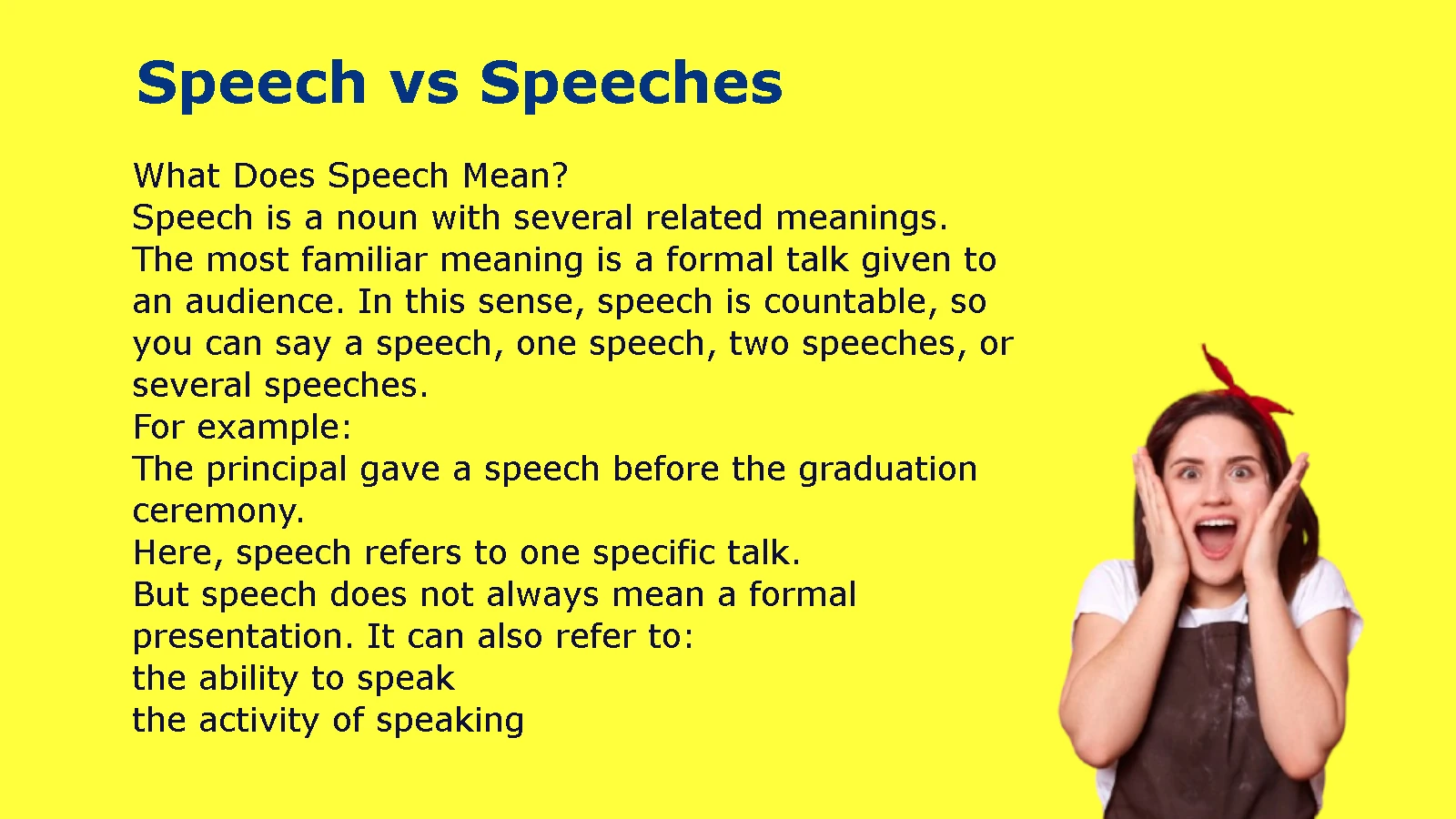
Speech vs speeches can be confusing because both words are correct, but they are used differently depending on whether you are talking about one speech or more than one speech. The word speech can refer to a spoken presentation, a formal address, the ability to speak, or the way someone expresses ideas, while speeches is the plural form used when referring to multiple speeches or addresses.
The speech vs speeches distinction mainly comes down to singular and plural usage. Use speech when you are referring to one particular speech or to speech as a general ability or form of communication. Use speeches when you are talking about two or more separate speeches, presentations, or formal addresses. The meaning can also change slightly depending on the context, such as public speaking, political speeches, graduation speeches, wedding speeches, famous speeches, and everyday communication.
In this guide, you’ll learn the difference between “speech” and “speeches,” when to use each word, how to make “speech” plural, and how both forms work in sentences. You’ll also see clear examples, common mistakes, and practical explanations to help you choose the correct form in different contexts.
By the end, you’ll know exactly when to use speech and when to use speeches and how to use both forms naturally and correctly in English.
Speech vs Speeches: Quick Answer
Speech is the singular form of the noun when it refers to one formal talk, while speeches is the plural form used for two or more formal talks.
| Word | Number | Main use | Example |
| speech | Singular | One formal talk | She gave a speech. |
| speeches | Plural | More than one formal talk | They gave several speeches. |
| speech | Uncountable | Ability or activity of speaking | The accident affected his speech. |
| speech | Uncountable | Spoken language | This expression is common in speech. |
The key point is that speech has more than one grammatical use. When it refers to a particular formal talk, it is countable. When it refers to speaking, spoken language, or the general ability to speak, it is normally uncountable. Oxford and Cambridge both identify these different uses in their dictionary entries.
What Does Speech Mean?
Speech is a noun with several related meanings.
The most familiar meaning is a formal talk given to an audience. In this sense, speech is countable, so you can say a speech, one speech, two speeches, or several speeches.
For example:
The principal gave a speech before the graduation ceremony.
Here, speech refers to one specific talk.
But speech does not always mean a formal presentation. It can also refer to:
- the ability to speak
- the activity of speaking
- spoken language
- a person’s way of speaking
- a group of lines spoken by a character in a play
Cambridge lists speech as uncountable when it means the ability to talk, the activity of talking, or spoken language. It lists the formal-talk meaning as countable.
Speech as a Formal Talk
When speech means a formal talk, it is normally a countable noun.
You can therefore use articles and numbers:
- a speech
- one speech
- two speeches
- several speeches
- the speech
- another speech
Examples:
- The mayor gave a speech.
- I wrote a speech for the ceremony.
- She delivered the speech yesterday.
- Three speakers gave speeches.
Speech as the Ability to Speak
Speech can also mean the human ability to communicate through spoken words.
In this meaning, it is generally uncountable.
Examples:
- The accident affected his speech.
- The child is developing speech.
- She temporarily lost the power of speech.
- The therapist works with children who have speech difficulties.
You would not normally say speeches in these sentences because you are not counting individual talks.
Oxford specifically identifies speech as uncountable when it means the ability to speak.
Speech as Spoken Language
Another uncountable use refers to language as it is spoken rather than written.
For example:
- This expression is more common in speech than in writing.
- Some features of informal speech do not appear in formal writing.
- The researcher studied differences between written language and speech.
Again, this is not about several formal talks. It is about spoken language generally.
What Does Speeches Mean?
Speeches is the standard plural form of speech when speech is being used as a countable noun.
If one person gives one formal talk, you can call it a speech.
If several people give formal talks, you can call them speeches.
For example:
The students prepared speeches for the competition.
The sentence refers to multiple speeches, so the plural form speeches is appropriate.
The same applies when one person gives multiple talks:
The president delivered several speeches during the campaign.
The word speeches does not necessarily mean that different people gave the talks. It simply means that there was more than one speech.
Dictionary sources identify speeches as the plural form of speech. Oxford gives examples such as “Several people made speeches at the wedding,” while Collins explicitly lists speeches as the plural form.
Is Speech Singular or Plural?
Speech is singular when it refers to one countable speech.
For example:
She gave a speech at the wedding.
The article a tells you that speech is being treated as a singular countable noun.
The plural is:
She gave three speeches at different events.
There is also an important exception: speech can be uncountable.
Compare these examples:
| Sentence | Use of speech |
| She gave a speech. | Singular, countable |
| She gave two speeches. | Plural, countable |
| His speech was unclear. | Uncountable/general ability or manner |
| He lost his speech after the accident. | Uncountable |
| This phrase is common in speech. | Uncountable |
| The actor delivered two speeches in the play. | Plural, countable |
So the answer to “Is speech singular or plural?” depends on how the noun is being used.
When it means one formal talk, it is singular.
if it refers to the general ability or activity of speaking, it is uncountable rather than simply “singular.”
When to Use Speech
use speech when you are referring to one formal talk or when you are using one of its uncountable meanings.
Use Speech for One Formal Talk
Examples:
- She prepared a speech for graduation.
- He delivered a speech at the conference.
- The teacher asked me to give a speech.
- Her speech lasted ten minutes.
- I listened to his speech carefully.
The noun can be modified by adjectives:
- a short speech
- a long speech
- a formal speech
- an acceptance speech
- a graduation speech
- a campaign speech
- a wedding speech
- an opening speech
- a closing speech
Use Speech for the Ability to Speak
Use speech without a plural ending when you mean the ability or act of speaking.
Examples:
- The injury affected her speech.
- The child has delayed speech development.
- He temporarily lost his speech.
- The therapist evaluated his speech.
- Clear speech can be difficult after certain neurological injuries.
This meaning is uncountable.
Use Speech for Spoken Language
Use speech when contrasting spoken language with writing.
Examples:
- The phrase is common in everyday speech.
- Formal writing differs from everyday speech.
- The researcher analyzed natural speech.
- Some words are more common in speech than in writing.
Oxford gives this same distinction by treating speech as uncountable when it means language used when speaking or the fact of speaking rather than writing.
When to Use Speeches
Use speeches when you are talking about multiple individual speeches.
You might use the word for:
- several formal talks
- talks given at different events
- talks delivered by different speakers
- multiple speeches given by the same person
- speeches in plays
- collections of historical speeches
Examples:
- The students gave speeches at graduation.
- Several politicians delivered speeches during the event.
- The book contains famous historical speeches.
- We listened to three speeches before dinner.
- The actor had several long speeches in the play.
The plural therefore focuses on individual instances of a speech, not on speaking as a general human activity.
Why Is the Plural of Speech Speeches?
The plural of speech is speeches, not speechs.
The spelling changes because the word ends in the sound represented by ch.
The basic pattern is:
speech → speeches
Compare:
- speech → speeches
- church → churches
- branch → branches
- match → matches
- watch → watches
The added -es also affects pronunciation.
Speech is pronounced approximately /spiːtʃ/.
Speeches is pronounced approximately /ˈspiːtʃɪz/.
The plural has an additional syllable.
Speech and Speeches Spelling Examples
| Singular | Plural |
| speech | speeches |
| church | churches |
| branch | branches |
| match | matches |
| watch | watches |
A common mistake is writing speechs. That spelling is incorrect in standard English.
The correct form is speeches.
Speech vs Speeches in Different Contexts
The choice between speech and speeches becomes easy when you identify what exactly you are counting.
Speech in Public Speaking
Public speaking often involves a specific, countable talk.
For example:
The keynote speaker delivered a speech.
If an event has several speakers, you might say:
The event featured five speeches.
The distinction is based on quantity.
One formal talk:
a speech
Multiple formal talks:
speeches
Speech in Education
Schools frequently use speech for an individual assignment:
I have to give a speech tomorrow.
When several students complete the assignment:
The students will give speeches tomorrow.
Other examples include:
- a persuasive speech
- an informative speech
- a graduation speech
- a student speech
- class speeches
- competition speeches
The singular and plural forms work exactly as they do in other countable contexts.
Speech in Politics and History
Historical and political writing frequently uses both forms.
For example:
The president gave a speech about the economy.
When discussing several addresses:
Historians have analyzed the president’s speeches.
The distinction is particularly useful when discussing a collection of public addresses.
A writer might discuss one speech in detail and then compare it with other speeches from the same period.
Speech in Literature and Drama
Speech can also refer to a group of lines spoken by a character in a play.
For example:
The character’s final speech is one of the most memorable parts of the play.
If several characters have important speeches:
The play contains several powerful speeches.
Cambridge and Oxford both recognize this countable literary use.
Speech vs Speeches: Example Sentences
Examples make the distinction much easier to see.
Examples With Speech
- She gave a speech at the wedding.
- He wrote a speech for the ceremony.
- The principal delivered a short speech.
- I practiced my speech several times.
- Her speech lasted about fifteen minutes.
- The teacher asked each student to prepare a speech.
- His speech was difficult to understand.
- The accident affected his speech.
- The phrase is common in everyday speech.
- She gave an acceptance speech after receiving the award.
Notice that speech does not always mean a formal public presentation. Its meaning depends on context.
Examples With Speeches
- The students prepared speeches for the competition.
- Several guests gave speeches at the wedding.
- The book contains famous speeches from history.
- We listened to three speeches during the ceremony.
- The candidates delivered speeches to the audience.
- Her speeches attracted large audiences.
- The students practiced their speeches before the event.
- The collection includes speeches from different periods.
- Several speeches were recorded during the conference.
- The actors had long speeches in the final scene.
In every example, speeches refers to multiple individual talks or sets of spoken lines.
Speech vs Speeches: A Simple Comparison
| Question | Use speech | Use speeches |
| Are you referring to one formal talk? | Yes | No |
| Are you referring to multiple formal talks? | No | Yes |
| Are you discussing the ability to speak? | Yes | No |
| Are you discussing spoken language generally? | Yes | No |
| Are you referring to one character’s lines in a play? | Yes | No |
| Are you referring to several characters’ lines? | No | Yes |
| Is the noun countable in this context? | Sometimes | Yes, when referring to individual talks |
The most useful question is:
Am I talking about one individual speech, multiple individual speeches, or speech as a general ability/activity?
That question usually gives you the answer immediately.
Is Speeches Grammatically Correct?
Yes. Speeches is grammatically correct and is the standard plural form of speech when the noun means individual formal talks or other countable instances.
Correct:
The students gave speeches.
Correct:
She listened to several speeches.
Incorrect:
The students gave speechs.
The mistake occurs when a writer simply adds s to speech. Because of the spelling and pronunciation pattern, the standard plural is speeches.
Speech vs Speaking
Both are related, but they do not always perform the same grammatical job.
Speech is a noun.
Speaking can function as a gerund or present participle and refers to the activity of using spoken language.
Compare:
Speech is an important form of communication.
Speaking clearly can improve communication.
Another comparison:
His speech was difficult to understand.
He was speaking very quickly.
The first sentence describes his manner or quality of speech. The second focuses on the action of speaking.
Speech vs Speaking Table
| Word | Typical grammatical role | Example |
| speech | Noun | Her speech was clear. |
| speeches | Plural noun | Her speeches were popular. |
| speaking | Gerund/participle | Speaking clearly takes practice. |
| speak | Verb | She can speak clearly. |
Understanding this difference prevents writers from treating speech, speeches, and speaking as interchangeable forms.
Speech vs Language
Another common source of confusion is speech vs language.
The two words overlap, but they refer to different concepts.
Language is a structured system of communication, such as English, Spanish, Arabic, or Japanese.
Speech generally refers to spoken communication, the ability to speak, or a particular way of speaking.
For example:
English is a language.
English speech can vary considerably between regions and social groups.
You can also say:
The child has difficulty with speech and language.
This expression is common because speech and language describe related but distinct areas of communication. Oxford specifically distinguishes speech as the ability to speak and as language used when speaking.
Speech vs Speech’s vs Speeches vs Speeches’
These four forms can look confusing, especially in possessive constructions.
Speech
This is the ordinary singular noun.
Her speech was excellent.
Speech’s
This is the singular possessive form.
The speech’s opening was memorable.
It means the opening of one speech.
However, in many cases, a different construction may sound more natural:
The opening of the speech was memorable.
Speeches
This is the plural form.
The candidates gave several speeches.
Speeches’
This is the plural possessive form.
The speeches’ themes were different.
It means the themes belonging to multiple speeches.
Compare all four:
| Form | Meaning | Example |
| speech | One speech | The speech was short. |
| speech’s | Belonging to one speech | The speech’s conclusion was powerful. |
| speeches | More than one speech | The speeches were recorded. |
| speeches’ | Belonging to multiple speeches | The speeches’ themes differed. |
The apostrophe matters because it changes the grammatical function.
Common Mistakes With Speech and Speeches
Mistake: Using Speeches for One Talk
Incorrect:
She gave three speeches yesterday.
This is only incorrect if you actually mean that she gave one talk.
If she gave one talk, write:
She gave a speech yesterday.
If she gave three separate talks, speeches is correct.
Mistake: Writing Speechs
Incorrect:
The students prepared speechs.
Correct:
The students prepared speeches.
The standard plural is formed with -es.
Mistake: Pluralizing Uncountable Speech
When speech means the ability to speak, it is normally uncountable.
For example:
The accident affected his speech.
Not:
The accident affected his speeches.
The second sentence would suggest that you are talking about multiple individual talks rather than his ability to speak.
Mistake: Confusing Speech With a Formal Talk
Consider:
Freedom of speech is a fundamental principle.
Here, speech does not mean a formal presentation.
It refers to the broader concept of expressing ideas through speech.
Compare:
She gave a speech about freedom of speech.
The first speech is a formal talk. The second is part of the expression freedom of speech.
The same word can therefore have different meanings in the same sentence.
Case Study: Choosing Speech or Speeches
Imagine a school graduation ceremony.
One student, Maya, is selected to address the graduating class.
You could write:
Maya gave a speech at graduation.
There is one formal talk, so the singular form is appropriate.
Now imagine that Maya, the principal, and the class president all speak.
You could write:
Maya, the principal, and the class president gave speeches at graduation.
There are multiple individual talks, so the plural is required.
Now consider a different sentence:
Maya’s speech was clear and confident.
This refers to the way she spoke or the quality of her spoken delivery, depending on context.
Finally:
The child is developing speech normally.
Here, speech refers to the ability to speak, so it is uncountable.
What This Case Shows
The word does not change simply because the subject changes. Instead, the meaning and grammatical use determine whether you need speech or speeches.
That is the central principle behind this entire comparison.
Common Phrases With Speech
Many English expressions naturally use the singular form speech.
Examples include:
- give a speech
- make a speech
- deliver a speech
- write a speech
- prepare a speech
- acceptance speech
- graduation speech
- wedding speech
- campaign speech
- opening speech
- closing speech
- freedom of speech
- speech development
- speech disorder
- speech therapist
- speech pattern
- speech sounds
Notice that these phrases do not all use speech in exactly the same sense.
For example:
He gave a speech.
Here, it means a formal talk.
But:
She works with children who have speech difficulties.
Here, it relates to the ability or activity of speaking.
Common Phrases With Speeches
The plural form naturally appears when multiple talks are involved.
Examples include:
- political speeches
- famous speeches
- historical speeches
- graduation speeches
- acceptance speeches
- campaign speeches
- wedding speeches
- presidential speeches
- public speeches
- opening speeches
- closing speeches
- inspiring speeches
- persuasive speeches
- short speeches
- long speeches
For example:
The collection contains several famous historical speeches.
The plural makes it clear that the collection includes more than one individual speech.
Speech and Speeches in Formal Writing
Both forms are standard in academic, professional, and formal writing.
The important thing is to match the noun to the meaning.
For example:
The study analyzes a political speech delivered during the campaign.
One speech is being examined.
If the study examines multiple addresses:
The study analyzes political speeches delivered during the campaign.
Here, the plural is appropriate.
Academic writing may also use uncountable speech:
The study examines differences between speech and writing.
In this sentence, speech means spoken language in general rather than individual formal talks.
Speech vs Speeches in Academic Examples
Here are several examples showing the difference:
The researcher analyzed a speech delivered at the conference.
One specific speech.
The researcher analyzed speeches delivered at the conference.
Multiple speeches.
The researcher examined speech patterns in the interviews.
Speech refers to spoken language or manner of speaking.
The researcher compared speech with written language.
Speech refers to spoken language generally.
This distinction is particularly useful in essays and research papers because a writer may accidentally change the meaning by pluralizing speech.
How to Choose Between Speech and Speeches
Use this simple process.
Ask How Many Formal Talks You Mean
If you mean one:
speech
She gave a speech.
If you mean two or more:
speeches
She gave three speeches.
Ask Whether You Mean Speaking Generally
If you mean the ability, activity, or general form of spoken communication:
speech
He has difficulty with speech.
Do not automatically pluralize it.
Check the Determiner
A singular countable speech can appear after:
- a
- an
- the
- this
- that
- one
- my
- her
- his
Examples:
- a speech
- this speech
- one speech
- her speech
A plural countable noun can appear after:
- two
- three
- several
- many
- these
- those
- their
Examples:
- two speeches
- several speeches
- many speeches
- their speeches
This provides a quick grammatical clue.
Speech vs Speeches: Quick Grammar Test
Try replacing the word with one talk or multiple talks.
If the sentence means one talk, use speech.
She gave a ___ at the ceremony.
→ She gave one talk.
Therefore:
She gave a speech.
If the sentence means multiple talks, use speeches.
The students gave ___ at the ceremony.
→ The students gave multiple talks.
Therefore:
The students gave speeches.
If the sentence means the ability or activity of speaking, use speech as an uncountable noun.
The injury affected his ___.
→ The injury affected his ability to speak.
Therefore:
The injury affected his speech.
This three-part test works in most everyday situations.
Facts to Remember About Speech vs Speeches
Here are the essential facts in one place:
- Speech is the singular form of the countable noun.
- Speeches is the plural form.
- The plural is spelled speeches, not speechs.
- Speech can also be uncountable.
- As an uncountable noun, speech can mean the ability to speak.
- Speech can mean spoken language generally.
- Speech can describe a person’s manner of speaking.
- A formal talk is normally a countable speech.
- Multiple formal talks are speeches.
- A speech in a play can also be countable.
- Speaking is related to speech but is not simply another plural form.
- Language and speech overlap in meaning but are not identical.
Frequently Asked Questions About Speech vs Speeches
Is speech singular or plural?
Speech is singular when it refers to one countable formal talk. Its plural form is speeches. However, speech can also be an uncountable noun when it means the ability to speak, spoken language, or the activity of speaking.
What is the plural of speech?
The plural of speech is speeches.
Example:
One speech
Two speeches
Is speeches a real word?
Yes. Speeches is the standard plural form of speech when referring to multiple countable speeches. Major dictionaries identify it as the plural form.
Is speechs correct?
No. The standard plural spelling is speeches, not speechs.
When should I use speech instead of speeches?
Use speech for one formal talk or for uncountable meanings such as the ability to speak or spoken language.
Use speeches when referring to multiple individual talks.
Can speech be uncountable?
Yes. Speech is commonly uncountable when it means the ability to speak, the activity of speaking, spoken language, or a person’s general manner of speaking. Cambridge and Oxford both document these uncountable uses.
What is the difference between speech and speeches?
Speech can refer to one formal talk or to speech in an uncountable sense. Speeches specifically refers to multiple countable speeches.
What is the difference between speech and speaking?
Speech is a noun, while speaking is generally a gerund or present participle related to the verb speak.
Her speech was clear.
Speaking clearly is important.
What is the difference between speech and language?
Language is a structured system of communication, while speech generally refers to spoken communication, the ability to speak, or a person’s way of speaking.
Is speeches singular or plural?
Speeches is plural. Its singular form is speech.
What is the correct phrase: a speech or a speeches?
The correct phrase is a speech.
Because a is used with a singular countable noun, a speeches is grammatically incorrect.
Should I say give a speech or give speeches?
Use give a speech when referring to one talk.
Use give speeches when referring to multiple talks.
Examples:
She will give a speech tonight.
She regularly gives speeches at conferences.
Speech vs Speeches: Final Difference
The difference between speech vs speeches is straightforward once you identify whether you are referring to one individual speech, multiple speeches, or speech in a general sense.
Use speech for one formal talk:
He gave a speech.
Use speeches for multiple formal talks:
He gave several speeches.
Use speech without a plural ending when you mean the ability to speak, spoken language, or the activity of speaking:
The injury affected his speech.
The most important rule is simple:
One formal talk = speech. Multiple formal talks = speeches. General ability or activity of speaking = speech.
Remember that speech has both countable and uncountable uses. That is why simply thinking of speeches as “more speech” can sometimes lead to mistakes. The correct form depends on what the noun means in the sentence.
Once you distinguish the formal-talk meaning from the general-speaking meaning, choosing between speech and speeches becomes much easier.