Pouring vs Poring is a commonly confused spelling pair because the two words sound alike but have completely different meanings and uses. If you’ve come across “pouring” and “poring” and wondered which spelling is correct, the difference becomes clear when you look at their meanings, contexts, and grammatical uses.
The pouring vs poring distinction mainly depends on what you are describing. Pouring is the present participle of pour and means causing a liquid or other substance to flow, or falling heavily, as in pouring water or pouring rain. Poring, on the other hand, is the present participle of pore and means reading, studying, or examining something closely and attentively, as in poring over a book. Although these words are homophones, they cannot normally be used interchangeably.
In this guide, you’ll learn the difference between “pouring” and “poring,” which spelling is correct in different contexts, how each word is used in sentences, and why these commonly confused words are so easy to mix up. You’ll also see clear examples, related expressions, and simple tips to help you remember when to use pouring and when to use poring.
By the end, you’ll know exactly when to use pouring vs poring and how to choose the correct spelling naturally and confidently.
Quick Answer: Pouring vs Poring
The simplest distinction is this:
- Pouring = flowing or causing something to flow, especially a liquid.
- Poring = studying, reading, or examining something carefully.
- Pouring comes from the verb pour.
- Poring comes from the verb pore.
- Poring over means examining or studying something closely.
- Pouring over can be correct when something is literally being poured over something else.
For example:
She was pouring water into the glass.
Here, pouring describes the movement of water.
She was poring over her exam notes.
Here, poring over means studying the notes carefully.
The two words sound very similar, but their meanings are unrelated.
| Word | Base verb | Main meaning | Example |
| Pouring | pour | Flowing or causing something to flow | He is pouring coffee. |
| Poring | pore | Studying or examining carefully | She is poring over the report. |
Pouring Meaning
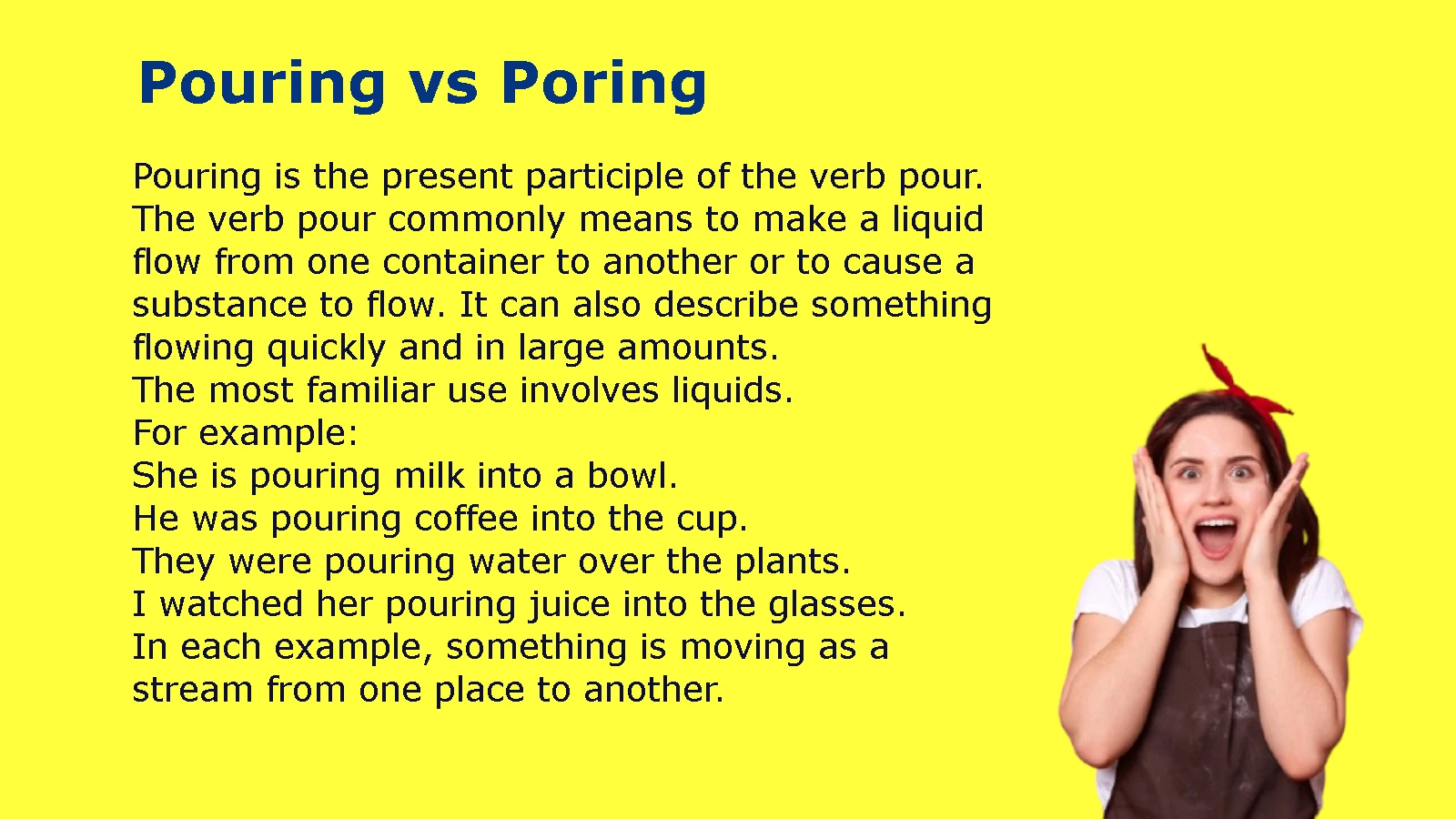
Pouring is the present participle of the verb pour. The verb pour commonly means to make a liquid flow from one container to another or to cause a substance to flow. It can also describe something flowing quickly and in large amounts.
The most familiar use involves liquids.
For example:
- She is pouring milk into a bowl.
- He was pouring coffee into the cup.
- They were pouring water over the plants.
- I watched her pouring juice into the glasses.
In each example, something is moving as a stream from one place to another.
Pouring as a Description of Heavy Rain
Pouring also commonly describes heavy rain.
When someone says:
It is pouring outside.
they mean that it is raining heavily.
English speakers also use expressions such as:
- pouring rain
- pouring with rain
- pouring down
- pouring down with rain
Cambridge Dictionary gives pouring as a way of describing heavy rain and also lists expressions such as pour with rain and pouring rain.
Examples include:
We canceled the picnic because it was pouring.
She walked home in the pouring rain.
It started pouring down just as we left the house.
This use is particularly important because pouring does not always require an object such as water or coffee. The weather itself can be described as pouring.
Pouring Can Describe Large Amounts
The verb pour can also describe something moving quickly or appearing in large quantities. This means pouring can be used beyond literal liquids.
For example:
Fans came pouring into the stadium.
People were pouring out of the building.
Support came pouring in after the announcement.
In these sentences, the subjects are not liquids. The word describes a large amount of people, support, or something else arriving or leaving rapidly. This broader use is recognized in dictionary definitions of pour.
Poring Meaning
Poring is the present participle of pore when pore means to study or examine something carefully.
The most common construction is:
pore over something
Therefore:
poring over something
means carefully examining or studying it.
For example:
She was poring over the documents.
He spent the afternoon poring over his notes.
The researchers were poring over the results.
Cambridge Dictionary specifically lists pore over something as a phrasal verb and provides examples of people carefully examining information.
What Does Poring Over Mean?
Poring over means giving close and sustained attention to something, particularly when reading, studying, examining, or analyzing it.
It is often used with:
- books
- documents
- reports
- notes
- maps
- records
- photographs
- research
- data
- manuscripts
- financial statements
For example:
The student was poring over her textbook before the examination.
The sentence suggests more than simply opening or reading the textbook. It emphasizes careful and concentrated examination.
Another example:
The detective spent hours poring over the evidence.
Here, poring over suggests that the detective examined the evidence closely in an effort to understand it.
Pouring vs Poring: Key Difference
The most important difference is the base verb.
Pouring comes from pour.
Poring comes from pore.
Those verbs have different meanings, so their -ing forms also have different meanings.
| Feature | Pouring | Poring |
| Base verb | pour | pore |
| Meaning | Cause something to flow or flow in large amounts | Study or examine carefully |
| Common object | Water, coffee, liquid, etc. | Book, report, notes, records, etc. |
| Common expression | pouring rain | poring over a book |
| Example | He is pouring water. | He is poring over the book. |
A useful way to remember the difference is to connect each word to its base verb:
pour → pouring → liquid or flowing
pore → poring → careful examination
Why Are These Words So Easy to Confuse?
The spelling difference is only one letter:
- pouring
- poring
Both words also have similar pronunciation in many varieties of English. That makes the distinction harder to notice when people hear the words rather than see them in writing.
The confusion becomes particularly strong in the expression “___ over.”
Compare:
She was pouring water over the flowers.
and:
She was poring over the report.
The first describes water flowing over something.
The second describes careful examination of information.
The surrounding words usually make the intended meaning clear.
Pouring vs Poring Examples
Seeing the words in complete sentences is one of the easiest ways to understand the distinction.
Examples With Pouring
Here are several correct examples of pouring:
He was pouring water into the bottle.
She is pouring coffee for the guests.
The children were pouring sand into the bucket.
Rain was pouring down outside.
People came pouring through the doors.
The river was pouring over the rocks.
She was pouring sauce over the pasta.
In every case, pouring relates to flow, movement, or a large amount arriving or moving.
Examples With Poring
Here are examples of poring:
She was poring over her history textbook.
He spent the evening poring over old photographs.
The accountant was poring over the financial records.
The scientist was poring over the research data.
They were poring over the map to find the correct route.
I was poring over my notes before the interview.
The editor spent hours poring over the manuscript.
In these examples, poring indicates careful attention or examination.
Poring Over Meaning
The phrase poring over is one of the most important expressions to understand when comparing pouring and poring.
Poring over means studying, reading, inspecting, or examining something carefully and attentively.
The object is often something that contains information.
For example:
Maria was poring over the contract before signing it.
This means Maria was carefully reading and examining the contract.
Similarly:
The students were poring over their notes before the test.
This suggests concentrated study rather than casual reading.
The expression can also describe physical examination of something that does not necessarily involve reading.
The archaeologists were poring over the ancient artifacts.
The idea is still one of close attention and careful examination.
Poring Over Books Meaning
Poring over books means spending time reading or studying books carefully.
For example:
He spent the weekend poring over books about ancient history.
The phrase suggests concentrated reading. It can imply that the person is searching for information, trying to understand difficult material, or examining details.
Other natural examples include:
- poring over textbooks
- poring over reference books
- poring over old books
- poring over legal books
- poring over history books
The phrase does not necessarily mean reading every page from beginning to end. The emphasis is on close attention.
Pouring Over or Poring Over?
If you mean studying or examining something carefully, use:
Poring over
not:
Pouring over
For example:
Correct:
She was poring over her exam notes.
Incorrect for the intended meaning:
She was pouring over her exam notes.
The second sentence makes it sound as though something is being poured over the notes, rather than carefully studied.
However, pouring over is not automatically grammatically wrong. It can be correct when pour has its ordinary meaning of causing something to flow over something else.
For example:
He was pouring water over the plants.
Here, pouring over is perfectly appropriate because water is literally flowing over the plants.
This distinction is crucial:
| Sentence | Correct? | Meaning |
| She was poring over the report. | Yes | She was studying the report carefully. |
| She was pouring water over the report. | Yes | Water was being poured onto the report. |
| She was pouring over the report. | Not for the intended studying meaning | The wrong verb is being used for careful examination. |
| He was poring water over the plants. | No | Poring does not mean causing liquid to flow. |
A Simple Test
Ask yourself:
Is something physically flowing?
If yes, pouring may be the correct word.
She was pouring water over the flowers.
Is someone carefully studying or examining something?
If yes, use poring over.
She was poring over the documents.
That simple test resolves most cases.
Pouring vs Poring in Context
The context surrounding the word often makes the correct choice obvious.
When to Use Pouring
Use pouring when the sentence involves:
- liquid
- rain
- substances flowing
- people moving in large numbers
- large quantities arriving or moving quickly
Examples:
He was pouring milk into the glass.
It was pouring outside.
The crowd came pouring into the stadium.
Donations came pouring in.
The common idea is flow or abundance.
When to Use Poring
Use poring when someone is:
- studying
- reading closely
- examining details
- analyzing information
- inspecting records
- concentrating on written or visual material
Examples:
She was poring over the report.
He was poring over the map.
The lawyer was poring over the contract.
The researchers were poring over the data.
The common idea is close attention.
Common Mistakes With Pouring and Poring
Because the words are similar in appearance and pronunciation, several mistakes occur repeatedly.
Using Pouring Over to Mean Studying
One of the most common errors is writing:
I was pouring over my notes all night.
If the intended meaning is that you carefully studied the notes, the standard expression is:
I was poring over my notes all night.
The confusion probably comes from the fact that pour is much more familiar to many learners than the less common verb pore.
Confusing Pore With Pour
The two base verbs have entirely different meanings.
Pour means to cause something to flow or to flow in large amounts.
Pour the milk into the bowl.
Pore means to study or examine carefully.
Pore over the instructions before beginning.
A useful comparison is:
Pour the liquid.
Pore over the document.
Assuming Poring Refers to Liquid
Poring does not mean pouring liquid.
The verb pore has a separate meaning from the noun pore, which refers to a small opening in skin or another surface. Cambridge Dictionary defines pore as a small hole in skin or similar surfaces and separately recognizes pore over something as a phrasal verb.
Therefore, do not assume that poring is simply a different spelling of pouring.
They are separate words formed from separate verbs.
Pouring vs Poring: Easy Memory Trick
A simple memory trick can help:
Pouring → pour → liquid
Think:
Pouring water
Poring → pore over → studying
Think:
Poring over a book
Another useful pair is:
Pour a drink.
Pore over a document.
The words become easier to distinguish once you connect them with their typical objects.
The One-Line Rule
Pouring is about flow; poring is about focus.
That is not a complete dictionary definition, but it is a useful way to remember the difference.
Pouring vs Poring: Related Words and Phrases
Several related expressions are worth knowing because they can appear in the same sentences.
| Word or phrase | Meaning | Example |
| Pour | Make a substance flow | Pour the water into the glass. |
| Pouring | Flowing or causing something to flow | She is pouring coffee. |
| Pore | Study or examine carefully | I need to pore over the report. |
| Poring | Studying or examining carefully | He is poring over the records. |
| Poring over | Examining closely | She is poring over her notes. |
| Pouring rain | Heavy rain | We drove through pouring rain. |
| Pouring down | Raining heavily | It was pouring down all morning. |
Understanding the base verbs makes these expressions much easier to use.
Pouring Through vs Poring Over
Pouring through and poring over can also cause confusion because both expressions can appear in sentences involving information or movement.
Poring over means examining something carefully:
She was poring over the documents.
Pouring through can describe people or things moving through a place in large numbers or quantities:
People were pouring through the gates.
The distinction is therefore significant.
Poring over emphasizes careful examination.
Pouring through emphasizes movement or a large flow through something.
The verb pour can describe people entering or leaving a place in large numbers, which is an established extended use of the word.
Can Pouring Through Mean Reading?
In informal usage, you may encounter pouring through used in contexts involving reading or searching through material. However, when you specifically want to express careful, concentrated examination, poring over is the clearer standard choice.
For example:
She was poring over the research papers.
This clearly communicates close examination.
Is Poring a Correct Word?
Yes, poring is a correct English word.
It is the -ing form of pore when pore means to examine or study something carefully.
The usual construction is:
pore over
and its continuous form is:
poring over
Examples include:
He is poring over the instructions.
They were poring over the records.
She spent hours poring over the manuscript.
Cambridge Dictionary recognizes pore over something as a phrasal verb, confirming that this is an established English construction.
Is Pouring a Correct Word?
Yes. Pouring is also completely correct.
It is the -ing form of pour.
The verb commonly describes transferring or causing a liquid to flow:
She is pouring tea.
It can also describe heavy rain:
It is pouring outside.
And it can describe large amounts of people, objects, money, or other things moving quickly:
Customers came pouring into the store.
These different uses all relate to the broader idea of flowing or moving in a large amount.
Pouring vs Poring: Grammar Explained
Both pouring and poring are present participles ending in -ing, but they are formed from different verbs.
Pour + -ing = Pouring
The verb is:
pour
Add -ing:
pour + ing = pouring
Examples:
I am pouring the water.
She was pouring coffee.
Pore + -ing = Poring
The verb is:
pore
Add -ing:
pore + ing = poring
Examples:
He is poring over the report.
She was poring over the textbook.
The final e of pore is dropped before adding -ing, producing poring, just as write becomes writing.
This spelling pattern is one reason the two words look so similar even though their meanings differ.
Case Study: Why One Letter Changes the Meaning
Consider this sentence:
The student was poring over her textbook.
The student is reading or studying carefully.
Now change just one letter:
The student was pouring over her textbook.
The intended meaning changes dramatically. The sentence now suggests that the student is pouring some substance over the textbook.
To make the second sentence meaningful in its literal sense, you could write:
The student was pouring water over her textbook.
That sentence describes an actual physical action.
The comparison demonstrates why choosing the correct spelling matters. A single letter can change the verb from careful study to physical movement of a liquid.
Pouring vs Poring: More Example Pairs
Paired examples are useful because they show the distinction without relying on abstract definitions.
Books and Water
She was poring over her book.
She was pouring water over the book.
The first sentence describes reading. The second describes liquid flowing over the book.
Reports and Coffee
The manager was poring over the report.
The manager was pouring coffee while reading the report.
Here, both words can appear in the same situation, but they perform different grammatical jobs.
Notes and Rain
He was poring over his notes before the exam.
It was pouring outside while he studied.
The first sentence describes concentration. The second describes heavy rain.
Records and People
The accountant was poring over the financial records.
Customers came pouring through the doors.
One involves examination; the other involves movement in large numbers.
A Quick Decision Guide
When you are unsure whether to use pouring or poring, follow these steps.
Ask What the Verb Means
If the meaning involves flowing, choose pouring.
Water is pouring from the pipe.
If the meaning involves studying or examining, choose poring.
She is poring over the report.
Look at the Object
Certain objects strongly suggest one word.
Common with pouring:
- water
- milk
- coffee
- juice
- sauce
- rain
Common with poring over:
- books
- reports
- notes
- documents
- records
- maps
- data
- manuscripts
These are not absolute rules, but they are useful clues.
Check for “Over”
The phrase poring over is especially important.
If you mean:
studying carefully
use:
poring over
If you mean:
causing a liquid or substance to flow over something
use:
pouring over
For example:
She was poring over the map.
versus:
He was pouring water over the map.
Facts to Remember About Pouring vs Poring
Here are the key facts in one place:
- Pouring is derived from pour.
- Poring is derived from pore.
- Pour commonly relates to making a liquid flow.
- Pouring can also describe heavy rain.
- Pouring can describe people or things moving in large quantities.
- Pore over means to examine or study something carefully.
- Poring over is the continuous form of pore over.
- Poring over a book means studying or reading the book carefully.
- Pouring over is not interchangeable with poring over.
- Pouring over can be correct when something is literally being poured over another thing.
- Poring has no connection to the act of pouring liquid.
- Pore can also be a noun meaning a small opening in skin or another surface, but that meaning is unrelated to pore over.
Frequently Asked Questions About Pouring vs Poring
Is it pouring over or poring over?
Use poring over when you mean studying, reading, or examining something carefully.
She was poring over her notes.
Use pouring over when something is literally being poured over something.
He was pouring water over the plants.
What does poring over mean?
Poring over means studying, reading, or examining something carefully and attentively.
The student was poring over the textbook.
The phrase often suggests sustained concentration.
What does pouring mean?
Pouring is the present participle of pour. It commonly means causing a liquid or other substance to flow, but it can also describe heavy rain or things moving in large quantities.
She was pouring milk into the cup.
It was pouring outside.
People came pouring into the theater.
Is poring a real word?
Yes. Poring is a standard English word formed from the verb pore. In the relevant usage, pore over something means to study or examine it carefully.
Is pouring over a book correct?
If you mean reading or studying a book carefully, the standard expression is:
poring over a book
For example:
She spent the evening poring over a book about ancient history.
Pouring over a book would normally suggest that something is physically being poured over the book.
What is the difference between pore and pour?
Pour means to make a liquid or substance flow.
Pour the water into the glass.
Pore over means to study or examine carefully.
Pore over the instructions before starting.
The verbs are distinct even though they sound similar.
What is the difference between pouring and poring?
Pouring relates to pouring or flowing.
Poring relates to careful study or examination.
Rain was pouring down.
She was poring over the report.
Is “pouring rain” correct?
Yes. Pouring rain is a standard expression for heavy rain.
For example:
We got caught in the pouring rain.
English also uses pouring on its own to describe heavy rain:
It is pouring outside.
Cambridge Dictionary recognizes these weather uses of pour.
What does “poring over books” mean?
Poring over books means spending time carefully reading or studying books.
It emphasizes concentration and close attention rather than casual reading.
Is “pouring through” the same as “poring over”?
No. Poring over means examining something carefully. Pouring through generally emphasizes movement through something in large numbers or quantities.
People were pouring through the gates.
Researchers were poring over the data.
The expressions should not be treated as interchangeable.
Conclusion: Pouring vs Poring
The difference between pouring vs poring becomes simple once you identify the two base verbs.
Pouring comes from pour and is associated with liquid flowing, heavy rain, or things moving in large quantities. You can pour water into a glass, walk through pouring rain, or watch people pouring into a building.
Poring comes from pore and refers to careful study or examination. The most common construction is poring over, as in poring over a book, poring over notes, or poring over a report.
The easiest rule to remember is:
Pouring = flow. Poring = careful study.
So, when you mean that someone is carefully reading or examining something, choose poring over. When you mean that a liquid is flowing or being transferred, choose pouring.
Getting this distinction right is especially important in phrases such as pouring over or poring over, because the single missing letter changes the meaning of the sentence.