Separate or seperate? Separate is the correct spelling in both British and American English. Seperate is a common misspelling that occurs when writers confuse the unstressed middle vowel with the letter E. The correct spelling applies to the verb, adjective, and related forms such as separation, separately, separated, and separating.
The word separate means to divide something, keep things apart, or identify things as distinct. You can use it when discussing separate rooms, separating documents, dividing responsibilities, or describing the separation of two groups. Learning its spelling pattern and grammatical functions will help you avoid this common mistake.
| Question | Answer |
| Is it separate or seperate? | Separate is correct; seperate is incorrect. |
| Is separate British or American spelling? | Both British and American English use separate. |
| What does separate mean? | It means to divide, distinguish, or keep things apart. |
| Is separate a verb? | Yes. It can function as both a verb and an adjective. |
| What is the correct spelling of separation? | Separation is the correct spelling. |
Separate or Seperate: Which Spelling Is Correct?
Separate is the correct spelling in standard English. The spelling seperate is incorrect and should not appear in formal writing, academic assignments, professional emails, or published content. Although both versions may sound similar in everyday speech, only separate follows the accepted English spelling.
The important detail is the letter A in the middle of the word. Many writers accidentally replace it with an E, producing the incorrect form seperate.
Separate
Correct
S E P A R A T E
The correct spelling contains A after P.
Seperate
Incorrect
S E P E R A T E
The middle A has been incorrectly replaced with E.
Why Is Separate the Correct Spelling?
The word separate comes from the Latin word separare, meaning to divide or set apart. Its spelling developed through French and entered English with the A in its middle syllable.
The modern English spelling preserves that A. Writers should therefore remember the sequence:
- S – First letter
- E – Second letter
- P – Third letter
- A – Fourth letter
- R – Fifth letter
- A – Sixth letter
- T – Seventh letter
- E – Eighth letter
The most important part to remember is PARA within the word.
For example:
- Correct: Please keep the personal and professional documents separate.
- Incorrect: Please keep the personal and professional documents seperate.
The first sentence uses the accepted spelling. The second contains a spelling error.
Is Seperate Ever Correct?
No. Seperate is not a standard English spelling of the word. It does not become correct in British English, American English, Australian English, or Canadian English.
You may encounter it in informal messages, online comments, handwritten notes, or older documents. However, its appearance does not make it an accepted spelling.
Use these alternatives when checking your writing:
| Incorrect spelling | Correct spelling |
| Seperate | Separate |
| Seperately | Separately |
| Seperation | Separation |
| Seperated | Separated |
| Seperating | Separating |
A useful proofreading habit is to search for seper in your document. This can help you identify several common mistakes involving the same incorrect spelling pattern.
Separate vs. Seperate: Quick Comparison
The difference between separate and seperate is straightforward: one is the correct English word, while the other is a misspelling.
| Feature | Separate | Seperate |
| Spelling status | Correct | Incorrect |
| Standard English | Yes | No |
| British English | Accepted | Not accepted |
| American English | Accepted | Not accepted |
| Dictionary usage | Standard word | Common misspelling |
| Formal writing | Recommended | Avoid |
Remember: Always write separate, regardless of whether you follow British or American English conventions.
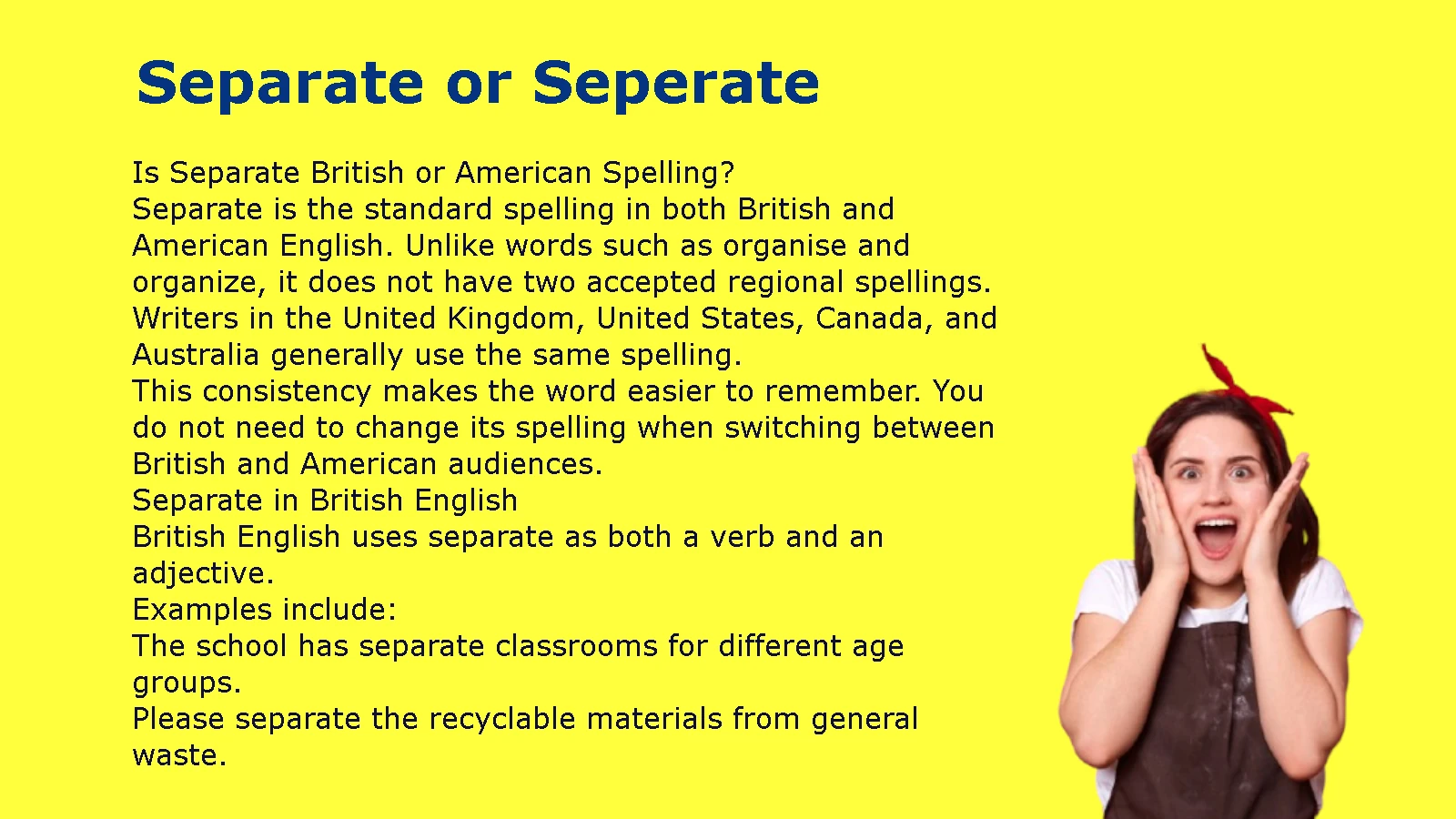
Is Separate British or American Spelling?
Separate is the standard spelling in both British and American English. Unlike words such as organise and organize, it does not have two accepted regional spellings. Writers in the United Kingdom, United States, Canada, and Australia generally use the same spelling.
This consistency makes the word easier to remember. You do not need to change its spelling when switching between British and American audiences.
Separate in British English
British English uses separate as both a verb and an adjective.
Examples include:
- The school has separate classrooms for different age groups.
- Please separate the recyclable materials from general waste.
- The two departments operate as separate units.
- The manager asked employees to submit separate reports.
British writers also use related forms such as separation, separately, separated, and separating.
Do not change the A to an E simply because you are following British spelling conventions.
Separate in American English
American English follows the same spelling rule. Writers in the United States use separate in education, business, journalism, everyday conversation, and professional communication.
Examples:
- We maintain separate accounts for personal and business expenses.
- Separate the white clothes from the colored laundry.
- The company operates separate offices in two cities.
- Each department has a separate budget.
The spelling remains unchanged in all these situations.
Does the Spelling of Separate Change in Other English Varieties?
No. Standard English varieties generally retain the same spelling.
| English variety | Correct spelling | Example |
| British English | Separate | Keep the records separate. |
| American English | Separate | Keep the records separate. |
| Canadian English | Separate | Keep the records separate. |
| Australian English | Separate | Keep the records separate. |
Regional vocabulary, punctuation, and other spelling conventions can differ. However, separate does not follow those regional spelling variations.
This distinction matters when writing for an international audience. You can use the same spelling without adjusting it for a particular English variety.
What Does Separate Mean?
Separate means to divide something into parts, keep people or objects apart, or recognize two or more things as different. It can describe a physical division, an independent arrangement, or a distinction between ideas. Its exact meaning depends on whether you use it as a verb or adjective.
The word appears in many contexts, including education, relationships, business, mathematics, science, and everyday communication.
Separate as a Verb
As a verb, separate describes the action of dividing, disconnecting, or moving things apart.
For example:
- Please separate the invoices by department.
- The teacher separated the students into smaller groups.
- Oil and water naturally separate under certain conditions.
- The company decided to separate its sales and marketing teams.
A verb can describe an action performed by a person, organization, object, or natural process.
Transitive verb: A transitive use takes a direct object.
Example: The assistant separated the documents.
Here, the documents receive the action.
Intransitive verb: An intransitive use does not require a direct object.
Example: The two substances separate when mixed.
Here, the verb describes what happens without a direct object.
Understanding this distinction helps you use separate correctly in more complex sentences.
Separate as an Adjective
As an adjective, separate describes things that remain distinct, independent, or apart from one another.
Examples:
- We booked separate hotel rooms.
- The business maintains separate financial records.
- Each student received a separate assignment.
- They have separate responsibilities within the organization.
In these sentences, separate describes a noun.
It does not describe an action. Instead, it tells readers that two or more things are not combined.
Separate as a Noun
The word separate can also function as a noun, although this use is less common.
The plural noun separates often describes individual clothing items that people can combine with other garments.
For example:
- The store sells matching separates for people.
- She purchased several separates for her new wardrobe.
- The collection includes skirts, trousers, and other separates.
In fashion, a separate is an individual garment designed to be worn with other pieces rather than as part of a single complete outfit.
This usage differs from the more common verb and adjective forms.
Is Separate a Verb or an Adjective?
Separate can function as both a verb and an adjective. Its grammatical role depends on how you use it in a sentence. As a verb, it describes dividing or moving things apart. As an adjective, it describes objects, people, or ideas that remain distinct or independent.
The same spelling can therefore perform different grammatical functions.
How to Use Separate as a Verb
Use separate as a verb when describing an action or process.
Common sentence patterns include:
- Separate + object.
- Separate + object + from + another object.
- Separate from + another person or thing.
Examples:
- Separate the important documents from the outdated files.
- The company plans to separate its two business divisions.
- You should separate recyclable waste from household rubbish.
- The children separated into different groups.
- The employee decided to separate personal concerns from workplace responsibilities.
The verb can also appear in different tenses:
| Tense | Example |
| Present | I separate the documents every morning. |
| Past | I separated the documents yesterday. |
| Future | I will separate the documents tomorrow. |
| Present continuous | I am separating the documents now. |
| Present perfect | I have separated the documents already. |
Notice that the spelling changes when you add certain endings, but the central spelling pattern remains recognizable.
How to Use Separate as an Adjective
Use separate before a noun or after a linking verb when describing something independent or distinct.
Examples:
- The two companies have separate management teams.
- We need separate files for each client.
- Their offices are separate.
- Each customer receives a separate invoice.
- The building has separate entrances.
Here are several common adjective combinations:
| Phrase | Meaning |
| Separate rooms | Rooms that are not shared |
| Separate accounts | Independent financial accounts |
| Separate documents | Individual documents |
| Separate departments | Distinct organizational units |
| Separate responsibilities | Different assigned duties |
| Separate opinions | Different viewpoints |
These phrases appear frequently in workplace communication, academic writing, and everyday English.
How to Identify Its Part of Speech in a Sentence
Look at the word’s function rather than its spelling.
Consider these two sentences:
Sentence 1: The manager will separate the departments.
Here, separate is a verb because it describes an action.
Sentence 2: The manager oversees two separate departments.
Here, separate is an adjective because it describes the departments.
A quick test can help:
- If the word describes what someone or something does, it is probably a verb.
- If it describes a noun, it is probably an adjective.
- If it names individual clothing pieces, it may function as a noun.
This method also helps distinguish separate from related words such as separation and separately.
How to Spell Separate Correctly
The correct spelling of separate is S-E-P-A-R-A-T-E. The most common mistake occurs in the middle of the word, where writers replace the letter A with E. Remembering the correct letter sequence and practicing related word forms can make this spelling easier to retain.
The Correct Letter-by-Letter Spelling
Break the word into smaller sections to make it easier to remember:
SEP + ARA + TE = SEPARATE
The fourth letter is A, not E. This small detail distinguishes the correct spelling from the common misspelling.
Try these practical exercises:
- Write separate five times while paying attention to the middle A.
- Compare separate with seper ate to identify the incorrect vowel.
- Use the word in three original sentences.
- Practice related forms such as separation and separately.
- Check your writing for the incorrect sequence seper.
Repeated exposure helps you recognize the correct spelling without having to think about every letter.
Why Do People Spell Separate as Seperate?
People commonly write seperate because English pronunciation does not always make vowel differences obvious.
In ordinary speech, the middle vowel in separate may sound weak or reduced. This makes it easy to confuse the A with an E, particularly when someone relies on pronunciation rather than visual memory.
Several factors contribute to this mistake:
Unstressed vowel sounds: English speakers often reduce vowels in unstressed syllables. As a result, the middle A may not sound as clear as expected.
Spelling by sound: Writers sometimes choose letters based on what they hear. However, English spelling does not always match pronunciation perfectly.
Visual confusion: The incorrect form looks similar to the correct word. Readers may recognize the intended meaning even when the spelling is wrong.
Limited spelling practice: People who rarely write the word may forget its internal letter sequence.
For example:
- Incorrect: We should keep the two projects seperate.
- Correct: We should keep the two projects separate.
The sentence’s meaning remains understandable, but the second version follows standard English spelling.
Easy Tricks to Remember the Spelling
A memorable spelling trick can help you avoid writing seperate.
One useful approach is to remember the word RAT inside separate.
Think of it as:
SEP-A-RAT-E
The word contains the letters A-R-A-T in its central sequence. The RAT reminder draws attention to the A that people commonly forget.
Other helpful techniques include:
- Remember the middle A: Picture the letter A whenever you write the word.
- Connect related words: Remember that separation also contains A.
- Use visual repetition: Write the correct spelling on a study card or vocabulary list.
- Practice sentence building: Use separate in different grammatical situations.
- Enable spell-checking: Use a spelling checker to catch accidental errors.
A simple memory trick is more useful when you apply it repeatedly. Instead of memorizing the word once, practice it in sentences that reflect your everyday writing.
Spellings of Separation and Other Related Words
The word separate has several related forms, including separation, separately, separated, and separating. These words share the same spelling family but perform different grammatical functions. Learning their forms helps you avoid mistakes when changing the original word into a noun, adverb, or verb form.
Separate vs. Separation
Separate can function as a verb or adjective. Separation is a noun that describes the act, process, or condition of being divided or kept apart.
Compare these examples:
- Separate: The manager decided to separate the two departments.
- Separation: The separation of the departments improved their efficiency.
The first sentence describes an action. The second names the process.
| Feature | Separate | Separation |
| Part of speech | Verb/adjective | Noun |
| Main meaning | Divide or keep apart | Act or state of being apart |
| Example | Separate the documents. | The separation took several hours. |
| Correct spelling | Separate | Separation |
Notice that separation retains the A after P. Writing seperation is incorrect.
Separate vs. Separately
Separately is the adverb form of separate. It describes how someone performs an action.
For example:
- Separate: The accountant prepared separate reports.
- Separately: The accountant prepared the reports separately.
In the first sentence, separate describes the reports. In the second, separately explains how the accountant prepared them.
Consider a few more examples:
- Please submit each application separately.
- The business manages its accounts separately.
- We discussed the two issues separately.
- The products are packaged separately.
Spelling rule: Add the adverb ending -ly to form separately. Do not change the middle A to E.
Separate vs. Separated
Separated is the past tense and past participle of the verb separate. It describes an action that happened previously or a resulting condition.
Examples:
- The teacher separated the students into groups.
- The files were separated by category.
- The two companies separated their operations last year.
- We have separated the personal records from the business records.
The spelling follows a straightforward pattern:
Separate + d = Separated
The final E remains before the D. Do not write seperated.
Separate vs. Separating
Separating is the present participle of separate. It can describe an ongoing action or function as a gerund, which is a verb form used as a noun.
Examples:
- The technician is separating the damaged components.
- Separating personal and professional expenses can simplify budgeting.
- The machine is separating different materials.
- They are separating the recyclable items from general waste.
When adding -ing, remove the final silent E:
Separate → Separating
This is a common English spelling pattern. You can see the same change in words such as create → creating and operate → operating.
Common Related Word Forms
The following table brings together the main forms of separate and explains how to use each one.
| Word | Part of speech | Meaning | Example |
| Separate | Verb/adjective | Divide or keep apart; distinct | Keep the files separate. |
| Separation | Noun | Act or condition of being apart | The separation lasted several months. |
| Separately | Adverb | Individually or independently | The items were packaged separately. |
| Separated | Past tense/past participle | Divided or moved apart | The documents were separated. |
| Separating | Present participle/gerund | Dividing or keeping apart | Separating the files takes time. |
| Separateness | Noun | State of being distinct | The design emphasizes the separateness of each section. |
These forms are useful in different contexts. Choosing the right one depends on the meaning and grammatical structure of your sentence.
Separate Pronunciation and Spelling Differences
The pronunciation of separate can contribute to spelling confusion because its unstressed vowel sounds may become less distinct in everyday speech. The word also has different stress patterns depending on whether you use it as a verb or adjective. Understanding these differences can make the spelling easier to remember.
How to Pronounce Separate
The word separate has different common pronunciations depending on its grammatical function.
| Usage | Pronunciation | Stress |
| Verb | /ˈsepəreɪt/ | First syllable |
| Adjective | /ˈsepərət/ | First syllable |
As a verb, the final syllable generally has a stronger sound. As an adjective, the ending is usually shorter and unstressed.
For example:
- Verb: Please separate the documents.
- Adjective: They work in separate offices.
Although the pronunciation changes slightly, the spelling remains exactly the same.
Why Pronunciation Causes Spelling Confusion
English contains many words whose spellings do not directly reflect their everyday pronunciation.
In separate, the middle vowel can become less prominent during normal speech. Some speakers therefore hear a sound that makes the incorrect E seem reasonable.
However, pronunciation should not determine the spelling of this word.
Consider the following points:
- Unstressed vowels often sound different from their written forms.
- Regional accents can affect vowel quality.
- Fast speech can make syllables less distinct.
- Familiar spelling patterns can influence how people write unfamiliar words.
The safest approach is to remember the written form rather than relying entirely on sound.
How to Remember the Correct Spelling Through Pronunciation
Combine pronunciation practice with visual spelling practice.
Try this simple routine:
- Say the word slowly.
- Pay attention to its first syllable.
- Picture the written word in your mind.
- Identify the A after P.
- Write a complete sentence using the word.
For example:
“The school has separate classrooms for younger and older students.”
This exercise connects pronunciation, spelling, meaning, and grammatical usage.
Separate or Seperate: Common Mistakes to Avoid
Writers often make mistakes with separate because they confuse its spelling with related words or choose the wrong grammatical form. Recognizing these errors helps improve everyday communication, professional documents, academic assignments, and website content.
Writing Seperate Instead of Separate
This is the most common spelling mistake associated with the word.
Incorrect: The manager requested seperate reports from each department.
Correct: The manager requested separate reports from each department.
The correction requires changing the middle E to A.
Remember that separate contains the sequence PARA, not PERE.
Confusing Separate and Separation
Although the words share a meaning, they are not interchangeable.
Incorrect: The separate of the two departments took several months.
Correct: The separation of the two departments took several months.
The second sentence uses the noun separation because it names a process.
Another example:
- Correct: The company will separate its operations.
- Correct: The separation of its operations will improve efficiency.
Both sentences are grammatical, but they use different word forms.
Using Separate and Separately Incorrectly
A common grammatical mistake involves using an adjective where an adverb is required.
Incorrect: The employees submitted their applications separate.
Correct: The employees submitted their applications separately.
The adverb separately describes how the employees submitted their applications.
However, separate is correct when it describes a noun:
Correct: The employees submitted separate applications.
The difference is simple:
- Separate: Describes a noun.
- Separately: Describes an action or another modifier.
Forgetting the Middle A in Separate
Another common mistake occurs when writers remember the beginning and ending of the word but forget its internal letters.
For example:
- Incorrect: Keep your business and personal finances seperated.
- Correct: Keep your business and personal finances separated.
The correct spelling contains A after P.
A useful proofreading method is to examine the middle of longer words rather than checking only their first and last letters.
Separate or Seperate: Correct Usage Examples
Seeing separate in different sentence structures helps you understand its meaning and spelling. The following examples cover everyday communication, education, workplace writing, and business situations.
Incorrect and Correct Spelling Examples
| Incorrect sentence | Correct sentence |
| Please seperate the documents. | Please separate the documents. |
| We need two seperate rooms. | We need two separate rooms. |
| The seperation was unexpected. | The separation was unexpected. |
| Keep these files seperate. | Keep these files separate. |
| They are seperating the groups. | They are separating the groups. |
| Submit your applications seperately. | Submit your applications separately. |
| The employees were seperated into teams. | The employees were separated into teams. |
Each corrected sentence uses the standard spelling of the relevant word form.
Examples of Separate in Everyday Sentences
Here are original examples showing how to use separate naturally:
Personal situations
- My brother and I have separate bedrooms.
- Please keep the clean clothes separate from the dirty ones.
- They decided to maintain separate living arrangements.
- We have separate opinions about the best solution.
School and education
- The teacher asked students to separate the words into different categories.
- Each group received a separate research assignment.
- The school maintains separate examination rooms.
- Students should write their answers on separate sheets.
Workplace communication
- Employees must keep personal and professional responsibilities separate.
- The supervisor created separate schedules for each team.
- Please save the documents in separate folders.
- The organization has separate departments for sales and customer support.
Business and finance
- The company maintains separate accounts for each branch.
- Business owners should separate personal expenses from business expenses.
- The accountant prepared separate financial statements.
- Management decided to separate the two business operations.
These examples demonstrate how the same word can describe an action or an independent arrangement.
Examples of Separation in Sentences
Separation appears in situations involving physical distance, relationships, organizations, and scientific processes.
- The separation of the two departments improved communication.
- Their separation surprised everyone in the family.
- The machine uses a filtration system for the separation of materials.
- The company announced the separation of its regional operations.
- The separation between personal and professional responsibilities can improve productivity.
- Scientists studied the separation of different chemical substances.
The noun works whenever you need to describe the act, process, or condition of being separated.
Frequently Asked Questions About Separate or Seperate
Is It Separate or Seperate?
Separate is the correct spelling in standard English. Seperate is a common misspelling caused by confusion over the middle vowel. Always use separate in academic assignments, professional emails, articles, and everyday writing.
Is Separate British or American Spelling?
Separate is correct in both British and American English. Neither variety uses seperate as an accepted alternative. You can use the same spelling regardless of your intended English-speaking audience.
Why Is Separate So Commonly Misspelled?
People often misspell separate because the middle vowel sounds weak or unclear in ordinary speech. They may hear an E-like sound and write seperate instead. Remembering the A after P is an effective way to avoid this error.
Is Separate a Verb?
Yes. Separate is a verb when it describes dividing, disconnecting, or moving things apart. For example, “Please separate the documents by date.” It can also function as an adjective, as in “We have separate offices.”
What Is the Correct Spelling of Separation?
The correct spelling is separation. It is a noun that describes the act, process, or condition of being apart. Remember the A after P to avoid the incorrect spelling seperation.
How Do You Remember How to Spell Separate?
Remember the middle A in separate. You can use the visual trick SEP-A-RAT-E to recall the correct letter sequence. Practicing related words such as separation, separately, and separated also reinforces the spelling pattern.
Conclusion: Always Use Separate, Not Seperate
The correct spelling is separate, not seperate. Both British and American English use the same spelling, so there is no regional variation to remember.
The word can function as a verb, adjective, and, less commonly, a noun. Its related forms include separation, separately, separated, and separating. Each form serves a different grammatical purpose, but they all follow the correct spelling pattern.
Keep these essential points in mind:
- Separate is the only correct standard spelling.
- Seperate is a common spelling mistake.
- British and American English both use separate.
- Separate can function as a verb and adjective.
- Separation is the correct noun form.
- Separately is the correct adverb form.
When writing, remember the A after P. If you are unsure, check the word before submitting your work or publishing your content.