Preferring is the correct spelling, while prefering is incorrect. The word comes from the verb prefer, which doubles its final R before adding the suffix -ing. This spelling rule also explains why the past-tense form is preferred, not prefered. Understanding this pattern helps you avoid common spelling mistakes and use related words such as preference, preferable, and preferably correctly.
Whether you’re writing an email, completing a school assignment, or improving your English grammar, knowing the difference between preferring and prefering will help you communicate more accurately. This guide explains the correct spelling, meaning, pronunciation, grammatical rules, synonyms, and practical sentence examples.
| Question | Answer |
| Is it preferring or prefering? | Preferring is correct. |
| Why does preferring have two Rs? | The final R doubles before adding -ing because the final syllable of prefer carries the stress. |
| What does preferring mean? | It means liking or choosing one thing more than another. |
| How do you pronounce preferring? | Approximately pri-FUR-ing, with stress on the second syllable of the base verb. |
| What is the past tense of prefer? | Preferred is the correct past-tense and past-participle form. |
Preferring vs. Prefering: Which One Is Correct?
Preferring is the correct spelling in standard English. The spelling prefering is incorrect because it leaves out one R. When you add the suffix -ing to the verb prefer, you must double its final consonant to form preferring.
The two spellings may look similar, but only one follows the standard English spelling rules.
| Word | Correct or Incorrect | Explanation |
| Preferring | Correct | Doubles the final R before adding -ing |
| Prefering | Incorrect | Omits the required second R |
For example:
- Correct: She is preferring the quieter environment.
- Incorrect: She is prefering the quieter environment.
However, the first sentence sounds somewhat unnatural in ordinary English because prefer is generally a stative verb. A more natural version would be:
- She prefers the quieter environment.
The spelling remains the same regardless of whether you use the word in a sentence, a question, or a longer grammatical construction.
Why Does Preferring Have Two Rs?
The word preferring has two Rs because of the English consonant-doubling rule. When a verb ends in a consonant-vowel-consonant pattern and its final syllable receives the stress, English generally doubles the last consonant before adding a suffix beginning with a vowel.
The base word prefer has two syllables:
- Pre
- Fer
The second syllable receives the primary stress. When you add -ing, you double the final R.
The transformation looks like this:
Prefer + ing = Preferring
The same principle applies when you add -ed:
Prefer + ed = Preferred
Here are other examples of the same spelling pattern:
| Base Verb | Correct -ing Form | Correct -ed Form |
| Prefer | Preferring | Preferred |
| Refer | Referring | Referred |
| Occur | Occurring | Occurred |
| Admit | Admitting | Admitted |
| Begin | Beginning | Began |
| Forget | Forgetting | Forgot |
These examples show why remembering the base word alone isn’t always enough. You also need to understand what happens when you attach a suffix.
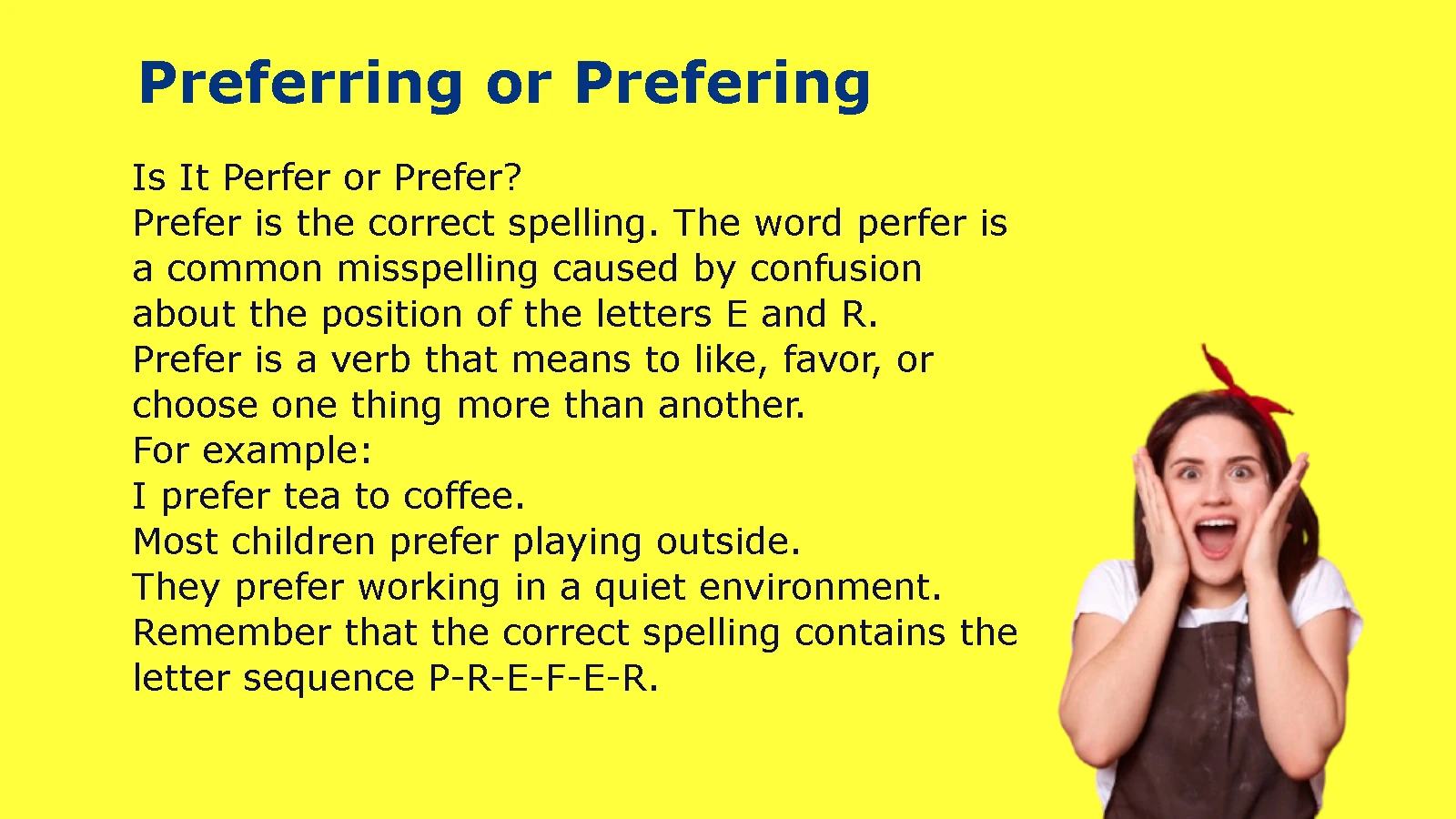
Is It Perfer or Prefer?
Prefer is the correct spelling. The word perfer is a common misspelling caused by confusion about the position of the letters E and R.
Prefer is a verb that means to like, favor, or choose one thing more than another.
For example:
- I prefer tea to coffee.
- Most children prefer playing outside.
- They prefer working in a quiet environment.
Remember that the correct spelling contains the letter sequence P-R-E-F-E-R.
Once you learn the base word, its related forms become easier to recognize:
| Correct Word | Meaning |
| Prefer | To like one option more |
| Prefers | Third-person singular form of prefer |
| Preferring | The -ing form of prefer |
| Preferred | Past-tense and past-participle form |
| Preference | A greater liking for something |
Why Do People Misspell Preferring?
People often write prefering because they forget to double the final R. English has several suffix rules, and consonant doubling can become confusing when writers apply different patterns to different words.
Some common reasons include:
- Forgetting the spelling rule: Writers add -ing without checking whether the final consonant needs doubling.
- Typing too quickly: The second R can disappear during fast typing.
- Confusing similar words: Some verbs take a single final consonant, while others require doubling.
- Remembering pronunciation instead of spelling: The additional R does not represent a separate spoken sound.
A useful trick is to learn related forms together. Practice writing prefer, preferring, and preferred as one word family.
Preferring Meaning and Definition
Preferring means liking, favoring, or choosing one thing over another because you consider it more suitable, enjoyable, or desirable. It is the present participle of the verb prefer and can also function as a gerund when it acts as a noun in a sentence.
The word expresses a choice or personal preference between available options.
For example, someone who chooses tea instead of coffee may say they prefer tea. When describing the act of making that choice, you can use the word preferring.
Simple definition: Preferring is the act of finding one option more desirable than another.
What Does Preferring Mean in Everyday English?
In everyday English, preferring describes a person’s tendency to favor something. That preference may relate to food, entertainment, work, education, clothing, or personal habits.
For example, imagine two friends choosing a restaurant.
One friend likes spicy food, while the other enjoys mild dishes. If the first friend consistently chooses spicy meals, you can say that the friend prefers spicy food.
Here are some everyday situations:
- Food: Preferring homemade meals over fast food.
- Education: Preferring classroom learning to online lessons.
- Work: Preferring flexible working hours.
- Entertainment: Preferring comedy movies over horror films.
- Travel: Preferring train journeys to long road trips.
The word doesn’t necessarily suggest that one choice is objectively better. It simply describes what someone likes or considers more suitable.
For example, preferring a small apartment doesn’t mean large apartments are bad. It means the smaller space better matches someone’s needs or lifestyle.
Preferring vs. Prefer: What’s the Difference?
Prefer is the base form of the verb, while preferring is its present participle and gerund form. Both relate to choosing or liking one thing more than another, but they serve different grammatical purposes.
| Feature | Prefer | Preferring |
| Word form | Base verb | Present participle / gerund |
| Main function | Expresses a preference | Expresses the -ing form of the action or concept |
| Example | I prefer tea. | Preferring tea is common in my family. |
| Typical use | General preferences | Gerund phrases and participial constructions |
Consider these examples:
Prefer:
- I prefer reading books before bedtime.
- She prefers coffee without sugar.
- They prefer traveling by train.
Preferring:
- Preferring simple designs can make a website easier to navigate.
- He enjoys preferring practical solutions over complicated ones. (Grammatically possible, but unnecessarily awkward.)
- Rather than choosing the expensive option, preferring a simpler solution may save money.
The distinction matters because prefer usually works more naturally than preferring when you describe a person’s general likes.
Prefer Over Meaning
The expression prefer over means to like, favor, or choose one thing instead of another. It introduces a comparison between two options and identifies which one someone considers more desirable.
For example:
- I prefer tea over coffee.
- She prefers walking over driving.
- Many employees prefer remote work over commuting to an office.
The expression is common in everyday American English.
However, English also uses the construction prefer X to Y.
For example:
- I prefer tea to coffee.
- She prefers walking to driving.
Both patterns communicate a preference. The construction with to is especially useful in formal writing and traditional grammar instruction.
One important point: When you use prefer, avoid unnecessary comparisons that repeat the same idea.
Awkward: I prefer tea more over coffee.
Better: I prefer tea over coffee.
How to Use Preferring in a Sentence
The word preferring can function as a gerund, a present participle, or part of a participial phrase. Its grammatical role depends on how it appears in the sentence.
As a gerund, it acts like a noun. As a participle, it contributes to a verb construction or describes an accompanying action.
For example:
- Gerund: Preferring quality over quantity is a sensible approach.
- Participial phrase: Preferring a quieter setting, Maria chose the library.
- Continuous construction: I am preferring the earlier option this week.
The last example is grammatically possible in a context where the preference is temporary or changing, but it sounds less natural than simply saying, “I prefer the earlier option this week.”
10 Examples of Preferring in a Sentence
The following examples demonstrate different ways to use preferring in English.
| Example | Usage |
| Preferring fresh food over processed meals can support healthier eating habits. | General preference |
| She enjoys preferring simple outfits for everyday occasions. | Gerund-like construction, though awkward |
| Preferring a quiet workplace, he moved to a private office. | Participial phrase |
| Some students are preferring digital textbooks this semester. | Temporary preference |
| Preferring quality over quantity often leads to better decisions. | Gerund |
| The manager noticed that employees were preferring flexible schedules. | Reported observation |
| Rather than accepting the first offer, preferring a better deal seemed sensible. | Participial construction |
| Preferring early mornings, Daniel scheduled his meetings before noon. | Participial phrase |
| Many customers are preferring reusable products. | Changing consumer tendency |
| Preferring familiar surroundings, the family decided to stay home. | Participial phrase |
Grammar tip: Because prefer is usually a stative verb, the simple present often sounds more natural when describing an ordinary or permanent preference.
For example:
- Less natural: She is preferring tea.
- More natural: She prefers tea.
Use preferring when the sentence genuinely needs an -ing form, especially in gerund phrases and participial constructions.
Preferring in a Sentence for Kids
Children can understand preferring by learning that it relates to liking or choosing one thing more than another.
For example, a child might prefer chocolate ice cream to vanilla. Another might prefer playing football instead of watching television.
Here are simple examples:
- Preferring apples over candy can be a healthy choice.
- Preferring blue shoes, Mia picked the blue pair.
- Preferring books, Adam visited the library.
- Preferring outdoor games, the children went to the park.
- Preferring chocolate ice cream, Sara chose it for dessert.
- Preferring sunny days, Tom enjoyed playing outside.
- Preferring dogs over cats, Liam wanted a puppy.
Easy explanation for kids: When you prefer something, you like it more than another thing.
For example, if you like apples more than bananas, you prefer apples.
Common Sentence Mistakes With Preferring
Even when writers know the correct spelling, they sometimes use the word incorrectly in a sentence.
Here are common mistakes and their corrections.
| Incorrect or Awkward Sentence | Better Sentence | Reason |
| She is prefering tea. | She prefers tea. | Incorrect spelling and unnecessary continuous tense |
| I am preferring coffee over juice. | I prefer coffee over juice. | Simple present expresses a general preference |
| He prefering the red car. | He prefers the red car. | Missing verb structure |
| They are prefering online classes. | They prefer online classes. | Correct spelling and more natural grammar |
| I prefer more tea over coffee. | I prefer tea over coffee. | Avoid redundant wording |
Remember that spelling and grammar are separate issues. A word can have the correct spelling but still appear in an awkward or grammatically incorrect sentence.
Preferring Pronunciation in English
The word preferring has three syllables and receives its primary stress on the second syllable. In American English, its pronunciation is approximately “pri-FUR-ing.” The final -ing sounds like the ending in words such as working and reading.
Learning its pronunciation helps you recognize the word when listening to English speakers and use it confidently in conversation.
How to Pronounce Preferring Correctly
The pronunciation of preferring can be understood by separating it into three syllables:
Pre-ferr-ing
The main stress falls on the middle syllable.
Its International Phonetic Alphabet (IPA) transcription in American English is:
/prɪˈfɝː.ɪŋ/
Follow these pronunciation points:
- Start with a short sound similar to the beginning of pretty.
- Give the middle syllable the strongest stress.
- Finish with the familiar -ing sound.
- Avoid adding an extra syllable for the doubled R.
The spelling contains two Rs, but they do not create two separate R sounds.
Is Preferring Pronounced Differently From Prefer?
Yes. The words prefer and preferring have different endings, although they share the same stressed syllable.
| Word | Syllables | Pronunciation |
| Prefer | 2 | pri-FUR |
| Preferring | 3 | pri-FUR-ing |
| Preferred | 2 | pri-FURD |
| Preference | 3 | PREF-er-uhns |
Notice that prefer and preferring both place the primary stress on the second syllable. Adding -ing introduces another syllable but does not change the main stress pattern.
Preferring Synonyms and Alternative Words
Synonyms for preferring include favoring, choosing, selecting, opting for, and leaning toward. These words communicate a similar idea, but their meanings and grammatical functions differ slightly.
Choosing the right synonym depends on what you want to express. Some alternatives emphasize personal liking, while others focus on making a decision.
10 Synonyms for Preferring
Here are ten useful alternatives with their meanings and examples.
| Synonym | Meaning | Example |
| Favoring | Showing a preference for something | She is favoring the simpler design. |
| Choosing | Selecting one option | He is choosing the healthier meal. |
| Selecting | Picking from available alternatives | The team is selecting a new supplier. |
| Opting for | Deciding to use or choose something | They are opting for a smaller home. |
| Leaning toward | Showing an inclination | I am leaning toward the blue version. |
| Favouring | British spelling of favoring | She is favouring traditional methods. |
| Valuing | Considering something important | He is valuing quality over price. |
| Prioritizing | Giving something greater importance | They are prioritizing customer satisfaction. |
| Going for | Choosing an option informally | She is going for the cheaper model. |
| Preferring | Finding one option more desirable | He is preferring practical solutions. |
Not every synonym works in every situation. For example, choosing emphasizes the act of making a decision, whereas favoring emphasizes a stronger liking or inclination.
Preferring vs. Favoring
Preferring and favoring both describe a tendency to like or choose one option over another. However, prefer usually highlights a personal comparison, while favor can also suggest support or approval.
Compare these examples:
- I prefer tea to coffee.
- I favor the new proposal.
The first sentence compares two drinks. The second expresses support for a particular proposal.
You can also use both words in similar situations:
- She prefers traditional clothing.
- She favors traditional clothing.
Both sentences communicate a similar preference, although the second may sound more like a statement of support for that style.
When Should You Use Preferring Instead of a Synonym?
Use preferring when you want to emphasize a person’s inclination or the act of favoring one choice.
Other words may communicate the same idea more naturally.
Consider these situations:
- Use preferring: When the sentence requires a gerund or participial phrase.
- Use choosing: When describing a specific decision.
- Use favoring: When expressing support or preference.
- Use opting for: When emphasizing a deliberate choice.
- Use leaning toward: When the decision remains uncertain.
For example:
“Preferring a flexible schedule, she accepted the remote position.”
This sentence works because the participial phrase explains the reason behind her decision.
Prefer, Preferring, Preferred, and Preference: Understanding the Grammar
The words prefer, preferring, preferred, and preference belong to the same word family, but they have different grammatical functions. Understanding these differences helps you choose the right form in sentences and avoid common English grammar mistakes.
The base verb is prefer. You can change its form to express different tenses, grammatical roles, and meanings.
| Word | Part of Speech | Meaning or Function |
| Prefer | Verb | To like one thing more than another |
| Prefers | Verb | Third-person singular present form |
| Preferring | Verb form | Present participle or gerund |
| Preferred | Verb form / adjective | Past form or favored choice |
| Preference | Noun | A greater liking for something |
| Preferences | Plural noun | Multiple likes or choices |
| Preferable | Adjective | More desirable or suitable |
| Preferably | Adverb | In a way that indicates a preference |
What Is the Difference Between Preferring and Preferred?
Preferring is the -ing form of the verb prefer, while preferred is its past-tense and past-participle form. Both contain a double R, but they express different grammatical functions.
Compare these examples:
Preferring:
- Preferring home-cooked meals, she rarely eats at restaurants.
- He enjoys preferring practical solutions to expensive alternatives. (Possible, but stylistically awkward.)
- Preferring to work independently, she chose a freelance career.
Preferred:
- She preferred the older design.
- They preferred traveling by train.
- He has always preferred simple explanations.
The key difference is time and grammatical function.
Use preferred when referring to a completed past preference or forming a perfect-tense construction.
Use preferring when the sentence needs an -ing form.
The spelling rule is consistent:
- Prefer → Preferring
- Prefer → Preferred
Both forms double the final R.
What Are Preferences in English Grammar?
Preference is a noun that describes a person’s greater liking for one option over another. Its plural form, preferences, refers to multiple likes, choices, or favored options.
The noun differs from the verb because it names the preference rather than expressing the act of preferring.
Examples:
- My preference is for black coffee.
- Her preferences have changed over time.
- The company collects customer preferences before recommending products.
- Everyone has different food preferences.
You can also use the adjective preferred to describe something someone favors.
For example:
- The preferred payment method is a bank transfer.
- Her preferred learning style is visual instruction.
- Friday is our preferred meeting day.
Here is a useful comparison:
| Word | Example |
| Prefer | I prefer reading. |
| Preferring | Preferring books, she visited the library. |
| Preferred | Reading was his preferred activity. |
| Preference | Reading is her preference. |
| Preferences | Their reading preferences differ. |
Prefer vs. Preferable vs. Preferably
Although these words share the same root, they have different grammatical functions.
Prefer is a verb.
- I prefer fresh fruit.
- She prefers working independently.
Preferable is an adjective that describes something more desirable or suitable.
- A quiet room is preferable for studying.
- The earlier appointment is preferable.
Preferably is an adverb that explains how something would ideally happen.
- Please arrive early, preferably before nine.
- Submit the document electronically, preferably as a PDF.
A simple way to remember the distinction is to identify what the word describes:
| Word | Grammar Role | Question It Answers |
| Prefer | Verb | What does someone like more? |
| Preferable | Adjective | Which option is more desirable? |
| Preferably | Adverb | How would something ideally happen? |
Common Grammar Patterns With Prefer
The verb prefer follows several useful sentence structures. Learning these patterns helps you express comparisons clearly.
Prefer something to something else
This structure compares two nouns.
- I prefer tea to coffee.
- She prefers books to movies.
- They prefer summer to winter.
Prefer doing something to doing something else
Use this construction when comparing two activities.
- I prefer reading to watching television.
- She prefers walking to driving.
- He prefers cooking to ordering food.
Prefer to do something rather than do something else
This construction expresses a choice between two actions.
- I prefer to work early rather than stay late.
- She prefers to walk rather than drive.
- They prefer to save money rather than spend unnecessarily.
Prefer one option over another
This is a common construction in everyday English.
- I prefer the blue shirt over the black one.
- The manager prefers the first proposal over the second.
- Most customers prefer online payments over cash.
These patterns are useful in conversations, professional writing, academic assignments, and everyday communication.
Common Spelling Rules Similar to Preferring
The spelling of preferring follows a broader English rule known as consonant doubling. This rule explains why certain words repeat their final consonant before adding suffixes such as -ing and -ed.
Understanding the rule helps you spell more than one word correctly.
When Do You Double the Final Consonant?
English commonly doubles the final consonant when a verb ends in a consonant-vowel-consonant pattern and its final syllable receives the primary stress.
For example:
- Stop → Stopping
- Plan → Planning
- Admit → Admitting
- Prefer → Preferring
However, the rule depends on the word’s structure and stress pattern. It does not apply to every verb ending in a consonant.
For instance:
- Open → Opening
- Visit → Visiting
- Listen → Listening
These words do not double their final consonants because their final syllables are not stressed.
The word prefer follows the doubling rule because its second syllable receives the stress.
This explains why the correct spelling is preferring rather than prefering.
Preferring vs. Other Words With Double Consonants
Comparing similar words makes the spelling rule easier to remember.
| Base Word | Correct -ing Form | Correct -ed Form |
| Prefer | Preferring | Preferred |
| Refer | Referring | Referred |
| Occur | Occurring | Occurred |
| Admit | Admitting | Admitted |
| Begin | Beginning | Began |
| Forget | Forgetting | Forgot |
| Commit | Committing | Committed |
| Regret | Regretting | Regretted |
Notice that the final consonant doubles when the relevant spelling rule applies.
Not all forms follow the same pattern. For example, begin becomes beginning but its past tense is began, not beginned. This is because begin is an irregular verb.
How to Remember the Correct Spelling
You don’t need to memorize every spelling separately. A few simple habits can help you remember the correct form of prefer and similar verbs.
Try these techniques:
- Learn the base word: Start with the correct spelling of prefer.
- Remember the stressed syllable: The final syllable receives the main stress.
- Practice word families: Write prefer, preferring, and preferred together.
- Use comparison examples: Remember similar words such as referring and occurring.
- Check your writing: Use a spelling checker when preparing important documents.
A useful memory trick is to remember this short pattern:
Prefer → Preferring → Preferred
All three forms contain the same double-R spelling pattern once you add the relevant suffix.
Frequently Asked Questions About Preferring
Is Preferring or Prefering Correct?
Preferring is correct, while prefering is a misspelling. The final R in prefer doubles before adding the suffix -ing because the word’s final syllable receives the primary stress.
Why Does Preferring Have Two Rs?
Preferring has two Rs because English spelling rules generally require doubling the final consonant when a verb ends in a stressed consonant-vowel-consonant pattern before adding -ing. The same rule explains why prefer becomes preferred.
What Is the Meaning of Preferring?
Preferring means liking, favoring, or choosing one thing more than another. For example, someone who enjoys tea more than coffee may say they prefer tea. The word describes a personal choice or inclination.
What Is the Past Tense of Prefer?
The past tense of prefer is preferred. It also serves as the past participle. For example, “She preferred the earlier appointment.” Remember to double the final R before adding -ed.
What Is Another Word for Preferring?
Common alternatives include favoring, choosing, selecting, opting for, and leaning toward. The best synonym depends on the sentence. Use choosing when describing a decision and favoring when expressing a preference or inclination.
How Do You Pronounce Preferring?
In American English, preferring is pronounced approximately “pri-FUR-ing.” It has three syllables, with the primary stress on the middle syllable. The double R affects the spelling, not the number of spoken R sounds.
Final Thoughts on Preferring vs. Prefering
The correct spelling is preferring, not prefering. The word comes from prefer, which doubles its final R before adding the suffix -ing. The same spelling principle applies to preferred, the past-tense and past-participle form.
Understanding this rule also makes it easier to recognize related words such as preference, preferences, preferable, and preferably. Each word has a different grammatical role, but they all share the same word family.
When you’re unsure about the spelling, remember this simple pattern:
- Prefer = Base verb
- Preferring = Present participle or gerund
- Preferred = Past tense or past participle
- Preference = Noun describing a greater liking
Use these forms correctly in your writing, and you’ll avoid one of the most common mistakes involving the verb prefer. If you’re improving your English spelling, practice these related forms together and apply the consonant-doubling rule to other words with similar patterns.