Ridgid vs Rigid is a common spelling confusion because both terms look and sound almost identical. However, they have different uses. Rigid is the correct English word for something stiff, inflexible, or resistant to change, while RIDGID is the name of a well-known tool brand that makes plumbing equipment, power tools, and professional jobsite products.
The difference becomes easier to understand when you look at their meanings and contexts. You use rigid when describing a material, structure, person, or strict rule. You use RIDGID when discussing the tool manufacturer, its cordless drills, pipe wrenches, drain-cleaning machines, or other equipment.
This guide explains the Ridgid or Rigid spelling difference, pronunciation, definition, synonyms, and antonyms. It also explores the RIDGID brand in the USA and compares RIDGID vs RYOBI to help you understand their products and choose tools for different projects.
Ridgid vs Rigid: Quick Answer
| Question | Answer |
| Is it Ridgid or rigid? | Rigid is the correct standard English spelling. |
| Is RIDGID a real word? | RIDGID is a tool brand name, not the standard spelling of the adjective. |
| What does rigid mean? | Rigid means stiff, inflexible, firm, or resistant to change. |
| Are rigid and RIDGID pronounced the same? | They have essentially the same pronunciation in ordinary English. |
| Is RIDGID an American tool brand? | Yes. RIDGID originated in the United States and has a long history in professional tools. |
Ridgid vs Rigid: What’s the Difference?
Rigid is a standard English adjective that describes something stiff, inflexible, or difficult to bend or change. RIDGID is a tool brand name associated with plumbing equipment, power tools, and professional equipment. Although the two spellings look similar and sound alike, they serve different purposes and are not interchangeable.
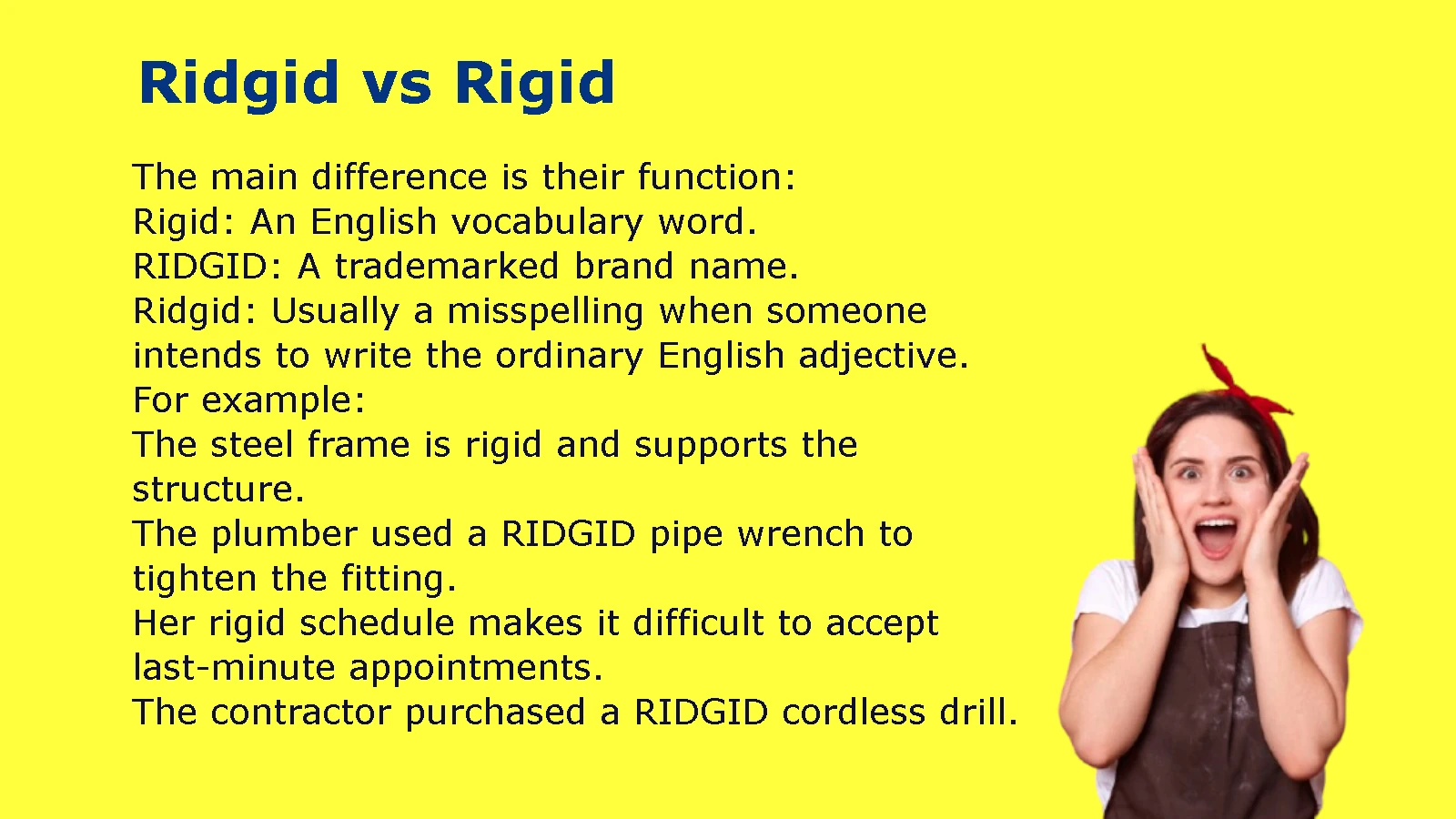
The main difference is their function:
- Rigid: An English vocabulary word.
- RIDGID: A trademarked brand name.
- Ridgid: Usually a misspelling when someone intends to write the ordinary English adjective.
For example:
- The steel frame is rigid and supports the structure.
- The plumber used a RIDGID pipe wrench to tighten the fitting.
- Her rigid schedule makes it difficult to accept last-minute appointments.
- The contractor purchased a RIDGID cordless drill.
Notice that the spelling changes according to the meaning. When you describe something that cannot bend easily, use rigid. When you identify the manufacturer, use RIDGID.
Rigid Meaning and Definition
Rigid means stiff, firm, or resistant to bending, movement, or change. It describes physical objects that maintain their shape under pressure and people, rules, or systems that do not easily adapt to new situations.
The word has several related meanings depending on the context.
Physical meaning: Something rigid does not bend or flex easily.
Example: A rigid metal rod maintains its shape when you apply moderate pressure.
Behavioral meaning: A rigid person may refuse to consider different opinions or change established habits.
Example: The manager has a rigid attitude toward workplace procedures.
Rules and systems: A rigid system follows fixed requirements and allows little flexibility.
Example: The school introduced rigid attendance rules for all students.
| Context | Meaning | Example |
| Materials | Difficult to bend | The rigid plastic casing protects the equipment. |
| Personality | Unwilling to change | He has a rigid approach to problem-solving. |
| Rules | Strict and inflexible | Employees must follow a rigid schedule. |
| Structures | Firm and stable | The rigid frame supports the roof. |
| Thinking | Limited openness to ideas | Rigid thinking can prevent innovation. |
What Does RIDGID Mean?
RIDGID is the name of a tool brand known for manufacturing equipment used in plumbing, construction, maintenance, and industrial applications. Its product range includes pipe wrenches, drain-cleaning machines, inspection equipment, and various power tools.
Unlike the adjective rigid, RIDGID does not describe a physical property or personality trait. It identifies a manufacturer and its products.
You may encounter the brand name in:
- Hardware stores.
- Construction supply shops.
- Plumbing equipment catalogs.
- Power tool reviews.
- Professional contractor discussions.
- Online product listings.
- Repair and maintenance guides.
For example:
- The plumber keeps a RIDGID pipe wrench in his toolbox.
- I purchased a RIDGID inspection camera for the maintenance project.
- The contractor compared several RIDGID cordless tools before buying a new kit.
Writing tip: Use the brand’s official capitalization, RIDGID, when referring to its products. This makes the distinction clear to readers and avoids confusing the manufacturer with the ordinary adjective.
Ridgid or Rigid: Which Spelling Is Correct?
The correct spelling depends on what you want to communicate. Rigid is correct when you describe something stiff or inflexible. RIDGID is correct when you refer to the tool manufacturer. Writing ridgid in an ordinary English sentence is generally a spelling mistake.
Consider these examples:
| Spelling | Correct usage | Example |
| Rigid | Standard English adjective | The rigid pipe cannot bend easily. |
| RIDGID | Tool manufacturer | He purchased a RIDGID pipe wrench. |
| Ridgid | Usually an incorrect adjective spelling | The material is ridgid. |
| rigid | Correct lowercase form | The rules are too rigid. |
Here is an easy way to remember the difference:
- Talking about stiffness? Write rigid.
- Talking about the tool company? Write RIDGID.
- Describing a person who refuses to change? Write rigid.
- Reviewing a manufacturer’s drill or wrench? Write RIDGID.
The distinction matters in professional writing, product descriptions, online searches, and everyday communication.
Rigid Definition, Meaning, and Usage
Rigid is an adjective that describes something that resists bending, movement, or change. People use it in everyday English, science, engineering, construction, and workplace discussions. Its meaning can refer to physical stiffness, strict rules, or an unwillingness to accept different ideas.
Understanding these contexts helps you use the word accurately rather than treating every example as a reference to physical stiffness.
What Does Rigid Mean in Different Contexts?
The word rigid has several applications. Its central idea remains the same: something does not easily change its position, shape, behavior, or structure.
Physical rigidity
Physical rigidity describes an object’s resistance to bending or deformation.
For example, a steel support beam is more rigid than a thin rubber strip. The beam maintains its shape under ordinary working conditions, while the rubber strip bends easily.
You might use this meaning when discussing:
- Metal frames.
- Plastic containers.
- Building materials.
- Pipes and fittings.
- Furniture structures.
- Mechanical components.
Personal rigidity
When you describe someone as rigid, you usually mean that the person struggles to adapt or accept different opinions.
For example:
“Daniel follows a rigid routine and dislikes unexpected changes.”
This does not necessarily mean that Daniel is a bad person. It simply describes his limited willingness to adjust his habits.
Rigid rules and policies
Organizations sometimes introduce rigid rules to maintain consistency, safety, or discipline.
For example:
“The factory follows rigid safety procedures when employees operate heavy machinery.”
In this sentence, rigid means strict and firmly enforced.
Rigid thinking
Rigid thinking refers to a fixed way of looking at situations. Someone with rigid thinking may struggle to consider alternative explanations or solutions.
For example:
“A rigid approach to customer service can make it difficult to resolve unusual complaints.”
This meaning frequently appears in discussions about management, education, relationships, and decision-making.
Rigid Person Meaning
A rigid person is someone who finds it difficult to adjust their behavior, opinions, routines, or expectations. Such a person may strongly prefer familiar methods and resist suggestions that challenge their established beliefs.
For example, imagine a manager who insists that every employee follow the same work process, even when a different method would produce better results. You could describe that manager as rigid.
Common characteristics associated with a rigid personality include:
- Strong attachment to established routines.
- Difficulty accepting alternative opinions.
- Resistance to unexpected changes.
- Preference for fixed rules and procedures.
- Limited willingness to compromise.
- A tendency to follow familiar methods.
However, context matters. A person who follows strict rules is not automatically unreasonable.
For example, a surgeon may follow rigid hygiene procedures because patient safety requires consistency. In this situation, rigidity can support professional standards.
On the other hand, a manager who refuses to consider a practical improvement simply because it differs from an existing process may demonstrate unhelpful rigidity.
Example sentences:
- My supervisor is too rigid to consider new suggestions.
- A rigid person may struggle in a rapidly changing workplace.
- She follows a rigid routine to manage her daily responsibilities.
- His rigid opinions sometimes create unnecessary arguments.
- The teacher maintains rigid classroom rules to ensure discipline.
Rigid in a Sentence
The following examples show how to use rigid naturally in different situations.
Physical objects:
- The rigid plastic container protects delicate equipment.
- Engineers designed a rigid frame to support the machine.
- This metal pipe is too rigid to bend by hand.
- The rigid structure remained stable during installation.
People and personalities:
- My father has a rigid approach to household rules.
- She dislikes working with rigid managers.
- His rigid attitude makes group discussions difficult.
- A rigid person may find it challenging to accept criticism.
Rules and systems:
- The company follows rigid safety regulations.
- Our school has a rigid attendance policy.
- The application process follows a rigid schedule.
- The organization needs fewer rigid procedures.
Thinking and behavior:
- Rigid thinking can limit creative problem-solving.
- Employees should avoid rigid assumptions about customers.
- His rigid beliefs prevent him from considering other perspectives.
- A flexible strategy often works better than a rigid plan.
Rigid as a Part of Speech
Rigid is primarily an adjective. It modifies nouns by describing their physical properties, behavior, or resistance to change.
For example:
- A rigid structure.
- A rigid policy.
- A rigid personality.
- A rigid material.
The word also has related grammatical forms.
| Word | Part of speech | Meaning | Example |
| Rigid | Adjective | Stiff or inflexible | The frame is rigid. |
| Rigidity | Noun | The state of being rigid | The material has considerable rigidity. |
| Rigidly | Adverb | In a rigid or inflexible manner | The rules were rigidly enforced. |
These forms are useful when writing about materials, behavior, policies, and systems.
For example:
“Although the structure has considerable rigidity, the engineers designed the surrounding components to allow controlled movement.”
Here, rigidity acts as a noun, while rigid describes the structure.
Rigid Pronunciation and Spelling
Rigid is pronounced with two syllables, with the stress on the first syllable. Its pronunciation remains the same whether you write the adjective rigid or refer to the RIDGID tool brand. The different spelling reflects the brand identity, not a different English pronunciation.
How Do You Pronounce Rigid?
The standard pronunciation of rigid is:
IPA: /ˈrɪdʒ.ɪd/
The word contains two syllables:
- First syllable: Rihj
- Second syllable: Id
The first syllable receives the main stress. The letter combination “gi” produces the soft /dʒ/ sound, similar to the sound in giant, giraffe, and engine.
To pronounce the word naturally:
- Start with the short vowel sound in sit.
- Follow it with the /dʒ/ sound, as in judge.
- Finish with a short, unstressed vowel and the /d/ sound.
- Keep the first syllable stronger than the second.
Example sentences:
- The rigid material is difficult to bend.
- Engineers designed a rigid support structure.
- His rigid attitude caused disagreements.
Is RIDGID Pronounced the Same as Rigid?
Yes. RIDGID and rigid have essentially the same pronunciation in ordinary English. The difference is visual and semantic: rigid is a dictionary word, while RIDGID is a manufacturer’s brand name.
For example, you might say:
- “This metal frame is rigid.”
- “I bought a RIDGID metal-cutting tool.”
Both use the same basic spoken word sound. However, listeners understand the intended meaning from the surrounding sentence.
This explains why people sometimes search for “rigid tools” when they actually mean RIDGID tools.
Why Do People Spell Rigid as Ridgid?
People often write ridgid because the brand name RIDGID contains an extra letter that does not appear in the ordinary English adjective.
Several factors contribute to this confusion:
- Similar pronunciation: Both spellings sound alike.
- Brand exposure: People regularly see RIDGID printed on tools and packaging.
- Typing habits: Someone familiar with the brand may accidentally transfer its spelling into ordinary writing.
- Autocorrect: Predictive text may reinforce a previously used spelling.
- Search behavior: People often type the spelling they remember rather than the dictionary spelling.
For example, someone might write, “The plastic is ridgid,” after seeing RIDGID branding on a nearby tool.
The correct sentence is:
“The plastic is rigid.”
Remember that brand names do not determine the spelling of ordinary English words.
Rigid Synonyms and Antonyms
Rigid has several synonyms and antonyms, but you should choose an alternative based on the context. Words such as stiff, firm, and unbending describe physical properties, while inflexible, strict, and uncompromising often describe behavior, rules, or attitudes.
Common Synonyms for Rigid
Here are useful alternatives to rigid, along with their meanings and examples.
| Synonym | Meaning | Example |
| Stiff | Difficult to bend or move | The stiff material holds its shape. |
| Inflexible | Unwilling to change | The manager has an inflexible attitude. |
| Firm | Solid or stable | The table has a firm structure. |
| Unyielding | Not giving way | The unyielding surface resisted pressure. |
| Unbending | Not changing position or opinion | His unbending attitude surprised everyone. |
| Strict | Enforcing rules firmly | The school follows strict guidelines. |
| Uncompromising | Unwilling to make concessions | She takes an uncompromising approach to safety. |
| Sturdy | Strong and solid | The sturdy frame supports heavy equipment. |
How to choose the right synonym:
- Use stiff when describing something that does not bend easily.
- Use inflexible when describing a person or system that resists change.
- Use strict when discussing rules and requirements.
- Use sturdy when emphasizing strength and durability.
- Use uncompromising when describing someone’s firm position.
For example, calling a metal rod inflexible is understandable, but stiff or rigid may describe its physical properties more naturally.
Common Antonyms for Rigid
An antonym is a word with the opposite meaning. The best antonym for rigid depends on whether you describe a physical object, a person’s behavior, or a set of rules.
| Antonym | Meaning | Example |
| Flexible | Able to bend or adapt | The flexible pipe bends easily. |
| Pliable | Easy to bend or shape | The pliable material fits the design. |
| Adaptable | Able to adjust to change | An adaptable manager welcomes new ideas. |
| Elastic | Able to stretch and return to shape | Elastic material stretches under tension. |
| Yielding | Willing to give way | The yielding surface absorbs pressure. |
| Lenient | Not excessively strict | The teacher has a lenient attendance policy. |
| Open-minded | Willing to consider new ideas | An open-minded person listens to different opinions. |
Example sentences:
- Flexible materials work well in applications that require movement.
- An adaptable employee can handle unexpected changes.
- The company replaced its rigid policy with a more flexible system.
- An open-minded manager considers suggestions from the entire team.
Rigid vs Stiff vs Inflexible
Rigid, stiff, and inflexible have related meanings, but they do not always work in the same situations.
| Word | Main meaning | Common application |
| Rigid | Resistant to bending or change | Materials, rules, and attitudes |
| Stiff | Difficult to bend or move | Muscles, materials, and movement |
| Inflexible | Unable or unwilling to adapt | People, policies, and systems |
Consider these examples:
Rigid: The machine has a rigid metal frame.
This emphasizes the frame’s resistance to bending or deformation.
Stiff: My shoulders feel stiff after working all day.
This describes restricted movement or physical tightness.
Inflexible: The company has an inflexible scheduling policy.
This highlights the organization’s unwillingness to accommodate changes.
Although these words sometimes overlap, choosing the most precise one makes your writing clearer.
What Is RIDGID? Understanding the Tool Brand
RIDGID is a tool brand with American origins and a history dating back to 1923. The company began with pipe wrenches and expanded into professional equipment for plumbing, construction, maintenance, and other trades. Today, the RIDGID name appears on a broad range of specialized tools and selected power equipment.
Brand history: Founded in Elyria, Ohio, in 1923.
RIDGID 12″ Heavy-Duty Straight Pipe Wrench, 31015
RIDGID, Cordless, K-4310 FXP, Cordless Drain Cleaning Machine – 817JP2|73048 – Grainger
7
Is RIDGID an American Brand?
Yes. RIDGID originated in the United States. The Ridge Tool Company was incorporated in Elyria, Ohio, in 1923, when founder Carl Ingwer Sr. introduced the company’s now-iconic pipe wrench.
ridgid.com+1
The brand developed around the needs of professional tradespeople, particularly plumbers and pipe workers.
Here are some important historical milestones:
| Year | Historical event |
| 1923 | Ridge Tool Company was incorporated in Elyria, Ohio. |
| 1930 | The company expanded its range of professional hand tools. |
| 1943 | The company moved to its current world headquarters location in Elyria. |
| 1946 | RIDGID began exporting tools to international markets. |
| 1948 | The company introduced its Model 400 Power Drive. |
| 1962 | Ridge Tool Company opened an overseas factory in Belgium. |
| 1966 | Ridge Tool Company became part of Emerson Electric. |
ridgid.com+1
The American origin does not mean every RIDGID product is manufactured in the United States. Manufacturing locations can differ by product and model.
If country of origin matters to your purchase, check the individual product’s packaging or manufacturer specifications rather than relying on the brand’s history.
What Is RIDGID Known For?
RIDGID is particularly associated with professional plumbing and pipe-working equipment. Its product range also includes tools for inspection, maintenance, construction, and general jobsite applications.
Here are some of its major product categories.
Pipe wrenches and plumbing tools
These tools help plumbers grip, tighten, loosen, and work with threaded pipe connections.
Ridgid Drain Cleaner, Model K-60SP 66492 | Zoro
Drain-cleaning equipment
RIDGID offers machines designed to clear blockages in household, commercial, and industrial drainage systems.
Mini Sewer Camera | SC Industries
Inspection cameras
These products help professionals inspect pipes and drainage systems without opening the entire installation.
18V Brushless Cordless 2-Tool Combo Kit with Drill/Driver, Impact Driv – RIDGID
Power tools
The brand also sells drills, impact drivers, saws, grinders, and other tools for construction and repair work.
Pipe-threading equipment
These machines help professionals cut threads into pipes for threaded connections.
RIDGID 16 gal. 5.0-Peak HP Wet Dry Vacuum NXT with Attachments and Blower Function – Walmart.com
Wet/dry vacuums
RIDGID also offers jobsite and workshop vacuum equipment for collecting dust, debris, and liquids.
The important distinction is that RIDGID is not simply a general-purpose drill manufacturer. Its history and product range have strong connections to plumbing and professional trade applications.
RIDGID Brand in the USA
RIDGID has an established presence in the American tool market. Its products serve professional plumbers, contractors, maintenance workers, and homeowners who need equipment for repair and construction projects.
The company’s headquarters remains in Elyria, Ohio. Its history, professional product range, and service infrastructure contribute to its recognition among American tradespeople.
ridgid.com+1
When researching RIDGID tools in the United States, consider these factors:
- Product availability: Check authorized retailers and established tool distributors.
- Intended application: Some products target professional plumbing work, while others suit general home improvement.
- Replacement parts: Check whether the required accessories and replacement components are available.
- Service support: Confirm that an authorized service location can handle your particular product.
- Warranty eligibility: Read the coverage terms for the exact product category.
One important point concerns RIDGID’s Lifetime Service Agreement (LSA).
Eligible RIDGID power tools purchased through qualifying US retail channels may receive this agreement after registration and approval. The current program requires registration within 90 days of purchase for eligible products. Coverage can include service, parts, and batteries, subject to the program’s terms and exclusions.
RIDGID Tools+1
Do not assume that every product carrying the RIDGID name automatically qualifies. Plumbing equipment, power tools, vacuums, and other product categories can have different warranty arrangements.
What Does RIDGID NXT Mean?
RIDGID NXT is a product-line designation used on certain RIDGID equipment, including wet/dry vacuum models. It is not another spelling of the English word rigid, nor is it a separate brand.
The NXT label appears in product names and model descriptions. Buyers should identify the exact model before comparing performance, capacity, accessories, or features.
For example, when comparing two RIDGID NXT shop vacuums, check:
- Tank capacity.
- Peak horsepower or other stated motor specifications.
- Airflow and suction specifications.
- Hose diameter and length.
- Filter compatibility.
- Included accessories.
- Warranty coverage.
A model designation alone does not tell you whether one vacuum performs better than another. Compare the actual specifications and intended applications.
RYOBI vs RIDGID: Which Tool Brand Is Better?
RIDGID
Professional trade equipment and power tools.
These Ryobi Power Tools Will Have You Rethinking Your Hand Tool Setup
RYOBI
DIY, home improvement, and cordless tools.
RIDGID vs RYOBI: Brand Overview
The two brands have different corporate backgrounds.
RIDGID originated as Ridge Tool Company in Ohio in 1923. It became part of Emerson Electric in 1966.
ridgid.com+1
RYOBI originated in Japan in 1943. Today, its power tool business operates under Techtronic Industries (TTI), which also manages other major tool brands.
Techtronic Industries TTI+2
| Comparison | RIDGID | RYOBI |
| Origin | United States | Japan |
| Founding year | 1923 | 1943 |
| Main association | Plumbing and professional tools | DIY and home improvement tools |
| Product range | Plumbing equipment, inspection tools, power tools | Power tools, outdoor equipment, home improvement products |
| Cordless platform | RIDGID 18V | RYOBI 18V ONE+ |
| Brand background | Ridge Tool Company, part of Emerson | Power tool business under TTI |
One important detail: the RIDGID power tool line and the RIDGID plumbing equipment business should not be treated as identical product operations. Certain RIDGID power tools use a licensing arrangement involving TTI. This explains why the brands’ corporate relationships can seem confusing.
RIDGID vs RYOBI: Tool Quality and Durability
Tool quality depends on the individual product, its design, materials, motor, components, and intended workload. Neither brand automatically wins every comparison.
When evaluating a RIDGID or RYOBI tool, examine the specifications rather than relying only on the logo.
For example, when comparing cordless drills, look at:
- Motor type: Brushless motors can improve efficiency and reduce routine motor maintenance.
- Torque: Higher torque can help with demanding fastening and drilling tasks.
- Speed settings: Multiple speed settings provide better control across applications.
- Chuck capacity: This determines the compatible drill bit size.
- Battery capacity: Higher amp-hour ratings generally provide more stored energy.
- Build quality: Check the housing, chuck, gearbox, and grip.
- Serviceability: Consider replacement parts and repair support.
A homeowner who drills occasional holes in wood has different requirements from a contractor who uses a drill throughout the working day.
That is why model-to-model comparisons provide more useful information than broad brand comparisons.
RIDGID vs RYOBI: Price and Value
Price is another important consideration when choosing between RIDGID and RYOBI.
RYOBI offers a broad selection of tools for homeowners and DIY users. Its range includes individual tools, starter kits, batteries, chargers, and outdoor equipment.
RIDGID also offers cordless tools and kits, along with specialized equipment for professional trades.
Instead of comparing brand names alone, calculate the complete cost of ownership.
Consider:
| Buying factor | What to examine |
| Initial price | Cost of the tool or kit |
| Batteries | Number and capacity included |
| Charger | Whether a compatible charger comes with the purchase |
| Accessories | Drill bits, blades, cases, and attachments |
| Replacement parts | Availability and cost |
| Warranty | Coverage period and registration requirements |
| Future expansion | Cost of adding compatible tools |
For example, a drill kit that costs more initially may offer two batteries and a charger. Another kit may look cheaper but require additional purchases.
The better value depends on what comes inside the package and how frequently you will use the equipment.
RIDGID vs RYOBI: Battery Platforms
Battery compatibility matters when you buy cordless tools.
RIDGID offers an 18V cordless tool platform, while RYOBI offers its 18V ONE+ system. Both platforms allow users to operate compatible tools using batteries from the same system.
However, RIDGID batteries and RYOBI batteries are not interchangeable.
A RIDGID 18V battery does not automatically fit an RYOBI 18V tool, even though both systems use the same nominal voltage.
RYOBI’s ONE+ system has maintained battery compatibility across its 18V platform since 1996, according to TTI.
Techtronic Industries TTI+1
Before choosing a brand, ask yourself:
- Do you already own compatible batteries?
- How many cordless tools do you plan to purchase?
- Will you need high-capacity batteries?
- Does the manufacturer offer the specific tools you need?
- Can you easily obtain replacement batteries and chargers?
A battery ecosystem can influence long-term spending more than the price of an individual drill.
RIDGID vs RYOBI: Warranty and Customer Support
Warranty coverage is another area where buyers should examine the details.
In the United States, eligible RIDGID handheld power tools generally receive an automatic three-year limited warranty. Certain qualifying products can also receive the Lifetime Service Agreement after successful registration.
RIDGID Tools+1
The LSA requires registration within 90 days of purchase for eligible products. It is not an unconditional lifetime warranty on every RIDGID product.
RYOBI warranty coverage also varies by market and product category. Buyers should check the applicable terms for their country and model.
Before purchasing either brand, verify:
- The standard warranty period.
- Whether registration is necessary.
- The deadline for registration.
- Whether batteries receive separate coverage.
- Whether normal wear and tear qualifies.
- Which service centers handle repairs.
- Whether proof of purchase is required.
Practical tip: Save your purchase receipt and record your model and serial numbers. These details can make warranty claims and replacement-part searches much easier.
Which Brand Should You Choose?
Your choice should depend on the work you perform, the specific equipment you need, and your existing battery system.
| Buyer type | What to consider |
| Professional plumber | RIDGID’s specialized plumbing and pipe-working equipment |
| DIY homeowner | RYOBI’s broad selection of home improvement tools |
| General contractor | Compare individual models, durability, and service support |
| Budget-conscious buyer | Compare complete kits and long-term battery costs |
| Existing cordless tool owner | Stay within a compatible battery platform when practical |
| Drain-cleaning professional | Evaluate RIDGID’s specialized drain-cleaning equipment |
Practical buying example
Imagine two people shopping for cordless drills.
The first person needs a drill for assembling furniture, installing shelves, and completing occasional household repairs. A suitable RYOBI ONE+ kit may meet those needs while providing access to a large selection of compatible home improvement tools.
The second person works on construction sites and already owns RIDGID cordless equipment. A compatible RIDGID drill may make more financial sense because the buyer can use an existing battery system.
Neither choice is automatically better. The application and existing equipment determine the practical value.
When Should You Use Rigid vs RIDGID?
Use rigid when describing something stiff, inflexible, or resistant to change. Use RIDGID when referring to the tool manufacturer or its products. The distinction applies to everyday writing, professional documents, product reviews, shopping searches, and technical discussions.
When to Use Rigid in Everyday English
Use rigid as an adjective when discussing physical properties, behavior, rules, or systems.
Here are some common situations:
Describing materials
- The rigid metal sheet cannot bend easily.
- Engineers selected a rigid support for the structure.
- This rigid plastic casing protects the electronic components.
people
- My supervisor has a rigid management style.
- A rigid person may struggle to accept different opinions.
- Her rigid attitude makes negotiations difficult.
Describing rules
- The organization introduced rigid attendance requirements.
- Employees must follow rigid safety procedures.
- The rigid schedule leaves little room for adjustments.
When to Use RIDGID in Tool-Related Writing
Use RIDGID when the manufacturer or its products are the subject of your sentence.
Examples include:
- The contractor purchased a RIDGID cordless drill.
- RIDGID manufactures equipment for plumbing professionals.
- I need a replacement part for my RIDGID pipe wrench.
- The plumber uses RIDGID drain-cleaning equipment.
- This RIDGID tool comes with a product-specific warranty.
The brand spelling also matters in search queries. If you want to find the manufacturer’s products, searching for RIDGID tools will help distinguish the brand from general discussions about rigid materials.
Common Examples of Rigid vs RIDGID
These examples show how a small spelling difference changes the intended meaning.
| Incorrect or confusing sentence | Correct sentence |
| This material is ridgid. | This material is rigid. |
| He has a ridgid attitude. | He has a rigid attitude. |
| The rules are too ridgid. | The rules are too rigid. |
| I bought a rigid pipe wrench from RIDGID. | I bought a RIDGID pipe wrench. |
| The plastic frame is RIDGID. | The plastic frame is rigid. |
| I need a new ridgid drill. | I need a new RIDGID drill. |
Remember: The adjective rigid describes a quality. RIDGID identifies a brand. Once you understand this distinction, you can avoid the spelling mistake in almost every situation.
Ridgid vs Rigid: Common Mistakes to Avoid
Writers and buyers sometimes confuse the two spellings because they look almost identical. However, using the wrong form can change the meaning of a sentence or make a product search less accurate.
Here are some mistakes worth avoiding:
Mistake: Using ridgid as an adjective
Incorrect: The company introduced a ridgid safety policy.
Correct: The company introduced a rigid safety policy.
Mistake: Using rigid when identifying the manufacturer
Confusing: I purchased a rigid cordless drill.
Clearer: I purchased a RIDGID cordless drill.
Mistake: Assuming RIDGID describes a tool’s physical properties
Incorrect interpretation: The word RIDGID means that a tool cannot bend.
Correct interpretation: RIDGID is the manufacturer’s brand name. Its tools may have rigid components, but the brand name itself does not describe their physical properties.
Mistake: Assuming every RIDGID product has identical warranty coverage
Different product categories can have different warranty terms. Always check the specific model and applicable coverage.
A Practical Example: Choosing the Correct Spelling
Imagine you are writing a product review about a RIDGID pipe wrench.
You might write:
“The RIDGID pipe wrench features a strong construction and a rigid frame that helps it maintain its shape during normal use.”
This sentence uses both terms correctly:
- RIDGID identifies the manufacturer.
- Rigid describes a physical property.
This is the easiest way to understand the difference. Both forms can appear in the same paragraph, but they perform different grammatical and semantic functions.
“A brand name identifies who makes a product; an adjective describes what that product is like.”
This simple distinction also applies to product descriptions, technical articles, and professional writing.
Frequently Asked Questions About Ridgid vs Rigid
Is it Ridgid or rigid?
Rigid is the correct spelling of the standard English adjective. It means stiff, firm, or resistant to change. RIDGID is the correct spelling of the tool brand. Use lowercase rigid for ordinary descriptions and the brand’s capitalization when discussing its products.
Is RIDGID a real word?
RIDGID is a real brand name, but it is not the standard dictionary spelling of the English adjective. The correct adjective is rigid. RIDGID identifies a manufacturer known for plumbing equipment, professional tools, and power tools.
Is RIDGID an American brand?
Yes. RIDGID originated in Elyria, Ohio, in 1923 as the Ridge Tool Company. It became part of Emerson Electric in 1966. The brand has since developed an international presence in professional tool markets.
ridgid.com+1
Are RIDGID and RYOBI the same company?
No. They are separate tool brands with different corporate backgrounds. RIDGID originated with Ridge Tool Company and became part of Emerson Electric, while RYOBI’s power tool business operates under Techtronic Industries.
RIDGID Tools+1
How do you pronounce rigid and RIDGID?
Both have essentially the same pronunciation in ordinary English. They contain two syllables, with the stress on the first. The spelling difference reflects the distinction between an English adjective and a tool brand name.
What is the meaning of rigid when describing a person?
A rigid person is someone who resists changes, strongly prefers established routines, or finds it difficult to accept different opinions. The word can describe someone who follows strict principles, but it often suggests limited flexibility in thinking or behavior.
What is the difference between rigid and rigidity?
Rigid is an adjective that describes something stiff or inflexible. Rigidity is a noun that describes the state or quality of being rigid.
For example:
- The metal frame is rigid.
- The metal frame has considerable rigidity.
What does rigid atau ridgid mean?
“Atau” is the Indonesian word for “or.” Therefore, rigid atau ridgid asks whether rigid or ridgid is the correct spelling. Use rigid for the English adjective and RIDGID for the tool brand.
Conclusion: Ridgid vs Rigid
The difference between Ridgid vs Rigid comes down to spelling, meaning, and context.
Rigid is the correct English adjective. It describes something stiff, firm, inflexible, or resistant to change. You can use it when discussing materials, structures, personalities, rules, and behavior.
RIDGID, on the other hand, is a tool brand with American origins dating back to 1923. It is associated with pipe wrenches, plumbing equipment, inspection tools, and power equipment.
If you are researching tools, you can also compare RIDGID with RYOBI by examining product specifications, battery compatibility, pricing, and warranty coverage.
Keep this simple rule in mind: Use rigid for the English word and RIDGID for the tool brand.
When writing your next product review, technical article, or everyday sentence, check the context before choosing the spelling.