Bellies or bellys? Bellies is the correct spelling when you want to write the plural of belly. Bellys is generally considered a misspelling in standard English. The difference comes from a common English plural spelling rule: nouns ending in a consonant followed by y usually change y to ies.
Understanding the belly meaning, bellies meaning, and belly plural helps you avoid common grammar mistakes. The same spelling pattern appears in words such as baby/babies, city/cities, and puppy/puppies. However, words like trolley/trolleys follow a different rule because a vowel comes before the final y.
This guide explains the correct spelling, singular and plural forms, example sentences, related spelling patterns, and the meaning of bellies in different contexts.
| Question | Answer |
| Is it bellies or bellys? | Bellies is correct. |
| What is the plural of belly? | Bellies. |
| What does bellies mean? | Bellies is the plural of belly, referring to the abdominal area of people or animals. |
| What is the plural of trolley? | Trolleys. |
| Is belly’s the same as bellies? | No. Belly’s can show possession or represent a contraction, while bellies is the plural. |
Bellies or Bellys: Which One Is Correct?
Bellies is the correct standard plural spelling of belly. The word bellys is generally incorrect when referring to more than one belly. To form the plural, change the final y to ies. For example, one belly becomes two bellies.
The correct spelling depends on what you want to communicate.
| Word | Correct? | Explanation |
| Belly | Yes | Singular noun |
| Bellies | Yes | Standard plural noun |
| Bellys | Generally no | Nonstandard spelling when used as the plural |
| Belly’s | Yes, in certain contexts | Possessive form or contraction |
For example:
- Correct: The babies had round bellies.
- Incorrect: The babies had round bellys.
- Correct: The baby has a round belly.
The distinction matters in school assignments, blog posts, professional writing, product descriptions, and everyday communication.
Why Is Bellies the Correct Spelling?
The word belly ends with a consonant + y combination. In English, most nouns with this ending form their plurals by replacing y with ies.
The spelling transformation looks like this:
Belly → Bellies
You remove the final y and add ies.
This rule also applies to many familiar words:
- Baby → Babies
- City → Cities
- Puppy → Puppies
- Party → Parties
- Berry → Berries
The spelling changes, but the word’s basic meaning stays the same. Only the number changes from singular to plural.
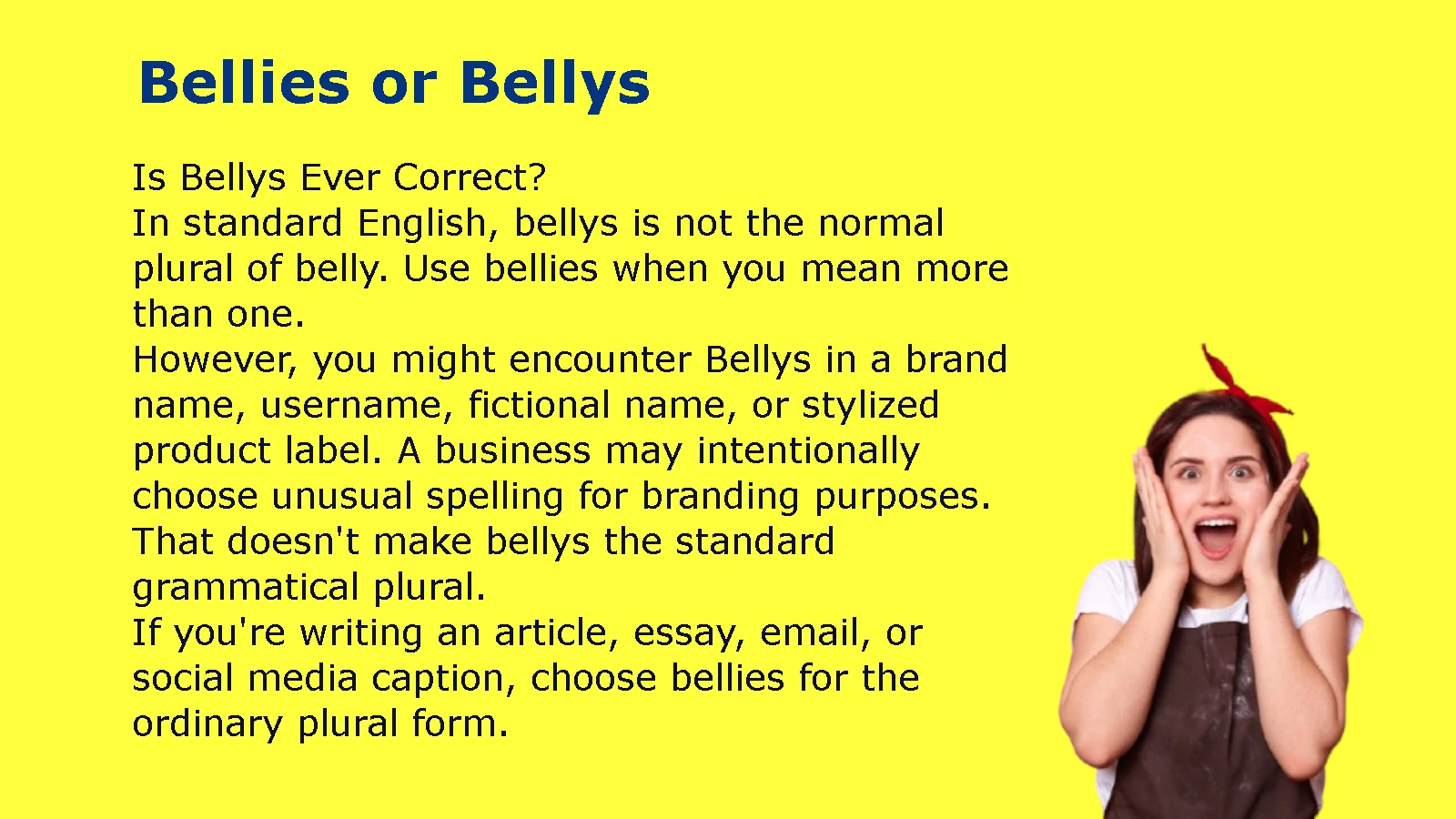
Is Bellys Ever Correct?
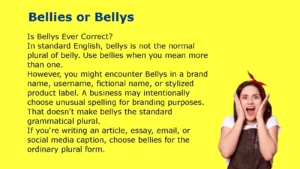
In standard English, bellys is not the normal plural of belly. Use bellies when you mean more than one.
However, you might encounter Bellys in a brand name, username, fictional name, or stylized product label. A business may intentionally choose unusual spelling for branding purposes.
That doesn’t make bellys the standard grammatical plural.
If you’re writing an article, essay, email, or social media caption, choose bellies for the ordinary plural form.
Bellies Meaning and Definition
Bellies is the plural form of belly. It refers to the abdominal or stomach area of two or more people or animals. In everyday English, people often use belly as an informal word for the front part of the body between the chest and pelvis.
The word can describe different body shapes, positions, or physical sensations.
For example:
- The children rubbed their bellies after lunch.
- The puppies slept with their bellies facing upward.
- The fish had silver scales and pale bellies.
- The kittens had soft, rounded bellies.
In these sentences, bellies identifies the same general body area in multiple people or animals.
Belly Meaning in Everyday English
The word belly usually means the front part of the body around the abdomen. It is common in casual conversation, children’s stories, descriptive writing, and familiar expressions.
People often use belly instead of abdomen because it sounds more conversational.
Compare these examples:
| Word | Meaning or tone | Example |
| Belly | Informal and everyday | My belly feels full. |
| Abdomen | More anatomical or formal | The doctor examined the abdomen. |
| Stomach | Common everyday term, also the name of an organ | I have a stomachache. |
These words overlap in everyday conversation, but they are not always anatomically interchangeable.
The stomach is a digestive organ inside the body. The abdomen is the broader body region that contains the stomach, intestines, and other organs. A person’s belly usually refers to the visible front abdominal area.
For example, someone might say, “My belly hurts,” without identifying which internal organ causes the discomfort.
Bellies Meaning With Example Sentences
Seeing bellies in different sentences makes its meaning easier to understand.
Everyday conversation
- Our bellies were full after the family dinner.
- The children laughed when their bellies made funny noises.
- Their bellies felt uncomfortable after eating too quickly.
Animal descriptions
- The puppies had round bellies and tiny paws.
- The birds showed white feathers on their bellies.
- The kittens curled up with their bellies against the blanket.
Descriptive writing
- Warm sunlight fell across the children’s bellies as they rested on the grass.
- The fish moved through the clear water, revealing their pale bellies.
- The cartoon characters had oversized heads and round bellies.
Informal expressions
- The phrase “belly laugh” refers to a deep, hearty laugh.
- “Belly up” can describe an overturned position or, informally, a business failure in expressions such as “the company went belly up.”
- “Belly button” refers to the navel.
Notice that belly can appear in expressions where its meaning extends beyond a simple body-part description.
What Is the Plural of Belly?
The plural of belly is bellies. English normally forms the plural of nouns ending in a consonant followed by y by changing y to ies. Therefore, you write one belly, two bellies, and several bellies rather than bellys.
The singular form refers to one belly, while the plural form refers to more than one.
| Singular | Plural | Example |
| Belly | Bellies | The baby has a round belly. |
| Belly | Bellies | The babies have round bellies. |
| Belly | Bellies | The puppies have soft bellies. |
The word bellies does not need an apostrophe to show plurality.
Belly vs. Bellies
The main difference between belly and bellies is number.
Belly is singular. Use it when referring to one person, animal, or belly.
Bellies is plural. Use it when referring to multiple people, animals, or bellies.
Consider these sentences:
- The child has a small belly.
- The children have small bellies.
- One puppy rolled onto its belly.
- Three puppies rolled onto their bellies.
The plural noun also affects subject-verb agreement.
| Singular sentence | Plural sentence |
| The belly is round. | The bellies are round. |
| The belly looks swollen. | The bellies look swollen. |
| This belly feels soft. | These bellies feel soft. |
When you use a plural noun as the subject of a sentence, make sure the verb agrees with it.
For example, write “The bellies are full,” not “The bellies is full.”
How to Use Bellies in a Sentence
You can use bellies whenever you need to describe more than one belly.
Here are some original examples:
- The toddlers patted their bellies after eating watermelon.
- Several puppies rested on the floor with their bellies exposed.
- The artist drew cartoon characters with enormous bellies.
- The swimmers noticed that their wetsuits felt tight around their bellies.
- The fish displayed bright orange markings on their bellies.
- The children painted funny faces on paper cutouts shaped like bellies.
You can also use the word in figurative or informal contexts.
For example:
“The boat turned belly up in the water.”
Here, belly up describes the boat’s overturned position.
Another example:
“Everyone enjoyed a belly laugh during the comedy show.”
In this expression, belly laugh means a strong, hearty laugh. The word doesn’t refer to multiple body parts.
Common Mistakes When Writing Belly and Bellies
Some spelling and grammar mistakes appear frequently when writers use singular and plural nouns.
Mistake: Writing bellys instead of bellies
Incorrect: The babies had round bellys.
Correct: The babies had round bellies.
Mistake: Adding an apostrophe to make a plural
Incorrect: The children rubbed their belly’s.
Correct: The children rubbed their bellies.
An apostrophe does not normally make a noun plural.
Mistake: Using the wrong verb
Incorrect: Their bellies is full.
Correct: Their bellies are full.
Mistake: Confusing belly’s with bellies
These forms have different grammatical functions.
- Belly’s: Can show possession or represent a contraction.
- Bellies: Standard plural form.
For example:
“The belly’s shape changed.”
Here, belly’s is possessive. It means the shape of the belly.
“The babies’ bellies were round.”
Here, babies’ is the plural possessive, while bellies is the plural noun.
“The belly’s getting bigger.”
Here, belly’s means belly is.
Understanding these differences helps you write accurate sentences without unnecessary apostrophes.
The Spelling Rule for Words Ending in Y
Many English nouns ending in consonant + y form their plurals by changing y to ies. However, nouns ending in vowel + y usually add s instead. The letter immediately before the final y determines which pattern normally applies.
This distinction explains why belly becomes bellies, while trolley becomes trolleys.
When to Change Y to IES
When a noun ends in a consonant followed by y, replace the final y with ies to form its regular plural.
Here are common examples:
| Singular | Plural |
| Belly | Bellies |
| Baby | Babies |
| City | Cities |
| Puppy | Puppies |
| Party | Parties |
| Berry | Berries |
| Lady | Ladies |
| Story | Stories |
| Country | Countries |
| Family | Families |
Look at the letters before the final y.
In belly, the letter before y is l, a consonant. That means the word follows the consonant + y pattern.
The same applies to baby, where b comes before the final y.
A simple way to remember the rule is:
Consonant + y → ies
For example:
- One family, two families.
- One city, three cities.
- One party, several parties.
This rule covers many everyday nouns, so learning it can improve your spelling beyond the word belly.
When to Add S Instead of IES
If a noun ends in a vowel followed by y, you usually add s without changing the final letters.
Examples include:
| Singular | Plural |
| Boy | Boys |
| Toy | Toys |
| Day | Days |
| Key | Keys |
| Monkey | Monkeys |
| Valley | Valleys |
| Journey | Journeys |
| Trolley | Trolleys |
The key difference is the letter immediately before y.
In boy, the letter o is a vowel.
In trolley, the letter e is a vowel.
Both words therefore take s in their usual plural forms.
Vowel + y → s
This gives you:
- One boy, two boys.
- One toy, three toys.
- One trolley, several trolleys.
English spelling has exceptions and special cases, especially with borrowed words and names, but these patterns work for many common nouns.
What Is the Plural of Trolley?
The standard plural of trolley is trolleys. The word ends in a vowel followed by y, so you normally add s rather than changing y to ies. This spelling is used in both American and British English.
For example:
- The supermarket purchased five new trolleys.
- Two luggage trolleys stood near the entrance.
- The workers pushed the loaded trolleys into the warehouse.
- Several shopping trolleys were available outside the store.
The spelling rule is different from the one used for belly.
| Singular | Plural | Rule |
| Belly | Bellies | Consonant + y |
| Trolley | Trolleys | Vowel + y |
| Baby | Babies | Consonant + y |
| Journey | Journeys | Vowel + y |
You may occasionally see trollies in informal writing or less common usage. However, trolleys is the standard spelling to use in general-purpose writing.
Why Belly Becomes Bellies but Trolley Becomes Trolleys
This difference becomes simple once you compare the final letters.
Belly:
- The word ends in l + y.
- The letter l is a consonant.
- Change y to ies.
- Correct plural: bellies.
Trolley:
- The word ends in e + y.
- The letter e is a vowel.
- Add s.
- Correct plural: trolleys.
The words look similar, but the letter before y changes the pluralization pattern.
This is why you should avoid applying the belly → bellies rule to every word that ends in y.
Bellies vs. Similar Words: More Plural Spelling Examples
Comparing related words helps you recognize spelling patterns faster. Some words follow the consonant + y rule, while others take only s. Learning both patterns helps you avoid mistakes when writing unfamiliar words.
| Singular | Plural | Pattern |
| Belly | Bellies | Consonant + y |
| Jelly | Jellies | Consonant + y |
| Berry | Berries | Consonant + y |
| Lady | Ladies | Consonant + y |
| Valley | Valleys | Vowel + y |
| Trolley | Trolleys | Vowel + y |
| Journey | Journeys | Vowel + y |
| Monkey | Monkeys | Vowel + y |
| Key | Keys | Vowel + y |
| Toy | Toys | Vowel + y |
These examples demonstrate why the spelling of a word’s ending matters.
How to Remember the Belly-to-Bellies Rule
Use this quick memory trick:
Check the letter before Y.
- If it is a consonant, the plural usually changes y to ies.
- If it is a vowel, the plural usually adds s.
You can use this two-step process whenever you are unsure:
Step 1: Find the final Y.
Look at the end of the singular noun.
Step 2: Check the letter before it.
Choose the plural pattern based on that letter.
For example:
- Belly: l + y → bellies.
- Baby: b + y → babies.
- Trolley: e + y → trolleys.
- Key: e + y → keys.
Quick spelling test
Try choosing the correct plural form before checking the answers.
- One puppy, two ______.
- One trolley, three ______.
- One lady, four ______.
- One toy, five ______.
- One belly, two ______.
Answers:
- Puppies
- Trolleys
- Ladies
- Toys
- Bellies
The exercise reinforces the rule through familiar words rather than memorizing isolated spellings.
A Practical Editing Example: Catching the Bellies Mistake
Imagine you’re proofreading a short product description for a children’s clothing store.
Original draft:
“The soft fabric fits comfortably around babies’ bellys. The outfits feature playful designs and pictures of smiling babys.”
The draft contains two plural spelling mistakes.
Corrected version:
“The soft fabric fits comfortably around babies’ bellies. The outfits feature playful designs and pictures of smiling babies.”
Why does the correction work?
- Belly becomes bellies.
- Baby becomes babies.
- Babies’ is possessive because the sentence refers to the bellies belonging to the babies.
This small editing example shows how the same spelling rule can improve an entire sentence.
When proofreading, check the noun ending and then review apostrophes and subject-verb agreement.
Bellies Shoes and Bellies for Women: What Does It Mean?
In some retail markets, especially South Asian shopping contexts, bellies refers to women’s flat shoes, often similar to ballet flats. This shopping meaning differs from bellies, the plural of belly. The intended meaning depends on the context in which you encounter the word.
For example:
- “The babies have round bellies” refers to body parts.
- “She bought new bellies for work” may refer to women’s flat shoes in a regional retail context.
This distinction matters because the same word can appear in searches with completely different intentions.
What Are Bellies Shoes?
Bellies shoes is a regional retail term for women’s flat footwear, often featuring a closed toe and a low or flat sole.
These shoes may resemble ballet flats, although exact designs vary by store and market.
Common features can include:
- Flat soles: Many styles have little or no heel.
- Closed toes: The front covers the toes.
- Slip-on designs: Some styles don’t require laces or buckles.
- Decorative details: Certain pairs feature bows, stitching, patterns, or metallic accents.
- Different materials: Retailers may offer leather, synthetic materials, fabric, or other finishes.
For example, a shopper might search for “black bellies shoes” when looking for simple black flats for office wear.
In this context, bellies is not functioning as the plural of belly. It is a footwear label used in some retail settings.
What Does Bellies for Women Refer To?
The phrase bellies for women generally refers to women’s flat shoes in markets where retailers use bellies as a footwear term.
A shopper might use this phrase to find:
- Everyday flats
- Office shoes
- Casual slip-ons
- Embellished flat footwear
- Comfortable walking shoes
If you’re choosing a pair, consider the following practical factors:
| Factor | What to check |
| Fit | The shoe should hold your foot without pinching. |
| Sole | Look for suitable grip and flexibility. |
| Material | Consider breathability, durability, and maintenance. |
| Toe shape | Choose a shape that leaves enough room for your toes. |
| Intended use | Office wear, occasional outings, or daily walking may require different features. |
For longer periods of walking, comfort depends on more than whether a shoe is flat. Fit, cushioning, support, and the walking surface also matter.
SEO note: If you publish a separate footwear guide, target shopping keywords such as bellies shoes for women, women’s flat shoes, and bellies shoes designs. Keep this spelling article focused on grammar and use contextual internal links where appropriate.
Frequently Asked Questions
Is It Bellies or Bellys?
Bellies is the correct standard spelling when you mean more than one belly. The spelling bellys is generally a mistake because nouns ending in a consonant + y usually change y to ies in the plural.
What Is the Plural Form of Belly?
The plural form of belly is bellies. For example, you can write, “The puppies have round bellies.” The singular form is belly, and the plural form is bellies.
What Does Bellies Mean?
Bellies is the plural of belly, referring to the abdominal or stomach area of multiple people or animals. For example, “The kittens rested with their bellies facing upward.”
Why Does Belly Become Bellies?
Belly becomes bellies because it ends in a consonant followed by y. Many nouns with this ending replace y with ies when forming the plural. Similar examples include baby/babies and city/cities.
What Is the Plural of Trolley?
The standard plural of trolley is trolleys. Because trolley ends in a vowel + y, you normally add s without changing the final y.
Is Belly’s the Same as Bellies?
No. Belly’s can indicate possession or serve as a contraction of belly is or belly has in suitable contexts. Bellies is the plural noun. For example, “The belly’s shape changed” uses the possessive, while “The bellies are round” uses the plural.
Conclusion: Choose Bellies, Not Bellys
When you’re deciding between bellies or bellys, choose bellies for the standard plural of belly.
The spelling follows a familiar English rule: nouns ending in a consonant + y usually change y to ies. That’s why belly becomes bellies, while trolley becomes trolleys.
Remember these key points:
- Belly is singular.
- Bellies is plural.
- Belly’s can be possessive or a contraction.
- Bellys is generally a nonstandard plural spelling.
- Trolleys is the standard plural of trolley.
- Bellies shoes can refer to women’s flat footwear in certain retail contexts.