Choose vs chose is a common grammar question because both words come from the same verb but describe different forms of an action. Choose is the base form and present-tense form, while chose is the simple past tense of choose. The past participle is chosen.
Understanding the difference between choose vs chose, their meaning, pronunciation, spelling, and sentence patterns helps you write more clearly. Whether you’re describing a decision you make today, one you made yesterday, or a choice you’ve already completed, the correct verb form depends on how your sentence works.
Chose vs Choose : Quick Answer
| Question | Answer |
| What is the difference between choose and chose? | Choose is the base form; chose is the simple past tense. |
| What is the past tense of choose? | Chose. |
| What is the past participle of choose? | Chosen. |
| Is chose a word? | Yes. Chose is the correct simple past form of choose. |
| How do you pronounce choose vs chose? | Choose sounds like /tʃuːz/, while chose sounds like /tʃoʊz/ in standard American English. |
Choose vs Chose: What’s the Difference?
Chose describes the same action in the simple past. The key difference is grammatical tense, not meaning. Use choose for present habits, instructions, and base-form constructions. Use chose when you describe a completed past action.
| Feature | Choose | Chose |
| Word type | Verb | Verb |
| Verb form | Base form | Simple past |
| Main use | Present actions, habits, instructions, and infinitives | Completed past actions |
| Pronunciation | /tʃuːz/ | /tʃoʊz/ |
| Example | I choose the blue one. | I chose the blue one yesterday. |
| Common time reference | Today, usually, every day | Yesterday, last year, earlier |
When Should You Use Choose?
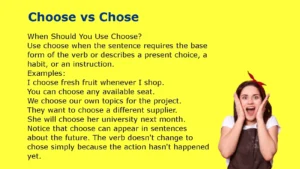
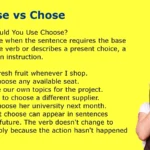
Use choose when the sentence requires the base form of the verb or describes a present choice, a habit, or an instruction.
Examples:
- I choose fresh fruit whenever I shop.
- You can choose any available seat.
- We choose our own topics for the project.
- They want to choose a different supplier.
- She will choose her university next month.
Notice that choose can appear in sentences about the future. The verb doesn’t change to chose simply because the action hasn’t happened yet.
For example:
- Correct: I will choose a new laptop tomorrow.
- Incorrect: I will chose a new laptop tomorrow.
The modal verb will takes the base form of the main verb.
When Should You Use Chose?
Use chose when you describe a completed action in the past.
Examples:
- I chose the window seat on my last flight.
- Sarah chose a different career path.
- We chose the cheaper plan last month.
- The committee chose three finalists.
- He chose to remain silent during the meeting.
The word chose often appears with past-time expressions such as:
- Yesterday
- Last night
- Last month
- A few years ago
- Earlier that morning
However, you don’t always need an explicit time expression. The surrounding context may already show that the action happened in the past.
Example: “Everyone wanted the larger room, but I chose the smaller one.”
The contrast between the two preferences makes the past action clear.
Choose vs Chose Meaning
The meanings of choose and chose remain essentially the same. Both refer to selecting an option, person, course of action, or possibility. The difference lies in when or how the sentence presents the action.
What Does Choose Mean?
Choose means to select someone or something from available possibilities, or to decide what action to take.
You can choose:
- An item: I choose the black jacket.
- A person: The students choose their class representative.
- An action: We choose to save money.
- A direction: Drivers choose the safest route.
- A preference: She chooses comfort over style.
The verb doesn’t always require several visible options. You can also choose to act, wait, participate, or decline.
For example:
“After thinking about the invitation, I choose to attend.”
Here, the speaker describes a decision rather than picking a physical object.
What Does Chose Mean?
Chose means selected or decided in the past. It works as the simple past form of choose.
Examples:
- My parents chose this neighborhood because it was quiet.
- The company chose a new accounting system.
- I chose to study English in college.
- She chose the most practical solution.
The verb can describe deliberate decisions, quick selections, or choices made under pressure.
For instance, “The manager chose another candidate” tells readers what decision the manager made. It doesn’t necessarily explain the reasons behind that decision.
Choose vs Chose: Does the Meaning Change?
No. The core meaning stays the same, but the time reference changes.
Compare these sentences:
Present: We choose the safest option.
Past: We chose the safest option.
Present perfect: We have chosen the safest option.
All three sentences refer to selecting the safest option. However, each construction presents the action differently.
- Choose uses the base form.
- Chose places the action in the simple past.
- Have chosen connects a past choice to the present or presents it within a relevant time frame.
Choose Past Tense and Past Participle
The simple past tense of choose is chose, and its past participle is chosen. These forms belong to an irregular verb, so you shouldn’t add -ed to make the past tense. Use chose for simple past statements and chosen in perfect tenses and many passive constructions.
Choose Verb Forms
| Verb Form | Correct Word | Example |
| Base form | Choose | I choose carefully. |
| Third-person singular | Chooses | She chooses carefully. |
| Present participle | Choosing | He is choosing now. |
| Simple past | Chose | They chose carefully. |
| Past participle | Chosen | We have chosen carefully. |
These forms serve different grammatical functions.
Choose: The base form appears after modal verbs, to, and certain other verbs.
Chooses: Use this form with a third-person singular subject in the simple present, such as he, she, or it.
Choosing: This -ing form appears in progressive constructions and other patterns.
Chose: This form expresses a simple past action.
Chosen: This participle appears in perfect tenses and passive constructions.
Why Is Choose an Irregular Verb?
Regular verbs typically form their simple past and past participle by adding -ed or -d.
For example:
- Walk → walked → walked
- Clean → cleaned → cleaned
- Decide → decided → decided
However, choose follows an irregular pattern:
Choose → Chose → Chosen
You must learn these forms because choosed isn’t the standard past tense or past participle of choose.
When Should You Use Chose vs Chosen?
Use chose for a simple past action. Use chosen when the sentence needs a past participle, usually with a helping verb or in a participial construction.
Compare:
- I chose a new phone yesterday.
- I have chosen a new phone.
- She had chosen her course before registration closed.
- The winner was chosen by the judges.
The difference becomes clearer when you examine the verb patterns.
Simple past:
Subject + chose + object
Example: “The director chose a new location.”
Present perfect:
Subject + has/have + chosen + object
Example: “The director has chosen a new location.”
Past perfect:
Subject + had + chosen + object
Example: “The director had chosen a new location before the team arrived.”
Passive voice:
Subject + form of be + chosen
Example: “A new location was chosen for the event.”
The word chosen doesn’t independently tell you when an action happened. The helping verb and sentence context establish the time.
Choose Past Tense and Past Participle Examples
Consider these examples:
- Simple past: I chose the earlier flight.
- Present perfect: I have chosen the earlier flight.
- Past perfect: I had chosen the earlier flight before prices increased.
- Passive voice: The earlier flight was chosen by the travel coordinator.
- Future perfect: By Friday, we will have chosen our new office.
These sentences demonstrate why memorizing only the simple past form isn’t enough. You also need to understand the sentence structure.
Choose vs Chose Pronunciation
Choose and chose begin and end with similar sounds, but their vowel sounds differ. In standard American English, choose uses the /uː/ sound, while chose uses the /oʊ/ sound. Listening for this vowel change can help you distinguish the words in conversation.
How Do You Pronounce Choose?
The pronunciation of choose is:
IPA: /tʃuːz/
Break the sound into three parts:
- /tʃ/: The opening sound in chair.
- /uː/: A long vowel sound, similar to the vowel in food.
- /z/: A voiced sound, as in zoo.
The word has one syllable.
Example:
“I choose the blue notebook.”
When you say the sentence, hold the vowel slightly longer than you would in chose.
How Do You Pronounce Chose?
The pronunciation of chose in standard American English is:
IPA: /tʃoʊz/
Its sound pattern includes:
- /tʃ/: The same opening sound as choose.
- /oʊ/: The vowel sound in go in standard American English.
- /z/: The same final consonant as choose.
Example:
“I chose the blue notebook.”
The vowel shifts from /uː/ to /oʊ/. This sound difference makes the words easier to recognize when someone speaks.
Choose vs Chose Pronunciation Difference
| Word | IPA | Vowel Sound | Similar Sound |
| Choose | /tʃuːz/ | /uː/ | Food |
| Chose | /tʃoʊz/ | /oʊ/ | Rose |
| Chosen | /ˈtʃoʊzən/ | /oʊ/ | First part of chosen sounds like chose |
Pronunciation can vary slightly across English accents, especially in the exact quality of the vowels.
A practical way to practice is to say these three words slowly:
Choose — Chose — Chosen
Then place them in short sentences:
- I choose the blue one.
- I chose the blue one.
- I have chosen the blue one.
This exercise helps you connect the sound differences to their grammatical roles.
How Do You Spell Chose?
The correct spelling is chose. It contains five letters: C-H-O-S-E. The word is the simple past tense of choose. Don’t write choosed when you mean that someone selected something in the past.
Is Chose a Word?
Yes, chose is a standard English word. It’s the simple past tense of the irregular verb choose.
Correct examples:
- She chose the winning design.
- We chose a quiet restaurant.
- He chose to leave early.
The word chose is not a typo or an informal abbreviation. It’s the accepted grammatical form for the simple past tense.
Incorrect: I choosed the green option.
Correct: I chose the green option.
The past participle is chosen, not chose.
Incorrect: I have chose the green option.
Correct: I have chosen the green option.
Choose vs Chose Spelling Mistakes
Some spelling mistakes happen because writers apply regular verb rules to irregular verbs.
| Incorrect | Correct | Reason |
| Choosed | Chose | The simple past is irregular. |
| Chosen (in simple past) | Chose | Use chose for a simple past action. |
| Chose (after have) | Chosen | Perfect tenses require the past participle. |
| Choose (for a completed past action) | Chose | The sentence needs the simple past form. |
Examples in context:
- Incorrect: Last Friday, I choose the cheaper ticket.
- Correct: Last Friday, I chose the cheaper ticket.
- Incorrect: They have chose a new supplier.
- Correct: They have chosen a new supplier.
- Incorrect: She choosed the second proposal.
- Correct: She chose the second proposal.
Remember that spelling and grammar work together. The right word depends on the verb form your sentence requires.
Choose vs Chose or Chosen: Which One Should You Use?
Choose is the base form, chose is the simple past, and chosen is the past participle. To select the correct form, check whether the sentence describes a present choice, a past action, or a perfect or passive construction.
Choose, Chose, and Chosen in Sentences
Compare the same idea across three sentence structures.
Choose:
“I choose to work from home.”
This sentence describes a current preference or decision.
Chose:
“I chose to work from home last year.”
This sentence describes a completed past decision.
Chosen:
“I have chosen to work from home.”
This sentence uses the present perfect to connect the decision to the present.
Here’s another comparison:
| Choose | Chose | Chosen |
| I choose my meals carefully. | I chose my meals yesterday. | I have chosen my meals. |
| They choose a team leader. | They chose a team leader. | They have chosen a team leader. |
| She will choose a topic. | She chose a topic. | She has chosen a topic. |
The best choice depends on the grammar, not just on the date of the action.
Common Sentence Patterns
Understanding sentence patterns makes it easier to use the three forms naturally.
Choose + noun
- Please choose a seat.
- I choose the silver model.
Choose + to + verb
- She chooses to exercise in the morning.
- We chose to postpone the event.
Modal verb + choose
- You should choose carefully.
- They might choose another candidate.
- We will choose a winner tomorrow.
Have/has/had + chosen
- I have chosen a new course.
- He has chosen a different route.
- They had chosen the venue before the invitations went out.
Be + chosen
- She was chosen for the scholarship.
- The team is chosen by the coach.
- A new representative will be chosen next week.
These structures offer a quick way to spot errors. If you see have, has, or had before the main verb, you generally need chosen rather than chose.
Quick Test: Choose, Chose, or Chosen?
Fill in each blank with the correct form.
- Yesterday, we _____ a different restaurant.
- I have _____ a topic for my presentation.
- You should _____ the option that meets your needs.
- The captain was _____ by the players.
- She _____ to study medicine when she was younger.
Answers and explanations
| Sentence | Answer | Explanation |
| Yesterday, we _____ a different restaurant. | Chose | Yesterday signals a simple past action. |
| I have _____ a topic for my presentation. | Chosen | Have requires the past participle. |
| You should _____ the option that meets your needs. | Choose | Should takes the base form. |
| The captain was _____ by the players. | Chosen | This is a passive construction. |
| She _____ to study medicine when she was younger. | Chose | The sentence describes a past decision. |
Score guide:
- 5 correct: You understand the main verb forms.
- 3–4 correct: Review the difference between chose and chosen.
- 0–2 correct: Practice the sentence patterns before moving on.
Choose in a Sentence: Examples and Usage
Use chose for completed past decisions. Use chosen in perfect tenses and passive sentences. Looking at complete sentences helps you understand how each form works in natural English.
Choose in a Sentence
Here are examples of choose in different situations.
Everyday conversation
- I choose tea over coffee every morning.
- You can choose any available seat.
- We choose our movie together.
- They choose fresh vegetables whenever possible.
Education
- Students choose their preferred subjects.
- I choose books that challenge my thinking.
- Teachers choose activities that match their lessons.
Work and business
- We choose suppliers based on quality and reliability.
- The hiring team can choose another candidate.
- Managers choose tools that fit their team’s needs.
Personal decisions
- I choose to spend more time with my family.
- She chooses kindness even during disagreements.
- You can choose to accept or decline the invitation.
These examples show that choose doesn’t only refer to selecting physical things. It can also introduce decisions, actions, and personal values.
Chose in a Sentence
Use chose to describe past choices.
Everyday conversation
- She chose the red dress for the event.
- We chose a table near the window.
- I chose the smaller coffee.
- He chose the wrong file by mistake.
Education
- Maya chose biology as her major.
- The students chose their own research topics.
- I chose to study at home last weekend.
Work and business
- The company chose a new software provider.
- The director chose three employees for the project.
- Our team chose the simpler solution.
Personal decisions
- He chose to apologize after the argument.
- They chose to move closer to their family.
- I chose not to respond immediately.
A useful detail: chose can describe both intentional and unintentional selections. The verb tells readers what happened, not necessarily whether the decision was wise.
Chosen in a Sentence
The word chosen commonly appears with helping verbs.
Examples:
- I have chosen a new password.
- She has chosen her preferred university.
- They had chosen their seats before the show began.
- The winner was chosen by the judges.
- Our proposal has been chosen for the next phase.
- He will have chosen a suitable candidate by Monday.
Chosen can also appear in adjective-like uses.
For example:
“She was the chosen representative.”
In this sentence, chosen describes the representative’s selection status.
Another example:
“The chosen route avoids heavy traffic.”
Here, chosen modifies route. It refers to a route that someone selected.
Common Mistakes and Corrections
These mistakes often occur in everyday writing, school assignments, emails, and professional documents.
Mistake: Using choose with a past-time marker
Incorrect: Yesterday, I choose the blue jacket.
Correct: Yesterday, I chose the blue jacket.
Why: The sentence describes a completed past action.
Mistake: Using chose after have
Incorrect: We have chose a new strategy.
Correct: We have chosen a new strategy.
Why: The present perfect requires the past participle.
Mistake: Adding -ed
Incorrect: He choosed the cheaper option.
Correct: He chose the cheaper option.
Why: Choose is an irregular verb.
Mistake: Using chosen as the simple past
Incorrect: She chosen the winning entry yesterday.
Correct: She chose the winning entry yesterday.
Why: A simple past sentence needs chose.
Mistake: Changing the verb after will
Incorrect: They will chose a new date.
Correct: They will choose a new date.
Why: Will takes the base form of the main verb.
A Practical Editing Case Study: Choosing the Right Verb Form
Imagine you’re reviewing a short email before sending it to your manager.
Original draft:
“Yesterday, we choose a vendor for the project. We have chose the company with the lowest price, and the team will chose a delivery date tomorrow.”
The message communicates the basic idea, but all three verb forms need attention.
Edited version:
“Yesterday, we chose a vendor for the project. We have chosen the company with the lowest price, and the team will choose a delivery date tomorrow.”
Why the Corrections Work
| Original | Revision | Grammar Rule |
| We choose a vendor yesterday. | We chose a vendor yesterday. | Simple past |
| We have chose the company. | We have chosen the company. | Present perfect |
| Will chose a delivery date. | Will choose a delivery date. | Modal + base form |
This example demonstrates a useful editing strategy: check the words around the verb before changing the verb itself.
Look for clues such as:
- Yesterday or last week: Often signals simple past.
- Have, has, or had: Usually requires the past participle.
- Will, can, should, or must: Takes the base form.
- Was, were, is, or are: May introduce a passive construction when followed by a past participle.
These clues are helpful, but context still matters. For example, was choosing is a valid past progressive construction, while was chosen is a passive construction.
How to Remember the Difference Between Choose and Chose
The easiest way to remember choose vs chose is to learn the three main verb forms together: choose, chose, chosen. Connect each form to a sentence pattern rather than relying only on spelling or pronunciation.
A Simple Memory Trick
Use this sequence:
Choose → Chose → Chosen
Remember these associations:
- Choose: I choose now.
- Chose: I chose before.
- Chosen: I have chosen.
The word choose has a long /uː/ vowel, while chose has an /oʊ/ vowel in standard American English.
That pronunciation difference can help, but grammar should guide your final decision.
For example:
“I have chosen my favorite.”
Even if you remember the sound of chose, the helping verb have signals that you need chosen.
A Three-Step Grammar Check
Before publishing or submitting your writing, follow this quick process.
Check the time reference
Ask whether you’re describing a habit, a present decision, a future selection, or a completed past action.
Examples:
- I choose my meals every Sunday.
- I chose my meals last Sunday.
Check the sentence structure
Look for helping verbs and modal verbs.
- Have/has/had + chosen
- Will/can/should/must + choose
- Simple past action + chose
Read the sentence again
Make sure the verb matches the subject and the surrounding words.
For example:
- She chooses her clothes carefully.
- They choose their clothes carefully.
The third-person singular form chooses changes with the subject. The simple past chose doesn’t change for different subjects.
Compare:
- I chose.
- You chose.
- She chose.
- They chose.
This consistency makes the simple past easier to use.
Frequently Asked Questions
Is chose the past tense of choose?
Yes. Chose is the simple past tense of choose. Use it to describe a completed past action.
Example: “I chose the blue shirt yesterday.”
Is chose a word?
Yes. Chose is a standard English word and the correct simple past form of choose.
Example: “She chose the winning design.”
How do you spell chose?
The correct spelling is chose: C-H-O-S-E. Don’t write choosed when you mean the simple past tense of choose.
What is the difference between choose, chose, and chosen?
Choose is the base form, chose is the simple past, and chosen is the past participle.
Examples:
- I choose carefully.
- I chose carefully.
- I have chosen carefully.
Is it choose or chose for past tense?
Use chose for the simple past tense.
Correct: “We chose a new location last month.”
Use choose after modal verbs such as will, can, and should.
What is the past participle of choose?
The past participle of choose is chosen.
Examples:
- I have chosen my preferred option.
- She had chosen the earlier flight.
- The winner was chosen by the judges.
Conclusion: Choose, Chose, or Chosen?
The difference between choose vs chose comes down to verb form and sentence structure.
- Choose is the base form used for present habits, instructions, and constructions involving modal verbs.
- Chose is the simple past tense for completed past actions.
- Chosen is the past participle used in perfect tenses and passive constructions.
Remember the sequence choose, chose, chosen, and pay attention to helping verbs. That small habit can prevent many common grammar and spelling mistakes.