Whose vs Who’s is a common English grammar confusion, but the difference is simple: whose shows possession or association, while who’s is a contraction of who is or who has. Both are correct words, but they serve different purposes in a sentence.
Understanding whose meaning, who’s meaning, and when to use whose helps you avoid spelling mistakes in emails, essays, messages, and everyday writing. You can also use a simple substitution test to determine which word fits your sentence.
Whose vs Who’s: Quick Answer Table
| Question | Answer |
| What is the difference between whose and who’s? | Whose shows possession; who’s means who is or who has. |
| Is whose a word? | Yes. Whose is a standard English possessive word. |
| What does who’s mean? | Who’s is short for who is or who has. |
| When should you use whose? | Use whose to ask about ownership or show association. |
| Is who’s the same as whose? | No. They have different meanings and grammatical functions. |
Whose vs Who’s: What’s the Difference?
The apostrophe in who’s marks omitted letters. Whose doesn’t need an apostrophe because it isn’t a contraction. Choosing the correct form depends on what you want your sentence to mean.
Compare these examples:
- Whose jacket is hanging by the door? (Who owns the jacket?)
- Who’s standing by the door? (Who is standing there?)
- Who’s taken my jacket? (Who has taken it?)
The words may sound identical in ordinary speech, but their meanings differ.
Whose vs Who’s at a Glance
| Feature | Whose | Who’s |
| Meaning | Belonging to or associated with whom | Who is or who has |
| Word type | Possessive determiner or pronoun | Contraction |
| Apostrophe | No | Yes |
| Common use | Ownership questions and relative clauses | Questions and statements involving who is or who has |
| Example | Whose laptop is this? | Who’s using my laptop? |
The key distinction is possession versus contraction.
For example, in “Whose idea was it?” the word whose asks who owns or is associated with the idea.
In “Who’s ready?” the word who’s means “Who is ready?”
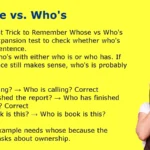
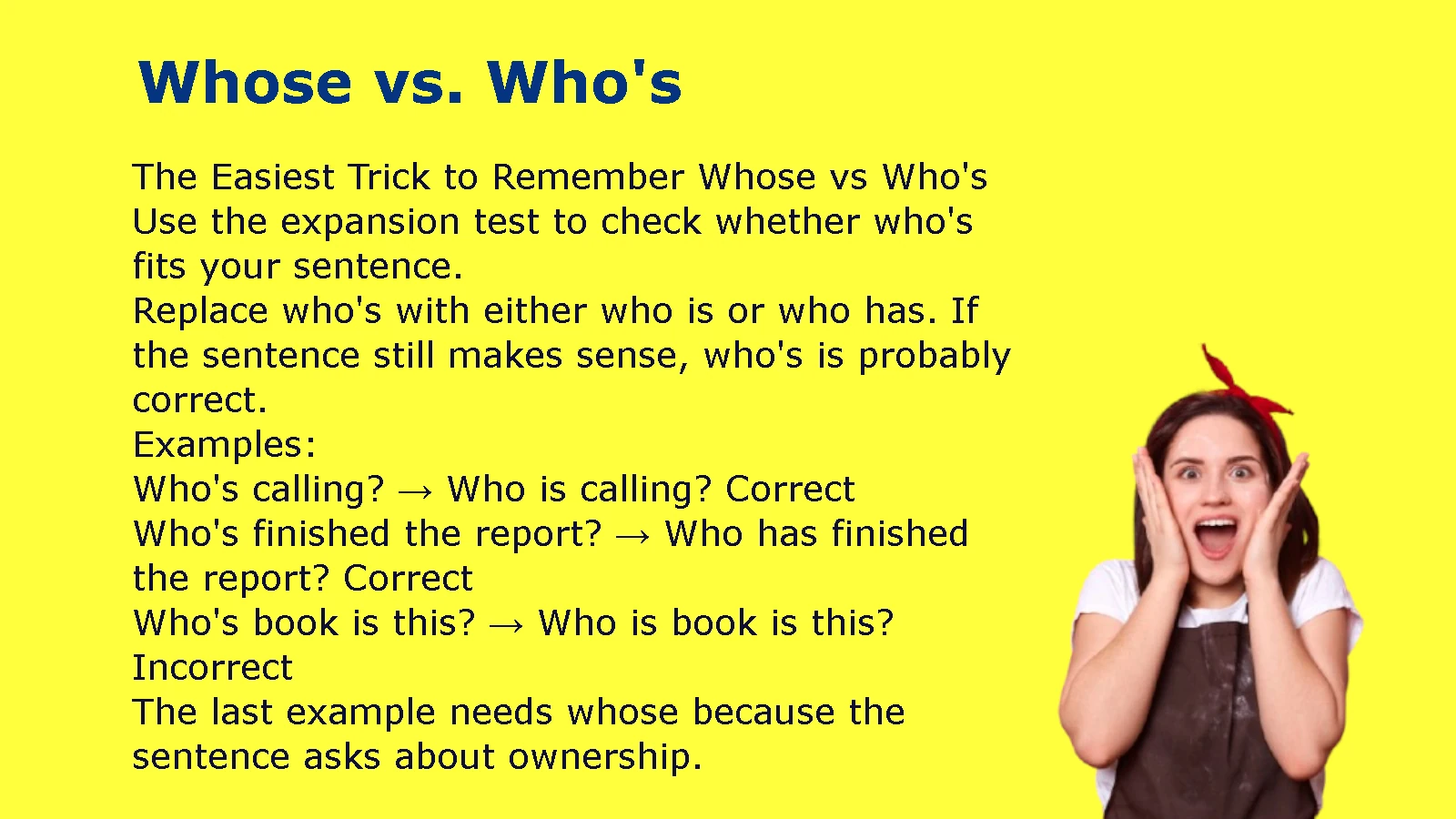
The Easiest Trick to Remember Whose vs Who’s
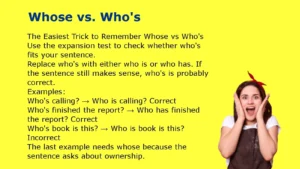
Use the expansion test to check whether who’s fits your sentence.
Replace who’s with either who is or who has. If the sentence still makes sense, who’s is probably correct.
Examples:
- Who’s calling? → Who is calling? Correct
- Who’s finished the report? → Who has finished the report? Correct
- Who’s book is this? → Who is book is this? Incorrect
The last example needs whose because the sentence asks about ownership.
However, don’t rely only on how a sentence sounds. Some sentences can accept both expansions, depending on context.
For example:
“Who’s been working here?”
This can mean “Who has been working here?” The auxiliary verb has helps form the present perfect continuous tense.
A useful rule is to check the sentence’s meaning, not just its pronunciation.
What Does Whose Mean?
Whose is the possessive form of who. It identifies the person, group, or sometimes thing associated with something. You can use whose to ask who owns an object, identify relationships, or connect a person with a characteristic, action, or possession in a sentence.
Examples:
- Whose notebook is this?
- Whose decision was it?
- I met a woman whose daughter is a doctor.
- They restored a building whose windows were broken.
In each example, whose expresses a relationship between someone or something and another noun.
When to Use Whose
Use whose when you want to identify ownership or association.
It commonly appears in three sentence structures.
Direct questions
Use whose to ask about ownership.
- Whose shoes are these?
- Whose phone keeps ringing?
- Whose turn is it?
These questions seek information about the person associated with an item, responsibility, or situation.
Indirect questions
Whose can also appear inside a larger sentence.
- I wonder whose bag this is.
- Do you know whose car is parked outside?
- She asked whose keys were on the table.
An indirect question doesn’t always follow the word order of a direct question.
Compare:
- Direct: Whose car is this?
- Indirect: Do you know whose car this is?
Notice the word order in the indirect question. We say “whose car this is,” not “whose car is this,” when the phrase functions as an embedded question.
Relative clauses
Use whose to connect a person or thing with something associated with them.
- I know a student whose handwriting is beautiful.
- We hired a designer whose portfolio impressed everyone.
- She bought a house whose garden faces the river.
Here, whose introduces a relative clause that provides additional information.
Whose as a Possessive Determiner
A possessive determiner appears before a noun and identifies a relationship or possession.
Whose works this way in questions and relative clauses.
Examples:
- Whose bicycle is parked outside?
- Whose name should I write on the form?
- The artist whose painting won the competition thanked the judges.
- I spoke to a manager whose team exceeded its target.
In these sentences, whose comes directly before a noun such as bicycle, name, painting, or team.
One useful detail: whose doesn’t always indicate legal ownership.
For instance, in “the student whose teacher called,” whose expresses a relationship, not ownership of a person.
Whose as a Possessive Pronoun
Whose can also function independently in questions without an explicitly stated following noun.
Examples:
- Whose is this?
- Whose are they?
- Whose is the blue one?
The noun is understood from context.
Imagine someone points to a collection of coats and asks, “Whose are they?” The question means, “Whose coats are they?”
This form is grammatically correct. However, if the context isn’t clear, naming the object makes the sentence easier to understand.
For example:
- Less specific: Whose are they?
- Clearer: Whose gloves are they?
The second question gives readers or listeners more information.
What Does Who’s Mean?
Who’s is a contraction of who is or who has. It can introduce a question or a statement about a person’s identity, condition, action, or experience. The apostrophe represents omitted letters, so who’s never functions as the ordinary possessive form of who.
Examples:
- Who’s your favorite author? (Who is)
- Who’s at the reception? (Who is)
- Who’s written this note? (Who has)
- Who’s been here before? (Who has)
The intended meaning depends on the grammatical structure of the sentence.
Who’s Meaning: Who Is
Who’s frequently stands for who is.
You can use it before nouns, adjectives, participles, and other sentence elements.
Examples:
- Who’s your new supervisor?
- Who’s available this afternoon?
- Who’s responsible for this decision?
- Who’s waiting outside?
- Who’s the person in charge?
Each sentence allows you to expand who’s into who is.
For instance:
“Who’s responsible for the delay?”
means:
“Who is responsible for the delay?”
This distinction becomes particularly useful when checking sentences with adjectives or descriptions.
Compare:
- Who’s responsible for the project?
- Whose responsibility is the project?
Both sentences can be grammatical, but they express the question differently.
The first asks who is responsible. The second asks whose responsibility it is.
Who’s Meaning: Who Has
Who’s can also mean who has, especially when has works as an auxiliary verb.
Examples:
- Who’s finished the assignment?
- Who’s taken my charger?
- Who’s been using this computer?
- Who’s seen the latest announcement?
- Who’s already submitted the application?
In these examples, who’s expands naturally into who has.
For example:
“Who’s taken my charger?”
means:
“Who has taken my charger?”
However, who’s doesn’t always mean who has simply because the next word is a past participle. Sentence structure matters.
Consider:
“Who’s tired?”
This means “Who is tired?” It doesn’t mean “Who has tired?”
The grammatical pattern helps you identify the correct expansion.
Is Who’s Correct in Formal Writing?
Yes, who’s is grammatically correct in formal and informal writing. However, some academic, legal, or professional style guides may prefer expanded forms in particular contexts.
Use contractions when they suit your tone and audience.
Contractions often work well in:
- Emails to colleagues
- Blog articles
- Informal reports
- Conversations and dialogue
- Friendly business messages
Expanded forms may work better in:
- Highly formal documents
- Legal writing where precision matters
- Writing that follows a no-contractions style guide
- Sentences where expansion improves clarity
For example:
Conversational: “Who’s responsible for approving the request?”
More formal: “Who is responsible for approving the request?”
Both versions are correct.
The important point is to choose the appropriate tone without confusing who’s with whose.
Is Whose a Word?
Yes, whose is a standard English word. It functions as a possessive determiner before a noun and can also function independently in questions. You don’t need an apostrophe because whose isn’t a shortened form of another expression.
Examples:
- Whose book is on the desk?
- I know a teacher whose lessons are engaging.
- Whose is this?
- The company whose products we tested received our feedback.
Whose has an established grammatical role in modern English.
Is Whose a Word Even Without an Apostrophe?
Yes. Whose is correct without an apostrophe.
Many writers mistakenly add an apostrophe because they associate possession with apostrophes. However, English uses different structures to show possession.
Compare:
- Whose: Whose wallet is this?
- Who’s: Who’s carrying the wallet?
- The student’s: The student’s wallet is missing.
- The students’: The students’ wallets are missing.
The possessive form of a noun often uses an apostrophe, but whose follows its own established spelling.
The same principle applies to its and it’s.
- Its = possessive determiner
- It’s = it is or it has
Is Whom’s Correct?
Whom’s is generally not standard in ordinary modern English.
When you need to express possession, use whose rather than trying to form a possessive with whom.
For example:
- Awkward or nonstandard: Whom’s bag is this?
- Standard: Whose bag is this?
Whom typically functions as an object, while whose expresses possession or association.
Whose vs. Whom: What’s the Difference?
Whose expresses possession or association, while whom traditionally functions as the object of a verb or preposition. Use whose to ask about ownership and whom to identify the person receiving an action or following a preposition in formal English.
Examples:
- Whose book did you borrow?
- Whom did you invite?
- To whom did you send the email?
The two words serve different grammatical purposes.
When to Use Whose
Use whose when a sentence asks about possession or describes an association.
Examples:
- Whose car is parked outside?
- Whose application did the committee approve?
- I met a musician whose songs became popular.
Whose doesn’t depend on whether the person is the subject or object of the main verb. Its role is possessive.
For instance:
“Whose application did the committee approve?”
The committee approves an application, but whose identifies the person associated with that application.
When to Use Whom
Use whom as the object of a verb or preposition in traditional formal grammar.
Examples:
- Whom did you invite?
- Whom are you calling?
- To whom should I address the letter?
- With whom did you travel?
In everyday English, many speakers use who instead of whom, especially in questions.
For example:
“Who did you invite?”
is widely accepted in ordinary conversation.
However, whom remains useful in formal writing and after certain prepositions.
Whose vs. Whom Examples
| Sentence | Correct word | Reason |
| ___ laptop is this? | Whose | Asks about ownership |
| ___ did you call? | Whom (formal) | Functions as the object of called |
| The author ___ book I read is visiting. | Whose | Shows association with a book |
| To ___ did you give the keys? | Whom | Follows a preposition |
| ___ idea was accepted? | Whose | Asks who is associated with the idea |
Practical test: If the sentence needs a possessive relationship, use whose. If it needs an object form of who in formal grammar, consider whom.
Whose in a Sentence: Examples and Usage
Whose appears in questions, statements, relative clauses, and indirect questions. It can identify ownership, responsibility, relationships, or association. The best way to understand its usage is to study complete sentences and notice how the surrounding words establish the meaning.
Whose in Questions
These examples show how whose works in everyday questions.
- Whose keys are these?
- Whose fault is that?
- Whose idea was it?
- Whose turn is it to pay?
- Whose jacket did you borrow?
- Whose signature is missing?
- Whose office are we visiting?
- Whose responsibility is it to lock the door?
These questions ask who is connected with an object, decision, or responsibility.
Whose in Statements
Whose can also add descriptive information.
- I know someone whose brother owns a bookstore.
- We visited a house whose roof needed repairs.
- She hired an editor whose suggestions improved the article.
- The company whose software we use released an update.
- He adopted a dog whose energy surprised everyone.
- They interviewed a chef whose restaurant serves regional dishes.
Notice that whose can refer to people and, in suitable contexts, animals, organizations, or things.
For example:
“The company whose software we use…”
The company doesn’t literally own the software in every possible context. The sentence expresses an association between the company and the software.
Whose in Indirect Questions
Indirect questions often appear inside statements or other questions.
Examples:
- I wonder whose bag this is.
- Can you tell me whose desk this is?
- She asked whose turn it was.
- Do you remember whose number we saved?
- He wanted to know whose suggestion the team accepted.
Pay attention to word order.
Direct question: “Whose bag is this?”
Indirect question: “Do you know whose bag this is?”
This difference matters because writers sometimes transfer direct-question word order into indirect questions.
Incorrect: “I wonder whose bag is this.”
Standard: “I wonder whose bag this is.”
Who’s in a Sentence
Use who’s when you mean who is or who has.
Examples:
- Who’s coming to dinner?
- Who’s responsible for the schedule?
- Who’s left the lights on?
- Who’s joining the meeting?
- Who’s been waiting for an hour?
- Who’s your favorite teacher?
- Who’s already completed the form?
To check these examples, expand who’s.
For instance:
“Who’s joining the meeting?” becomes “Who is joining the meeting?”
“Who’s left the lights on?” becomes “Who has left the lights on?”
This quick check catches many common mistakes.
Whose Fault Is That?
“Whose fault is that?” is grammatically correct. It asks who is responsible for a mistake, problem, or undesirable outcome. Whose refers to the person associated with the fault, while fault acts as the noun being discussed.
Examples:
- The report contains several errors. Whose fault is that?
- The delivery arrived late. Whose fault was it?
- Whose fault is it that the meeting started late?
The phrase can sound accusatory, so tone and context matter.
Whose Fault Is That vs. Who’s at Fault
These expressions are related but structurally different.
| Expression | Meaning |
| Whose fault is that? | Who is responsible for that problem? |
| Who’s at fault? | Who is responsible? |
| Who’s responsible for that? | Who is accountable for the situation? |
| Whose responsibility is that? | Who has that responsibility? |
Compare these examples:
Whose fault is that?
The speaker asks who should be held responsible for a problem.
Who’s at fault?
The speaker asks who is responsible. Here, who’s means who is.
Whose responsibility is that?
The speaker asks who has been assigned or should carry a particular duty.
The phrases overlap in meaning, but their grammar differs.
How to Use Whose Fault Is That Naturally
Consider the situation before choosing the expression.
In casual conversation, “Whose fault is that?” may sound direct or confrontational.
In workplace communication, softer alternatives may work better:
- Who was responsible for this issue?
- Where did the process break down?
- Which part of the workflow needs attention?
- Who owns the next step?
For example, a project manager reviewing a missed deadline might ask, “Where did the process break down?” rather than assigning blame immediately.
This approach encourages problem-solving instead of defensiveness.
Whose Are They? Is This Correct?
Yes, “Whose are they?” is grammatically correct when the context makes the missing noun clear. Whose can function independently, so you don’t always need to repeat the object. However, adding the noun often makes the question easier to understand.
Examples:
- These shoes are new. Whose are they?
- I found three umbrellas. Whose are they?
- Someone left two bags here. Whose are they?
- Those jackets look familiar. Whose are they?
The surrounding conversation tells the listener what they refers to.
Whose Are They vs. Whose Shoes Are They?
Both expressions can be correct.
Whose are they?
This is concise and natural when everyone already knows what the speaker means.
Whose shoes are they?
This gives more context and works better when the object isn’t obvious.
Compare:
At a shoe store, someone points to a pair of shoes and asks, “Whose are they?”
The sentence is clear because the shoes are visible.
However, in a conversation involving shoes, bags, and coats, the question “Whose are they?” may create confusion.
In that situation, “Whose shoes are they?” gives the listener a clearer reference.
Can You Say Whose Is Better?
Yes, but the meaning depends on the context.
For example:
- Whose design is better?
- Whose performance was better?
- Whose is better, yours or mine?
In the last sentence, whose stands independently and refers to something understood, such as a design, product, or result.
However, “whose is better” doesn’t mean whose is grammatically better than who’s. The two words aren’t interchangeable alternatives.
If you’re asking which word is correct, say:
“Should I use whose or who’s?”
If you’re asking about ownership or comparing items, whose may fit naturally.
Whose Is Better? How to Choose the Right Word
Neither whose nor who’s is universally better. Each word serves a different purpose. Use whose for possession or association, and use who’s when you mean who is or who has. The right choice depends on the sentence’s intended meaning.
Quick Decision Checklist
Follow these steps whenever you’re unsure.
Step 1: Identify what you’re trying to express.
Are you asking about ownership?
- Whose wallet is this?
- Whose idea was accepted?
Use whose.
Step 2: Check whether you’re describing someone or asking about an action.
- Who’s calling?
- Who’s responsible?
- Who’s waiting outside?
Use who’s if you mean who is.
Step 3: Check whether you’re asking who has done something.
- Who’s completed the test?
- Who’s taken my seat?
- Who’s seen the message?
Use who’s if you mean who has.
Step 4: Expand the contraction.
Replace who’s with who is or who has.
If neither works, reconsider the spelling or sentence structure.
Step 5: Read the full sentence.
Don’t check only the word immediately after whose or who’s. Read the complete sentence to make sure the intended meaning remains clear.
Common Whose vs Who’s Mistakes to Avoid
These are frequent errors in emails, assignments, captions, and everyday writing.
| Incorrect | Correct | Explanation |
| Who’s book is this? | Whose book is this? | Asks about ownership |
| Whose coming with us? | Who’s coming with us? | Means who is coming |
| Whose responsible for this? | Who’s responsible for this? | Means who is responsible |
| Who’s phone is ringing? | Whose phone is ringing? | Asks whose phone it is |
| Whose taken my seat? | Who’s taken my seat? | Means who has taken it |
| Who’s idea was accepted? | Whose idea was accepted? | Asks about the person associated with the idea |
A Practical Editing Example
Imagine you’re proofreading this message:
“Who’s presentation is this? I wonder who’s prepared these slides. Whose joining the meeting?”
There are three sentences, but only one uses who’s correctly.
Corrected version:
“Whose presentation is this? I wonder who’s prepared these slides. Who’s joining the meeting?”
Here’s why:
- “Whose presentation is this?” asks about ownership or association.
- “Who’s prepared these slides” means “Who has prepared these slides?”
- “Who’s joining the meeting?” means “Who is joining the meeting?”
This example shows why checking the sentence’s meaning is more reliable than checking the apostrophe alone.
Whose vs Who’s: Comparison Table
Use this reference table to review the most important differences.
| Feature | Whose | Who’s |
| Main function | Shows possession or association | Contracts who is or who has |
| Grammatical role | Possessive determiner or pronoun | Contraction |
| Apostrophe required? | No | Yes |
| Can appear before a noun? | Yes | Not as a possessive modifier |
| Used in ownership questions? | Yes | No |
| Example | Whose keys are these? | Who’s holding the keys? |
| Example meaning | Who owns the keys? | Who is holding them? |
More Examples to Compare
| Whose sentence | Who’s sentence |
| Whose dog is barking? | Who’s barking? |
| Whose office is this? | Who’s in the office? |
| Whose idea was chosen? | Who’s choosing the idea? |
| Whose work did you review? | Who’s reviewing the work? |
| Whose responsibility is this? | Who’s responsible for this? |
The comparison reveals an important point: changing whose to who’s can change the entire meaning of a sentence.
For example:
“Whose work did you review?” asks about the person associated with the work.
“Who’s reviewing the work?” asks who is doing the reviewing.
These sentences may use similar vocabulary, but they communicate different information.
Frequently Asked Questions
Is Whose or Who’s Correct?
Both are correct English words, but they aren’t interchangeable. Use whose to express possession or association. Use who’s as a contraction of who is or who has. The correct choice depends on what your sentence means.
How Do You Use Whose in a Sentence?
Use whose to ask about ownership or describe a relationship. For example, “Whose notebook is on the desk?” asks who owns the notebook. You can also use whose in relative clauses, as in “I met a writer whose books I enjoy.”
Does Who’s Mean Who Has or Who Is?
Who’s can mean either who has or who is. For example, “Who’s ready?” means “Who is ready?” while “Who’s finished the task?” can mean “Who has finished the task?” Sentence structure and context determine the meaning.
Can Whose Refer to Things Instead of People?
Yes. Whose can refer to things, particularly in relative clauses. For example, “We visited a building whose windows overlooked the river.” Although whose often refers to people, its use with things is established English usage.
Is Whose Fault Is That Correct?
Yes. “Whose fault is that?” is grammatically correct and asks who is responsible for a problem or mistake. A related expression, “Who’s at fault?” is also correct, but who’s means who is.
Why Doesn’t Whose Have an Apostrophe?
Whose doesn’t have an apostrophe because it isn’t a contraction. It’s an established possessive form of who. Who’s, by contrast, is short for who is or who has, so it requires an apostrophe.
Conclusion: Remember the Difference Between Whose and Who’s
The difference between whose and who’s becomes easy once you focus on meaning.
Whose shows possession or association.
Who’s means who is or who has.
When you’re uncertain, expand who’s into its full form. If the sentence doesn’t make sense, check whether you need whose instead.
Keep these examples in mind:
- Whose phone is this?
- Who’s calling?
- Who’s taken my phone?
- Whose fault is that?
A small spelling choice can change the meaning of a sentence. Before publishing an article, sending an email, or submitting an assignment, take a moment to check it.