Plain vs plane is a common English spelling confusion because both words have the same pronunciation but different meanings. Plain describes something simple, ordinary, or an extensive flat area of land, while plane refers to an aircraft, a flat geometric surface, or a level of existence. Understanding their meanings, pronunciation, and grammatical uses helps you choose the correct word in every context.
Although these words sound identical, their spelling depends entirely on what you want to communicate. You might wear a plain shirt, travel by plane, study a mathematical plane, or read about a spiritual plane of existence. Each expression uses a different word for a specific reason.
| Question | Answer |
| What is the difference between plain and plane? | Plain means simple or refers to flat land, while plane means an aircraft, geometric surface, or level of existence. |
| Are plain and plane homophones? | Yes. Both have the same pronunciation but different spellings and meanings. |
| Is it plane or plain in mathematics? | Plane is correct when referring to a flat, two-dimensional geometric surface. |
| Is it plane of existence or plain of existence? | Plane of existence is the correct conventional expression. |
| How do you pronounce plain and plane? | Both are pronounced /pleɪn/, with one syllable. |
Plain vs Plane: What’s the Difference?
The easiest way to distinguish these words is to identify the subject of your sentence.
- Use plain when describing something simple, ordinary, clear, or undecorated.
- Use plain when referring to a broad, relatively flat area of land.
- Use plane when talking about an aircraft.
- Use plane when discussing geometry or mathematical surfaces.
- Use plane when describing a level or dimension of existence.
Consider these examples:
- She prefers plain white curtains instead of patterned ones.
- The plane landed safely despite the heavy rain.
- Farmers grow wheat across the fertile plain.
- The geometry teacher drew a line on the plane.
- The story describes a mysterious spiritual plane.
Each sentence uses the correct spelling because the intended meaning changes.
Plain vs Plane at a Glance
The following table highlights the main differences between these two English words.
| Feature | Plain | Plane |
| Pronunciation | /pleɪn/ | /pleɪn/ |
| Main grammatical roles | Adjective, noun, adverb | Noun, verb |
| Main meaning | Simple, ordinary, or flat land | Aircraft, flat surface, or level |
| Appearance | Plain clothing | Not applicable |
| Geography | A large flat area of land | Not its usual geographical meaning |
| Aviation | Incorrect for aircraft | Correct for aircraft |
| Mathematics | Describes simplicity in ordinary language | Geometric surface |
| Spirituality | Generally incorrect in this expression | Plane of existence |
| Example | The room has plain walls. | The plane took off. |
One useful distinction is that plain often describes a quality or physical landscape, whereas plane identifies an object, mathematical concept, or abstract level.
Quick Examples of Plain and Plane
These examples show how the words work in ordinary sentences.
Examples using plain:
- The restaurant serves plain rice with grilled chicken.
- She prefers a plain black handbag.
- The instructions use plain English.
- A wide plain stretches beyond the village.
- His explanation was plain and easy to understand.
Examples using plane:
- We booked a plane ticket for Monday.
- The plane flew above the clouds.
- Draw a circle on the coordinate plane.
- Some traditions describe different planes of existence.
- The carpenter used a plane to smooth the wooden surface.
Pay attention to the surrounding words. Expressions such as plain English, plain clothes, and plain rice describe simplicity. Phrases such as plane ticket, coordinate plane, and plane of existence refer to different uses of plane.
Plain vs Plane Meaning and Definitions
The meanings of plain and plane differ even though their pronunciation is identical. Plain generally describes something without decoration or unnecessary complexity, while plane has several meanings involving aircraft, geometry, tools, and levels of existence. Both words can function as nouns, but plain also commonly functions as an adjective.
Understanding their individual definitions makes it easier to recognize the correct spelling.
What Does Plain Mean?
Plain means simple, ordinary, clear, or without decorative details. As a noun, it also describes a broad area of relatively flat land. The word can appear in everyday conversation, literature, geography, clothing descriptions, and explanations.
Plain has several grammatical uses.
Plain as an adjective
As an adjective, plain describes something that lacks decoration, complexity, or special features.
Examples:
- She wore a plain cotton dress.
- The hotel room had plain white walls.
- I prefer plain coffee without sugar.
- His writing style is simple and plain.
- They served plain bread with the soup.
In these examples, plain describes the appearance, ingredients, or style of something.
Plain as a noun
As a noun, plain refers to an extensive area of relatively flat land with few major changes in elevation.
Examples:
- The Great Plains cover a large region of North America.
- Buffalo once roamed across the open plain.
- The village stands near a fertile coastal plain.
- Heavy rainfall turned the dry plain into green farmland.
Geographers use the term to describe a type of landform. Plains often support agriculture because their relatively level terrain can make cultivation and transportation easier.
Plain as an adverb
Plain can also function as an adverb, particularly in informal expressions meaning clearly or directly.
Examples:
- I told him plain and simple.
- She spoke plain so everyone could understand.
- The warning was written plain for visitors.
In modern writing, expressions such as plainly stated or clearly explained may sound more natural in formal contexts.
Common expressions containing plain
| Expression | Meaning | Example |
| Plain English | Clear, simple language | Explain the contract in plain English. |
| Plain clothes | Ordinary clothes, not a uniform | The officer was wearing plain clothes. |
| Plain and simple | Completely straightforward | It was a mistake, plain and simple. |
| Plain sailing | An easy or uncomplicated process | The project was plain sailing after approval. |
| Plain sight | Easily visible | The missing keys were in plain sight. |
| Plain Jane | An informal expression for someone or something considered ordinary-looking | The design looks like a plain Jane version. |
These expressions show why plain appears frequently in everyday English.
What Does Plane Mean?
Plane is a noun with several meanings. It can refer to an aircraft, a flat geometric surface, a level of existence, or a woodworking tool. It can also function as a verb meaning to smooth or shape a surface using a plane tool.
The intended meaning depends on the subject.
Plane as an aircraft
In everyday conversation, plane commonly means an aircraft designed for air travel.
Examples:
- Our plane leaves at 8:30 a.m.
- The passengers boarded the plane.
- She booked a plane ticket to New York.
- The plane flew above the mountains.
- Heavy winds delayed the plane’s departure.
An airplane is a powered, fixed-wing aircraft that uses engines to generate thrust and wings to produce lift.
Plane in mathematics
In geometry, a plane is a flat, two-dimensional surface that extends infinitely in all directions. It has length and width but no thickness.
Examples:
- The points lie on the same plane.
- Draw a triangle on the coordinate plane.
- Two intersecting lines can define a plane.
- Parallel planes never intersect.
This mathematical meaning appears in geometry, engineering, architecture, and physics.
Plane as a level of existence
Plane can also describe a level, dimension, or state of reality, particularly in philosophical and spiritual discussions.
Examples:
- The author describes a higher plane of consciousness.
- Some traditions refer to an astral plane.
- The characters believe they have entered another plane of existence.
Here, plane does not refer to an aircraft or physical surface. It describes an abstract level or dimension.
Plane as a woodworking tool
A plane is also a hand tool or power tool used to smooth, flatten, or shape wood.
Examples:
- The carpenter used a plane to smooth the wooden door.
- He adjusted the blade of the hand plane.
- The wooden surface needed another pass with the plane.
The word can also function as a verb.
For example:
– The carpenter planed the rough edge of the board.
Notice that the past tense is planed, not planed with a different pronunciation from the expected word. The spelling stays connected to the base verb plane.
Plain vs Plane: Key Differences in Meaning
The following comparison helps clarify their different applications.
| Context | Correct word | Explanation |
| Simple clothing | Plain | Describes clothing without decoration. |
| Flat geographical land | Plain | Names a landform. |
| Passenger aircraft | Plane | Refers to an aircraft. |
| Mathematical surface | Plane | Names a geometric concept. |
| Spiritual dimension | Plane | Refers to a level of existence. |
| Clear language | Plain | Describes straightforward communication. |
| Woodworking tool | Plane | Names a tool used to smooth wood. |
A helpful memory technique is to associate plain with simplicity and plane with an aircraft or geometric surface.
Plain vs Plane Pronunciation: Do They Sound the Same?
Plain and plane have exactly the same standard pronunciation in English. Both are pronounced /pleɪn/, using one syllable and the same vowel sound. Their identical pronunciation makes them homophones, so listeners usually rely on context rather than sound to understand which word someone means.
Although their spellings differ, their spoken forms are identical in standard English.
How to Pronounce Plain
The word plain has one syllable and uses the long A sound.
- IPA: /pleɪn/
- Syllables: One
- Rhyming words: Rain, train, brain, chain, and gain.
Examples:
- Plain clothes.
- Plain language.
- A plain surface.
- A wide plain.
The vowel sound is the same one you hear in the word rain.
How to Pronounce Plane
Plane has the same pronunciation as plain.
- IPA: /pleɪn/
- Syllables: One
- Rhyming words: Rain, train, brain, chain, and gain.
Examples:
- An airplane.
- A plane ticket.
- A geometric plane.
- A different plane of existence.
You do not change your pronunciation when switching from plain to plane. Only the spelling and meaning change.
Why Are Plain and Plane Homophones?
Homophones are words that sound alike but have different spellings and meanings.
Plain and plane meet this definition because:
- They contain different letter combinations.
- They share the same pronunciation.
- They have different definitions.
- They perform different grammatical functions.
For example, listen to these two sentences:
- The room has a plain design.
- The plane has a blue design.
Although the bold words sound identical, their meanings are completely different.
This distinction matters in writing because spell-checking software may not detect the wrong word. Both plain and plane are correctly spelled English words. A grammar checker needs sentence context to identify a possible mistake.
Are Plain and Plane Homophones?
Yes, plain and plane are homophones because both words have the same pronunciation, /pleɪn/, but different spellings and meanings. Plain describes simplicity or a flat area of land, whereas plane refers to an aircraft, a geometric surface, or a level of existence. Their pronunciation never changes simply because their meanings differ.
Homophones are a common source of spelling errors in English, especially when writers rely on pronunciation instead of context.
What Are Homophones in English?
Homophones are words that share the same sound but differ in spelling, meaning, or both.
English contains many homophones because different spelling patterns can represent identical sounds.
For example:
- Their: A possessive pronoun.
- There: Refers to a place or position.
- They’re: A contraction of they are.
- Brake: A device used to slow or stop a vehicle.
- Break: To damage or separate something.
- Principal: A school leader or someone with a leading role.
- Principle: A fundamental rule, belief, or standard.
The words plain and plane belong to this group.
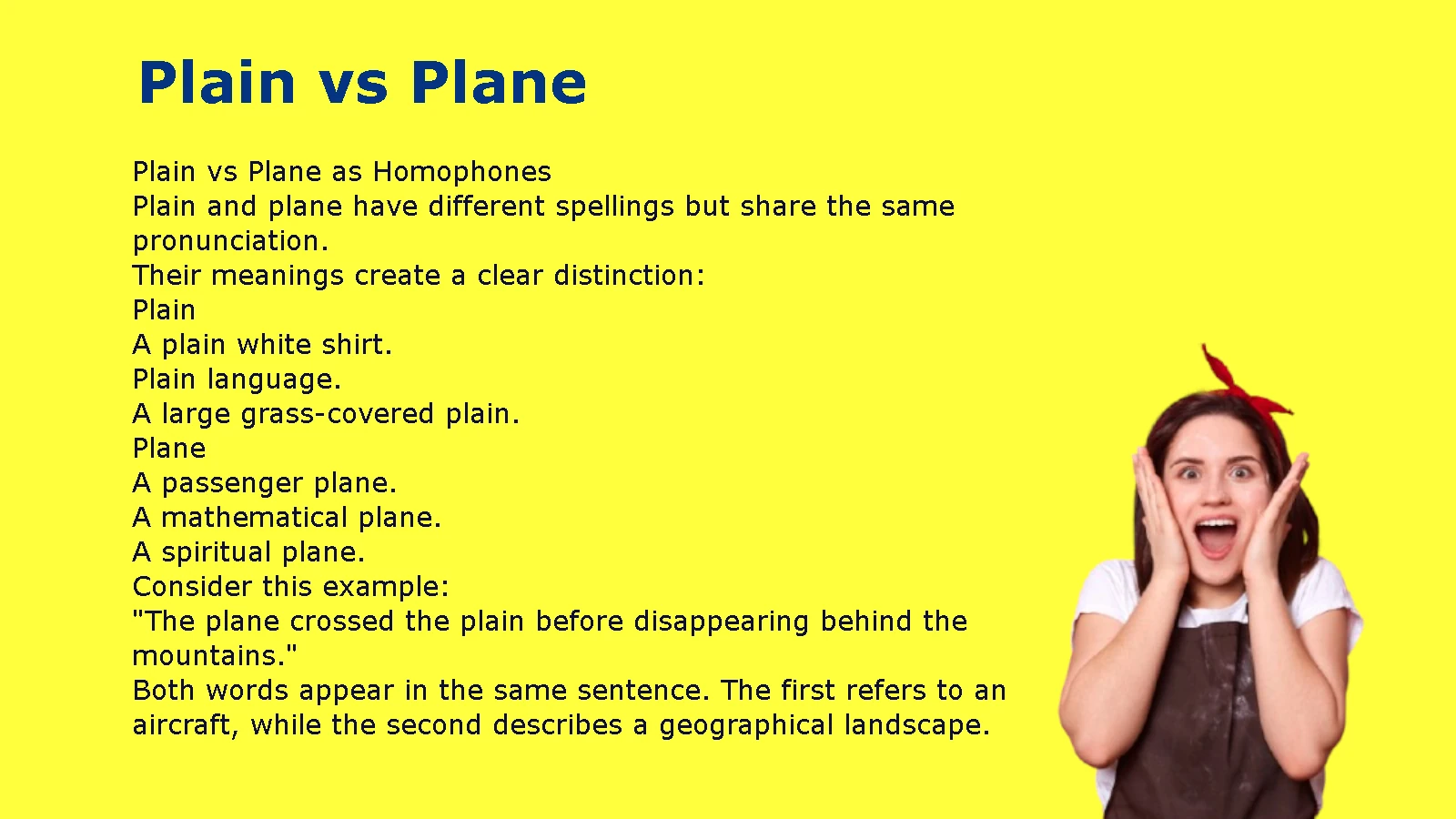
Plain vs Plane as Homophones
Plain and plane have different spellings but share the same pronunciation.
Their meanings create a clear distinction:
Plain
- A plain white shirt.
- Plain language.
- A large grass-covered plain.
Plane
- A passenger plane.
- A mathematical plane.
- A spiritual plane.
Consider this example:
“The plane crossed the plain before disappearing behind the mountains.”
Both words appear in the same sentence. The first refers to an aircraft, while the second describes a geographical landscape.
This sentence demonstrates why understanding context matters more than memorizing pronunciation.
Other Common English Homophones
Plain and plane are not the only English words that create confusion.
| Homophones | Meaning of the first word | Meaning of the second word |
| Plain / Plane | Simple or flat land | Aircraft or geometric surface |
| Principal / Principle | Main person or school leader | Rule or belief |
| Their / There | Belonging to them | A place or position |
| Brake / Break | Stopping mechanism | Separate or damage |
| Right / Write | Correct or opposite of left | Put words on paper |
| Flour / Flower | Baking ingredient | Part of a plant |
| Sea / See | Large body of salt water | To perceive with your eyes |
| Weather / Whether | Atmospheric conditions | Expresses a choice or alternative |
One particularly useful comparison is principal vs principle.
Principal refers to someone in a leading position or something most important. Principle refers to a fundamental belief, rule, or standard.
For example:
- The school principal welcomed the students.
- Honesty is an important principle.
This is another case where pronunciation alone cannot determine spelling.
Plane or Plain in Math: Which Spelling Is Correct?
The correct mathematical spelling is plane, not plain. In geometry, a plane is a flat, two-dimensional surface that extends infinitely in every direction. Mathematicians use planes to describe points, lines, angles, shapes, coordinate systems, and relationships between geometric objects.
Although plain can describe something flat in ordinary English, it is not the standard mathematical term for a geometric plane.
What Is a Plane in Mathematics?
A mathematical plane is a two-dimensional surface with length and width but no thickness.
It extends infinitely in every direction, although diagrams usually represent only a small section of it.
A plane contains:
- Points.
- Lines.
- Angles.
- Geometric shapes.
- Intersections.
- Parallel lines.
In three-dimensional geometry, a plane can be uniquely determined by three non-collinear points.
For example, imagine placing three dots on a flat sheet of paper. If the dots do not lie on the same straight line, they determine one unique mathematical plane.
A plane is often represented by a Greek letter or a name based on three points.
For example, plane ABC represents the plane passing through points A, B, and C, provided those points are not collinear.
Example sentences:
- The triangle lies on plane ABC.
- Two parallel lines exist on the same plane.
- The teacher explained how a line intersects a plane.
- Every point on the coordinate plane has an ordered pair.
Plane Geometry and Its Applications
Plane geometry is the branch of geometry that studies two-dimensional figures and their properties.
It focuses on shapes that exist on a flat surface.
Common examples include:
- Triangles.
- Squares.
- Rectangles.
- Circles.
- Polygons.
- Angles.
- Parallel and perpendicular lines.
Plane geometry differs from solid geometry, which studies three-dimensional objects such as cubes, spheres, cylinders, and pyramids.
| Feature | Plane Geometry | Solid Geometry |
| Dimensions | Two | Three |
| Main focus | Flat figures | Three-dimensional objects |
| Measurements | Length and area | Length, area, and volume |
| Examples | Circles and triangles | Cubes and spheres |
| Applications | Maps, diagrams, and design | Architecture and engineering |
Coordinate planes
A coordinate plane is a flat mathematical surface formed by two perpendicular number lines.
These lines are called the x-axis and y-axis.
They meet at the origin, represented by (0, 0).
Coordinate planes help students and professionals:
- Plot ordered pairs.
- Graph equations.
- Study mathematical functions.
- Represent relationships between variables.
- Analyze geometric patterns.
For example, the point (3, 4) lies three units to the right of the origin and four units above it.
Parallel and intersecting planes
In three-dimensional geometry, planes can have different relationships.
- Parallel planes never intersect.
- Intersecting planes meet along a straight line.
- Coincident planes occupy exactly the same geometric position.
These concepts appear in advanced mathematics, computer graphics, architectural design, and engineering.
Is It a Plain or Plane Surface?
The correct word depends on what you mean by the surface.
A plane surface is a geometrically flat surface. A plain surface is a surface that looks simple or lacks decoration, texture, or complex patterns.
Consider these examples:
- The carpenter checked whether the wooden board had a plane surface.
- The designer selected a plain white surface for the background.
- The engineer measured the angle between two plane surfaces.
- The room had plain walls without decorative patterns.
The difference is subtle but important.
A surface can be both plain and plane. For example, an undecorated, perfectly flat wall has both qualities.
However, the words describe different properties:
| Expression | Meaning |
| Plain surface | Simple or undecorated surface |
| Plane surface | Geometrically flat surface |
| Plain wall | Wall without decoration |
| Plane wall | A wall described in terms of its geometric flatness |
In technical writing, use plane when discussing geometry, measurement, and engineering.
Plane of Existence or Plain of Existence: Which Is Correct?
Plane of existence is the correct conventional expression when referring to a level, dimension, or state of reality. The word plane represents an abstract level rather than an aircraft or physical surface. Plain of existence is generally a spelling mistake because plain does not carry the intended meaning in this expression.
This distinction appears frequently in fantasy literature, philosophy, metaphysics, and spiritual discussions.
What Does Plane of Existence Mean?
A plane of existence refers to a particular level or dimension of reality. Writers use the expression when discussing different states of being, consciousness, or spiritual experience.
The phrase often appears in fictional and philosophical contexts.
For example:
- The characters traveled to another plane of existence.
- The story describes creatures living on a different plane.
- The philosopher discussed reality beyond the physical plane.
- Some spiritual traditions describe higher planes of consciousness.
The expression does not always refer to a scientifically established dimension. Its meaning depends on the philosophical, religious, fictional, or spiritual framework in which someone uses it.
Common expressions include:
- Physical plane.
- Mental plane.
- Astral plane.
- Spiritual plane.
- Higher plane of existence.
- Different plane of reality.
These expressions describe different conceptual levels rather than geographical areas.
Spiritual Plane or Plain: Which Is Correct?
Spiritual plane is the standard expression when referring to a spiritual level or dimension of existence.
The word plane communicates the idea of a particular level of reality, consciousness, or experience.
For example:
- The meditation teacher discussed the spiritual plane.
- The novel describes a journey into the astral plane.
- The character believes that consciousness can exist beyond the physical plane.
- Some traditions describe spiritual development as movement toward a higher plane.
Using plain instead would change the meaning.
Compare:
- Spiritual plane: A conceptual or spiritual level of existence.
- Spiritual plain: An unusual expression that could describe a simple or ordinary spiritual landscape in a creative context, but does not communicate the established idea of a spiritual dimension.
The difference becomes clearer when you consider the word’s function.
Plain describes simplicity or a geographical area. Plane describes a level or dimension.
Plane of Existence in Philosophy and Spirituality
The phrase plane of existence appears in several philosophical, spiritual, and fictional frameworks.
Different traditions use different terminology, so these categories should not be treated as a universal classification.
Physical plane
The physical plane generally refers to the material world that people experience through their bodies and senses.
It includes:
- Physical objects.
- Natural environments.
- Living organisms.
- Material processes.
- Everyday human experiences.
In fantasy and spiritual writing, the physical plane is often contrasted with nonphysical or spiritual dimensions.
Mental plane
The mental plane commonly refers to thought, perception, imagination, and consciousness.
Writers may use it to describe an abstract level associated with the mind.
Examples:
- The character entered a mental plane through meditation.
- The discussion moved to a different plane of thought.
Astral plane
The astral plane is a concept found in various esoteric and spiritual traditions.
It generally describes a nonphysical realm associated with consciousness or spiritual experience.
The concept also appears in fantasy novels, games, and popular culture.
Spiritual plane
The spiritual plane refers to a level associated with spiritual awareness, transcendence, or nonphysical existence.
Its interpretation varies across belief systems and literary traditions.
The following table summarizes these expressions.
| Expression | General meaning |
| Physical plane | Material or physical reality |
| Mental plane | Thought and consciousness |
| Astral plane | A proposed nonphysical realm in esoteric traditions |
| Spiritual plane | A level associated with spiritual existence |
| Higher plane | An elevated or different level of reality or awareness |
These are conceptual descriptions, not universally accepted scientific dimensions.
Plane vs Plain in Abstract Expressions
The difference between these words becomes especially important in abstract expressions.
Compare the following sentences:
| Sentence | Correct interpretation |
| She believes in another plane of existence. | A different level of reality |
| He lives on a higher spiritual plane. | A different spiritual level |
| Give me a plain explanation of existence. | A simple explanation |
| The author described the vast plain. | A flat geographical area |
| Their ideas operate on a different plane. | Their ideas belong to a different level or category |
Notice that plain remains correct when describing something simple, even when the topic involves philosophy or spirituality.
For example, a plain explanation of a spiritual plane uses both words correctly.
The first describes the explanation, while the second identifies the concept being explained.
When to Use Plain vs Plane in a Sentence
Use plain when you describe simplicity, ordinary appearance, straightforward language, or flat geographical land. Choose plane when referring to an aircraft, mathematical surface, woodworking tool, or level of existence. Checking the meaning of the entire sentence is the easiest way to avoid confusing these homophones.
When to Use Plain
Use plain in the following situations.
When describing something simple
Plain describes something without extra decoration, complexity, or unnecessary features.
Examples:
- She bought a plain blue notebook.
- The restaurant serves plain rice.
- I prefer plain furniture in my bedroom.
- He wore a plain shirt to the interview.
When describing clear language
Plain also describes communication that people can understand easily.
Examples:
- Please explain the rules in plain English.
- The lawyer gave us a plain explanation of the agreement.
- The instructions use plain language for beginners.
When describing flat land
Use plain as a noun when discussing an extensive, relatively level area of land.
Examples:
- The farmers cultivated crops across the plain.
- The Great Plains support extensive agricultural activity.
- A wide plain stretches toward the mountains.
When describing something obvious
Plain can also mean clear or unmistakable.
Examples:
- It was plain that he needed help.
- Her disappointment was plain to everyone.
- The evidence made the answer plain.
When to Use Plane
Use plane in several different contexts.
When discussing aircraft
Examples:
- The plane landed safely.
- We missed our plane because of traffic.
- She looked out of the plane window.
- The airline operates several passenger planes.
Passenger plane lands on runway at airport.
When discussing mathematics
Examples:
- The line crosses the plane at one point.
- The teacher drew a circle on the coordinate plane.
- Three non-collinear points determine a unique plane.
- Parallel planes do not intersect.
When discussing spirituality or philosophy
Examples:
- They believe consciousness exists on another plane.
- The story explores a higher plane of existence.
- The spiritual teacher discussed the astral plane.
When discussing woodworking
Examples:
- The carpenter selected a sharp hand plane.
- The woodworker used a plane to smooth the board.
- He planed the rough surface before painting it.
Common Plain vs Plane Mistakes
Even experienced English speakers sometimes confuse these words because both are legitimate spellings.
The following table shows common mistakes and their corrections.
| Incorrect sentence | Correct sentence | Explanation |
| The plain landed safely. | The plane landed safely. | An aircraft is a plane. |
| A mathematical plain | A mathematical plane | Geometry uses plane. |
| Plain of existence | Plane of existence | Refers to a level of reality. |
| Spiritual plain | Spiritual plane | Refers to a spiritual dimension. |
| The plain is ready for takeoff. | The plane is ready for takeoff. | Aircraft terminology requires plane. |
| She wore a plane dress. | She wore a plain dress. | Plain describes simple clothing. |
| The farmers crossed the plane. | The farmers crossed the plain. | A flat geographical area is a plain. |
| Explain it in plane English. | Explain it in plain English. | Plain means clear and simple. |
A practical editing example
Suppose you write:
“The plain flew over the green plane.”
The sentence contains two spelling mistakes if you intend to describe an aircraft flying over a geographical area.
The corrected version is:
“The plane flew over the green plain.”
The first word refers to the aircraft, while the second refers to the landscape.
This type of correction requires understanding the sentence rather than simply checking whether each word appears in a dictionary.
Easy Ways to Remember the Difference Between Plain and Plane
The easiest way to remember plain vs plane is to associate plain with simplicity and ordinary appearance, while plane connects with aircraft, geometry, and dimensions. Both words sound the same, so visual memory and sentence context are more useful than pronunciation when choosing the correct spelling.
Remember Plain as Simple or Ordinary
Think of plain as something without additional decoration or complexity.
Remember these familiar expressions:
- Plain clothes.
- Plain language.
- Plain food.
- Plain design.
- Plain appearance.
- Plain and simple.
You can also associate plain with the geographical meaning of a flat landscape.
For example, a wide grassland with relatively level terrain is a plain.
Memory trick: If you can replace the word with simple, ordinary, or undecorated, plain is probably the correct choice.
Examples:
- A plain shirt = a simple shirt.
- Plain English = simple English.
- Plain food = simple food.
Remember Plane as an Aircraft or Flat Geometric Surface
Connect plane with an airplane or a mathematical plane.
Think of these examples:
- Passenger plane.
- Airplane ticket.
- Coordinate plane.
- Geometric plane.
- Plane of existence.
- Spiritual plane.
Memory trick: If your sentence discusses flying, geometry, dimensions, or levels of reality, plane is usually the correct choice.
For example:
- The plane took off.
- The points lie on the same plane.
- They believe in another plane of existence.
Use Context to Choose the Correct Word
When you are unsure, ask yourself what the sentence describes.
| Question | Correct word |
| Am I describing something simple? | Plain |
| Am I discussing an undecorated object? | Plain |
| Am I referring to flat geographical land? | Plain |
| Am I talking about an aircraft? | Plane |
| Am I discussing geometry? | Plane |
| Am I describing a dimension of existence? | Plane |
| Am I referring to a woodworking tool? | Plane |
You can also use this quick decision-making method:
- Aircraft? Write plane.
- Simple or undecorated? Write plain.
- Flat land? Write plain.
- Mathematical surface? Write plane.
- Spiritual dimension? Write plane.
This method works because it focuses on meaning rather than pronunciation.
Plain vs Plane: Frequently Asked Questions
Is it plain or plane in English?
Both plain and plane are correct English words, but they have different meanings. Plain describes something simple, ordinary, or a broad area of flat land. Plane refers to an aircraft, a geometric surface, a woodworking tool, or a level of existence. Choose the spelling that matches your intended meaning.
Is an airplane called a plain or a plane?
An airplane is called a plane, not a plain. Plane is the correct spelling for an aircraft that flies through the air. For example, “Our plane arrives at the airport at noon.” Plain refers to something simple or an extensive area of relatively flat land.
Is it a plane or plain surface?
Both expressions are possible, but they communicate different meanings. A plane surface describes a geometrically flat surface, particularly in mathematics and engineering. A plain surface describes a simple or undecorated surface. For example, a plain white wall may also be a plane surface if it is geometrically flat.
Is it plane of existence or plain of existence?
Plane of existence is the correct conventional expression. It describes a level or dimension of reality, consciousness, or spiritual experience. Plain of existence is generally incorrect when someone intends this meaning. For example, “The novel describes a different plane of existence” uses the correct spelling.
Are plain and plane pronounced the same?
Yes. Plain and plane are homophones, and both have the IPA pronunciation /pleɪn/. They contain one syllable and rhyme with rain, train, and brain. Their pronunciation stays the same even though their spellings and meanings differ.
What is the difference between plain, plane, and airplane?
Plain describes something simple, ordinary, or a flat area of land. Plane can refer to an aircraft, geometric surface, woodworking tool, or level of existence. Airplane specifically refers to a powered, fixed-wing aircraft. In everyday English, plane and airplane are often interchangeable when discussing commercial air travel.
Conclusion: Choose Plain or Plane Based on Meaning
Plain and plane may sound identical, but their meanings make them easy to distinguish once you understand their uses.
Remember these essential differences:
- Plain describes something simple, ordinary, clear, or undecorated.
- Plain also refers to a broad area of relatively flat land.
- Plane refers to an aircraft or airplane.
- Plane is the correct mathematical term for a flat, two-dimensional geometric surface.
- Plane of existence is the conventional expression for a level or dimension of reality.
- Both words are homophones pronounced /pleɪn/.
The best way to avoid spelling mistakes is to focus on the meaning of your sentence rather than how the word sounds. If you are describing simplicity or flat land, choose plain. If you are discussing aircraft, geometry, or dimensions, choose plane.
Before publishing or submitting your next piece of writing, check the context around these two words. A quick review can prevent a small spelling mistake from changing your entire sentence.