Erie vs Eerie is a comparison between two words that sound alike but have different meanings, spellings, and uses. Eerie means strange, mysterious, or frightening, while Erie is a proper noun used in names such as Lake Erie and Erie, Pennsylvania. Although both words share the same pronunciation in American English, you cannot use them interchangeably.
The confusion usually happens because people hear the words before they see them written. However, remembering their meanings makes the distinction simple. Use eerie when describing a spooky atmosphere, an unsettling sound, or an unusual experience. Use Erie when referring to a geographical location, historical name, or specific organization.
This guide explains the difference between Erie and Eerie, their definitions, pronunciation, synonyms, and correct usage. You’ll also find practical sentence examples, spelling tips, and answers to common questions.
Erie vs Eerie: Quick Answer
| Question | Answer |
| What is the difference between Erie and Eerie? | Eerie means strange or frightening, while Erie is a proper noun. |
| Is it Erie or Eerie for scary? | Eerie is the correct spelling. |
| Are Erie and Eerie pronounced the same? | Yes, they are generally homophones in American English. |
| What is an eerie synonym? | Spooky, creepy, uncanny, unsettling, and mysterious. |
| Is Erie a place? | Yes. Erie is a city in Pennsylvania and part of the name Lake Erie. |
Eerie vs Erie: What’s the Difference?
Erie and eerie have the same pronunciation in standard American English, but they serve different grammatical purposes. Eerie is an adjective that describes something unsettling, mysterious, or frightening. Erie is a proper noun that identifies specific places, historical groups, and organizations.
The easiest way to distinguish them is to consider what you’re describing. If you’re talking about a strange noise in an empty house, use eerie. If you’re talking about a city in Pennsylvania or one of the Great Lakes, use Erie.
Erie vs Eerie Comparison Table
| Feature | Eerie | Erie |
| Part of speech | Adjective | Proper noun |
| Meaning | Strange, mysterious, or frightening | A geographical or historical name |
| Main purpose | Describes something | Identifies something |
| Pronunciation | /ˈɪəri/ | /ˈɪəri/ |
| Capitalization | Usually lowercase | Always capitalized in standard name usage |
| Example | The forest looked eerie. | We visited Erie, Pennsylvania. |
| Related words | Creepy, spooky, uncanny | Lake Erie, Erie County |
Both spellings are correct English words, but they aren’t interchangeable.
For example:
- Correct: The abandoned hospital had an eerie atmosphere.
- Incorrect: The abandoned hospital had an Erie atmosphere.
The second sentence incorrectly uses a geographical proper noun where an adjective belongs.
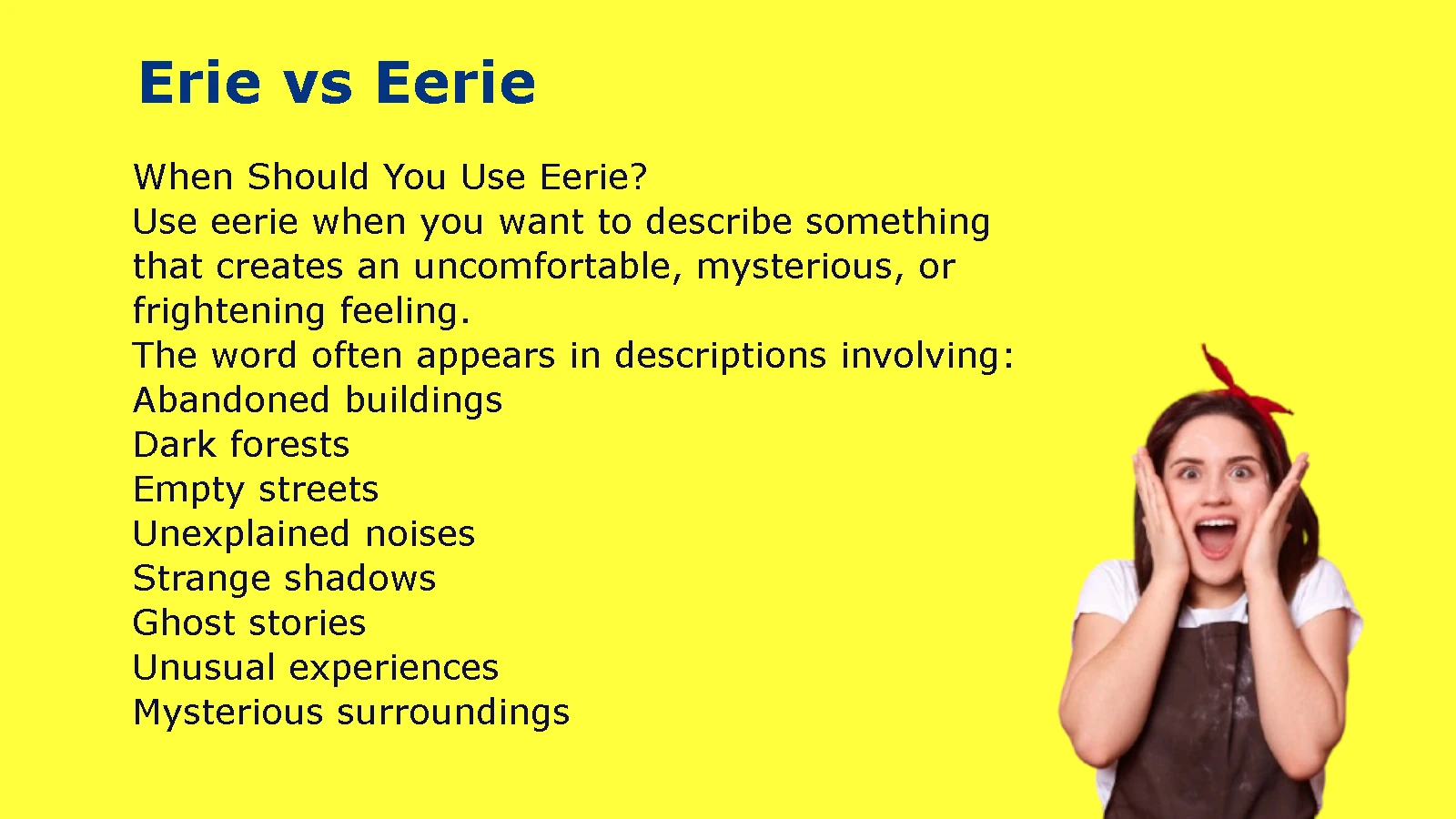
When Should You Use Eerie?
Use eerie when you want to describe something that creates an uncomfortable, mysterious, or frightening feeling.
The word often appears in descriptions involving:
- Abandoned buildings
- Dark forests
- Empty streets
- Unexplained noises
- Strange shadows
- Ghost stories
- Unusual experiences
- Mysterious surroundings
For example:
- An eerie silence filled the empty classroom.
- The old mansion looked eerie after sunset.
- We heard an eerie whisper coming from the basement.
- A strange light created an eerie glow across the water.
- The abandoned railway station had an eerie atmosphere.
Notice that eerie describes the quality of a person, place, sound, or situation. It doesn’t identify a particular location.
When Should You Use Erie?
Use Erie when referring to a proper name.
The word appears in several geographical and historical contexts, including:
- Lake Erie: One of the five Great Lakes of North America.
- Erie, Pennsylvania: A city in northwestern Pennsylvania.
- Erie people: An Indigenous people historically associated with the southern shore of Lake Erie.
- Erie-related organizations: Businesses, institutions, and local services that use the name.
Examples:
- My family visited Erie, Pennsylvania, during the summer.
- Lake Erie attracts visitors interested in boating and fishing.
- The city of Erie has a location along the Great Lakes.
- We learned about the historical Erie people in class.
In each example, Erie identifies a specific name rather than describing an emotion or atmosphere.
Is Erie or Eerie Correct?
Both are correct spellings, but the right choice depends on your intended meaning.
Use eerie for something spooky, frightening, or mysterious. Use Erie for a proper noun, such as the city in Pennsylvania or Lake Erie.
Compare these sentences:
| Incorrect usage | Correct usage |
| The house looked Erie. | The house looked eerie. |
| We visited Eerie, Pennsylvania. | We visited Erie, Pennsylvania. |
| The forest had an Erie atmosphere. | The forest had an eerie atmosphere. |
| Lake Eerie is beautiful. | Lake Erie is beautiful. |
The key is to identify whether the word describes something or names something.
Eerie Meaning and Definition
Eerie means strange, mysterious, or frightening in a way that makes someone feel uneasy. It describes something that seems unusual, unnatural, or difficult to explain. People commonly use the adjective for places, sounds, situations, and experiences that create a spooky or uncomfortable atmosphere.
An eerie experience doesn’t always involve ghosts or supernatural events. Sometimes, an ordinary situation feels eerie because something about it seems unusual.
For instance, walking through a completely empty shopping mall at midnight might feel eerie because the familiar surroundings look different without people.
What Does Eerie Mean in Simple English?
In simple English, eerie means spooky, creepy, or strangely frightening.
It describes something that makes you feel uncomfortable without necessarily showing an obvious danger.
Consider these situations:
- Walking through an empty school after dark.
- Hearing unexplained footsteps in an otherwise quiet house.
- Seeing a shadow move across a room when nobody is there.
- Watching thick fog cover an abandoned road.
- Standing in a forest where every sound suddenly stops.
Each situation could create an eerie feeling.
The word also works outside horror stories. A familiar place can become eerie when something changes unexpectedly.
For example:
“The normally busy street looked eerie after the sudden power outage.”
The street isn’t necessarily dangerous. Its unusual appearance creates an unsettling feeling.
Eerie Definition and Part of Speech
Eerie is an adjective.
An adjective modifies a noun by describing its qualities or characteristics. Eerie tells readers that something feels strange, unsettling, or frightening.
| Grammatical feature | Explanation |
| Word | Eerie |
| Part of speech | Adjective |
| Meaning | Strange, mysterious, or unsettling |
| Comparative | Eerier |
| Superlative | Eeriest |
| Adverb form | Eerily |
| Noun form | Eeriness |
Here are examples of its different grammatical forms:
Eerie: The house had an eerie appearance.
Eerier: The forest became eerier as the fog grew thicker.
Eeriest: That was the eeriest sound I’ve ever heard.
Eerily: The abandoned playground was eerily quiet.
Eeriness: The darkness and silence added to the eeriness of the room.
These forms allow you to use the word naturally in different sentence structures.
What Does Eerie Mean in a Sentence?
Eerie describes something that creates a strange, mysterious, or uncomfortable impression.
Here are original examples showing how to use it correctly.
| Example sentence | Explanation |
| The empty hallway had an eerie silence. | The silence felt unusual and unsettling. |
| An eerie shadow appeared behind the curtain. | The shadow created a mysterious impression. |
| The abandoned house looked eerie at night. | The house seemed frightening. |
| Her voice sounded eerie in the empty room. | Her voice created an uncomfortable feeling. |
| The fog gave the village an eerie appearance. | The fog made the village look mysterious. |
| We heard an eerie noise outside the window. | The noise sounded strange and frightening. |
| The old photograph had an eerie quality. | Something about the photograph felt unsettling. |
You can also use eerie in everyday conversations:
- “That coincidence was really eerie.”
- “There’s something eerie about this place.”
- “I had an eerie feeling that someone was watching me.”
What Is the Difference Between Eerie, Scary, and Creepy?
Eerie, scary, and creepy have related meanings, but each word communicates a slightly different feeling.
| Word | Meaning | Example |
| Eerie | Strange, mysterious, or unsettling | The empty house had an eerie atmosphere. |
| Scary | Causing fear or fright | The horror movie was scary. |
| Creepy | Causing discomfort, suspicion, or fear | The stranger’s behavior was creepy. |
Eerie often suggests mystery or something difficult to explain.
Scary directly communicates fear. A loud explosion, dangerous animal, or frightening movie can be scary.
Creepy often describes something that makes a person uncomfortable. It can refer to unusual behavior, strange appearances, or unsettling situations.
For example, imagine walking into an abandoned building:
- The darkness makes the building look eerie.
- A sudden scream inside makes the experience scary.
- A strange figure watching you through a window seems creepy.
These words overlap, but they aren’t always suitable substitutes for one another.
Erie Meaning: What Does Erie Refer To?
Erie is a proper noun most commonly associated with Lake Erie, Erie, Pennsylvania, and the Indigenous Erie people. It identifies specific geographical and historical subjects rather than describing something frightening. Unlike eerie, Erie normally begins with a capital letter because it functions as a name.
The name has an important connection to the history and geography of the Great Lakes region.
What Is Erie, Pennsylvania?
About Erie, Pennsylvania – VisitErie
Erie, Pennsylvania is a city in northwestern Pennsylvania, located along the southern shore of Lake Erie.
It is known for its waterfront, maritime history, and access to outdoor recreation.
Some notable features include:
- Presque Isle State Park: A peninsula extending into Lake Erie, known for beaches, trails, and recreational activities.
- Presque Isle Bay: A protected body of water near the city.
- Erie Maritime Museum: A museum dedicated to the region’s maritime history.
- Lake Erie waterfront: An important part of the city’s identity and recreational life.
The city is also associated with shipping, manufacturing, tourism, and regional commerce.
Example sentences:
- We spent the weekend exploring Erie, Pennsylvania.
- Erie attracts visitors who enjoy its waterfront.
- My cousin moved to Erie for work.
- The weather in Erie can change quickly near the lake.
In all these examples, Erie functions as a proper noun.
What Is Lake Erie?
Presque Isle State Park | Pennsylvania
Lake Erie is one of the five Great Lakes of North America. It borders the United States and Canada and forms part of the international boundary between them.
Lake Erie is the southernmost and shallowest of the five Great Lakes.
Here are some important facts:
| Feature | Information |
| Name | Lake Erie |
| Location | North America |
| Countries bordering it | United States and Canada |
| Great Lakes position | Southernmost |
| Surface area | Approximately 9,910 square miles |
| Maximum depth | Approximately 210 feet |
| Major nearby cities | Erie, Cleveland, Toledo, Buffalo |
| Main uses | Shipping, fishing, recreation, and water supply |
Lake Erie supports commercial shipping, recreational boating, fishing, and tourism.
Its relatively shallow waters also make it more responsive to temperature changes than the deeper Great Lakes.
The lake has several important connections to nearby communities. Cities along its shoreline use the lake for recreation, commerce, transportation, and tourism.
Is Lake Erie in Erie, Pennsylvania?
No. Lake Erie is not entirely located within Erie, Pennsylvania. It is a large freshwater lake that borders multiple communities and regions in the United States and Canada.
However, the city of Erie sits along its southern shoreline.
This explains why the two names frequently appear together.
For example:
- Erie is a city in Pennsylvania.
- Lake Erie is a Great Lake.
- Erie, Pennsylvania, has direct access to Lake Erie.
- Presque Isle State Park extends into Lake Erie near the city.
Remember that the two words have different functions even when they appear in the same sentence.
Correct: Erie is a city located along Lake Erie.
Incorrect: Eerie is a city located along Lake Eerie.
Who Were the Erie People?
The Erie were an Indigenous people historically associated with the southern shore of Lake Erie and nearby parts of what are now Pennsylvania, Ohio, and New York.
Their name is closely connected to the history of the Great Lakes region.
European historical accounts also refer to them as the Erie people or Erie Nation. Their communities experienced conflict and displacement during the seventeenth century, particularly during the Beaver Wars.
The historical name remains visible in geographical references, especially Lake Erie and the city of Erie.
This is another reason why Erie should be capitalized when used as a proper noun.
How to Pronounce Erie and Eerie
Erie and eerie are generally pronounced the same in standard American English. Both have two syllables, with stress on the first syllable. Their identical pronunciation makes them homophones, meaning they sound alike but have different spellings and meanings.
How to Pronounce Erie
The American English pronunciation of Erie is:
IPA: /ˈɪəri/
A simple pronunciation guide is “EER-ee.”
The word has two syllables:
- First syllable: EER
- Second syllable: ee
Place the main stress on the first syllable.
Example:
“Erie is located in northwestern Pennsylvania.”
When speaking, the pronunciation does not indicate whether you mean the city, the lake, or another use of the proper name. The surrounding sentence provides that information.
How to Pronounce Eerie
The pronunciation of eerie is also:
IPA: /ˈɪəri/
It has the same two-syllable structure as Erie.
Example:
“The abandoned house looked eerie.”
Both words sound alike when spoken with the same accent. The difference becomes clear through their spelling and context.
Are Erie and Eerie Homophones?
Yes. Erie and eerie are homophones in standard American English.
Homophones are words that share the same pronunciation but have different spellings or meanings.
Other common homophone pairs include:
| Homophones | Difference |
| Pair / Pear | A set of two / A fruit |
| Sea / See | A large body of water / To look |
| Right / Write | Correct or opposite of left / To form words |
| Flower / Flour | A plant part / Powder used in baking |
| Night / Knight | Darkness after sunset / A historical title |
| Eerie / Erie | Strange or frightening / A proper noun |
Homophones can cause confusion in writing because listeners cannot always determine the intended spelling from pronunciation alone.
The best solution is to understand the meaning and grammatical role of each word.
Eerie Synonyms and Similar Words
Common synonyms for eerie include spooky, creepy, uncanny, unsettling, mysterious, ghostly, and unnerving. These words describe situations or experiences that create fear, discomfort, or uncertainty. However, each synonym carries a slightly different meaning, so the best replacement depends on the context.
Common Synonyms for Eerie
Here are useful alternatives to eerie:
| Synonym | Meaning |
| Spooky | Suggesting ghosts or supernatural activity |
| Creepy | Causing discomfort or fear |
| Uncanny | Strange in a way that feels unnatural |
| Unsettling | Disturbing someone’s sense of comfort |
| Mysterious | Difficult to understand or explain |
| Ghostly | Resembling or suggesting a ghost |
| Strange | Unusual or unfamiliar |
| Sinister | Suggesting something evil or threatening |
| Unnerving | Making someone nervous or uncomfortable |
| Haunting | Creating a lasting, often unsettling impression |
Eerie Synonyms With Example Sentences
Understanding synonyms becomes easier when you see how they work in actual sentences.
Spooky: The children refused to enter the spooky old house.
Creepy: A creepy noise came from the dark basement.
Uncanny: She had an uncanny ability to predict what would happen next.
Unsettling: The sudden silence was unsettling.
Mysterious: A mysterious figure appeared near the entrance.
Ghostly: A ghostly figure seemed to move across the hallway.
Sinister: The abandoned building had a sinister appearance.
These alternatives help you avoid repeating eerie throughout an article or conversation.
Eerie vs Spooky vs Creepy
Although these words are similar, their emotional meanings differ.
| Word | Main feeling | Best context |
| Eerie | Mystery and uneasiness | Strange places and unexplained events |
| Spooky | Supernatural fear | Ghost stories and haunted houses |
| Creepy | Discomfort or suspicion | Unusual behavior and disturbing situations |
| Uncanny | Unnatural strangeness | Unusual similarities or experiences |
| Unsettling | Emotional discomfort | Disturbing situations and uncertainty |
For example, a quiet forest at night might feel eerie. A house believed to contain ghosts might seem spooky. A person behaving strangely might appear creepy.
Choosing the right synonym makes your writing more precise.
Common Spelling Mistakes: How to Spell Eerie Like Scary
The correct spelling of the adjective meaning scary or mysterious is eerie. It begins with two e’s and ends with the letters i-e. Erie, with one fewer e, is a proper noun used in geographical and historical names. Remembering this distinction helps prevent common spelling mistakes.
Is It Eerie or Erie When Describing Something Scary?
The correct spelling is eerie.
If you want to describe something frightening, unusual, mysterious, or unsettling, choose eerie.
Examples:
- The movie had an eerie atmosphere.
- An eerie sound came from the empty room.
- The abandoned school looked eerie.
- Her strange smile gave me an eerie feeling.
Avoid writing Erie in these situations because Erie identifies a name rather than describing an experience.
Why Do People Confuse Erie and Eerie?
Several factors explain the confusion.
Similar pronunciation: Both words sound alike in standard American English, so people may not recognize their different spellings during conversation.
Different meanings: Eerie describes an atmosphere or experience, while Erie identifies a proper noun. People unfamiliar with the distinction may choose the wrong spelling.
Autocorrect: Spelling software may recognize both words as valid. It may not understand which meaning you intended.
Limited exposure: Someone who frequently encounters the name Erie but rarely reads the adjective eerie may struggle to remember the correct spelling.
The solution is to connect the spelling with its meaning rather than relying entirely on pronunciation.
Easy Trick to Remember Eerie
Use this simple memory trick:
Eerie = Extra E = Extra strange.
The adjective eerie contains an additional e compared with Erie.
Remember the following associations:
- Eerie: An eerie house, eerie sound, eerie feeling.
- Erie: Lake Erie, Erie city, Erie history.
Another useful technique is to create a sentence that includes both words:
“The eerie atmosphere around Lake Erie made the evening feel mysterious.”
Here, eerie describes the atmosphere, while Erie identifies the lake.
This example demonstrates both meanings in one sentence.
Is Erie or Eerie a Scrabble Word?
Eerie is a valid English word used in Scrabble, while Erie is a proper noun and is not permitted under standard Scrabble rules. Although both words have the same pronunciation, Scrabble distinguishes them by spelling, dictionary eligibility, and whether a word is a proper name.
Is Eerie a Valid Scrabble Word?
Yes. EERIE is a valid word in standard English Scrabble word lists.
Its letter values are:
| Letter | Point value |
| E | 1 |
| E | 1 |
| R | 1 |
| I | 1 |
| E | 1 |
| Total | 5 |
The basic score for EERIE is 5 points, before any board bonuses.
You can play it when your available letters and board position allow.
Can You Play Erie in Scrabble?
No, Erie is generally not accepted in standard Scrabble because it is a proper noun.
Standard Scrabble rules exclude names of specific people, places, and other proper nouns.
For example:
- EERIE: Accepted as an ordinary English adjective.
- ERIE: Not accepted as a geographical proper noun.
This distinction applies even though the two spellings have the same pronunciation.
Erie vs Eerie: Examples in Everyday Writing
The best way to understand Erie vs Eerie is to examine how both words appear in everyday communication.
Erie vs Eerie Comparison Examples
| Sentence | Correct word | Explanation |
| The abandoned building looked eerie. | Eerie | Describes an unsettling appearance. |
| We visited Erie last summer. | Erie | Refers to a city. |
| The forest had an eerie atmosphere. | Eerie | Describes a mysterious feeling. |
| Lake Erie is one of the Great Lakes. | Erie | Identifies a geographical feature. |
| An eerie noise came from upstairs. | Eerie | Describes a frightening sound. |
| Erie is located in Pennsylvania. | Erie | Identifies a city. |
| The empty road looked eerie at midnight. | Eerie | Describes an unsettling scene. |
| The ship traveled across Lake Erie. | Erie | Identifies a lake. |
Eerie vs Erie in Questions
Here are some common questions that demonstrate the correct usage.
Is this place eerie?
Correct. Eerie describes the strange or frightening atmosphere of a place.
Have you ever visited Erie?
Correct. Erie refers to a geographical location.
Why does this abandoned house look so eerie?
Correct. The adjective describes the house’s unsettling appearance.
Where is Erie, Pennsylvania?
Correct. Erie is the proper name of a city.
Does Lake Erie have an eerie atmosphere at night?
Correct. Erie identifies the lake, while eerie describes its atmosphere.
Common Incorrect and Correct Sentences
Small spelling changes can completely alter the meaning of a sentence.
| Incorrect sentence | Correct sentence |
| The forest looked Erie. | The forest looked eerie. |
| We traveled to Eerie, Pennsylvania. | We traveled to Erie, Pennsylvania. |
| The lake was called Lake Eerie. | The lake was called Lake Erie. |
| I heard an Erie noise. | I heard an eerie noise. |
| The city of Eerie is in Pennsylvania. | The city of Erie is in Pennsylvania. |
Practical writing example:
Suppose you’re writing a travel article about a nighttime visit to Lake Erie.
You might write:
“The shoreline of Lake Erie looked eerie after sunset. Thick fog covered the water, and the distant lights created a mysterious atmosphere.”
This passage uses both words correctly. Erie names the lake, while eerie describes its appearance.
How to Remember the Difference Between Erie and Eerie
You don’t need to memorize complicated grammar rules to distinguish these words. A simple meaning test and a spelling association will help you choose correctly.
Use the Meaning Test
Ask yourself one question:
Am I describing something strange, or am I naming a specific place?
If you’re describing something mysterious or frightening, use eerie.
If you’re identifying a location or historical name, use Erie.
Examples:
- A spooky house = eerie.
- A strange noise = eerie.
- A city in Pennsylvania = Erie.
- A Great Lake = Erie.
This test works in most everyday writing situations.
Use the Extra-E Memory Trick
Remember that eerie has an extra e.
The additional letter helps distinguish the adjective from the proper noun.
Try memorizing these two phrases:
- Eerie experiences are unsettling.
- Erie identifies a place.
You can also associate eerie with other descriptive words, such as creepy and spooky.
Check the Context Before Choosing
Before publishing or submitting a sentence, check the role of the word.
Follow these steps:
- Identify the noun you’re discussing.
- Determine whether the word describes that noun or names it.
- Choose eerie for an unsettling description.
- Choose Erie for a proper name.
- Read the complete sentence to make sure the meaning remains clear.
For example:
“The Erie shoreline looked eerie during the storm.”
The first Erie identifies the geographical location. The second eerie describes the shoreline’s unusual appearance.
This is a useful way to test whether you understand the distinction.
Frequently Asked Questions
Is It Erie or Eerie?
Both spellings are correct, but they have different meanings. Eerie describes something strange, spooky, or frightening. Erie is a proper noun used for names such as Lake Erie and Erie, Pennsylvania.
What Does Eerie Mean?
Eerie means strange, mysterious, or unsettling in a way that creates discomfort or fear. For example, an empty building with unusual noises may have an eerie atmosphere.
How Do You Spell Eerie Like Scary?
The correct spelling is eerie. It begins with two e’s and ends with i-e. Use it when describing something spooky, mysterious, or frightening.
Are Erie and Eerie Pronounced the Same?
Yes. Erie and eerie are generally pronounced the same in standard American English. Both have two syllables and stress the first syllable, making them homophones.
Is Lake Erie in Erie, Pennsylvania?
Lake Erie borders several areas in the United States and Canada. The city of Erie, Pennsylvania, sits along its southern shoreline, but the lake extends far beyond the city.
What Is Another Word for Eerie?
Common alternatives include spooky, creepy, uncanny, mysterious, unsettling, ghostly, sinister, and unnerving. The best synonym depends on whether you want to emphasize mystery, fear, or discomfort.
Conclusion: Erie vs Eerie
The difference between Erie vs Eerie comes down to spelling, meaning, and grammatical function.
Eerie is an adjective that describes something strange, mysterious, spooky, or frightening. You can use it for an unsettling atmosphere, an unusual sound, or a creepy experience.
Erie is a proper noun associated with geographical and historical names, including Lake Erie and Erie, Pennsylvania.
Although both words sound alike, their meanings are different. The easiest way to remember the distinction is to associate eerie with strange experiences and Erie with specific names.
Before using either word, consider what your sentence communicates. If you’re describing something scary, choose eerie. If you’re naming a place, choose Erie.