Made vs maid can be confusing because the two words sound alike, but they have completely different meanings and uses. Made is the past tense and past participle of make, while maid is a noun that traditionally refers to a female domestic worker and can also appear in expressions such as bridesmaid. If you’ve come across “made” and “maid” and wondered which word is correct, the difference becomes clear once you look at their meanings, grammar, and sentence contexts.
The made vs maid distinction is mainly about meaning and word function. Made describes something that was created, produced, prepared, or caused, while maid refers to a person, particularly a woman employed to perform domestic work. Although they are homophones because they have the same pronunciation in many varieties of English, they are not interchangeable. Related words and expressions include make, making, made-up, housemaid, domestic worker, and bridesmaid.
In this guide, you’ll learn the difference between made and maid, what each word means, how to use them correctly in sentences, and why these commonly confused words sound the same but have different spellings and meanings. You’ll also see clear examples, comparisons, and common mistakes to make the distinction easy to remember.
By the end, you’ll know exactly when to use made and when to use maid, so you can choose the correct word naturally and confidently in your writing.
Made vs Maid at a Glance
The quickest way to distinguish made vs maid is to remember that made describes an action or result, whereas maid is a person or role.
| Word | Meaning | Part of Speech | Example |
| made | Past tense or past participle of make | Verb | She made a cake. |
| made | Produced, created, constructed, or prepared | Verb/adjective depending on use | The table was made of wood. |
| maid | A woman employed to clean or perform domestic work | Noun | The maid cleaned the room. |
| maid | A young unmarried woman in older or literary usage | Noun | The story describes a village maid. |
The central rule is simple:
Use made for the past form of make. Use maid when referring to a person or, in older usage, a young unmarried woman.
Dictionaries and language references identify made as the past tense and past participle of make, while maid is a noun with a different meaning.
A Simple Memory Trick
Think of the words this way:
made → make → action
maid → person → noun
If you can replace the word with created, prepared, built, produced, or did, you probably need made.
If the word refers to a domestic worker, you need maid.
For example:
- He made a sandwich. → He prepared a sandwich.
- The maid entered the room. → A domestic worker entered the room.
Made: Meaning, Definition, and Usage
Made is the simple past tense and past participle of the verb make.
The verb make has many meanings in English. Depending on context, it can mean to create something, prepare something, cause something to happen, construct something, earn something, reach a destination, or perform an action.
The past form of make is made.
| Present | Past | Past Participle |
| make | made | made |
Unlike regular verbs such as walk → walked, make is irregular. You do not form its past tense by adding -ed.
Made as the Past Tense of Make
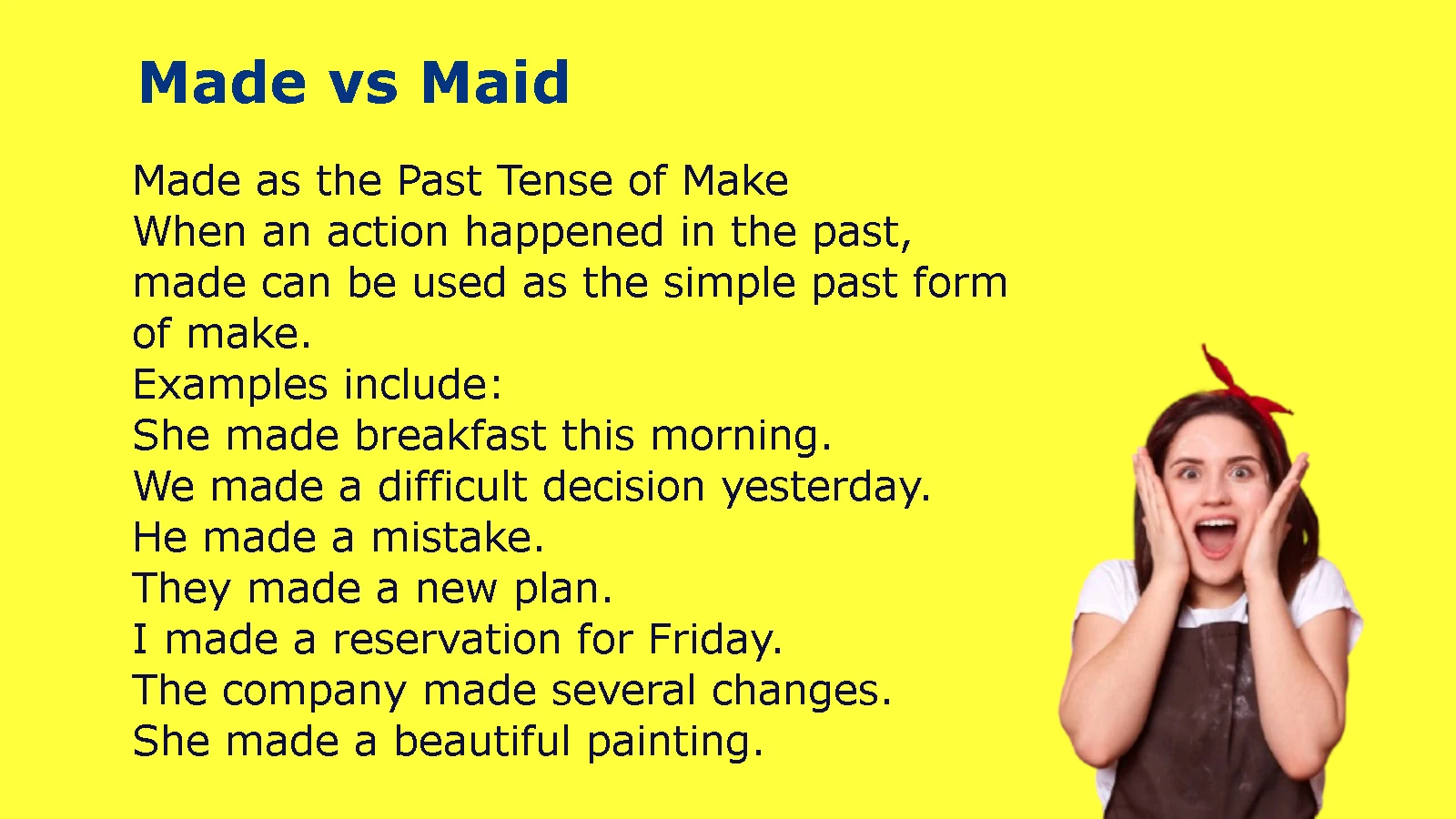
When an action happened in the past, made can be used as the simple past form of make.
Examples include:
- She made breakfast this morning.
- We made a difficult decision yesterday.
- He made a mistake.
- They made a new plan.
- I made a reservation for Friday.
- The company made several changes.
- She made a beautiful painting.
In each sentence, made describes something that happened or was produced.
The meaning changes according to the object that follows it.
Compare:
- She made a cake. → She prepared or created it.
- She made a decision. → She decided something.
- She made a mistake. → She committed an error.
- She made money. → She earned money.
- She made a promise. → She gave a promise.
- She made an appointment. → She arranged one.
This flexibility is one reason made appears much more broadly in English than maid.
Made as a Past Participle
Made also works as the past participle of make.
It appears after auxiliary verbs such as have, has, and had:
- I have made my decision.
- She has made several improvements.
- They had made the arrangements already.
- We have made enough food for everyone.
It can also appear in passive constructions:
- The table was made by hand.
- The cake was made yesterday.
- These shoes are made in Italy.
Cambridge Dictionary identifies made as the past tense and past participle of make.
Made in Common Expressions
Because make has many meanings, made occurs in a large number of common expressions.
Some frequent combinations include:
| Expression | Meaning | Example |
| made a mistake | committed an error | I made a mistake. |
| made a decision | decided | She made a decision quickly. |
| made a choice | chose something | He made a choice. |
| made a plan | created a plan | We made a plan for the weekend. |
| made money | earned money | The business made money last year. |
| made an effort | tried | She made an effort to help. |
| made a promise | promised | He made a promise to his parents. |
| made dinner | prepared dinner | Dad made dinner. |
| made a change | changed something | The company made a change to its policy. |
The word remains made because all of these expressions come from the verb make.
Maid: Meaning, Definition, and Usage
Maid is a noun.
Its most familiar modern meaning is a woman employed to clean a home, hotel room, or other living or working space. Dictionaries also record older or literary senses involving a young unmarried woman or maiden.
For example:
- The maid cleaned the hotel room.
- The maid arrived early.
- The hotel provides a maid service.
- A maid was responsible for cleaning the house.
The word can also appear in compound terms such as maidservant, chambermaid, and lady’s maid, although the exact terminology and social implications depend on historical and modern context.
Maid as a Noun for a Domestic Worker
In its traditional occupational sense, maid refers to a woman employed to perform domestic tasks.
Historically, household maids could have duties involving:
- Cleaning rooms
- Washing clothes
- Preparing or assisting with meals
- Making beds
- Maintaining household spaces
- Serving members of a household
The term also occurs in hospitality, particularly in historical descriptions and some modern contexts.
For example:
The maid cleaned the guest room before the visitors arrived.
Here, maid identifies a person. It cannot be replaced by made.
Maid in Historical and Modern Usage
The meaning of maid has changed somewhat over time.
Older English uses include maid as a shortened form of maiden, referring to a young unmarried woman. That sense is now dated, poetic, or literary rather than the ordinary meaning in everyday American English.
You may encounter this older sense in:
- Fairy tales
- Historical fiction
- Poetry
- Traditional songs
- Older literature
- Descriptions of medieval or early modern society
For instance:
The knight encountered a fair maid in the village.
In modern everyday English, however, maid is much more likely to be understood as referring to a domestic worker than simply an unmarried young woman.
Made vs Maid: Key Differences
The spelling difference is only one part of the distinction. The words also differ in meaning, grammatical function, and typical sentence position.
| Feature | Made | Maid |
| Pronunciation | /meɪd/ | /meɪd/ |
| Word type | Mainly verb; can also function adjectivally | Noun |
| Basic meaning | Past form of make | Domestic worker; older sense: maiden |
| Refers to an action? | Yes | No |
| Refers to a person? | Usually no | Yes |
| Related base word | Make | Maiden/maid |
| Example | She made lunch. | The maid cleaned the room. |
The easiest distinction is therefore grammatical:
Made normally tells you what someone did or produced.
Maid names a person.
Made vs Maid in a Sentence
Consider:
The maid made the bed.
This short sentence is useful because it contains both words.
- maid = the person
- made = the action
The sentence means that a domestic worker prepared the bed.
Changing the spellings would change the sentence:
The made maid the bed. ❌
That version does not work because made cannot replace the noun maid.
Likewise:
The maid the bed. ❌
That sentence is missing the verb. It needs made.
Made vs Maid Pronunciation
One of the biggest reasons people confuse these words is that made and maid are pronounced the same way in standard English.
Both have the pronunciation:
/meɪd/
The vowel is the long a sound found in words such as day, say, and name, followed by the d sound. Language references identify the two words as homophones.
Are Made and Maid Homophones?
Yes.
Made and maid are homophones because they have the same pronunciation but different spellings and meanings.
Other familiar homophone pairs include:
- right / write
- there / their / they’re
- to / too / two
- sea / see
- flower / flour
- new / knew
Made and maid fit the same pattern.
When someone says:
“The maid made the bed.”
You hear the same /meɪd/ sound twice, but context tells you which meaning is intended.
How to Pronounce Made and Maid
Both words are pronounced:
/meɪd/
There is no standard pronunciation distinction that lets you hear whether someone means made or maid.
That is why spelling becomes especially important in writing.
For English learners, the main pronunciation points are:
- Start with the m sound.
- Use the /eɪ/ vowel sound.
- Finish with the d sound.
- Do not pronounce made like mad.
- Do not add an extra syllable.
The same pronunciation applies to maid.
Made vs Maid Meaning in Context
Context is what separates these words when you hear them.
Consider this sentence:
Sarah made the bed.
Because made follows the subject and describes an action, it is the correct choice.
Now consider:
Sarah called the maid.
Here, maid refers to a person.
The surrounding words usually make the intended meaning obvious.
When to Use Made
Choose made when the sentence involves an action connected to make.
Use it when someone:
- Created something
- Built something
- Prepared something
- Produced something
- Caused something
- Arranged something
- Earned money
- Reached a decision
- Committed an error
- Formed something
Examples:
- He made a sandwich.
- She made a mistake.
- They made a new product.
- We made a decision.
- I made enough money.
- She made an appointment.
- The artist made a sculpture.
A useful test is to replace made with another past-tense verb related to make. If the sentence describes an action, made is likely correct.
When to Use Maid
Choose maid when you are referring to a person or role.
Examples:
- The maid cleaned the bedroom.
- The hotel maid entered the room.
- The maid prepared the guest room.
- The story featured a young maid.
- The household employed several maids.
If you can replace the word with domestic worker, housekeeper, or, in an appropriate historical context, maiden, maid may be the intended word.
Made vs Maid Examples
Seeing the two words in real sentences makes the distinction much easier.
Examples With Made
- She made breakfast for the family.
- He made a serious mistake.
- We made plans for the weekend.
- They made a beautiful wooden table.
- I made a cup of coffee.
- She made an important decision.
- The company made several improvements.
- He made enough money to buy a car.
- We had made arrangements before the meeting.
- She made the cake herself.
In each example, made comes from the verb make.
Examples With Maid
- The maid cleaned the room.
- The hotel maid replaced the towels.
- The maid entered the bedroom.
- The household hired a maid.
- The story describes a young maid.
- The maid prepared the guest room.
- Several maids worked in the large house.
- The hotel provides maid service.
- The maid finished cleaning before noon.
- The character is described as a village maid.
Here, maid is a noun.
Made and Maid in the Same Sentence
The best way to understand the difference is to use both words together:
The maid made the bed.
This example clearly separates the meanings.
Maid = person.
Made = action.
Other examples include:
The maid made breakfast.
The maid made the beds before noon.
These sentences are grammatically different from sentences such as:
She made breakfast.
There is no person named maid in the second sentence. The verb alone tells us what she did.
Made vs Maid in Common Phrases
Both words occur in established expressions, but their phrase patterns are very different.
Common Expressions With Made
Some common combinations include:
- made a mistake
- made a decision
- made a choice
- made a promise
- made an effort
- made money
- made a plan
- made a difference
- made a change
- made dinner
- made a living
- made progress
For example:
Her advice made a difference.
He made a mistake in the report.
We made a plan before leaving.
The expression made up is also common and has several meanings. It can mean to invent something, form a whole from parts, prepare something, or reconcile after an argument, depending on context. Cambridge Dictionary documents these different uses.
Common Expressions With Maid
Maid commonly appears in expressions connected with domestic work, hospitality, or historical descriptions.
Examples include:
- maid service
- hotel maid
- maidservant
- chambermaid
- lady’s maid
- milkmaid
- bridesmaid
Not every expression has the same modern meaning.
For example, bridesmaid refers to a member of the bridal party and does not mean a domestic worker. The word has developed into a separate established compound.
Likewise, milkmaid is a historical occupational term for a girl or woman who worked with milk or dairy production.
Common Mistakes With Made and Maid
The most common mistake is choosing the spelling based on pronunciation.
Because both words sound like /meɪd/, someone writing from memory may select the wrong spelling.
When Maid Is Mistaken for Made
Incorrect:
She maid dinner for her family.
Correct:
She made dinner for her family.
Why? The sentence describes an action. The person prepared dinner, so the past form of make is required.
Another example:
Incorrect:
He maid a terrible mistake.
Correct:
He made a terrible mistake.
Again, the word comes from make.
When Made Is Mistaken for Maid
Incorrect:
The made cleaned the hotel room.
Correct:
The maid cleaned the hotel room.
Here, the word refers to a person, so maid is required.
Another example:
Incorrect:
The hotel made changed the towels.
Correct:
The hotel maid changed the towels.
The context identifies a worker rather than an action.
Made vs Maid: Grammar Differences
Grammar provides one of the fastest ways to distinguish the two words.
Made as a Verb
Made is commonly used as a verb because it is the past tense and past participle of make.
Examples:
- She made lunch.
- He made a promise.
- They made a decision.
- We have made progress.
- The machine was made in Germany.
The first three examples use made as the simple past.
The last two demonstrate other grammatical uses of the past participle.
Maid as a Noun
Maid is a noun.
It can be singular:
The maid cleaned the room.
Or plural:
The maids cleaned the rooms.
It can also occur after determiners:
- a maid
- the maid
- this maid
- several maids
- two maids
Unlike made, it does not function as the past tense of an action.
Made vs Maid Synonyms
Because the words have different meanings, their synonyms are also different.
Synonyms for Made
Depending on context, possible alternatives include:
- created
- produced
- built
- prepared
- constructed
- formed
- developed
- manufactured
- arranged
- caused
You cannot substitute every synonym in every sentence.
For example:
She made dinner.
The natural alternatives include prepared dinner or cooked dinner, but constructed dinner would sound inappropriate.
Likewise:
He made a decision.
A natural alternative is reached a decision or simply decided, not built a decision.
Synonyms for Maid
Depending on the intended meaning and context, possible alternatives include:
- housekeeper
- domestic worker
- domestic servant
- cleaner
- housemaid
- maiden in historical or literary contexts
Some of these terms carry different social, historical, or occupational meanings, so they should not automatically be treated as interchangeable.
For modern professional writing, housekeeper or housekeeping worker may be more precise in contexts where the person’s occupation is being described.
Made vs Maid: Easy Ways to Remember the Difference
If you regularly confuse these homophones, use a simple substitution test.
Ask: Is It an Action?
If the answer is yes, try made.
She ___ a cake.
The answer is:
She made a cake.
You can substitute created or prepared, so made works.
Ask: Is It a Person?
If the answer is yes, try maid.
The ___ cleaned the room.
The answer is:
The maid cleaned the room.
The missing word identifies a person.
Remember the Related Word
Another useful connection is:
make → made
This is the strongest memory aid for spelling made.
If you are writing the past form of make, it must be made, not maid.
For example:
make → made
make a cake → made a cake
Made and Maid in Writing
The distinction becomes especially important in written English because spelling carries information that pronunciation does not.
When you hear:
“The maid made the bed.”
Both words sound identical.
When you read the sentence, however, the spellings immediately reveal the roles:
- maid identifies the person.
- made identifies the action.
That is why proofreading matters with homophones. Spell-checkers may not always detect the mistake because made and maid are both valid English words.
For example:
The maid cleaned the room.
A spelling checker has no reason to flag maid.
But if you accidentally write:
The made cleaned the room.
the sentence is grammatically wrong even though made itself is a correctly spelled English word.
Which Word Should You Use in Formal Writing?
Use the word that matches the grammatical function and intended meaning.
For professional or academic writing:
- Use made when referring to the past form of make.
- Use maid only when the noun is genuinely relevant.
- Consider more specific occupational terms when appropriate.
- Do not choose a spelling based solely on pronunciation.
For example:
The researchers made several changes to the methodology.
Correct.
The hotel employed a maid to clean the rooms.
Grammatically correct, although modern terminology may vary according to the specific occupation and context.
Made vs Maid: Homophone Sentences
Here are several sentences that demonstrate the contrast clearly:
The maid made the bed.
The maid made breakfast.
These examples contain both homophones, making the distinction easy to see.
Another useful exercise is to complete the sentence:
She ___ a cake.
Made
The ___ cleaned the house.
Maid
We ___ a plan.
Made
The hotel ___ entered the room.
Maid
The grammatical role gives you the answer even though the pronunciation remains identical.
A Quick Comparison: Made vs Maid
| Question | Made | Maid |
| Is it a homophone? | Yes | Yes |
| Does it sound like the other word? | Yes | Yes |
| Pronunciation | /meɪd/ | /meɪd/ |
| Is it related to make? | Yes | No |
| Is it normally a verb? | Yes | No |
| Is it normally a noun? | No, although it can have other uses | Yes |
| Can it refer to a domestic worker? | No | Yes |
| Can it mean the past form of make? | Yes | No |
| Example | She made dinner. | The maid cleaned the room. |
A Practical Case Study: Choosing Made or Maid
Consider this short paragraph:
Maria ___ dinner before the hotel ___ arrived. The ___ then cleaned the kitchen while Maria ___ the final preparations for the guests.
There are four blanks, but the pronunciation alone cannot help.
The correct version is:
Maria made dinner before the hotel maid arrived. The maid then cleaned the kitchen while Maria made the final preparations for the guests.
The logic is straightforward:
- made dinner → an action
- hotel maid → a person
- the maid → a person
- made the final preparations → an action
This is exactly why homophones can be confusing in writing. Both spellings are legitimate words, so you have to use meaning and grammar, not spelling-check software alone.
Why Made and Maid Are Confused
There are several reasons these words cause mistakes.
First, they are homophones. Their pronunciation is the same, so listening does not reveal the spelling.
Second, both are common English words. A writer cannot simply rely on a spell-checker to catch the error.
Third, the spelling difference is small. The words differ by only one letter.
Fourth, English has many homophones. Learners regularly encounter pairs such as right/write, sea/see, and flower/flour, so made/maid belongs to a broader spelling challenge.
The solution is to connect each spelling with its grammatical meaning rather than trying to memorize the two spellings independently.
FAQs About Made vs Maid
What is the difference between made and maid?
Made is the past tense and past participle of make. It can describe creating, preparing, producing, arranging, causing, or performing various actions.
Maid is a noun traditionally referring to a woman employed for domestic work. It can also mean a young unmarried woman in older or literary usage.
Are made and maid homophones?
Yes. Made and maid are homophones because they have the same pronunciation but different spellings and meanings.
Both are pronounced /meɪd/ in standard English.
How do you pronounce made and maid?
Both are pronounced /meɪd/.
There is no standard pronunciation difference between the two words that reliably tells a listener which spelling is intended.
What does made mean?
Made is the past tense and past participle of make.
For example:
She made a cake.
Here, made means that she created or prepared the cake.
What does maid mean?
Maid is a noun traditionally used for a woman employed to perform domestic work, such as cleaning.
The word also has older or literary meanings related to a young unmarried woman or maiden.
Is maid a noun or verb?
Maid is a noun.
For example:
The maid cleaned the room.
The word identifies a person.
Can made and maid be used interchangeably?
No.
Although made and maid sound the same, they have different meanings and grammatical functions.
You cannot write:
She maid dinner.
The correct sentence is:
She made dinner.
Likewise:
The made cleaned the room.
is incorrect when referring to a domestic worker. The correct word is:
The maid cleaned the room.
Which is correct: made or maid?
Both are correct words, but they are correct in different contexts.
Use made when you mean the past form of make.
Use maid when you mean a domestic worker or, in older/literary contexts, a maiden or young unmarried woman.
Is “made” a homophone of “maid”?
Yes. Made and maid are homophones because they share the same pronunciation while having different spellings and meanings.
What is an easy way to remember made vs maid?
Remember:
make → made
If you are talking about an action performed in the past, made is usually the correct spelling.
If you are naming a person who traditionally performs domestic work, use maid.
Conclusion: Made vs Maid
The difference between made vs maid is simple once you separate sound from meaning.
Made is primarily the past tense and past participle of make:
She made dinner.
Maid is a noun traditionally referring to a female domestic worker:
The maid cleaned the room.
The two words are homophones, so they sound exactly alike in standard pronunciation: /meɪd/.
The best way to choose the correct spelling is to look at the role of the word in the sentence. If it describes something someone did, created, prepared, produced, or arranged, choose made. If it refers to a person or occupational role, choose maid.
Quick Rule to Remember
Made = past form of make.
Maid = a person or, in older usage, a maiden.
Once you connect made with make, the spelling becomes much easier to remember. And because maid is a noun, you can usually identify it by asking whether the sentence is naming a person rather than describing an action.