Dear and deer are two different words that sound alike but have completely different meanings and uses. If you’ve come across “dear vs deer” and wondered which word is correct, the difference is simple: dear can describe someone or something valued, loved, or important, while deer refers to a hoofed animal commonly found in forests, grasslands, and other natural habitats.
The dear vs deer meaning depends entirely on the context. Dear is commonly used as an adjective, noun, or term of address in phrases such as dear friend, dear mother, my dear, and Dear Sir or Madam. In contrast, deer is a noun that refers to an animal belonging to the deer family. Although the two words have different meanings and spellings, they are homophones, meaning they are pronounced alike but have different meanings and spellings.
In this guide, you’ll learn what “dear” and “deer” mean, how to use each word in a sentence, why they are often confused, and how to remember the difference between them. You’ll also see clear examples, definitions, and comparisons to make the distinction easy to understand.
By the end, you’ll know exactly when to use dear and when to use deer, so you can avoid this common spelling and word-choice mistake in both everyday writing and formal communication.
Dear vs Deer: Meaning, Pronunciation, and Usage
The easiest way to remember the difference is simple: dear is usually connected with people, feelings, greetings, or cost, while deer refers to an animal.
Both words are homophones, which means they share the same pronunciation while having different spellings and meanings. Cambridge gives both dear and deer the US pronunciation /dɪr/ and the UK pronunciation /dɪə(r)/.
Because they sound identical, the surrounding words are what tell you which spelling belongs in a sentence.
Dear vs Deer at a Glance
Here is the difference between dear vs deer in the simplest possible form:
| Word | Meaning | Part of Speech | Example |
| dear | Loved, valued, or important | Adjective | She is a dear friend. |
| dear | Used to address someone | Adjective/form of address | Dear Mr. Brown, |
| dear | Expensive | Adjective | That restaurant is too dear. |
| dear | A loved or kind person | Noun | She is such a dear. |
| dear | An expression of surprise or concern | Exclamation | Oh dear! |
| deer | A hoofed animal | Noun | We saw a deer in the forest. |
Oxford lists dear and deer as homophones and gives deer as a noun referring to an animal, while dear has several uses involving affection, address, and people.
The one-line rule
Dear = someone or something valued, a greeting, or sometimes something expensive.
Deer = the animal.
That distinction solves most spelling questions involving these two words.
Dear Meaning and Definition
Dear has several meanings, so context matters. It is most commonly used as an adjective, but it can also function as a noun or an exclamation.
Cambridge defines the adjective dear in one sense as something or someone that is loved or liked very much. It also recognizes its use at the beginning of letters and emails.
Dear meaning loved or valued
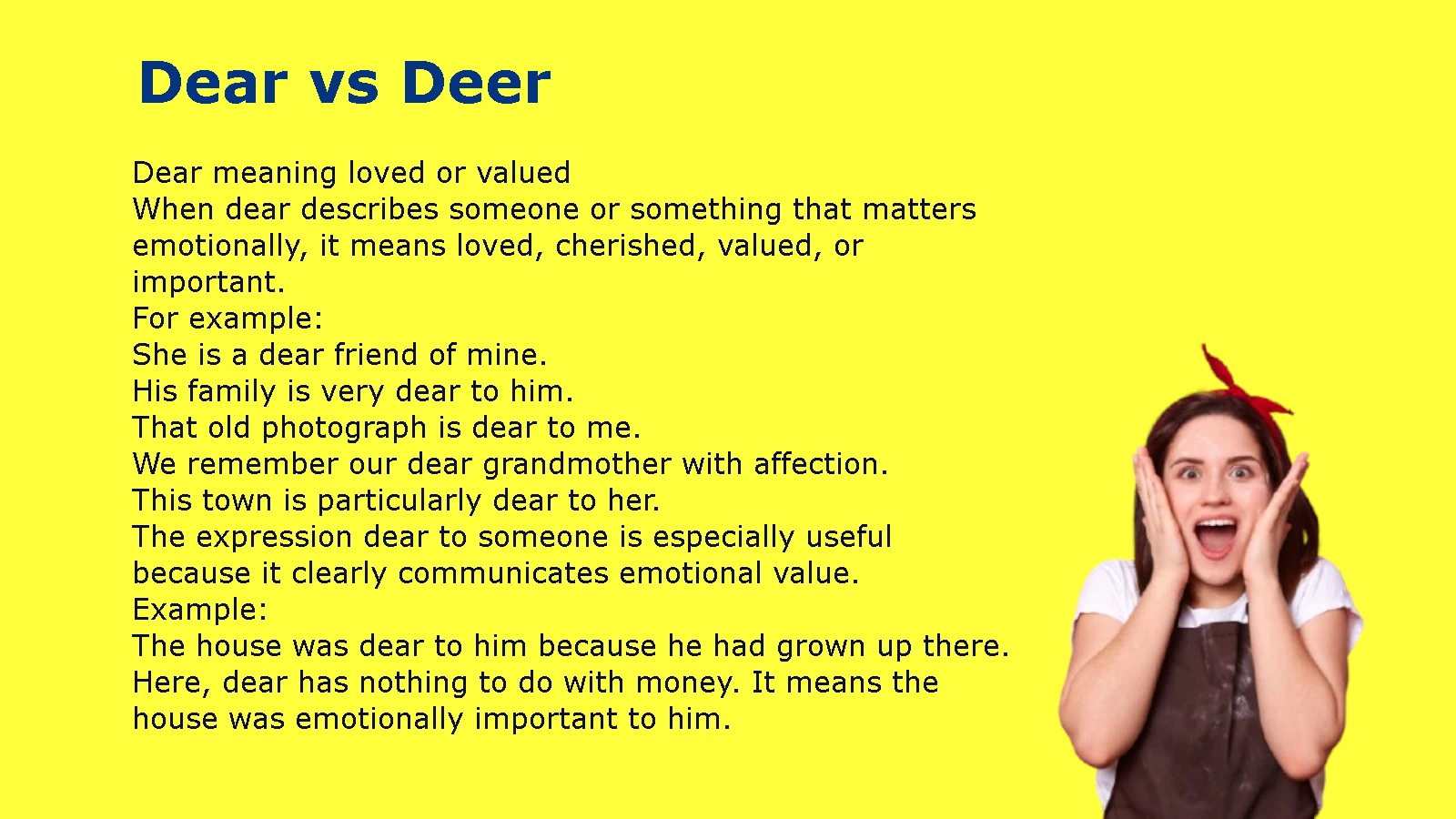
When dear describes someone or something that matters emotionally, it means loved, cherished, valued, or important.
For example:
- She is a dear friend of mine.
- His family is very dear to him.
- That old photograph is dear to me.
- We remember our dear grandmother with affection.
- This town is particularly dear to her.
The expression dear to someone is especially useful because it clearly communicates emotional value.
Example:
The house was dear to him because he had grown up there.
Here, dear has nothing to do with money. It means the house was emotionally important to him.
Dear as a form of address
You will frequently see dear at the beginning of a letter or email.
Examples include:
- Dear John,
- Dear Ms. Smith,
- Dear Professor Lee,
- Dear Sir or Madam,
- Dear Mom,
- Dear Customer,
In this construction, dear does not mean that the writer is necessarily romantically or personally attached to the recipient.
For example:
Dear Hiring Manager,
Thank you for considering my application.
This is a conventional opening for professional correspondence.
Oxford specifically identifies dear as a word used at the beginning of a letter before the name or title of the recipient.
Dear as a noun
Dear can also refer to a person who is loved, liked, or regarded affectionately.
Examples:
- She is such a dear.
- Come here, my dear.
- Would you like some tea, dear?
- Be a dear and help me carry this.
Oxford lists this noun use for a kind person and for someone being addressed affectionately or in a friendly manner.
The exact tone depends heavily on context, relationship, age, and regional usage. In some situations, dear sounds warm and affectionate. In others, particularly between strangers, it can sound old-fashioned or overly familiar.
Dear meaning expensive
There is another important meaning that learners sometimes overlook.
In particular, British English uses dear to mean expensive or costing too much.
For example:
- That hotel is rather dear.
- The food was good, but it was very dear.
- Houses in that area are becoming dearer.
- The restaurant is too dear for us.
Cambridge labels this meaning as primarily British and gives expensive as a synonym.
In American English, expensive or pricey is generally more natural in everyday conversation.
Dear as an exclamation
You may also see dear in expressions such as:
- Oh dear!
- Dear me!
These expressions can communicate surprise, disappointment, concern, annoyance, or distress.
For example:
Oh dear! I forgot to bring my keys.
Here, dear is not describing a person or an object. It is part of an exclamation.
Deer Meaning and Definition
Deer is a noun referring to animals in the deer family, Cervidae.
Cambridge defines a deer as a four-legged animal that eats grass and leaves and notes that the plural form is also deer.
Oxford similarly defines deer as an animal with long legs that eats vegetation and notes that many types of deer exist.
Examples include:
- We saw a deer near the road.
- A deer crossed the trail.
- Several deer were standing in the meadow.
- The forest is home to a large herd of deer.
- We watched the deer from a distance.
Deer is an animal word
Whenever you’re talking about the mammal, the correct spelling is deer.
For example:
We saw a deer in the woods.
Not:
We saw a dear in the woods.
The second sentence would normally suggest that someone accidentally used the spelling associated with affection or address.
Deer can be singular or plural
One particularly useful fact about deer is that its plural form is also deer.
| Number | Correct form | Example |
| One | deer | I saw one deer. |
| Two | deer | I saw two deer. |
| Several | deer | Several deer crossed the road. |
| Many | deer | The park has many deer. |
Oxford explicitly lists deer as the plural form.
Therefore, you generally do not need to add -s when referring to multiple deer in standard English.
Common types of deer
The word deer covers many animals within the deer family.
Depending on the region and context, you may encounter terms such as:
- white-tailed deer
- red deer
- fallow deer
- roe deer
- reindeer
- moose
- elk
- mule deer
Specific classifications can become more technical in zoological contexts, but everyday English uses deer as a broad term for these related animals.
Dear vs Deer: What’s the Difference?
The central difference between dear vs deer is meaning and spelling, not pronunciation.
Both words sound alike in standard English pronunciation.
Consider these two sentences:
My dear friend lives nearby.
A deer lives nearby.
The first sentence concerns a person who is valued or loved. The second concerns an animal.
Nothing in the pronunciation tells the listener which spelling the speaker intends. The meaning comes from context.
Dear vs Deer comparison
| Feature | Dear | Deer |
| Pronunciation | /dɪr/ in US English | /dɪr/ in US English |
| UK pronunciation | /dɪə(r)/ | /dɪə(r)/ |
| Main meaning | Loved, valued, addressed, or expensive | A hoofed mammal |
| Common part of speech | Adjective, noun, exclamation | Noun |
| Plural | dears, when used as a noun | deer |
| Used in greetings? | Yes | No |
| Refers to an animal? | No | Yes |
| Homophone? | Yes | Yes |
Cambridge’s pronunciation entries show the same US and UK pronunciations for the two words.
Dear vs Deer Pronunciation
One reason dear vs deer causes so many spelling mistakes is that the words are pronounced alike.
American English pronunciation
In American English, both words are commonly pronounced:
/dɪr/
The vowel sound is similar to the one heard in near, fear, and clear.
Cambridge gives /dɪr/ for both dear and deer in US English.
British English pronunciation
In British English, Cambridge gives both words as:
/dɪə(r)/
The final r can vary depending on the speaker’s accent and phonological context.
Again, the important point is that the two words share the same standard pronunciation within the same variety of English.
Why identical pronunciation causes confusion
Imagine hearing:
“I saw a deer.”
If you only hear the sentence, you cannot determine the spelling from the sound alone.
You need the meaning to choose between dear and deer.
This is exactly why homophones create spelling problems. Spoken English gives you the sound, while written English requires you to select the correct word.
Are Dear and Deer Homophones?
Yes. Dear and deer are homophones.
A homophone is a word that has the same pronunciation as another word but a different meaning and usually a different spelling.
The pair fits the definition perfectly:
- dear → loved, valued, addressed, or expensive
- deer → an animal
- pronunciation → the same
- spelling → different
- meaning → different
Oxford directly lists dear and deer as homophones.
Other common English homophones
The English language contains many similar pairs:
| Homophones | Meanings |
| to / two / too | direction, number, also |
| there / their / they’re | place, possession, they are |
| hear / here | perceive sound, location |
| see / sea | perceive with eyes, body of water |
| right / write | correct, put words on paper |
| flower / flour | plant bloom, baking ingredient |
| dear / deer | loved/valued, animal |
Homophones are not necessarily difficult once you stop relying on sound alone. Context is the key.
How to Use Dear in a Sentence
The meaning of dear changes depending on its grammatical role.
Dear meaning loved or valued
Use dear when describing someone or something that is emotionally important.
Examples:
- My sister is a dear friend.
- This necklace is very dear to me.
- He lost someone dear to him.
- She remains a dear member of our family.
- That childhood memory is particularly dear to me.
In these sentences, dear expresses emotional value.
Dear as a greeting
Use Dear at the beginning of many letters and emails.
Examples:
- Dear Mr. Johnson,
- Dear Dr. Patel,
- Dear Sarah,
- Dear Team,
- Dear Customer Service,
For professional writing, the exact greeting depends on the situation and the relationship between the sender and recipient.
Dear meaning expensive
Examples:
- The apartment is too dear for my budget.
- Hotels in that area can be quite dear.
- The meal was rather dear.
- Imported products are sometimes dear.
This meaning is particularly associated with British English.
How to Use Deer in a Sentence
Use deer when referring to the animal.
Examples:
- We saw a deer beside the road.
- The deer disappeared into the forest.
- A deer was grazing in the field.
- Several deer crossed the trail.
- The park protects a large population of deer.
- We watched a herd of deer from a safe distance.
The plural remains deer:
Three deer were grazing near the river.
Not:
Three deers were grazing near the river.
For ordinary modern English, deer is the standard plural form.
Dear vs Deer in Common Phrases
Certain phrases make the spelling distinction especially easy to see.
Dear Friend vs Deer Friend
Dear friend is correct when referring to a friend you value.
She is my dear friend.
Deer friend is not correct if you mean a human friend.
The only time deer friend would make literal sense is in a deliberately unusual context where deer is being used as a noun modifier or as part of a creative expression.
Dear Sir or Madam vs Deer Sir or Madam
The standard formal greeting is:
Dear Sir or Madam,
Here, dear is used as part of a conventional letter greeting.
Deer Sir or Madam is a spelling error.
My Dear vs My Deer
My dear can be an affectionate form of address.
Come here, my dear.
My deer would refer literally to an animal owned or associated with the speaker, although the construction is unusual.
For example, someone discussing wildlife might theoretically say:
My deer keeps returning to the garden.
In ordinary communication, however, this would be a very different meaning from my dear.
Dear Diary vs Deer Diary
The familiar expression is:
Dear Diary,
It is a way of addressing a diary as though it were a listener.
Deer Diary would be a spelling error unless deer were intentionally being used as a reference to the animal.
Dear vs Deer: Common Mistakes
Most mistakes happen because the two words sound identical.
Using deer for a person
Incorrect:
She is my deer friend.
Correct:
She is my dear friend.
The word describes emotional affection, so dear is required.
Using dear for the animal
Incorrect:
We saw a dear crossing the road.
Correct:
We saw a deer crossing the road.
The sentence refers to an animal, so deer is correct.
Writing deer in a letter greeting
Incorrect:
Deer Mr. Smith,
Correct:
Dear Mr. Smith,
A letter greeting uses dear.
Assuming the sound tells you the spelling
This is the biggest underlying problem.
When you hear dear or deer, you hear essentially the same word. You must use the meaning of the sentence to select the spelling.
A useful question is:
Am I talking about affection, a person, a greeting, or cost?
If yes, dear is probably the word you need.
If you’re talking about the animal, choose deer.
Dear vs Deer in Formal Writing
Dear has an established role in professional correspondence.
You may see:
Dear Hiring Manager,
Dear Members of the Committee,
The capitalization depends on where the word appears and the style of the document, but the spelling remains dear, not deer.
The distinction is especially important because a spelling error in a formal greeting can immediately stand out.
Formal example
Dear Dr. Williams,
I am writing to ask about the research position advertised on your department’s website.
Here, dear is simply part of the greeting.
It does not necessarily communicate personal affection.
Informal example
Dear Maria,
I hope you’re doing well. It was wonderful seeing you last weekend.
The same word works in a personal message, but the overall tone comes from the rest of the communication.
How to Remember the Difference Between Dear and Deer
You don’t need a complicated mnemonic to remember these words.
Dear = someone or something you value
Think:
Dear = dear to my heart.
Examples:
- dear friend
- dear family
- dear memory
- dear colleague
You can also connect dear with Dear Sir or Madam, since it is the spelling used in greetings.
Deer = the animal
Think of the extra e in deer as part of the longer animal word.
You can associate it with:
- deer
- doe
- fawn
- antlers
- forest
- herd
The key is to connect the spelling with the concept rather than trying to distinguish the pronunciation.
The fastest memory trick
Dear = affection. Deer = animal.
If you remember only that sentence, you’ll get most uses right.
Dear vs Deer Examples
The following pairs show how one letter changes the meaning.
| Dear | Deer |
| She is my dear friend. | We saw a deer in the forest. |
| This photograph is dear to me. | A deer crossed the road. |
| Dear Mr. Brown, thank you for your email. | The deer disappeared into the trees. |
| My dear grandmother lives nearby. | We watched several deer grazing. |
| The memory remains dear to her. | A young deer followed its mother. |
| Dear Diary, today was unforgettable. | The park is home to many deer. |
| He is a dear friend of mine. | The deer moved quietly through the woods. |
| That old house is dear to them. | We photographed a deer from a distance. |
| The hotel was rather dear. | A deer was standing beside the trail. |
| Oh dear! I forgot my wallet. | The deer ran across the field. |
A useful mixed example
You can even use both words in the same sentence:
My dear friend enjoys watching deer in the countryside.
This sentence makes the distinction obvious:
- dear = valued or loved
- deer = animals
Dear and Deer: Related Words and Homophones
Understanding related words can make the distinction easier.
Words related to dear
Depending on the meaning, related words include:
- beloved
- cherished
- valued
- precious
- loved
- favorite
- costly
- expensive
- pricey
The appropriate synonym depends on context.
For example:
She is a dear friend.
Here, beloved, valued, or close may work.
But:
That restaurant is too dear.
Here, expensive or pricey is more appropriate.
Words related to deer
Words commonly associated with deer include:
- doe
- buck
- stag
- hind
- fawn
- antler
- herd
- wildlife
- forest
- habitat
The exact terminology can vary by species and regional usage.
Why context matters so much
Compare:
That painting is dear to me.
and:
I saw a deer near the painting.
The pronunciation of dear and deer does not help the listener distinguish the words. The surrounding nouns and meanings do the work.
Dear vs Deer vs Deers
A common follow-up question is whether deers is correct.
In standard everyday English, the usual plural of deer is simply deer.
Correct:
We saw five deer.
Correct:
The park contains hundreds of deer.
Generally incorrect in ordinary standard English:
We saw five deers.
Oxford and Cambridge both identify deer as the plural form.
This follows a broader pattern in English in which some animal nouns have unchanged singular and plural forms.
For example:
- one sheep → two sheep
- one fish → two fish
- one deer → two deer
That makes deer particularly easy to use once you remember the rule.
A Simple Case Study: Choosing Dear or Deer
Imagine you are editing this sentence:
“My ___ friend and I saw three ___ near the lake.”
There are two blanks, and both words sound the same.
The first blank describes friend.
A person who is valued or loved is a dear friend.
The second blank refers to animals.
Therefore, the correct sentence is:
My dear friend and I saw three deer near the lake.
This example captures the central problem with these homophones: pronunciation alone cannot tell you which spelling to use.
The sentence’s meaning provides the answer.
Quick Trick to Choose Dear or Deer
Use this simple decision guide:
Are you talking about a person you value?
→ Use dear.
Are you addressing someone in a letter or email?
→ Use dear.
Are you describing something emotionally important?
→ Use dear.
Are you saying something costs a lot?
→ Use dear, particularly in British English.
Are you talking about the animal?
→ Use deer.
One final memory sentence
My dear friend saw a deer.
The sentence contains both spellings and gives you the distinction in one line.
FAQs About Dear vs Deer
What is the difference between dear and deer?
Dear has several meanings. It can describe someone or something loved or valued, serve as a form of address, refer to a loved or kind person, or mean expensive, especially in British English.
Deer is a noun referring to an animal in the deer family.
The two words are pronounced alike but spelled differently.
Are dear and deer pronounced the same?
Yes. In standard English, dear and deer are pronounced the same.
Cambridge gives both words as /dɪr/ in US English and /dɪə(r)/ in UK English.
Are dear and deer homophones?
Yes. Dear and deer are homophones because they have the same pronunciation but different spellings and meanings. Oxford explicitly identifies them as homophones.
What does dear mean?
Dear can mean loved, cherished, valued, or emotionally important. It is also used in greetings such as Dear John, can refer to a loved or kind person, and can mean expensive in some varieties of English, particularly British English.
What does deer mean?
Deer refers to a group of hoofed mammals in the family Cervidae. The word is a noun, and its plural is normally also deer.
Is dear used for a person?
Yes. Dear can describe someone you love or value, as in a dear friend. It can also be used as a noun or form of address, as in my dear.
Can deer be plural?
Yes. Deer has the same form in both singular and plural.
- one deer
- two deer
- many deer
For example:
We saw four deer in the field.
How do you remember dear vs deer?
Remember:
Dear = affection, address, or cost.
Deer = animal.
If you’re talking about a person, feeling, greeting, or price, dear is likely correct. If you’re talking about the animal, use deer.
Is “deer friend” correct?
Usually, no. If you mean a friend who is loved or valued, the correct phrase is dear friend.
She is my dear friend.
Deer friend would only make sense as an intentionally literal or creative phrase involving a deer.
Is “dear friend” correct?
Yes. Dear friend is a standard expression meaning a friend who is loved, valued, or close to you.
Sarah has been my dear friend for many years.
Conclusion
The difference between dear vs deer is easy once you connect each spelling with its meaning.
Dear is used for affection, value, greetings, loved people, and sometimes high cost. Deer refers to an animal. Although the words have different spellings and meanings, they are pronounced alike, making them classic English homophones.
Remember the simplest rule:
Dear = valued or loved. Deer = the animal.
So you write “Dear Mr. Smith”, “my dear friend,” and “a dear memory.” When you’re talking about wildlife, you write “a deer,” “two deer,” or “a herd of deer.”
Once you use context instead of pronunciation to identify the word, dear vs deer becomes much easier to get right.