Line vs Queue
Line and queue both refer to a group of people waiting for their turn. The main difference is regional usage. Line is more common in American English, while queue is the preferred term in British English and many other English-speaking countries.
Examples:
- We stood in line to buy concert tickets. (American English)
- We joined the queue at the ticket counter. (British English)
The confusion is understandable. Many people search for the difference between line and queue, line meaning, queue meaning, and line vs queue in American and British English because these terms are used differently around the world. And here’s the kicker: using the right word can make your writing and speech sound more natural and contextually accurate.
In this guide, you’ll learn the difference between Line vs Queue, discover the correct usage of line and queue, understand when to use line or queue, and see line vs queue examples in everyday conversations. You’ll also learn how to pronounce queue, explore queue pronunciation, and find out why line is preferred in American English while queue is more common in British English.
What Is a Line?
A line is a group of people or objects arranged one behind another while waiting for something. In American English, it’s the standard word for almost every waiting situation.
Whether you’re buying groceries, checking in for a flight, or ordering coffee, you’ll probably hear someone say, “The line is long today.”
Common Situations Where “Line” Is Used
People commonly use line in places like:
- Grocery stores
- Movie theaters
- Banks
- Airports
- Theme parks
- Restaurants
- Ticket counters
- Retail checkout lanes
Examples
- I’m standing in line for concert tickets.
- The checkout line moved quickly.
- Please wait in line until your number is called.
- There were only three people ahead of us in line.
Although the word sounds simple, line also suggests fairness. Everyone joins at the back and moves forward in the same order. This unwritten rule helps keep public spaces organized.
“First come, first served” is the principle that governs most lines.
Other Meanings of “Line”
English often gives one word several meanings. Besides referring to people waiting, line can also mean:
| Meaning | Example |
| A straight mark | Draw a straight line. |
| A row of objects | Trees formed a line along the road. |
| A phone connection | Hold the line, please. |
| A railway route | The train line is closed today. |
| A product category | The company launched a new clothing line. |
Context usually makes the intended meaning obvious.
What Is a Queue?
A queue is an orderly sequence of people, vehicles, tasks, or data waiting to be served or processed. While its meaning closely matches line, the word is far more common in British English.
For example, someone in London might say:
- Please join the queue.
- We’ve been queuing for twenty minutes.
An American would likely express the same idea by saying:
- Please get in line.
- We’ve been waiting in line for twenty minutes.
Both statements communicate exactly the same situation.
Physical Queues
A physical queue forms whenever people wait their turn in a public place.
Examples include:
- Airport security
- Museum entrances
- Stadium gates
- Bus stops
- Amusement parks
- Government offices
The goal stays the same: everyone receives service according to arrival order.
Digital Queues
Unlike line, the word queue frequently appears in technology.
Digital queues manage requests such as:
- Purchasing concert tickets online
- Downloading game updates
- Customer support chats
- Cloud computing tasks
- Streaming services
- Website traffic during major product launches
Instead of people physically standing together, computers organize requests automatically.
For instance, when thousands of shoppers try to buy limited-edition sneakers at the same time, the website often places visitors into a virtual queue.
Why Is “Queue” Spelled That Way?
Many English learners notice the unusual spelling.
The word comes from the French word queue, meaning tail. Think of a line of people as forming a tail behind the person at the front.
Although it contains five letters, only the first one carries the primary pronunciation.
Queue sounds almost exactly like cue or the letter Q.
Line vs Queue: Quick Comparison
The easiest way to understand line vs queue is to compare their features side by side.
| Feature | Line | Queue |
| Primary meaning | People waiting in order | People or tasks waiting in order |
| Common in | American English | British English |
| Physical waiting | Yes | Yes |
| Virtual waiting | Sometimes | Very common |
| Computing term | Rare | Standard |
| Can be a verb | Less common | Yes (“queue up”) |
| Everyday US speech | Very common | Less common |
| Everyday UK speech | Less common | Very common |
Quick Summary
- Americans usually stand in line.
- Britons usually stand in a queue.
- Computer systems almost always use queue.
The Main Difference Between Line and Queue
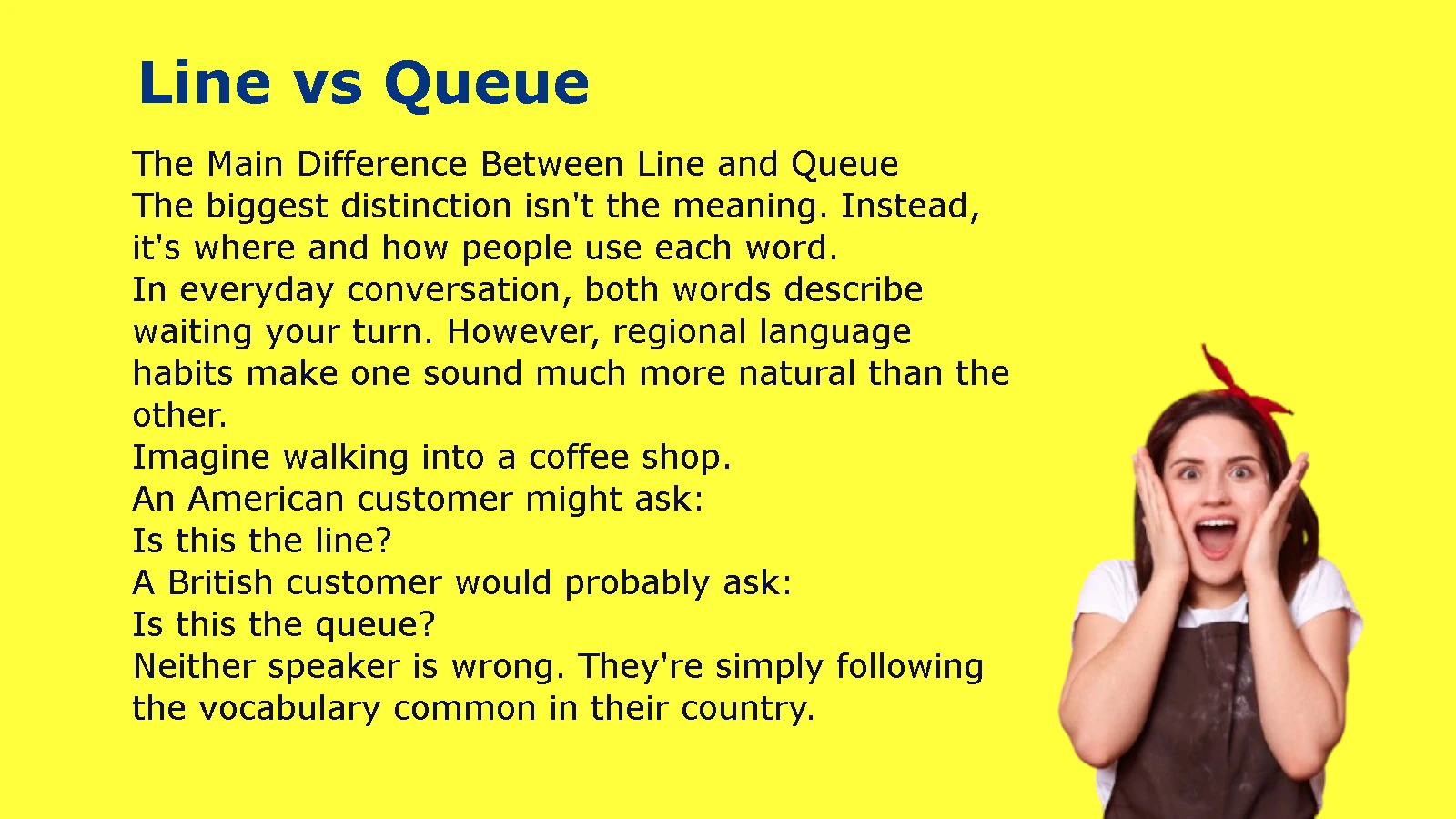
The biggest distinction isn’t the meaning. Instead, it’s where and how people use each word.
In everyday conversation, both words describe waiting your turn. However, regional language habits make one sound much more natural than the other.
Imagine walking into a coffee shop.
An American customer might ask:
Is this the line?
A British customer would probably ask:
Is this the queue?
Neither speaker is wrong. They’re simply following the vocabulary common in their country.
Regional English Differences
Language evolves differently across English-speaking countries. That’s why you’ll hear different words for the same situation.
| Country | Preferred Word |
| United States | Line |
| United Kingdom | Queue |
| Canada | Both, depending on region |
| Australia | Queue |
| New Zealand | Queue |
| Ireland | Queue |
American English
Americans overwhelmingly prefer line.
Examples include:
- Wait in line
- Stand in line
- Get in line
- The checkout line
- The lunch line
Using queue isn’t incorrect, though it often sounds formal or technical to American ears.
British English
British speakers almost always choose queue.
Common phrases include:
- Join the queue
- Queue up
- Leave the queue
- Jump the queue
The phrase stand in line is understandable in Britain, though it sounds distinctly American.
Canadian English
Canada sits somewhere between American and British English.
Many Canadians use line in casual conversation because of American influence. However, queue also appears in formal writing, transportation systems, and government communications.
Australian and New Zealand English
Australians and New Zealanders strongly favor queue.
Visitors from North America often notice signs that read:
- Please queue here.
- Queue starts beyond this point.
Is There Any Difference in Meaning?
For most everyday situations, line and queue mean exactly the same thing.
Both describe an ordered arrangement where people wait for service.
However, subtle differences appear in specialized contexts.
| Situation | Better Choice |
| Grocery shopping | Line (US) / Queue (UK) |
| Airport security | Either, depending on region |
| Software engineering | Queue |
| Customer support systems | Queue |
| Theme park entrance | Line (US) / Queue (UK) |
The meaning stays consistent. The preferred vocabulary changes with the audience.
Why Context Matters
Imagine reading this sentence:
Your request has entered the line.
Technically, it makes sense.
However, software developers almost always say:
Your request has entered the queue.
Likewise, most Americans wouldn’t naturally say:
I’m queuing for pizza.
Instead, they’d say:
I’m waiting in line for pizza.
Choosing the expected word makes your writing sound fluent and natural.
Physical Line vs Digital Queue
Technology has changed how people wait.
Instead of standing outside a store for hours, customers often wait online. While the experience feels different, the underlying idea remains the same: everyone receives service in order.
Waiting in Person
Physical waiting happens everywhere.
Examples include:
- Supermarket checkout
- Airport security
- Theme parks
- Restaurants
- Government offices
- Concert venues
- Banks
Real-Life Example
Imagine arriving at a busy bakery on Saturday morning.
Ten customers reached the counter before you.
Whether you call it a line or a queue, you’ll wait until those ten customers finish ordering.
The system rewards patience and keeps service organized.
Waiting Online
Virtual waiting has become increasingly common.
Instead of people standing shoulder to shoulder, software places visitors into an electronic waiting room.
Examples include:
- Buying Taylor Swift concert tickets
- Ordering limited-edition sneakers
- Registering for popular online courses
- Booking government appointments
- Reserving theme park passes
- Accessing high-demand gaming servers
When demand exceeds capacity, websites create a virtual queue to prevent crashes and distribute access fairly.
Case Study: Online Ticket Sales
Imagine a major concert goes on sale at 10:00 AM.
More than 500,000 fans try to enter the ticket website simultaneously.
Without a virtual queue:
- The website could slow down.
- Pages might fail to load.
- Payments could time out.
- Some users might lose their place.
With a virtual queue:
- Visitors receive a position in line.
- The website admits users gradually.
- Servers remain stable.
- Customers enjoy a fairer purchasing process.
This is why many ticketing platforms display messages such as:
“You are now in the queue. Please don’t refresh your browser.”
Line vs Queue in Computing
Outside everyday conversations, queue has a precise technical meaning. If you’ve studied programming, computer science, or information technology, you’ve probably encountered the term.
In computing, a queue is a data structure that stores items in the order they arrive. The first item added becomes the first item removed. This method keeps processing predictable and fair.
Developers rarely use the word line in this context because queue is the accepted technical term across programming languages, operating systems, and networking.
Understanding FIFO (First In, First Out)
Most queues follow the FIFO (First In, First Out) principle.
Think of a coffee shop.
The first customer to place an order receives their drink before customers who arrived later. A computer queue works the same way.
Front Back
+——-+——-+——-+——-+
| Task1 | Task2 | Task3 | Task4 |
+——-+——-+——-+——-+
↑ ↑
Processed First Added Last
This simple system helps computers handle millions of requests every day without confusion.
Where Queues Appear in Technology
Queues power many digital services you use daily.
| Application | How the Queue Works |
| Print spooler | Documents print in the order you send them. |
| Customer support chat | Requests wait until an agent becomes available. |
| Email servers | Messages wait before delivery. |
| Cloud computing | Tasks wait for processing resources. |
| Web servers | Incoming requests wait during heavy traffic. |
| Video streaming | Data packets arrive and process in sequence. |
| Banking systems | Transactions process in a controlled order. |
Without queues, many online services would become unreliable during periods of high demand.
Queue Operations
Every programming language supports similar queue operations.
- Enqueue – Add an item to the back.
- Dequeue – Remove the item at the front.
- Peek – View the first item without removing it.
- Is Empty – Check whether the queue contains any items.
These operations keep data organized while maintaining the correct processing order.
Common Expressions With “Line”
The word line appears in dozens of everyday expressions. Some relate to waiting while others carry completely different meanings.
Stand in Line
This is the most common American expression.
Examples
- We stood in line for an hour.
- You’ll need to stand in line before entering.
Wait in Line
People often use this phrase interchangeably with stand in line.
Examples
- I don’t mind waiting in line.
- Everyone waited in line quietly.
Get in Line
This phrase means to join the people already waiting.
It can also mean follow the rules depending on the situation.
Examples
- Please get in line behind the last customer.
- The coach told the players to get in line.
Cut in Line
Someone who cuts in line unfairly moves ahead of others.
Examples
- He tried to cut in line.
- Nobody appreciates line cutters.
Hold the Line
This phrase usually refers to staying on the phone.
Example
- Please hold the line while I transfer your call.
Draw the Line
This idiom means setting a limit or refusing to accept something.
Example
- I’ll help with the project, but I draw the line at doing all the work myself.
Common Expressions With “Queue”
British English includes several expressions built around queue.
Join the Queue
This simply means entering the waiting line.
Example
- Please join the queue near the entrance.
Queue Up
This verb phrase means to form or enter a queue.
Examples
- Fans queued up before sunrise.
- Visitors queued outside the museum.
Form a Queue
This expression commonly appears on signs and public announcements.
Example
- Please form a queue at Counter 3.
Leave the Queue
Someone exits before reaching the front.
Example
- Several customers left the queue after the delay.
Jump the Queue
In British English, jump the queue has the same meaning as the American phrase cut in line.
Example
- It’s rude to jump the queue.
Grammar and Parts of Speech
Although line and queue often describe the same idea, they behave a little differently in grammar.
“Line” as a Noun
This is its most common use.
Examples
- The line moved quickly.
- We joined the checkout line.
“Line” as a Verb
The verb usually means to cover, fill, or arrange something.
Examples
- Trees lined the street.
- Shelves lined the walls.
Notice that this meaning differs completely from waiting.
“Queue” as a Noun
As a noun, queue refers to an ordered group waiting for service.
Examples
- The queue stretched around the block.
- The queue moved slowly.
“Queue” as a Verb
Unlike line, the verb queue directly relates to waiting.
Examples
- People queued outside the stadium.
- Customers queued for the new smartphone.
This difference explains why British English commonly uses queue as both a noun and a verb.
Line vs Queue Around the World
English changes from one country to another. Knowing your audience helps you choose the most natural word.
| Country | Preferred Term | Example |
| United States | Line | Stand in line |
| United Kingdom | Queue | Join the queue |
| Canada | Both | Depends on region |
| Australia | Queue | Queue here |
| New Zealand | Queue | Queue at reception |
| Ireland | Queue | Queue for tickets |
| South Africa | Queue | Queue outside the office |
Why Regional Usage Matters
Imagine you’re writing instructions for American shoppers.
This sounds natural:
Please stand in line until the cashier calls you.
Now imagine the same sign in London.
Most people would expect:
Please join the queue until the cashier is available.
Neither version is incorrect. Each simply matches local usage.
For international audiences, consistency matters more than the specific word you choose. Pick one term and use it throughout your document.
Real-Life Examples of Line vs Queue
Looking at everyday situations makes the distinction much easier to understand.
At a Supermarket
American English
There’s a long line at checkout.
British English
There’s a long queue at the checkout.
The situation stays identical. Only the vocabulary changes.
At an Airport
Airport announcements often reflect the country’s preferred English.
United States
- Please remain in line.
- Form a single line.
United Kingdom
- Please remain in the queue.
- Queue behind the yellow line.
Buying Concert Tickets
Concert ticket sales combine physical and digital waiting.
Years ago, fans often waited overnight outside ticket offices.
Today, many ticket platforms place customers into a virtual queue before they can purchase tickets.
Although you’re sitting at home, the software still serves customers in arrival order.
Customer Service Centers
Call centers also rely on queues.
When all representatives are busy, your call enters a waiting queue.
You may hear messages such as:
- Your call is in the queue.
- Estimated wait time is five minutes.
Behind the scenes, software decides which caller receives assistance next.
Common Mistakes to Avoid
Even fluent English speakers occasionally confuse these words.
Here are the mistakes seen most often.
Using “Queue” for Every American Audience
If you’re writing for readers in the United States, line usually sounds more natural.
Better
- Wait in line.
Instead of
- Wait in the queue.
Using “Line” in Technical Documentation
Computer science almost always uses queue.
Correct
- Add the request to the queue.
Not
- Add the request to the line.
Confusing a Queue With a Straight Line
A line can describe many arrangements.
A queue specifically refers to ordered waiting.
For example:
- A line of trees.
- A line on paper.
These examples aren’t queues because nothing is waiting for service.
Mixing Regional Expressions
Some phrases belong almost exclusively to one variety of English.
| American English | British English |
| Stand in line | Stand in a queue |
| Cut in line | Jump the queue |
| Get in line | Join the queue |
Using the regional expression your audience expects makes your writing feel polished and authentic.
Similar Words and Related Terms
Several related words appear in discussions about waiting systems.
| Term | Meaning |
| Waiting line | A physical line of people waiting. |
| Queueing system | A method for organizing service requests. |
| Waiting list | A list for future availability rather than immediate service. |
| FIFO | First In, First Out processing order. |
| Virtual queue | An online waiting system. |
| Checkout line | Customers waiting to pay. |
| Service queue | Customers waiting for assistance. |
| Ticket line | People waiting to buy tickets. |
Although these terms overlap, each serves a slightly different purpose.
Line vs Queue vs Waiting List
These expressions aren’t interchangeable in every situation.
| Feature | Line | Queue | Waiting List |
| Immediate service | Yes | Yes | No |
| Physical waiting | Usually | Sometimes | Rarely |
| Digital waiting | Occasionally | Very common | Sometimes |
| Future reservation | No | No | Yes |
| Example | Grocery checkout | Website waiting room | Restaurant reservation |
A waiting list differs because you aren’t actively waiting for immediate service. Instead, you’re waiting for something that may become available later, such as a table at a busy restaurant or admission to a university program.
Which Word Should You Use?
The best choice depends entirely on your audience and context.
Choose “Line” When:
- You’re writing for an American audience.
- The setting involves everyday conversations.
- The context includes shopping, restaurants, schools, or public services in the United States.
- You want wording that sounds natural to US readers.
Choose “Queue” When:
- You’re writing for British or Commonwealth audiences.
- You’re discussing software, networking, or computer science.
- The topic involves virtual waiting rooms or digital request processing.
- You’re using British English consistently.
For International Writing
If your audience comes from multiple English-speaking regions:
- Stay consistent throughout the article.
- Match the regional style guide you’re following.
- Clarify unfamiliar terms when necessary.
- Avoid switching between line and queue without a reason.
A simple rule works in most situations:
- Everyday American English → line
- Everyday British English → queue
- Technology and computing → queue
Frequently Asked Questions About Line vs Queue
Is queue the same as line?
Yes. In most everyday situations, queue and line describe the same thing: people or items waiting their turn. The main difference is regional usage.
- American English: “Stand in line.”
- British English: “Stand in a queue.”
Both expressions are correct. Simply choose the one that matches your audience.
Why do Americans say line instead of queue?
American English evolved differently from British English over time. While queue remained common in Britain, line became the everyday word across the United States.
Today, Americans naturally say:
- Wait in line
- Get in line
- The checkout line
Although Americans understand the word queue, it often sounds formal or technical outside computing.
Why do British people say queue?
British English has used queue for generations. The word comes from French, where it originally meant tail.
You’ll hear expressions like:
- Queue here.
- Join the queue.
- Queue up, please.
These phrases sound completely natural throughout the United Kingdom and many Commonwealth countries.
Is it stand in line or stand in queue?
That depends on where you’re speaking.
| Audience | Natural Expression |
| United States | Stand in line |
| United Kingdom | Stand in a queue |
| Australia | Stand in a queue |
| Canada | Either, depending on the region |
If you’re writing for an international audience, choose one style and use it consistently.
What is a virtual queue?
A virtual queue is an online waiting system that organizes users when demand exceeds available resources.
Instead of standing in a physical line, you wait electronically while software keeps your place.
Common examples include:
- Concert ticket sales
- Online gaming launches
- Government appointment portals
- Customer support systems
- Limited-edition product releases
Virtual queues improve fairness and help websites remain stable during traffic spikes.
What is a queue in computer science?
In computer science, a queue is a data structure that follows the First In, First Out (FIFO) principle.
Imagine placing books into a return bin.
The first book placed inside is the first one the librarian removes. A computer queue behaves the same way.
Developers use queues for:
- Processing tasks
- Managing print jobs
- Scheduling requests
- Handling network traffic
- Delivering messages
- Balancing workloads
Because this concept has a precise technical meaning, professionals almost always use queue instead of line.
Can queue be used as a verb?
Yes.
Unlike line, queue frequently functions as both a noun and a verb.
Examples:
- Customers queued outside the store.
- Fans queued for several hours.
- People queued up before sunrise.
This usage is especially common in British English.
Is line ever used in British English?
Yes, but usually with meanings unrelated to waiting.
For example:
- Draw a straight line.
- Read the next line.
- Railway line.
- Telephone line.
When referring to people waiting, British speakers generally prefer queue.
Quick Comparison: Line vs Queue at a Glance
If you only remember one table from this guide, make it this one.
| Feature | Line | Queue |
| Meaning | People waiting in order | People or tasks waiting in order |
| Primary region | United States | United Kingdom and Commonwealth countries |
| Everyday conversations | Very common | Very common outside the US |
| Computing | Rare | Standard terminology |
| Verb usage | Limited | Common |
| Physical waiting | Yes | Yes |
| Digital waiting | Occasionally | Frequently |
| Example | Wait in line | Join the queue |
Real-World Scenarios
The following examples show how context changes the preferred word.
Scenario 1: Grocery Store
You’re shopping in New York.
A cashier says:
“The next customer in line, please.”
Most Americans wouldn’t think twice about that wording.
Scenario 2: London Underground Station
You arrive at a busy station in London.
A sign reads:
“Please queue behind the yellow line.”
Interestingly, the sentence contains both words.
- Queue refers to the people waiting.
- Line refers to the painted safety marking on the platform.
This example highlights how each word serves a different purpose.
Scenario 3: Online Product Launch
A popular gaming console goes on sale.
Hundreds of thousands of shoppers visit the website within seconds.
The retailer places everyone into a virtual queue.
Instead of crashing, the website gradually admits customers based on their position.
No physical line exists, yet the same first-come, first-served principle still applies.
Scenario 4: Airport Security
An American airport employee might say:
“Please stay in line until you reach the screening area.”
A British airport employee would likely say:
“Please remain in the queue.”
Different wording. Same instruction.
Expert Tips for Choosing the Right Word
Choosing between line and queue becomes easy once you know your audience.
Keep these practical tips in mind:
- Use “line” for American readers.
- Use “queue” for British and Commonwealth readers.
- Always use “queue” when discussing computer science or software.
- Avoid mixing regional styles in the same article.
- Match the vocabulary your audience expects.
Consistency improves readability and makes your writing feel more natural.
Common Myths About Line vs Queue
Several misconceptions continue to circulate online. Let’s clear them up.
| Myth | Reality |
| Queue and line have different meanings. | In most cases, they mean the same thing. |
| Americans never understand “queue.” | Most Americans understand it, though they rarely use it in daily speech. |
| Queue only refers to computers. | It also describes people waiting in British English. |
| Line is incorrect in Britain. | It’s understood, though “queue” sounds more natural. |
| Queue is always more formal. | Not in the UK, where it’s the everyday term. |
Key Takeaways
Here’s a quick recap of the most important points:
- Line and queue both describe people or items waiting in order.
- The primary difference lies in regional English, not meaning.
- Line dominates everyday conversations in the United States.
- Queue is the preferred term in the United Kingdom, Australia, New Zealand, and many other Commonwealth countries.
- In computer science, queue has a specialized meaning based on the First In, First Out (FIFO) principle.
- Expressions such as cut in line and jump the queue describe the same action in different varieties of English.
- Understanding your audience helps you choose the word that sounds most natural.
Conclusion
The debate over line vs queue isn’t really about which word is correct. Both are accurate because they describe the same basic idea: waiting your turn in an orderly sequence. The real distinction comes from where and how the words are used.
If you’re writing or speaking to an American audience, line will almost always sound more familiar. For readers in the United Kingdom and many Commonwealth countries, queue is the natural choice. In technical fields such as programming, networking, and software development, queue is the standard term regardless of location.
Understanding this difference does more than improve your vocabulary. It helps you communicate clearly, adapt your language to different audiences, and avoid awkward phrasing. Whether you’re waiting at a coffee shop, joining a virtual waiting room, or building software that processes thousands of requests every second, choosing the right word ensures your message feels natural and precise.
The next time you find yourself waiting your turn, you’ll know exactly when to say line and when queue is the better choice.