Gray and grey are both correct spellings of the same color, but gray is the preferred spelling in American English, while grey is more common in British English. The difference also applies to related words such as grayish and greyish. Although both forms describe the same neutral color between black and white, choosing the right spelling depends on your audience, regional writing conventions, and context.
The distinction becomes especially interesting when you look at expressions such as Fifty Shades of Grey, Crayola gray crayons, and common color descriptions. Understanding these differences will help you choose the correct spelling, avoid inconsistencies, and write naturally for American, British, and international audiences.
| Question | Answer |
| Is gray or grey correct? | Both are correct. Gray is preferred in American English, while grey is preferred in British English. |
| Is grey or gray more common? | Gray is more common in the United States, while grey dominates in British English. |
| Is grayish or greyish correct? | Both are correct. Grayish is American English; greyish is British English. |
| Why is it called Fifty Shades of Grey? | Grey is the official spelling used in the book’s title by E. L. James. |
| Does Crayola use gray or grey? | Gray is the spelling commonly used in Crayola’s US product naming. |
Gray vs. Grey: What’s the Difference?
Gray and grey have the same meaning, pronunciation, and grammatical function. They describe a color that falls between black and white. The primary difference is regional spelling: American English generally uses gray, whereas British English generally uses grey. Neither spelling is inherently incorrect, and both appear in standard English.
For example:
- American English: The house has a beautiful gray exterior.
- British English: The house has a beautiful grey exterior.
Both sentences communicate exactly the same information.
The distinction follows a broader pattern in English spelling. American English often uses different spellings from British English, as seen in color/colour, favorite/favourite, and center/centre.
Gray and grey belong to this group of regional spelling differences.
Gray Is the Preferred American English Spelling
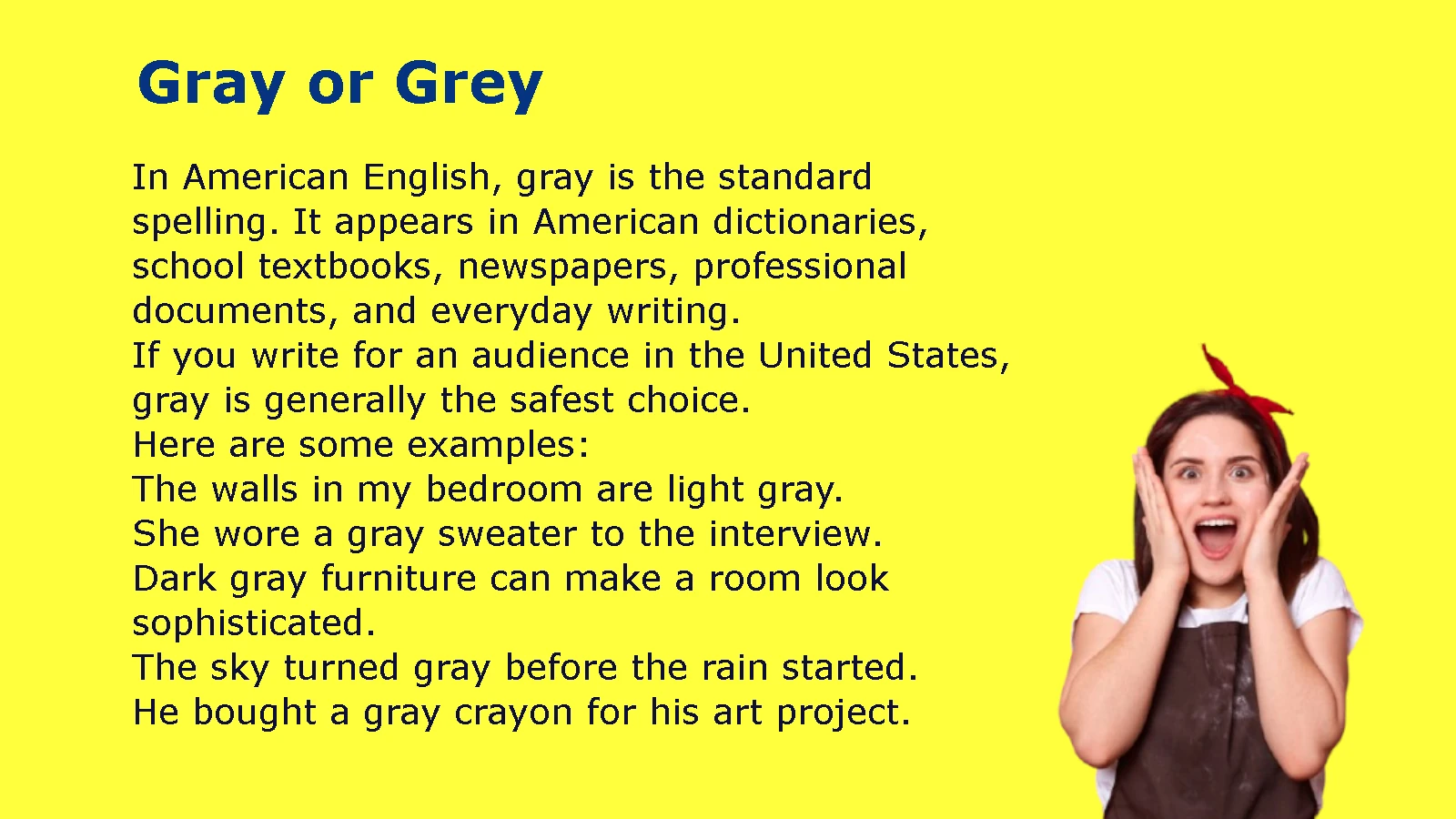
In American English, gray is the standard spelling. It appears in American dictionaries, school textbooks, newspapers, professional documents, and everyday writing.
If you write for an audience in the United States, gray is generally the safest choice.
Here are some examples:
- The walls in my bedroom are light gray.
- She wore a gray sweater to the interview.
- Dark gray furniture can make a room look sophisticated.
- The sky turned gray before the rain started.
- He bought a gray crayon for his art project.
American writers also use gray in compound color expressions, including:
- Light gray
- Dark gray
- Blue-gray
- Gray-green
- Gray-haired
- Grayish-white
The same spelling convention applies to related words. For example, American English uses grayish, not greyish, as its usual form.
One useful point is that American spelling conventions apply beyond the United States when a publication, company, or website deliberately follows a US style guide.
Grey Is the Preferred British English Spelling
In British English, grey is the standard spelling. Writers in the United Kingdom generally use this form in books, newspapers, educational materials, and professional communication.
For example:
- The sky became grey as the storm approached.
- She bought a grey dress for the occasion.
- The building has grey stone walls.
- His hair turned grey as he grew older.
- The artist used several shades of grey in the painting.
British English also uses grey in compound expressions:
- Light grey
- Dark grey
- Blue-grey
- Grey-haired
- Greyish
- Grey matter
The spelling remains consistent across related forms.
For example, a British writer would normally write:
“The old building had a greyish appearance.”
An American writer would generally write:
“The old building had a grayish appearance.”
Both versions are correct within their respective spelling conventions.
Are Gray and Grey Pronounced the Same?
Yes. Gray and grey have the same standard pronunciation in English. The difference exists in writing, not speech.
Both words are generally pronounced with a long A sound, as in day and say.
This means listeners cannot normally identify which spelling someone intends simply by hearing the word.
The distinction becomes visible when someone writes it down.
For example:
- “I like gray.”
- “I like grey.”
Both sentences sound identical when spoken.
This is why spelling questions about gray and grey usually concern regional writing conventions rather than pronunciation or meaning.
Is Grey or Gray Correct?
Both gray and grey are grammatically correct English words. The correct choice depends on the variety of English you use. American writers generally choose gray, while British writers generally choose grey. Neither spelling represents a grammatical mistake, provided you follow the appropriate regional convention consistently.
The important distinction is between correctness and regional preference.
A British reader will understand gray, and an American reader will understand grey. However, choosing the expected spelling makes your writing look more consistent and familiar to its intended audience.
When Should You Use Gray?
Use gray when writing in American English or addressing an audience that expects US spelling.
Common situations include:
- American school assignments.
- US business documents.
- American news articles.
- Website content targeting US readers.
- Product descriptions written for American customers.
- Social media posts aimed at an American audience.
Consider these examples:
| Sentence | Why Gray Is Correct |
| The car comes in metallic gray. | American color spelling |
| My favorite shirt is gray. | Standard US usage |
| She has gray eyes. | American descriptive writing |
| The gray walls complement the furniture. | American interior design terminology |
| He used a gray pencil to sketch the outline. | American educational context |
If your website primarily targets American search traffic, use gray throughout the article, including in headings, image descriptions, and examples.
You can still mention grey when explaining the British spelling difference.
When Should You Use Grey?
Use grey when writing in British English or following a style guide that prefers British spelling.
Typical situations include:
- UK school assignments.
- British newspapers and magazines.
- Professional documents for UK readers.
- British English educational websites.
- Publications following British editorial conventions.
- Product descriptions intended for British customers.
Examples include:
| Sentence | Why Grey Is Correct |
| The sky looks grey today. | British color spelling |
| She bought a grey coat. | Standard UK usage |
| His hair is turning grey. | British descriptive writing |
| The room has grey curtains. | British interior design terminology |
| The artist painted the door grey. | British color description |
Remember that grey is not simply an alternative spelling used in literature. It is the normal spelling in many varieties of British English.
Can You Use Gray and Grey Interchangeably?
You can use either spelling, but you should avoid switching between them without a reason.
Both forms communicate the same meaning. However, mixing American and British spelling conventions can make an article or document look inconsistent.
For example:
Inconsistent spelling:
“The gray walls matched the grey curtains, creating a beautiful grayish appearance.”
Consistent American spelling:
“The gray walls matched the gray curtains, creating a beautiful grayish appearance.”
Consistent British spelling:
“The grey walls matched the grey curtains, creating a beautiful greyish appearance.”
The second and third examples follow consistent regional conventions.
For professional writing, choose one variety of English before drafting. Apply the same decision to related words throughout the document.
Is Grey or Gray More Common?
Gray is more common in American English, while grey is more common in British English. There is no single spelling preference shared by every English-speaking country. The United States strongly favors gray, whereas the United Kingdom, Australia, and New Zealand generally prefer grey. Canadian usage includes both forms.
The answer depends on geography, publication standards, and the type of writing.
Which Spelling Is More Common in the United States?
Gray is the dominant spelling in American English.
American dictionaries and editorial conventions generally recognize gray as the preferred form. It also appears in everyday writing, product descriptions, educational resources, and color terminology.
Examples include:
- Gray hair
- Gray clouds
- Gray paint
- Gray fabric
- Gray crayon
- Gray area
- Gray matter
American writers generally choose gray even when discussing shades, materials, or objects.
For instance, an American interior designer might describe a room as having “soft gray walls and dark gray furniture.”
A British designer would normally use grey in the same description.
The difference does not change the color or the design concept. It simply reflects the spelling convention used by the writer.
Which Spelling Is More Common in the United Kingdom?
Grey is the standard spelling in British English.
British publications, schools, and everyday writers generally use grey when referring to the color.
Examples include:
- Grey hair
- Grey clouds
- Grey paint
- Grey fabric
- Grey crayon
- Grey area
- Grey matter
British spelling also appears in established expressions and proper names.
For example, Fifty Shades of Grey retains its official spelling even when an American publisher releases the book.
This illustrates an important writing principle: regional spelling preferences do not automatically change established titles or brand names.
What About Canada, Australia, and Other English-Speaking Countries?
English spelling conventions vary outside the United States and the United Kingdom.
Australia and New Zealand generally follow British spelling conventions, making grey the usual choice.
Canada presents a more interesting situation. Canadian English has historical connections with British English but also reflects substantial American influence. As a result, both gray and grey appear in Canadian writing.
The appropriate choice can depend on the publication, dictionary, or editorial style guide.
Here is a practical comparison:
| Country or Region | Commonly Preferred Spelling |
| United States | Gray |
| United Kingdom | Grey |
| Australia | Grey |
| New Zealand | Grey |
| Canada | Both are used; grey is common |
| Ireland | Grey |
| South Africa | Grey |
These are general tendencies rather than absolute rules. Individual publishers and organizations may adopt their own conventions.
For example, a Canadian company working with American customers might use gray in its product descriptions. A British publication might retain grey even when writing for an international audience.
The best approach is to follow the spelling standards of your intended readership.
Gray vs. Grey: Quick Regional Comparison
The following table provides a simple reference for choosing between the two spellings.
| Writing Context | Recommended Form | Example |
| American English | Gray | A gray jacket |
| British English | Grey | A grey jacket |
| Australian English | Grey | A grey building |
| New Zealand English | Grey | Grey clouds |
| Canadian English | Either, depending on style | Gray or grey paint |
| American product description | Gray | Gray crayon |
| British product description | Grey | Grey crayon |
A helpful memory trick is to associate the letter A in gray with America.
Although this is only a memory aid, it works well for everyday writing.
Grayish or Greyish: Which Spelling Is Correct?
Both grayish and greyish are correct spellings. Grayish is the preferred American English form, while greyish is the preferred British English form. Both words describe something that has a gray or grey appearance, often without being completely gray. Their meaning and pronunciation remain the same.
This distinction is especially important because grayish and greyish are common descriptive words.
Writers use them when a color does not fit neatly into one category.
For example, a fabric might appear gray with a slight blue tint. Describing it as grayish-blue communicates that it resembles blue and gray without being a pure shade of either.
What Does Grayish Mean?
Grayish is an adjective that means somewhat gray, slightly gray, or having the appearance of gray.
The suffix -ish changes the original color word by suggesting approximation or resemblance.
For example:
- Gray means having the color gray.
- Grayish means somewhat gray or gray-like.
The word helps describe colors that fall between clearly defined categories.
Consider these examples:
- The old photograph had a grayish appearance.
- Her grayish sweater looked almost silver under the lights.
- The morning sky turned grayish before the rain started.
- The stone had a grayish-brown surface.
- A grayish tint covered the white walls.
In each sentence, grayish communicates that something resembles gray but may contain other visible tones.
This makes the word useful in writing about:
- Clothing and fashion.
- Interior decoration.
- Photography.
- Weather.
- Natural materials.
- Painting and illustration.
- Physical descriptions of objects.
Grayish does not necessarily mean dark gray. It describes a resemblance to gray, not a specific brightness level.
A pale fabric can look grayish, just as a dark stone can have a grayish appearance.
Is Greyish the British Spelling of Grayish?
Yes. Greyish is the usual British English equivalent of American grayish.
The difference follows the same regional pattern as the base words.
| American English | British English |
| Gray | Grey |
| Grayish | Greyish |
| Grayish-white | Greyish-white |
| Grayish-blue | Greyish-blue |
| Grayish-brown | Greyish-brown |
The spelling changes, but the meaning remains identical.
For example:
American English:
“The clouds had a grayish appearance throughout the afternoon.”
British English:
“The clouds had a greyish appearance throughout the afternoon.”
Neither sentence is more grammatically correct than the other. Each follows a different regional spelling convention.
Writers should also remember that adding a suffix does not usually change the original regional spelling.
If you write gray in American English, you should generally write grayish as well.
Likewise, if you write grey in British English, greyish is the consistent choice.
Grayish vs. Greyish Example Sentences
The following examples show how the words work in everyday sentences.
| American English | British English |
| The sky looked grayish. | The sky looked greyish. |
| She selected a grayish shade. | She selected a greyish shade. |
| The fabric had a grayish tone. | The fabric had a greyish tone. |
| His old photograph appeared grayish. | His old photograph appeared greyish. |
| The stone had a grayish surface. | The stone had a greyish surface. |
Here are additional examples in different contexts.
Fashion:
“The designer chose a grayish-blue fabric for the winter collection.”
Interior design:
“The grayish walls made the small room feel calm and understated.”
Nature:
“The bird had grayish feathers that blended into the rocky landscape.”
Photography:
“The old photograph developed a grayish tint over time.”
Weather:
“A grayish layer of clouds covered the horizon.”
These examples demonstrate how grayish adds detail to descriptions without requiring an exact color name.
How Does the Suffix -ish Change a Color Word?
The suffix -ish is commonly added to adjectives and nouns to express approximation, resemblance, or a partial quality.
When added to a color word, it suggests that something has that color to some degree.
For example:
| Base Color | Word With -ish | Meaning |
| Gray | Grayish | Somewhat gray |
| Green | Greenish | Slightly green |
| Blue | Bluish | Somewhat blue |
| Red | Reddish | Slightly red |
| Yellow | Yellowish | Somewhat yellow |
| Brown | Brownish | Having a brown appearance |
| Pink | Pinkish | Slightly pink |
This suffix is particularly useful when describing colors that contain mixed tones.
For instance, calling a wall gray might suggest a fairly clear gray color. Calling it grayish leaves room for a subtle blue, brown, or green undertone.
That small difference can make a description more accurate.
The Color Gray or Grey: Meaning, Shades, and Usage
Gray and grey describe an achromatic color between black and white. The color has no strong hue of its own, although real-world gray surfaces may contain subtle warm or cool undertones. Both spellings refer to the same color, and the preferred written form depends on regional English conventions.
Gray is a familiar part of everyday language, but it also has important uses in art, design, fashion, photography, and science.
What Is the Color Gray?
Gray is an achromatic color formed by combining black and white in different proportions.
The word achromatic means that a color lacks a distinct hue. In simple terms, gray does not belong to the main color families in the same way that red, green, or blue does.
Different proportions of black and white produce different shades.
- More white creates light gray.
- More black creates dark gray.
- Balanced proportions produce a medium gray.
However, gray does not always look like a simple mixture of black and white.
In design and painting, gray can have subtle undertones.
For example:
- Warm gray may contain hints of brown, beige, or red.
- Cool gray may contain hints of blue or green.
- Neutral gray has little noticeable warm or cool influence.
These distinctions help artists and designers create more realistic color combinations.
Gray also appears frequently in nature.
Examples include:
- Clouds before a storm.
- Granite and other stones.
- Ash from burned materials.
- Some animal coats and feathers.
- Concrete and metal surfaces.
- Natural shadows.
The color can communicate different ideas depending on its context. In interior design, it often creates a calm and balanced appearance. In photography, it helps represent shadows, depth, and contrast.
The Color Gray Spelling: Is It Gray or Grey?
Both spellings are correct when describing the color.
The choice depends on the English variety used in the surrounding text.
Use the color gray when writing for an American audience.
Use the color grey when writing for a British audience.
Examples:
American English:
- Gray is a popular color for modern kitchens.
- The color gray works well with white furniture.
- Dark gray creates strong visual contrast.
British English:
- Grey is a popular colour for modern kitchens.
- The colour grey works well with white furniture.
- Dark grey creates strong visual contrast.
Notice that other regional spelling differences may appear in the same sentences.
For example, American English uses color, while British English generally uses colour.
When writing for one region, it is best to maintain the entire spelling system rather than changing only gray or grey.
Popular Shades of Gray and Grey
Gray comes in many shades, from almost white to nearly black.
Designers, artists, and photographers use different shades to create contrast, balance, and visual depth.
Here are some familiar gray shades:
| Shade | Description | Common Uses |
| Light gray | A pale, soft gray | Walls, backgrounds, clothing |
| Dark gray | A deep gray close to black | Furniture, clothing, typography |
| Charcoal gray | A rich, dark gray | Interior design, fashion |
| Slate gray | A gray with a noticeable blue influence | Architecture, paint |
| Silver gray | A light gray with a metallic appearance | Jewelry, vehicles, decoration |
| Ash gray | A muted gray inspired by ash | Clothing, paint, design |
| Warm gray | Gray with subtle warm undertones | Living spaces, furniture |
| Cool gray | Gray with blue or green undertones | Modern interiors, digital design |
The same shade names can also use the British spelling.
For example:
- Light grey
- Dark grey
- Charcoal grey
- Slate grey
- Silver grey
- Ash grey
A useful distinction is that silver and gray are not always interchangeable.
Silver usually suggests a metallic appearance or reflective surface. Gray describes a broader range of neutral colors.
Similarly, slate gray may have a blue undertone, while charcoal gray is usually darker and closer to black.
How Do Designers Use Gray and Grey?
Designers use gray because it can create balance without competing strongly with other colors.
It works particularly well as a background or supporting color.
For example, a website might use a light gray background, dark gray text, and a brighter accent color for buttons. This arrangement creates visual hierarchy without making the page look overly colorful.
Gray also plays an important role in interior design.
Common design applications include:
- Light gray walls for a clean, understated appearance.
- Charcoal furniture for contrast.
- Gray flooring to complement wooden furniture.
- Silver-gray decorations for a modern look.
- Warm gray fabrics for a softer atmosphere.
- Cool gray surfaces for a contemporary appearance.
Gray also appears frequently in fashion.
A gray suit, for example, can work in professional and formal settings. A light gray sweater offers a softer alternative to black, while charcoal trousers provide a darker neutral option.
The main advantage of gray is its flexibility. It can support brighter colors, create contrast, or work as the dominant color in a design.
50 Shades of Grey or Gray: Which Is Correct?
Fifty Shades of Grey is the correct official title of the novel written by E. L. James. The title uses grey rather than gray, reflecting the spelling chosen for the original work. Although American English normally prefers gray, proper titles retain their established spelling regardless of the reader’s regional spelling conventions.
This is an important exception to ordinary spelling preferences.
A writer should not automatically change a book title to match American or British spelling.
Why Is It Called Fifty Shades of Grey?
Fifty Shades of Grey is an erotic romance novel by British author E. L. James.
The book was originally published in 2011 and became the first installment in the Fifty Shades trilogy.
Its official title uses Grey, not Gray.
The spelling is part of the book’s established name.
This matters because proper names and titles generally retain their original written forms.
For example, an American writer might normally use gray when describing a character’s gray eyes. However, when mentioning the novel, that writer should still write Fifty Shades of Grey.
The same principle applies to:
- Book titles.
- Film titles.
- Album titles.
- Product names.
- Company names.
- Other established proper nouns.
Changing a title to match a regional spelling preference can introduce an error even when the replacement word is normally correct.
Should You Write Fifty Shades of Gray?
No, not when referring to the official title of the novel.
The established title is Fifty Shades of Grey.
Writing Fifty Shades of Gray changes the official title and should be avoided in formal references, book reviews, academic writing, and ordinary discussions of the novel.
Compare these examples:
Correct:
“I recently read Fifty Shades of Grey.”
Incorrect title spelling:
“I recently read Fifty Shades of Gray.”
However, you can use gray when describing fifty different shades of the color in American English.
For example:
“The artist created fifty shades of gray for the painting.”
The difference comes down to context.
One sentence refers to a specific published work. The other describes different variations of a color.
Crayola Grey or Gray: Which Spelling Is Correct?
When referring to Crayola’s US crayon products, gray is the usual spelling. Crayola is an American brand, and its US product naming generally follows American English conventions. However, exact product labels and regional packaging should take priority when identifying a particular crayon.
The distinction is useful for parents, teachers, students, artists, and people searching for specific coloring supplies.
Does Crayola Use Gray or Grey?
Crayola is an American art-supply brand known for its crayons, markers, colored pencils, and other creative products.
Its US color naming generally follows American spelling conventions.
Therefore, gray is the expected spelling when referring to the standard gray color in American Crayola products.
For example:
- Gray Crayola crayon.
- Gray colored pencil.
- Gray marker.
- Gray coloring supplies.
However, product collections and packaging can differ across countries and product lines. If you need the exact official name of a particular crayon, check the packaging or the relevant product listing.
This distinction matters when writing product descriptions or searching for specific items online.
For an American shopping search, gray crayon is generally the more natural phrase.
For a British audience, grey crayon is equally understandable and follows local spelling conventions.
What Is a Gray Crayon Used For?
A gray crayon is used to create neutral tones, shadows, texture, and depth in drawings and coloring projects.
It can represent objects that naturally appear gray or help artists add contrast to other colors.
Common applications include:
- Coloring clouds and stormy skies.
- Drawing rocks and stones.
- Shading metal objects.
- Adding shadows to buildings.
- Creating animal fur and feathers.
- Drawing roads and sidewalks.
- Adding depth to black-and-white illustrations.
Gray also helps artists transition between darker and lighter areas.
For example, a student drawing a silver car might use a gray crayon to create shadows around the wheels and underneath the vehicle.
A lighter gray can represent reflective surfaces, while a darker shade can add depth.
Gray crayons are also useful for blending neutral areas into colorful illustrations.
Gray Crayon vs. Grey Crayon: Is There a Difference?
No significant color difference exists between the terms gray crayon and grey crayon.
Both expressions refer to a crayon intended to produce a gray-colored mark.
The distinction is regional spelling.
| Term | Typical Audience | Meaning |
| Gray crayon | American English | A crayon in a gray shade |
| Grey crayon | British English | A crayon in a grey shade |
| Dark gray crayon | American English | A darker gray crayon |
| Dark grey crayon | British English | A darker grey crayon |
| Light gray crayon | American English | A pale gray crayon |
| Light grey crayon | British English | A pale grey crayon |
If you are searching for Crayola products in the United States, gray crayon is generally the better search phrase.
However, both expressions are understandable, and the spelling does not determine the actual pigment inside the crayon.
Gray vs. Grey: Common Spelling Mistakes to Avoid
Although gray and grey are both correct, writers sometimes use them incorrectly by ignoring regional conventions or changing established names.
Understanding a few common mistakes will help you maintain accurate and consistent writing.
Mixing American and British Spellings
One common mistake is combining American and British spelling conventions in the same piece of writing.
For example:
“The grey color looked beautiful beside the gray furniture.”
The sentence is understandable, but the spelling is inconsistent if both words refer to the same color in ordinary descriptive writing.
A consistent American version would be:
“The gray color looked beautiful beside the gray furniture.”
A consistent British version would be:
“The grey colour looked beautiful beside the grey furniture.”
This principle applies to an entire article, not just one word.
If you use American English, check related words such as:
- Color instead of colour.
- Favorite instead of favourite.
- Center instead of centre.
- Gray instead of grey.
- Grayish instead of greyish.
For British English, use the corresponding British forms.
Assuming One Spelling Is Incorrect
Another common mistake is assuming that gray is the only correct spelling or that grey is always wrong.
Neither assumption is accurate.
Both forms are established English spellings.
The difference is regional, not grammatical.
For example, a British student writing “The sky is grey” is using the standard British spelling.
An American student writing “The sky is gray” is using the standard American spelling.
Neither student needs to change the word.
The best way to avoid this mistake is to understand the audience before choosing a spelling.
Changing the Spelling of Proper Names
Proper names require special attention.
A title or brand name may use a spelling that differs from the spelling normally preferred in your region.
For example:
- Fifty Shades of Grey retains grey.
- A brand that officially uses Gray should retain Gray.
- A published book title should not be rewritten to match a different regional convention.
This principle also applies to quotations.
If you quote a British writer who uses grey, preserve the original spelling rather than changing it to gray without explanation.
Accurate writing requires more than following a spelling preference. It also requires respecting established names and original wording.
How to Remember Whether to Use Gray or Grey
The easiest way to remember the difference is to associate gray with American English and grey with British English.
Once you learn this simple pattern, you can apply it to related words such as grayish and greyish.
Use the A in Gray for America
The letter A in gray provides a convenient memory trick:
A = America = Gray
If you are writing for an American audience, choose gray.
Examples:
- Gray walls.
- Gray hair.
- Gray clouds.
- Gray crayon.
- Grayish fabric.
This simple association can help prevent common spelling mistakes.
Use Grey for British English
For British English, remember that grey is the preferred spelling.
The same rule applies to its related forms.
Examples:
- Grey walls.
- Grey hair.
- Grey clouds.
- Grey crayon.
- Greyish fabric.
If you write for readers in the United Kingdom, grey is generally the more natural choice.
Follow Your Audience and Stay Consistent
Your audience should determine which spelling you use.
Here is a practical framework:
Step 1: Identify your audience.
Determine whether your readers primarily use American, British, Australian, or another variety of English.
Step 2: Choose a spelling convention.
Select gray for American English or grey for British English.
Step 3: Apply the same convention to related words.
Use grayish with gray and greyish with grey.
Step 4: Check proper names separately.
Do not change established titles or brand names to match your preferred spelling.
Step 5: Review the entire document.
Search for both gray and grey to identify accidental inconsistencies.
This process is particularly useful for:
- Bloggers.
- Content writers.
- Editors.
- Students.
- Teachers.
- Website owners.
- Professional copywriters.
For example, if you publish an American English article about gray paint, use gray in the title, headings, body text, image descriptions, and examples.
You can still include grey naturally when explaining the British spelling or answering a related search question.
Conclusion: Should You Write Gray or Grey?
Both gray and grey are correct English spellings of the same color. The main difference is regional preference: American English generally uses gray, while British English generally uses grey.
The same distinction applies to grayish and greyish. Both forms mean somewhat gray or grey, and neither changes the color’s basic meaning.
Remember these key points:
- Gray is the preferred American English spelling.
- Grey is the preferred British English spelling.
- Both spellings have the same meaning and pronunciation.
- Grayish and greyish follow the same regional spelling pattern.
- Fifty Shades of Grey is the official book title.
- Gray crayon is the usual American product-search spelling.
- Consistency matters more than choosing one spelling as universally correct.
If you write for an American audience, choose gray. If you write for a British audience, choose grey. When discussing a proper name, preserve its official spelling.
Your next step: Check your writing for both forms, choose the spelling that matches your readers, and apply it consistently throughout your document.